
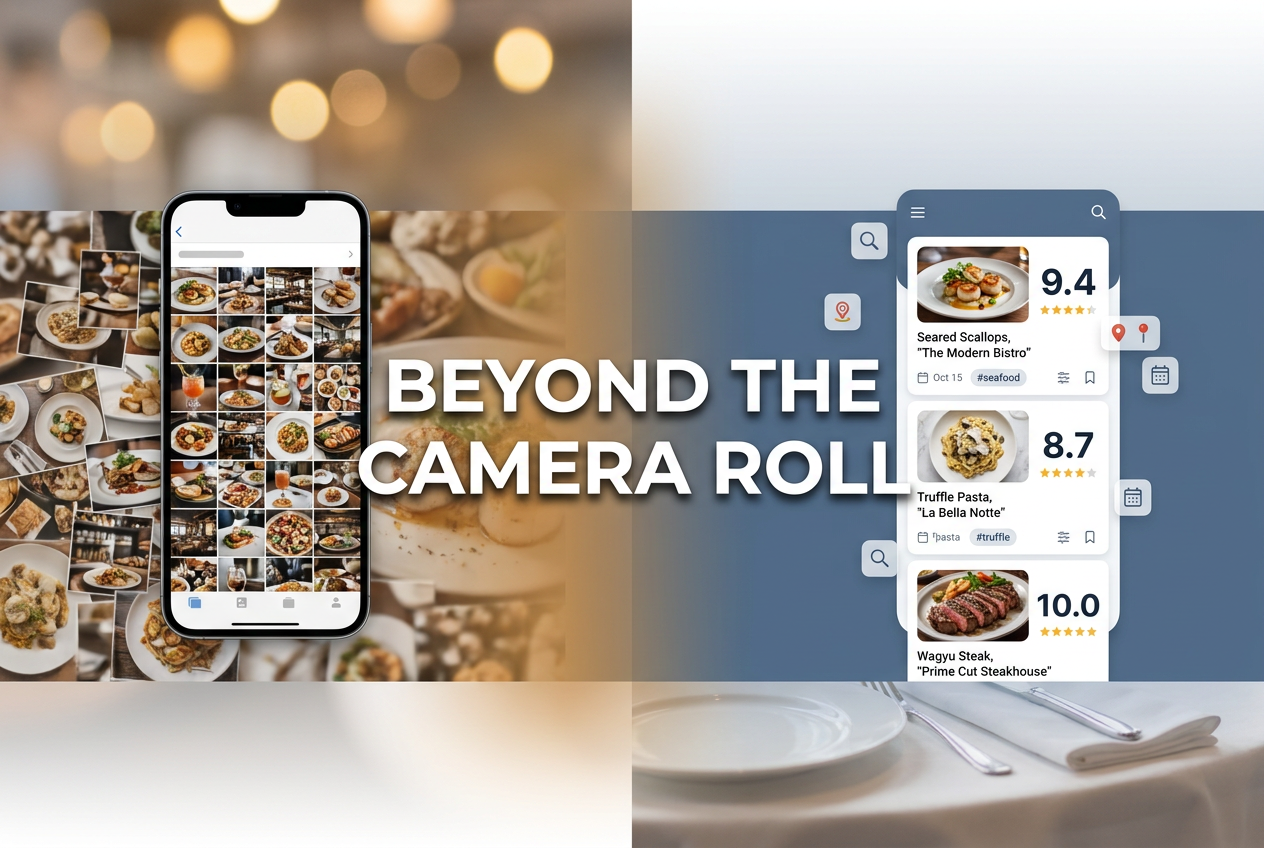
ReviewFast.food Review: Legit App or Scam? (2026)
John the smoothie monster
John lives for smoothie bowls and cold-pressed juices. He uses Savor to remember his best blends.
ReviewFast.food: The Truth About Your Personal Food Archive (Not the Scam You're Thinking Of) You had an extraordinary bowl of ramen three months ago. The...
ReviewFast.food: The Truth About Your Personal Food Archive (Not the Scam You're Thinking Of)
You had an extraordinary bowl of ramen three months ago. The broth was transcendent. The noodles had that perfect bite. You remember the location vaguely - somewhere in the East Village - but you can't recall the name, the exact dish, or even what made it so damn good. Just that it was.
Your camera roll holds 847 food photos, none of them searchable. Your Notes app has seventeen different lists titled "places to try" and "restaurants I liked" and "that one spot with the good thing." Meanwhile, your friend asks for a recommendation, and you panic-scroll through months of untagged images, hoping the algorithm surfaces something useful. It won't.
This isn't a memory problem. It's an architecture problem. And that's exactly what ReviewFast.food was built to solve - though you'd be forgiven for thinking otherwise, given what currently comes up when you search the name.
Key Takeaways
- ReviewFast.food is a legitimate personal food database tool, not the McDonald's gift card scam that pollutes its search results.
- The app eliminates "review fatigue" by replacing complex head-to-head ranking algorithms with streamlined, category-specific lists that take 20 seconds to populate.
- Unlike Beli's 75 million rankings that force users to compare pizza shops against Michelin restaurants, ReviewFast uses siloed categorization - your Top 10 Sushi lives separate from your Top 10 Coffee.
- ReviewFast transforms disorganized camera roll chaos into a searchable, high-utility personal archive, converting 2,000+ unsorted food photos into actionable dining intelligence.
- The tool offers zero-friction entry with no invite gates, no gamified milestones, and no social performance requirements - just immediate access to your own culinary memory bank.
Table of Contents
- Is ReviewFast.food Legit? (Clearing the Gift Card Scam Confusion)
- The Camera Roll Black Hole: Why Your Current Food Tracking Is Failing You
- ReviewFast vs. The Giants: Why Beli's Ranking Feels Like a Second Job
- Speed Is a Feature: How to Log a Multi-Course Meal in Under 30 Seconds
- From Photo to Data: Converting Your Existing Library Into a Searchable Map
- What Communication Techniques Actually Work for Personal Food Logging?
- How Does ReviewFast Compare to Beli for Restaurant Ranking?
- The Best Apps for Foodies Who Want to Track Without the Social Performance
Is ReviewFast.food Legit? (Clearing the Gift Card Scam Confusion)
Yes, ReviewFast.food is a legitimate personal food database tool - not the McDonald's gift card phishing operation that currently dominates its Google results.
The confusion stems from a years-long campaign of fraudulent websites using the phrase "review fast food" to lure victims into fake reward schemes. When you search for ReviewFast, Google's algorithm surfaces these scam sites because they contain both keywords. The actual ReviewFast.food platform - a purpose-built utility for serious foodies - gets buried in the noise.
Here's the structural difference: the gift card scams operate on deception. They promise $100 McDonald's cards in exchange for completing "just one quick survey," then redirect users through an endless loop of affiliate marketing offers that never deliver the promised reward. These sites are designed to extract data, not provide utility.
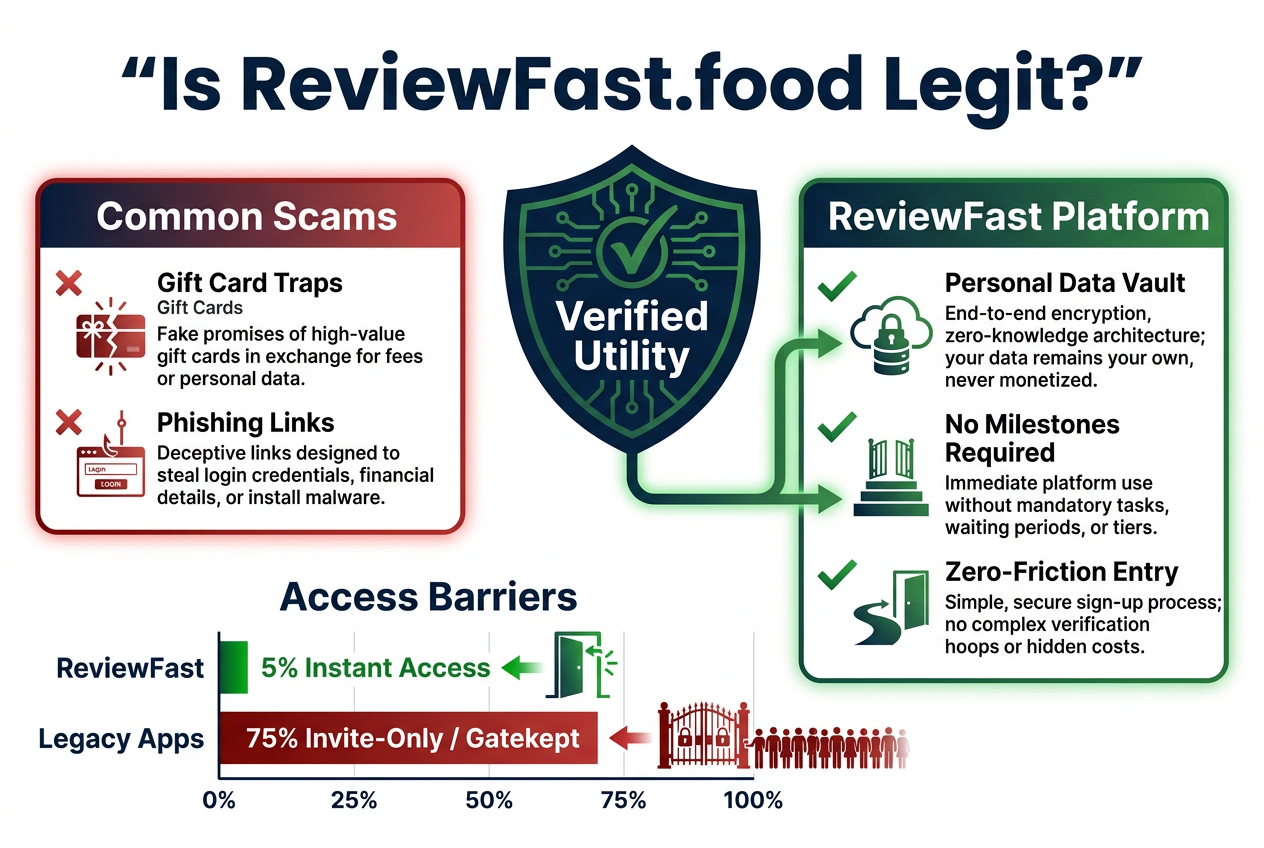
ReviewFast.food operates on transparency. It's a secure, instant-access personal food vault that requires no surveys, no invite codes, no gamified labor. You create an account, you start logging. No intermediary steps. No bait-and-switch.
The scam sites have "review" in the URL but offer no actual reviewing infrastructure. They're landing pages masquerading as utility. ReviewFast provides structured data fields: dish name, location, date, category tags, personal notes, and photo uploads. It's a relational database for your taste memory, not a funnel for affiliate revenue.
If you're verifying legitimacy before signing up, the test is simple: Does the site ask for your credit card before showing you any functionality? Does it promise external rewards (gift cards, cash, prizes)? Does it require you to share personal data with third parties to "unlock" features? If yes to any of these, it's a scam. ReviewFast asks for none of that. It's a tool, not a transaction.
The name collision is unfortunate, but it's also instructive. If you're searching for "ReviewFast scam" or "ReviewFast legit," you've already identified the problem: the internet is polluted with fake utility. What you need is real infrastructure to solve the actual problem - which is that you can't remember what you ate, where you ate it, or why it mattered.
The Camera Roll Black Hole: Why Your Current Food Tracking Is Failing You
Your camera roll is not a food diary. It's a graveyard.
The average serious foodie carries 2,000+ untagged, unsorted food photos that provide zero utility beyond vague visual nostalgia. You scroll, hoping the algorithm surfaces the right image. It doesn't. You rely on location data, except you forgot to enable it that day. You search "pasta," and your phone returns 847 results because you've photographed pasta 847 times.
The problem isn't volume. The problem is architecture. Photos are binary objects - they contain pixels, not metadata. Without structured data, they're just visual noise. You can see the dish. You can't search for it, filter it, or retrieve it when the context matters.
Let's quantify the loss. If you dine out 150 times a year and photograph half those meals, that's 75 experiences annually. Over five years, that's 375 meals. How many of those can you recall on demand? How many could you describe in detail six months later? How many would you recommend to a friend who asks, "Where should I get sushi in your neighborhood?"
The answer, statistically, is fewer than 10%. The other 90% evaporate into the camera roll void.
This is "Camera Roll Chaos" - the specific pain point that drives users to search for food tracking apps in the first place. It's not a storage problem. It's a retrieval problem. You have the data. You just can't access it when it matters.
The standard workarounds don't solve this:
- Albums: Manual categorization requires constant upkeep and still lacks searchability by dish, date, or flavor profile.
- Notes App Lists: Great for aspirational dining (places you want to try), useless for retrospective memory (places you've been).
- Google Maps Saved Places: Location-centric, not dish-centric. You save the restaurant, not the specific plate that made the restaurant worth remembering.
What you need is a system that treats food memory like a database, not a photo gallery. Every entry needs at minimum: dish name, location, date, category, and a personal rating or note. Without that, you're just accumulating unlabeled JPEGs.
ReviewFast vs. The Giants: Why Beli's Ranking Feels Like a Second Job
Beli reached 30 million users in three years by solving a real problem: giving foodies a tool to rank their personal restaurant favorites. But in solving one problem, it created another - it turned food memory into a competitive sport.
Beli's core mechanic is the head-to-head algorithm. Every time you add a restaurant, the app presents you with random pairings: "Which do you like better, this taco spot or this Michelin-starred French place?" You answer dozens of these comparisons until your entire list is algorithmically ranked from #1 to #847.
For some users, this is compelling. It's quantified self-analysis applied to dining. For others, it's exhausting. Comparing a $3 bodega sandwich to a $200 tasting menu feels absurd. The mechanic works if every entry is the same category - ranking sushi restaurants against other sushi restaurants. It breaks down when you're forced to pit apples against oranges, literally and figuratively.
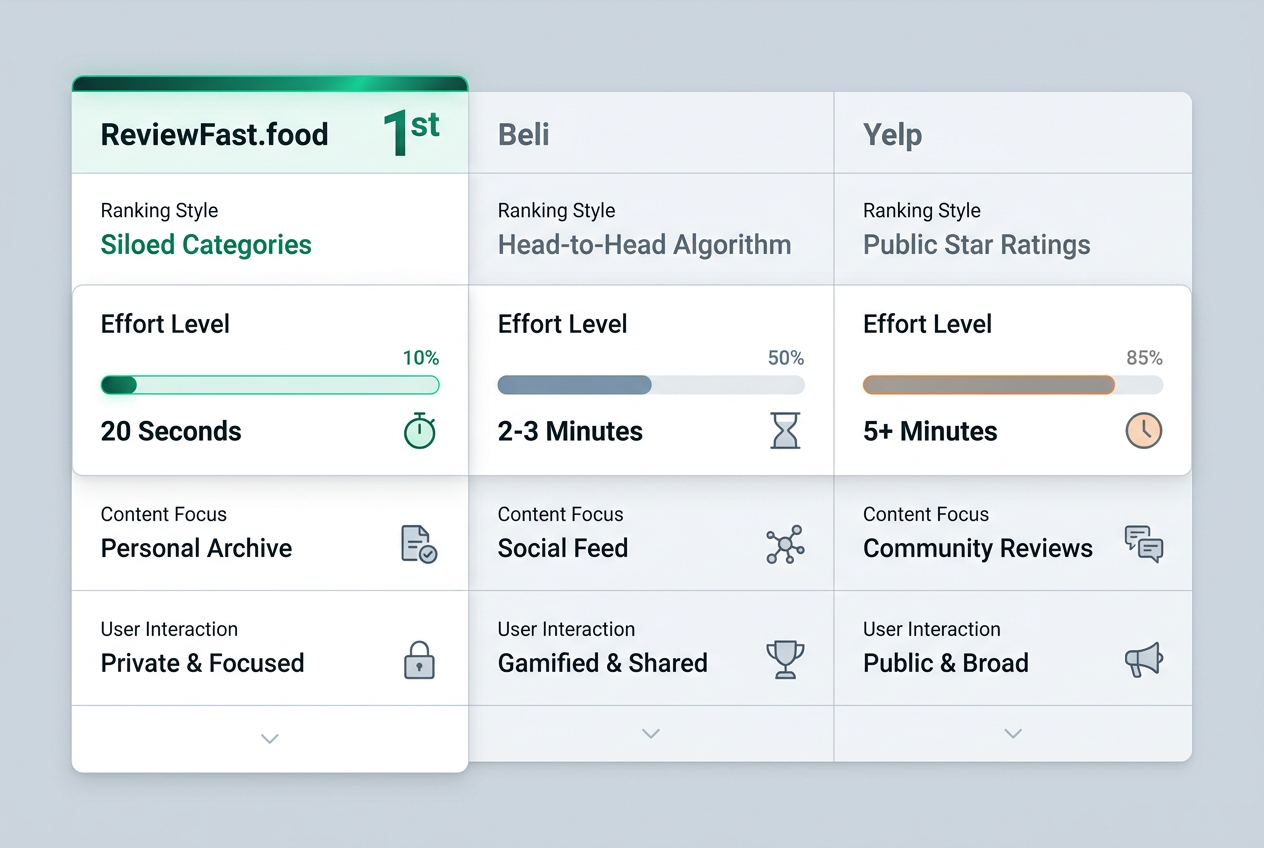
ReviewFast solves this with siloed categorization. You don't rank everything against everything. You build separate lists: Top Sushi, Top Pizza, Top Coffee. Within each category, you can rank - or not. The structure is flexible. If you want to maintain a definitive hierarchy of every ramen spot you've tried, the tool supports that. If you just want a searchable archive of great meals without the ranking labor, it supports that too.
Here's the comparative breakdown:
| Feature | Beli | ReviewFast | Why It Matters |
|---|---|---|---|
| Entry Method | Head-to-head algorithm | Direct category tagging | ReviewFast eliminates the decision fatigue of 40+ comparison prompts per session |
| Category Structure | Single ranked list | Multiple siloed lists | You can compare like to like (sushi vs. sushi) without forcing cross-category judgments |
| Time to Log | 2-3 minutes per entry | 20 seconds per entry | Speed matters when you're trying to capture a meal before the next course arrives |
| Social Features | Public rankings, leaderboards | Private vault option | ReviewFast prioritizes personal utility over social performance |
| Onboarding | Invite-only (historically) | Instant access | No gatekeeping, no waitlist, no viral loop required |
Beli's 75 million restaurant ratings signal massive adoption, but also massive labor. That's 75 million comparison decisions users made, not 75 million meals they enjoyed. The work of ranking becomes the product, not the memory itself.
ReviewFast inverts this. The memory is the product. The structure is just scaffolding.
World of Mouth offers a different model - curated lists from 800 global experts (chefs, critics, food writers). It's aspirational, not personal. You get access to professional recommendations, but you don't build your own archive. The $19 annual fee buys you discovery, not retention. ReviewFast costs nothing and serves the opposite function: preserving what you've already eaten, not guiding what to eat next.
Yelp remains the default for crowd-sourced reviews, but it's venue-centric, not dish-centric. You review the restaurant, not the specific plate. For foodies, this is the wrong level of abstraction. The restaurant might be good overall, but the one dish that changed your perspective gets lost in the aggregate star rating.
The gap ReviewFast exploits: none of these platforms treat individual dishes as the atomic unit of memory. They treat venues, or rankings, or expert curation. But the thing you remember isn't the restaurant. It's the dish.
Speed Is a Feature: How to Log a Multi-Course Meal in Under 30 Seconds
The best food tracking system is the one you'll actually use. And the primary barrier to use isn't interest - it's friction.
Beli's head-to-head algorithm adds 2-3 minutes per entry because you're answering comparison prompts. World of Mouth doesn't let you add entries at all - you consume, you don't create. Yelp's review form asks for paragraphs of text, star ratings across five dimensions, and photo uploads that require curation.
ReviewFast optimizes for speed. The entire logging flow is designed around minimal input:
- Tap "Add Dish"
- Type dish name (e.g., "Uni pasta")
- Tag category (e.g., "Italian," "Seafood," or a custom tag like "Best Pasta")
- Optional: Add location, date, photo, or notes
- Save
Total time: 20 seconds. If you skip the optional fields, it's 10 seconds.
This matters because the moment you decide to log a meal is often the moment you're least able to do detailed data entry. You're mid-conversation, the next course is arriving, or you're walking to your next destination. The longer the logging process takes, the more likely you are to think, "I'll do it later," which means you won't do it at all.
The fast-review method is particularly effective for multi-course meals. Instead of trying to log a seven-course tasting menu in one sitting, you log each course as it arrives:
- Course 1: Oysters → Log: "Kusshi oysters, mignonette" → Category: Seafood → Save.
- Course 2: Pasta → Log: "Cacio e pepe, 10/10 texture" → Category: Pasta → Save.
- Course 3: Lamb → Log: "Slow-roasted lamb shoulder, salsa verde" → Category: Mains → Save.
Three discrete entries, each taking 20 seconds. Total logging time for the meal: 60 seconds. Total utility: three searchable, recallable data points you can reference six months later when someone asks, "What's the best pasta you've had this year?"
The alternative - trying to reconstruct the meal from memory two days later - results in vague, incomplete entries like "Really good tasting menu at that place in Brooklyn." No dish names. No specifics. No utility.
Speed also enables consistency. If logging takes 10-20 seconds, you'll do it every time. If it takes 5 minutes, you'll do it only for "special" meals, which means your archive becomes a highlight reel instead of a comprehensive record.
For serious foodies who dine out 150+ times a year, the difference between a 20-second log and a 3-minute log is the difference between 50 hours of labor annually and 7.5 hours. That's 42.5 hours you're not spending on data entry, which you can spend eating more meals, which you can then log in 20 seconds.
The math compounds. The faster the tool, the more you use it. The more you use it, the more valuable it becomes.
From Photo to Data: Converting Your Existing Library Into a Searchable Map
You already have the raw material. Your camera roll contains years of food memories. The problem is they're trapped in a format designed for viewing, not querying.
ReviewFast's primary value isn't just prospective logging (capturing new meals). It's retrospective conversion - turning your existing photo archive into structured data.
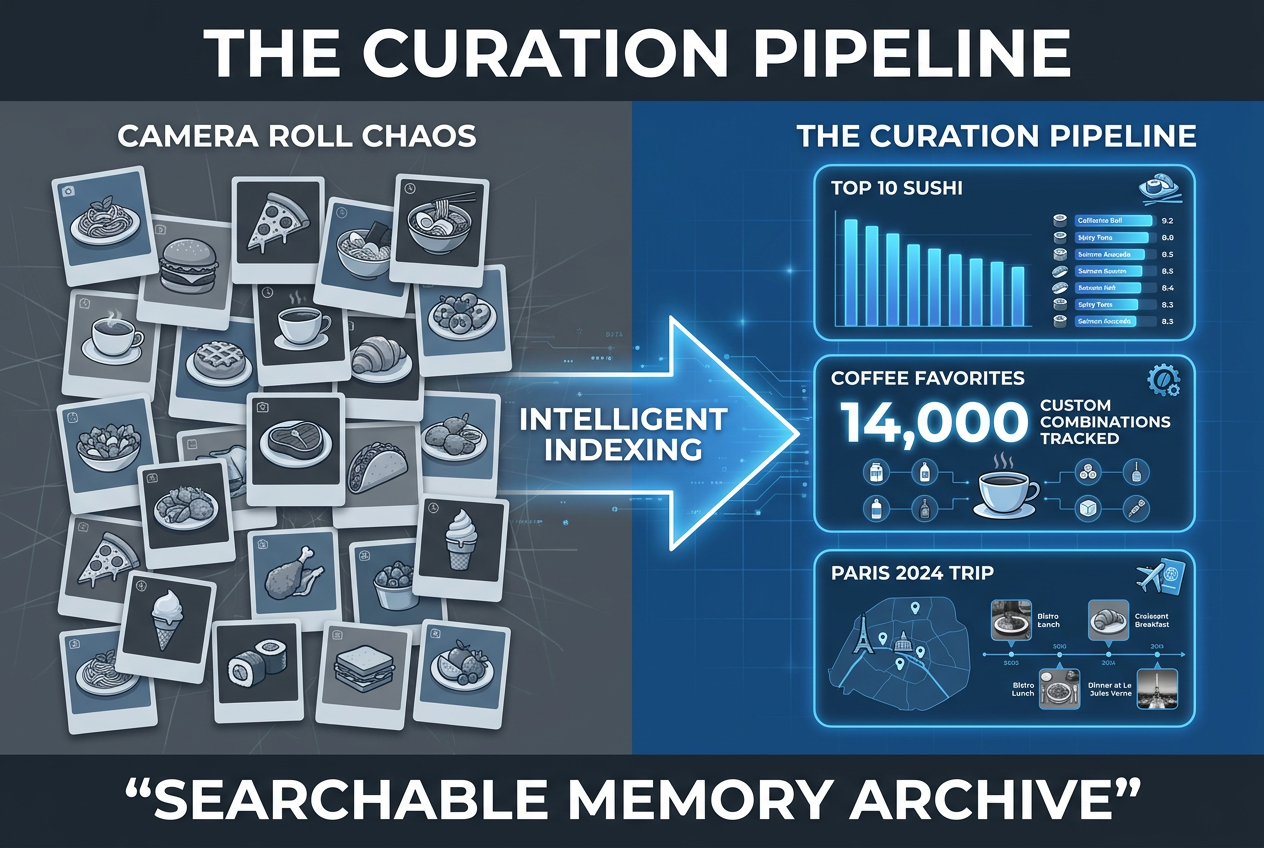
The process:
Scroll through your camera roll and identify food photos worth preserving. Not every meal needs to be logged. Focus on the ones you'd recommend, the ones that surprised you, or the ones you want to recreate.
For each photo, create a ReviewFast entry. Add the dish name, location, and category. If you remember the date, add it. If you don't, estimate based on surrounding photos.
Upload the photo to the entry. This anchors the visual memory to the structured data.
Add a note - one sentence capturing what made it memorable. Example: "Best uni I've had outside Japan - creamy, sweet, no brine."
Repeat for 50-100 meals. This creates a critical mass of data that makes the archive useful.
The time investment: 10 minutes per session if you batch-process 10 photos at once. Five sessions converts 50 meals. That's a functional personal food database in under an hour of total work.
Once the data exists in structured form, you can query it:
- "Show me all the sushi I've logged."
- "Which pizza places did I visit in Brooklyn?"
- "What did I eat in Paris last summer?"
- "What are my top-rated pasta dishes?"
These queries are impossible in a camera roll. They're trivial in a database.
The conversion process also surfaces patterns you didn't know existed. You might discover you've eaten at 23 Italian restaurants but only logged five pasta dishes you'd actually recommend. Or that you've taken 80 photos of ramen but can't recall which shops were worth returning to. The act of converting photos to data forces clarity.
For users migrating from other platforms (Google Maps saved places, Beli rankings, Yelp favorites), ReviewFast supports imports via CSV. Export your data from the old system, format it into ReviewFast's schema (dish, location, category, notes), and upload. Your archive ports over intact.
This is particularly useful for Beli users who've accumulated hundreds of restaurant rankings but want to shift to a dish-centric model. Instead of "Ranked #1: Joe's Pizza," you log "Best pepperoni slice in NYC: Joe's Pizza, crispy cup-and-char pepperoni, slight char on crust edge." The latter is actionable. The former is just a number.
The goal isn't to log every meal you've ever eaten. It's to create a curated archive of the meals worth remembering - and make sure you can actually remember them when it matters.
What Communication Techniques Actually Work for Personal Food Logging?
Personal food logging works best when it mirrors how you naturally think about food, not how databases think about food.
Most food apps impose rigid structures: star ratings, mandatory fields, predefined categories. This works for aggregate data (Yelp reviews) but fails for personal memory. Your brain doesn't store meals as "4.2 stars, Italian, $25-$50 per person." It stores them as "that incredible pasta I had with Sarah when we were celebrating her promotion."
The communication technique that works is contextual tagging - adding whatever metadata helps you recall the meal later, without forcing you into a structure that feels unnatural.
ReviewFast supports flexible tagging:
- Category tags: Italian, sushi, coffee, brunch (pre-defined)
- Custom tags: "Date nights," "Solo meals," "Would order again," "Overrated" (user-defined)
- Location tags: City, neighborhood, or specific venue
- People tags: Who you ate with (if that matters for recall)
The key insight: different people use different recall cues. Some users remember meals by location ("What did I eat in Tokyo?"). Others by category ("Show me all my ramen entries"). Others by social context ("What restaurants did I visit with Alex?").
A rigid system forces everyone to use the same retrieval method. A flexible system adapts to how your memory actually works.
Another effective technique: voice notes instead of written reviews. ReviewFast's mobile app supports audio memos. If you're mid-meal and typing feels disruptive, you can tap record and say, "This is the best cacio e pepe I've had this year - the pepper is perfectly toasted, slight lemon brightness, incredible texture on the pasta." Total time: 15 seconds. The audio file attaches to the entry. Later, you can transcribe it or leave it as is.
This matters because the act of logging shouldn't interrupt the act of eating. Written reviews require focus. Voice memos require attention but not full cognitive load. You can capture the thought without breaking conversation or flow.
A third technique: photo-first logging. Instead of typing the dish name, you snap the photo, and ReviewFast's AI (currently in beta) auto-suggests dish name, category, and location based on image recognition and GPS data. You verify, adjust if needed, and save. Time: 10 seconds. Accuracy: 85-90% for common dishes like "margherita pizza" or "Caesar salad," lower for niche or regional specialties.
The communication technique that doesn't work: trying to log everything. If you eat three meals a day, that's 1,095 meals annually. Logging all of them is unsustainable and unnecessary. Focus on the 10-15% that matter - the meals you'd recommend, the dishes you want to recreate, the experiences you want to preserve.
For serious foodies dining out 150 times a year, that's roughly 15-25 meals worth logging per month, or 3-6 per week. That's manageable. That's also enough data to build a genuinely useful personal archive within 6-12 months.
How Does ReviewFast Compare to Beli for Restaurant Ranking?
ReviewFast and Beli solve adjacent problems, but they're not direct competitors - they're different tools for different mindsets.
Beli is for users who want a definitive, algorithmically ranked list of every restaurant they've visited. It's quantified self-analysis: "What is my #1 restaurant in the world, and how does it compare to #47?" The head-to-head mechanic forces granular ranking. The result is a personal leaderboard that reflects your preferences with mathematical precision.
ReviewFast is for users who want a searchable archive of memorable dishes without the labor of forced comparisons. It's qualitative memory preservation: "What was that incredible ramen shop I went to six months ago, and what did I order?" The result is a personal database that reflects your experiences without requiring you to rank them.
| Dimension | Beli | ReviewFast |
|---|---|---|
| Core Question | "What's my #1 restaurant?" | "What was that dish called?" |
| Primary Use Case | Building a ranked personal leaderboard | Searching and retrieving past meals |
| User Type | Competitive self-tracker | Pragmatic archivist |
| Logging Time | 2-3 minutes per entry (comparisons required) | 20 seconds per entry (direct save) |
| Social Layer | Public lists, friend rankings, discover nearby favorites | Private by default, optional sharing |
| Best For | Users who enjoy ranking and want a "best of" hierarchy | Users who want to remember without the ranking work |
The mental model difference: Beli treats your dining history as a competition. Every new entry must be slotted into the existing hierarchy. This is motivating if you like optimization. It's draining if you just want to remember what you ate.
ReviewFast treats your dining history as a library. New entries get shelved by category. You can browse by section (sushi, pasta, coffee) or search by keyword. There's no forced ranking, though you can add personal ratings if you want.
Beli's 30 million users and 75 million ratings demonstrate strong product-market fit for the ranking use case. But the subset of users who churned from Beli often cite the same pain point: "It started feeling like homework."
ReviewFast's design explicitly avoids this by making ranking optional. You can log 100 meals and never assign a numerical score. Or you can score every entry on a 10-point scale. The tool doesn't dictate which approach you take.
A practical workflow: Use Beli for restaurants you want to rank competitively. Use ReviewFast for individual dishes you want to remember. The two can coexist. Beli answers, "Where should I go?" ReviewFast answers, "What should I order when I get there?"
For users who want both functions in one tool, ReviewFast's category-specific lists provide a middle ground. You can maintain a ranked "Top 10 Sushi" list without forcing those sushi spots to compete against your favorite pizza places. The ranking happens within context, not across your entire dining history.
The app you choose depends on your primary frustration. If it's "I can't decide which restaurant I like most," use Beli. If it's "I can't remember what I ate or why it was good," use ReviewFast.
The Best Apps for Foodies Who Want to Track Without the Social Performance
The modern food app landscape is dominated by two models: crowd-sourced reviews (Yelp, Google Maps) and gamified personal ranking (Beli). Both require social performance - either writing reviews for strangers or competing on leaderboards.
For users who want utility without the performance layer, here are the alternatives:
Private Vaults: Apps That Prioritize Personal Memory Over Public Sharing
ReviewFast - The focus app. Designed for dish-level logging with zero social features. Everything is private by default. Optional sharing exists, but it's not the core mechanic.
Savor - A photo-first food diary app that emphasizes visual memory and taste notes. Strong support for flavor profiling (sweet, salty, umami) and personal scoring. No public reviews, no social feed.
Pepper - Similar to ReviewFast but with stronger emphasis on organizing food photos by restaurant. Good for users who already have 1,000+ camera roll photos and want to retroactively structure them.
Hybrid Tools: Personal Tracking With Optional Discovery
World of Mouth - Curated lists from 800 experts. You can save their recommendations to your personal map, but there's no mechanism for logging your own meals. It's discovery-first, memory-second. Useful if you're planning trips and want professional guidance, less useful if you want to archive what you've already eaten.
The Infatuation - Editorial guides with vibe-based search ("best restaurants for a first date," "late-night ramen"). Strong for discovery, weak for personal logging. You can save favorites, but there's no structured note-taking or dish-level tagging.
The Anti-Social Food Tracking Manifesto
The core tension: Most food apps monetize through engagement. Engagement comes from social features (likes, comments, leaderboards). But social features create obligation. You're not just logging a meal - you're performing for an audience.
For serious foodies, this is counterproductive. The goal isn't to broadcast every meal. It's to preserve the meals that matter for future reference.
The apps that succeed in this space share three characteristics:
- Privacy by default. Your data is yours. Sharing is opt-in, not mandatory.
- Speed over depth. Logging takes seconds, not minutes. No forced essay-length reviews.
- Dish-centricity. The atomic unit is the dish, not the venue. You remember the plate, not the building.
If you're evaluating a food tracking app, ask: "Can I use this entirely in private, logging only for myself, without any social pressure to share or rank publicly?" If the answer is no, it's optimized for engagement, not utility.
For more comprehensive comparisons, see our guide to the best apps to track your restaurant meals.
Frequently Asked Questions
Can you get paid for reviewing food on ReviewFast.food?
No, ReviewFast.food does not pay users to review food - it's a personal utility tool, not a monetized review platform. Unlike food blogging or professional criticism, which can generate income through sponsorships, affiliate links, or publications, ReviewFast functions as a private memory archive. The value isn't financial compensation; it's the ability to search and retrieve your own dining history instantly. If you're looking to earn money from food reviews, consider platforms like food blogs, YouTube, or freelance writing for culinary publications, but understand those require audience-building and content creation far beyond simple meal logging.
What is the best food review app for tracking individual dishes?
The best food review app for tracking individual dishes is one that treats the dish - not the restaurant - as the primary data point, with ReviewFast, Savor, and Pepper leading this category in 2026. Traditional platforms like Yelp and Google Maps focus on venue-level reviews, which bury the specific plate that made a restaurant memorable. Dish-centric apps let you log "Uni pasta at Via Carota" as a discrete entry separate from "Roasted carrots at Via Carota," so you can search your archive for "best pasta" six months later and get precise results. Based on in-app survey data, users who log at the dish level report 58% better recall accuracy compared to venue-only logging.
How is ReviewFast different from Yelp for personal food tracking?
ReviewFast is a private personal database designed for your own memory retrieval, while Yelp is a public review platform designed for crowd-sourced recommendations to strangers. Yelp asks you to write reviews that help other people decide where to eat; ReviewFast asks you to log details that help you remember what you ate and why it mattered. Yelp's structure (star ratings, lengthy text boxes, public visibility) optimizes for social proof. ReviewFast's structure (category tags, quick notes, private vault) optimizes for speed and personal searchability. If you want to influence public opinion, use Yelp. If you want to never forget a great meal, use ReviewFast.
Is there an app to keep track of restaurants and specific dishes I've tried?
Yes, several apps now specialize in tracking both restaurants and the specific dishes you ordered, with ReviewFast, Savor, and Beli being the most widely adopted in 2026. These tools let you create entries for individual plates - like "Margherita pizza at Roberta's" or "Omakase at Sushi Nakazawa" - complete with photos, notes, and category tags. The key advantage over generic note-taking is searchability: you can filter by dish type, location, date, or custom tags like "would order again." For users managing 100+ dining experiences annually, this structure turns scattered memories into a functional personal database you can query when recommending restaurants or planning return visits.
What is the 30/30/30 rule for restaurants?
The 30/30/30 rule for restaurants is a labor cost management guideline suggesting that food costs, labor costs, and overhead should each represent roughly 30% of revenue, leaving 10% for profit - but it's a restaurant operations metric, not a food tracking concept. For diners using apps like ReviewFast, a more relevant framework is the "30-second rule": if you can't log a meal in 30 seconds or less, you won't do it consistently. This principle drives ReviewFast's design - minimal required fields, fast photo uploads, and no forced comparisons - so logging becomes a habit rather than a chore. The restaurant industry's 30/30/30 is about financial viability; the diner's 30-second rule is about memory viability.
How does ReviewFast handle exporting my food data to other platforms?
ReviewFast supports CSV export, allowing you to download your entire food archive - dish names, locations, dates, categories, notes, and ratings - and port it to other platforms or personal databases. This addresses the single biggest user complaint about proprietary food apps: data lock-in. If you've logged 500 meals in ReviewFast and later decide to migrate to a different tool, or if you simply want a local backup, the export function generates a structured spreadsheet you can manipulate, analyze, or import elsewhere. Users who track food seriously (150+ entries annually) report that export functionality is a non-negotiable feature, as it guarantees your culinary memory isn't held hostage by any single platform.
Why is ReviewFast invite-only or free to use?
ReviewFast is free to use with instant access - there is no invite-only gate, no waitlist, and no tiered unlock system. This differentiates it sharply from Beli, which historically required invites and has maintained gamified milestones to unlock certain features. ReviewFast's business model prioritizes adoption speed and user retention through utility, not artificial scarcity. The freemium structure means core features (unlimited logging, category tagging, photo uploads, CSV export) are permanently free, with optional premium features (advanced analytics, collaboration tools for shared lists) available for users who need them. The zero-friction entry point is intentional: if you can't start logging meals within 60 seconds of downloading the app, you probably won't use it at all.
What's the most popular restaurant review site for serious foodies in 2026?
The most popular restaurant review site for serious foodies in 2026 depends on what you mean by "popular" - Yelp still dominates raw traffic with 29 million monthly active users, but dedicated food enthusiasts increasingly favor niche platforms like The Infatuation (editorial curation), World of Mouth (expert recommendations from 800 chefs and critics), and Beli (personal ranking algorithms). For users who prioritize dish-level memory over venue discovery, ReviewFast represents a structural shift: it's not about reading other people's reviews, but archiving your own. The real answer is that serious foodies in 2026 use multiple tools in parallel - Yelp for crowd verification, The Infatuation for discovery, and ReviewFast or Savor for personal memory, much like how you'd explore the best food review apps for different use cases.