

Place Review App Crossword Clue: 4 and 5 Letter Answers
John the smoothie monster
John lives for smoothie bowls and cold-pressed juices. He uses Savor to remember his best blends.
Place Review App Crossword Clue: The Answer (And What You Should Use Instead) You're halfway through the Sunday crossword. Four letters. "Place review app."...
Place Review App Crossword Clue: The Answer (And What You Should Use Instead)
You're halfway through the Sunday crossword. Four letters. "Place review app." You write YELP and move on.
But here's the problem: that four-letter answer represents a dining strategy that's been obsolete since 2022. By the time you're reading a thousand strangers' opinions about "vibe" and "service," the serious foodie has already moved to personal ranking systems that capture what actually matters - individual dishes, not aggregate noise. The gap between what crossword editors think is the standard review tool and what discerning diners actually use in 2026 is widening every month.
Key Takeaways
- YELP (4 letters), ZAGAT (5 letters), and EATER (5 letters) are the most common crossword answers for "place review app" clues.
- Beli reached 30 million users in just 3 years, compared to Yelp which took 20 years to reach 29 million MAUs, signaling a massive shift toward relationship-based rankings.
- 83% of restaurants are invisible to AI assistants when someone asks for recommendations, making personal archives the only reliable discovery method.
- Modern food tracking apps like Savor focus on dish-level ratings rather than restaurant-level averages, addressing the "screenshot madness" problem that plagues serious diners.
- Traditional review platforms fail because they aggregate opinions from people with fundamentally different taste profiles than yours.
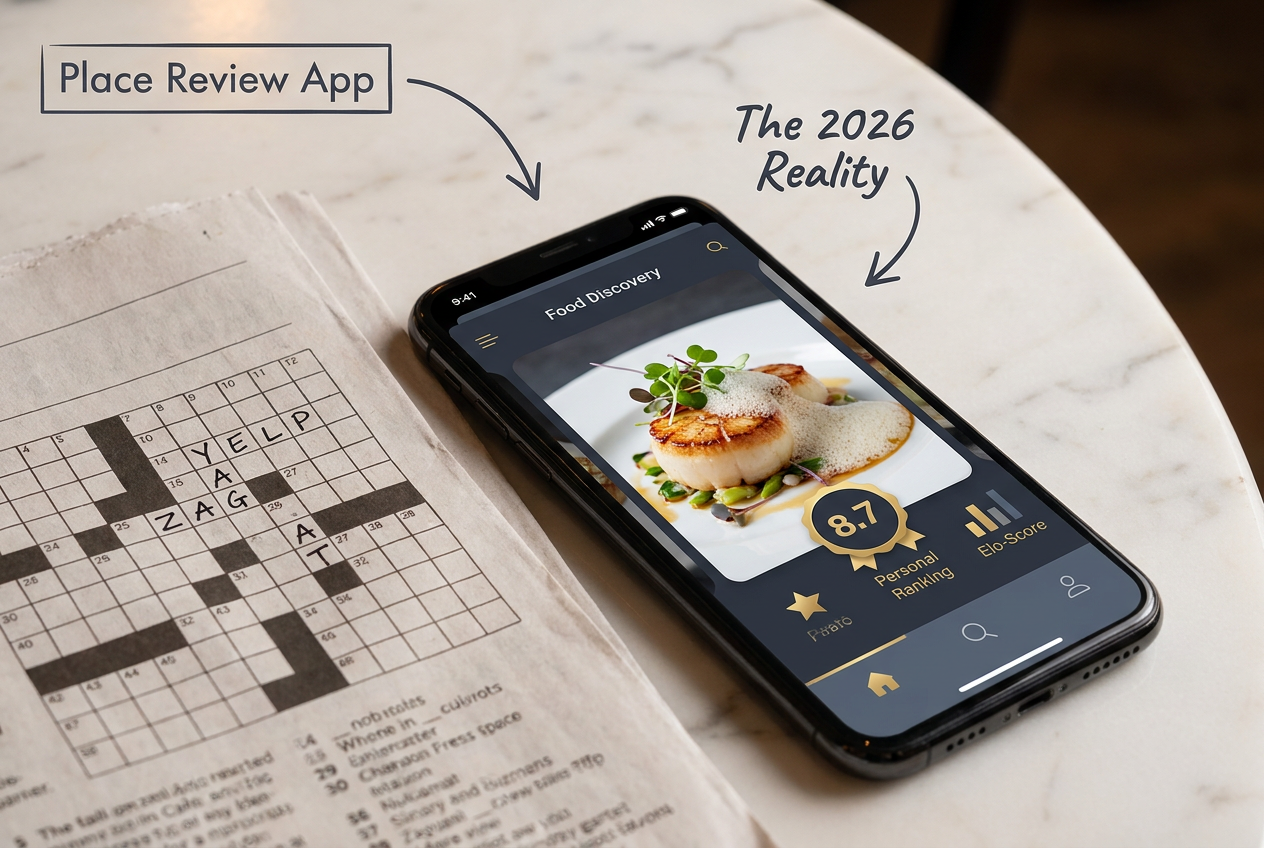 While YELP remains the standard four-letter crossword answer, serious foodies in 2026 have migrated to personal archives and Elo-ranking systems for more accurate discovery.
Table of Contents
- The Quick Crossword Answer: All Common Solutions
- Why These Four-Letter Answers Are Legacy Systems
- The Screenshot Madness Problem: Your Camera Roll Is Failing You
- The 2026 Authority Toolkit: Beyond the Crossword
- How to Build Your Professional Restaurant Archive
- Why Traditional Review Sites Fail Serious Diners
- Which Foodie App Has the Best Reviews?
- Frequently Asked Questions
The Quick Crossword Answer: All Common Solutions
The crossword clue "place review app" or "restaurant review app" has four standard answers depending on letter count:
4-letter answer: YELP This is the default. Yelp currently hosts over 199 million reviews of businesses worldwide, making it the most recognized name in crowd-sourced restaurant reviews. It fits perfectly in standard grids and appears in the New York Times, LA Times, and Wall Street Journal puzzles multiple times per year.
5-letter answers: ZAGAT or EATER ZAGAT, the burgundy-covered guidebook turned digital platform, was the authority for upscale dining before its acquisition. EATER, Vox Media's restaurant news and guide platform, has become the go-to for urban dining culture and food journalism.
9-letter answer: OPENTABLE For longer clues, OPENTABLE (technically a reservation platform, not a review app) occasionally appears. It's less common because the primary function is booking, not reviewing.
If you're solving a puzzle, write one of these and you're done. But if you're trying to remember that incredible carbonara you had three months ago, these platforms won't help you find it again.
Why These Four-Letter Answers Are Legacy Systems
Crossword editors are stuck in 2014. The actual dining landscape has moved past generic star ratings toward personal taste mapping.
The core issue with traditional review platforms is the aggregation problem. Yelp's average rating tells you what 500 random people thought about an entire restaurant. But you don't eat restaurants - you eat dishes. The crispy pork belly might be transcendent while the fish is mediocre. A five-star average tells you nothing about which one to order.
More fundamentally, you don't share taste preferences with those 500 reviewers. Someone giving a taco spot five stars because "the margaritas were strong" has zero predictive value for whether the al pastor will meet your standards. The wisdom of crowds works for commodity products. It fails completely for subjective sensory experiences.
Beli hit 30 million users in just 3 years, compared to Yelp which took 20 years to reach 29 million MAUs. That growth curve isn't luck - it's a direct response to the personal ranking vs. crowdsourced review gap. When people discover they can build a private map of restaurants ranked by their own taste instead of algorithmic averages, they don't go back.
The urban professional demographic (25-45 years old) that dines out 3.4 times per week in major metros has largely abandoned Yelp for discovery. They might check it for hours and location, but the actual decision of where to eat comes from personal networks and individual taste profiles, not star counts.
The Screenshot Madness Problem: Your Camera Roll Is Failing You
You have 2,000+ food photos in your camera roll. How many times have you scrolled for 10 minutes trying to find that one ramen place from last summer?
This is the silent crisis of the modern food lover. We capture everything - every beautifully plated dish, every wine pairing, every street cart discovery - but we've built zero organizational structure around it. Your camera roll becomes a digital junk drawer where incredible meals go to be forgotten.
The transition from "capture" to "archive" requires intent. Taking a photo is passive documentation. Building an archive means creating a searchable, structured system where you can find that specific dish six months later.
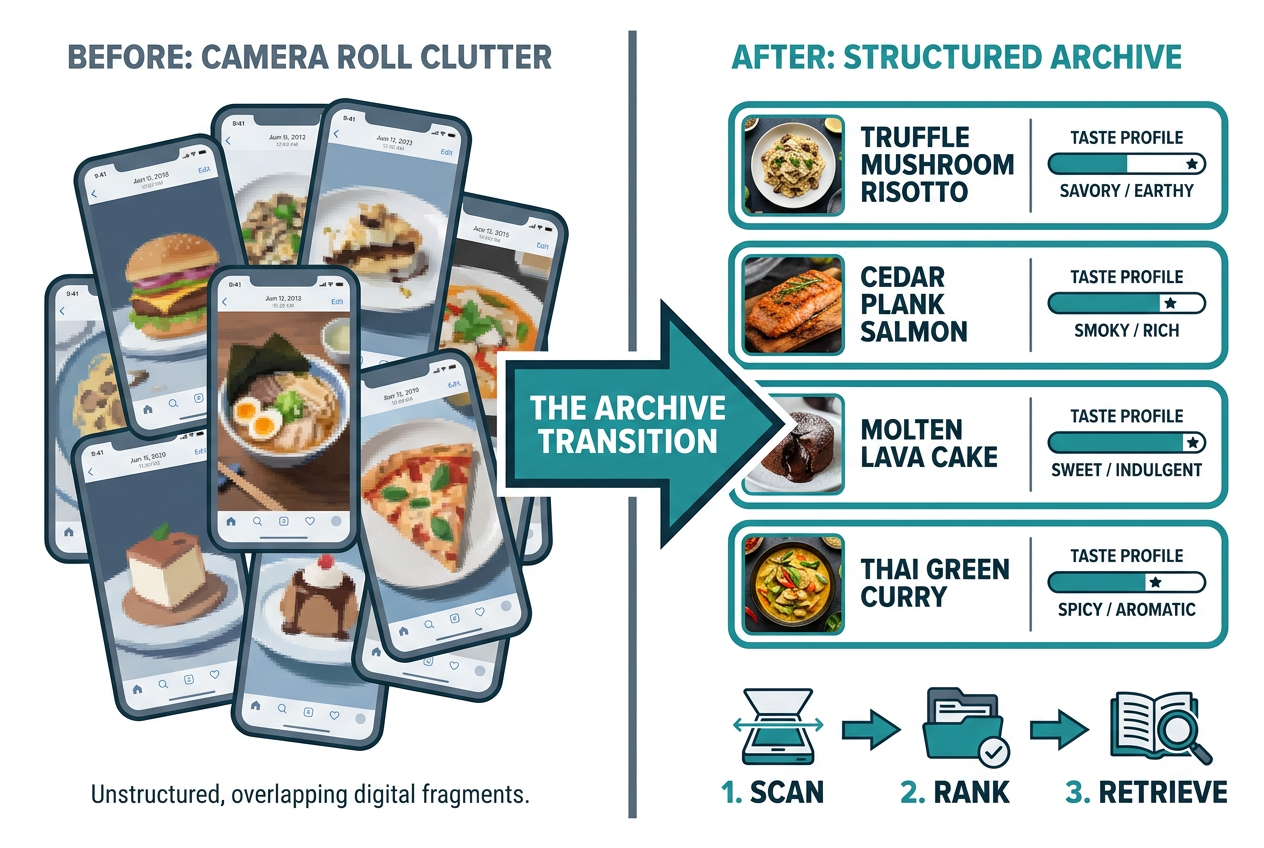 Transforming your disorganized camera roll into a structured personal archive allows you to move from passive photo capture to active culinary authority.
This matters more now than ever because of the AI visibility gap. A 2026 visibility study found that 83% of restaurants never appear when someone asks an AI assistant for recommendations. If you don't own your own data, you're entirely dependent on algorithmic gatekeepers who don't know your taste profile and can't surface the small regional spots that don't have corporate SEO budgets.
The solution isn't taking fewer photos. It's building a system that makes every photo retrievable and useful. That means dish-specific notes, location tags, and a rating framework you can trust months later when your memory has faded.
The 2026 Authority Toolkit: Beyond the Crossword
The modern foodie doesn't use one app - they use a strategic combination based on use case. Here's what serious diners are actually running in 2026:
Beli: The Relationship Ranking King
Beli's innovation is simple: instead of rating restaurants on a 1-5 scale, you rank them against each other. The app shows you two restaurants you've been to and asks "which was better?" This Elo-ranking system (borrowed from chess) builds a personalized hierarchy that reflects your actual preferences.
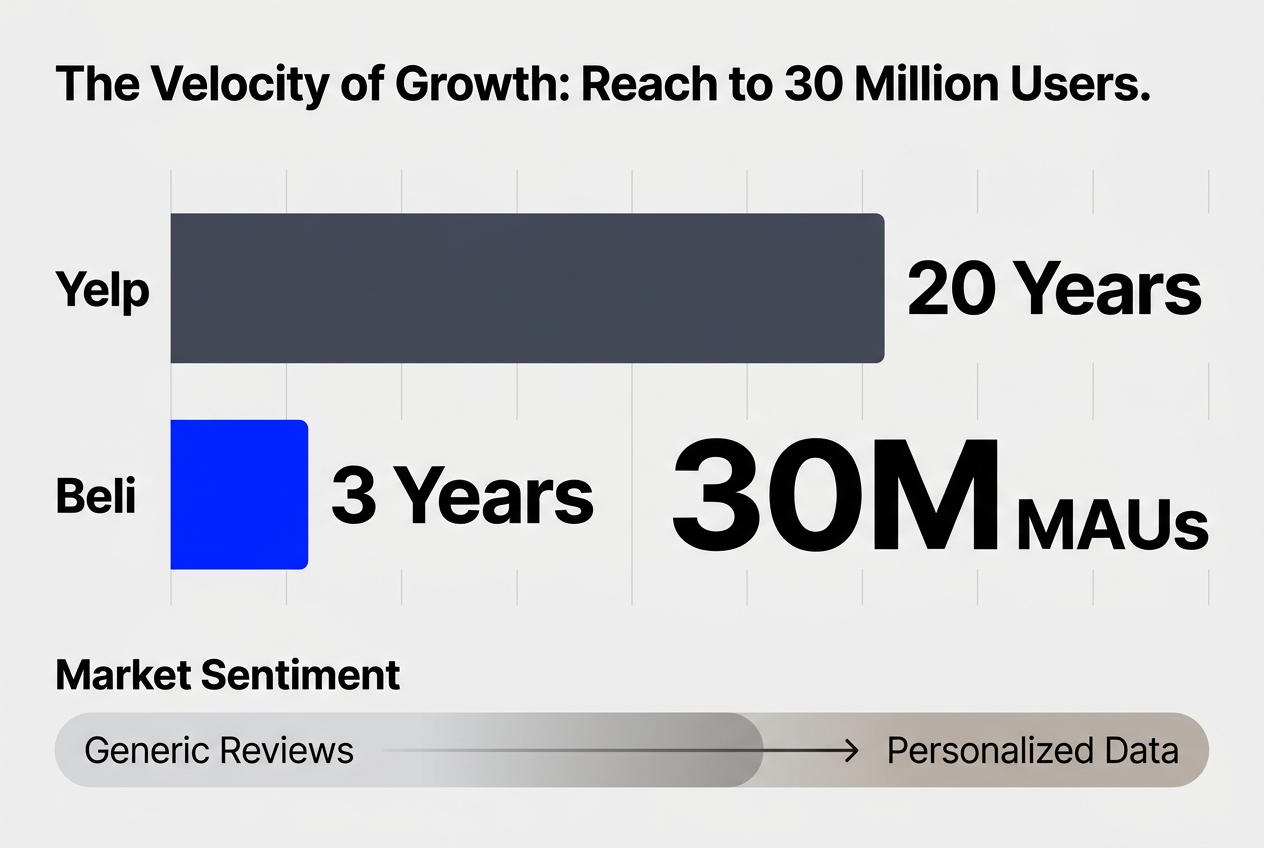 Beli's rapid ascent to 30 million users demonstrates a massive cultural shift toward relationship-based rankings over traditional crowdsourced review platforms like Yelp.
Why this works: comparative judgment is more reliable than absolute rating. You might struggle to articulate whether a meal was "4 stars" or "4.5 stars," but you can instantly answer whether it was better than the Thai spot you tried last month. Over time, these binary comparisons create a ranked list that actually reflects your taste.
Beli reported over 75 million restaurant ratings worldwide as of early 2024, with internal data showing growth from 2.5 million rankings in late 2022 to 6 million by March 2023. The velocity indicates product-market fit for a specific user frustration: "I want to know what I think is best, not what everyone else thinks."
Savor: The Private Dish Archive
While Beli ranks restaurants, Savor takes the opposite approach: it ranks dishes. This is the solution to the "great restaurant, but which dish?" problem.
Every entry in Savor is dish-specific. You're not rating "Osteria Francescana" - you're rating the "Five Ages of Parmigiano Reggiano" and the "An Eel Swimming Up the Po River" separately. Over time, this creates a personal database of specific flavor profiles, preparation methods, and ingredient combinations that work for you.
This dish-level granularity addresses the core weakness of traditional review apps. When 83% of serious foodies report frustration with "generic" crowdsourced reviews, they're describing the mismatch between restaurant-level averages and dish-level excellence. Savor lets you build a personal archive where every memorable plate has its own entry, searchable by cuisine, location, or ingredient.
The dish rating app model also solves the retroactive documentation problem. You can upload that photo from three months ago, tag the specific dish, add tasting notes while the memory is still accessible, and create a permanent record that's infinitely more useful than a camera roll screenshot.
World of Mouth: The Insider Access Platform
World of Mouth is the answer to "how do professional critics find new restaurants?" It's a members-only platform where chefs, food writers, and hospitality professionals share recommendations. Think of it as a vetted network where every suggestion comes from someone whose job is understanding food at a professional level.
This addresses a specific gap in the market: there's crowdsourced (Yelp), there's personal (Beli/Savor), but there's also expert-curated. World of Mouth fills that third category for people who want access to insider knowledge without spending years building industry connections.
8it: The Vibe-Check Utility Tool
For the Gen Z segment, 8it focuses on "near me" discovery with a heavy emphasis on aesthetic and atmosphere. It's less about building a long-term archive and more about solving the immediate "where should we go tonight?" question with options that match your current mood.
The platform uses visual-first browsing and real-time availability, making it functionally different from the archive-building philosophy of Beli or Savor. It's tactical rather than strategic.
How to Build Your Professional Restaurant Archive
Moving from casual photo-taker to systematic documentarian requires a structured approach. Here's the step-by-step system for building a personal restaurant archive that actually works:
Step 1: Retroactive Documentation (The Camera Roll Purge)
Block off 2-3 hours. Go through your camera roll for the past 12 months. For every food photo that represents a meal you'd eat again, create an entry in your chosen archive system. Don't try to remember every detail - capture location, restaurant name, dish name, and a one-sentence note while you still have context.
This isn't about perfection. It's about creating baseline data. Even incomplete entries are infinitely more useful than photos buried in your camera roll with zero metadata.
Step 2: The Hit List Strategy
Organize your archive into three core categories:
To-Try List: Restaurants you haven't visited yet but want to. Think of this as your personal queuing system - every recommendation from a trusted source, every "best of" list entry, every spot you pass and think "I should try that."
Greatest Hits: Dishes you'd order again without hesitation. This is your personal canon. When someone asks "where's the best ramen in the city?" you're not guessing - you're pulling from documented experience.
Comparative Rankings: Dishes in the same category (all the tacos, all the pasta, all the fried chicken) ranked against each other. This creates the structure that makes future decisions easy.
Step 3: The Scoring Framework
Don't use a 5-star system. It's too coarse. Instead, use a 10-point scale where:
- 1-3: Actively bad, would not return
- 4-5: Forgettable, no reason to go back
- 6-7: Solid, would return if convenient
- 8: Excellent, worth seeking out
- 9: Best-in-category, worth traveling for
- 10: Transformative, changes your understanding of the dish
Over time, your 9s and 10s become your personal Michelin stars - a curated collection of dishes that represent your taste at its most refined.
Step 4: The Annotation Discipline
Every entry needs three pieces of information beyond the photo:
- Specific dish name and key ingredients (not "pasta," but "cacio e pepe with house-made tonnarelli")
- One standout sensory detail (the crispy-edged guanciale, the aggressive black pepper, the silky emulsion)
- Context note (solo lunch, anniversary dinner, business meeting - this helps you remember the full experience later)
This takes 45 seconds per entry. The return on investment is permanent searchability and the ability to articulate exactly why that dish worked.
Step 5: Weekly Maintenance
Set a recurring calendar event: "Archive This Week's Meals." Every Sunday, spend 15 minutes processing the week's food photos. Delete the mediocre ones. Create entries for anything worth remembering. Add notes while the memory is fresh.
This prevents the backlog problem. The camera roll purge is a one-time reset. Weekly maintenance keeps the system current.
Why Traditional Review Sites Fail Serious Diners
The fundamental architecture of Yelp, TripAdvisor, and Google Reviews creates systematic problems that no amount of interface improvement can fix.
The Noise Problem
Traditional review platforms aggregate opinions from people with zero shared context. The person giving a Michelin-starred restaurant three stars because "the portions were small" and the critic giving it five stars for "perfect execution of haute cuisine technique" are both counted equally in the average.
This creates a race to the middle. Restaurants that please everyone (inoffensive, large portions, familiar flavors) rank higher than restaurants that excel at a specific culinary perspective. The algorithm rewards consensus, not excellence.
With 83% of restaurants invisible to standard AI discovery, building a personal archive is the only way for serious diners to maintain a reliable culinary database.
The AI Visibility Gap
When you ask ChatGPT or Google's AI Overview for restaurant recommendations, what you're actually getting is algorithmic amplification of whoever has the best SEO and the most online reviews. The 2026 visibility study showing 83% of restaurants are invisible to AI assistants isn't a technical limitation - it's a direct result of how these systems are designed.
Small regional restaurants, family-run operations, and new establishments that haven't accumulated review mass simply don't exist in AI recommendation engines. If your discovery method is entirely dependent on these platforms, you're seeing a curated subset of reality that systematically excludes the exact spots serious diners care most about.
The only solution is personal data ownership. When you build your own archive, you're creating a recommendation engine that isn't dependent on corporate algorithms or SEO gaming. You control what gets surfaced. You control the ranking criteria. You own the data.
The Taste Profile Mismatch
The person who thinks Olive Garden is "authentic Italian" and the person who spent three weeks eating through Rome's trattorie are both using the same five-star scale on Yelp. Their ratings are mathematically equivalent in the aggregate.
This is the core failure of crowdsourced reviews for subjective experiences. Taste isn't democratic. A dish isn't "good" or "bad" in absolute terms - it's good or bad relative to your specific palate, your experience level, and your expectations.
Personal ranking systems solve this by removing the crowd entirely. Your Beli rankings reflect your taste. Your Savor ratings reflect your standards. The recommendations come from comparisons within your own data, not averages across strangers.
For food lovers who want to track what you eat with the same rigor they apply to other areas of expertise, traditional review platforms are fundamentally the wrong tool.
Which Foodie App Has the Best Reviews?
This question contains a category error. "Best reviews" assumes all review systems are trying to solve the same problem. They're not.
If "best" means "most useful for personal taste mapping," the answer is whichever app matches your documentation philosophy:
- Beli if you think in hierarchies and want comparative rankings
- Savor if you think in specific dishes and want granular archives
- World of Mouth if you want expert curation from hospitality professionals
- 8it if you prioritize real-time discovery and visual browsing
If "best" means "most reviews per restaurant," Yelp wins by volume. It has 199 million reviews. But volume and usefulness are different metrics. A million mediocre opinions don't compound into wisdom - they compound into noise.
The serious foodie strategy in 2026 is tool stacking. Use best food review apps like Beli for restaurant-level rankings, Savor for dish tracking, World of Mouth for insider discovery, and Yelp only for operational details (hours, phone number, location).
This multi-app approach acknowledges that different use cases require different tools. There is no single "best" - there's only "best for this specific decision."
Is Beli More Popular Than Yelp?
By user count, no. Yelp has 199 million reviews and decades of market presence. Beli reached 30 million users in 3 years.
But "popularity" measured by total users misses the velocity story. Beli's growth rate - reaching 30 million users in the time it took Yelp 20 years - signals a fundamental shift in user expectations. The people adopting Beli aren't casual reviewers. They're serious diners who have already tried Yelp and found it inadequate.
Among the "Serious Foodie" demographic (urban professionals 25-45 who dine out 3.4 times per week), Beli's adoption rate suggests it's becoming the default tool for personal taste mapping. These aren't users who will migrate back to traditional review platforms. Once you experience comparative ranking, star ratings feel uselessly imprecise.
The trajectory matters more than the snapshot. Beli's internal data showed growth from 2.5 million rankings in late 2022 to 6 million by March 2023 - a 140% increase in four months. That's not linear growth. That's exponential adoption within a specific user cohort.
For New York foodies, Los Angeles foodies, and other major metro areas, the restaurant discovery toolkit has fundamentally changed. Traditional review platforms are still checked for basic information, but the actual decision-making has migrated to personal ranking systems and trusted networks.
Frequently Asked Questions
What is the 4-letter crossword answer for place review app?
YELP is the standard 4-letter answer for "place review app" crossword clues. It appears in the New York Times crossword, Wall Street Journal, LA Times, and most major puzzle publications. Yelp currently hosts over 199 million reviews and remains the most recognized brand in restaurant reviews, making it the default crossword solution for editors. If you see "restaurant review app (4 letters)" or "place review app (4 letters)," write YELP and move on.
Are there 5-letter or 9-letter crossword answers for restaurant review apps?
Yes. For 5-letter clues, ZAGAT and EATER are the two standard answers. ZAGAT was the burgundy guidebook authority before going digital, while EATER is Vox Media's restaurant news and culture platform. For 9-letter clues, OPENTABLE occasionally appears, though it's technically a reservation platform rather than a review app. The specific answer depends on which letters intersect with other puzzle entries, but ZAGAT is more common in traditional crosswords while EATER appears in contemporary puzzles focused on digital media.
What is the best app for restaurant reviews in 2026?
The best restaurant review app depends on what you're trying to accomplish. For personal taste mapping based on comparative rankings, Beli's Elo-ranking system (30 million users in 3 years) outperforms traditional star ratings. For dish-level documentation, Savor provides granular archives where you rate individual plates instead of entire restaurants. For expert curation, World of Mouth connects you to recommendations from chefs and food writers. For volume and operational details (hours, location), Yelp's 199 million reviews remain useful. Serious foodies use multiple apps strategically rather than relying on a single platform.
How does the Beli app ranking system work compared to Yelp?
Beli uses an Elo-ranking system (borrowed from chess) where you compare two restaurants you've visited and select which was better. These binary comparisons build a personalized hierarchy that reflects your actual preferences. Yelp uses a 1-5 star rating system aggregated across all reviewers. The fundamental difference: Beli rankings are personal and comparative (showing your taste profile), while Yelp ratings are crowdsourced and absolute (showing aggregate opinions). Research shows comparative judgment is more reliable than absolute rating - you can instantly say whether Restaurant A was better than Restaurant B, but quantifying "4 stars vs 4.5 stars" is cognitively harder and less consistent.
What app allows you to rate individual dishes instead of just the restaurant?
Savor is built specifically for dish-level ratings rather than restaurant-level averages. Every entry in Savor documents a specific dish with its own photo, rating, tasting notes, and tags. This addresses the core problem with traditional review platforms: a restaurant might have excellent pasta but mediocre fish, and a five-star average tells you nothing about which dish to order. Dish-level tracking creates a searchable personal database of flavor profiles, preparation methods, and ingredient combinations that actually work for your palate.
How can I organize 1,000+ restaurant photos in my phone?
Start with a retroactive camera roll purge: block 2-3 hours to go through the past year of food photos and create structured entries in a dish tracking app for any meal worth remembering. For each entry, capture restaurant name, specific dish name, one standout sensory detail, and a 10-point rating. Then establish a weekly maintenance routine - every Sunday, spend 15 minutes processing that week's meals while memory is fresh. This prevents backlog accumulation. The goal isn't perfect retroactive documentation of every meal; it's creating baseline structure for future searchability.
Why is Yelp considered legacy in 2026?
Yelp's architecture creates three systematic problems: the noise problem (aggregating opinions from people with zero shared taste context), the AI visibility gap (83% of restaurants never appear in AI recommendations), and the restaurant-level average problem (a great pasta spot with mediocre fish gets a meaningless middle rating). Meanwhile, Beli reached 30 million users in 3 years using comparative ranking, and dish-specific tracking apps address granular documentation needs. Among serious foodies who dine out 3.4+ times per week in major metros, Yelp is still checked for operational details but no longer drives discovery decisions. The user expectation has shifted from "what do strangers think?" to "what do I think, and what do people with my taste profile think?"
Is Beli still invite only in 2026?
No. Beli removed its invite-only requirement in 2024 and is now publicly available as a free download. The early invite-only phase created network density in major metro areas (New York, Los Angeles, San Francisco) before opening to general availability. As of 2026, anyone can download Beli and start building their personal restaurant rankings immediately. The app remains free with optional premium features for power users who want advanced filtering and export capabilities.