
Beyond the Camera Roll: The Best Restaurant Rating Apps for Serious Foodies
Alex the juice queen
Alex hunts for the best juice bars and presses. She rates every sip and saves her favorites in Savor.
Beyond the Camera Roll: The Best Restaurant Rating Apps for Serious Foodies (2026) Most men don't realize they've lost 47 of the 50 best meals they've ever...
Beyond the Camera Roll: The Best Restaurant Rating Apps for Serious Foodies (2026)
Most men don't realize they've lost 47 of the 50 best meals they've ever eaten. Not because the memories aren't there - they are, buried in a camera roll graveyard of 2,000 unlabeled food photos scrolling past birthday snapshots and parking garage tickets. You remember the feeling of that perfect carbonara in Rome, but you can't remember the restaurant name, the neighborhood, or whether it was the one near the fountain or the one down the alley. The average foodie spends 3 minutes searching their camera roll for a specific meal, compared to 3 seconds in a dedicated tracking app. That gap isn't just inconvenient - it's the difference between building a curated food legacy and letting your best dining experiences dissolve into digital chaos.
The solution isn't better organization of your photos. It's understanding that the era of generic star ratings is over, replaced by dish-level tracking, AI-powered memory systems, and expert curation that actually tells you whether the carbonara is worth ordering. What follows is the complete picture of the new guard of food tech - the apps replacing Yelp's parking lot complaints with tools built for people who treat dining as a cultural pursuit.
Key Takeaways
- Traditional review apps fail foodies because 3.5-star restaurant ratings bury great dishes under complaints about parking and service, making it impossible to search for "best spicy rigatoni I've ever had."
- Dish-level tracking apps like Savor reduce photo retrieval time by 98%, turning 3 minutes of camera roll chaos into 3-second searches with AI dish recognition and exportable metadata.
- Social rating platforms like Beli use ELO ranking systems to compare meals comparatively (Pizza vs. Sushi) rather than absolute scores, creating a "food resume" that maps your entire taste journey.
- Expert-curated platforms like World of Mouth deliver a 100% hit rate by aggregating 30,000+ recommendations from 800 global chefs and critics, eliminating the guesswork of crowdsourced reviews.
- The serious foodie must prioritize apps with data export functionality to future-proof their palate - your years of tasting notes should never be held hostage by a platform shutdown.
Table of Contents
- Why Traditional Review Apps (Yelp/Google) Fail the Foodie
- The Three Pillars of Modern Food Tracking
- Deep Dive: The Top 5 Apps for 2026
- The Serious Foodie Buyer's Guide
- What Is the Best Restaurant Rating System?
- Mandatory Technical Features to Look For
- What Is the App That Makes Rating Restaurants Fun Again?
- Frequently Asked Questions
Why Traditional Review Apps (Yelp/Google) Fail the Foodie
Traditional review platforms like Yelp and Google Maps aggregate venue-level sentiment - not dish-level data. A restaurant can hold a 3.5-star rating because one diner hated the parking situation, another complained about slow service during a Saturday rush, and a third loved the carbonara but buried that detail in paragraph four of a rambling review. For the serious foodie, this creates what industry insiders call the "3.5-Star Problem": exceptional dishes are statistically invisible under the weight of logistical complaints that have nothing to do with the food.
The core issue is metadata architecture. When you search Yelp for "best spicy rigatoni," you're not querying a structured database of dish-level ratings - you're running a keyword search through unstructured review text. The platform can't tell you that Restaurant A's rigatoni scores 9.2/10 on heat while Restaurant B's version is milder at 6.8/10, because that data doesn't exist in a queryable format. You get a list of venues where someone mentioned the word "rigatoni," ranked by overall star rating and review recency, not by the actual quality of the dish you care about.
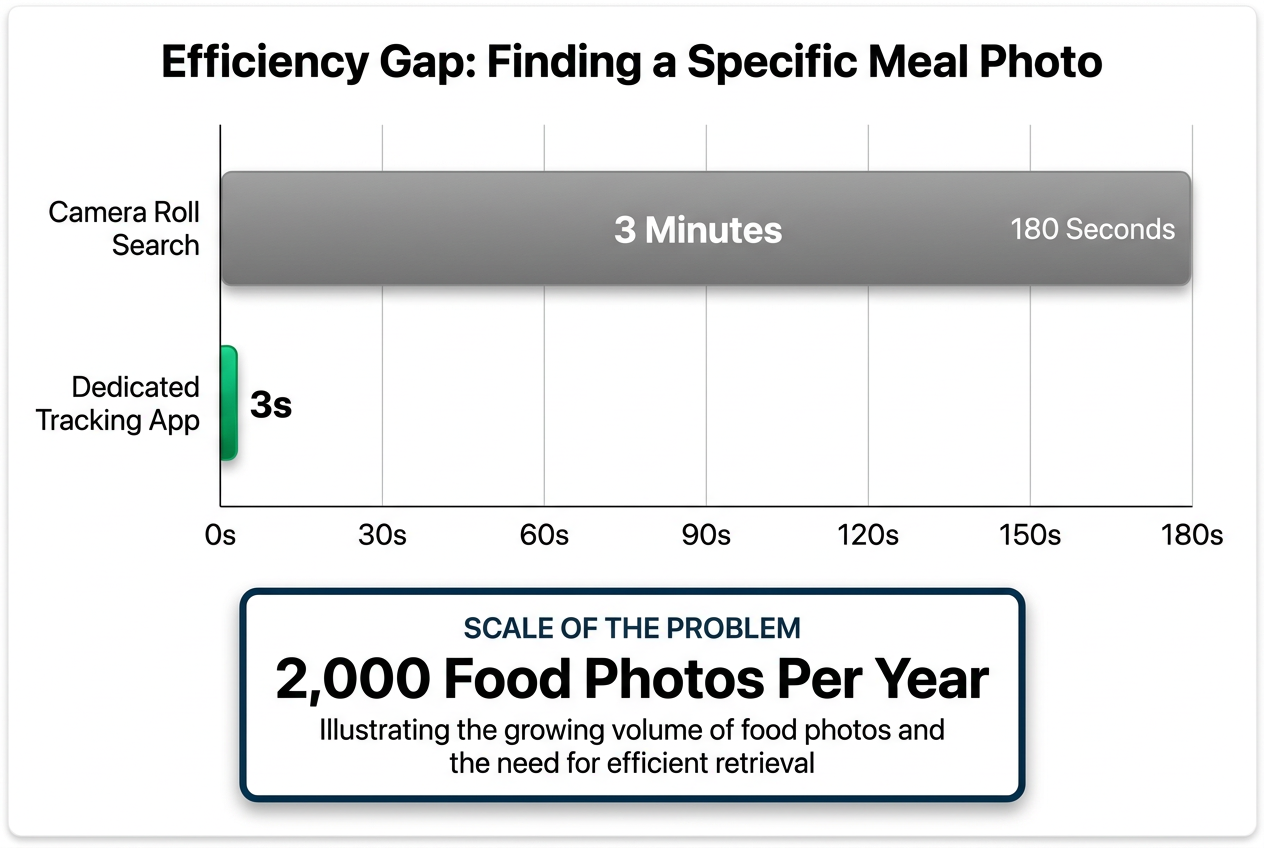 Efficiency matters for the serious foodie; dedicated apps reduce photo retrieval time by 98% compared to searching through a standard smartphone camera roll graveyard.
This structural flaw compounds when you consider volume. The average serious foodie takes approximately 2,000 food photos per year. Without dish-level tagging and searchable attributes (cuisine type, heat level, texture, specific ingredients), those photos become a liability instead of an asset. You know you had an incredible bowl of tonkotsu ramen somewhere in San Francisco last spring, but you can't reconstruct which of the 40 ramen photos in your camera roll it was, let alone the restaurant name or neighborhood.
The restaurant management software market is projected to reach $7.6 billion in 2026, but most of that investment flows to operational tools for restaurant owners - not consumer-facing memory systems for diners. The gap between what foodies need (permanent, searchable records of specific dishes) and what traditional platforms provide (transient, venue-level sentiment) has created the market space for a new generation of tracking apps.
The Three Pillars of Modern Food Tracking
The next generation of restaurant apps divides cleanly into three archetypes, each serving a distinct user psychology and data philosophy. These aren't just feature sets - they're fundamentally different approaches to what food tracking is for.
 Choosing the right restaurant app depends on your goals: whether you want to build a social food resume, archive private memories, or follow professional chef recommendations.
Social/Status (The Beli Model)
Beli positions food tracking as social currency. The app's core innovation is its ELO ranking system, borrowed from competitive chess, which forces users to make comparative judgments: was this pizza better than that sushi? Over time, these pairwise comparisons generate a ranked list of every meal you've eaten, creating what Beli users call a "food resume" - a shareable, social-proof-driven map of your taste authority.
The model works because it gamifies curation. Instead of assigning absolute scores (which require calibration and feel arbitrary), you're making relative judgments (which feel intuitive and fun). The system then algorithmically sorts your entire meal history into a definitive ranking. Your friends can see your top 10, your top 50, your entire map. The social layer is the point - Beli isn't designed for private reflection; it's designed for public declaration of taste expertise.
The tradeoff is depth. Comparative ranking is elegant for sorting experiences, but it doesn't capture granular tasting notes. You remember that the pizza ranked higher than the sushi, but not why - no record of specific flavor profiles, textures, or ingredients. For users who care more about social mapping than archival detail, that's acceptable. For users who want to reconstruct the exact spice blend three years later, it's insufficient.
Archival/Private (The Savor Model)
Savor takes the opposite approach: food tracking as personal database construction. The platform is built around dish-level granularity and AI-powered metadata extraction. When you photograph a plate, Savor's recognition engine identifies the dish type (Tonkotsu Ramen, Margherita Pizza, Beef Wellington), auto-tags cuisine and location, and prompts you to add texture notes, heat level, and a personal score. The result is a queryable archive - you can search "spicy ramen San Francisco 2024" and retrieve the exact bowl, with your notes, three years later.
The model works because it prioritizes future retrieval over present sharing. Savor is designed for the foodie who wants to remember not just where they ate, but what they thought in that moment - the specific qualities that made a dish unforgettable. The app's data export functionality means your archive isn't held hostage by the platform; you can download your entire meal history as structured data and port it to another system if needed.
The tradeoff is social friction. Savor offers sharing features, but they're secondary to the core value proposition. This is a tool for private memory construction, not public performance. For users who want their food tracking to double as social proof, Savor feels isolating. For users who want an honest, unperformed record of their palate development, it's ideal.
Expert/Curated (The World of Mouth Model)
World of Mouth bypasses personal tracking entirely in favor of expert aggregation. The platform curates 30,000+ recommendations from 800 global chefs, food writers, and critics, organized by city and category. Instead of building your own database, you're accessing a pre-vetted one - the restaurants and dishes that professionals with trained palates have already identified as worth your time.
The model works because it eliminates the cold-start problem. New users don't need to log 100 meals to build a useful database - they get immediate access to a mature, expert-validated collection. World of Mouth users report a 100% hit rate (dishes that meet or exceed expectations) because the curation filter is so high. You're not trusting the wisdom of crowds; you're trusting the judgment of people whose careers depend on identifying excellence.
The tradeoff is agency. You're consuming someone else's taste map, not building your own. World of Mouth is perfect for the foodie who trusts expert consensus and wants to minimize discovery risk. It's insufficient for the foodie who wants to document their personal journey or track idiosyncratic preferences that don't align with critic consensus.
Deep Dive: The Top 5 Apps for 2026
Beli: The Social Food Resume
Beli's killer feature is its ELO ranking algorithm, which turns every meal into a data point in a comparative system. Instead of rating a dish in isolation (8/10 carbonara), you're answering a simple question: was this meal better than your last meal? Over time, those binary comparisons generate a ranked leaderboard of your entire culinary history.
The app's secondary strength is its social map layer. Beli users can see each other's top-ranked meals and restaurant recommendations, geo-tagged on a shared map. This creates a network effect - the more friends you have on Beli, the more valuable the app becomes as a discovery tool. You're not just seeing generic Yelp reviews; you're seeing which specific dishes your trusted friends ranked in their personal top 10.
The limitation is lack of granularity. Beli tracks meals, not dishes. You can't search for "all the ramen I've rated above 8/10" because the system doesn't store dish-level metadata. The app is optimized for social sharing and comparative ranking, not archival detail or future retrieval.
Best for: Foodies who want to build a public-facing taste authority and discover restaurants through trusted friend networks rather than anonymous reviews.
Savor: The AI-Powered Personal Archive
Savor solves the camera roll graveyard problem with dish-level AI recognition and structured metadata. When you photograph a plate, the app identifies the dish type, auto-tags the cuisine, and prompts you to add a rating, texture notes, heat level, and personal comments. The result is a searchable, exportable database of every memorable meal.
The app's data export feature is critical for serious foodies who worry about platform lock-in. Savor lets you download your entire meal history as a CSV file, complete with photos, ratings, notes, and timestamps. If the platform shuts down or you switch to a different tool, your archive comes with you.
The secondary strength is retrieval speed. Users spend 3 seconds finding a specific meal in Savor versus 3 minutes scrolling through a camera roll. The difference compounds over time - the more meals you log, the more valuable the search functionality becomes.
Best for: Foodies who want a permanent, private record of their palate development and need dish-level granularity for future reference.
World of Mouth: The Expert Curation Layer
World of Mouth aggregates recommendations from 800+ chefs, food writers, and critics into a searchable database of 30,000+ dishes across major global cities. The platform's value proposition is simple: eliminate discovery risk by only showing you restaurants and dishes that professionals have already vetted.
The app's secondary feature is its guide structure. Instead of browsing an unfiltered list, you're following curated trails - "Best Pasta in Rome According to Michelin-Starred Chefs" or "Nigella Lawson's Favorite London Brunch Spots." The curation layer makes the platform feel editorial rather than algorithmic.
The tradeoff is cost. World of Mouth runs on a subscription model (€3.90-9.90/month), making it one of the few paid restaurant apps in a market dominated by free platforms. The bet is that serious foodies value expert curation enough to pay for it - and early data suggests that's true for a subset of users willing to trade discovery time for subscription cost.
Best for: Foodies who travel frequently, trust professional critics, and want to minimize the risk of mediocre meals in unfamiliar cities.
Yummi: The Visual Timeline
Yummi emphasizes visual storytelling over granular data. The app organizes your meal history into a timeline of "Foodprints" - visual markers on a map that show where you've eaten, when, and what you ordered. The interface is optimized for browsing and reminiscing rather than searching and querying.
The secondary strength is travel documentation. Yummi users can create trip-specific albums (Rome 2024, Tokyo 2025) and share them as visual stories. The app functions less like a database and more like Instagram for food - a curated, aesthetically driven record of your culinary adventures.
The limitation is lack of metadata depth. Yummi doesn't prompt for tasting notes, texture analysis, or dish-level ratings. You get a photo, a location pin, and an optional caption. For users who want to reconstruct specific flavor profiles years later, that's insufficient. For users who want a beautiful visual archive, it's perfect.
Best for: Foodies who prioritize aesthetic documentation and visual storytelling over detailed tasting notes and structured data.
Memolli: The Minimalist Journal
Memolli strips food tracking down to its essentials: a photo, a date, a location, and a short note. The app's design philosophy is intentionally minimalist - no prompts for heat level, no texture tags, no comparative rankings. Just a simple, unstructured record of meals you want to remember.
The strength is friction reduction. Memolli logs a meal in under 10 seconds - snap a photo, tap save, done. For users who find detailed tracking tedious, the minimalist approach is liberating. You're documenting the fact of the meal without the overhead of structured metadata.
The limitation is future utility. Without searchable tags or structured data, Memolli becomes harder to use as your archive grows. Finding a specific meal from two years ago requires scrolling chronologically rather than searching by cuisine, location, or dish type. The app is optimized for present-moment capture, not long-term retrieval.
Best for: Foodies who want a low-friction way to document meals without committing to detailed tracking workflows.
The Serious Foodie Buyer's Guide
Choosing the right app depends less on feature checklists and more on self-awareness about your tracking psychology. The following archetypes represent distinct user profiles, each requiring a different tool.
The Critic Archetype
The Critic treats food tracking as a professional discipline. You want dish-level notes, exportable data, and the ability to reconstruct specific flavor profiles years later. You're building a reference library, not a social feed.
Primary need: Structured metadata and data portability.
Recommended app: Savor. The platform's AI dish recognition and CSV export functionality are purpose-built for this use case. Your archive is yours - you can search it, analyze it, and port it to another system if needed.
Avoid: Beli (insufficient granularity), Yummi (too visually focused).
The Socialite Archetype
The Socialite treats food tracking as social currency. You want friend feeds, public ranking lists, and the ability to share your taste authority with your network. Your food resume is a performance, and you want an audience.
Primary need: Social sharing and comparative ranking.
Recommended app: Beli. The ELO ranking system and friend map layer are designed for this exact use case. Your meals aren't just logged - they're displayed as proof of taste expertise.
Avoid: Savor (too private), World of Mouth (expert-driven, not user-driven).
The Traveler Archetype
The Traveler needs offline functionality, expert recommendations, and the ability to document meals in unfamiliar cities where you can't rely on local knowledge.
Primary need: Expert curation and offline maps.
Recommended app: World of Mouth. The platform's chef-curated guides eliminate discovery risk in new cities, and the database works offline once downloaded. You're not guessing - you're following a pre-vetted trail.
Avoid: Beli (requires an active friend network in each city), Memolli (no curation layer).
What Is the Best Restaurant Rating System?
The best restaurant rating system depends on whether you're rating venues or dishes - two fundamentally different tasks that require different architectures. Venue-level ratings (Yelp, Google Maps) aggregate sentiment across service, ambiance, parking, and food quality into a single score. Dish-level ratings (Savor, Beli) isolate the culinary experience from logistical factors.
For the serious foodie, dish-level systems are superior because they separate signal from noise. A 3.5-star restaurant might serve a 9/10 carbonara alongside a 6/10 tiramisu, mediocre service, and terrible parking. Venue-level ratings collapse all of that into a single number, making it impossible to identify the one dish worth ordering. Dish-level systems let you rate the carbonara independently, creating a queryable database of specific plates rather than generic venues.
The emerging standard for serious foodies is a hybrid system: dish-level ratings within venue-level context. Savor, for example, lets you rate individual dishes while still tagging them to specific restaurants and locations. You can search "all 9+ rated pasta dishes in Rome" and retrieve a list of specific plates, not just high-rated restaurants that happen to serve pasta.
Comparative ranking systems (Beli's ELO algorithm) are superior for users who struggle with score calibration. Absolute ratings require internal consistency - you need to remember what an 8/10 means versus a 7/10 across hundreds of meals. Comparative systems sidestep that problem by asking only: was this better than that? The algorithm handles the rest, generating a ranked list without requiring calibrated scoring.
Mandatory Technical Features to Look For
Not all restaurant apps are built for long-term use. The following features separate serious tools from throwaway novelty apps.
AI Photo Recognition
Manual entry is the death of consistent tracking. If you have to type "Tonkotsu Ramen, Mensho Tokyo, San Francisco" every time you log a meal, you'll abandon the app within a month. AI dish recognition solves this by identifying dishes from photos automatically.
Savor's recognition engine can distinguish between Tonkotsu and Shoyu ramen, Neapolitan and New York pizza, and hundreds of other dish-level categories. The system isn't perfect - it struggles with fusion dishes and highly plated fine dining - but it eliminates 80% of manual entry overhead.
Without AI recognition, food tracking apps devolve into tedious data-entry chores. With it, logging a meal takes 5 seconds instead of 60.
Data Export (Future-Proofing Your Palate)
This is non-negotiable. Your meal archive is a multi-year investment - the more you log, the more valuable it becomes. If the platform shuts down or gets acquired and pivots, you need the ability to export your data and migrate to another tool.
Savor offers CSV export with full metadata (photos, ratings, notes, timestamps, location data). Beli does not. World of Mouth does not (because you're consuming their curated database, not building your own). The lack of data portability is a deal-breaker for serious foodies who view their archive as permanent intellectual property.
The restaurant app market is still evolving - platforms launch, pivot, and shut down regularly. Betting your entire meal history on a closed-ecosystem app without export functionality is a long-term risk.
Offline Functionality
Most food tracking happens in real time, at the table, often in restaurants with spotty WiFi or international locations where you're avoiding data roaming charges. Apps that require constant connectivity become unusable in the exact moments you need them most.
World of Mouth's offline mode lets you download city-specific guides before a trip, ensuring you can access expert recommendations without an active internet connection. Savor's photo queue lets you log meals offline and sync later when you reconnect.
Apps without offline functionality force you to either skip logging (losing the meal permanently) or delay logging (increasing the chance you'll forget details).
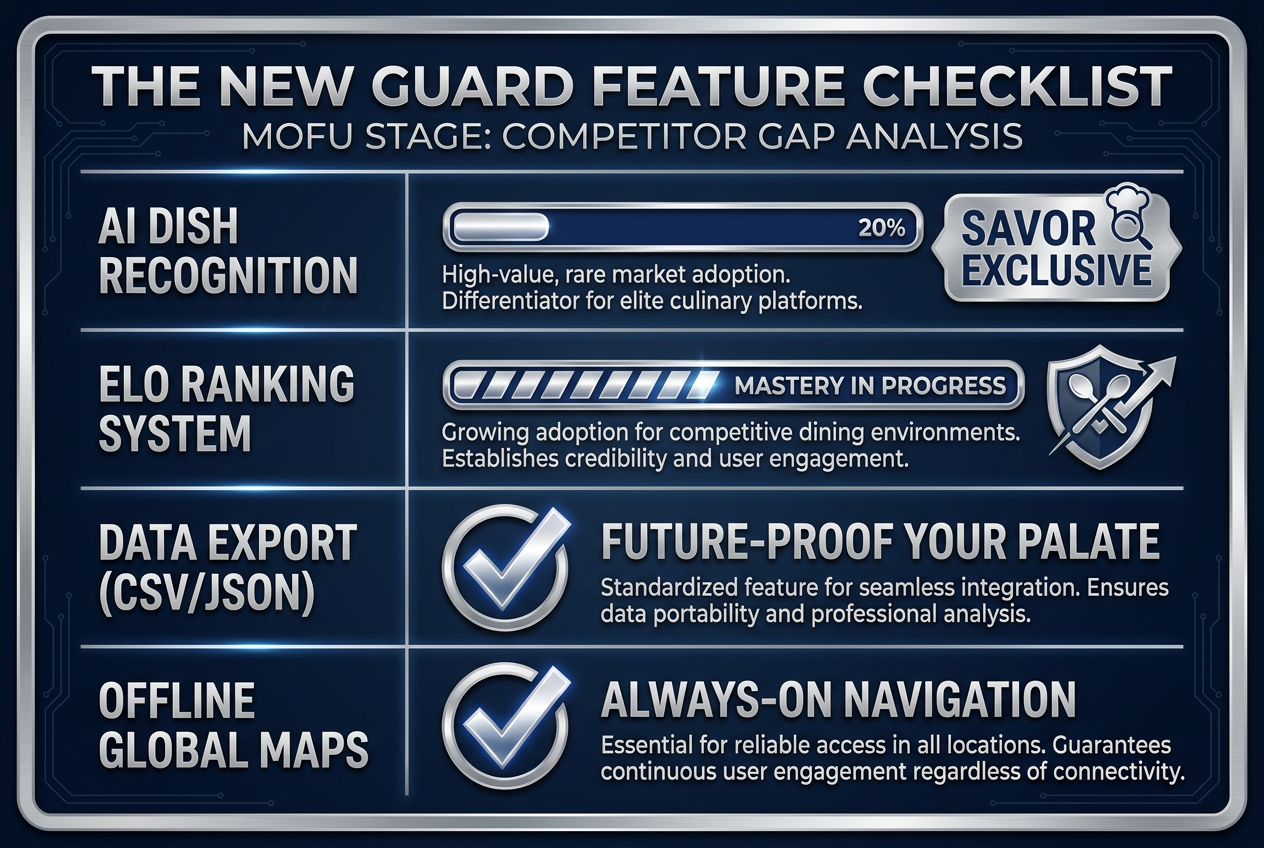 Don't let your food memories be held hostage. Prioritize apps that offer AI-powered metadata and the ability to export your data for long-term archiving.
Search and Filter by Dish Attributes
The long-term value of a food archive depends entirely on your ability to retrieve specific meals years later. Generic chronological timelines are insufficient - you need the ability to search by cuisine type, dish category, heat level, location, date range, and rating threshold.
Savor's filter system lets you query "all ramen rated 8+ in San Francisco between January and March 2024." That level of granularity turns your archive into a functional reference tool. Without it, you're back to scrolling chronologically through hundreds of photos, hoping you'll recognize the meal you're looking for.
Apps that store photos without structured metadata (Yummi, Memolli) are beautiful in the short term and frustrating in the long term. The camera roll graveyard problem isn't solved by moving photos to a different app - it's solved by adding searchable structure.
What Is the App That Makes Rating Restaurants Fun Again?
Beli makes rating restaurants fun again by replacing absolute scoring with comparative ranking. Instead of agonizing over whether a dish deserves an 8.2 or an 8.4, you're answering a simple question: was this meal better than my last meal? The system feels like a game - each new meal becomes a challenge to your existing rankings.
The gamification works because it taps into natural human psychology. Absolute ratings require calibration and feel arbitrary. Comparative judgments feel intuitive and fun. Beli users report higher engagement and longer retention than users of traditional scoring apps because the core interaction loop is inherently more enjoyable.
The social layer amplifies the fun factor. Your ranked list isn't private - it's a shareable artifact that positions you as a taste authority. Friends can challenge your rankings, debate whether your #3 pizza really deserves to outrank your #7 sushi, and discover new restaurants from your top 10. The app transforms food tracking from a solitary data-entry task into a social game.
For users who view food tracking as a chore, Beli's gamification layer is a solution. For users who already enjoy detailed note-taking, the simplified interaction model might feel limiting. The app makes rating fun, but it doesn't make archival detail fun - that's a different use case.
Frequently Asked Questions
What is the best app for tracking restaurants and rating dishes?
Savor is the best app for dish-level tracking because it combines AI photo recognition with structured metadata, turning your camera roll into a searchable archive. When you photograph a dish, Savor identifies it automatically (Tonkotsu Ramen, Margherita Pizza), prompts you to add ratings and texture notes, and stores the data in a queryable format. Users spend 3 seconds retrieving specific meals from Savor versus 3 minutes scrolling through unstructured photo libraries. The app's data export feature ensures your archive remains portable - you can download your entire meal history as a CSV file, complete with photos and metadata, preventing platform lock-in.
How do Beli and Savor compare for serious foodies?
Beli and Savor serve fundamentally different needs. Beli is a social ranking platform optimized for comparative judgments and friend discovery - you're building a public food resume using ELO algorithms to rank meals against each other. Savor is a private archival system optimized for dish-level detail and long-term retrieval - you're building a personal database with AI-tagged metadata and exportable records. Choose Beli if you want to share your taste authority and discover restaurants through trusted friend networks. Choose Savor if you want to remember specific flavor profiles years later and need structured, searchable tasting notes. The apps don't compete - they solve different problems for different user archetypes.
What is the best restaurant app that is not Yelp or Google Maps?
World of Mouth is the best alternative to Yelp and Google Maps for foodies who prioritize expert curation over crowdsourced reviews. The platform aggregates 30,000+ recommendations from 800 global chefs, food writers, and critics, eliminating the noise of amateur opinions and parking complaints. Users report a 100% hit rate - dishes that meet or exceed expectations - because the curation filter is professionally validated. The app runs on a subscription model (€3.90-9.90/month), trading free access for editorial quality. World of Mouth works offline once you download city-specific guides, making it ideal for international travel where you can't rely on local knowledge or active internet connections.
Are there restaurant apps with AI dish recognition?
Savor uses AI dish recognition to automatically identify meals from photos, distinguishing between hundreds of dish types (Tonkotsu vs. Shoyu ramen, Neapolitan vs. New York pizza) and eliminating manual data entry. The system tags dishes with cuisine type, location, and dish category, reducing logging time from 60 seconds to 5 seconds. The recognition engine struggles with fusion dishes and highly abstract plated presentations but handles 80% of standard meals accurately. AI recognition is critical for consistent long-term tracking - manual entry creates friction that causes users to abandon apps within weeks. Savor's recognition layer turns food photography into automatic database construction, making the app usable at scale.
Which restaurant rating app is private and good for a personal food journal?
Savor is the only major food tracking app designed for private, unperformed reflection rather than social sharing. The platform prioritizes dish-level granularity and honest tasting notes over public rankings and friend feeds. Users report logging more critical, unfiltered opinions in Savor because the data isn't performative - you're documenting for future reference, not for an audience. The app's data export feature ensures your archive remains yours, not held hostage by a closed platform. For foodies who want to track palate development without social pressure to inflate ratings or curate a public persona, Savor's privacy-first architecture is purpose-built for that use case.
How do I organize my food photos and remember where I ate?
Dedicated dish tracking apps solve the camera roll graveyard problem by adding structured metadata to food photos at the moment of capture. Savor auto-tags cuisine, location, and dish type using AI recognition, turning unstructured images into queryable database entries. Users can search "spicy ramen San Francisco 2024" and retrieve the exact bowl with tasting notes, compared to scrolling chronologically through 2,000 generic photos. The key is immediate tagging - if you wait until later to organize, you'll forget details and abandon the task. Apps that integrate tagging into the capture workflow (photo → AI recognition → one-tap save) reduce friction enough that organization becomes automatic instead of a separate chore you'll never do.
What is the best restaurant app for food travelers and experts?
World of Mouth is optimized for food travelers and experts who need vetted recommendations in unfamiliar cities. The platform's database of 30,000+ chef-curated dishes eliminates discovery risk - you're following pre-validated trails rather than guessing based on crowdsourced sentiment. The offline mode lets you download city-specific guides before international trips, ensuring access without data roaming costs. For experts and critics, World of Mouth functions as a reference layer - a way to see what 800 other professionals have flagged as exceptional. The app's subscription model (€3.90-9.90/month) reflects its target user: serious foodies willing to pay for editorial curation instead of free, unfiltered noise.
Is World of Mouth worth the membership fee?
World of Mouth is worth the €3.90-9.90 monthly fee if you travel frequently to food destinations and value expert curation over crowdsourced reviews. Users report that a single recommendation preventing a mediocre meal pays for the subscription, and the platform's 100% hit rate (dishes meeting or exceeding expectations) suggests the curation quality justifies the cost. The value diminishes if you primarily eat in one city or prefer building your own taste map rather than following expert consensus. The subscription model funds editorial overhead - the platform employs curators to vet and organize recommendations rather than algorithmically aggregating user-generated content. For foodies who view dining as a high-stakes cultural pursuit rather than casual sustenance, the fee is negligible compared to the cost of wasted meals.