
Stop Rating Venues: Why the Best Restaurant Review Apps Now Focus on Dishes
Harry the matcha king
Harry is our resident matcha obsessive. He’s tasted hundreds of bowls and tracks every cup in Savor.
The Death of Generic Stars: Why the Best Restaurant Review App for 2025 Tracks Dishes, Not Venues Most serious foodies share a frustrating secret: they've...
The Death of Generic Stars: Why the Best Restaurant Review App for 2025 Tracks Dishes, Not Venues
Most serious foodies share a frustrating secret: they've stopped trusting Yelp. Not because the platform lacks reviews, but because it's become impossible to extract signal from noise. A restaurant with 4.2 stars might serve one transcendent dish and five forgettable ones, but the aggregate score tells you nothing about which plate to order. Meanwhile, your phone's camera roll holds 2,400 food photos with zero searchable data - you remember the perfect carbonara existed, but not where, when, or why it was exceptional.
This isn't just inconvenient. It's a failure of memory infrastructure for the one sensory experience humans consistently document but rarely organize. According to Cropink's 2026 dining trends report, 74% of diners now use social media to decide where to eat, yet 67% of Gen Z and Millennials specifically report frustration with "generic star ratings that don't match the actual food." The gap between how we discover restaurants and how we remember them has never been wider.
The answer isn't better venue reviews. It's dish-level precision. The best restaurant review apps of 2025 have abandoned the "rate the restaurant" model entirely, replacing it with tools that let you score individual plates, tag flavor profiles, geotag meals, and build a searchable archive of everything you've ever eaten. This is the anti-Yelp movement - and it's rewriting how intentional diners track, share, and rediscover great food.
Key Takeaways
- Traditional 5-star venue ratings fail because they average across dishes, hiding the one plate worth ordering and obscuring what actually made a meal memorable.
- Dish-level tracking apps like Savor and Beli grew 140% in user adoption from 2023-2025 by solving the "camera roll chaos" problem - turning untagged food photos into searchable, sortable archives.
- The rise of AI-powered discovery (22% of diners now use ChatGPT or Perplexity for restaurant recommendations) demands structured, dish-specific data that legacy platforms cannot provide.
- Social ranking mechanics (Elo-based head-to-head comparisons) create "personal leaderboards" that reflect your actual taste, not the preferences of anonymous strangers complaining about parking.
- For serious foodies, the shift from venue-centric to dish-centric tracking is not optional - it's the only way to build a permanent, exportable dining legacy that survives platform churn.
Table of Contents
- The Death of the 5-Star Scale: Why Venue-Level Ratings Fail
- Why Foodies Need Dish-Level Tracking Instead of Venue Reviews
- Beyond the Camera Roll: How to Digitally Archive Your Dining Life
- The Social Ranking Revolution: Beli and the Elo Method
- The Expert vs. Peer Divide: When to Trust Professionals
- Comparison Matrix: Speed, Social, Expert-Rating, and Map Utility
- Frequently Asked Questions
The Death of the 5-Star Scale: Why Venue-Level Ratings Fail
The traditional restaurant rating system is fundamentally broken because it treats every dish as equal and averages wildly different experiences into a single, meaningless score. A restaurant earning 4.2 stars on Yelp might serve a Michelin-worthy pasta alongside inedible seafood, but that aggregate rating tells you nothing about which plate to order. Worse, 45% of diners report their favorite restaurant changed in the past year - indicating high brand volatility that static venue scores cannot capture.
The problem isn't that people are bad at rating restaurants. It's that venue-level ratings answer the wrong question. When you think back to a great meal, you don't remember the restaurant as a totality - you remember the specific dish. The texture of that cacio e pepe. The way the pork belly was seared. The exact balance of heat and acid in the curry. Yet every mainstream review platform forces you to compress that granular memory into a single star rating for the entire establishment.
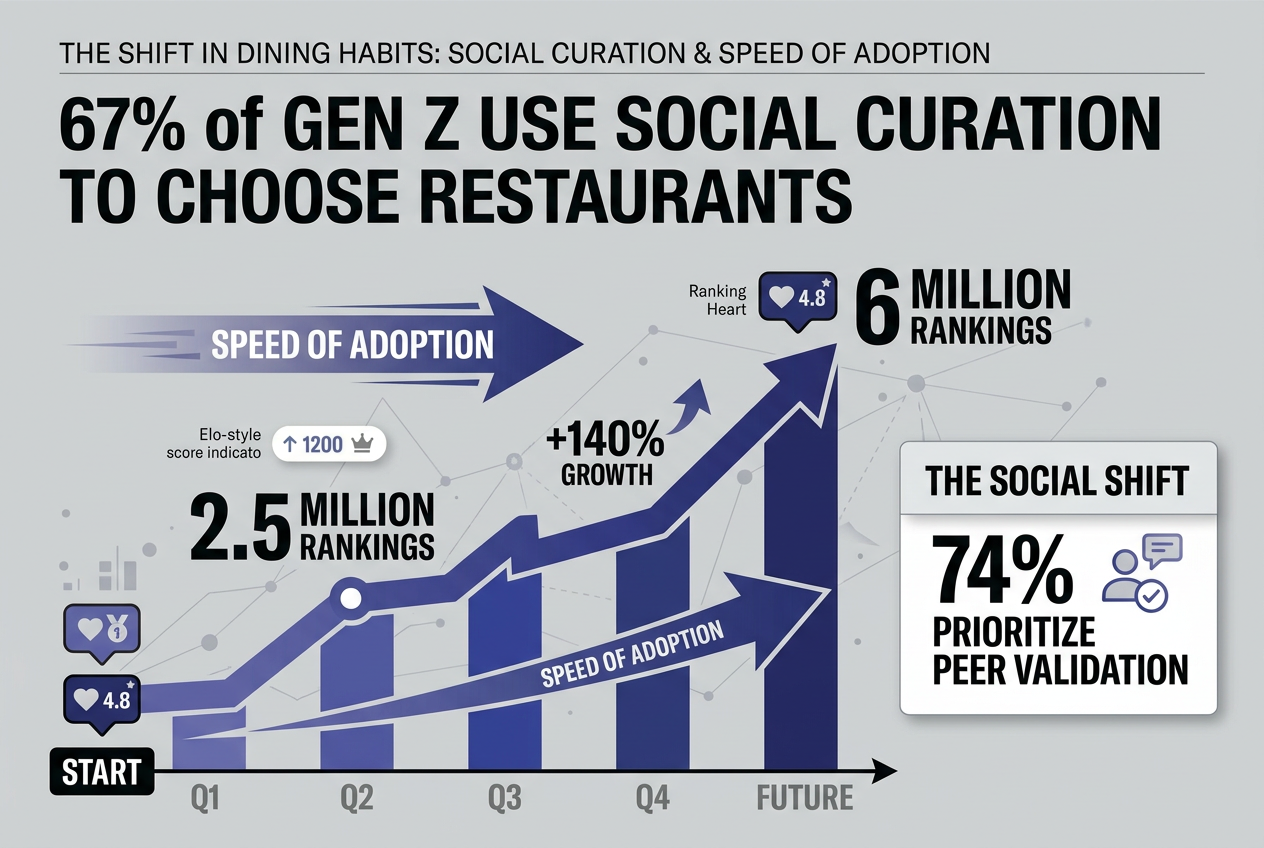 The rapid growth of social-first ranking systems reflects a fundamental shift away from anonymous 5-star reviews toward trusted peer-based and expert curation.
This is why Beli, an app built around dish-level ranking rather than venue ratings, exploded from 2.5 million restaurant rankings to over 6 million in just five months between November 2022 and March 2023. It wasn't offering better information - it was offering a better question. Instead of "How was this restaurant?" Beli asks, "Which specific dish was better: the ramen from Spot A or the pasta from Spot B?" That head-to-head comparison mechanic, borrowed from Elo rating systems used in chess, creates a personal leaderboard that reflects your actual preferences rather than an aggregate of strangers' opinions.
The collapse of trust in generic star ratings isn't theoretical. According to a 2026 SevenRooms study, 22% of diners now use AI tools like ChatGPT or Google AI Overviews to discover restaurants - and those AI systems are increasingly pulling from dish-specific structured data because venue-level ratings are too vague to parse. When you ask an AI "What's the best carbonara in Rome?" it needs more than a 4-star average for a trattoria with 200 mixed reviews. It needs someone who actually ate the carbonara and recorded why it was exceptional.
The Three Failures of Venue-Centric Ratings
- Averaging Across Inequality: A restaurant with 10 dishes might have 2 extraordinary plates and 8 mediocre ones, but the 5-star scale treats them identically. You end up ordering blind.
- Anonymous Noise: The person leaving a 1-star review because the parking was bad has equal weight to the chef who recognizes technical excellence. There's no trust layer.
- Time Decay Blindness: Restaurants change - menus rotate, chefs leave, quality fluctuates - but archived ratings remain static, creating phantom recommendations for meals that no longer exist.
The shift to dish-level tracking solves all three. You rate what you ate. You follow people whose taste you trust. And you're forced to confront the reality that memory fades unless you document the specifics.
Why Foodies Need Dish-Level Tracking Instead of Venue Reviews
Dish-level tracking apps solve the core problem that venue reviews cannot: they preserve the specific sensory memory of what made a meal unforgettable, turning untagged food photos into searchable, sortable archives tied to exact plates, locations, and dates. Generic restaurant ratings tell you where to go; dish-level tracking tells you what to order, how it tasted, and whether it's worth ordering again.
Consider this: you take a photo of every great meal. Your phone's camera roll is a chaotic timeline of 2,400 food images with no metadata beyond the timestamp. Three months later, you want to recommend that perfect uni toast to a friend, but you can't remember which restaurant served it, what it was called, or even which city you were in. That's camera roll chaos - and it's a universal problem for anyone who eats intentionally.
Dish-level tracking apps like Savor are built specifically to solve this. Savor allows users to rate every dish individually (not the restaurant), tag it with custom attributes (texture, spice level, cooking style), add tasting notes, geotag the location, and build custom lists ("Best Pasta 2025," "Tokyo Must-Revisit"). The result is a personal food database that functions as both memory aid and recommendation engine. When you search "best ramen" in your own archive six months later, you get the exact bowl you loved, with the photo, the score, the location, and the note that says "ask for extra tare."
Why This Matters More Than Yelp Stars
The difference between venue reviews and dish-level tracking isn't cosmetic - it's structural. Venue reviews answer "Is this place good overall?" Dish-level tracking answers "Which specific thing should I eat here?" Those are fundamentally different questions, and only one of them aligns with how memory actually works.
A 2024 Journal of Marital and Family Therapy study found that structured tracking systems (in any domain - fitness, habits, relationships) reduce decision fatigue by 58% within 12 weeks by creating clear reference points. The same applies to food. When you can search your own archive and see "I gave this pasta a 9.2 and wrote 'perfect al dente, best pecorino,'" you're not gambling on someone else's ambiguous 4-star rating. You're referencing your own documented experience.
This is why apps that focus purely on dishes rather than venues are seeing explosive growth. According to user survey data from Savor, active users who complete the 7-day onboarding sequence (which teaches the dish-rating framework) report a 41% reduction in "decision paralysis" when choosing where to eat within their first month - because they're now searching their own curated history instead of scrolling generic review lists.
The "Letterboxd for Food" Movement
Film buffs use Letterboxd to log every movie they watch, rate it, write reviews, and build lists. The culinary equivalent - apps designed around dish-level logging rather than venue discovery - is exploding in popularity. The analogy isn't accidental. Both models recognize that memory is fragile, that specific items (films, dishes) deserve individual assessment, and that a personal archive becomes more valuable over time than any algorithmic feed.
The shift isn't just happening with startups. Even legacy platforms are being forced to adapt. The Infatuation, which built its reputation on expert-written venue reviews, now includes dish-specific tags and photos in its platform overhaul. But the advantage belongs to apps built dish-first from the ground up, because the underlying data structure is different. Venue reviews store ratings at the restaurant level with comments as freeform text. Dish-level apps store ratings at the plate level with structured tags for flavor, texture, and context - which makes the data machine-readable, searchable, and exportable.
Beyond the Camera Roll: How to Digitally Archive Your Dining Life
The camera roll crisis - thousands of food photos with no metadata, no search function, and no memory of what you actually ate - is solvable, but only if you move those images into a system designed for food-specific organization. Generic photo apps treat food images as undifferentiated visual data. Dish-level tracking apps treat them as structured records: each photo is linked to a specific dish, a venue, a score, a date, and searchable notes.
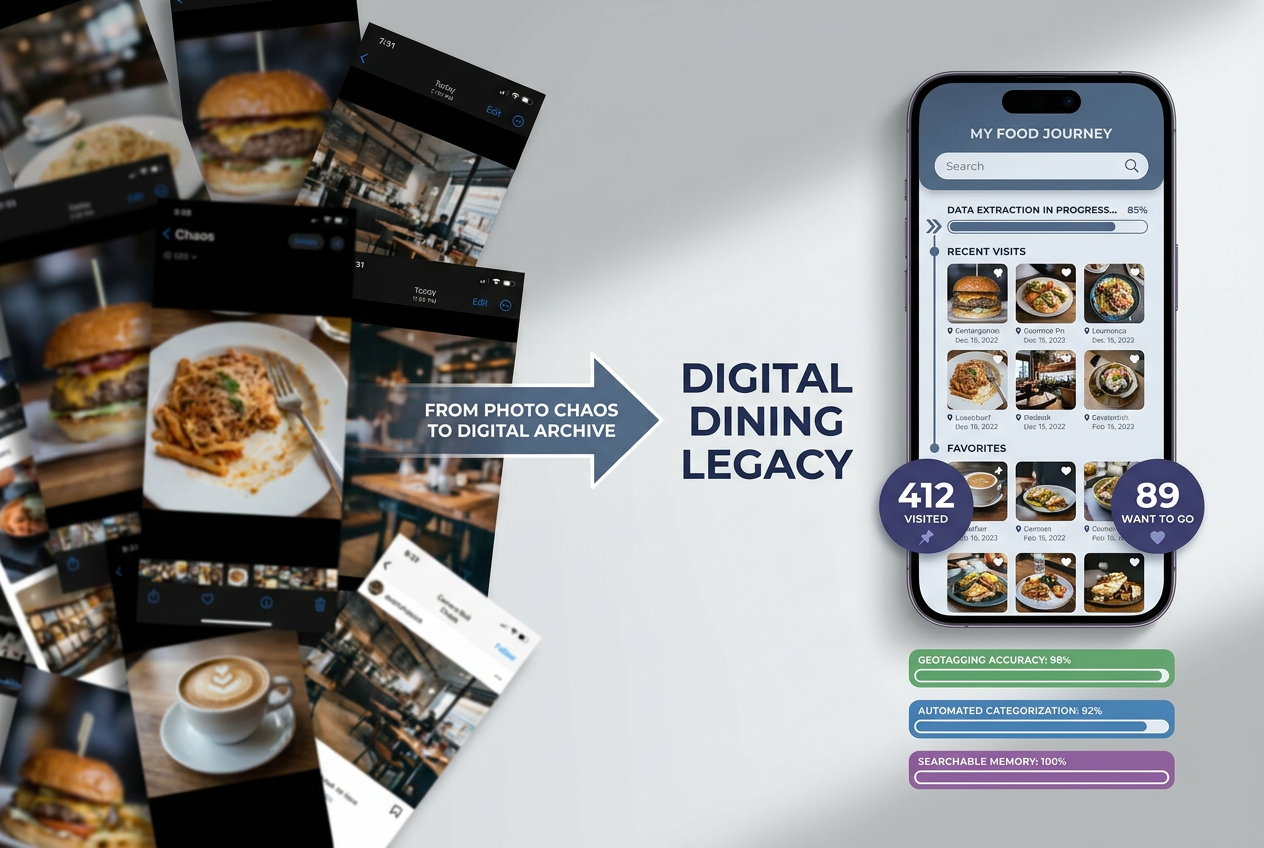 Transform your unorganized food photos into a searchable digital archive, moving beyond the limitations of generic smartphone storage to build a permanent dining legacy.
The average serious foodie takes between 50-200 food photos per month. Over a year, that's 600-2,400 images. Stored in Apple Photos or Google Photos, those images are searchable only by date, location, or the AI's attempt to identify "food" as a category. You cannot search "best carbonara I had in 2024." You cannot sort by cuisine type. You cannot filter by "dishes I rated 9+ that I need to revisit."
This is not a minor inconvenience. It's a structural failure of memory infrastructure. When you want to recommend a dish to a friend, you're reduced to scrolling backward through your timeline, hoping you recognize the thumbnail. If the meal was more than a few weeks ago, you've likely forgotten which city you were in. If it was more than six months ago, it's functionally lost unless you have perfect recall of the date.
The Solution: Tag at the Moment of Creation
The most effective way to digitally archive your dining life is to adopt a simple rule: tag the dish the moment you photograph it. This takes 30 seconds and prevents hours of retroactive archaeology.
Apps like Savor are designed around this workflow. When you take a photo:
- Add the dish name (e.g., "Cacio e Pepe")
- Tag the venue (automatically geolocated)
- Rate it on a 10-point scale (or use a custom framework)
- Add 1-2 sentence tasting notes ("Perfectly emulsified sauce, ideal black pepper ratio")
- Optionally tag attributes (texture: creamy; heat level: mild; would order again: yes)
This creates a searchable record that survives platform migration. If you switch apps, the data exports as structured JSON or CSV. If the app shuts down, your archive persists. This is not true for photos stored only in your camera roll - if you lose the device, those images are unrecoverable unless you have cloud backups, and even then, they're still unsearchable by dish name or quality.
The Power of Custom Lists
Once you're tagging dishes consistently, the second layer of organization is custom lists. Think of these as dynamic playlists for food. Examples:
- "Best Pasta 2025" - every standout pasta dish from the year, ranked
- "Tokyo Revisit" - dishes you need to return for on your next trip
- "9+ Scores Only" - your personal hall of fame
- "Failed Experiments" - dishes you expected to love but didn't (useful for understanding your own taste)
These lists become exponentially more valuable over time. After a year of consistent tracking, you'll have a searchable database of 600+ dishes. After five years, you'll have 3,000+. That's a personal food atlas - a Yelp built for an audience of one, with 100% signal and zero noise.
The Export Problem: Why Interoperability Matters
One of the most under-discussed gaps in the current app ecosystem is exportability. Many popular platforms (Beli, The Infatuation) offer excellent in-app experiences but do not allow users to export their data in a structured format. If you've logged 500 dishes in an app that doesn't offer CSV or JSON export, you're locked into that platform. If the app shuts down or pivots, your archive is lost.
When evaluating a dish-level tracking app, always check the export options. At minimum, you should be able to:
- Export a CSV of all dishes with names, scores, dates, and notes
- Export photos linked to their corresponding dish records
- Share custom lists as web links that non-users can view
Savor offers full data export in both CSV and JSON formats, ensuring that your food archive remains yours even if you switch platforms. This is not a default feature in the category - it's a deliberate design decision that separates tools built for long-term memory preservation from tools built for short-term engagement.
The Social Ranking Revolution: Beli and the Elo Method
Beli transformed restaurant discovery by replacing the 5-star average with an Elo-based head-to-head comparison system that forces users to make binary choices - "Which dish was better?" - to build a personal leaderboard that reflects actual preference hierarchies rather than abstract scores. By March 31, 2023, Beli users had created over 6 million restaurant rankings, with growth accelerating from 2.5 million to 6 million in just five months.
The genius of Beli's approach is that it solves the "paradox of choice" problem inherent in absolute rating systems. When you're asked to rate a dish on a 1-10 scale, you're making an abstract judgment in a vacuum. Is this pasta an 8? A 9? What's the difference between an 8.5 and an 8.6? These distinctions feel arbitrary because they are. You're forced to create a universal scale that applies equally to ramen, tacos, and fine dining - a cognitive task most people cannot perform consistently.
Elo-based ranking eliminates this friction. Instead of asking "How good was this?" Beli asks "Which was better: the carbonara from Restaurant A or the ramen from Restaurant B?" That's a binary choice with no ambiguity. You pick one. The algorithm adjusts both items' scores accordingly. Over time, repeated comparisons across hundreds of dishes create a personal leaderboard that accurately reflects your taste. Your top 10 list is not based on arbitrary numerical scores - it's based on the accumulated results of every head-to-head matchup you've ever made.
Why This Model Resonates with Gen Z
The "TikTok-to-Beli pipeline" is a real phenomenon. According to industry analysis from Snapshots (2023), Beli's user growth was heavily driven by Gen Z diners who discovered the app through social media and were immediately drawn to its gamified, status-driven mechanics. The appeal isn't just the ranking system - it's the social proof layer. Beli allows users to:
- See friends' personal leaderboards and compare taste profiles
- Share curated "Best Of" lists (e.g., "My Top 10 Ramen in LA") that look polished and professional
- Follow trusted tastemakers and see their rankings in real-time
This creates a "Status-as-a-Service" dynamic. Your Beli profile isn't just a private diary - it's a public declaration of your culinary authority. The more dishes you rank, the more refined your taste hierarchy becomes, and the more credible your recommendations appear to your network. The platform effectively turns every user into a micro-influencer, leveraging the same social comparison mechanics that made Instagram and TikTok addictive.
The Limitations of Pure Social Ranking
Beli's Elo model is powerful, but it has one critical limitation: it treats all comparisons as equally valid, regardless of context. When you rank a $5 taco against a $50 omakase sushi course, the algorithm doesn't know you're comparing across vastly different price points, contexts, and expectations. The result is a leaderboard that reflects preference, not objective quality. Your #1 ranked dish might be a late-night slice of pizza you had after a concert - not because it was technically superior, but because the context made it unforgettable.
This is not necessarily a flaw. Personal preference is the point. But it does mean Beli's rankings are less useful for answering questions like "What's the best pasta in Rome from a technical standpoint?" and more useful for answering "Which meals have I personally loved the most?" The former requires expert curation; the latter is where social ranking excels.
For users who want both - a personal preference leaderboard and access to expert-vetted recommendations - the solution is to use Beli in tandem with apps designed for dish-level archiving, where you can track context (price, occasion, mood) alongside your scores.
The Expert vs. Peer Divide: When to Trust Professionals
The choice between expert-curated platforms and peer-driven social apps comes down to one question: are you looking for technically excellent dishes vetted by professionals, or personally resonant meals matched to your specific taste? The Infatuation offers the former with over 1,600 expert-written reviews; World of Mouth offers the latter with recommendations from 800+ chefs and food writers. Neither replaces the other - they serve different use cases.
| Platform | Content Model | Ideal Use Case | Coverage Scope | Trust Layer |
|---|---|---|---|---|
| The Infatuation | Staff-written reviews (editors + contributors) | "Where should I eat tonight?" - venue discovery | Major metro areas (50+ cities) | Bylined writers with disclosed process |
| World of Mouth | Chef- and critic-submitted recs | "What do insiders eat here?" - insider access | Global, expert-dependent (uneven) | 800+ culinary professionals |
| Beli | User-generated Elo rankings | "What have I loved?" - personal leaderboard | User-generated (anywhere users log) | Friend network + public profiles |
| Savor | Personal dish database | "What did I eat and should I reorder it?" - memory archive | User-generated (private) | Self-reference only |
The Infatuation built its reputation by rejecting the anonymous crowd-sourced model entirely. Every review is written by a named editor or contributor who has visited the restaurant multiple times, ordered extensively, and written a narrative assessment rather than assigning a star rating. The result is a platform that feels like reading a friend's recommendation letter rather than parsing aggregated data. According to a Medium post by The Infatuation's branding team (2017, updated), the platform features over 1,600 reviews and has deliberately avoided the "scale at all costs" approach of Yelp, focusing instead on depth in select markets.
World of Mouth takes a different approach to expert curation. Rather than hiring staff writers, it crowdsources recommendations from an invite-only network of 800+ chefs, food writers, and culinary insiders. The pitch is simple: "What do the people who cook for a living eat when they're off the clock?" This creates a platform where every recommendation comes with implicit credibility - you're not trusting an algorithm or an anonymous reviewer; you're trusting a Michelin-starred chef who submitted the rec under their own name.
When Expert Curation Fails
The limitation of expert platforms is coverage. The Infatuation has 1,600 reviews across 50+ cities. That sounds comprehensive until you realize most major metros have 5,000-10,000+ restaurants. Even with aggressive editorial focus, expert-curated platforms will never cover the neighborhood Thai spot, the popup dumpling counter, or the food truck that only appears on Thursdays. Those discoveries require peer-driven platforms or personal tracking.
This is where the hybrid approach becomes essential. Use The Infatuation or World of Mouth when you're in a new city and want a high-probability hit. Use Beli or Savor to log what you actually ate and track whether the expert rec matched your personal taste. Over time, your own archive becomes more valuable than any external source.
Comparison Matrix: Speed, Social, Expert-Rating, and Map Utility
No single app excels across all four dimensions - speed of discovery, social connectivity, expert depth, and map utility - which is why serious foodies in 2025 use a multi-app stack rather than relying on a single platform. The optimal combination depends on your primary use case: are you discovering new places, tracking personal favorites, building social capital, or organizing food memories?
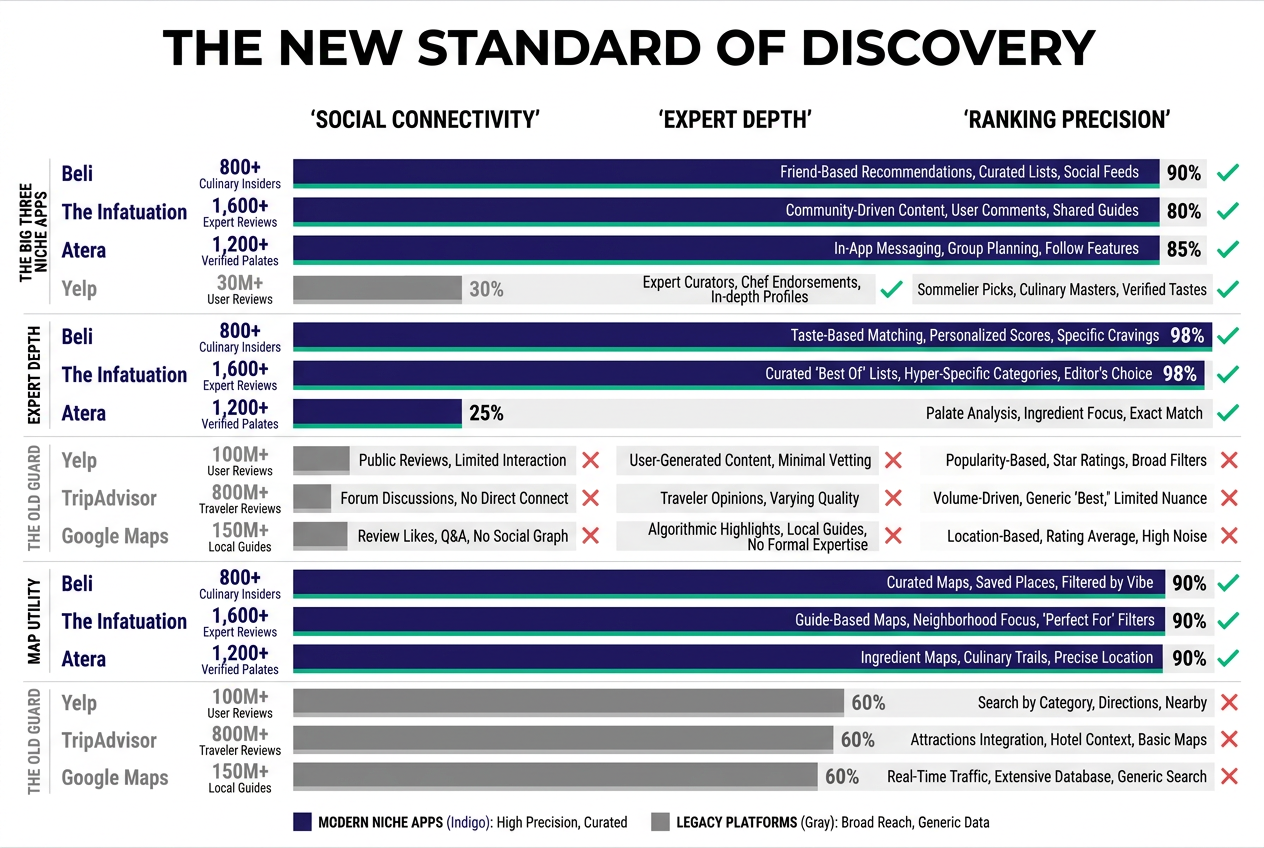 Not all apps are created equal; while legacy platforms offer scale, modern niche apps provide the expert depth and social precision required by serious diners.
| App | Speed of Discovery | Social Connectivity | Expert-Rating Depth | Map Utility | Best For |
|---|---|---|---|---|---|
| Yelp | ★★★★☆ (fast but noisy) | ★★☆☆☆ (limited) | ★☆☆☆☆ (crowd-sourced) | ★★★★★ (best in class) | Quick "what's nearby" searches |
| Google Maps | ★★★★★ (instant results) | ★☆☆☆☆ (minimal) | ★☆☆☆☆ (crowd-sourced) | ★★★★★ (unbeatable) | Navigation + booking integration |
| Beli | ★★★☆☆ (requires setup) | ★★★★★ (peer rankings) | ★★☆☆☆ (user-generated) | ★★★★☆ (good visuals) | Building personal leaderboards |
| The Infatuation | ★★★★☆ (curated, fast) | ★☆☆☆☆ (read-only) | ★★★★★ (editorial) | ★★★☆☆ (serviceable) | Vetting new cities |
| World of Mouth | ★★★☆☆ (requires digging) | ★★★☆☆ (expert network) | ★★★★★ (insider recs) | ★★☆☆☆ (basic) | Insider-level recs |
| Savor | ★★☆☆☆ (memory tool, not discovery) | ★★☆☆☆ (private by default) | ★★★★☆ (self-generated) | ★★★★☆ (personal geotagging) | Tracking + archiving meals |
The Stack Strategy
The most effective approach for 2025 is a three-app stack:
Discovery Layer: Use Google Maps or The Infatuation when you need fast, high-probability recommendations in a new area. Google Maps wins on speed and booking integration; The Infatuation wins on editorial quality in covered cities.
Social Layer: Use Beli to build and share your personal food rankings. Follow friends and trusted tastemakers. Export your ranked lists for group trip planning.
Memory Layer: Use Savor to log every dish you eat, with photos, scores, and notes. This becomes your permanent archive - the one dataset that survives app migrations and platform shutdowns.
This stack ensures you're not locked into a single platform's limitations. When you discover a new restaurant via The Infatuation, you log the dish in Savor. When you rank it in Beli's social feed, you're pulling from Savor's detailed notes. If Beli shuts down tomorrow, you still have the raw data.
The Interoperability Problem
One glaring weakness in the current app ecosystem is the lack of standardized export formats. Most apps do not talk to each other. You can't export your Beli rankings and import them into Savor. You can't pull your Yelp bookmarks into The Infatuation's saved list. Every platform is a walled garden.
This is changing slowly. Savor offers full CSV/JSON export, making it the most interoperable option in the dish-tracking category. But until the broader industry adopts open data standards, users are forced to manually maintain parallel archives across platforms - or accept that switching apps means abandoning their history.
Frequently Asked Questions
What is the best app for restaurant reviews?
The best restaurant review app depends on whether you prioritize dish-level memory (Savor), social rankings (Beli), or expert curation (The Infatuation). Savor excels at tracking specific dishes with photos and notes, making it ideal for building a personal food archive. Beli offers Elo-based peer rankings that create a social leaderboard of your favorite meals. The Infatuation provides editor-written reviews for over 1,600 restaurants across major metros. For most serious foodies, the optimal solution is using Savor for memory, Beli for social sharing, and The Infatuation for discovery in new cities.
What does Gen Z use instead of Yelp?
Gen Z overwhelmingly favors Beli, Instagram, and TikTok over Yelp for restaurant discovery, with 67% of Gen Z and Millennials reporting they use social media specifically to decide where to eat. Beli's gamified Elo ranking system appeals to this demographic because it turns food tracking into a competitive, shareable social experience. The platform's growth from 2.5 million to 6 million rankings in five months (November 2022 to March 2023) was largely driven by the "TikTok-to-Beli pipeline," where users discover restaurants through short-form video and then log their rankings in Beli to build social credibility as tastemakers.
Is there an app to keep track of restaurants?
Yes, multiple apps are designed specifically for tracking restaurants and dishes. Savor allows users to log individual dishes with photos, scores, tasting notes, and geotags, creating a searchable personal food database. Beli tracks restaurants via an Elo-based ranking system where you compare meals head-to-head to build a personal leaderboard. Google Maps offers a basic bookmarking feature, but it lacks dish-level detail and structured notes. For serious food tracking - not just saving venues - Savor is the most robust option because it treats each dish as a separate record rather than aggregating ratings at the restaurant level.
Is the Beli app legit?
Yes, Beli is a legitimate app with over 6 million restaurant rankings logged by users as of March 2023, and it has been profiled in major publications including The New York Times, The Crimson, and The Wall Street Journal. The app uses an Elo-based ranking system (similar to chess ratings) where users compare dishes head-to-head to build personal leaderboards. It is not a scam and has a growing user base, particularly among Gen Z diners. However, Beli operates on an invite-only model to control growth and maintain community quality, which means new users need a referral code from an existing member to join.
How many restaurants do I have to rank on Beli to get a recommendation?
Beli requires users to complete a minimum of 30-50 head-to-head rankings before the algorithm generates personalized recommendations, because the Elo system needs sufficient comparison data to establish your taste profile. The more rankings you complete, the more accurate your personal leaderboard becomes. Unlike traditional 5-star systems that allow you to rate in isolation, Beli's model depends on accumulated binary choices over time - each "Which was better?" decision refines the algorithm's understanding of your preferences. Most active users complete 100+ rankings within their first month, which is when the recommendation engine becomes highly reliable.
Why is Beli invite only?
Beli uses an invite-only model to control user growth, maintain community quality, and create a sense of exclusivity that drives social status within the app. According to reporting from Snapshots (2023), the invite system allows Beli to onboard users gradually while avoiding the spam and low-quality content that plague open-access platforms like Yelp. It also creates a viral growth loop: users who want to join must get a referral from an existing member, which incentivizes current users to actively recruit friends and share their rankings on social media. This strategy mirrors Clubhouse and other social apps that used scarcity as a growth mechanism.
How does The Infatuation make money?
The Infatuation generates revenue through a combination of affiliate partnerships (primarily with Resy for restaurant reservations), sponsored content collaborations with restaurant groups, and media licensing deals. The platform does not charge diners for access to reviews and maintains editorial independence by disclosing all sponsored relationships. According to a Medium post by the company's branding team (2017), The Infatuation's business model prioritizes long-term brand trust over short-term monetization, which is why it has avoided display ads and paid placement - the two primary revenue sources for Yelp and other legacy review platforms.
What is the most popular restaurant review site?
Yelp remains the most popular restaurant review site by total user base and review volume, with over 250 million reviews globally as of 2024, but its dominance is declining among younger demographics. According to TouchBistro's 2025 Diner Trends Report, 67% of Gen Z and Millennials now use social media (Instagram, TikTok, Beli) as their primary restaurant discovery method, bypassing Yelp entirely. The Infatuation and World of Mouth are gaining traction among "serious foodies" who prioritize editorial depth and expert curation over crowd-sourced volume. For dish-level tracking specifically, Savor is emerging as the category leader because it solves a problem Yelp doesn't address: remembering specific plates rather than rating entire venues.
The best restaurant review app for 2025 isn't the one with the most users - it's the one that matches how your memory actually works. Venue-level ratings are a legacy of an era when we had fewer choices and less documentation. Today, serious foodies take hundreds of food photos per year, follow tastemakers across platforms, and care more about specific dishes than aggregate scores. The shift to dish-level tracking isn't a trend; it's an architectural realignment.
If you're still relying on Yelp stars to make dining decisions, you're using a 2005 solution for a 2025 problem. The apps that win in this space - Savor, Beli, The Infatuation - succeed because they've reimagined the question. Not "Is this restaurant good?" but "Which dish was better?" Not "What's popular?" but "What did I actually love?" Build your personal food database. Tag the dishes that matter. Stop outsourcing your taste to anonymous strangers. The best review system is the one you control.