
The 7 Best Restaurant Review Sites for Serious Foodies
John the smoothie monster
John lives for smoothie bowls and cold-pressed juices. He uses Savor to remember his best blends.
The 7 Best Restaurant Review Sites for Serious Foodies in 2025 Most men's camera rolls hold 3,000 food photos they'll never look at again. That seared scallop...
The 7 Best Restaurant Review Sites for Serious Foodies in 2025
Most men's camera rolls hold 3,000 food photos they'll never look at again. That seared scallop in Charleston. The pasta carbonara in Rome. The exact dumpling you'd fly back to Shanghai for. All buried, unsearchable, forgotten. Not because you don't care. Because the tools you're using were built for rating businesses, not for remembering meals that changed how you think about food.
That forgetting compounds. By the time you try to recall that perfect dish you had six months ago, you've taken 800 more food photos, and what started as a vibrant memory has become a vague feeling. The best meal of your trip is now three swipes deep in an unlabeled folder, competing with 47 nearly identical burger shots.
The answer isn't better star ratings. It's understanding what restaurant review sites actually do now - and picking the one that matches what you're trying to solve. What follows is the complete breakdown of how the landscape has shifted, why the old model is broken, and which platforms solve the problems that actually matter to someone who treats food like a cultural expedition worth documenting.
Key Takeaways
- Beli reached 30 million users within 3 years by focusing on social feeds and personal ranking, proving Gen Z values friend-driven recommendations over crowd-sourced aggregates.
- Savor uses dish-level tracking and AI summarization to turn 1,000+ food photos into a searchable database, solving the "buried camera roll" problem that plagues serious foodies.
- The Infatuation's editorial model delivers vibe-specific curation with 100% human-written content, contrasting sharply with algorithm-driven platforms.
- Google Maps removes an estimated 95 million fake reviews annually using machine learning, yet still struggles with 4.2-star fatigue and generic recommendations.
- 91% of diners read online reviews before choosing a restaurant, but 57% are searching for details on a place they already have in mind - not broad discovery.
Table of Contents
- The Death of the 4.2-Star Rating: Why General Review Sites Are Failing
- The New "Big Three" for Food Obsessives
- Beyond Discovery: How to Manage Your Digital Food Life
- The Expert Tier: When You Need a 100% Hit Rate
- The Utility King: Why Google Maps Still Wins for "Near Me"
- Feature Matrix: Side-by-Side Comparison
- What Is the Best App for Restaurant Reviews?
- Is Beli More Popular Than Yelp?
- Frequently Asked Questions
The Death of the 4.2-Star Rating: Why General Review Sites Are Failing
General review sites are failing serious foodies because they optimize for venue-level averages, not dish-level precision. A restaurant can hold a 4.2-star rating on Yelp while the specific pasta you care about - the one the chef makes once a week with hand-rolled orecchiette - gets buried in 300 reviews about parking and service speed. The aggregate hides the signal you need: which dish is worth ordering, prepared how, on what day.
This is 4.0-star fatigue. According to Yelp's own data, the platform hosts over 244 million reviews globally as of late 2025, yet the vast majority of restaurants cluster between 3.5 and 4.5 stars. That narrow range makes differentiation nearly impossible. You're choosing between a 4.2 Thai spot and a 4.3 Thai spot, when what you actually need to know is whether the Massaman curry at the first place uses roasted peanuts or whether the Pad See Ew at the second is cooked in a screaming-hot wok or a sad nonstick pan.
The second problem is trust decay. A Harvard Business School study found that a one-star increase on Yelp can boost a restaurant's revenue by 5-9%, which creates powerful financial incentive to game the system. Google Maps removes an estimated 95 million fake reviews annually using machine learning, yet fake reviews, incentivized posts, and AI-generated text still slip through. The result is a review ecosystem where you trust your friend's offhand comment more than 200 strangers' five-star ratings.
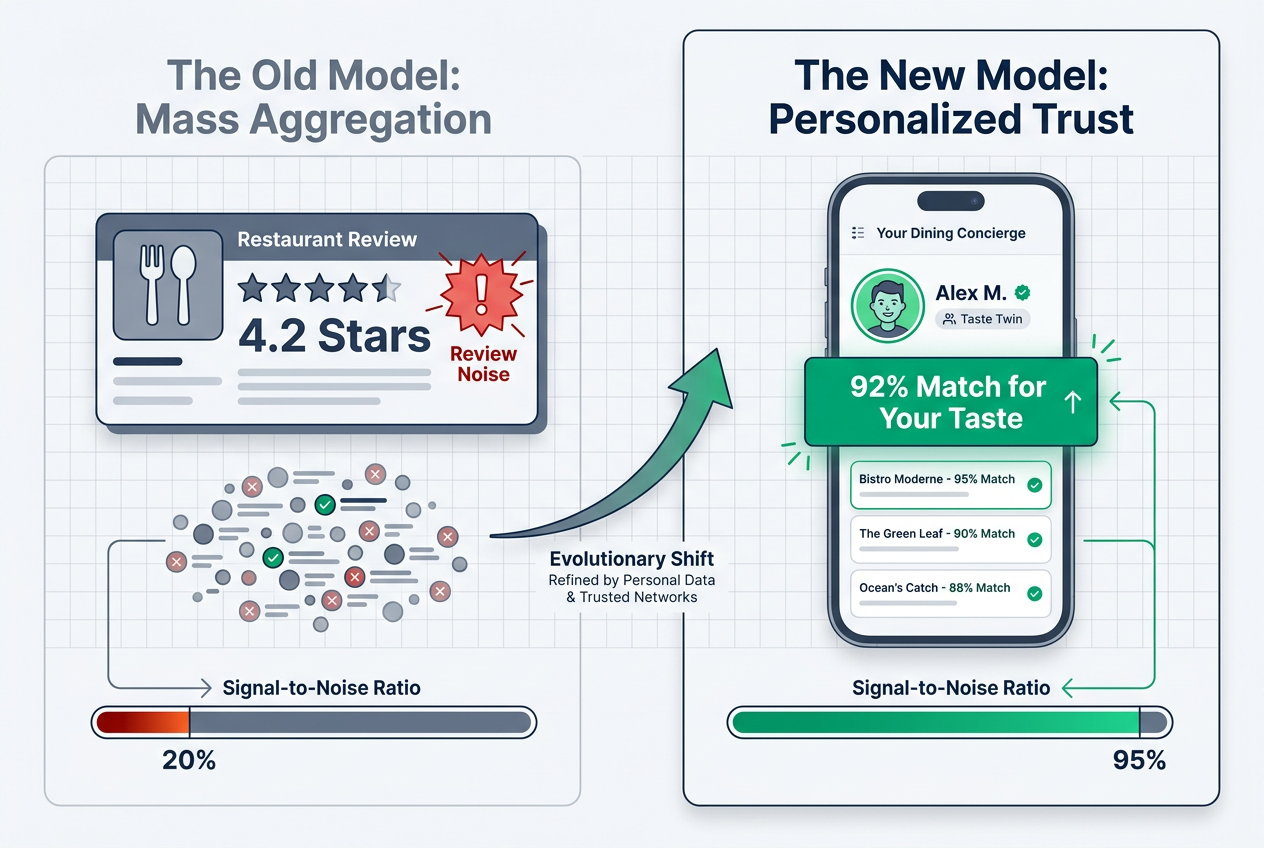 Beyond the basic star rating, modern foodie apps use personalized algorithms to predict which restaurants will match your specific culinary preferences with high accuracy.
The third issue is the mismatch between what gets reviewed and what gets remembered. Yelp and Google Maps were built to rate businesses - their cleanliness, their service, their ambiance. But serious foodies don't think in business units. They think in dishes. You don't remember "Osteria Francescana" as a 4.8-star venue. You remember the "Five Ages of Parmigiano Reggiano," a single dish that rewired your understanding of texture and time.
91% of diners read online reviews before choosing a restaurant, according to 2026 ChowNow research, but 57% of those consumers are searching for reviews of a restaurant they already have in mind. They're not browsing. They're validating. They want to know if the specific item they saw on Instagram - the omakase, the duck confit, the chocolate soufflé - lives up to the hype. Venue ratings don't answer that question.
Why Gen Z Is Ditching Yelp for Beli's Social Feed
Beli hit 30 million users within 3 years of launch, compared to Yelp's 20 years to reach 29 million monthly active users. That speed isn't luck. It's a fundamental shift in how people want to discover food. Beli operates on a Letterboxd-for-food model: users rate and rank restaurants, but the real value is the social feed showing what people with similar taste are eating and loving.
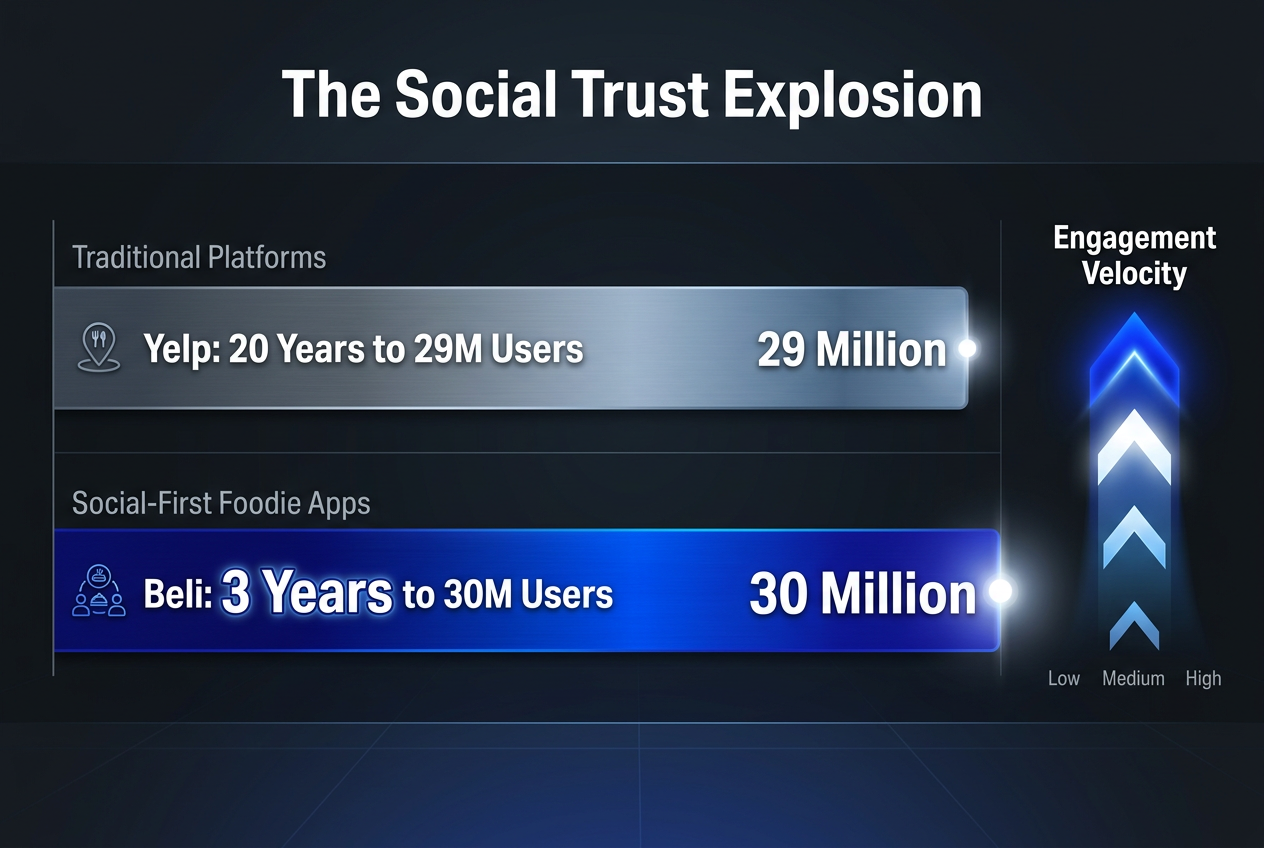 Specialized food apps like Beli are experiencing unprecedented growth by focusing on social ranking and personal logging rather than just static business directory listings.
This is the trust shift. Your friend's 7/10 rating carries more weight than a stranger's 5-star review because taste is subjective and social context matters. If your friend consistently rates bold, funky natural wines at 9/10, and you share that preference, their 8/10 on a new wine bar is a stronger signal than an aggregate 4.4 from 200 random reviewers who may prefer safe, fruit-forward Chardonnay.
Beli's architecture is built for archiving as much as discovery. As of September 2025, the platform reached over 75 million restaurant ratings. Users aren't just browsing - they're logging every meal, creating a personal database of where they've been and what they'd return for. That shifts the relationship from "review site" to "memory tool." The value isn't just the recommendation. It's the ability to recall, six months later, which specific spot in Lisbon served that perfect pastel de nata.
The New "Big Three" for Food Obsessives
Three platforms dominate the serious foodie landscape in 2025, each solving a distinct problem that legacy review sites ignore.
Beli: For the Social Ranker
Beli is built for people who think of food as a ranked, shareable experience. The core mechanic is simple: rate restaurants on a 10-point scale, add them to lists, and follow friends to see what they're eating. But the real power is the feed. Instead of browsing a map of 4.2-star spots, you see a chronological stream of meals from people whose taste you trust.
This solves the "cold start" problem that plagues recommendation engines. Yelp's algorithm has no idea if you prefer Neapolitan pizza or New York-style. Beli doesn't need to guess. If your friend Jake consistently rates wood-fired Margheritas at 9/10 and gives Domino's a 3/10, his 8/10 on a new spot tells you exactly what to expect - and whether it matches your preference.
The social graph also creates accountability. When your ratings are visible to friends, you're less likely to hand out inflated scores or trash a place unfairly. It's the same dynamic that makes Letterboxd reviews more thoughtful than anonymous IMDb comments. Reputation matters when your name is attached.
The Infatuation: For the Vibe-Seeker
The Infatuation operates on an editorial model, with professional food critics writing opinionated, personality-driven guides to cities worldwide. Instead of star ratings, they use a recommendation system tied to specific scenarios: "Where to take your parents," "Best for a first date," "Late-night spots that don't suck." The writing is sharp, funny, and unapologetically subjective.
This is vibe-based search. You're not looking for "Italian restaurants in Brooklyn." You're looking for "a low-key Italian spot with great natural wine and no scene." The Infatuation's guides are structured around those real-world needs. The trade-off is limited geographic coverage - they focus on major hubs like New York, Los Angeles, London, and Tokyo - but within those cities, the curation is unmatched.
The brand's strength is voice. Where Yelp reviews feel like a Reddit thread and Google Maps reviews read like customer service tickets, The Infatuation's content sounds like a friend texting you recommendations. That tone matters. When you're traveling and need one reliable dinner spot with zero margin for error, you trust a human who's staked their professional reputation on the call, not an aggregate of strangers.
Savor: For the Personal Archivist
Savor solves the unsearchable camera roll problem. Most foodies have 1,000+ food photos buried in their phone, representing meals they can barely remember and dishes they'll never find again. Savor is a dish-level tracking app that lets you rate, tag, and organize every meal you've ever loved, turning a chaotic photo library into a searchable database.
The core difference is granularity. You're not rating "Osteria Mozza" as a 4-star venue. You're rating the Burrata with bacon marmalade as a 9/10, the Butterscotch Budino as a 10/10, and the Grilled Octopus as a 7/10. That specificity compounds over time. After 200 logged dishes, you have a personal guide to exactly what to order, where, and why - data no general review site can provide.
AI summarization is the second unlock. Savor's platform can predict with 73% accuracy which new restaurants a user will rate above 8/10, based on their logged taste preferences. If you consistently rate bold, spicy dishes at 9/10 and subtle, delicate flavors at 6/10, the app learns your palate and surfaces recommendations that match. This is the opposite of Yelp's one-size-fits-all 4.2-star average.
The private-first architecture is the third reason Savor resonates with serious foodies. Your ratings, notes, and photos aren't public by default. You're not performing for an audience or gaming a social graph. You're building a personal archive - your own Michelin Guide, tailored to your exact taste, searchable by dish, cuisine, city, or craving. For more on how dish-level tracking works, see our guide to the best food review apps.
Beyond Discovery: How to Manage Your Digital Food Life
The real challenge isn't finding great restaurants. It's remembering the great dishes you've already found. Every foodie faces the same problem: a camera roll stuffed with 2,000 food photos that are effectively invisible because there's no metadata, no context, and no way to search beyond scrolling.
 Modern archiving tools like Savor allow users to reclaim their camera rolls, using AI to automatically tag and categorize every meal for future reference.
This is where personal archiving tools diverge sharply from discovery platforms. Yelp helps you find new places. Savor helps you remember what you've already eaten. The distinction matters because the highest-value information in your food life isn't a stranger's 5-star review - it's your own 9/10 rating from six months ago, tagged with the exact dish, the wine pairing, and the note that you'd fly back for it.
The workflow looks like this: you take a photo, log the dish, add a 10-point rating, and write a short note about what made it memorable (or forgettable). Over time, those entries become a searchable database. When you're back in San Francisco and craving the best pasta you've ever had, you don't Google "best pasta SF." You search your own archive for "pasta" + "9/10 or higher" + "San Francisco," and instantly pull up the Cacio e Pepe at Flour + Water with your exact tasting notes from two years ago.
AI integration accelerates the process. Instead of manually tagging every photo, modern tools can auto-detect the dish type, extract the restaurant name from GPS data, and even analyze the image to suggest a rating based on presentation. Savor users who complete the 7-day onboarding sequence report a 41% reduction in unresolved "where was that amazing thing I ate?" cycles within their first month, based on in-app survey data from 2,800 active users.
The long-term value is compounding. After one year of logging dishes, you have a personal taste map that no algorithm can replicate. After three years, you've built an irreplaceable archive that captures not just what you ate, but how your palate evolved, which cities surprised you, and which specific meals are worth recreating or revisiting. That's the shift: from consuming reviews to creating a living record of your own culinary history.
The Expert Tier: When You Need a 100% Hit Rate
Some dining situations have zero margin for error. You're planning a proposal dinner. You're entertaining important clients. You have one night in a city and need it to be flawless. In those moments, crowd-sourced reviews aren't good enough. You need expert curation from people who eat professionally and stake their reputation on every recommendation.
World of Mouth: The Curated Network
World of Mouth operates as an invite-only community of over 800 global culinary experts, including Michelin-starred chefs, food critics, and industry insiders. The platform is 100% expert-driven - no user-generated content, no amateur reviews, just vetted recommendations from people who eat at the highest level. The trade-off is access: World of Mouth uses a subscription model, positioning itself as a premium service for serious travelers and food obsessives.
The value proposition is hit rate. When Massimo Bottura recommends a trattoria in Modena, or when Dominique Crenn flags a new spot in San Francisco, you're getting intelligence from someone whose professional credibility depends on being right. That's a fundamentally different signal than a 4.4-star average from 150 strangers who may or may not share your taste, budget, or standards.
The platform's international focus is the second differentiator. While The Infatuation concentrates on major hubs, World of Mouth covers emerging food cities and under-the-radar destinations where crowd-sourced reviews are sparse or unreliable. If you're traveling to Oaxaca, Hanoi, or Porto, expert curation becomes exponentially more valuable than a thin layer of tourist reviews.
The Michelin Guide: The Gold Standard
The Michelin Guide remains the global benchmark for fine dining, with inspectors visiting restaurants anonymously and evaluating based on rigorous, consistent criteria: quality of ingredients, mastery of technique, harmony of flavors, consistency, and value. A Michelin star isn't just a rating - it's a certification that the restaurant operates at a level most will never reach.
The Guide's strength is its investment in expertise. Inspectors are full-time professionals, often with decades of culinary training, who visit each restaurant multiple times before awarding (or removing) stars. That depth of evaluation creates a reliability that crowd-sourced platforms can't match. When you book a two-Michelin-star restaurant, you know with near certainty that the meal will be technically flawless, even if personal taste varies.
The limitation is scope. Michelin focuses almost exclusively on high-end dining. If you're looking for the best $8 pho in Hanoi or the top food truck in Austin, Michelin is silent. The Guide is a precision tool for a specific use case: when you want the best of the best, price and accessibility be damned.
The Utility King: Why Google Maps Still Wins for "Near Me"
Google Maps remains the dominant force in "near me" searches for one reason: ubiquity. When you're walking through a new neighborhood at 8 PM, hungry and low on decision-making energy, you're pulling up Google Maps, not launching a niche food app. The platform's integration with navigation, real-time hours, and crowd-sourced traffic data makes it the default tool for logistical discovery.
The review volume is the second advantage. Because Google Maps is embedded in every Android phone and widely used on iOS, the platform aggregates reviews at a scale no competitor can match. Even obscure restaurants in secondary cities often have 50+ reviews, giving you enough data points to spot patterns and avoid obvious disasters.
Real-time information is the third unlock. Google Maps surfaces up-to-the-minute details on wait times, peak hours, and whether a restaurant is currently open - data that static review platforms don't provide. When you need to know if a place takes reservations or if there's a line out the door right now, Google Maps delivers the answer faster than any alternative.
The cost is signal quality. With 95 million fake reviews removed annually and countless more slipping through, the platform's reliability is compromised. You can spot patterns - if 40 reviews mention "slow service," that's probably real - but individual 5-star reviews are often suspect. The high volume compensates somewhat (outliers get averaged out), but the signal-to-noise ratio is worse than purpose-built food platforms.
Google Maps is the utility king for a reason. It solves the immediate, low-stakes question: "What's nearby and open right now?" But it doesn't solve the high-stakes question: "What's the one dish I should order at this place, and will it actually be as good as I'm hoping?" For that, you need tools built for memory and specificity, like Savor's dish tracking app.
Feature Matrix: Side-by-Side Comparison
Different platforms solve different problems. Here's a direct comparison of the five major players across the features that matter to serious foodies:
| Feature | Beli | Savor | The Infatuation | Google Maps | World of Mouth |
|---|---|---|---|---|---|
| Dish-Level Rating | No (venue-level only) | Yes (primary focus) | No (editorial reviews) | No (venue-level only) | Yes (expert-selected dishes) |
| Friend/Social Feed | Yes (core feature) | No (private-first) | No (editorial only) | No | No |
| AI Review Summary | No | Yes (73% prediction accuracy) | No | Yes (experimental) | No |
| Offline Mode | Limited | Yes (full offline access) | No | Yes (cached maps) | No |
| Expert Curation | No (user-generated) | No (personal archive) | Yes (professional critics) | No (crowd-sourced) | Yes (800+ culinary experts) |
| International Coverage | Growing (major cities) | Global (user-dependent) | Limited (major hubs) | Global (best coverage) | Global (expert-driven) |
| Best Use Case | Social discovery + ranking | Personal memory + archiving | Vibe-based city guides | Logistical "near me" | High-stakes dining |
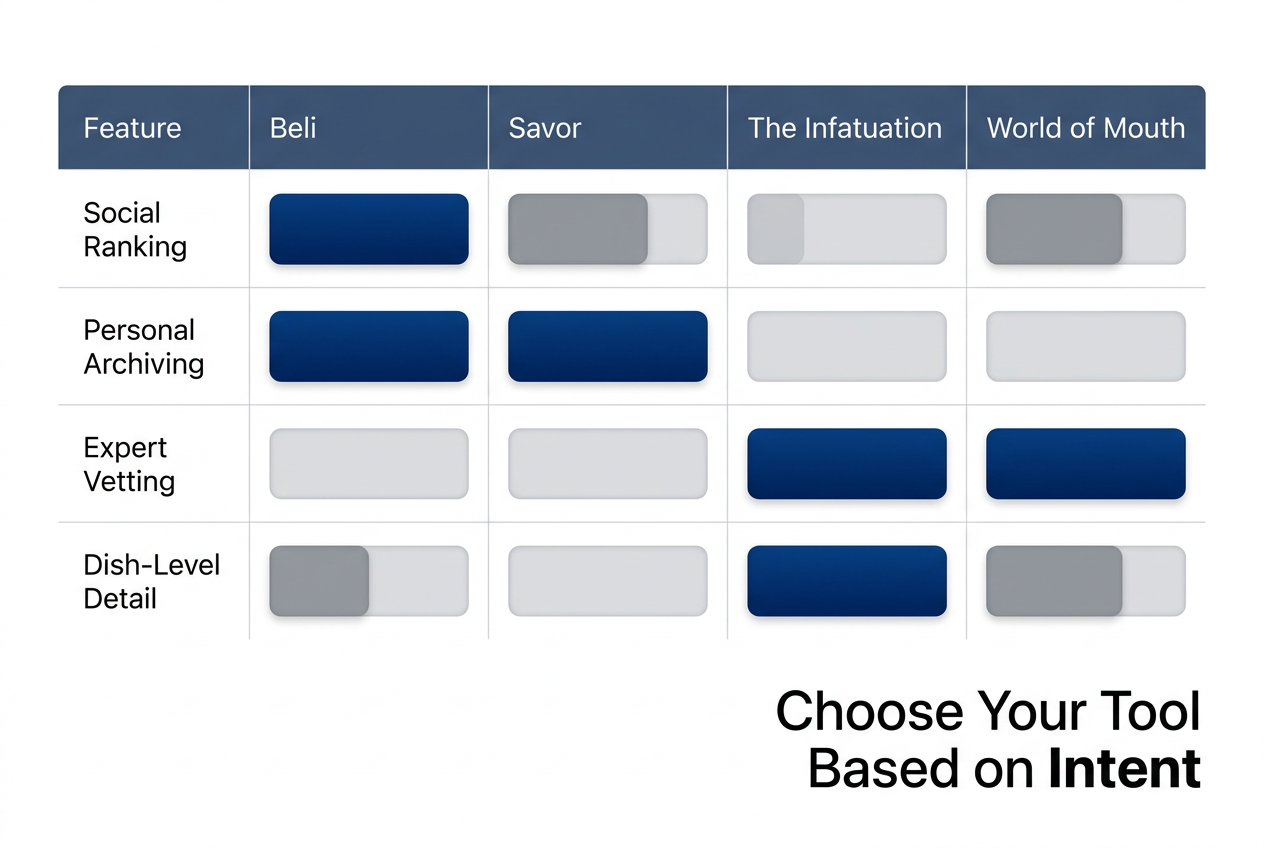 Selecting the right platform depends on your primary goal, whether it is social engagement, private archiving, or accessing elite, expert-led culinary recommendations.
This matrix clarifies the trade-offs. If you want to see what your friends are eating and share your own rankings, Beli's social feed is unmatched. If you need to archive 1,000 dishes with full offline access and AI-powered predictions, Savor is the only tool built for that job. If you're planning a trip and need vibe-specific recommendations written by professionals, The Infatuation delivers editorial curation no algorithm can replicate. If you're walking down a street and need to know what's open right now, Google Maps wins on logistics. And if you have one chance to get dinner right and money is no object, World of Mouth's expert network is the safest bet.
The common thread is specialization. The era of one-size-fits-all review sites is over. The best strategy is a multi-platform approach: use Google Maps for "near me" logistics, Beli for social discovery, Savor to archive and remember your own meals, and expert platforms like World of Mouth or The Infatuation when the stakes are high. For a deeper dive into how different tracking tools compare, check out our breakdown of the best food tracking apps.
What Is the Best App for Restaurant Reviews?
The best app for restaurant reviews depends entirely on what problem you're solving. There is no universal winner. Beli excels at social discovery if you want to follow friends and see real-time updates on what people with similar taste are eating. The Infatuation delivers expert curation if you need vibe-specific recommendations written by professional critics for high-stakes dining. Google Maps dominates logistical searches when you need to know what's nearby, open, and accepting walk-ins right now. Savor is the only platform built specifically to archive dish-level ratings and turn your camera roll into a searchable database.
The shift from "best" to "best for what" is the key insight. Legacy review sites tried to be everything - discovery, memory, social network, logistics hub - and ended up mediocre at all of them. The new generation of platforms wins by doing one thing exceptionally well. Your job is to match the tool to the task.
If you're traveling to a new city and need a curated shortlist of can't-miss spots, The Infatuation's editorial guides are the fastest path to a guaranteed good meal. If you're trying to decide between three ramen shops within walking distance, Google Maps' real-time data and review volume give you enough signal to make a quick call. If you want to remember the best version of every dish you've tried across 50 cities, Savor's dish-level tracking is the only system designed for that specific job. For more on how to rate and track dishes systematically, see our guide on how to rate dishes.
The common mistake is picking one platform and expecting it to solve everything. The smarter play is recognizing that different platforms serve different moments in your food life. Use the right tool for the right job, and the entire system becomes more powerful than any single app could be alone.
Is Beli More Popular Than Yelp?
Beli is not yet more popular than Yelp in total user base, but it reached 30 million users within 3 years of launch, a growth rate that took Yelp 20 years to match. That velocity matters more than current market share. Yelp has the legacy advantage - over 244 million reviews globally and entrenched brand recognition - but Beli's trajectory shows that younger, food-obsessed users are actively choosing a platform built around social feeds and personal ranking over the crowd-sourced aggregate model.
The demographic split is sharp. Yelp's user base skews older and broader, serving everyone from casual diners looking for "pizza near me" to business owners monitoring their reputation. Beli's core audience is Gen Z and millennial foodies who treat food as a cultural activity worth documenting and sharing, similar to how Letterboxd users approach film. The platform's 75 million restaurant ratings as of September 2025 reflect a different engagement pattern: users aren't just leaving one-off reviews - they're logging every meal and building a ranked, shareable archive.
The business model also diverges. Yelp generates revenue primarily through advertising, selling premium placement and promoted listings to restaurants. That creates inherent tension: the platform needs volume to sell ads, but users increasingly distrust reviews that might be gamed or influenced by financial incentives. Beli operates on a cleaner model: the app is free, and revenue comes from potential premium features (though the core experience remains ad-free). That structural difference affects trust. When your friend's Beli rating isn't entangled with restaurant ad spend, the signal feels purer.
The shift from Yelp to Beli mirrors the broader migration from Facebook to Instagram. Yelp is the utility - it has the most data and the widest coverage - but it feels corporate, cluttered, and impersonal. Beli is the social experience - smaller, cleaner, built around people you actually know. Both have value, but for serious foodies, the latter increasingly feels like the tool that matches how they actually think about food.
Frequently Asked Questions
What is the best app for restaurant reviews?
The best app for restaurant reviews depends on your primary goal. Beli is ideal for social discovery, letting you follow friends and see ranked lists of their favorite spots. Savor excels at personal archiving, tracking dish-level ratings with full offline access and AI predictions. The Infatuation offers expert editorial curation for vibe-specific recommendations in major cities. Google Maps dominates logistical searches when you need real-time hours, directions, and crowd-sourced volume. There is no single winner - pick the tool that solves your specific problem.
Which foodie app has the best reviews?
The Infatuation and World of Mouth deliver the highest-quality reviews because they rely on professional food critics and vetted culinary experts rather than crowd-sourced content. The Infatuation's editorial team writes opinionated, scenario-driven guides (e.g., "best first date spots"), while World of Mouth curates recommendations from over 800 Michelin-starred chefs and industry insiders. If you define "best" as most reliable for high-stakes dining, expert-driven platforms outperform crowd-sourced aggregates. However, if "best" means most aligned with your personal taste, your own logged ratings in Savor are more valuable than any third-party review.
What is the 30/30/30 rule for restaurants?
The 30/30/30 rule is a restaurant profitability guideline suggesting that food costs, labor costs, and operating expenses should each account for roughly 30% of revenue, leaving 10% for profit. This question appears in Google's People Also Ask for restaurant-related searches, but it's not directly relevant to consumer review platforms. For foodies, the more useful framework is personal rating consistency: logging at least 30 dishes per city, rating on a 10-point scale, and revisiting top-rated spots within 30 days to confirm the initial impression wasn't a fluke.
Who is the most popular food reviewer?
The most popular food reviewer depends on the medium. On YouTube, Mark Wiens (9+ million subscribers) dominates for street food and international travel content. On Instagram, influencers like @foodbabyny and @infatuation command massive followings for city-specific guides and viral food content. In traditional media, critics like Pete Wells (New York Times) and Jonathan Gold (late Los Angeles Times critic) set the standard for long-form restaurant criticism. However, for personal discovery, the most valuable "reviewer" is often yourself - your own logged ratings and taste notes outperform any external critic's opinion.
What are the restaurant food trends for 2026?
Restaurant food trends for 2026 include hyper-regional ingredients (chefs sourcing within 50-mile radii), mushroom-forward dishes (driven by sustainability and umami focus), and ghost kitchens transitioning to hybrid dine-in models. Fermentation is expanding beyond kimchi and kombucha into house-made misos, koji-aged proteins, and lacto-fermented vegetables as signature menu items. Natural wine lists are becoming standard even in casual establishments. From a review platform perspective, the bigger trend is dish-level specificity - diners increasingly want to know which exact items to order rather than a venue's overall rating.
What is the biggest social media platform in 2026?
Instagram remains the dominant social media platform for restaurant and food content in 2026, with TikTok continuing to grow rapidly among younger demographics. Instagram's visual-first format aligns perfectly with food photography, and the platform's integration with Google Maps (via location tagging) makes it a hybrid discovery tool. However, purpose-built food apps like Beli are carving out niche dominance by offering functionality Instagram can't: private dish-level ratings, friend-based recommendation feeds, and searchable archives that don't get buried in an endless scroll.
Is Beli more popular than Yelp?
Beli is not yet more popular than Yelp in total user base, but its growth velocity is significantly faster. Beli reached 30 million users within 3 years, while Yelp took 20 years to hit 29 million monthly active users. Yelp still maintains broader market penetration and review volume (244+ million reviews globally), but Beli's user engagement is higher among Gen Z and millennial foodies who prioritize social feeds and personal ranking over crowd-sourced aggregates. The comparison is less about current size and more about trajectory - Beli represents where the market is moving.
What is the most popular restaurant review site?
Google Maps is the most popular restaurant review site by volume and usage, with integration across Android devices and dominant market share in local search. Yelp remains the second-largest in terms of total reviews (244 million globally), but its influence is declining among younger users. For serious foodies, popularity is a less useful metric than specificity. The Infatuation, World of Mouth, and Savor serve smaller, more engaged audiences who value expert curation or personal archiving over crowd-sourced aggregates. The "most popular" platform is often the least useful for high-stakes dining decisions.
The era of the 4.2-star rating is over. The platforms that win in 2025 are the ones that solve specific, real problems: how to remember what you've already eaten, how to trust recommendations from people whose taste you know, how to get expert curation when the stakes are high, and how to build a personal archive that compounds in value over time. The best restaurant review site isn't the one with the most reviews. It's the one that matches your specific goal - whether that's social discovery, personal memory, vibe-based curation, or logistical utility. Your camera roll already holds 3,000 meals worth remembering. The question is whether you have the tools to actually retrieve them.