
Beyond the Camera Roll: How to Build a Personal Restaurant Library
Harry the matcha king
Harry is our resident matcha obsessive. He’s tasted hundreds of bowls and tracks every cup in Savor.
Beyond the Camera Roll: The Serious Foodie’s Guide to Building a Personal Restaurant Library You’re scrolling through 2,400 food photos trying to remember the...
Beyond the Camera Roll: The Serious Foodie’s Guide to Building a Personal Restaurant Library
You’re scrolling through 2,400 food photos trying to remember the name of that incredible pasta place from three months ago. The lighting was dim, the dish was transcendent, and now it’s just photo #1,847 between a blurry overhead shot and your friend’s birthday cake. Sound familiar?
Here’s the uncomfortable truth: your current system for tracking restaurants is broken. Those Google Maps stars you’ve been carefully placing? They tell you nothing about what to order. That "Saved" list on Instagram with 347 restaurants? It’s a graveyard of good intentions. And those 4.2-star Yelp ratings? They’re averaging the opinions of people who think Olive Garden is "authentic Italian."
The modern foodie faces a paradox. We’ve never had more access to great food, better tools to document it, or more ways to share our experiences. Yet somehow, we can’t answer the simplest question: "What was that amazing thing I ate?"
Table of Contents
- The Crisis of the Modern Foodie
- The Three Pillars of Curation
- The Tool Audit: 2026 Update
- How to Build Your ’To-Try’ Stack
- The Expert Wrap: Your Dining Life Deserves Better
- Frequently Asked Questions
The Crisis of the Modern Foodie
The real problem isn’t that you forget restaurants - it’s that you forget the specific dishes that made them memorable, and your current tools can’t capture the context that made those moments matter.
Remember that bistro in Paris where you had the duck confit that changed your understanding of what poultry could be? Of course you do. Can you remember what you ordered at that "highly rated" spot you tried last Tuesday? Probably not.
This isn’t a memory problem. It’s a curation problem.
The average food-obsessed person takes hundreds of meal photos per year. They bookmark dozens of "must-try" lists. They save restaurants on multiple platforms. And yet, when Friday night rolls around and they’re trying to decide where to eat, they’re back to googling "best restaurants near me" like it’s 2010.
The traditional review model has failed us. A 4-star rating tells you absolutely nothing. Was the pasta perfect but the service glacial? Did one spectacular appetizer carry an otherwise forgettable meal? You’ll never know, because the rating system averages everything into meaningless numerical soup.
What we actually need is a personal archive - a searchable, detailed record of every meal that mattered, organized by the criteria that matter to us. Not what some algorithm thinks we should care about, but what actually helps us make better dining decisions.
Think of it as building a culinary library. You wouldn’t organize your bookshelf by how many stars strangers gave each book. You’d arrange it by genre, author, when you read it, how it made you feel. Your restaurant collection deserves the same thoughtfulness.
The good news? The tools to build this library finally exist. The challenge is understanding what actually works and what’s just another digital graveyard for your dining memories.
The Three Pillars of Curation
An effective personal restaurant library requires three distinct types of data: visual memory triggers, dish-level specificity, and contextual information that captures why the meal mattered beyond just taste.
Let’s break down what actually makes a food memory stick.
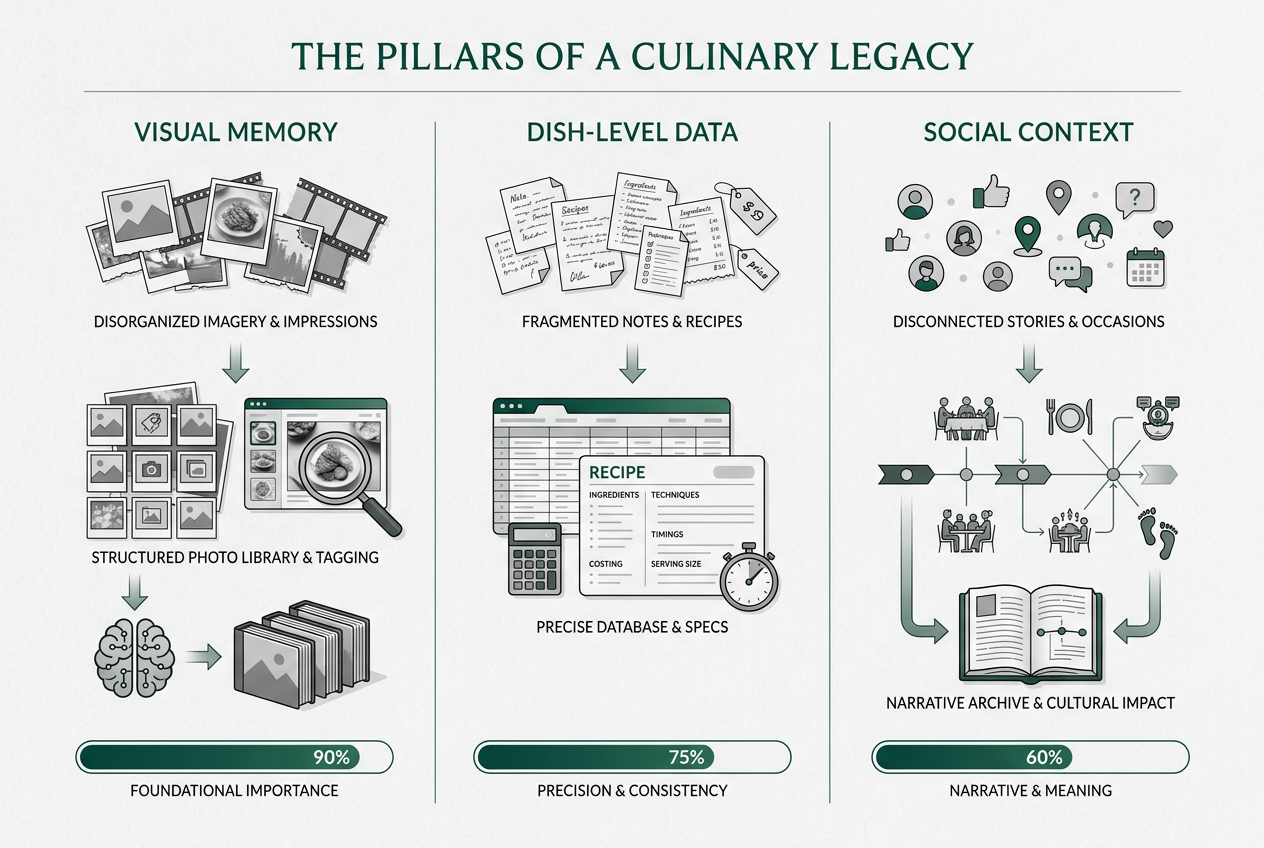
Building a culinary legacy requires more than just photos. By balancing visual triggers with specific data and social context, you create a searchable, professional-grade food archive.
Pillar One: The Visual Memory Trigger
Your food photos aren’t just Instagram content. They’re mnemonic devices.
But here’s what most people get wrong: they shoot for social media instead of personal recall. That overhead shot with perfect lighting? Gorgeous, but it won’t help you remember the dish six months from now. What you need is context.
The most useful food photos include:
- The dish from a natural dining angle (how you actually saw it)
- A shot of the menu or a business card
- The restaurant exterior or a distinctive interior detail
- If relevant, the specific kitchen station or preparation method
Geotagging is non-negotiable. Your phone does this automatically, but verify it’s enabled. Future you will thank present you when you’re trying to remember the name of that incredible taqueria "somewhere in the Mission District."
The key insight: your photos should trigger memories, not jealousy. Shoot for recall, not likes.
Pillar Two: The Dish-Level Detail
This is where most systems catastrophically fail.
Rating "restaurants" is like rating "books" without specifying whether you’re talking about the mystery novel or the cookbook. A single venue can serve transcendent pasta and deeply mediocre fish. Rating the place averages this into uselessness.
What you actually need to track:
- The specific dish name (not just "pasta" but "Cacio e Pepe with black pepper from Tellicherry")
- Your personal rating using a consistent scale you’ll actually remember (10-point systems work better than 5-star ratings for capturing nuance)
- Standout elements (Was it the texture? The unexpected ingredient? The perfect balance?)
- What to skip (Just as important as what to order)
This is the difference between "I remember liking that place" and "I remember the bucatini all’amatriciana was a 9/10 but skip the carbonara."
Learn more about creating your own personal food rating system that captures the details that matter to you.
Pillar Three: The Context Layer
Food doesn’t exist in a vacuum. The best meals of your life probably weren’t just about the food.
The contextual layer captures:
- Who you were with (Some dishes are inseparable from the company)
- Why you were there (Anniversary dinner hits differently than a solo Tuesday lunch)
- The moment (First date, celebration, comfort meal during a hard week)
- Your food era (What you were exploring or learning at that time)
This is what transforms a list of meals into an actual archive of your culinary journey. It’s the difference between data and story.
When you’re flipping through your food memories three years from now, you won’t just remember that the sushi was excellent. You’ll remember it was the place your friend took you after your job interview, and the chef came out to explain the seasonal fish, and you realized you’d been eating grocery store sushi your entire life like a barbarian.
The Tool Audit: 2026 Update
The best curation system matches your social preferences and detail requirements - private archivists need different tools than ranking enthusiasts, and both need different solutions than editorial discovery seekers.
Let’s be brutally honest about what actually works.
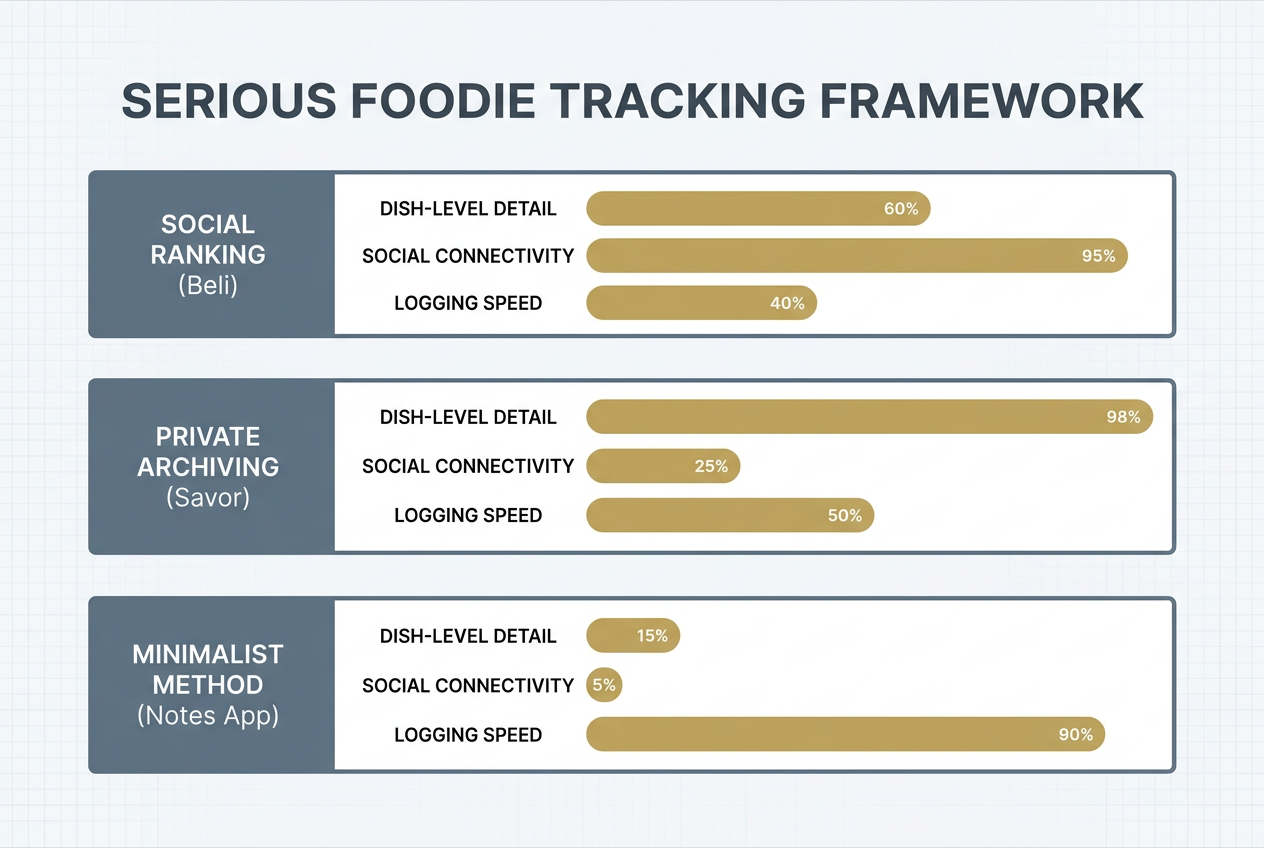
Choosing the right tool depends on your goals. Use this matrix to determine if you prioritize social status, private data depth, or minimalist efficiency in your dining logs.
For the Competitive Curator: Beli
Best for: People who treat dining like a sport and want everyone to know their taste level.
Beli’s core insight was turning restaurant tracking into a game. You don’t just save places - you rank them. Your top 10 becomes a public declaration of taste.
The strength is social pressure. When your rankings are public, you’re more thoughtful about what makes the cut. The weakness? The same thing. Public rankings can make you weigh social perception over personal truth.
Beli works when you’re the type who genuinely enjoys the competitive element of food culture. If the thought of defending your #3 pick to your foodie friends sounds fun rather than exhausting, this is your system.
For the Meticulous Archivist: Savor
Best for: People who care about dishes, not venues, and want their data to actually be useful years from now.
Full disclosure: this is the app we built, because nothing else solved the fundamental problem. You can’t remember great restaurants. You remember great dishes.
Savor’s entire architecture revolves around dish-level logging. You’re not rating "Joe’s Italian." You’re rating the rigatoni (8.5/10, perfect bite, slightly undersalted), while noting that the veal marsala (6/10) was forgettable.
This is for people who recognize that their food memory is a database problem, not a social media problem. No public rankings. No follower counts. Just a searchable archive of every dish you’ve cared enough to log, organized by the criteria that help you make better dining decisions.
The tradeoff is effort. Logging at the dish level takes an extra 30 seconds per meal. If that sounds tedious rather than valuable, you’ll never use it consistently.
Discover how to use the best app to track restaurant meals for your specific dining style.
For the Editorial Consumer: The Infatuation
Best for: People who trust curators more than crowds and value situation-based discovery.
The Infatuation’s genius is categorical clarity. They don’t just tell you what’s good - they tell you what’s good for a specific purpose. "Perfect for Date Night." "Best Solo Lunch Counter." "Impress Your Parents."
This isn’t a tracking tool. It’s a discovery engine maintained by people whose entire job is eating at restaurants and telling you which ones don’t waste your time.
The limitation is obvious: someone else’s taste, not yours. But if you’re newer to serious dining or in an unfamiliar city, a well-curated editorial voice beats crowdsourced chaos every time.
For the Minimalist: The "Pro" Notes App System
Best for: People who value simplicity over features and chronological storytelling over searchability.
Here’s the method, per Bon Appétit food editor:
- After every meal that matters, open Notes
- Write the date, restaurant name, and what you ordered
- Add 2-3 sentences about what made it memorable
- Do nothing else
The beauty is friction removal. No app to open. No fields to fill. Just a running chronological log of your dining life.
The weakness is searchability. Finding "that Vietnamese place with the incredible pho" requires scrolling through months of entries. But for some people, that chronological storytelling is the point. Your food life as a journal, not a database.
The Reality Check
No tool is universal. The best system is the one you’ll actually use consistently.
Competitive rankers thrive on Beli’s social framework. Detail-obsessed archivists need dish-level specificity. Editorial consumers want trusted curation. Minimalists just want to remember what they ate without learning a new interface.
The biggest mistake is choosing a system based on features rather than your actual behavior. If you won’t maintain a public ranking, Beli will become a ghost town. If you can’t be bothered with detailed logging, Savor will gather dust. If you don’t trust editorial voices, The Infatuation’s recommendations won’t help you.
Pick the system that matches your natural habits, not the one with the most impressive feature list.
How to Build Your ’To-Try’ Stack
An effective restaurant queue requires priority ranking based on neighborhood clustering, cuisine gaps, and occasion-specific needs - not just an endless undifferentiated list of "places to try someday."
Let’s fix the "Saved" list problem.
You know the pattern. Someone recommends a restaurant. You save it somewhere. Six months later, you’re deciding where to eat, and you’ve completely forgotten about it. Or you remember it exists but have no context for why it mattered or when you’d actually go.
The issue isn’t having a list. It’s having a flat list. Every restaurant is equally "saved," which means nothing is truly prioritized.
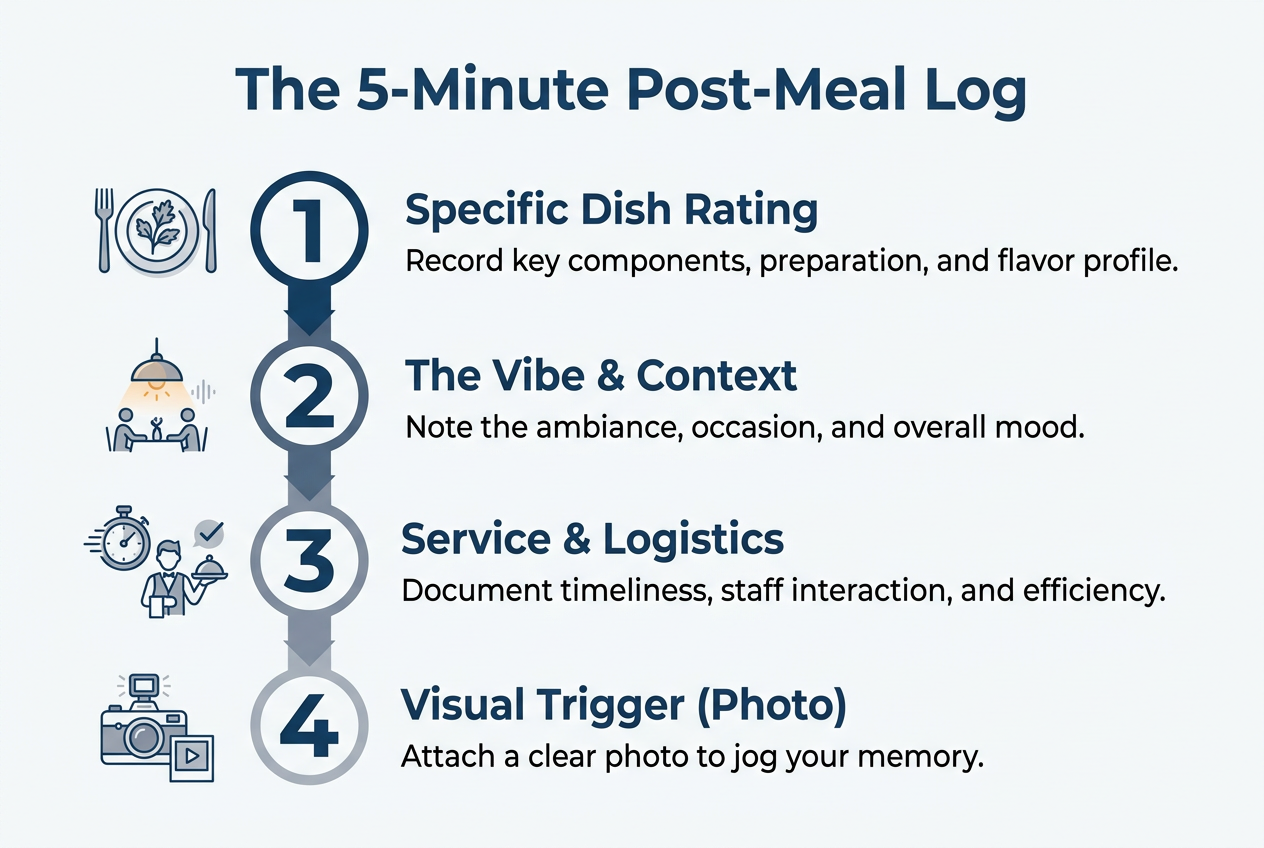
Transform your dining habits with this simple four-step logging protocol. Capturing these specific data points immediately ensures your personal restaurant library remains a high-utility resource.
The Three-Tier Priority System
Tier 1: Active Targets (5-7 restaurants maximum) These are spots you’re actively trying to visit within the next 2-4 weeks. They’re either new openings everyone’s talking about, long-standing classics you’re embarrassed you haven’t tried, or specific recommendations that filled a gap in your knowledge.
Key rule: if something’s been in Tier 1 for two months, either book it this week or demote it to Tier 2. Active Targets require action.
Tier 2: Neighborhood Anchors (organized geographically) These are restaurants you’ll visit when you happen to be in that area. Sort them by neighborhood, not by some abstract "how much you want to go" metric.
When you find yourself in the Mission District with 90 minutes to kill, you don’t need a citywide list of great restaurants. You need to know the three best options within a six-block radius.
Tier 3: Occasion-Specific (categorized by use case) These aren’t sorted by location or general interest. They’re filed by purpose: "Impress Clients," "Vegetarian-Friendly for Mixed Groups," "Solo Friendly Counter Seating," "Anniversary-Worthy."
Most restaurant lists are sorted by cuisine or rating. But you don’t choose restaurants by thinking "I want Italian food tonight." You think "I need somewhere impressive but not stuffy for my parents’ visit."
The Cuisine Gap Analysis
Here’s an exercise that will immediately upgrade your dining strategy:
List the ten cuisines you’ve eaten most in the past six months. Be honest. For most people, it’s heavy on Italian, Mexican, Japanese, and whatever happens to be convenient.
Now list the ten cuisines in your city that you’ve barely explored: Burmese, Senegalese, Georgian, Peruvian, Ethiopian, Korean (beyond Korean BBQ), real Sichuan, Southern Indian, Lebanese, Filipino.
Your Tier 2 list should explicitly address these gaps. Not because you need to check boxes, but because the most exciting dining experiences come from expanding your reference points.
The "Vibe Check" Filter
Not every great restaurant is right for every situation. Before adding something to your list, tag it with basic contextual info:
- Noise level (Can you actually have a conversation?)
- Pacing (Is this a two-hour experience or a quick in-and-out?)
- Formality (Am I underdressed in jeans?)
- Party size (Does this work for solo dining or require a group?)
This prevents the classic mistake of picking a loud, trendy spot for a serious conversation or choosing a quiet, formal restaurant when you just want casual hangout energy.
The Implementation Protocol
When someone recommends a restaurant:
- Add it to your system immediately (not "later")
- Note who recommended it and why
- Assign it to the appropriate tier and category
- If it’s Tier 1, set a specific timeframe for visiting
When you visit a restaurant from your list:
- Log the experience while the details are fresh
- Note what to order (and what to skip) for next time
- If it was exceptional, identify similar places to add
- Remove it from the "To-Try" stack - it’s now part of your archive
The goal isn’t to "complete" your list. New restaurants open weekly. Your taste evolves. The goal is to ensure that when you decide to eat out, you’re choosing from a curated set of options that reflect your actual priorities, not just whatever Google Maps shows you.
For more guidance on organizing your culinary discoveries, explore how to keep a food journal that captures context beyond just restaurant names.
The Expert Wrap: Your Dining Life Deserves Better
Treating dining as culture rather than consumption means building systems that capture not just where you ate, but what made those experiences meaningful enough to remember years later.
Let’s return to the fundamental question: why does any of this matter?
Because food is culture. It’s history. It’s the physical manifestation of place and tradition and someone’s life work. Reducing it to a 4-star rating is like describing a symphony by its length.
When you build a personal restaurant library - whether it’s a meticulously organized app or a running Notes document - you’re doing something more significant than optimizing your Friday night dinner choice. You’re creating a record of your relationship with food.
Years from now, that record will tell a story. Not just about what you ate, but about who you were when you ate it. The restaurants you visited during your first year in a new city. The dishes that expanded your palate. The meals that marked important moments.
This is why the system matters. Not because you need better restaurant recommendations (though you’ll get them), but because your dining life is worth documenting with the same care you’d apply to photos, travel, or any other aspect of life you value.
The camera roll chaos you’re experiencing right now? That’s not a storage problem. It’s a signal that you care deeply about food but haven’t found a framework equal to that care.
Start small. Pick one system from this guide and commit to using it consistently for a month. Log ten dishes with real detail. Build a properly prioritized To-Try list. Take photos that trigger memories instead of likes.
You’ll know it’s working when Friday night rolls around and instead of defaulting to the same five restaurants or googling "best food near me," you’re consulting your own carefully built archive. That pasta place you tried four months ago where the cacio e pepe was perfect? It’s right there, complete with notes about what to order and who to bring.
Your taste is too valuable to leave scattered across random screenshots and fading memories. Build the library. Your future self will be grateful.
For inspiration from someone who’s built a career around food memories, read about how to become a food critic and develop professional-level evaluation skills.
Frequently Asked Questions
What is the best app to track restaurant meals?
The best app depends on your tracking style. Savor excels at dish-level detail and private archiving, Beli works for competitive rankers who enjoy public lists, and The Infatuation serves editorial discovery needs. Choose based on whether you prioritize searchable data, social engagement, or curated recommendations over building your own system.
How do I remember what dishes to order at restaurants?
Log specific dish names and ratings immediately after eating, not hours later. Note standout elements like texture or unexpected ingredients, plus what to skip. Use a consistent 10-point scale rather than vague star ratings. The key is capturing enough detail that future you can make informed ordering decisions without re-reading full reviews.
Why are Google Maps stars useless for serious foodies?
Generic star ratings average vastly different experiences into meaningless numbers. A 4.2 rating tells you nothing about whether the pasta was transcendent but the fish mediocre, or if service was excellent but food disappointing. You need dish-level granularity and personal context, not crowd-sourced averages from people with completely different taste references.
Should I track restaurants publicly or privately?
Track privately if you value honest assessments over social performance. Public systems like Beli create accountability but can bias your ratings toward what sounds impressive. Private archives let you capture real opinions without worrying about defending your #8 pick to foodie friends. Choose based on whether external validation motivates or inhibits your logging consistency.
How do I organize my restaurant to-try list?
Use a three-tier system: Tier 1 for active targets you’ll visit within weeks, Tier 2 sorted by neighborhood for location-based decisions, and Tier 3 categorized by occasion like "client dinners" or "anniversary-worthy." Avoid flat undifferentiated lists where everything is equally "saved." Priority and context make lists actionable instead of overwhelming.
What is dish-level rating and why does it matter?
Dish-level rating means evaluating specific menu items rather than entire restaurants. A single venue can serve exceptional pasta and forgettable fish - rating the place averages this into uselessness. Rating dishes lets you remember "order the bucatini" versus "skip the carbonara," creating genuinely useful guidance for return visits.
How can I turn food photos into useful memories?
Shoot for recall, not social media. Include the dish from your actual dining angle, a menu shot, and contextual details like the restaurant exterior. Enable geotagging. Add written notes about taste, company, and why the meal mattered within 24 hours while details are fresh. Photos plus context create memory triggers; photos alone create digital clutter.
What food details should I log immediately after eating?
Capture dish name (specific, not just "pasta"), personal rating on your consistent scale, standout elements that made it memorable, what to skip next time, who you were with, and why you chose this restaurant. Log within hours, not days - memory fades fast. These six data points transform vague recollection into actionable intel.