
The Serious Foodie's Guide to Every Food City: Stop Reviewing, Start Archiving
John the smoothie monster
John lives for smoothie bowls and cold-pressed juices. He uses Savor to remember his best blends.
The Serious Foodie's Guide to Every Food City: Stop Reviewing, Start Archiving Your camera roll holds 2,000+ food photos. You scroll through them searching for...
The Serious Foodie's Guide to Every Food City: Stop Reviewing, Start Archiving
Your camera roll holds 2,000+ food photos. You scroll through them searching for that incredible pasta place from last month, but the photos are unlabeled, the restaurant name forgotten, and the memory fading. Meanwhile, Google Maps shows you five stars for a place that serves mediocre truffle fries, and your friend just asked for your "top recommendations" in a city you visited six months ago.
This is the paradox of modern food culture: we document everything but remember nothing useful.
The problem isn't that you're not taking enough photos or leaving enough reviews. The problem is that the tools we've been using - Yelp stars, Google ratings, Instagram stories - were never designed to build a personal culinary archive. They were built for the masses, for generic opinions, for social performance. Not for you, the serious foodie who treats meals as cultural experiences worth preserving.
This guide will show you how to transform your relationship with food cities from passive consumer to active archivist. You'll learn to document meals with the precision of a professional critic, organize your experiences into a searchable cultural asset, and build a personal food database that actually serves you years later.
No more lost meals. No more vague recommendations. Just a system that turns every dining experience into a lasting, retrievable memory.
Table of Contents
- The Cultural North Star: Understanding What Makes a Food City
- The Archivist's Shortlist: Essential Bites Worth Documenting
- The System: Solving the Camera Roll Problem
- The Anti-Yelp Vibe Check: Separating Hype from Reality
- Building Your Personal Culinary Archive
- Frequently Asked Questions
The Cultural North Star: Understanding What Makes a Food City
A food city isn't defined by Michelin stars or viral TikTok trends - it's characterized by cultural authenticity, technical innovation, and a dining community that treats food as heritage rather than entertainment.
Think about the last time someone recommended a city for its "amazing food scene." What did they actually mean? Were they talking about the Instagram-worthy presentations at trendy spots, or the family-run establishments where technique has been refined over generations?
In 2026, the definition of a food city has evolved beyond the simple presence of good restaurants. The cities that matter to serious foodies share three distinct characteristics: they possess a clear culinary DNA rooted in cultural heritage, they demonstrate technical execution that goes beyond trends, and they maintain dining communities where knowledge is shared among passionate eaters, not casual tourists.
Consider Chicago's evolution. It's not just a steakhouse city anymore - it's where Midwestern agricultural abundance meets immigrant culinary traditions, where you can find Polish pierogis perfected over 80 years alongside modern interpretations of Southern soul food. The city's DNA is about honest ingredients prepared with skill, not about chasing the next fusion concept.
Miami's Latin-Caribbean fusion tells a different story. Here, the culinary identity emerges from waves of immigration - Cuban, Venezuelan, Haitian, Dominican - creating a food landscape where a perfectly grilled churrasco sits alongside ceviches that would impress any Lima native. The city's strength isn't novelty; it's authenticity maintained across generations.
This matters because the cities worth archiving are the ones with stories deeper than their newest restaurant opening. When you're building your personal food database, you're not just collecting meal memories - you're documenting cultural moments that connect you to larger traditions.
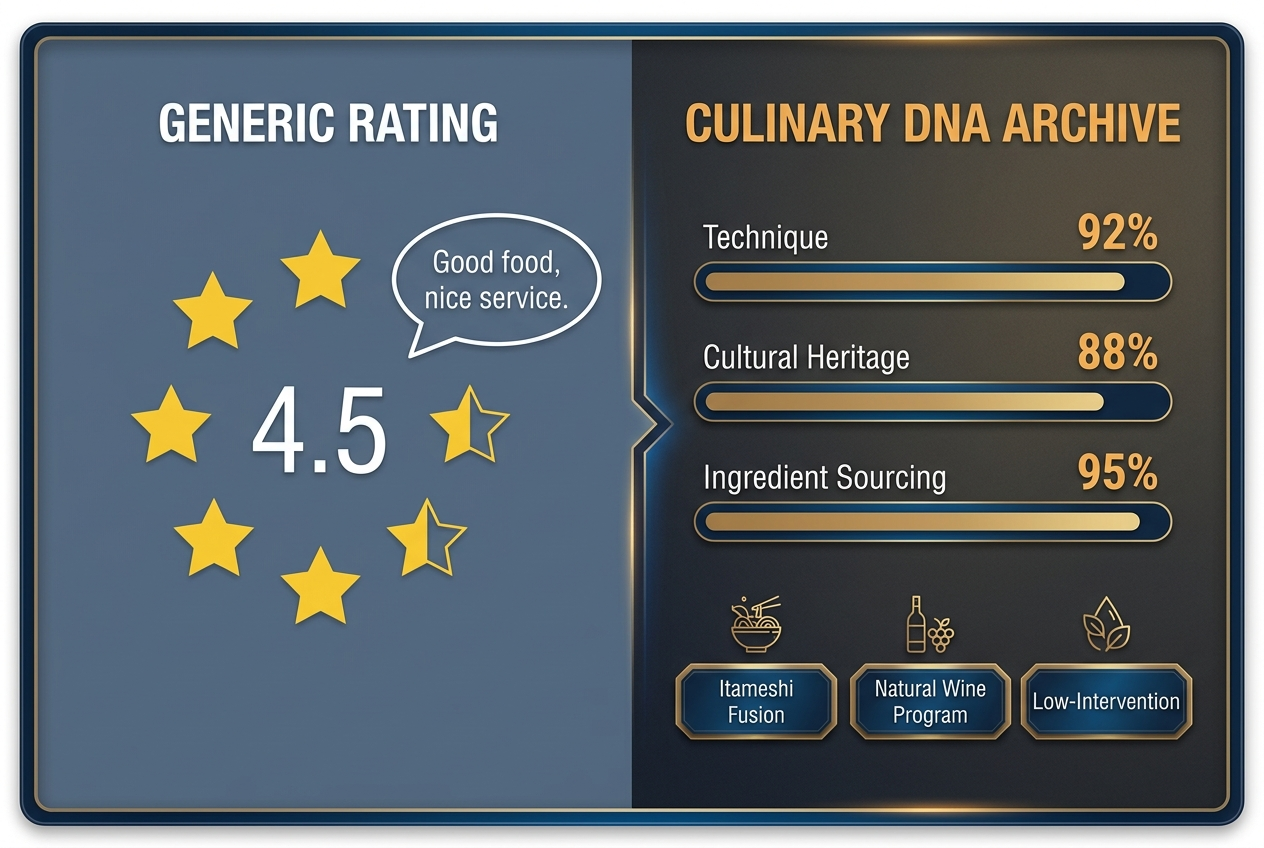 Moving beyond the limits of generic star ratings requires a more sophisticated lens that prioritizes cultural heritage and technical execution over vague opinions.
The shift from reviewing to archiving starts with understanding this distinction. A five-star rating tells you almost nothing about why a meal mattered. Was it the perfect acid balance in the sauce? The way the chef honored a regional technique? The story behind the family recipe? These details vanish in the averaged opinion of crowd-sourced platforms.
Urban professionals who travel frequently understand this instinctively. They've learned that the best recommendations come from people who can articulate specifics: "Get the fire-roasted seafood tower at Maple & Ash - the octopus has this perfect char that most places can't achieve because they're rushing service." That's valuable. "Great seafood place, five stars" is noise.
The DNA of a food city reveals itself in its details. Portland's culinary identity isn't just about farm-to-table restaurants - it's about a regional obsession with ingredient sourcing that borders on fanaticism, where chefs can tell you which farm grew your radishes and why those particular radishes matter. New Orleans isn't just about Creole food - it's about the specific techniques of roux-making, passed down through families, that create the foundation for everything from gumbo to étouffée.
When you start documenting food cities through this lens, your archive becomes infinitely more valuable. You're not collecting star ratings; you're building a reference library of cultural experiences. Six months from now, when you're trying to remember that incredible meal in Tokyo, you won't just recall "good ramen." You'll remember the specific tonkotsu technique, the way the pork belly was prepared, the regional variation that made it distinct.
This approach requires a fundamental mindset shift. You're no longer a reviewer offering opinions for public consumption. You're an archivist preserving personal cultural experiences. The question isn't "Would I recommend this to everyone?" It's "What made this meal significant enough to preserve?"
For more insights into how professional critics approach food evaluation, check out our guide on how to become a food critic.
The Archivist's Shortlist: Essential Bites Worth Documenting
The most archivable dishes combine technical mastery with cultural significance - they're the meals that teach you something about a city's culinary identity while demonstrating exceptional execution.
Your goal isn't to document every meal. That's exhausting and dilutes your archive with noise. Instead, focus on the dishes that represent a city's culinary North Star - the ones where technique, tradition, and terroir intersect.
Let's break down what makes a dish worth the full archival treatment, using concrete examples from cities that serious foodies actually care about.
Chicago: The Fire-Roasted Seafood Tower at Maple & Ash
This isn't just expensive seafood on ice. The dish demonstrates why Chicago's steakhouse culture evolved - it's about flame, about char, about understanding how high heat transforms texture. The octopus arrives with a crust that could only come from a ripping-hot grill, the kind of surface temperature most restaurants won't risk because it requires perfect timing. Document this one because it teaches you what proper char technique looks like.
When you archive this, note the temperature contrast: ice-cold shellfish against that hot octopus. That's intentional design, not accident. The restaurant understands textural interplay. This level of detail matters when you're trying to recall why a dish stayed with you.
Charleston: Lowcountry She-Crab Soup at Husk
The city's culinary DNA runs through this soup. It's built on a foundation of roe-rich female crabs, fortified with sherry, finished with a technique that requires constant attention to prevent breaking. Most places serve you gloppy, over-thickened versions that bear no resemblance to the real thing.
The archival value here is cultural. This dish connects you to Lowcountry tradition, to a specific time and place where this preparation method developed. When you're building a personal food database, these historical connections become part of your reference library. You're not just remembering a soup; you're documenting a regional tradition.
Los Angeles: Cacio e Pepe at Felix
People think they know this pasta. They don't. Felix demonstrates why technique trumps ingredients - their version achieves that glossy, emulsified sauce that most Italian restaurants in America can't execute. The cheese and pasta water combine into something that coats each strand without turning grainy or separating.
Archive this because it's a masterclass in a fundamental technique. Years from now, when you're eating cacio e pepe somewhere else, you'll have a reference point. You'll remember how the sauce should move on the plate, how it should cling to the pasta, what proper emulsification looks like.
New York: Pastrami at Katz's Delicatessen
The temptation with iconic dishes is to skip documentation because "everyone knows about it." Wrong approach. Katz's pastrami matters because it represents the apex of a specific curing and smoking technique developed by Eastern European immigrants over a century ago. The meat's texture - that perfect balance between tender and structured - comes from a 30-day process most delis abandoned decades ago for faster, cheaper methods.
When you archive this, note the fat distribution, the smoke penetration, the way the meat pulls apart without falling into mush. These details create a benchmark. Every pastrami you eat afterward gets measured against this reference.
Tokyo: Omakase at Any Serious Sushi Counter
Here's where dish-level archiving becomes critical. You're not documenting "sushi at Restaurant X." You're documenting 12-15 individual pieces, each representing a different technique, fish variety, and seasonal consideration. That chu-toro (medium fatty tuna) prepared with a specific knife cut, the aged kohada (gizzard shad) that took two weeks of salt and vinegar curing, the uni (sea urchin) sourced from a particular region of Hokkaido.
Your archive needs this granularity. The value isn't "I had great sushi in Tokyo." The value is remembering that Hokkaido uni has a sweeter, creamier profile than uni from other regions, that aged kohada demonstrates a technique most sushi chefs outside Japan don't even attempt.
If you're serious about documenting dishes at this level, consider using a dish tracking app designed specifically for this purpose.
The pattern across these examples is clear: archivable dishes teach you something transferable. They expand your understanding of technique, tradition, or terroir. They give you a reference point for future meals. They're not just good food - they're educational experiences worth preserving.
This is why serious foodies obsess over specific dishes rather than restaurants. A restaurant can have one transcendent preparation and a dozen forgettable ones. Your archive should reflect that reality. You're documenting excellence at the dish level, not the venue level.
When you approach food cities with this mindset, your archival practice becomes selective and meaningful. You're not trying to photograph every meal. You're identifying the 5-7 dishes in each city that teach you something worth remembering.
The System: Solving the Camera Roll Problem
The 3-Photo Rule combined with AI-powered tagging transforms your camera roll from a digital junk drawer into a searchable culinary reference library that actually serves you when you need it.
Let's address the uncomfortable truth: your current food photo system is a disaster. You have thousands of images, most unlabeled, many duplicates, none searchable in any meaningful way. Six months from now, when you want to remember that incredible pasta dish, you'll scroll through 800 photos before giving up in frustration.
The solution isn't taking more photos. It's implementing a consistent capture protocol that makes future retrieval possible.
The 3-Photo Rule Explained
Every archivable meal gets exactly three photos, each serving a specific purpose in your future recall process:
Photo 1: The Ambiance Shot This establishes context. Capture the dining room, the table setting, the overall environment. This isn't Instagram content - it's your memory anchor. When you review this six months later, the ambiance shot triggers recall of the entire experience: who you were with, what the service was like, whether the vibe matched the food quality.
Shoot this wide. Include environmental details that differentiate this place from others. Is there specific architecture, distinctive lighting, unique table design? These elements help you distinguish between the 47 Italian restaurants in your archive.
Photo 2: The Hero Dish This is your technical reference. Get close. Fill the frame with the actual dish. Capture the plating style, the sauce distribution, the garnish placement, the portion size. This photo needs to show you what excellence looked like so you can compare future dishes against this benchmark.
Don't worry about making it beautiful. Worry about making it clear. You need to see texture, color, composition. If it's a soup, get low to show depth. If it's pasta, capture how the sauce coats the noodles. If it's sushi, shoot from an angle that shows both the fish and the rice.
Photo 3: The Menu or Receipt This is your data layer. Photograph the menu item description, or better yet, the itemized receipt. This locks in the official dish name, price point, and any preparation notes the restaurant provided. It also date-stamps the experience.
This photo solves the problem of memory decay. In two years, you won't remember whether that pasta was $24 or $42, whether it was called "Cacio e Pepe Classico" or "Bucatini with Pecorino," whether it came with a specific wine pairing. The menu photo preserves these details.
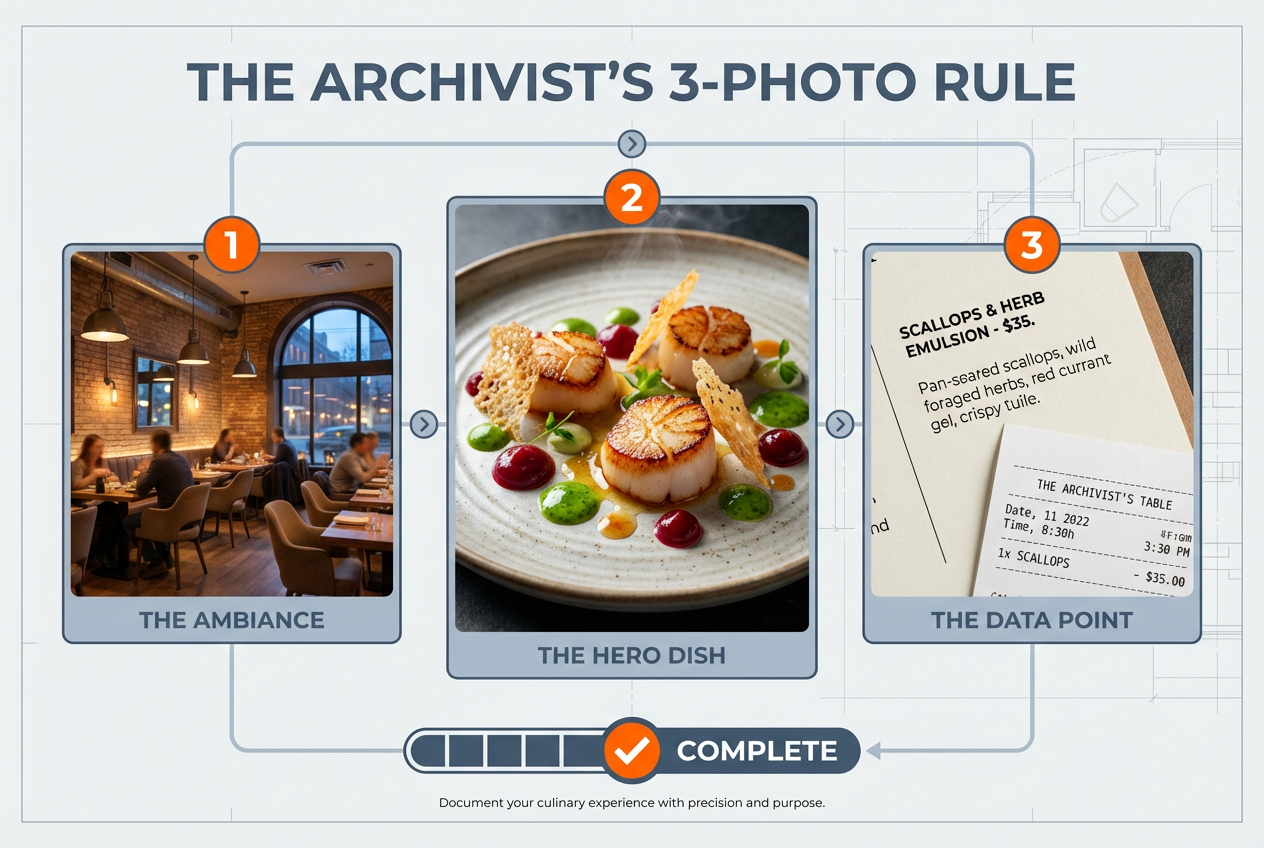 Mastering the 3-Photo Rule ensures your personal culinary archive is both visually rich and contextually searchable, turning a camera roll into a professional resource.
Making Your Archive Searchable
Here's where modern technology finally serves the serious foodie. In 2026, smartphone operating systems and third-party apps can recognize objects in photos, extract text, and make your images searchable by content.
The key is feeding your system the right tags. After capturing your 3-photo sequence, immediately add searchable text:
- Restaurant name and location
- Dish name and key ingredients
- Standout flavors or techniques
- Notable details (aged 30 days, wood-fired, house-made pasta)
- Personal rating or notes
This takes 60 seconds. Do it while you're still at the table, while the experience is fresh. Future you will thank present you for this discipline.
For iPhone users, the Photos app's built-in search has become surprisingly capable. It can recognize "truffle," "uni," "pasta," "grill marks." But you need to train it by consistently tagging. Add text to the photo metadata using the native caption feature. Over time, your archive becomes genuinely searchable.
Android users have similar functionality through Google Photos, which offers even more aggressive AI recognition. The platform can identify specific ingredients, cooking methods, and even cuisine types without manual tagging.
The Pro Move: Dedicated Food Archive Apps
For serious foodies who want more control, specialized apps like Savor take this system to the next level. These platforms are built specifically for dish-level documentation, with fields for restaurant, dish name, ingredients, ratings, and notes. They create a structured database instead of a chaotic photo roll.
The advantage is searchability by any field. Want to find every dish where you've had black truffle? Search your ingredient tags. Trying to remember which restaurants served excellent natural wine? Filter by your wine ratings. Need to recommend pasta spots in three different cities? Pull up your highest-rated pasta dishes organized by location.
This is the difference between a camera roll and an archive. One is passive storage. The other is an active reference tool.
The Hidden Value: Time-Stamped Memory
Here's something most people miss: your archive becomes more valuable over time. That photo of a dish from five years ago isn't just a memory - it's a historical data point. You can track how your palate has evolved, how a restaurant's quality has changed, how a city's food scene has developed.
I've gone back to restaurants based on notes I took three years earlier, only to discover they've slipped in quality. Without my archive, I would have remembered them as "great." With my archive, I can compare: the current version uses less expensive ingredients, the portion sizes have shrunk, the technique has gotten sloppier. This is powerful information.
The inverse is also true. You discover restaurants that have dramatically improved, chefs who have refined their techniques, dishes that have evolved in fascinating ways. Your archive becomes a personal food history, tracking the trajectory of the places and dishes you care about.
For more advanced strategies on documenting your food experiences, read our guide on how to take better food photos.
The system works because it's simple enough to maintain consistently. Three photos, basic tagging, done. No elaborate journaling, no pressure to write eloquent descriptions, no social media performance. Just clean documentation that serves your future self.
Your camera roll isn't a graveyard. It's your personal museum of taste. Start treating it that way.
The Anti-Yelp Vibe Check: Separating Hype from Reality
Generic crowd-sourced ratings prioritize popularity over quality, while a personal vibe check matrix helps you identify restaurants where the hype actually matches the execution.
We need to talk about why most restaurant ratings are worthless.
When you see 4.5 stars on Google Maps, what does that tell you? That 2,000 random people thought something was above average? That the restaurant successfully encouraged reviews from satisfied customers while unhappy ones didn't bother? That the place is Instagram-friendly, which inflates scores regardless of food quality?
The serious foodie's fundamental problem with platforms like Yelp and Google Reviews is that they optimize for the wrong things. They aggregate opinions from people with wildly different standards, experiences, and expectations. A tourist rating their first "authentic" taco truck counts the same as a third-generation Mexican-American who grew up eating their grandmother's cooking.
This creates noise, not signal.
Building Your Personal Vibe Check Matrix
The alternative is developing your own evaluation framework - a consistent way to separate marketing hype from actual culinary value. This isn't about being snobbish; it's about being systematic.
Your vibe check matrix should assess four dimensions:
Technique vs. Trends Does the restaurant demonstrate fundamental cooking skills, or does it rely on trendy ingredients and presentations to distract from weak execution? A spot serving wagyu beef with truffle foam might photograph well, but if they can't properly sear the meat or emulsify a sauce, they're prioritizing hype over substance.
Real technique is surprisingly easy to spot. Order something simple - a roasted chicken, a basic pasta, a properly grilled fish. These preparations can't hide behind complexity. They require precise timing, temperature control, and ingredient quality. If a restaurant can't execute the fundamentals, their elaborate signature dishes are probably smoke and mirrors.
Sourcing vs. Supply Chain Does the restaurant have genuine relationships with quality suppliers, or do they source from the same food service companies as everyone else? This distinction matters more than most diners realize.
The tell is specificity. When a menu says "Heritage pork chop," that's meaningless. When it says "Berkshire pork from Smith Meadows Farm in Berryville, Virginia," that's a real sourcing commitment. The restaurant is staking its reputation on a specific producer, which means they've vetted the quality and are confident enough to name names.
 Our Vibe Check matrix provides a transparent look at the city's most talked-about spots, filtering out the marketing noise to find true culinary value.
Authenticity vs. Appropriation This is delicate but important. Is a restaurant genuinely representing a culinary tradition, or is it cherry-picking appealing elements while ignoring the techniques and context that make those dishes meaningful?
The difference shows up in details. An authentic taqueria uses proper techniques - fresh tortillas, traditional salsas, respectful treatment of regional preparations. An appropriated version might have decent tacos but treats them as interchangeable vehicles for trendy proteins and fusion toppings that have nothing to do with Mexican culinary tradition.
Neither approach is inherently wrong, but you need to know which one you're experiencing. Your archive should reflect this distinction because it affects how you use these reference points later.
Value vs. Performance Is the price point justified by the quality of ingredients, skill level, and experience, or are you paying for ambiance, location, and brand recognition?
This isn't about finding cheap food. It's about understanding what you're paying for. A $45 pasta dish can be worth every penny if it's made with imported Italian ingredients, house-made noodles, and a sauce that required three hours of preparation. The same $45 pasta at a place using dried noodles and jarred sauce is a ripoff, regardless of how many Instagram followers the restaurant has.
Applying the Vibe Check in Real Time
When you walk into a hyped restaurant, run through your matrix before you even order:
Look at the menu. Is it focused or scattered? Restaurants with 80 items from six different cuisines are spreading themselves thin. They can't possibly execute all those dishes well. A focused menu - 15-20 items, clear culinary point of view - suggests confidence and specialization.
Observe the space. Not the Instagram-worthy decor, but the operational details. Is the kitchen visible? Are tables too close together (suggesting they're maximizing turnover over experience)? How does the staff interact? Rushed, frazzled service indicates either understaffing or poor training, neither of which bodes well for food quality.
Order strategically. Get one simple, technique-driven dish and one signature item. If they can't execute the simple one properly, the signature dish's complexity is probably hiding flaws. If both are excellent, you've found a place worth archiving.
The Comparison Table
Here's how this plays out with real examples. Let's examine three hyped restaurants in a major food city:
Restaurant A: Social Media Darling
- 50,000+ Instagram followers
- Photogenic dishes with elaborate presentations
- Menu changes weekly to follow trends
- Simple roast chicken is dry and under-seasoned
- Signature dish relies on expensive ingredients to mask weak technique
- Verdict: Hype exceeds reality by significant margin
Restaurant B: Critical Favorite
- Modest social media presence
- Unphotogenic but delicious food
- Menu stays consistent with minor seasonal adjustments
- Simple preparations are flawless
- Signature dishes demonstrate clear technique and judgment
- Sourcing relationships listed in detail
- Verdict: Reality exceeds hype; underrated gem
Restaurant C: Justified Reputation
- Strong both on social media and in critical reviews
- Dishes photograph well because they're executed well
- Menu balance between accessibility and sophistication
- Fundamentals and complex dishes both excellent
- Transparent about sourcing and techniques
- Premium pricing justified by quality
- Verdict: Hype matches reality
Your personal archive should note these distinctions. Not every restaurant needs to be extraordinary - sometimes you just want something good and consistent. But knowing the difference between justified hype and marketing performance helps you set expectations and make informed decisions.
For more on evaluating restaurant quality, explore our guide to restaurant reviews.
The vibe check isn't about being critical for its own sake. It's about developing a calibrated palate for quality that serves you across different cities, cuisines, and price points. The more you practice this framework, the more quickly you can identify the restaurants worth your time and money.
That's the real value of moving beyond star ratings. You stop outsourcing your judgment to the crowd and start trusting your own increasingly sophisticated criteria.
Building Your Personal Culinary Archive
Your archive becomes a cultural asset when you treat it as a professional reference tool rather than a social media feed - this requires systematic organization, consistent documentation, and selective curation.
Now we get to the practical reality: how do you actually build and maintain a culinary archive that serves you for years?
The answer isn't complicated, but it does require discipline. Most people fail at food documentation because they start with enthusiasm, take 500 photos in the first month, then abandon the system because it feels like work. The solution is removing friction through smart tools and sustainable habits.
Choosing Your Archive Platform
You have three viable options, each with distinct tradeoffs:
Option 1: Native Photo Apps (iPhone Photos, Google Photos) Advantages: Already on your phone, zero learning curve, excellent AI recognition Disadvantages: Not designed for food documentation, limited organizational structure, no dish-specific fields
Best for: Casual archivers who want minimal friction and basic searchability
The key to making this work is ruthless organization. Create albums by city or category. Use the caption field consistently. Tag photos immediately after capturing. Accept that your search capabilities will be limited to what AI can recognize and what you manually caption.
Option 2: General Note-Taking Apps (Notion, Evernote) Advantages: Highly customizable, can create elaborate databases, good for detailed notes Disadvantages: Requires manual setup, photo organization is clunky, not optimized for mobile capture
Best for: Detail-oriented archivers who value extensive notes and custom categorization
If you go this route, build templates. Create a "Meal Archive" database with fields for restaurant, city, dish name, ingredients, rating, price, date, and notes. This structure forces consistency and makes searching easier. The challenge is that entering all this data on mobile while at a restaurant is tedious, which means you'll often delay documentation and lose details.
Option 3: Specialized Food Apps Advantages: Purpose-built for dish documentation, fields designed for culinary details, often include rating systems and social features Disadvantages: Requires learning a new platform, varying quality across apps
Best for: Serious archivers who want maximum functionality and dish-level precision
This is where apps like Savor come in. They're built specifically for the problem we're discussing: creating a searchable, organized database of individual dishes rather than restaurant reviews. You get fields for everything that matters - ingredients, preparation methods, ratings, notes, photos - all optimized for mobile entry.
The tradeoff is committing to a new platform. But if you're serious about building a long-term culinary archive, the purpose-built tool will serve you better than trying to force a general-purpose app into this specific use case.
The Documentation Workflow
Regardless of platform, your workflow should be identical:
At the table:
- Take your three photos (ambiance, dish, menu)
- Add basic text: restaurant name, dish name, location
- Snap any additional reference photos (wine label, special ingredients)
Within 24 hours: 4. Add ratings if your system uses them 5. Write 2-3 sentences capturing what made the dish memorable 6. Tag key ingredients and techniques 7. Note any context (who you were with, what you learned)
This two-phase approach balances immediate capture with thoughtful reflection. You get the essential data in real-time when details are fresh, then add depth when you have a few quiet minutes.
The 24-hour rule is critical. Beyond that window, details fade and you'll never add the notes. Be honest with yourself: if you haven't documented a meal within a day, you probably never will. Accept that and move on rather than letting undocumented meals guilt you into abandoning the system entirely.
The Selective Curation Principle
Here's where many people go wrong: they try to archive everything. Every meal becomes a documentation project. This is exhausting and unsustainable.
Instead, apply the 70/20/10 rule:
- 70% of meals: No documentation. It was fine, nothing special, not worth preserving.
- 20% of meals: Quick capture. One or two photos, basic notes. Reference-quality but not exceptional.
- 10% of meals: Full archive treatment. Three photos, detailed notes, technique observations. These are your benchmarks.
This selectivity makes the archive more valuable, not less. When you open your database and see 50 entries from the past year, you know every single one represents something worth remembering. There's no noise cluttering your reference library.
The challenge is fighting FOMO. You'll worry you're losing memories by not documenting everything. You're not. You're protecting the signal by filtering out the noise. The mediocre pasta from Tuesday lunch doesn't deserve space in your archive. The transcendent handmade pappardelle from Saturday dinner absolutely does.
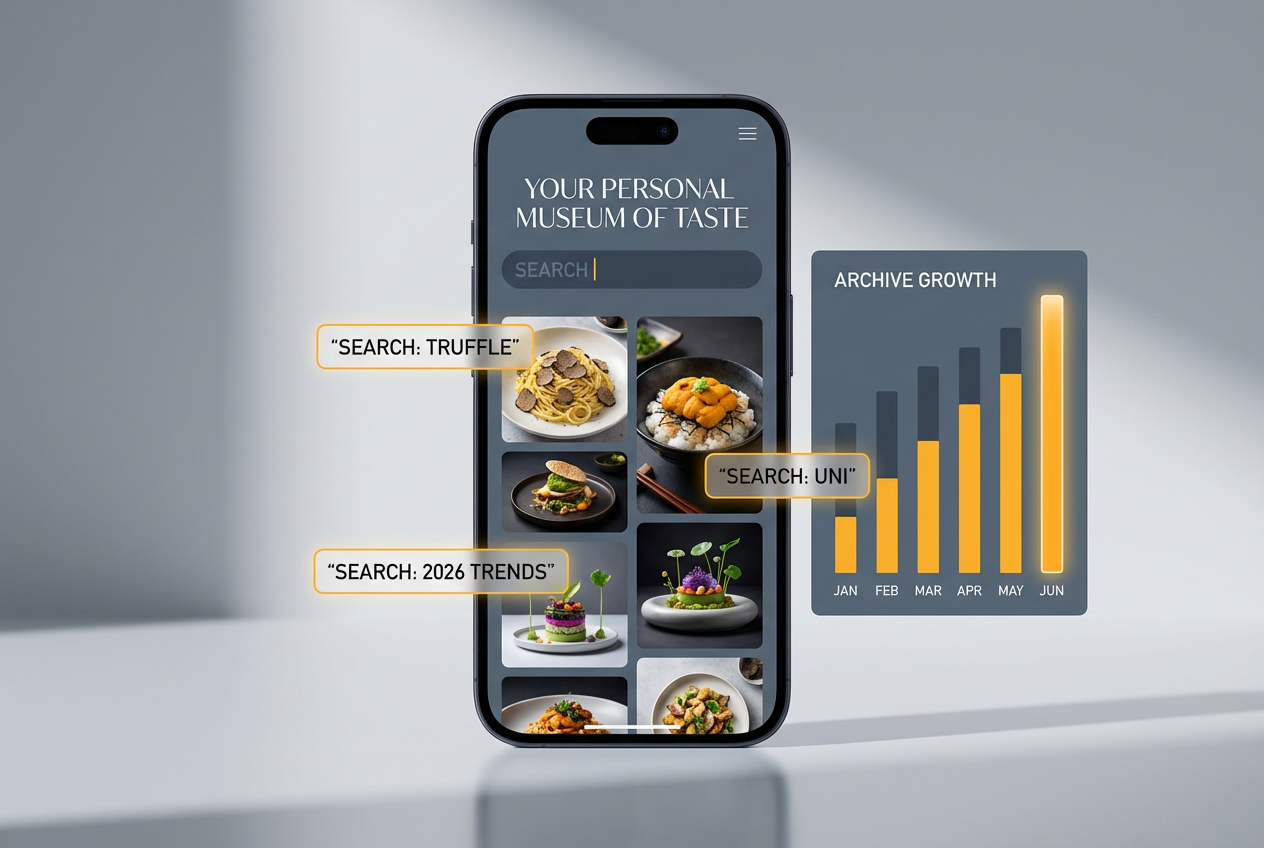 Transform your dining history into a searchable cultural asset that allows you to recall specific flavors and ingredients with the precision of a professional.
Making Your Archive Work for You
The ultimate test of your archive's value is utility. Can you actually use it when you need it?
Scenario: A friend asks for restaurant recommendations in a city you visited eight months ago. With a proper archive, you pull up your highest-rated dishes from that city, see the photos and notes, and give specific recommendations: "Go to Restaurant X and get the braised short rib - it's the best demonstration of low-and-slow technique I've seen. Skip Restaurant Y; it was overhyped and the execution was sloppy."
Without an archive, you respond with vague memories: "I think there was a good Italian place? Maybe? Somewhere near the downtown area?"
The archive turns you into a valuable resource for your community. The urban professionals in your network quickly learn that your recommendations are specific, reliable, and based on actual experience rather than crowd-sourced ratings.
This social currency matters more than people admit. In professional circles where food knowledge signals cultural sophistication, being the person who can make precise recommendations carries weight.
But beyond social value, the archive serves you. It tracks your own evolution. You can look back three years and see how your palate has developed, what you used to rate highly that now seems pedestrian, which cuisines you've explored deeply and which remain gaps in your education.
This meta-level awareness is what separates casual food enthusiasts from serious foodies. You're not just eating; you're learning, tracking, evolving.
For more on building and maintaining your food memories, check out our article on best food diary apps.
The Long Game
Your culinary archive is a decades-long project. You're building something that will serve you for years, that will grow more valuable as it accumulates breadth and depth.
In five years, you'll have reference points across dozens of cities and hundreds of dishes. You'll be able to compare regional variations of the same preparation, track how individual restaurants have evolved, identify your true preferences versus the things you thought you liked.
In ten years, you'll have a genuine food history - a personal document of your culinary education and the experiences that shaped your understanding of great food.
This is what separates the serious foodie from the casual Instagram poster. They capture moments. You're building a legacy.
The key is starting now, committing to the system, and trusting that the cumulative value will justify the effort. Every documented meal is a data point. Every note is context. Every photo is a memory preserved.
Your camera roll isn't a graveyard anymore. It's your personal museum of taste, your reference library, your proof that you were there, that you tasted it, that you understood what made it special.
Treat it that way.
Frequently Asked Questions
What makes a food city worth visiting?
A worthwhile food city combines three elements: cultural authenticity rooted in immigrant or regional traditions, technical excellence that goes beyond trendy presentations, and a community of knowledgeable diners who share information rather than just Instagram photos. Look for cities where locals can articulate why specific dishes matter, where restaurants maintain consistent standards over years, and where the food scene reflects actual cultural heritage rather than manufactured marketing narratives. Cities like Tokyo, Mexico City, New Orleans, and Copenhagen fit this profile because their culinary identities emerge from genuine tradition and innovation, not just capital investment in trendy concepts.
How do I organize food photos so I can actually find them later?
The 3-Photo Rule provides structure: capture ambiance, the hero dish, and the menu or receipt for every archivable meal. Immediately add text tags including restaurant name, location, dish name, and key ingredients. Use your phone's native caption feature or a specialized app like Savor that includes fields for culinary details. Create albums by city or cuisine type. The critical habit is tagging within 24 hours while details are fresh. In 2026, smartphone AI can recognize ingredients and cooking methods, but you need consistent tagging to train the system. Consider a dish tracking app if you want advanced search capabilities by ingredient, technique, or rating.
Why are Yelp and Google ratings unreliable for serious foodies?
Crowd-sourced platforms aggregate opinions from people with vastly different standards and expectations. A tourist's first exposure to a cuisine counts the same as an expert's assessment based on decades of experience. These platforms also can't distinguish between popularity (social media appeal, convenient location) and quality (technique, sourcing, execution). A restaurant can have high ratings because it photographs well and offers large portions, even if its cooking fundamentals are weak. Serious foodies need dish-level evaluation focused on technique, ingredient quality, and cultural authenticity rather than venue-level popularity contests. Build your personal vibe check matrix assessing technique versus trends, sourcing specificity, cultural authenticity, and value relative to price point.
What's the difference between reviewing and archiving food?
Reviewing is public performance - offering opinions for general consumption, usually venue-focused, often influenced by social pressure to seem sophisticated or accessible. Archiving is private documentation - preserving personal experiences at the dish level, focused on details that help future recall, organized for your own retrieval needs rather than public consumption. Reviews ask "Would I recommend this to everyone?" Archives ask "What made this dish significant enough to preserve?" Archiving captures cultural education: the technique you learned, the regional tradition you encountered, the benchmark against which future dishes will be measured. It's selective curation for long-term personal reference rather than crowdsourced opinion aggregation.
How many meals should I document per trip?
Apply the 70/20/10 rule: document nothing for 70% of meals (fine but unremarkable), capture basic photos and notes for 20% (reference quality), and give full archive treatment to 10% (exceptional benchmarks). On a week-long food-focused trip with 21 meals, that means 14 undocumented, 4-5 with basic capture, and 2-3 with detailed documentation. This selectivity keeps your archive signal-rich rather than cluttered with mediocre experiences. The goal isn't comprehensive documentation - it's preserving the meals that teach you something about technique, tradition, or terroir. Trying to archive everything leads to documentation fatigue and abandoned systems. Be ruthlessly selective about what deserves preservation.
Should I use a dedicated food app or my phone's camera roll?
If you're documenting fewer than 50 meals per year and only need basic recall, your phone's native photos app with disciplined captioning works fine. If you're serious about building a long-term culinary reference library with 100+ documented dishes annually, a purpose-built tool like Savor provides better organization and search capabilities. Dedicated apps offer fields for ingredients, techniques, ratings, and notes optimized for dish-level documentation. They make finding specific reference points easier: "Show me every dish where I've rated the pasta texture 9 or higher" versus scrolling through hundreds of uncategorized photos. The tradeoff is learning a new platform. Choose based on your commitment level to systematic documentation versus casual photo collection.
How do I take food photos that are actually useful later?
Prioritize clarity over beauty. Your goal is documentation, not Instagram content. Fill the frame with the dish, showing texture, color, and composition clearly. Shoot from a slight angle to show depth and dimensionality rather than straight overhead (which flattens everything). Include a reference object for scale if portion size matters. Capture the dish in context - the table setting, the plating style, the presentation. Natural lighting is ideal but not essential; modern phone cameras handle restaurant lighting well. Avoid over-editing; you want to remember what the food actually looked like, not an idealized version. The menu or receipt photo is often more valuable than a beautifully styled dish photo because it locks in official names and prices. Read our complete guide on how to photograph food.
What details should I include in my food notes?
Focus on transferable learning rather than vague descriptions. Instead of "delicious pasta," note specific observations: "pappardelle with excellent bite - clearly rolled fresh, not dried. Ragu used both pork and beef, long braise evident from meat texture. Sauce emulsified perfectly with pasta water, not too thick. Generous parmesan but not overwhelming." Include technique observations (slow-roasted, wood-fired, sous-vide), standout ingredients (aged balsamic, Hokkaido uni, heritage pork), textural details (crispy skin, silky sauce, al dente pasta), and comparative notes (better than Version X at Restaurant Y). These specifics help future recall and create useful reference points for evaluating similar dishes later.