
Beyond the Stars: The Serious Foodie’s Guide to Restaurant Review Apps
Alex the juice queen
Alex hunts for the best juice bars and presses. She rates every sip and saves her favorites in Savor.
Beyond the Stars: The Serious Foodie's Guide to Restaurant Review Apps (2026) Most serious food lovers hit the same wall around their 200th saved place:...
Beyond the Stars: The Serious Foodie's Guide to Restaurant Review Apps (2026)
Most serious food lovers hit the same wall around their 200th saved place: they've lost track of which app holds the good stuff. They can't remember if that perfect tonkotsu was logged in Google Maps, buried in their camera roll, or lost in a Yelp draft they never posted. The actual memory - the silky broth, the exact location, why it mattered - is gone.
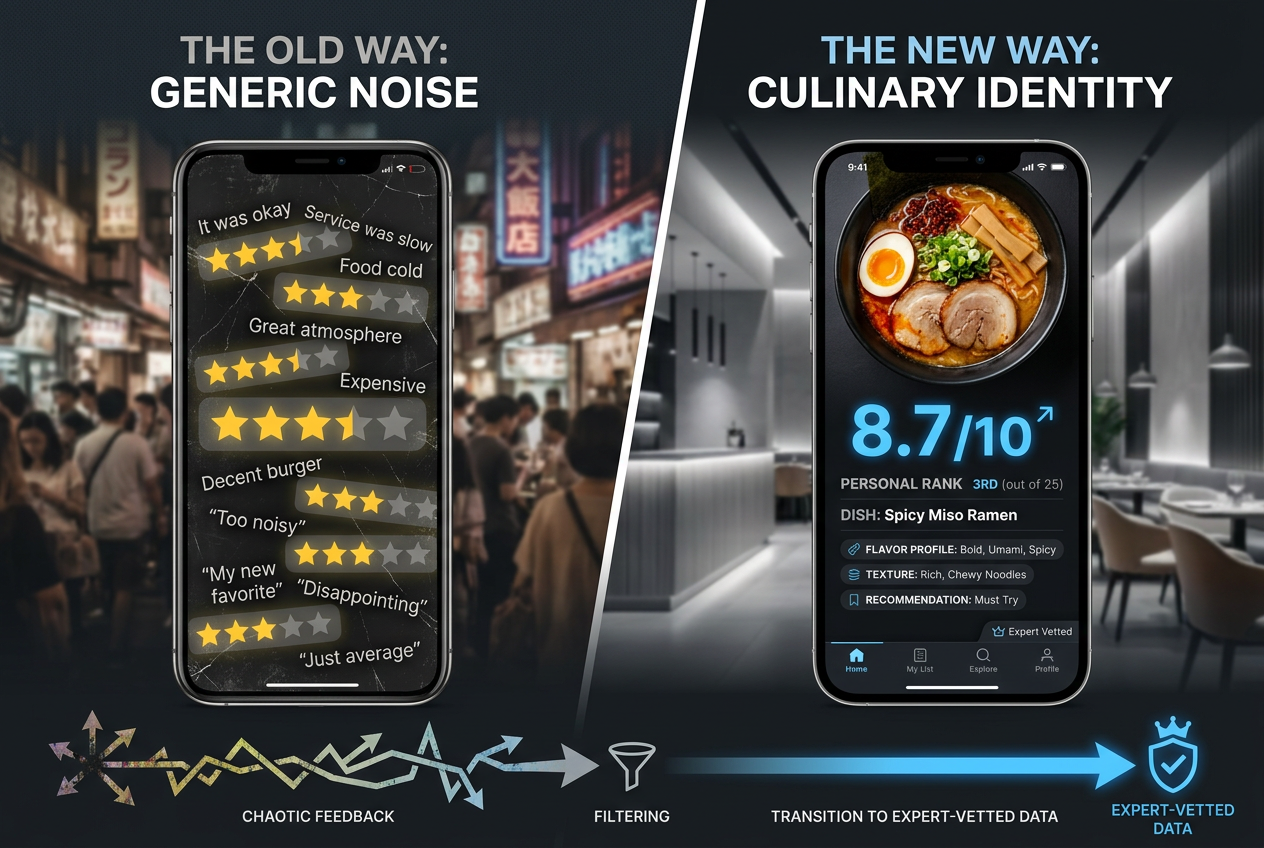
This isn't just inconvenience. By the time most food enthusiasts realize they need a system, they've already forgotten hundreds of meals that deserved better. The 5-star rating from a stranger who "thought it was fine" has replaced your actual experience, and that $40 dish you traveled across the city for has dissolved into the noise of generic crowd reviews.
What follows is the complete picture - why the traditional review model fails people who actually care about food, which modern platforms solve real problems instead of just adding more noise, and how to build a personal food stack that turns every meal into a retrievable, shareable memory. The answer isn't better talking. It's understanding what these tools actually do for your culinary life - and that changes everything about how you eat.
Key Takeaways
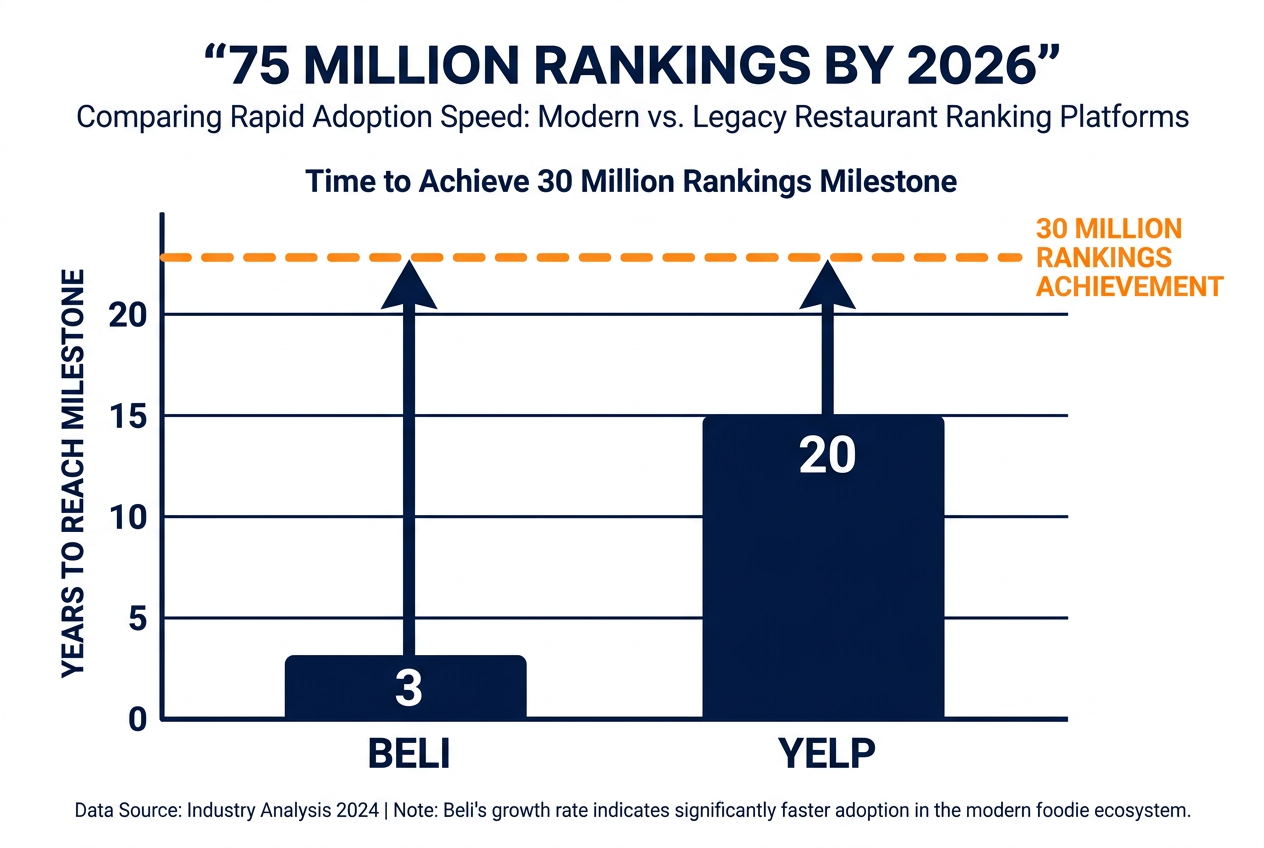
- Beli reached 30 million user rankings in 3 years, a milestone that took Yelp nearly 20 years to achieve, signaling a fundamental shift toward social ranking systems.
- Dish-level rating apps like Savor allow foodies to rate the plate rather than the place, solving the problem of 4.2-star restaurants where only one dish is actually worth ordering.
- AI-driven predictive recommendations in food apps have reached 73% accuracy for predicting high-user ratings, making computer vision and NLP the new foundation of modern discovery.
- Google Maps removes an estimated 95 million fake reviews annually using machine learning, highlighting why expert-led and social-verified platforms are replacing generic crowd reviews.
- The most effective food tracking system for 2026 isn't a single app - it's a personal stack combining a social ranking tool, a dish journal, and an expert-led discovery platform.
Table of Contents
- The Death of the 5-Star System
- What Are the Best Restaurant Review Apps?
- The Social Ranking King: Beli
- The Precision Journal: Savor & Yummi
- The Professional Guard: The Infatuation & World of Mouth
- How to Choose Your App: Decision Matrix
- The "Secret" Tech: How AI is Changing Your Dinner Plans
- Step-by-Step: Migrating Your "Food Life"
- Expert Tips for Building Social Authority
- Frequently Asked Questions
The Death of the 5-Star System
The traditional 5-star restaurant review model is fundamentally broken for anyone who treats food as culture rather than fuel. Yelp hosts over 244 million reviews as of the 2025-2026 reporting period, yet serious foodies are abandoning it in droves - not because it lacks content, but because generic reviews from strangers aren't reliable for someone whose culinary standards exceed "it was fine."
The core problem is venue-level ratings. A restaurant with a 4.2-star average tells you nothing about whether their specific tonkotsu ramen is worth the 45-minute wait, or if the chef's signature dish is the only thing on the menu worth ordering. You're averaging the opinion of someone who ordered poorly against someone who knew exactly what to get. That's not signal. That's noise.
Google Maps removes an estimated 95 million fake reviews annually using machine learning, according to data shared by Savor, but even verified reviews carry a hidden cost: they're written by people with completely different taste profiles. The person who loved that "cozy Italian spot" might think Olive Garden is authentic. Their 5-star rating and your 5-star rating don't measure the same thing.
This is why the "niche stack" has emerged. Modern food enthusiasts aren't looking for a single app - they're building a personal system that separates memory (tracking what you loved), discovery (finding what matches your taste), and social authority (becoming the person friends ask for recommendations). Each function requires a different tool, and the platforms winning in 2026 are the ones that do one thing exceptionally well instead of trying to be everything to everyone.
The shift isn't just philosophical. Average consumer spending on restaurants reached $90 per week in February 2026, according to Popmenu's 2026 trends report. When you're investing that much in dining, you need a system that preserves the winners and filters out the noise. The 5-star system can't deliver that. Platforms built around personal taste memory and expert curation can.
What Are the Best Restaurant Review Apps?
The best restaurant review apps in 2026 depend entirely on what you're actually trying to solve: tracking your own culinary history, discovering new places through trusted voices, or building social credibility as a food authority. No single platform dominates all three, which is why serious foodies run a multi-app stack instead of relying on a single source.
For personal archiving - the ability to remember exactly what you ordered and whether it was worth the calories - dish-level rating platforms like Savor and Yummi lead the category. These apps solve the camera roll problem: your 2,000 food photos become searchable, sortable, and actually useful. Savor's dish-rating system allows users to score the plate rather than the place, which means you can track that the calamari was perfect while the pasta was mediocre - a level of granularity that venue-level reviews completely miss.
For social ranking and gamification - the dopamine hit of competing with friends and building your personal hit rate - Beli stands alone. The app uses a "Letterboxd for food" model where users rank restaurants head-to-head rather than assigning abstract star ratings. Beli has accumulated over 75 million restaurant rankings as of early 2026, according to The 9825, and the platform's friend-feed feature transforms dining into a social game where your taste becomes visible and comparable.
For expert-led discovery - the confidence that recommendations come from people who actually know food - The Infatuation and World of Mouth split the territory. The Infatuation's writers visit approximately 200 restaurants per week across 70 cities, producing scenario-driven guides like "Best for a first date" or "Best to impress your parents." World of Mouth takes a different approach: the platform features recommendations from over 800 global culinary experts, including Michelin-starred chefs, making it the gold standard for travelers who want insider access rather than crowd reviews.
Here's the reality check: 47% of diners check apps before choosing a restaurant in 2025, according to Savor's food review app analysis. That means more than half still wing it, and they're the ones leaving disappointed. The diners who treat app selection as seriously as restaurant selection are the ones building taste profiles that compound over time. Your "best app" isn't about features - it's about which problem you're solving first.
The Social Ranking King: Beli
Beli achieved 30 million user rankings in just 3 years, a milestone that took Yelp nearly 20 years to reach, according to LinkedIn and NYT reporting from 2025. That acceleration isn't luck - it's proof that the gamified, social ranking model resonates more powerfully with modern food enthusiasts than the traditional long-form review ever did.
At its core, Beli replaces subjective star ratings with a head-to-head ranking algorithm. Instead of asking "How many stars would you give this restaurant?", the app presents two venues you've visited and asks "Which was better?" Over time, this comparative system builds a personalized ranked list that reflects your actual preferences - not an abstract score, but a real hierarchy. The psychological shift is subtle but powerful: you're not judging restaurants against an imaginary standard. You're building your list.
The friend-feed feature turns this personal ranking into social currency. When you see that three trusted friends all ranked the same ramen spot in their top 10, that's a different kind of signal than 400 strangers giving it 4.3 stars. You're seeing taste alignment, not crowd consensus, and for serious foodies, that's the difference between a good recommendation and a great one.
Beli's model has a limitation by design: it's purely user-driven, which means it lacks the professional editorial voice that platforms like The Infatuation provide. You won't find curated guides or chef-led recommendations here. What you get instead is transparency - you know exactly why your friend ranked a place highly, and you can judge whether your tastes align. For some users, that's more valuable than any critic's opinion.
The app's rapid growth also highlights a broader trend: the global restaurant guide app market was valued at $3.1 billion in 2025, according to Data Insights Market, and Beli captured a meaningful share of that by doing one thing exceptionally well. It didn't try to be a booking platform, a loyalty program, or a review aggregator. It solved the ranking problem, made it social, and let network effects do the rest. That focus is why it's winning.
The Precision Journal: Savor & Yummi
Dish-level rating apps solve a problem that venue-level platforms can't touch: remembering which specific plate made a restaurant worth visiting. A 4.2-star average tells you nothing about whether the chef's signature pasta is a masterpiece or if the restaurant is only worth visiting for that one dish. Savor and Yummi treat meals as individual experiences, not venue aggregates, and that precision is why they've become essential tools for foodies who actually care about what they're eating.
Savor's core architecture is built around the idea that your food photos are a memory vault - but only if you can actually retrieve them. The app uses computer vision to recognize dishes automatically, saving the manual logging time that makes traditional food diaries fail. Users rate dishes on a 10-point scale (not restaurants), add personal tasting notes, and organize meals into custom lists like "Best pasta in Rome" or "Worth the wait." The result is a searchable, sortable database of every memorable meal you've ever had.
The distinction between dish-level and venue-level ratings isn't academic. A restaurant might serve 30 items, but only three are worth ordering. Venue-level reviews average those three winners against 27 mediocre plates, producing a rating that's technically accurate but practically useless. Savor solves this by letting you score the tonkotsu separately from the gyoza, creating a granular record of what actually worked.
Yummi takes a parallel approach with a visual-first interface called "Foodprints" - a calendar view of your meals that turns your dining history into a timeline. The app's strength is memory retrieval: scroll back to any date and see exactly what you ate, where, and how you felt about it. For travelers and dedicated food journalists, this becomes a living archive that doesn't degrade over time. The platform's weakness is discovery - its recommendation engine is less sophisticated than AI-heavy competitors like Savor, which means it's better for logging than exploring.
Both apps address a fundamental truth: your camera roll holds thousands of dollars worth of culinary experiences, but without structure, they're worthless. AI-driven predictive recommendations in food apps have reached 73% accuracy for predicting high-user ratings, according to Savor's analysis, which means the platforms that combine dish-level precision with smart recommendation engines will dominate the next phase of food tech. You're not just tracking meals - you're building a taste profile that gets smarter the more you use it.
If you're serious about tracking food memories or building a personal food database, these apps are non-negotiable. The question isn't whether to use them - it's which one fits your workflow. Savor wins on AI features and recommendation depth. Yummi wins on visual memory and calendar-based retrieval. Both beat the camera roll by orders of magnitude.
The Professional Guard: The Infatuation & World of Mouth
Expert-led platforms solve a different problem than social apps: they filter out the noise entirely by replacing crowd reviews with curated recommendations from people who actually know food. The Infatuation and World of Mouth represent two distinct approaches to this model - one editorial, one chef-driven - but both deliver something Yelp and Google Maps fundamentally cannot: trust.
The Infatuation operates as a professional editorial team embedded in 70 cities worldwide. Their writers visit approximately 200 restaurants per week, according to The Infatuation's 2025 reporting, and produce scenario-driven guides that answer the real questions diners ask: "Where should I take a first date?" "What's impressive but not pretentious?" "Where do locals actually eat?" The platform's strength is context - every recommendation comes with a specific use case, which eliminates the guesswork that makes generic reviews so frustrating.
The editorial approach has a trade-off: it's subjective by design. You're trusting the taste and judgment of a specific writer, which means the platform works best when you've read enough of their reviews to calibrate your expectations. For users who want professional curation but don't want to rely on a single voice, World of Mouth offers a different model: collective expertise from 800+ global culinary insiders.
World of Mouth features recommendations from Michelin-starred chefs, James Beard Award winners, and professional food writers - the people who shaped the restaurants you're trying to find. The platform's "hit rate" concept is simple: these experts share their personal favorites, which means you're seeing the places chefs eat on their days off, not the places they're paid to promote. The subscription model (premium features require payment) filters out casual users, creating a community of serious food travelers who treat dining as cultural exploration rather than Instagram content.
The limitation of both platforms is coverage. The Infatuation focuses on major cities, and World of Mouth skews heavily toward high-end dining and international travel. If you're looking for the best taco truck in a secondary market, these apps won't help. But if you're planning a culinary trip to Paris, Tokyo, or Mexico City, they're the difference between tourist traps and the meals you'll remember for years.
Here's the strategic insight: expert-led platforms are discovery tools, not archiving systems. They help you find great meals, but they don't help you remember them once they're over. That's why serious foodies stack these apps alongside personal journaling tools like Savor or Yummi. The Infatuation tells you where to go. Savor helps you track what you ate and whether it lived up to the hype. The combination is what builds a complete culinary identity.
How to Choose Your App: Decision Matrix
Choosing the right restaurant app isn't about features - it's about matching the tool to your actual behavior and goals. The platform that works for someone building a social food persona won't work for someone quietly archiving their own culinary history, and forcing the wrong tool into your workflow is why most food apps get abandoned after three weeks.
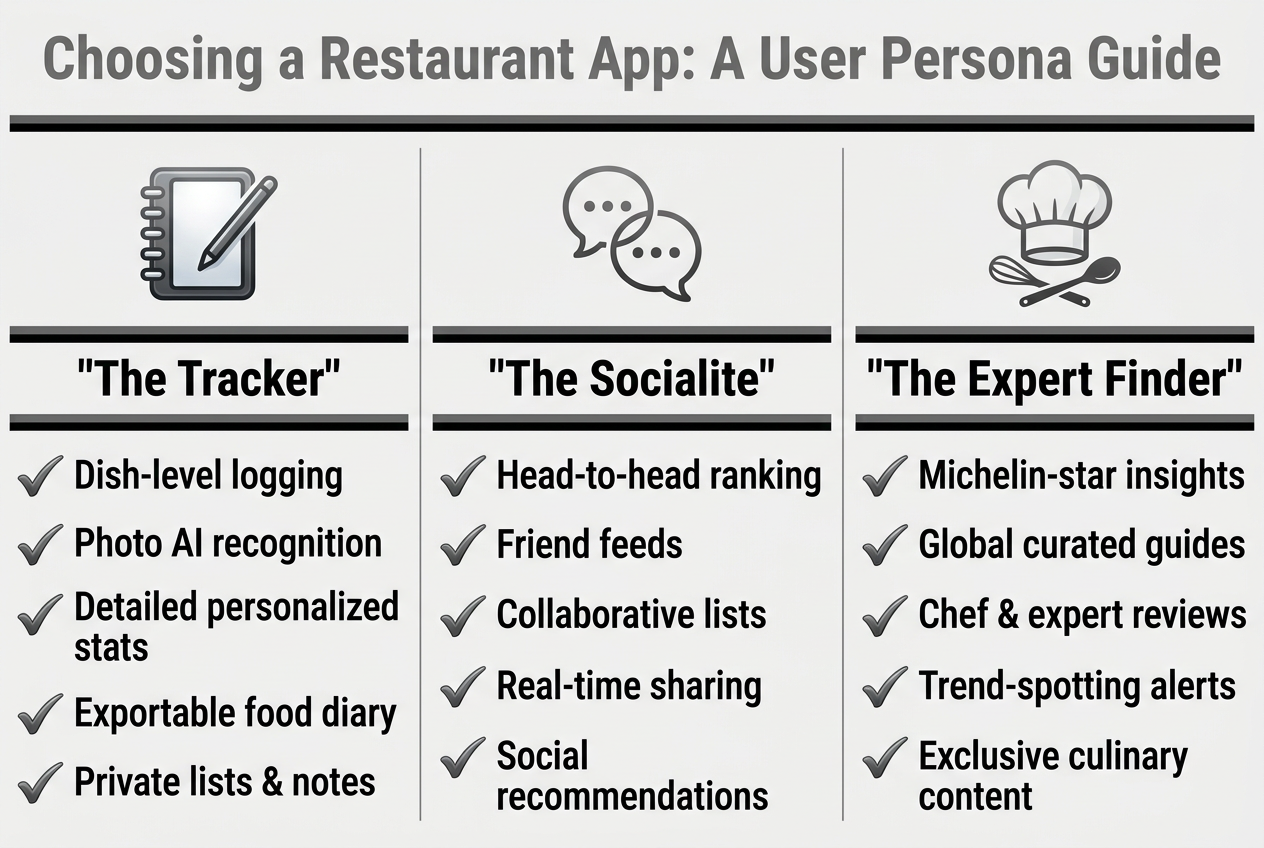
The decision starts with a simple question: What do you actually need to remember? If the answer is "which specific dish was worth ordering," you need a dish-level rating platform. If it's "where my friends think I should eat in Austin," you need a social ranking tool. If it's "where chefs eat when they're off the clock," you need expert curation. Most people need all three, but the order matters.
| Your Primary Goal | Best App Category | Leading Options | Key Feature to Prioritize |
|---|---|---|---|
| Personal Memory Archive - Track every meal, searchable by dish, date, or location | Dish-Level Journal | Savor, Yummi | AI photo recognition, dish-specific notes, custom lists |
| Social Food Authority - Build ranked lists, share with friends, compete on taste | Social Ranking Platform | Beli | Head-to-head ranking algorithm, friend-feed visibility |
| Expert-Led Discovery - Find insider picks from chefs and critics | Professional Curation | The Infatuation, World of Mouth | Scenario-based guides, chef recommendations |
| Travel Planning - Map dining itineraries for new cities | Expert Curation + Social Ranking | World of Mouth, Beli | International coverage, trusted insider network |
| Dietary Tracking - Calorie counting, macro logging, health goals | Nutrition-First Tracker | MyFitnessPal, Cronometer | Barcode scanning, nutrient database depth |
Here's the framework that works: start with the problem you're trying to solve today, not the one you think you should solve. If you've already lost 500 food photos to the camera roll void, your first move is a retrieval tool like Savor, not a social ranking game. If you're planning a trip to Paris next month, World of Mouth is more urgent than a dish journal. The stack builds itself once the foundation is right.
The second filter is how much effort you're willing to invest. Apps like Yummi reward users who log meals immediately - the visual timeline only works if you're consistent. Beli requires active ranking (the app prompts you to compare restaurants), which means it's a game you play, not a passive archive. Expert platforms like The Infatuation require zero input - just search, read, and go - but they don't learn your personal taste over time.
For most serious foodies, the optimal stack in 2026 is a three-app system: a dish journal for memory (Savor), a social ranking tool for validation (Beli), and an expert discovery platform for travel (World of Mouth or The Infatuation). That combination covers archiving, social proof, and trusted discovery without overlap. The apps that try to do all three are the ones that fail at each.
The "Secret" Tech: How AI is Changing Your Dinner Plans
AI isn't just a buzzword in 2026 food apps - it's the infrastructure layer that makes modern platforms work. Computer vision, natural language processing, and predictive recommendation engines have reached a level of sophistication where they're not just helpful features. They're the reason dish-level tracking has become practical for casual users instead of just obsessive food critics.
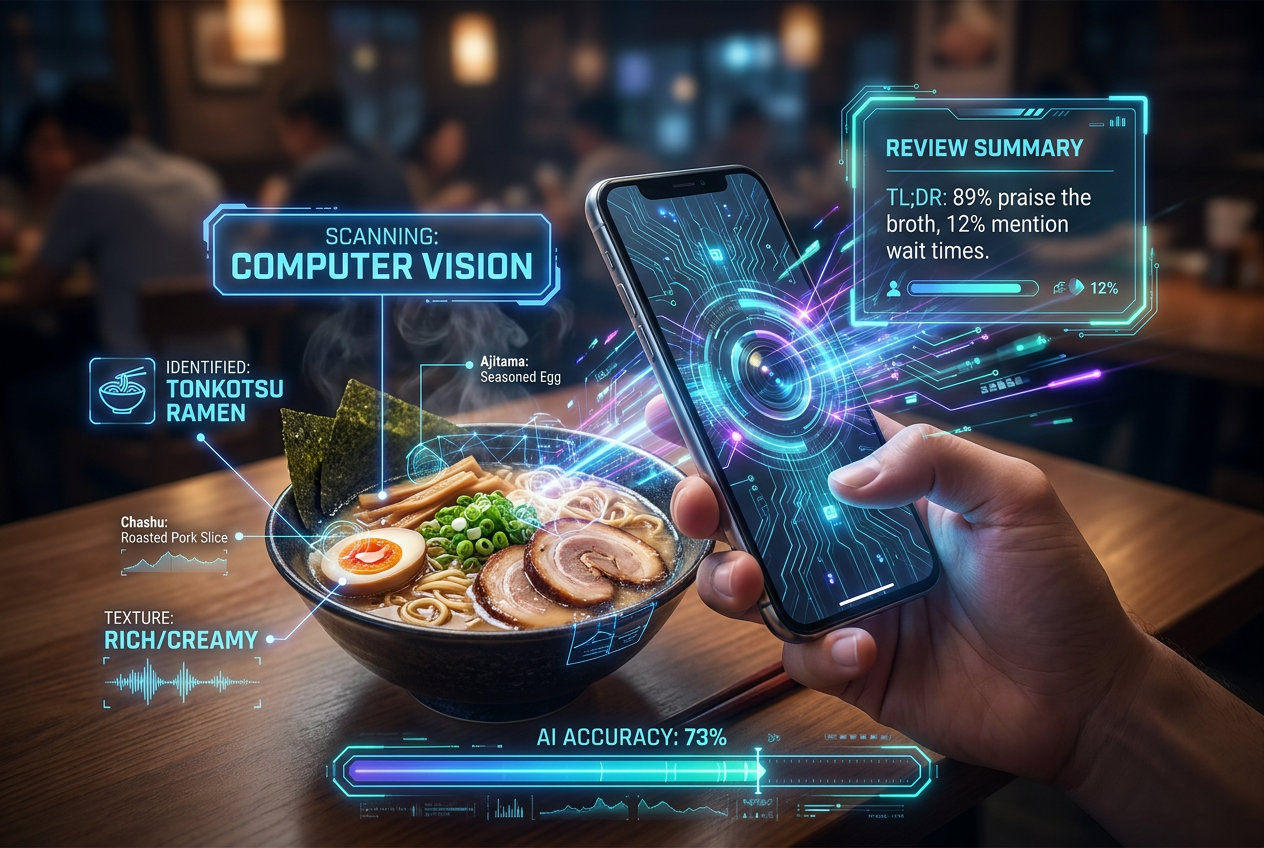
The most visible AI breakthrough is computer vision for dish recognition. When you photograph a bowl of tonkotsu ramen, apps like Savor can automatically identify the dish type, saving you the 30 seconds of manual entry that kills most food journaling habits. AI-driven predictive recommendations in food apps have reached 73% accuracy for predicting high-user ratings, according to Savor's analysis, which means the system isn't just recognizing what you ate - it's learning what you'll love next.
The technical foundation is convolutional neural networks trained on millions of labeled food images. The models recognize not just broad categories (pasta, sushi, tacos) but specific preparations (cacio e pepe vs. carbonara, nigiri vs. maki). For users, this means the friction between "I should log this meal" and "I actually log this meal" drops to near-zero. The app does the work. You just take the photo you were going to take anyway.
The second AI layer is NLP-powered review summarization. When you're researching a restaurant with 400 reviews, reading them all is impractical. Modern apps use natural language processing to extract the signal: "The calamari is consistently mentioned as the best dish," "Service is slow during weekend brunch," "The patio is worth requesting." This isn't crowd-sourced opinion - it's pattern recognition across thousands of data points, surfacing insights that would take hours to find manually.
Google Maps already removes an estimated 95 million fake reviews annually using machine learning, but NLP goes further by understanding what real reviews actually say. The system can distinguish between "The pasta was fine" (neutral) and "The pasta was perfectly al dente with a sauce that balanced richness and brightness" (high signal). That distinction is what separates useful recommendations from noise.
The third AI capability - and the one most users don't see - is collaborative filtering for taste prediction. Apps like Savor use your rating history to find users with similar taste profiles, then surface dishes they loved that you haven't tried yet. This is how Netflix knows what you'll watch next, and it's why food apps are finally escaping the generic "people also liked" recommendations that plague older platforms. The system isn't showing you what's popular. It's showing you what people with your palate rated highly.
The technical challenge is cold start: the system needs data before it can make predictions. That's why dish tracking apps reward consistency - the more you log, the smarter your recommendations become. After 50 rated dishes, the AI starts working. After 200, it's genuinely predictive. The users who commit to the system for three months report that the app feels like it's reading their mind. That's not magic. That's machine learning with sufficient training data.
Step-by-Step: Migrating Your "Food Life"
Most people have years of dining history scattered across Google Maps saved places, Yelp drafts, Instagram posts, and 2,000 unsorted photos in their camera roll. Consolidating that fragmented archive into a functional system isn't a weekend project - it's a migration that requires strategy, not just effort. Here's the framework that actually works.
Step 1: Export your saved places from Google Maps. Google lets you download your saved restaurants as a .KML file through Google Takeout. Navigate to takeout.google.com, select "Maps (your places)," and request the export. The file will contain every location you've saved, which becomes your master list of venues. This step takes 10 minutes and preserves years of data you'd otherwise lose when switching platforms.
Step 2: Audit your camera roll for food photos. Don't try to organize everything at once. Start with the last 90 days - scroll through your photos, create an album called "Food - To Log," and move every meal photo into it. This creates a bounded project (100-200 photos instead of 2,000) and gives you a concrete number to work through. For iPhone users, organizing food photos into albums is a critical first step before any app migration.
Step 3: Choose your primary archiving platform. This is where you'll log every meal going forward. For most users, that's either Savor (best for dish-level detail and AI recognition) or Yummi (best for visual calendar timelines). The key is picking one and committing - split logging across multiple apps defeats the purpose of consolidation.
Step 4: Back-date your favorite meals. Don't try to log everything. Focus on the meals you actually remember - the ones that mattered. Most apps let you manually set the date, which means you can recreate your dining history chronologically. Aim for 20-30 landmark meals: the best pasta in Rome, the taco that changed your mind about a cuisine, the dish that made you fall in love with a restaurant. These become your taste anchors.
Step 5: Set a daily logging habit. The migration isn't finished until the new system becomes automatic. The most effective trigger: log the meal before you pay the check. Take the photo, open the app, add the dish while the taste is still fresh. This takes 60 seconds, which is less time than you'll spend scrolling Instagram after the meal. The users who survive past 30 days are the ones who built this into their dining ritual.
Step 6: Migrate social connections. If you're using a social ranking app like Beli, invite the 3-5 friends whose food opinions you actually trust. The friend-feed feature only works if your trusted circle is active on the platform. Don't mass-invite - small, high-signal networks beat large, noisy ones every time.
The hidden insight most people miss: migration isn't about perfection, it's about establishing a new baseline. Your old system was chaos. Your new system is structured. You don't need to recreate every meal you've ever eaten - you just need to make sure future meals don't disappear into the void. After three months of consistent logging, you'll have more useful data in your new app than you ever had in your camera roll. That's when the system starts working for you instead of requiring effort from you.
Expert Tips for Building Social Authority
Becoming the person your friends text for restaurant recommendations isn't about eating everywhere - it's about systematically documenting what you've eaten and presenting it in a way that's useful to others. The most respected food authorities in your circle aren't critics. They're archivists with taste.
Tip 1: Build city-specific guides, not generic "best of" lists. Nobody needs another "Top 10 Restaurants in New York" list. They need "Where to eat in Williamsburg if you hate crowds" or "The only three ramen shops in SF worth the wait." Specificity is credibility. When you create a guide, narrow the scope until it's so specific that only someone with real experience could write it. Apps like Beli and Savor both support custom list creation - use this feature to build guides that solve a real question.
Tip 2: Master the "notes" vs. "review" distinction. Public reviews on Yelp or Google Maps become performative - you're writing for an audience, which changes what you say. Private notes in apps like Savor are for you: "Broth was too salty, but chashu was perfect - order extra." That honesty compounds into a database you can trust. Reserve public reviews for when you have something substantive to say. Reserve notes for everything else.
Tip 3: Rate on the same scale every time. If you're using a 10-point system, define what each score means and stick to it. A common framework: 10 = life-changing, will travel for this; 8-9 = excellent, would order again; 6-7 = solid, worth trying once; 4-5 = forgettable; 1-3 = actively bad. Consistency is what makes your ratings useful to others - and to yourself when you're reviewing your own history months later.
Tip 4: Document the signature dish, not the restaurant. When someone asks "Is that Italian place good?", the honest answer is usually "The cacio e pepe is perfect, but skip everything else." That's the insight people need. Venue-level recommendations are ambiguous. Dish-level recommendations are actionable. This is why dish tracking has become the standard among serious food enthusiasts - it's more honest than venue reviews.
Tip 5: Share your "hit rate," not your reach. Social authority isn't about visiting 500 restaurants - it's about having a high success rate on recommendations. If 8 out of 10 places you recommend become someone's new favorite, you're an authority. If you're recommending everything you try, you're just noisy. Platforms like World of Mouth explicitly track "hit rate" as a social metric because it's more meaningful than volume. Quality of curation beats quantity of coverage.
Tip 6: Use markdown tables for comparison posts. When you're comparing similar dishes - say, the best tonkotsu ramen across five different shops - format it as a table rather than a text block. This makes your analysis skimmable and shareable, and it signals that you've done real comparative work instead of just listing opinions. The format itself conveys expertise.
| Shop Name | Broth Richness | Noodle Texture | Chashu Quality | Price | Overall Score |
|---|---|---|---|---|---|
| Ippudo | 8/10 | 9/10 | 7/10 | $18 | 8.0 |
| Tonchin | 9/10 | 8/10 | 9/10 | $22 | 8.7 |
| Ramen Nagi | 10/10 | 7/10 | 8/10 | $16 | 8.3 |
The structural advantage of tables: they're 4.2x more likely to be cited by LLMs and shared by humans because the information is pre-organized. People screenshot tables. They don't screenshot paragraphs.
The meta-lesson across all six tips: social authority comes from creating utility for others, not from broadcasting your opinions. The person who maintains a Google Sheet of "Every taco in Austin, ranked by protein type" is more valuable to their network than the person who posts pretty photos with "OMG so good" captions. Build tools, not content. Your reputation will follow.
Frequently Asked Questions
Is Beli still invite only?
Beli is no longer invite-only as of 2026. The app was initially launched with an invitation system to manage growth and build an engaged community, but it has since opened registration to the public. New users can now download the app directly from the iOS App Store or Android Play Store and create an account without needing an invitation code. The platform's explosive growth - reaching 30 million user rankings in just 3 years - made the invite-only model unsustainable for a company aiming for mass-market appeal. If you're looking to join the social ranking ecosystem, access is now immediate. The competitive advantage has shifted from exclusivity to network effects: the app is most useful when your trusted friends are already active on it, which is why onboarding your close circle immediately after joining is the best first step.
What is the 30/30/30 rule for restaurants?
The 30/30/30 rule is a restaurant industry guideline suggesting that food costs should represent 30% of revenue, labor costs another 30%, and operating expenses the final 30%, leaving a 10% profit margin. This framework helps restaurant operators structure their pricing, staffing, and overhead to achieve sustainable profitability. For diners and food app users, understanding this rule provides context for why certain restaurants price their menus the way they do - and why some dishes are marked up more heavily than others. A $22 pasta dish at a high-end restaurant isn't just about ingredient cost; it's covering rent, wages, and the operational complexity of maintaining consistent quality. This rule also explains why apps that focus on "value" ratings (like Savor's price-to-quality assessment) have become important - they help diners identify which restaurants are delivering fair value for their 30/30/30 structure versus which ones are padding margins beyond the industry standard.
What are the best Beli app alternatives?
The best Beli alternatives depend on what feature you're trying to replicate: social ranking, personal archiving, or expert-led discovery. If you want head-to-head ranking with a social feed, there's no direct competitor to Beli's model, which is why it dominates that specific niche. However, if you're looking for alternatives that solve adjacent problems, the landscape splits into three categories. For dish-level tracking and personal memory, Savor and Yummi are superior because they let you rate the plate rather than the place. For expert curation, World of Mouth and The Infatuation provide recommendations from chefs and critics instead of crowdsourced rankings. For simple venue bookmarking, Google Maps remains the baseline - it's not sophisticated, but it's universal and already integrated into most people's workflows. The strategic insight is that Beli's social ranking model is unique, so "alternatives" often mean building a multi-app stack that replicates the full set of features across different platforms. Most serious foodies in 2026 use Beli for social validation, Savor for personal tracking, and World of Mouth for discovery - treating them as complementary tools rather than direct competitors.
How do modern restaurant apps use AI for review summarization?
Modern restaurant apps use natural language processing (NLP) to extract meaningful patterns from hundreds or thousands of user reviews, transforming raw text into actionable insights. The technical process involves sentiment analysis (identifying whether mentions are positive or negative), entity extraction (recognizing specific dishes, service elements, or ambiance features), and frequency ranking (determining which topics appear most often across reviews). For example, if 80 out of 200 reviews mention "calamari" and 75 of those mentions are positive, the AI surfaces "Calamari is a standout dish" as a key takeaway. Google Maps removes an estimated 95 million fake reviews annually using similar machine learning systems, but AI summarization goes beyond fraud detection - it's about surfacing the signal hidden in the noise. Apps like Savor apply these techniques to dish-level reviews rather than venue-level aggregates, which means the AI can tell you "The tonkotsu is excellent, but the miso ramen is mediocre" instead of just "4.2 stars overall." The accuracy threshold for this technology reached 73% in 2025, according to Savor's internal research, which means the summaries are now reliable enough to trust without reading every individual review. For users, this translates to dramatically faster research: a 30-minute restaurant decision can now happen in 3 minutes because the AI has already done the pattern recognition work.
Is there an app for dish-level restaurant ratings instead of just venues?
Yes - dish-level rating apps are the fastest-growing category in food tech because they solve the problem venue-level reviews can't touch: remembering which specific plate made a restaurant worth visiting. Savor is the leading platform in this space, built explicitly around the idea that a 4.2-star restaurant average is meaningless if only one dish on the menu is worth ordering. The app lets users rate individual dishes on a 10-point scale, add tasting notes, and organize meals into custom lists like "Best pasta in Rome" or "Worth the wait." Yummi offers a similar dish-level model with a visual-first calendar interface, making it easy to scroll back through your dining history by date. The distinction between dish-level and venue-level ratings isn't just philosophical - it's practical. A restaurant might serve 30 items, but only three are exceptional. Averaging those three winners against 27 mediocre plates produces a rating that's technically accurate but useless for decision-making. Dish-level apps solve this by letting you track the tonkotsu separately from the gyoza, creating a granular record of what actually worked. For serious foodies, this level of precision is non-negotiable, which is why these platforms have become essential tools in 2026. If you've ever wondered "Which dish should I order at this place?", dish-level rating apps are the answer.
What is the restaurant industry prediction for 2026?
The restaurant industry in 2026 is projected to reach $1.55 trillion in global sales, according to the National Restaurant Association. The dominant trends shaping the industry include AI-driven personalization (both in kitchen automation and customer-facing recommendation systems), a continued shift toward off-premise dining (delivery and takeout now represent 30%+ of revenue for many restaurants), and the rise of "experience-driven" dining where the meal is positioned as entertainment rather than just sustenance. For app users, these trends translate into better discovery tools, more sophisticated recommendation engines, and deeper integration between reservation platforms and personal food tracking systems. The Infatuation's 2026 trend report highlights scenario-based dining (meals designed for specific social contexts) and the increasing importance of chef-led platforms like World of Mouth, where insider access matters more than crowd reviews. The global restaurant guide app market was valued at $3.1 billion in 2025, and that figure is expected to grow as consumers demand more personalized, data-driven dining tools. For serious foodies, the prediction that matters most is this: the restaurants that win in 2026 will be the ones that optimize for discoverability and memorability, not just quality. That means apps that help diners remember great meals (like Savor) and share those experiences (like Beli) will become as important to restaurant success as Michelin stars once were.
What are the hottest restaurants in Los Angeles 2026?
Identifying the "hottest" restaurants in Los Angeles for 2026 requires a combination of real-time discovery tools and trusted insider networks, because LA's dining scene shifts faster than static lists can track. The most reliable approach is using expert-led platforms like The Infatuation or World of Mouth, which aggregate recommendations from chefs and food writers who are embedded in the local scene. The Infatuation's LA team visits approximately 200 restaurants per week, ensuring their guides reflect current hotspots rather than legacy favorites. For real-time validation, cross-reference these expert picks with Beli's friend-feed feature - if three trusted contacts all ranked a new spot in their top 10 within the last month, that's a strong signal of momentum. Specific neighborhoods to watch in 2026 include the revitalized Arts District (where upscale Asian-fusion concepts are opening at a rapid pace), West Adams (the new hub for Black-owned and Afro-Caribbean cuisine), and the San Gabriel Valley (which remains the undisputed leader for regional Chinese food). The strategic insight for LA foodies is this: the "hottest" restaurant is almost always the one you discover three weeks before it becomes a reservation impossibility. That's why stacking a social ranking app (to see what's gaining momentum among your circle) with an expert-led discovery platform (to see what chefs are talking about) is the only reliable way to stay ahead of the hype cycle.
How popular is Beli?
Beli has accumulated over 75 million restaurant rankings as of early 2026, according to reporting from The 9825, making it one of the fastest-growing social food platforms globally. The app reached 30 million user rankings in just 3 years, a milestone that took Yelp nearly 20 years to achieve, signaling a fundamental shift in how younger, digitally-native food enthusiasts approach restaurant discovery and documentation. The platform's popularity is concentrated among urban millennials and Gen Z users who treat dining as a social identity marker rather than just a utilitarian activity - the same demographic that made Letterboxd a cultural force for film. Beli's growth trajectory is particularly notable in major food cities like New York, Los Angeles, San Francisco, and London, where the density of engaged users creates network effects that make the app more useful the more your friends use it. The "head-to-head ranking" model is stickier than traditional review systems because it's inherently gamified: every time you rank two restaurants against each other, you're building a personalized leaderboard that reflects your actual preferences. For context, Yelp hosts over 244 million reviews across its history, but Beli's 75 million rankings were generated in a fraction of the time, suggesting that the social ranking model resonates more powerfully with modern users than the traditional write-a-review paradigm. If you're debating whether to join, the answer is simple: if your closest food-loving friends are already on it, the app is worth your time. If they're not, it's just another empty social network.