
How to Start Intuitive Eating and Reclaim Your Palate
Alex the juice queen
Alex hunts for the best juice bars and presses. She rates every sip and saves her favorites in Savor.
Starting your intuitive eating journey is less about following a new set of rules and more about unlearning the old ones. It’s a shift from listening to...
Starting your intuitive eating journey is less about following a new set of rules and more about unlearning the old ones. It’s a shift from listening to external diet culture to trusting your body's internal wisdom. The core practice is refreshingly simple: learn to listen to and honor your body's natural hunger and fullness cues without judgment.
This isn't another wellness trend. It's a sustainable path to making peace with food, finally stepping off the exhausting treadmill of restriction and guilt.
Moving Beyond Diets to Trust Your Body
If you've spent years jumping from one diet to the next, you know the drill. Each new plan promises the world but usually just delivers temporary changes and a more complicated relationship with food. Intuitive eating is the exit ramp from that chaotic cycle.
It’s not a diet at all; it’s an evidence-based framework for reconnecting with the innate intelligence you were born with. The goal isn’t weight loss—it's restoring a peaceful, trusting relationship with food and your body. Think of it this way: we’re all born knowing when we’re hungry and when we’re full. Diet culture, with its rigid rules and food moralizing, systematically erodes that trust. Learning to eat intuitively is simply the process of rebuilding it.
A Global Shift in Perspective
This isn't just a niche idea; the benefits are recognized worldwide. A huge study surveying 6,272 young adults across eight countries—including places as different as the United States, Japan, and Spain—found something remarkable. Higher intuitive eating scores consistently predicted better body satisfaction, higher self-esteem, and more balanced health outcomes, no matter the cultural backdrop.
The research was clear: people who relied on their internal body cues instead of external diet rules experienced less emotional eating and simply felt better in their own skin.
Of course, moving beyond diets means you have to quiet that nagging inner critic that diet culture helped create. Learning how to manage those thoughts is a huge piece of the puzzle. A great place to start is by exploring practical guides on stopping negative self-talk to foster a more compassionate relationship with yourself.
Understanding the Core Principles
Intuitive eating is built on ten core principles that work together, guiding you away from the dieting mindset and toward a genuine connection with your body. These aren't strict rules to be perfected overnight. Think of them as concepts to explore with curiosity and patience. They’re your roadmap for the journey ahead.
Key Takeaway: Intuitive eating is a practice of self-discovery and trust, not a set of rules to follow perfectly. The focus shifts from controlling food to honoring your body's needs and experiences.
To get started, it helps to have a quick reference for the foundational ideas behind intuitive eating. The table below breaks down the 10 core principles and what they actually look like in practice.
The 10 Core Principles of Intuitive Eating
A quick reference to the foundational ideas behind intuitive eating, helping you understand the full scope of this practice.
| Principle | What It Means in Practice |
|---|---|
| Reject the Diet Mentality | Acknowledging that diets don't work long-term and letting go of the hope for a quick fix. |
| Honor Your Hunger | Responding to the first biological signs of hunger by fueling your body adequately. |
| Make Peace with Food | Giving yourself unconditional permission to eat all foods without guilt. |
| Challenge the Food Police | Silencing the internal voice that judges your food choices as "good" or "bad." |
| Discover the Satisfaction Factor | Finding pleasure and satisfaction in the eating experience, which helps you feel content. |
| Feel Your Fullness | Learning to listen for the signals that you are no longer hungry and respecting them. |
| Cope with Emotions with Kindness | Finding non-food coping mechanisms for difficult emotions like stress, boredom, or sadness. |
| Respect Your Body | Accepting your genetic blueprint and treating your body with dignity and respect. |
| Movement—Feel the Difference | Shifting the focus from exercising to burn calories to moving in ways that feel good. |
| Honor Your Health with Gentle Nutrition | Making food choices that honor your health and taste buds while making you feel well. |
These principles work in harmony to help you tune out the noise of diet culture and tune into your body's wisdom. As you begin to explore them, remember to be patient and kind with yourself—this is a journey, not a race.
Your First Week of Practical Actions
Diving into intuitive eating feels a lot more real—and a lot less overwhelming—when you have a few concrete things to try. Think of this first week not as a rigid plan, but as a series of gentle experiments. It's all about tuning back into your body. There's no pass or fail here. Only curiosity.
The whole point is to take small, deliberate steps away from the constant noise of diet culture and start listening to your own internal cues again. Each day is just a chance to practice. One day, that might mean finally deleting that calorie-counting app. The next, you might mindfully reintroduce a food you’ve labeled “off-limits” for years, paying close attention to what it actually feels like to eat it.
Shifting from Tracking to Tasting
One of the most powerful moves you can make is to change how you think about your food log. Instead of a journal filled with numbers, calories, and macros, it becomes a private space to explore taste, texture, and satisfaction. This isn't about judging your choices; it's about finally understanding them.
A private food diary helps you track tastes, not grams. You’ll start to build a personal database of what truly satisfies you, connecting the dots between what you eat and how you feel, both physically and emotionally. You're building a food memory that serves you, not one that polices you.
This simple, three-step process is the core of checking in with your body before, during, and after you eat.
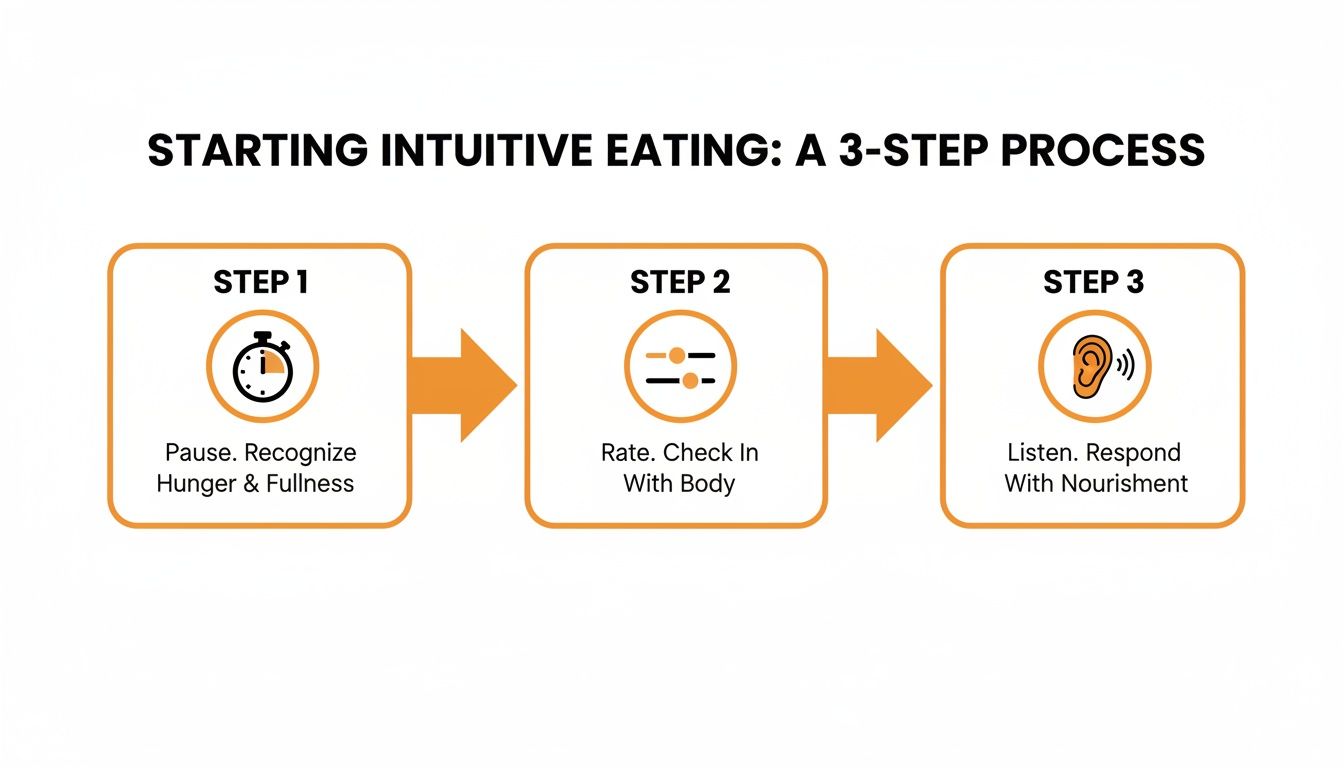
It’s all about creating a mindful pause, helping you shift from eating on autopilot to intentional nourishment.
A Simple Framework for Your First Seven Days
Here’s a sample structure you can play with for your first week. Just pick one action each day that feels doable. The key is to start small and build momentum with curiosity, not pressure.
Day 1: Declutter Your Diet Mentality
- Action: Unfollow social media accounts that promote diet culture, weight loss "transformations," or "what I eat in a day" videos that make you feel restricted.
- Journal Prompt: "What diet rule am I letting go of today?"
Day 2: Practice Mindful Observation
- Action: At one meal, put your phone away and turn off the TV. Give your full attention to the colors, smells, and textures on your plate.
- Journal Prompt: "What did I notice about my food today that I usually miss?"
Day 3: Honor Your Hunger Cues
- Action: Try to eat when you first notice gentle hunger signals, rather than waiting until you’re ravenous. Pack a satisfying snack, just in case.
- Journal Prompt: "How did my body feel when I ate at a '5' on the hunger scale versus an '8'?"
Day 4: Reintroduce a “Forbidden” Food
- Action: Pick one food you've labeled as "bad." Buy a single serving, sit down, and eat it slowly without any distractions. Focus only on the sensory experience.
- Journal Prompt: "Did this food taste as good as I remembered? How did I feel physically and emotionally afterward?"
Day 5: Focus on Satisfaction
- Action: Before a meal, ask yourself, "What do I really feel like eating?" Try to honor that craving and notice how it feels to be truly satisfied.
- Journal Prompt: "What made this meal satisfying? Was it the taste, the texture, or something else?"
Day 6: Do a Gentle Body Check-In
- Action: Take five minutes to just notice how your body feels. Are you tired, energized, stiff, or relaxed? Do this without any judgment.
- Journal Prompt: "What is one thing my body needs from me today, besides food?"
Day 7: Reflect and Rate Like a Critic
- Action: Look back at your journal entries from the week. What discoveries did you make?
- Journal Prompt: "What was the most surprising thing I learned about my own eating habits or preferences this week?"
Remember: This isn't a checklist you have to perfect. It's a series of invitations. If a day feels too challenging, just observe that feeling and try again when you’re ready. The real win here is just staying curious about your own experience.
As you explore these actions, you'll start gathering some really valuable data about your unique preferences. If you want to go a step further, you can discover more about your palate by taking our Taste Profile Quiz. It's a great tool for helping you identify and articulate the flavors you love most, which makes finding satisfying foods even more intuitive.
Learning to Decode Your Body's Signals
One of the biggest skills you'll build on this journey is learning to speak your body's language again. Diet culture spent years training us to ignore, suppress, or completely misread our internal cues, but intuitive eating is all about tuning back in. The first thing to understand is that not all hunger feels the same.
There’s a huge difference between physical hunger and emotional hunger. Physical hunger is the kind that builds gradually. You might notice a gentle gnawing in your stomach, a dip in energy, or a bit of brain fog setting in. Emotional hunger, on the other hand, often hits like a lightning bolt—sudden, intense, and usually craving one very specific thing for comfort or distraction.
Learning to just pause and ask, "What am I truly feeling right now?" is the first real step in decoding these messages from your body.
Mastering the Hunger and Fullness Scale
A game-changing tool for this is the hunger and fullness scale. It’s a simple 1-to-10 rating system that helps you put a number to your body’s signals. Instead of eating because the clock says it's noon, you start eating based on your own internal meter.
This isn't about getting a "perfect" score. It’s about gathering personal data. By checking in with yourself before, during, and after you eat, you'll start to recognize what true, comfortable satisfaction actually feels like for you.
- 1 - Ravenous: You feel weak, dizzy, maybe even a little irritable. Getting to this point almost always leads to overeating later.
- 3 - Gently Hungry: The first physical signs are showing up. You know it’s time to start thinking about your next meal.
- 5 - Neutral: You’re neither hungry nor full. This is a peaceful, comfortable state.
- 7 - Satisfied and Full: You feel content and pleasantly full. No discomfort, no bloating. Just right.
- 10 - Painfully Stuffed: This is the uncomfortable zone—bloated, maybe even a little nauseous.
A great starting point is to aim to eat when you’re around a 3 or 4 and stop when you hit a 6 or 7. This helps you stay out of the extreme zones, keeping your energy stable and your body happy.
Your Pre-Meal Mental Checklist
Getting into the habit of decoding your body's signals takes practice. To make it a little easier, try using a quick mental checklist before you eat. This isn't a rigid quiz, but more of a gentle moment of self-inquiry to make sure you’re giving your body what it truly needs.
Key Insight: This simple pause creates a powerful space between an impulse and an action, allowing you to respond to your body with intention rather than reacting on autopilot.
Before you take your next bite, take a breath and silently ask yourself:
- What’s my hunger level right now? Use the 1-10 scale for a quick reading.
- What does my body physically feel like it needs? Am I craving something light and fresh, or something warm and hearty?
- What tastes and textures sound good? Honoring what you find satisfying is a huge part of this. For a deeper dive, check out our guide on what are the five basic tastes.
- Is this physical hunger or an emotional trigger? If it’s an emotion, what else might I need right now that isn't food?
To really lean into intuitive eating, you'll need to get comfortable with this kind of internal awareness. The practice of cultivating mindfulness during challenging moments can be a massive help here.
Prioritizing these physical cues is a cornerstone of intuitive eating, and the research backs it up. A recent study found that intuitive eating practices act as a protective shield against health risks, even when routines are disrupted. In fact, one specific part of intuitive eating—Body-Food Choice Congruence—was shown to reduce the odds of being overweight by 43.3%.
Making Peace with Food and Finding Freedom
This is one of the most challenging—and liberating—principles of intuitive eating: giving yourself unconditional permission to eat.
For years, maybe decades, diet culture has drilled into us that some foods are “good” and others are “bad.” This creates a forbidden fruit effect. The moment you tell yourself you can’t have something, it’s all you can think about. That restriction is the very engine that powers the brutal cycle of deprivation, intense cravings, and backlash eating.
When a food is off-limits, it doesn’t just quietly disappear from your mind. It gets a spotlight. The craving intensifies until you finally “give in,” which often leads to overeating because of a deep-seated fear that you’ll have to restrict it again tomorrow. Making peace with food means calling a truce in this war against yourself.
Reintroducing Forbidden Foods Mindfully
I hear this fear all the time: "If I let myself eat anything, I'll just live on junk food forever!" It's a valid concern, but it’s almost never what actually happens. The key isn't to unleash a free-for-all, but to reintroduce these foods with a sense of mindful curiosity. Think of it less like a rebellion and more like a controlled experiment where you're the lead researcher of your own body.
Instead of tearing into a bag of chips while standing in the pantry, shrouded in guilt, create a calm, focused environment. Sit down without your phone or the TV. Take a moment to actually experience the food. Notice its aroma, the texture, the layers of flavor as you chew. When you do this, you knock the "forbidden" food off its pedestal and see it for what it is—just food. You can then rate it like a critic, asking yourself how satisfying it truly is.
Key Takeaway: When you give yourself permission to eat anything, you strip that food of its power over you. Eating becomes a choice based on what you truly want and enjoy, not a reaction against a set of rules.
This process of rebuilding trust with yourself is a profound shift. It’s a skill that feels like it should be innate, but it's surprisingly rare. For instance, in an Australian survey of 200 adults, only 17.6% were found to be practicing intuitive eating. The study noted a huge gender gap—26.1% of men ate intuitively compared to just 9.1% of women—but for those who did, it strongly correlated with higher self-esteem. Read the full research about these intuitive eating findings.
A Practical Walk-Through for Making Peace
Ready to try it? Here’s a simple, step-by-step process you can use to mindfully reintroduce a food you've labeled as "bad."
- Choose Your Food: Pick one thing you've been craving but restricting. A donut, a real-sugar soda, a bag of chips—anything works.
- Acquire a Normal Portion: Buy a single serving. A single donut, not a dozen. This helps defuse that "last supper" feeling that can trigger overeating.
- Set the Stage: Find a comfortable spot where you won't be distracted. Put the food on a real plate. Take a second to just look at it.
- Engage Your Senses: Before your first bite, what do you smell? What does it look like up close?
- Taste with Intention: Take one bite and chew it slowly. I mean really slowly. What’s the initial taste? The texture? The aftertaste?
- Check In with Yourself: Now, ask a few questions. Does this taste as good as I imagined? Is it hitting the spot? How does my body feel right now?
Using a food journaling app can be a game-changer here, but not for calorie counting. You're not logging numbers; you’re creating a private database of your own taste discoveries. This is how you start to track what truly makes you feel good, both physically and mentally.
Trusting the Process of Balance
As you keep practicing this, something fascinating happens. Those once-forbidden foods start to lose their sparkle. Their intense allure fades. When you know, truly know, that you can have a cookie anytime you want one, you might find you don't actually want one every single day.
Your body, finally free from the stress of deprivation, will start asking for a wider variety of foods. You'll find yourself craving a crisp, refreshing salad just as much as a slice of pizza because you're finally listening to what your body needs for energy, nourishment, and pure satisfaction. This is gentle nutrition in action. It doesn’t come from a rulebook; it arises naturally when you learn to trust your body again.
Troubleshooting Common Roadblocks on Your Journey
Let's be real for a moment. Starting your intuitive eating journey is a massive step toward food freedom, but the path isn't always a straight, easy line. Roadblocks are going to pop up—that’s just a normal, expected part of unlearning years and years of diet culture noise.
Think of these moments not as failures, but as data points. They're valuable opportunities to learn more about yourself and fine-tune your approach with a heavy dose of self-compassion. This is where the rubber meets the road, moving beyond theory and into the real world where you need practical tools. Facing a side-eye comment from a well-meaning family member or navigating a holiday party can feel like a minefield at first. The goal here is to build your confidence so you can handle these situations without getting pulled back into old, restrictive patterns.
Navigating Comments From the Food Police
One of the first and most common hurdles is dealing with unsolicited comments about what’s on your plate. It might come from a friend, a coworker, or even your own mother. The "food police" are everywhere, and their words can make you second-guess your entire journey.
Before you get defensive, try to remember this: their comments are almost always a reflection of their own complicated relationship with food, not a judgment on your worth. You don't owe anyone a dissertation on intuitive eating, but having a few prepared, respectful responses in your back pocket can make all the difference. A simple, firm boundary can shut down the conversation gracefully.
A Few Scripts to Try:
- For the concerned friend: "I really appreciate you looking out for me. I'm actually working on listening to my body and trusting its cues, and it's been a really positive shift for me."
- For the diet-obsessed coworker: "Thanks, but I'm not really focusing on food rules anymore. This is what feels good for my body today."
- For a direct question about your eating: "I’m practicing intuitive eating, which means I'm moving away from labeling foods as 'good' or 'bad.' My body and I are figuring things out together."
Key Takeaway: You are the one and only expert of your own body. Setting gentle but clear boundaries protects your energy and reinforces your commitment to trusting yourself over anyone else's opinion.
Handling Guilt After Overeating
It's going to happen. There will be times when you eat past the point of comfortable fullness. In the dieting world, this is a cardinal sin, a "failure" that requires you to "make up for it" with restriction tomorrow. In intuitive eating, it's just information. That’s it.
Instead of spiraling into a pit of guilt, I want you to get curious. This is a perfect moment to pull out your private food diary and track the discovery, not the "mistake." Ask yourself some compassionate questions to understand what was really going on.
- What was happening right before I started eating? Was I stressed? Bored?
- Was I distracted by my phone or the TV, or was I paying attention to my meal?
- How did my body feel physically afterward? (Forget emotion for a second—were you bloated, tired, energized?)
- What's one thing I could do differently next time to feel more comfortable?
This simple shift reframes the moment from a moral failing into a learning experience. You might notice you tend to overeat when you're watching TV or when you let yourself get absolutely ravenous. That isn't a character flaw; it’s a useful piece of information you can use to support yourself better in the future.
Managing Social Events Centered Around Food
Parties, holidays, and dinners out can feel like walking through a minefield when you're just starting out. The pressure to eat certain things—or to pointedly avoid others—can be intense. The key is to go in with a plan that centers your own needs and comfort.
Before you even leave the house, take a quiet moment to check in with your hunger levels. Sometimes, eating a satisfying snack beforehand can prevent you from arriving so hungry that you're overwhelmed. This gives you more mental space to make conscious, gentle choices.
Once you're there, scan the options and identify what genuinely looks and sounds good to you. Give yourself unconditional permission to eat what you truly want, to savor it, and to stop when you feel satisfied. You don't have to try a bite of everything, and you certainly don't have to clean your plate to please the host. Your only job is to honor your body. This practice of progress, not perfection, is what builds lasting trust and true food freedom.
Your Top Questions About Intuitive Eating
As you start dipping your toes into intuitive eating, it’s completely normal for a million questions to pop up. You’re essentially unlearning years—maybe decades—of diet culture rules, and that process is messy. Having clear, honest answers to the big concerns can make you feel a whole lot more confident as you move forward.
Think of this as your go-to guide for those initial "am I doing this right?" or "what if...?" moments. It's natural to wonder about weight, how long this all takes, and whether you'll ever eat a vegetable again. Let’s get into it.
"Will I Just Gain Weight If I Eat Whatever I Want?"
This is, without a doubt, the number one question on everyone’s mind. And it's a completely valid fear. When you start intuitive eating, the goal is to heal your relationship with food, not to manage your weight. Because of this, your body might do one of three things: your weight could go up, it could go down, or it could stay pretty much the same as it settles into its natural, comfortable set point.
For many people who have been trapped in the restrict-binge cycle, letting go of the rules actually leads to more weight stability in the long run. The hardest part? Approaching any changes on the scale with neutrality instead of panic. This is a huge piece of the puzzle.
"Okay, So How Long Will This Take?"
There’s no finish line here. Intuitive eating isn't a 12-week program you graduate from with a certificate. It’s a lifelong practice, a new way of relating to food and your body. The journey is deeply personal and really depends on your own history with dieting.
Some people feel a major shift in just a few months. For others, especially those who have been dieting for most of their lives, it might take a year or more to feel truly free. The goal isn't to race to some imaginary endpoint; it's to be patient and curious with yourself along the way.
Key takeaway: Progress isn’t measured by a timeline. It’s measured by the growing sense of peace you feel around food and the increasing trust you have in your body.
"Can I Still Be Healthy While Doing This?"
Absolutely. In fact, most people find they eat a wider and more nourishing variety of foods once the fight is over. One of the core principles is "Honor Your Health with Gentle Nutrition," but it’s the last principle for a reason. You have to make peace with food first.
This isn't about forcing down kale salads. It’s about what happens when you truly neutralize all foods. When a brownie is no longer a forbidden, high-stakes prize, you can choose it—or you can choose an apple—based on what your body is actually asking for. It’s the difference between making choices from a place of self-care versus a place of restriction.
"What If I Have a Medical Condition That Requires a Diet?"
Intuitive eating is flexible enough to work alongside medical needs. You can absolutely follow a specific dietary framework—for celiac disease, diabetes, or food allergies—while still honoring your body’s internal cues.
The key is to work on honoring your hunger, fullness, and satisfaction within the guardrails of the foods that are safe and appropriate for your health. This is where working with a registered dietitian who understands both your medical condition and intuitive eating is a game-changer. They can help you create a plan that feels supportive, not restrictive.
As you move forward, remember that the goal is to track your discoveries, not your calories. Savor is designed to be your private food diary, a place to remember every taste, texture, and satisfying meal along the way. Stop forgetting what you truly love and start building a personal food story you can actually rely on.