
The 2026 Japan Food Tech Stack: Finding and Booking the Best Local Meals
Harry the matcha king
Harry is our resident matcha obsessive. He’s tasted hundreds of bowls and tracks every cup in Savor.
The 2026 Japan Food Tech Stack: Your Complete Guide to Discovering, Booking, and Remembering Every Meal Picture this: you're three weeks into planning your...
The 2026 Japan Food Tech Stack: Your Complete Guide to Discovering, Booking, and Remembering Every Meal
Picture this: you're three weeks into planning your Tokyo trip, scrolling through Google Maps at 2 AM, and every sushi spot has 4.7 stars. You screenshot a dozen places, save a few Reddit threads, and tell yourself you'll "figure it out later." Fast forward to Day 3 in Shibuya - you've got 47 unsorted phone photos of amazing meals you can barely remember, no idea which ramen shop was the life-changing one, and your camera roll is now a 1,200-photo graveyard of untagged food moments you'll never be able to search or reconstruct.
That scattered approach compounds. By the end of most Japan trips, travelers have eaten 40+ memorable dishes across a dozen neighborhoods, but they can't recall which izakaya served that perfect yakitori, which station exit led to that hidden soba counter, or what the place was even called. The photos exist, but the searchable memory doesn't. What started as a simple discovery gap has become a curation crisis - not because the information doesn't exist, but because no one taught you the actual system locals use to navigate Japan's 890,000 registered food establishments.
What follows is the complete picture - the three-app tech stack that solves discovery, logistics, and memory in Japan's unique dining ecosystem, why your Google Maps habit is actively working against you, and how the 3.5-star threshold changes everything about how you evaluate restaurants in this country.
Key Takeaways
- Only 3% of restaurants on Tabelog achieve a 3.5 rating or higher, making it the single most important quality threshold in Japan's dining landscape.
- The November 2025 Tabelog app update introduced full English language support and international booking capability, eliminating the primary barrier that forced travelers to rely on Google Maps.
- A ¥440 (approximately $3) non-refundable booking fee now applies to international reservations through Tabelog's multilingual platform.
- Station-based search is the "pro move" in Japan - neighborhoods are too vague in a city like Tokyo with over 150,000 registered eating and drinking establishments.
- The optimal Japan food tech stack uses three distinct tools: Tabelog for discovery, AutoReserve or Gurunavi for booking logistics, and a dish-tracking app like Savor to prevent the "camera roll black hole."
- Traditional review apps fail in Japan because they focus on venue ratings instead of dish-level tracking, leaving travelers unable to search or reconstruct their food memories.
Table of Contents
- Why Your 4.8 Google Star Habit Is Failing You in Japan
- The 2026 Japan Food Tech Stack: The 3 Apps You Actually Need
- What Is the Most Popular Food Review App in Japan?
- Is There an English Version of Tabelog?
- Pro-Level Filtering: How to Find "The Spot"
- The Logistics Cheat Sheet: Booking Without a Japanese Phone Number
- Why Are Tabelog Ratings So Low Compared to Google Maps?
- Beyond Discovery: How to Archive Your Japan Food Map
- Frequently Asked Questions
Why Your 4.8 Google Star Habit Is Failing You in Japan
The average Google Maps rating for restaurants in Japan hovers around 4.5 to 4.8 stars, but locals rarely use it as their primary discovery tool. The disconnect is cultural: Google Maps reflects tourist traffic and grade inflation, while Japanese review platforms like Tabelog operate on a fundamentally different rating scale where 3.5 is elite-tier, not mediocre. This isn't a quirk - it's a reflection of Japan's culinary meritocracy, where even a 3.2-rated neighborhood spot can outperform a 4.7 Google listing in actual quality.
According to Planetware's 2026 analysis, only about 3% of restaurants on Tabelog achieve a 3.5 rating or higher. That threshold represents rigorous local consensus - not the inflated expectations of casual tourists leaving five-star reviews after their first conveyor-belt sushi experience. The rating culture in Japan is built on restraint: a 3.2 signals "solid execution," a 3.5 means "worth traveling for," and anything above 3.7 is Michelin-adjacent in local esteem.
Google Maps, by contrast, lacks the granular filtering and dish-level specificity that make Japanese platforms so effective. You'll see high ratings for tourist-friendly spots with English menus and accommodating service, but you won't see the counter-seating yakitori joint with 11 seats, no signage, and a 3.6 Tabelog score that locals queue for 90 minutes to access. That information asymmetry is the "tourist trap vs. local legend" data gap - and it's costing you the meals you came to Japan to experience.
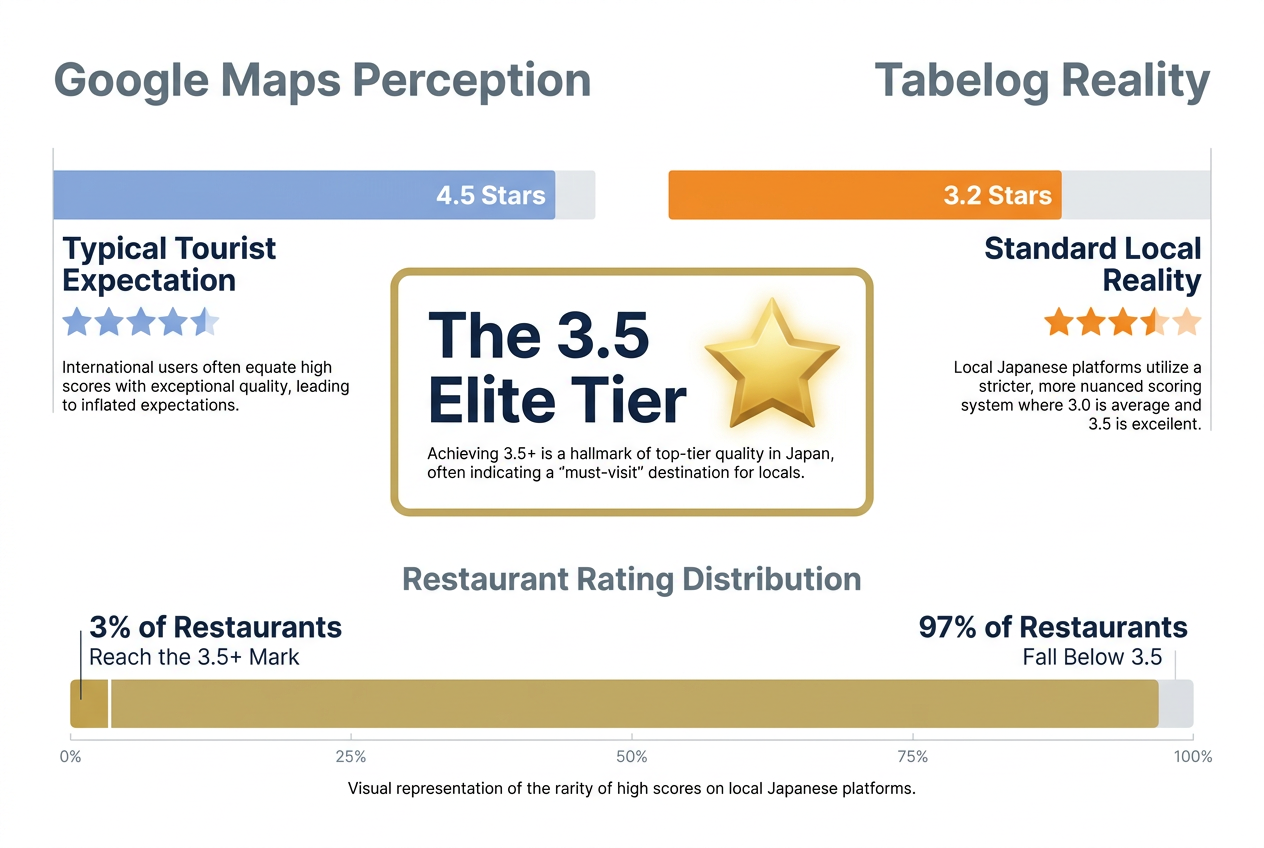 Understanding the Japanese rating culture: While a 3.2 seems low on Google, it represents a high-quality local establishment on apps like Tabelog, where 3.5 is elite.
The 2026 Japan Food Tech Stack: The 3 Apps You Actually Need
The optimal Japan dining strategy isn't about picking "The One App" - it's about understanding what each tool does best and assembling a three-layer tech stack: Discovery (Tabelog), Logistics (AutoReserve/Gurunavi), and Archiving (Savor or similar dish-tracking apps). Each layer solves a distinct problem that becomes painfully obvious once you're on the ground.
Tabelog: The Discovery Giant
Tabelog is Japan's most authoritative restaurant review platform, reporting approximately 100 million monthly users as of September 2025 according to Comunicaffe. The platform features information on approximately 890,000 establishments across Japan, with over 85 million user reviews and photos. The November 2025 app update introduced full English language support, eliminating the primary barrier that previously forced international travelers to rely on Google Maps or third-party translation tools.
Tabelog's filtering system is designed for the Japanese market's expectations: you can search by cuisine type, price range, seating style (critical for omakase counters), station proximity, and specific meal periods (lunch pricing can differ dramatically from dinner). The app's "Gold" rating badges (3.5+) and curated lists function as a vetted recommendation engine - not based on paid placements, but on aggregated local behavior and review quality.
The interface now supports multilingual search queries, real-time availability, and integration with Google Maps for navigation. However, the rating scale and review culture remain fundamentally Japanese - which is exactly why it works. You're not reading tourist reviews; you're accessing the same culinary signal-to-noise ratio that local foodies rely on.
AutoReserve / Gurunavi: The Booking Friction-Killers
Even with Tabelog's new English interface, many high-end or exclusive restaurants in Japan still require phone reservations, often in Japanese, and sometimes with a Japanese phone number. This is where booking-specific services like AutoReserve and Gurunavi become essential.
AutoReserve functions as a concierge layer - you submit a reservation request (often for a fee), and their bilingual staff handle the phone call, confirmation, and follow-up with the restaurant. This service is particularly valuable for Michelin-starred establishments, kaiseki restaurants, and counter-seating spots that don't integrate with digital booking systems.
Gurunavi, by contrast, operates more like OpenTable: it's a direct booking engine with English support, real-time availability, and confirmed reservations without the phone-call barrier. According to Planetware's guide, a ¥440 (approximately $3) non-refundable booking fee now applies to international reservations through Tabelog's multilingual platform - a similar model to Gurunavi's fee structure. That fee exists to reduce no-show rates, which have historically been a problem with tourists who "reserve everything" and only show up to a fraction of confirmed bookings.
The logistics layer is non-negotiable for serious foodies. You can discover 50 incredible restaurants on Tabelog, but if you can't secure a table, the information is academic.
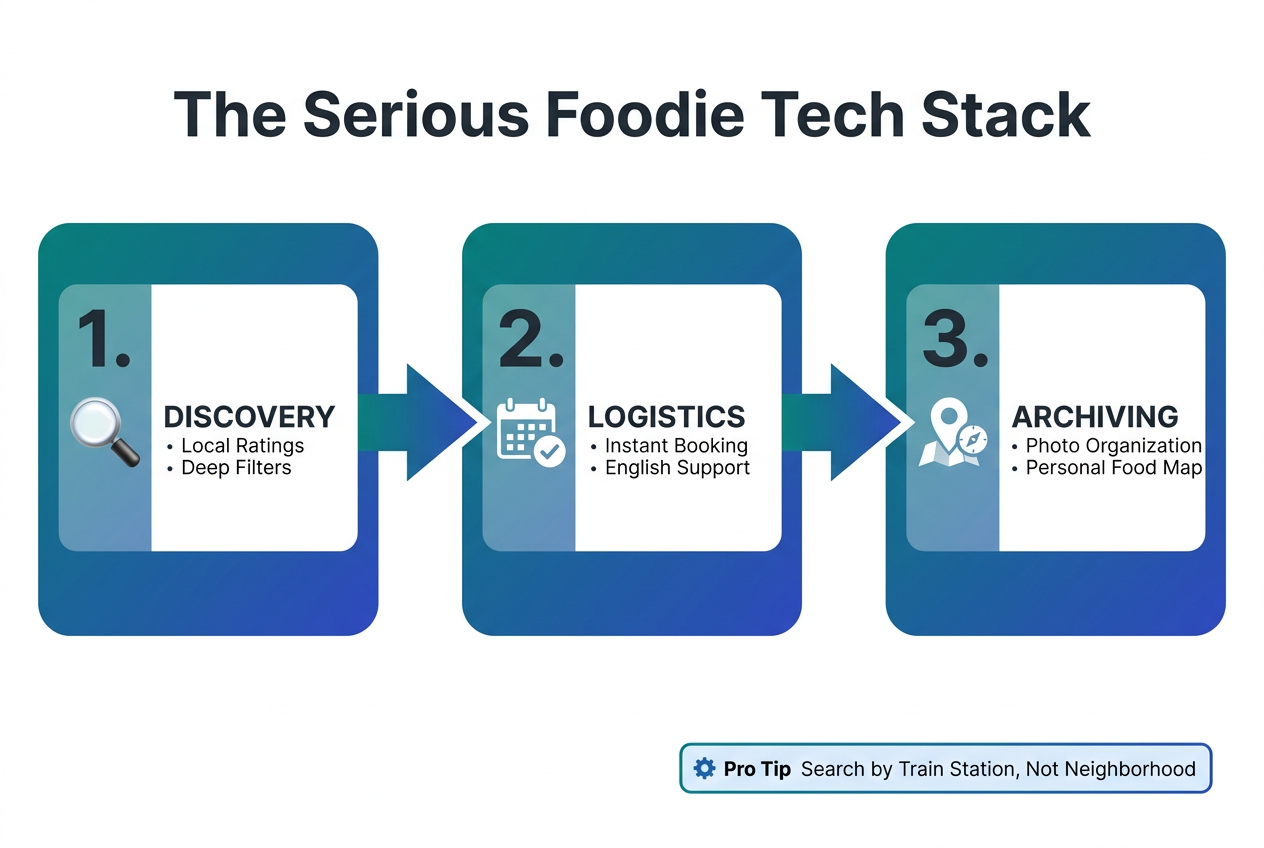 The modern traveler's tech stack for Japan combines discovery tools with booking engines and personal archiving apps to create a seamless culinary experience.
Savor / Personal Archiving: Solving the "Camera Roll Black Hole"
Here's where most travelers fail: they solve discovery and logistics, but they completely neglect memory and curation. You'll eat 40+ exceptional dishes across a two-week Japan trip, take 1,000+ food photos, and have no searchable way to recall which dish was served at which restaurant, which station you exited to get there, or what made that specific bowl of ramen better than the other six you tried.
This is the "camera roll black hole" - the gap between experiencing a meal and being able to recall, compare, or recommend it six months later. Generic review apps (Yelp, TripAdvisor, even Tabelog's public reviews) focus on venue ratings, not dish-level tracking. You can't search your own photos by "best gyoza in Tokyo" or "spicy mazesoba under ¥1,200" because that metadata doesn't exist in your camera roll or in venue-level review databases.
A dish-tracking app like Savor solves this by letting you rate individual dishes (not restaurants), add searchable tags (station name, cuisine type, texture notes), and build a private culinary map that functions as your personal food memory vault. According to Savor's Japan food review app guide, the platform is specifically designed for travelers and serious foodies who want to transition from "browsing" to "curating" their food history.
Think of it this way: Tabelog tells you where to go, AutoReserve gets you in the door, and Savor ensures you remember - and can search - every meal you ate. That's the complete tech stack.
What Is the Most Popular Food Review App in Japan?
Tabelog is the most popular food review app in Japan, with approximately 100 million monthly users and over 85 million user reviews and photos as of September 2025, according to Comunicaffe. The platform dominates local discovery because it operates on a rating scale and review culture that aligns with Japanese expectations - restraint, specificity, and merit-based reputation rather than promotional volume.
The app's authority comes from aggregated local behavior, not marketing spend. Restaurants with high Tabelog ratings (3.5+) see measurable increases in foot traffic, reservations, and media coverage. The platform's "Gold" badge system and curated regional lists function as an informal culinary vetting process - similar to how Michelin stars work, but driven by community consensus rather than anonymous inspectors.
Competitors like Retty and Hot Pepper Gourmet exist and have specific niches (Retty focuses on social discovery; Hot Pepper emphasizes coupons and all-you-can-drink deals), but Tabelog remains the default reference point for serious food discovery in Japan. Its 890,000-establishment database and hyper-local filtering capabilities make it the baseline tool for both residents and informed travelers.
The November 2025 multilingual app update fundamentally shifted Tabelog's accessibility for international users. Before that update, the platform was Japanese-language only, which created a massive information asymmetry: locals had access to the best data, while tourists defaulted to Google Maps or English-language blogs with outdated recommendations. That gap no longer exists.
Is There an English Version of Tabelog?
Yes. As of November 2025, Tabelog launched a fully multilingual app interface supporting English, Chinese, and Korean, according to Comunicaffe's report. The app is available for both iOS and Android, with real-time translation of user reviews, integrated navigation via Google Maps, and direct booking capability for participating restaurants.
The English version retains the same filtering functionality as the Japanese interface: you can search by cuisine type, budget, seating style, station proximity, and meal period. However, user-generated reviews remain in their original language (mostly Japanese), with auto-translation available. While the translation isn't perfect, it's functional enough to understand the core sentiment and identify recurring praise or criticism (e.g., "the tuna was exceptional" vs. "service was slow").
To download the app, search for "Tabelog" in your region's iOS App Store or Google Play Store. The app automatically detects your language preference and offers the multilingual interface upon first launch. According to Planetware's 2026 guide, a ¥440 (approximately $3) non-refundable booking fee applies to international reservations made through the app - a nominal cost compared to the value of securing a table at a high-demand restaurant.
The shift to English support eliminates the primary excuse for avoiding Tabelog. If you're still defaulting to Google Maps in Japan after November 2025, you're choosing grade inflation and tourist-optimized results over the actual local discovery standard.
Pro-Level Filtering: How to Find "The Spot"
Station-based search is the "pro move" in Japan, not neighborhood or district search. The reason is simple: Tokyo alone contains over 150,000 registered eating and drinking establishments according to WifiTalents' 2026 industry report. Searching by "Shibuya" or "Shinjuku" returns hundreds of results across multi-square-kilometer areas. Searching by "Shibuya Station, Hachiko Exit" or "Shinjuku-sanchome Station, Exit C5" narrows the radius to a 5-10 minute walk, which is the actual decision-making unit when you're hungry and on foot.
Tabelog's filtering system allows you to specify:
- Station name and exit - critical for navigating Tokyo's labyrinthine subway systems
- Cuisine type - from broad categories (ramen, sushi, izakaya) to hyper-specific sub-genres (tonkotsu ramen, edomae sushi, robatayaki)
- Budget per person - separated by lunch and dinner, because lunch pricing in Japan can be 40-60% lower than dinner at the same restaurant
- Seating style - counter seating vs. table seating matters for omakase, yakitori, and tempura where watching the chef work is part of the experience
The lunch vs. dinner price disparity is a hidden leverage point. A Michelin-starred sushi counter that costs ¥25,000 per person at dinner might offer a ¥3,500 lunch set featuring the same fish quality and technique. According to WifiTalents' data, 30% of Japanese consumers report eating out at least once per week, and lunch remains the most affordable entry point into high-end Japanese dining.
Another filtering pro-move: search by "Counter Seating" and apply a budget filter. Counter-seating restaurants in Japan are often chef-operated, small-capacity establishments where quality control is higher because the chef is cooking directly in front of you. These spots rarely accommodate large groups or tourists with strollers, which naturally filters for a more serious dining experience.
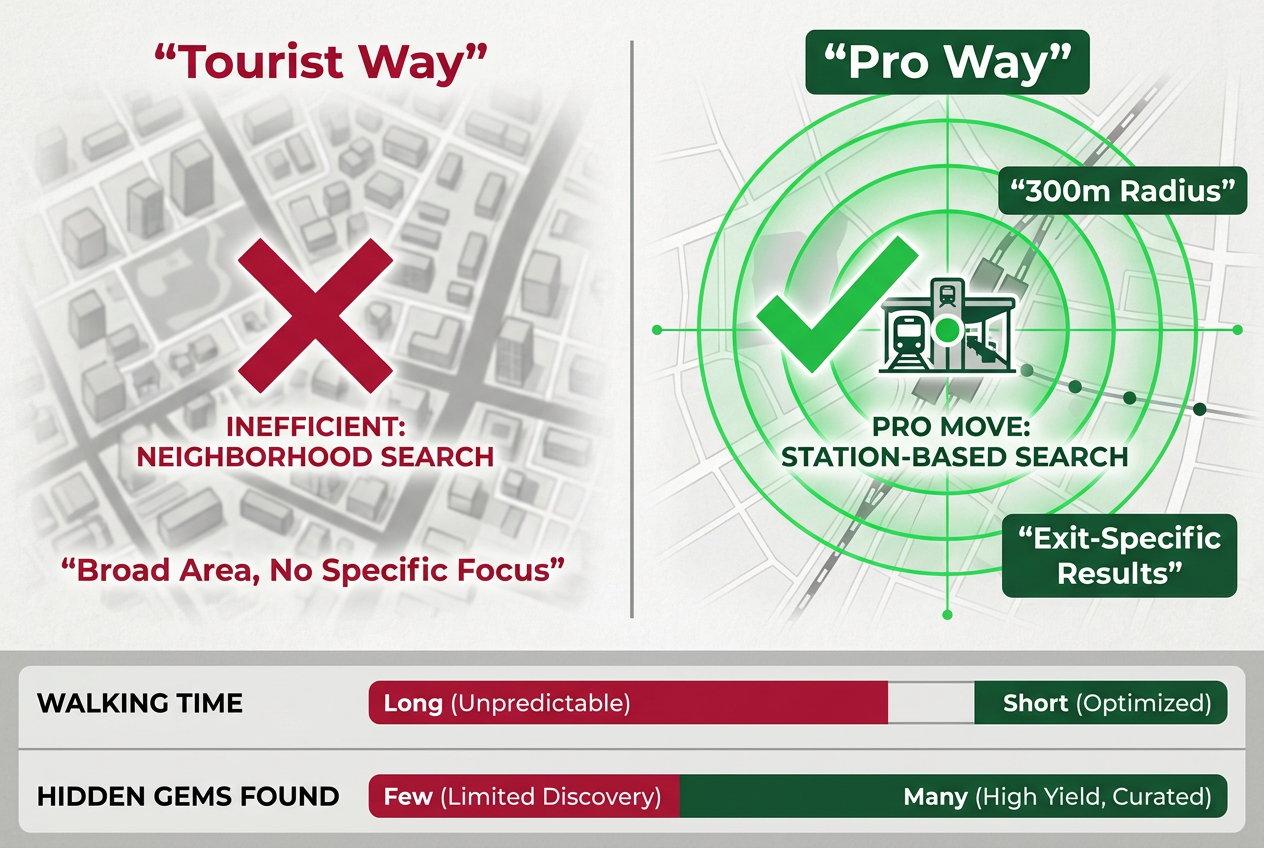 Mastering Japanese food apps requires switching from neighborhood searches to station-based filtering, allowing you to find high-rated gems within minutes of your platform exit.
The Logistics Cheat Sheet: Booking Without a Japanese Phone Number
The single biggest booking barrier for international travelers in Japan is the phone number requirement. Many high-end restaurants require reservations to be made by phone (not online), and some explicitly require a Japanese mobile number for confirmation and last-minute communication. This system exists because Japan's dining culture has extremely low tolerance for no-shows - a cancelled reservation without 24-48 hours' notice is considered deeply disrespectful, and repeat offenders can be blacklisted.
Here's how to navigate the system:
Option 1: Use AutoReserve or a concierge service.
AutoReserve functions as a bilingual reservation proxy. You submit your request (restaurant name, date, time, party size, dietary restrictions), pay a fee (typically ¥1,000-¥3,000 per reservation depending on the restaurant tier), and their staff make the phone call in Japanese, confirm the booking, and follow up with you via email. This service is worth the cost for Michelin-starred kaiseki, sushi counters with 8-seat maximums, and restaurants that don't appear on any English booking platform.
Option 2: Use Gurunavi or Tabelog's booking integration.
For restaurants that support digital reservations, platforms like Gurunavi and the new Tabelog multilingual interface allow direct booking without a phone call. According to Planetware, a ¥440 (approximately $3) non-refundable booking fee applies to international reservations through Tabelog. That fee is a no-show deterrent - if you don't show up, you forfeit the ¥440, and the restaurant reports the no-show to the platform, which can affect your future booking ability.
Option 3: Have your hotel concierge make the call.
If you're staying at a mid-to-high-end hotel in Japan, the concierge desk is accustomed to making restaurant reservations for international guests. This is a free service (though tipping culture doesn't exist in Japan, so there's no expectation of a cash tip). However, concierges prioritize reservations for their own hotel guests, so availability may be limited during peak dining hours.
The Cashless vs. Cash-Only Survival Kit:
According to WifiTalents' 2026 data, 70% of restaurants in metropolitan areas have adopted cashless payment systems. However, the remaining 30% - often the smallest, highest-rated neighborhood spots - remain cash-only. Always carry ¥10,000-¥15,000 in cash when visiting non-chain restaurants, especially in residential neighborhoods or izakaya districts. ATMs that accept international cards are widely available at 7-Eleven, Lawson, and Japan Post locations.
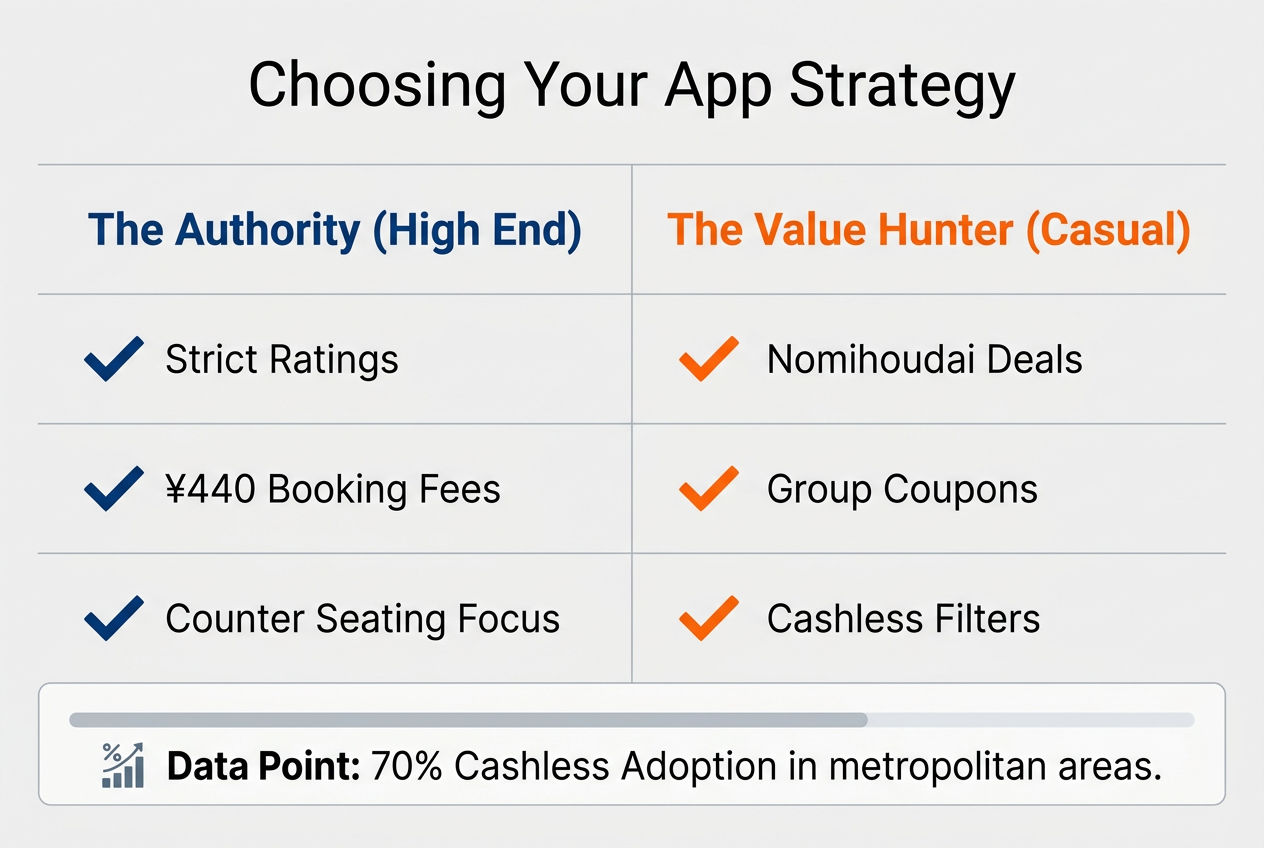 Whether you are seeking a Michelin-level counter seat or an all-you-can-drink 'Nomihoudai' deal, choosing the right app depends on your budget and dining style.
Why Are Tabelog Ratings So Low Compared to Google Maps?
Tabelog ratings appear "low" because the scale is fundamentally different from Western review platforms. A 3.5 rating on Tabelog is reached by only about 3% of restaurants, according to Planetware's 2026 research, while the median restaurant score hovers around 3.0-3.2. This isn't grade deflation - it's cultural restraint. Japanese reviewers reserve high ratings for objectively exceptional experiences, not "good enough" meals or friendly service.
The rating culture reflects Japan's broader social norms around criticism and merit. A 3.2 signals competent execution and consistent quality. A 3.5 means the restaurant has achieved something noteworthy - whether it's a specific dish, a technique, or an ingredient sourcing standard that stands out even in a competitive local market. Anything above 3.7 is Michelin-adjacent territory: these are destination restaurants where locals will travel 60+ minutes for a single meal.
By contrast, Google Maps ratings in Japan trend toward 4.5-4.8 stars because the reviewer base skews heavily toward tourists and casual diners who lack the reference points to distinguish "pretty good ramen" from "objectively exceptional ramen." A first-time visitor to Japan might give a conveyor-belt sushi chain five stars because the experience was novel and the service was polite, even though the fish quality and technique are middling by local standards.
Here's the practical takeaway: if a restaurant has a 3.5+ rating on Tabelog, it's worth traveling for. If it has a 3.7+ rating, book in advance - you're dealing with a spot that locals queue for or reserve weeks ahead. If it has a 4.5 rating on Google Maps but only a 3.1 on Tabelog, the Google rating reflects tourist traffic, not culinary merit.
Beyond Discovery: How to Archive Your Japan Food Map
Most travelers solve the discovery problem (Tabelog) and the logistics problem (AutoReserve/Gurunavi), but they completely neglect the memory problem. You'll eat 40+ memorable dishes across a two-week trip, take 1,000+ photos, and have zero way to search, compare, or reconstruct those meals six months later. That's the "camera roll black hole" - and it's where most food trips fall apart from a long-term value perspective.
Generic review apps don't solve this because they focus on venue ratings, not dish-level tracking. You can leave a five-star review for a restaurant, but that doesn't tell you which specific dish was exceptional, what the texture was like, or how it compared to the other versions you tried elsewhere. A year later, when someone asks "What was the best ramen you had in Tokyo?", you'll have to scroll through 1,200 unsorted phone photos, guess based on vague memory, and probably give up.
A dish-tracking app like Savor solves this by creating a private, searchable culinary database. You rate individual dishes (not restaurants), add tags (station name, cuisine type, texture notes like "rich and creamy" or "light and delicate"), and attach your photos to specific entries. Six months later, you can search "best mazesoba Tokyo" or "spicy ramen under ¥1,200" and get your own curated results - not Google's, not Tabelog's, but your personal ground truth.
According to Savor's guide to tracking meals, the difference between "browsing" and "curating" is the difference between consuming information and building authority. Browsing is what you do on Tabelog before your trip. Curating is what you do with your own experiences after the trip - turning raw data (photos, receipts, vague memory) into a structured reference library you can actually use.
Here's how the archiving workflow works in practice:
- During the meal: Take 2-3 photos of each dish (wide shot, close-up, plating detail). Don't over-shoot - you'll never look at 47 nearly-identical ramen photos.
- Immediately after the meal: Open your dish-tracking app, create a new entry, add the dish name and restaurant, rate it on whatever scale the app uses (Savor uses a 10-point system), and tag it with searchable metadata (station name, cuisine type, texture, price range).
- Add one sentence of context: Not a full review - just a single, specific observation. "The chashu melted on contact" or "Too much sesame oil overpowered the broth" or "Best tsukemen I've had outside of Menya Musashi."
That's it. Three minutes of effort per meal. After 40 meals, you have a 40-entry personal database that you can search, filter, and compare. You can rank your top 10 dishes, export your food map, or share specific recommendations with friends planning their own Japan trips - all from your own verified data, not someone else's opinion.
If you're serious about food travel, the archiving layer is non-negotiable. Tabelog gets you to the restaurant. Savor makes sure you remember it.
Frequently Asked Questions
What is the best food review app in Japan?
Tabelog is the best food review app in Japan, with approximately 100 million monthly users and over 85 million reviews covering 890,000 establishments as of September 2025. The platform's authority comes from its rating scale (where 3.5 is elite-tier, not mediocre) and its alignment with local expectations for restraint, specificity, and merit-based reputation. As of November 2025, the app includes full English language support, making it accessible to international travelers for the first time. For serious foodies, Tabelog should be paired with a dish-tracking app like Savor to create a personal, searchable food memory database beyond the public review ecosystem.
How do I make restaurant reservations in Japan without a Japanese phone number?
You can make reservations without a Japanese phone number using three methods: (1) AutoReserve or similar concierge services that handle phone-call reservations in Japanese for a ¥1,000-¥3,000 fee per booking, (2) digital booking platforms like Gurunavi or Tabelog's multilingual interface, which charge a ¥440 non-refundable booking fee for international reservations, or (3) asking your hotel concierge to make the call on your behalf. The ¥440 Tabelog booking fee exists to reduce no-show rates, which have historically been a problem with tourists who "reserve everything" and only show up to a fraction of confirmed bookings, according to Planetware's 2026 guide. Digital booking is the most efficient option for restaurants that support it, while concierge services are necessary for high-end kaiseki or sushi counters that require phone reservations.
What does a 3.5 rating on Tabelog mean?
A 3.5 rating on Tabelog is an elite-tier designation achieved by only about 3% of restaurants on the platform, according to Planetware's research. It signals that the restaurant has earned widespread local consensus for exceptional execution, technique, or ingredient quality - not just "good" food or polite service. Anything above 3.5 is worth traveling for, and ratings above 3.7 are Michelin-adjacent in local esteem. The Tabelog rating scale reflects Japanese cultural restraint: a 3.2 is competent and consistent, while a 3.5 represents something noteworthy that stands out in a competitive market. By contrast, Google Maps ratings in Japan trend toward 4.5-4.8 stars due to tourist-driven grade inflation, making the Tabelog scale a more accurate signal of culinary merit.
Is there a better alternative to Google Maps for finding restaurants in Japan?
Yes. Tabelog is the better alternative to Google Maps for finding restaurants in Japan because it operates on a rating scale and review culture aligned with local expectations, where 3.5 is elite-tier and the median restaurant score is 3.0-3.2. Google Maps ratings in Japan trend toward 4.5-4.8 stars due to tourist-driven grade inflation, making it difficult to distinguish genuinely exceptional restaurants from tourist-friendly spots with English menus. Tabelog's 890,000-establishment database, station-based search, and hyper-local filtering (by seating style, budget, meal period) provide the specificity that Google Maps lacks. As of November 2025, Tabelog supports full English language interface, eliminating the primary barrier that previously forced international travelers to default to Google Maps. For memory and curation, pair Tabelog with a dish-tracking app like Savor to create a searchable personal food database.
Which Japan food apps offer coupons or all-you-can-drink deals?
Hot Pepper Gourmet is the primary app for coupons, all-you-can-drink ("nomihoudai") deals, and value-seeking dining in Japan. The platform focuses on casual dining, izakayas, and chain restaurants rather than high-end or Michelin-level establishments. According to WifiTalents' industry data, 45% of consumers aged 20-29 discover new restaurants via social media apps like Instagram, but Hot Pepper remains the dominant coupon and deal aggregator for younger diners and budget-conscious travelers. The app is Japanese-language only as of 2026, so non-Japanese speakers will need translation support to navigate it effectively. For foodies prioritizing quality over discounts, Tabelog remains the better discovery tool, as Hot Pepper's deal-driven model skews toward volume and price competitiveness rather than culinary merit.
What is the ¥440 booking fee and can I avoid it?
The ¥440 (approximately $3) non-refundable booking fee is a no-show deterrent applied to international reservations made through Tabelog's multilingual platform, according to Planetware's 2026 guide. If you don't show up for your reservation, you forfeit the fee, and the restaurant reports the no-show to the platform, which can affect your future booking ability. The fee exists because Japan's dining culture has extremely low tolerance for no-shows - a cancelled reservation without 24-48 hours' notice is considered deeply disrespectful. You can avoid the fee by using alternative booking methods: (1) asking your hotel concierge to make the reservation (free, but limited availability), (2) using AutoReserve or similar concierge services that charge a higher per-booking fee (¥1,000-¥3,000) but handle phone-call reservations directly, or (3) booking directly with restaurants that use Gurunavi or other digital platforms. However, the ¥440 fee is nominal compared to the value of securing a table at a high-demand restaurant, and it ensures you're committed to showing up.
How can I organize and search my own food photos from my Japan trip?
Use a dish-tracking app like Savor to create a private, searchable culinary database where you rate individual dishes (not restaurants), add tags (station name, cuisine type, texture notes), and attach photos to specific entries. This solves the "camera roll black hole" problem: after a typical Japan trip, you'll have 1,000+ food photos with zero way to search or compare them. Generic review apps focus on venue ratings, not dish-level tracking, so they don't provide the metadata you need to search your own experiences. According to Savor's guide, the difference between "browsing" and "curating" is turning raw data (photos, receipts, vague memory) into a structured reference library you can actually use. The workflow is simple: take 2-3 photos per dish, create a new entry in your app immediately after the meal, rate it, tag it with searchable metadata, and add one sentence of context. After 40 meals, you have a 40-entry database you can search by "best mazesoba Tokyo" or "spicy ramen under ¥1,200."
Do Japanese locals use Tabelog?
Yes. Tabelog is the dominant discovery platform for local Japanese diners, with approximately 100 million monthly users as of September 2025, according to Comunicaffe. The platform's rating scale and review culture align with Japanese expectations for restraint, specificity, and merit-based reputation, making it the baseline reference tool for both casual dining and high-end restaurant selection. Restaurants with 3.5+ Tabelog ratings see measurable increases in foot traffic, reservations, and media coverage because locals trust the aggregated consensus more than individual influencer recommendations or paid promotions. The November 2025 multilingual app update was designed to extend Tabelog's authority to international travelers, but the core user base remains Japanese residents who use the platform multiple times per week to discover new restaurants, compare options, and read detailed reviews. If you're using Tabelog, you're accessing the same culinary signal-to-noise ratio that local foodies rely on.
Transitioning from Tourist to Authority
The gap between a good Japan food trip and a transformational one isn't about eating at more restaurants - it's about eating at the right restaurants, securing reservations without friction, and building a personal reference library you can search, share, and expand on future trips. That requires a three-layer tech stack: Tabelog for discovery, AutoReserve or Gurunavi for logistics, and a dish-tracking app like Savor for memory and curation.
Most travelers stop at discovery. They screenshot a dozen Tabelog listings, eat at five of them, take 300 photos, and never look at the data again. The photos sit in their camera roll, unsearchable and untagged, until they're eventually buried under 2,000 other images. That's the "camera roll black hole" - and it's the single biggest missed opportunity in food travel.
The solution isn't more apps. It's using the right apps for the right problems. Tabelog tells you where to go. AutoReserve gets you in the door. Savor ensures you remember - and can search - every meal you ate. That's not a tech stack. That's a culinary operating system.