
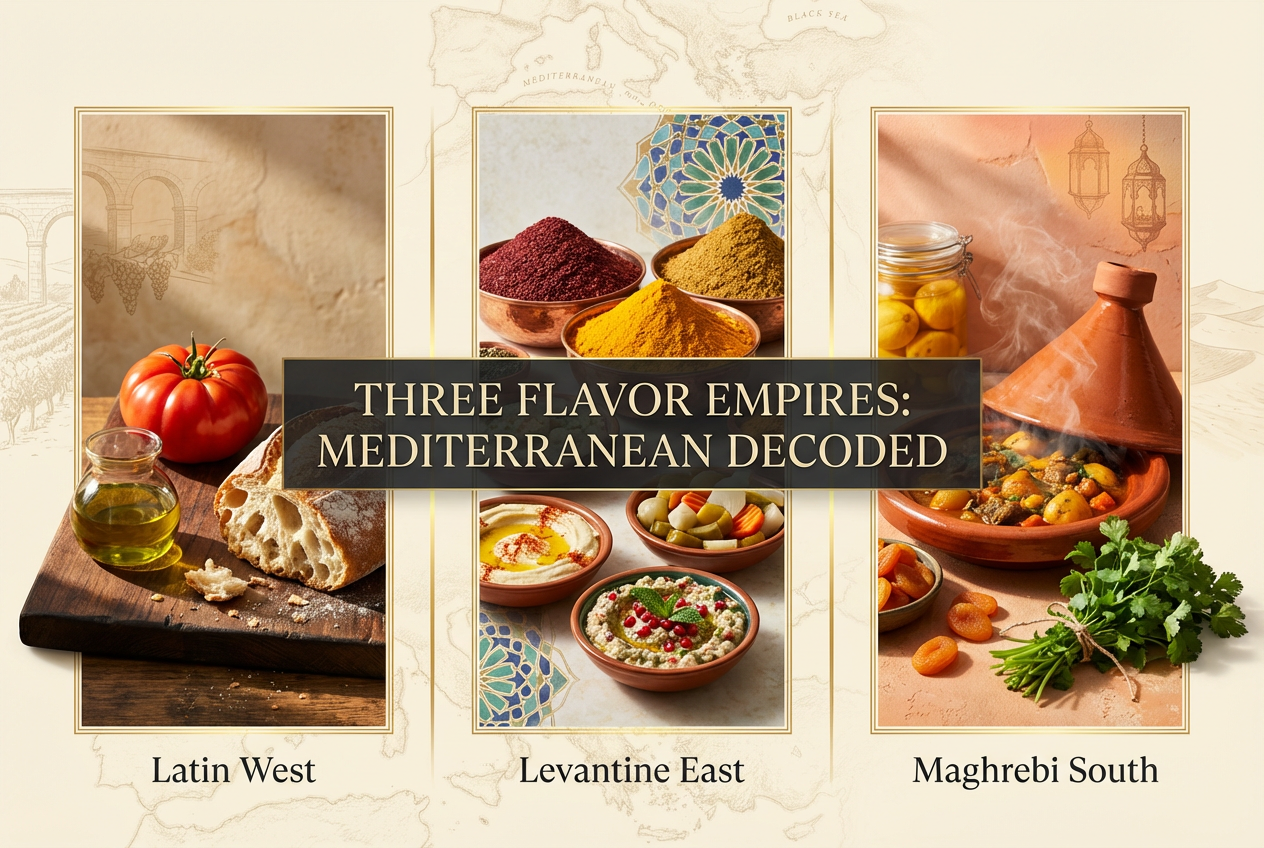
Mediterranean Food: Master the 3 Flavor Empires (2026)
Alex the juice queen
Alex hunts for the best juice bars and presses. She rates every sip and saves her favorites in Savor.
Mediterranean Food: A Connoisseur’s Guide to Decoding the Three Flavor Empires You just had a life-changing meal at a Mediterranean restaurant. The flavors...
Mediterranean Food: A Connoisseur’s Guide to Decoding the Three Flavor Empires
You just had a life-changing meal at a Mediterranean restaurant. The flavors were complex, the textures perfect, but when you try to describe it later, you’re stuck with "It was really good." That’s the problem. Most of us experience Mediterranean food as a blur of hummus, falafel, and olive oil, missing the intricate regional differences that separate a competent meal from a transcendent one.
This isn’t about discovering another hummus recipe. This is about mastering the cultural and technical language of Mediterranean dining so you can decode any menu, identify authenticity, and build a meaningful catalog of your experiences. Think of this as learning to speak the dialect of three distinct "flavor empires" that share a sea but tell very different culinary stories.
Table of Contents
- The Three Flavor Empires: Regional Mastery
- The Authenticity Checklist for Urban Diners
- 2026 Trends: The Modern Mediterranean Movement
- Building Your Personal Mediterranean Food Database
- Frequently Asked Questions
The Three Flavor Empires: Regional Mastery
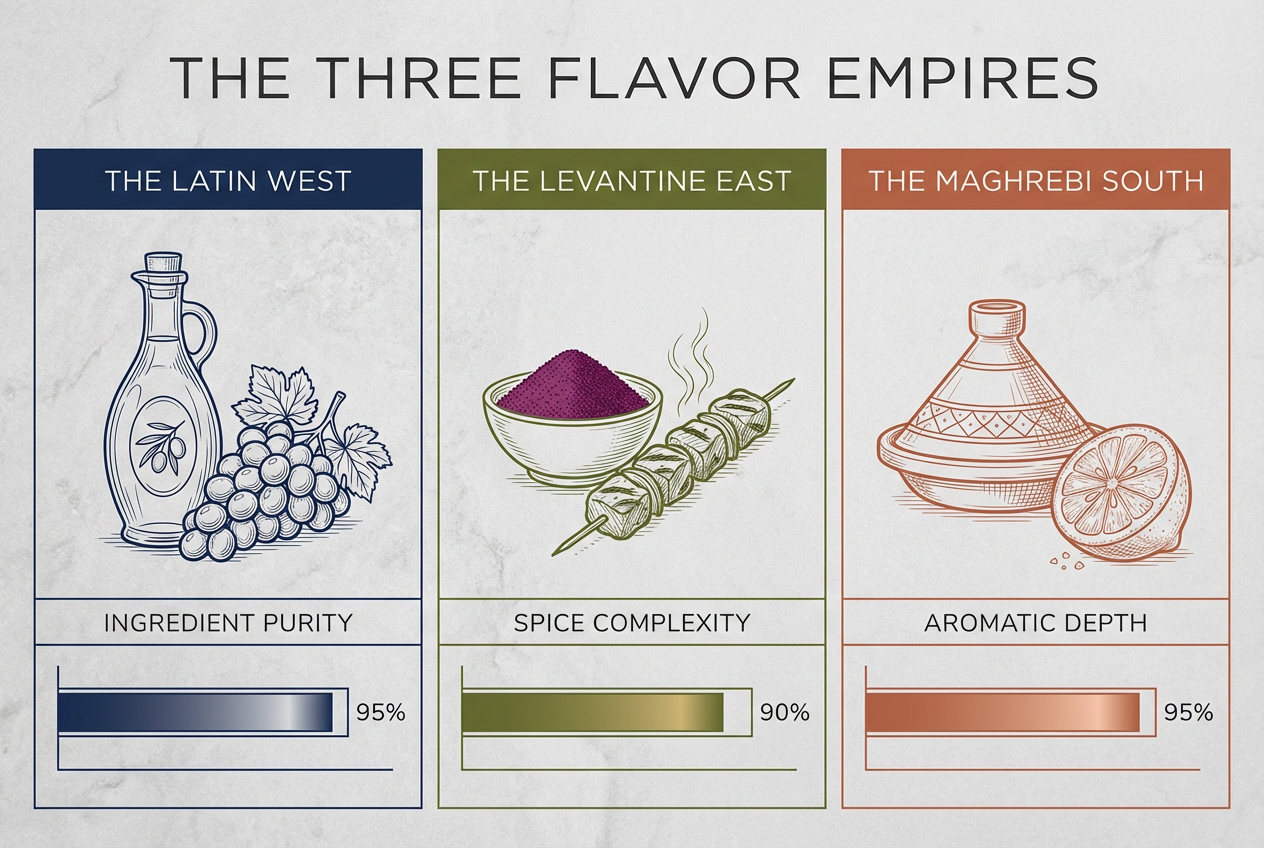
BLUF: Mediterranean food breaks into three distinct regional pillars - the Latin West (ingredient purity), Levantine East (spice complexity), and Maghrebi South (aromatic slow-cooking). Understanding these differences transforms you from a casual diner into a connoisseur who can categorize and appreciate dishes with precision.
The problem with treating "Mediterranean food" as one unified cuisine is that it erases centuries of distinct culinary evolution. The fisherman in Sicily and the shepherd in Lebanon both use olive oil, but they’re speaking entirely different flavor languages.
The Latin West: Spain, France, Italy
This is the empire of restraint and reverence for the ingredient itself. The philosophy here is simple: if you start with exceptional raw materials, your job is to not ruin them.
The Core Philosophy: Ingredient purity over transformation. The Spanish will tell you that a great tomato needs only olive oil and salt. The Italians built an entire culinary identity on this principle - the "Holy Trinity" of olive, wheat, and grape forms the foundation of nearly every dish.
What to Look For:
- Bread as a regional signature: In Italy, focaccia speaks to Liguria; in Spain, pan con tomate defines Catalonia; in southern France, fougasse signals Provence. The bread tells you where you are.
- Olive oil as terroir: A serious Italian restaurant will name the region of their oil (Puglia, Tuscany, Sicily) and ideally the harvest date. The oil should taste grassy, peppery, or fruity - never neutral.
- Minimal spice usage: This isn’t bland cooking; it’s confident cooking. A Roman cacio e pepe uses three ingredients (cheese, pepper, pasta) and achieves complexity through technique, not a spice rack.
The Tells of Authenticity: When you see pasta listed with four ingredients or fewer, you’re in Latin West territory. When a Spanish restaurant offers jamón without fanfare (just meat, bread, maybe tomato), that’s confidence in sourcing. The best paella you’ll ever have won’t be decorated - it’ll be a study in rice texture and saffron infusion.
The Levantine East: Greece, Turkey, Lebanon, Israel
This is the empire of mezze culture, where the meal is a social negotiation conducted through small plates. The Levantine table is generous, layered, and designed for sharing.
The Core Philosophy: Complexity through spices and fire. Where the Latin West minimizes, the Levantine East amplifies. Za’atar, sumac, Aleppo pepper, and seven-spice blends create depth that invites you to take another bite, trying to decode the layers.
What to Look For:
- Mezze as a litmus test: The quality of a Levantine restaurant reveals itself in the mezze spread. Is the hummus silky and cold? Does the baba ganoush have a genuine smoky depth from fire-roasted eggplant, or does it taste like it came from a food processor?
- Fire-grilled meats: Turkish ocakbaşı (open hearth cooking) and Lebanese charcoal-grilled kebabs should have visible char and a whisper of smoke. The meat should be seasoned simply because the fire does half the work.
- Yogurt everywhere: Not as a garnish - as a structural element. Labneh (strained yogurt) appears as a dip, a sauce, a marinade. It provides cooling contrast to grilled meats and spiced vegetables.
The Tells of Authenticity: A serious Levantine kitchen makes pita in-house or sources it daily. The bread should arrive warm, with a pocket that actually opens. The use of pomegranate molasses signals depth - it’s tart, sweet, and slightly funky, appearing in everything from salads to meat glazes. If sumac appears on the table as freely as salt, you’re in good hands.
The Maghrebi South: Morocco, Tunisia, Egypt
This is the empire of patience and aromatics, where tagines simmer for hours and spice blends (like ras el hanout) might contain 30 ingredients. North African cooking is about building flavor in layers that unfold slowly.
The Core Philosophy: Aromatic slow-cooking meets sweet-savory balance. The Maghrebi kitchen embraces dried fruits (dates, apricots, raisins) alongside savory meats, creating dishes that challenge Western expectations of what "dinner" should taste like.
What to Look For:
- Preserved lemons: These are non-negotiable. Salty, fermented, and intensely lemony, they appear in tagines, salads (like zaalouk), and couscous dishes. They’re a shortcut to identifying whether a kitchen understands Moroccan cooking or is approximating it.
- The tagine vessel: Authentic tagines are cooked and served in the conical clay pot that gives the dish its name. The shape matters - it creates a self-basting environment where steam rises, condenses, and drips back down.
- Harissa complexity: Not just "spicy red paste." Good harissa has smoky depth from roasted peppers, warmth from caraway or coriander, and a slight tang from fermentation.
The Tells of Authenticity: When a Moroccan restaurant offers couscous on Friday (the traditional day), that’s cultural fluency. If the menu lists different tagine preparations (lamb with prunes, chicken with preserved lemon and olives, kefta with eggs), you’re looking at a kitchen that respects regional variation. The bread should be khobz - round, dense, perfect for scooping.
The Authenticity Checklist for Urban Diners
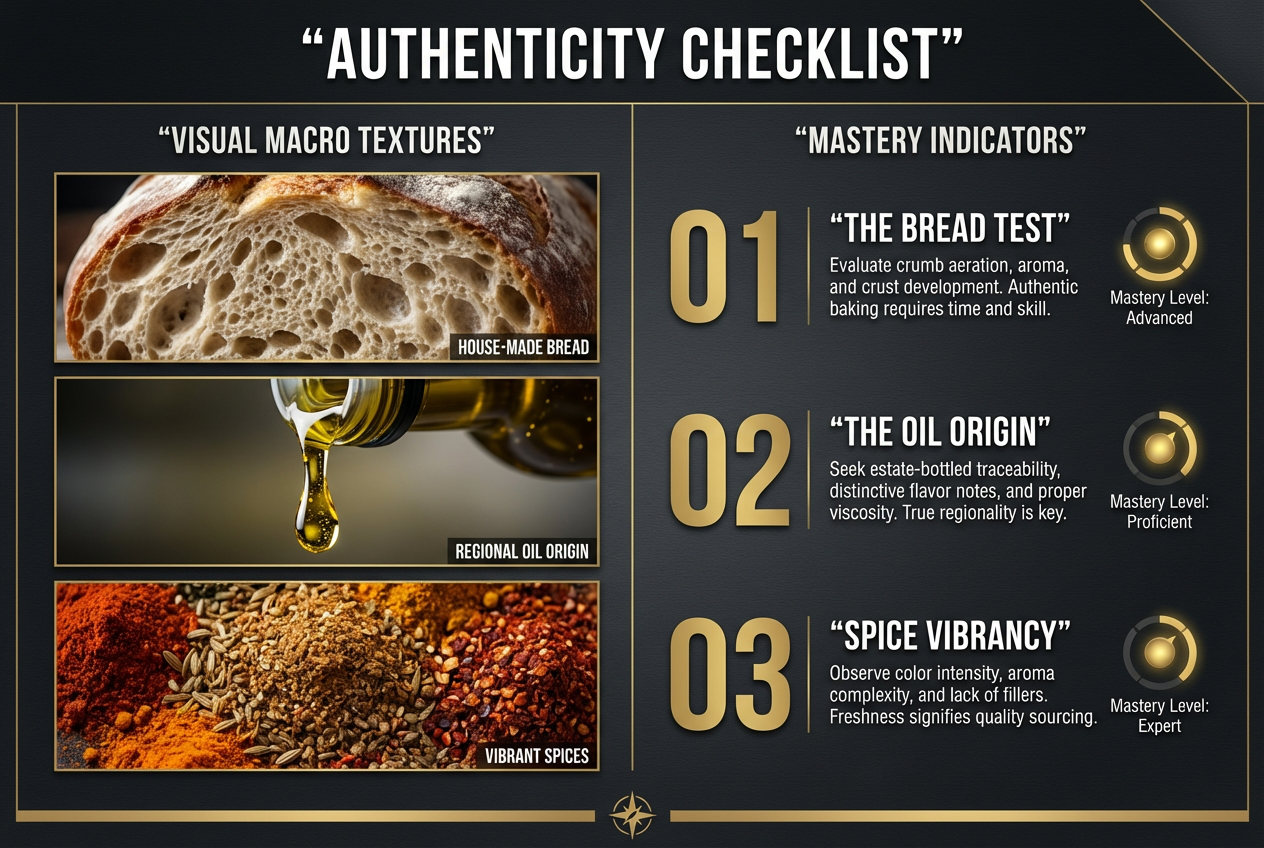
BLUF: Use three specific "tells" to verify authenticity in any Mediterranean restaurant: bread quality and regional variety, olive oil provenance and flavor, and spice vibrancy. These technical indicators separate insider knowledge from tourist-trap dining.
Walking into a four-star Mediterranean spot in New York, London, or San Francisco shouldn’t feel like guesswork. Here’s how to spot the real deal before you commit to a $200 dinner.
The Bread Test: House-Made vs. Generic
Bread is the first thing that hits your table and the most honest indicator of a kitchen’s standards. Mediterranean cultures take bread seriously because it’s both utensil and accompaniment.
What to Look For:
- Regional variation: Italian focaccia should be olive oil-rich and dimpled. Greek pita should be thicker and chewier than Levantine pita. Moroccan khobz should arrive in rounds dense enough to scoop tagine.
- Temperature and texture: Bread should arrive warm (or at minimum, room temperature). If it’s cold, it’s not fresh. If it’s hard, it’s been sitting.
- The crust speaks volumes: A proper baguette has an audible shatter when you break it. Focaccia should glisten with oil. Pita should have a visible pocket and slight char if it’s been properly baked.
The Serious Foodie Tip: If a restaurant lists the mill or flour they use (Italian tipo 00, whole wheat from a specific region), they’re signaling that they care about the foundation of the meal, not just the marquee proteins.
The Oil Origin: Geography in a Bottle
Olive oil isn’t a commodity in Mediterranean cooking - it’s a fingerprint. The region, harvest date, and variety of olive tell you everything about how a restaurant sources.
What to Look For:
- Named provenance: A serious restaurant will tell you their oil comes from Puglia, Crete, or southern Spain. They might even list the varietal (Arbequina, Koroneiki, Taggiasca).
- Harvest date matters: High-quality olive oil should list a harvest date, and it should be recent. Oil from two years ago has lost most of its peppery brightness.
- Finish and flavor: Pour a small amount on bread and taste it alone. It should have a distinct personality - peppery, grassy, fruity, or nutty. If it tastes neutral or greasy, it’s generic.
The Serious Foodie Tip: When a restaurant offers an oil tasting flight or drizzles finishing oil tableside with ceremony, they’re demonstrating that oil is an ingredient, not an afterthought.
The Spice Freshness Test: Vibrancy Over Age
Mediterranean spices should announce themselves. Sumac should be brick-red and tangy. Za’atar should smell like dried thyme met toasted sesame. Harissa should have visible texture and heat that builds.
What to Look For:
- Sumac color and tang: If sumac is brown instead of deep red, it’s stale. Fresh sumac has an immediate citrusy punch.
- Za’atar aroma: This Levantine spice blend should smell intensely herbal and nutty. If you can’t smell it from six inches away, it’s been sitting too long.
- Preserved lemon funk: When a tagine arrives, the preserved lemon should have that fermented, intensely salty-sour quality. If it just tastes like regular lemon, the kitchen took a shortcut.
The Serious Foodie Tip: Ask your server if spices are ground in-house or sourced whole and ground fresh. A kitchen that toasts and grinds cumin or coriander daily is operating at a different level than one using pre-ground spices from a jar.
2026 Trends: The Modern Mediterranean Movement
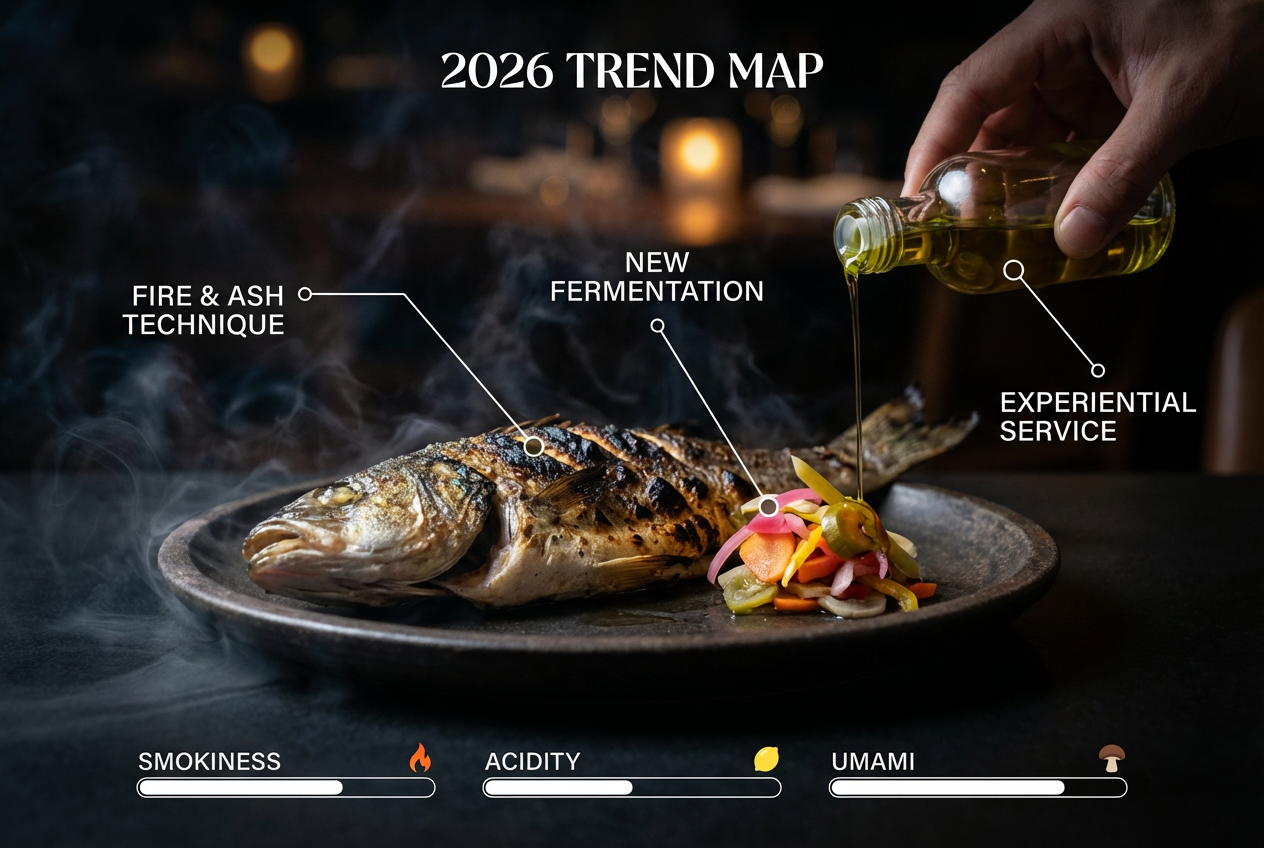
BLUF: 2026’s Mediterranean dining is defined by three forces: open-flame cooking techniques, advanced fermentation beyond yogurt, and tableside theater that creates experiential dining. These trends push boundaries while respecting tradition.
The best Mediterranean restaurants in 2026 are having a moment of creative confidence. They’re not abandoning tradition; they’re interrogating it, asking which techniques deserve revival and which presentations serve the diner’s experience.
Fire and Ash: The Return to Open Flame
Something primal happens when you cook over wood or charcoal. The Maillard reaction intensifies, smoke infuses protein and vegetables, and the dining room becomes theater.
What’s Happening: Turkish ocakbaşı-style cooking is migrating from Istanbul to New York, London, and Los Angeles. Chefs are installing open hearths in dining rooms, grilling whole fish, lamb chops, and vegetables tableside. The performance matters as much as the product.
Why It Works: Open-flame cooking isn’t new, but it’s newly prestigious. When a restaurant invests in a custom-built charcoal grill or wood-fired oven, they’re making a statement about priorities. Fire-cooked food has textural contrast (charred exterior, tender interior) that’s impossible to replicate in a conventional oven.
Where You’ll See It:
- Whole fish butterflied and grilled over olive wood
- Lamb chops cooked rare over charcoal, finished with flaky salt
- Vegetables (eggplant, peppers, zucchini) blistered and served with tahini or yogurt
The Serious Foodie Tip: When a menu lists the type of wood used (olive, oak, almond), the chef is using fire as a flavor ingredient, not just a heat source.
The New Fermentation: Beyond Yogurt
Fermentation is the defining trend separating ambitious Mediterranean restaurants from competent ones. We’re seeing chefs revive ancient techniques and apply modern precision.
What’s Happening: Garum (fermented fish sauce) is making a comeback, adding umami depth to dishes. Fermented vegetables are appearing beyond the standard pickles. Labneh (strained yogurt) is being aged, cultured with specific bacteria, or infused with herbs.
Why It Works: Fermentation creates complexity that can’t be faked. A fermented red pepper paste has funky depth that fresh peppers lack. Aged labneh develops tang and creaminess that young cheese can’t match. These are flavors that demand attention and reward repeat visits.
Where You’ll See It:
- Colatura di alici (Italian anchovy garum) drizzled over pasta
- Fermented chili pastes as condiments
- House-cultured yogurts with named bacterial strains
The Serious Foodie Tip: If a restaurant lists fermentation times or bacterial cultures on the menu, they’re operating at a technical level worth your attention.
Tableside Escapism: The Theater of Service
There’s a reason omakase restaurants command premium prices: diners want to witness craft, not just consume its result. Mediterranean restaurants are borrowing this playbook.
What’s Happening: Whole fish deboned tableside. Olive oil poured from named bottles. Mezze spreads composed in front of you. The meal becomes a guided experience, not just a transaction.
Why It Works: Tableside service solves a problem: in the age of food photos and instant reviews, diners crave memorable experiences, not just good food. When a server drizzles three different olive oils on your bread and explains each one’s origin, you’re getting education and entertainment.
Where You’ll See It:
- Whole roasted lamb carved tableside
- Couscous fluffed and plated in front of diners
- Cocktails made with Mediterranean ingredients (arak, Aperol, raki) prepared tableside
The Serious Foodie Tip: Tableside service should enhance the meal, not distract from it. If the server can explain the technique or ingredient, it’s theater worth watching. If it’s just showmanship, it’s a gimmick.
Building Your Personal Mediterranean Food Database
BLUF: Transform your dining experiences from forgotten camera roll clutter into a searchable, meaningful archive. Use a structured system to capture regional DNA, primary flavors, and texture contrasts for every dish you love.
You’ve eaten incredible meals, taken a hundred photos, and then... nothing. The memory fades, the photo sits in your camera roll, and you can’t remember if that was the spot in Athens or the one in Brooklyn.
Here’s the truth: your food memories deserve better than an Instagram caption and a fading recollection. If you’re serious about Mediterranean food, you need a system for cataloging what you eat.
The Three-Point Review System
Stop writing paragraphs. Start capturing data. Every Mediterranean dish you love can be understood through three lenses.
1. The Regional DNA
Which flavor empire does this dish belong to? Is this Latin West simplicity (three ingredients, perfect execution) or Levantine complexity (ten spices, layered flavor)? Write it down. Tag it. When you want to recreate that feeling six months from now, you’ll know what to look for.
Example: "Pasta alle vongole, Venice, June 2025. Latin West. Clams, olive oil, white wine, garlic, parsley. Perfect restraint."
2. The Primary Spice or Flavor
What’s the note you can’t stop thinking about? Was it the sumac on the fattoush? The preserved lemon in the tagine? The specific variety of olive oil on the bread?
Example: "Chicken tagine, Marrakech, July 2025. Preserved lemon and green olives. Funky, salty, bright."
3. The Texture Contrast
Great Mediterranean food is never one-note in texture. There’s the crunch of good bread against soft labneh. The char on grilled octopus against tender interior. The crispy phyllo giving way to creamy spanakopita filling.
Example: "Spanakopita, Athens, August 2025. Shatteringly crisp phyllo, creamy spinach and feta interior. Perfect contrast."
If you’re tracking these three elements for every memorable meal, you’re building a personal encyclopedia that actually serves you when you’re planning a trip, seeking a specific flavor, or trying to articulate what you loved about a dish.
For serious food tracking, Savor offers a purpose-built system for cataloging dishes with photos, ratings, and detailed notes that go beyond generic restaurant reviews.
Why Generic Reviews Fail Foodies
Yelp and Google reviews are written for the masses. They tell you if a restaurant is "good" or "bad," but they don’t tell you that the beef cheek tagine on Tuesday is transcendent while the lamb version is merely fine. They don’t help you remember that the oil they use on their bread is from a specific grove in Crete.
The Problem with Star Ratings: A five-star review of a Mediterranean restaurant could mean the reviewer loved the hummus, the ambiance, the service, or the Instagram-worthy plating. It tells you nothing about whether the kitchen understands regional technique.
The Solution: Build your own database. Use an app or notebook system that lets you search by region, spice, or texture. When you want to find "all the preserved lemon dishes I’ve loved," you should be able to pull them up instantly.
If you’re looking for ways to organize and track your food experiences, a dedicated food diary approach beats scattered photos and forgotten notes.
The Photo That Actually Works
Taking a hundred food photos is easy. Taking one useful food photo requires thought.
What to Capture:
- The dish in context: Is this mezze spread on a copper tray? Is the tagine in its clay pot? Context tells the regional story.
- The texture close-up: Get close enough to see the grain of the bread, the char on the octopus, the glisten of the olive oil.
- The plate composition: How does the restaurant present the dish? Rustic family-style or precise plating?
What to Skip: You don’t need 15 angles of the same dish. You need one great shot that captures what made the dish memorable, plus a quick note about what you tasted.
For more advanced techniques, explore how to photograph food in ways that actually preserve the memory, not just the image.
Frequently Asked Questions
What is Mediterranean food?
Mediterranean food refers to the diverse culinary traditions of countries surrounding the Mediterranean Sea, including Spain, France, Italy, Greece, Turkey, Lebanon, Morocco, Tunisia, and others. It’s defined by common ingredients (olive oil, wheat, fresh vegetables, legumes, fish) but expresses itself through three distinct regional styles: the Latin West’s ingredient-focused simplicity, the Levantine East’s spice-driven complexity, and the Maghrebi South’s aromatic slow-cooking. Calling it "one cuisine" erases important cultural and technical differences.
What are the most authentic Mediterranean dishes to try?
Authenticity depends on region. In Italy, try pasta alle vongole or cacio e pepe. In Greece, order grilled octopus or a proper horiatiki salad. In Lebanon, seek out kibbeh nayeh or fattoush. In Morocco, a lamb tagine with preserved lemons and olives is essential. In Turkey, köfte or lahmacun showcase grilled meat mastery. The key is matching the dish to its region of origin rather than ordering "Mediterranean" generically.
How can I tell if a Mediterranean restaurant is authentic?
Look for three indicators: house-made or regionally appropriate bread (focaccia in Italy, pita in the Levantine East, khobz in Morocco), named olive oil with harvest dates and regional provenance, and vibrant, fresh spices that smell potent. Authentic restaurants specify regional origins of ingredients, make mezze fresh daily, and often cook with fire or in traditional vessels like tagines. If the menu tries to represent all Mediterranean regions equally, it’s probably spreading itself too thin.
What is the difference between Greek and Turkish food?
Greek and Turkish cuisines share ingredients and Ottoman influences but diverge in preparation and emphasis. Greek food tends toward simplicity, highlighting quality olive oil, fresh vegetables, and grilled fish or lamb. Turkish cuisine embraces spice blends, yogurt-based sauces, and diverse bread varieties. Both grill meat expertly, but Turkish kebabs often feature more complex marinades. The mezze tradition exists in both, but Turkish mezze tends to include more hot dishes. Despite political tensions, the cuisines are culinary cousins with distinct personalities.
Is Mediterranean food healthy?
The Mediterranean diet (particularly the Latin West and Greek versions) is associated with cardiovascular health due to high consumption of olive oil, vegetables, legumes, fish, and moderate wine intake. However, "Mediterranean food" as served in restaurants can vary wildly. A vegetable-forward Greek salad with grilled fish is different nutritionally from fried calamari or a butter-rich French bouillabaisse. The health benefits come from ingredient quality and preparation methods, not from the label "Mediterranean" alone.
What spices are used in Mediterranean cooking?
Spices vary dramatically by region. The Latin West (Spain, France, Italy) uses relatively few spices, relying instead on fresh herbs like basil, oregano, thyme, and rosemary. The Levantine East (Greece, Turkey, Lebanon) features sumac, za’atar, Aleppo pepper, cumin, and seven-spice blends. The Maghrebi South (Morocco, Tunisia) uses complex blends like ras el hanout (up to 30 spices), harissa, cumin, coriander, and cinnamon in savory dishes. Understanding these regional patterns is key to identifying authentic cooking.
What is mezze and how do you eat it?
Mezze (also meze or mazza) is the Levantine tradition of small plates served as appetizers or a full meal. Common mezze includes hummus, baba ganoush, tabbouleh, fattoush, labneh, muhammara, and stuffed grape leaves. The cultural practice is communal sharing from the center of the table using bread as a utensil. Mezze isn’t rushed; it’s designed for conversation and slow eating. A proper mezze spread balances textures (creamy dips, crunchy salads, tender vegetables) and temperatures (cold salads, warm breads, room-temperature dips).
How do you properly taste olive oil?
Professional olive oil tasting follows a specific ritual. Pour a small amount into a glass and warm it in your palm. Smell it first, noting any grassy, fruity, or peppery aromas. Take a sip and let it coat your mouth, then inhale sharply through your teeth to aerate the oil. Quality olive oil should have a peppery finish that catches in your throat (that’s polyphenols, a sign of freshness). It should never taste greasy, rancid, or neutral. Compare oils side-by-side to develop your palate for regional differences.
Mediterranean food is too complex, too regionally specific, and too culturally rich to be reduced to a generic category. When you walk into a restaurant claiming to serve "Mediterranean cuisine," you now have the framework to ask: which Mediterranean? The ingredient-focused Latin West? The spice-driven Levantine East? The aromatic Maghrebi South?
More importantly, you have the tools to build a personal archive of every meaningful meal, turning your dining experiences from fading memories into a searchable, valuable database. That’s the difference between eating well and eating with purpose.
Your taste memory is worth cultivating. Start building your personal food database today.