
Fine Dining Guide: Master Your Culinary Experiences (2026)
Harry the matcha king
Harry is our resident matcha obsessive. He’s tasted hundreds of bowls and tracks every cup in Savor.
The Connoisseur’s Protocol: A Master Guide to Navigating, Evaluating, and Archiving Fine Dining (2026 Edition) You remember the feeling. That specific bite of...
The Connoisseur’s Protocol: A Master Guide to Navigating, Evaluating, and Archiving Fine Dining (2026 Edition)
You remember the feeling. That specific bite of sea urchin, perfectly balanced on a sliver of warm rice, the barest hint of yuzu cutting through the ocean’s brine. The sommelier’s unexpected pairing - a minerally Chablis that made the dish sing in a way you didn’t see coming. The silence at your table as everyone processed what they’d just tasted.
But three months later? You’re struggling to recall the restaurant’s name. The details have dissolved into a vague memory of "really good sushi somewhere downtown."
This is the fine dining paradox: we invest hundreds of dollars and plan months in advance for meals that evaporate from memory within weeks. We treat these experiences as transactions rather than what they really are - chapters in our personal culinary education.
The problem isn’t your memory. It’s your system.
Fine dining in 2026 has evolved beyond white tablecloths and Michelin stars. It’s become a choreography of storytelling, where regenerative sourcing meets fermentation science, where the "where" of an ingredient matters more than the "what." The challenge isn’t finding great restaurants - it’s developing the frameworks to evaluate, document, and learn from these experiences in a way that actually sticks.
This guide treats fine dining as an intellectual pursuit, a skill you can systematically improve. We’re moving beyond generic etiquette advice and "what is fine dining" definitions. Instead, you’ll learn the protocols professional critics use: how to select the right reservation, evaluate dishes with precision, document meals without disrupting the vibe, and speak the evolving language of 2026’s culinary landscape.
By the end, you won’t just be dining. You’ll be building your own culinary atlas.
Table of Contents
- The Pre-Meal Strategy: Selection and Booking
- The Art of Evaluation: A Pro’s Framework
- Solving the Camera Roll Fatigue: The Archiving Protocol
- The New Language: 2026 Culinary Vocabulary
- Building Your Culinary Atlas
- Frequently Asked Questions
The Pre-Meal Strategy: Selection and Booking
BLUF: Choose tasting menus when you want the chef’s complete narrative; go à la carte when you know exactly what you’re after. Book chef’s counter seats for education, dining room tables for intimacy.
The meal begins long before you sit down. Your choices during the booking phase shape everything that follows - the dishes you’ll taste, the stories you’ll hear, the memories you’ll build.
The Menu Logic Test: Tasting Menu vs. À La Carte
Michelin inspectors follow a simple decision tree, and you should too:
Choose the tasting menu when:
- It’s your first visit and you want the complete story the chef is telling
- The restaurant is known for a specific technique or philosophy (fermentation programs, live-fire cooking, molecular gastronomy)
- You’re dining with someone willing to surrender control and experience the meal as a narrative arc
- The restaurant offers a "trust the chef" option - this signals they’re confident in their sequencing and pacing
Go à la carte when:
- You’ve researched specific signature dishes and want to build your own experience
- Dietary restrictions would result in too many substitutions in a fixed menu
- You’re returning to a restaurant and want to explore different territory
- The menu features seasonal ingredients you specifically want to experience (white truffle season, soft-shell crab, the first asparagus of spring)
The 2026 trend worth noting: multi-concept restaurants are blurring these lines. You might find a Michelin-starred kitchen offering both a seven-course tasting menu and a separate, more casual menu at the bar. This isn’t a compromise - it’s an opportunity to experience different facets of the same culinary vision.
Seat Selection: Privacy vs. Theatre
Your table location isn’t just about convenience. It fundamentally alters your experience.
Chef’s counter advantages:
- Direct access to the team’s knowledge and stories
- You’ll see technique in real time - the precise moment a protein hits the pan, how a sauce comes together
- Chefs often send extra bites or experiments to counter guests
- Perfect for solo diners or couples comfortable with interaction
Dining room advantages:
- Better for larger groups or celebratory meals where conversation is the priority
- Less pressure to engage if you prefer observing quietly
- Often superior for wine pairings, as sommeliers have more time and space to discuss selections
- Allows you to focus entirely on your companions and the food, without the performance element
A practical note: counter seats fill up fastest at reservations openings. If that’s your target, be ready the moment bookings go live. If you’re wondering how others navigate impossible reservations, successful foodies in New York often use specialized tools beyond standard booking platforms.
The 2026 Trend Check: What to Look For
When researching restaurants, watch for these signals that a kitchen is operating at the forefront of modern fine dining:
Regenerative sourcing language: Restaurants that talk about soil health, carbon-negative farming, and closed-loop systems aren’t just virtue signaling. They’re part of a movement redefining luxury through sustainability. James Beard Foundation research shows this is the dominant theme shaping 2026’s culinary conversation.
Fermentation programs: If the menu mentions house-made garum, koji-aged proteins, or lacto-fermented vegetables, you’re dealing with a kitchen that’s invested in building complex flavors through time and technique.
Hyper-regional specificity: The best restaurants in 2026 aren’t just saying "local." They’re naming farms, talking about specific heirloom varieties, and building relationships that go beyond transactions. When you see "Singing Frogs Farm carrots" instead of just "carrots," you’re in good hands.
Beverage innovation: The shift toward savory cocktails and non-alcoholic pairings that rival wine programs signals a kitchen that thinks holistically about the meal.
Before you book, answer one question: What am I trying to learn from this meal? The best dining experiences happen when your intention matches the restaurant’s strengths.
The Art of Evaluation: A Pro’s Framework
BLUF: Professional critics score dishes across four dimensions - ingredient quality, technical execution, flavor balance, and pacing. This framework transforms vague impressions into concrete, searchable observations you can reference for years.
That incredible meal you had last month - can you articulate exactly why it was incredible? Most of us can’t. We remember feelings, not details. We know something was exceptional, but we lack the vocabulary and framework to capture what made it work.
Professional critics don’t rely on memory. They use systematic evaluation frameworks that break down the experience into measurable components. Here’s how to adopt that approach.
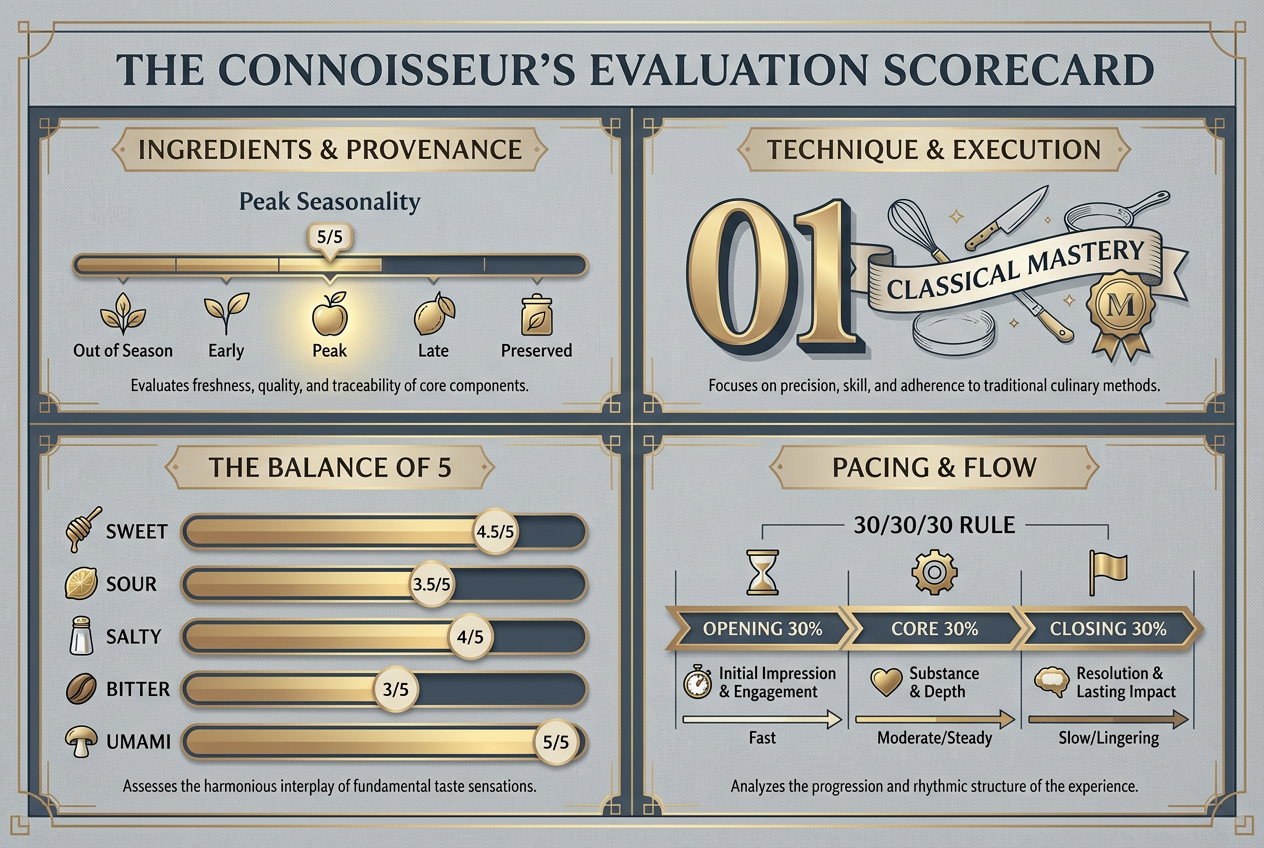 Adopt this professional framework to move beyond simple reviews and start evaluating your culinary experiences with the precision of a Michelin inspector.
The Four-Pillar Evaluation System
Copy this framework into your notes app, your journal, or better yet, into a dish tracking app designed for this exact purpose:
| Criterion | What to Evaluate | Questions to Ask | Score (1-10) |
|---|---|---|---|
| Ingredient Provenance & Seasonality | Quality and appropriateness of raw materials | Is this ingredient at its peak? Can you taste its origin? Does the sourcing justify the price? | |
| Technical Execution | Cooking precision and innovation | Are temperatures exact? Is texture intentional? Does the technique serve the ingredient or overshadow it? | |
| Flavor Harmony | The balance of sweet, sour, salty, bitter, umami | Does the dish build complexity? Are there layers you discover with each bite? Is there a clear point of view? | |
| Flow & Pacing | How the dish fits into the larger meal | Does this course make sense in sequence? Is portion size appropriate? Does it prepare you for what’s next? |
Let’s break down each pillar with practical examples.
Ingredient Provenance & Seasonality
This is where amateur and professional evaluation diverge most dramatically. Beginners ask "Is this good?" Experts ask "Is this the best version of itself?"
Consider a simple tomato salad. An average evaluation: "The tomatoes were fresh and flavorful." A professional evaluation: "Late August heirlooms from a named local farm, served at room temperature to preserve their complexity. The tomatoes showed the characteristic shoulder scarring of dry-farmed fruit - less water content, more concentrated sugars and acids. Paired with a finishing salt that highlighted rather than masked their natural flavor."
You don’t need to be a farmer to evaluate this. You need to ask: Can I taste the specific time and place of this ingredient? Does the menu tell me the story? Is the kitchen honoring the ingredient or fighting against it?
Red flags: Out-of-season ingredients (asparagus in November, tomatoes in February), generic sourcing language ("farm-fresh"), or preparations that rely heavily on masking sauces rather than celebrating the core ingredient.
Technical Execution: Innovation vs. Classics
Here’s where you evaluate the kitchen’s skill. Technical execution falls into two categories:
Classical precision: Is the protein cooked to the exact temperature it demands? Is the sauce properly emulsified? Are knife cuts uniform?
Innovative technique: Does the kitchen use modern methods (sous vide, centrifuges, dehydrators) to achieve something impossible through traditional cooking? Or are they using technology as a crutch for mediocre ingredients?
A perfectly executed classic dish - a French omelet, a whole roasted fish, a simple pasta - reveals more about a kitchen’s foundation than any amount of molecular wizardry.
Look for these markers of technical excellence:
- Proteins with even coloring and no grey bands (indicating precise temperature control)
- Sauces with perfect consistency - they should coat a spoon and release cleanly
- Vegetables with distinct texture - never mushy, never raw unless intentionally so
- Seasoning that enhances without overwhelming
The 30/30/30 rule matters here: 30 seconds too long, 30 degrees too hot, or 30 seconds too early on seasoning can ruin an otherwise perfect dish. The best kitchens nail these margins consistently.
Flavor Harmony: The Balance of Five
You’ve probably heard about the five basic tastes - sweet, sour, salty, bitter, umami. But understanding them intellectually and tasting them analytically are different skills.
Great dishes create conversation between these elements. They don’t just stack flavors - they orchestrate them.
Try this exercise on your next meal: Taste each component separately before eating the dish as composed. How does the acid in that vinaigrette wake up the richness of the protein? Why did the chef add that bitter green as a counterpoint to the sweet root vegetables? What’s providing the umami backbone that makes everything more satisfying?
The restaurants leading 2026’s conversation are masters of umami flavor - that savory, mouth-filling quality that makes dishes memorable. Watch for ingredients like aged cheese, fermented products, mushrooms, seaweed, and slow-cooked proteins.
A dish achieves harmony when removing any single element would diminish the whole. That’s your benchmark.
Flow & Pacing: The 30/30/30 Rule Applied
The 30/30/30 rule originally referred to timing, but it applies to pacing too:
30% Restraint: Earlier courses should intrigue without overwhelming. They’re building your palate, not exhausting it.
30% Escalation: Middle courses increase in intensity - richer proteins, bolder flavors, more complex techniques. This is where tasting menus typically peak.
30% Resolution: Final savory courses and desserts should feel conclusive. They’re answering questions posed earlier in the meal, bringing the narrative full circle.
10% Surprise: The best meals include an unexpected moment that reframes everything - a palate cleanser that’s actually a full course, a dessert that references the amuse-bouche, a final bite that sends you home thinking.
Poor pacing announces itself: You’re too full to appreciate the final courses. You’re confused about why dishes appeared in a particular sequence. You feel like you’re eating three separate meals instead of one coherent experience.
If you’re serious about tracking these evaluations beyond a single meal, you’ll want a better system than scattered phone notes. Many dedicated food enthusiasts use food journaling apps designed specifically for building a searchable memory bank of meals.
Solving the Camera Roll Fatigue: The Archiving Protocol
BLUF: Capture technical data immediately (dish name, key ingredients, standout element), then add emotional context within 24 hours. Use a private digital system, not public review platforms, to build a searchable archive you’ll actually reference.
Your camera roll currently holds thousands of food photos. Quick test: Pull up a photo from six months ago and try to remember the restaurant name, the specific dish, why you ordered it, and what made it memorable.
Can’t do it? You’re not alone.
The camera itself has become a distraction. We photograph compulsively, convinced we’re preserving the memory, when really we’re just building an unsearchable database of orphaned images.
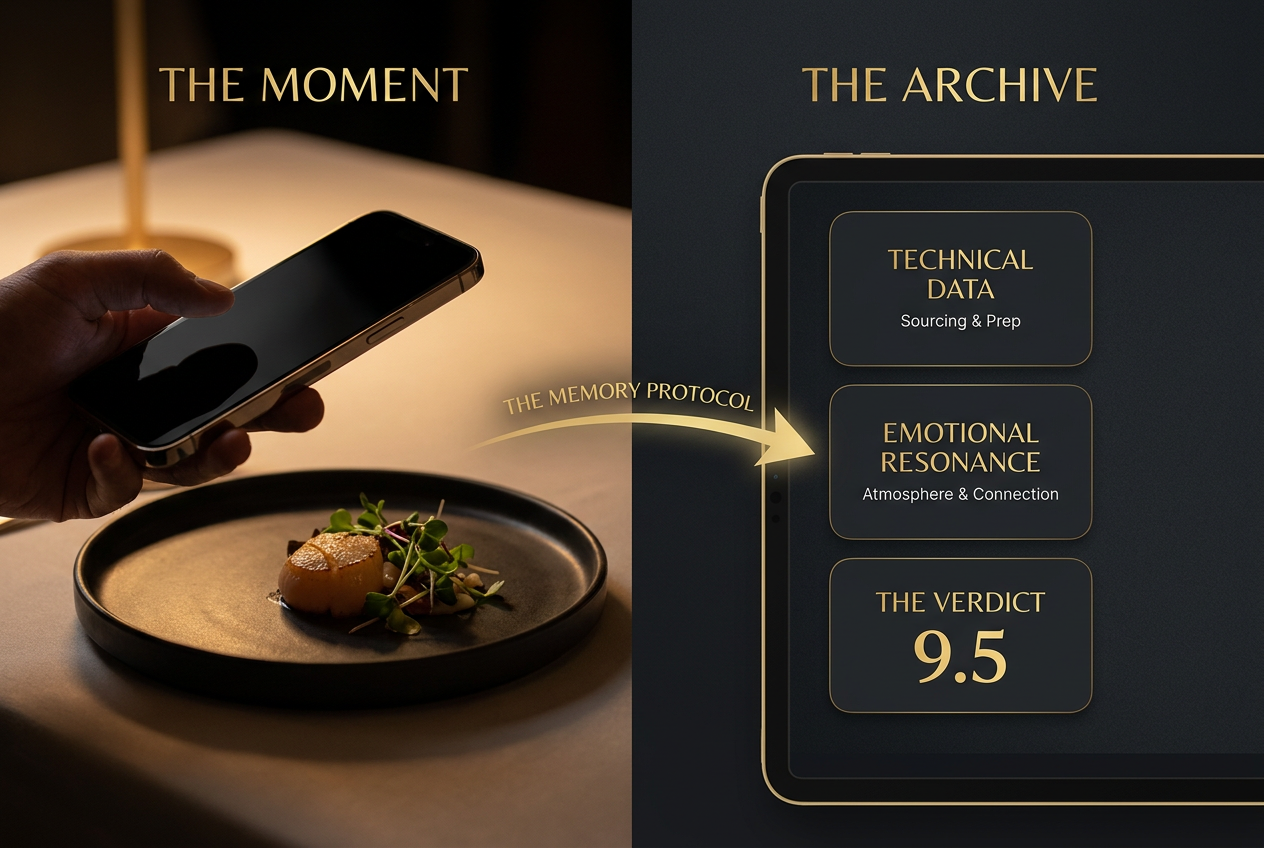 Stop losing your best meals to an unsearchable camera roll. Use this protocol to capture technical data and emotional resonance without disrupting the dining vibe.
The Two-Layer Documentation System
Professional food critics - the ones who evaluate hundreds of meals annually and can recall specific dishes years later - use a two-layer system:
Layer 1: Technical Data (Capture Immediately)
- Restaurant name and date
- Exact dish name as it appears on the menu
- Key ingredients and techniques (as described by server or observed)
- One sentence about what stood out (the element that made you photograph it)
- Score using your evaluation framework
Layer 2: Emotional Resonance (Add Within 24 Hours)
- Who you were with and why this meal mattered in that moment
- The conversation or realization that happened during the meal
- How the dish made you feel, not just how it tasted
- Connection to other meals or ingredients (building your mental map)
- Would you order it again, and under what circumstances?
The technical layer is what most people skip. Six months later, "amazing pasta in that Italian place" is useless information. "Tajarin with white truffle and butter at Trattoria della Posta, October 2025, during peak Piedmont truffle season, the pasta so thin it was nearly transparent" is a memory you can actually build on.
The emotional layer is what transforms data into story. "Celebrating Sarah’s promotion" or "First meal after recovering from COVID, everything tasted new again" or "Reminded me of that restaurant in Oaxaca where we - " these are the threads that make your archive worth revisiting.
Discreet Documentation: Staying Present While Recording
The worst food photography is obvious: Flash on, camera held high, multiple angles while the table waits, editing filters applied before anyone’s taken a bite.
The best documentation is nearly invisible:
Photo protocol:
- One photo per dish, natural light only
- Take it when the dish arrives, before you start eating
- Hold the phone low (table level), not overhead
- No filters, no flash, no edits in the moment
- If the restaurant has dim lighting and your photo is terrible, skip it - you can describe it in words
Note-taking protocol:
- Keep your phone on the table in view (not hiding it implies you’re not being sneaky)
- Type notes as the server describes dishes or immediately after each course
- Use voice notes in the car or restroom if phone use feels inappropriate at the table
- Better to capture a few key details than to disengage from your companions trying to record everything
Here’s what matters: The documentation should never be more memorable than the meal itself. If your companions remember you photographing every course, you’ve failed.
The Tech Stack: Where to Store Everything
You have three main options for organizing your culinary archive:
Option 1: Public Review Platforms (Yelp, Google Reviews, TripAdvisor)
- Pros: Built-in audience, potential to help others, some restaurants monitor and respond
- Cons: Your data is public and monetized by platforms, difficult to search your own history, pressure to write for an audience rather than for yourself
- Best for: Restaurants where you want to support or warn other diners
Option 2: General Productivity Tools (Notion, Apple Notes, Google Docs)
- Pros: Complete control over your data, infinite customization, works across devices
- Cons: Requires discipline to maintain consistent formatting, no purpose-built features for food documentation, searching across years of entries gets messy
- Best for: People who already have a personal organization system they love
Option 3: Dedicated Food Memory Apps
- Pros: Built specifically for dish and restaurant tracking, searchable by location/cuisine/ingredient, private by default, often include rating frameworks and photo organization
- Cons: Smaller than mainstream social apps, requires committing to a new platform
- Best for: Serious food enthusiasts building a long-term archive
If you’ve been struggling to remember meals, the platform matters less than the consistency. Pick one system and stick with it for at least three months before evaluating whether it’s working.
The real revolution happens when you start referencing your own archive. You’re planning a trip to Paris and you can instantly pull up every French meal you’ve ever loved, complete with notes about what made them work. You’re hosting dinner and you remember that wine pairing from 2024 that would be perfect for tonight’s menu. You can trace your own evolution as a diner - how your palate has developed, what techniques you’ve learned to recognize, which restaurants have stayed consistent over years.
That’s when documentation stops feeling like homework and starts feeling like building something valuable.
The Privacy Principle: Your Archive vs. Public Performance
Here’s an uncomfortable truth: The best food documentation is usually private.
Public reviews - on social media, on crowded platforms - are performances. You’re writing for an audience, even if you don’t consciously realize it. That changes what you say and how you say it. You soften criticism. You exaggerate praise. You focus on what makes a good story rather than what’s actually useful for future reference.
Private documentation is honest. You can write "Overhyped, saved only by the wine pairing" without worrying about the restaurant’s feelings or other diners’ opinions. You can admit "I don’t understand why everyone loves this" without feeling like you’re missing something.
Your private archive is also cumulative in a way public reviews aren’t. On Yelp, each review stands alone. In your personal system, every entry connects to everything else. You’re not just reviewing restaurants - you’re building a map of your own taste, a record of how your palate has evolved, a reference library you’ll use for decades.
This doesn’t mean never write public reviews. It means keep them separate. Your private notes are for you. Public reviews are for the community. They serve different purposes and require different approaches.
The New Language: 2026 Culinary Vocabulary
BLUF: Master three key areas to speak fluently about 2026’s fine dining landscape - the shift from sweet to savory in beverage programs, the precision language of fermentation, and the growing emphasis on terroir-driven storytelling over generic luxury descriptors.
Walk into a cutting-edge restaurant in 2026 and you’ll overhear conversations that would have sounded like science fiction five years ago. "The seaweed garum is giving it that low-tide funk without overwhelming the stone fruit notes" or "They’re doing a koji-aged duck with a savory cocktail built around fermented tomato water."
This isn’t pretentious jargon. It’s the evolving language that serious diners and innovative chefs use to communicate about what makes modern fine dining compelling.
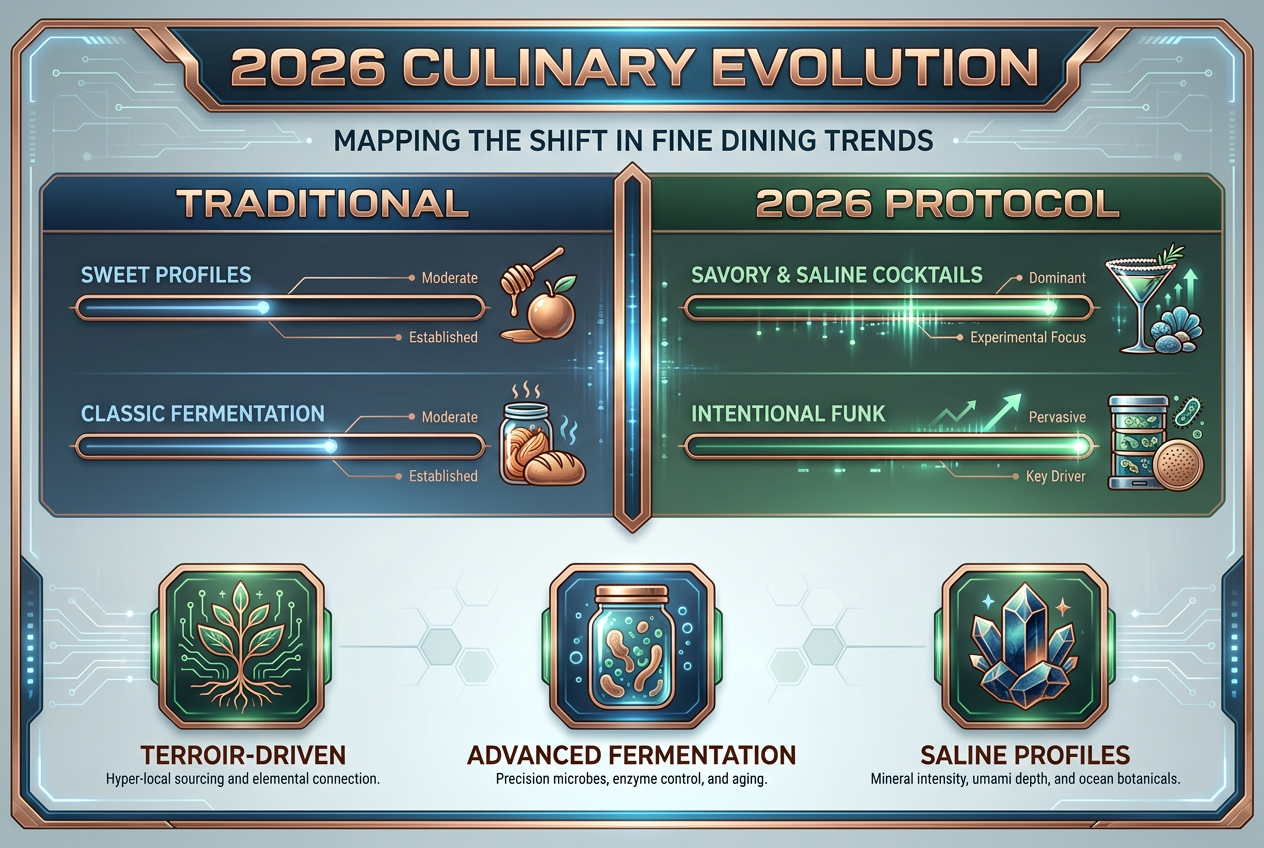 Stay ahead of the curve by mastering the new vocabulary of 2026, focusing on the shift toward savory beverage profiles and terroir-driven storytelling.
Savory Cocktails: The Beverage Revolution
For decades, cocktail programs at fine dining restaurants followed a predictable script: sweet, spirit-forward drinks before dinner, wine during, dessert cocktails or digestifs after.
2026’s leading bartenders have blown this model apart. The new language centers on botanical, saline, and umami-forward profiles that function more like wine pairings than traditional cocktails.
Key vocabulary to recognize:
Clarified stocks and broths: Cocktails built on a base of vegetable or even meat stocks, clarified until perfectly transparent. These drinks read as cocktails visually but taste like distilled versions of the meal itself.
Fermented juice bases: Rather than fresh citrus, bartenders are fermenting fruit juices (apple, pear, tomato, even carrot) to develop complex, funky acids that pair better with fatty or rich dishes.
Saline solutions and sea vegetables: Instead of salt rims, sophisticated drinks incorporate filtered seawater or kelp-infused spirits to add salinity without texture. This mirrors the umami-heavy direction of the food.
Botanical-driven spirits: Gin has been rediscovered, but not the juniper-forward London Dry style. Look for gins highlighting specific regions’ botanicals, or even custom distillations featuring herbs from the restaurant’s own garden.
When the sommelier suggests a "savory aperitif," don’t expect something sweet and fizzy. Expect something that tastes like the most interesting part of dinner distilled into a glass - grassy, mineral-driven, possibly a little challenging, but absolutely delicious with the first course.
If you want to understand this shift before you encounter it, explore how traditional categories are being reconsidered. The conversation around wine and food pairing basics is expanding beyond wine into the full spectrum of beverage possibilities.
Intentional Fermentation: Learning to Describe Funk
Fermentation is having its moment, but that word covers a vast spectrum of flavors. Being able to articulate what you’re tasting separates engaged diners from passive consumers.
The brightness spectrum (lactic acid fermentation): These are your quick ferments - sauerkraut, kimchi, pickled vegetables. The flavor profile is tangy, clean, vibrant. When you taste this in a dish, appropriate descriptors include "bright acidity," "clean funk," "refreshing sourness."
Watch for: Lacto-fermented hot sauces, quick-pickled garnishes, cultured butter, yogurt-based sauces
The funky spectrum (koji and miso): Longer fermentations with molds and yeasts that break down proteins and develop deep umami. This is where food gets genuinely funky - think aged cheese, miso paste, garum (fermented fish sauce). Appropriate language: "earthy depth," "savory complexity," "that low-tide quality," "mushroom-y without mushrooms."
Watch for: Koji-aged proteins, house-made miso varieties, garum-based sauces, amino sauces
The wild spectrum (spontaneous fermentation): This is where things get unpredictable. Sourdough breads, natural wines, spontaneously fermented hot sauces that develop their own cultures. The flavors are complex, sometimes challenging, often polarizing. Language: "barnyard funk," "wild yeast character," "unpredictable but intentional," "this is weird but I like it."
When a dish description mentions fermentation, ask which spectrum they’re working in. It demonstrates engagement and helps the server guide you toward profiles you’ll enjoy.
The key distinction in 2026: Restaurants using fermentation as a technique vs. fermentation as a gimmick. The former integrate these flavors seamlessly into the dish. The latter announce "FERMENTED!" on the menu and hit you over the head with it. You can taste the difference immediately.
Terroir-Driven Sourcing: Why the ’Where’ Matters More Than the ’What’
Generic luxury is dead in 2026. "Fresh seasonal ingredients" doesn’t cut it anymore. The restaurants worth your time and money can tell you exactly where everything came from and why that origin matters.
The new vocabulary of place:
Instead of "local tomatoes," you’ll hear "dry-farmed Early Girls from Coastside Farm, where the maritime fog and sandy soil produce fruit with concentrated sugars and low water content."
Instead of "grass-fed beef," you’ll hear "100% grass-finished beef from White Oak Pastures, where the regenerative grazing program has rebuilt six inches of topsoil and the cattle’s varied diet includes native grasses you can taste in the fat."
This isn’t marketing nonsense. Terroir is real, and the best chefs are obsessed with it. The milk from one specific dairy tastes different from another twenty miles away. The oysters from the cold end of the bay taste nothing like the oysters from the warm end. A chicken that ate bugs and foraged in pasture tastes dramatically different from one that ate only grain.
When you understand this, you stop asking "Is this good?" and start asking "Is this the best expression of what it is?" That’s the question professionals ask.
How to engage with terroir language:
When a menu lists specific farms or producers, that’s your signal to ask questions. "Why this farm?" or "What makes this producer’s version different?" are perfect queries. Good servers will light up - they’ve been trained on these stories and they’re excited to share them.
If the answer is vague or generic ("Oh, they’re local and we like them"), that tells you something. The restaurant is performing the language of terroir without understanding it.
If the answer is specific ("The soil composition in that valley is volcanic, which gives the vegetables a distinct mineral quality" or "That farmer hand-milks and the cheese reflects the specific grasses in each season"), you’re in the presence of a kitchen that cares about these details.
One warning: Beware of menus that list farms but can’t tell you why those farms matter. It’s become trendy to name-drop producers. The difference between restaurants that work with these farms as partners versus those that use the names as decoration becomes obvious when you start asking questions.
Understanding and using this language makes you a better dining companion, a more engaged customer, and frankly, it makes meals more interesting. You’re not just eating - you’re learning about agriculture, ecology, and the specific characteristics of place.
Building Your Culinary Atlas
Fine dining isn’t a transaction. It’s a collection of cultural data, a continuous education, an archive of experiences that compound in value over time.
Every meal you evaluate with precision becomes a reference point. That perfectly balanced pasta teaches you what proper seasoning tastes like. That overpriced disappointment teaches you to recognize style over substance. That surprising vegetable dish challenges your assumptions about what fine dining can be.
Your culinary atlas isn’t built in a year. It’s a decade-long project, maybe longer. But the process itself is what makes you a more thoughtful diner - someone who can articulate not just what you like, but why you like it, and how it connects to everything else you’ve tasted.
Start with your next meal. Before you sit down, decide what you’re trying to learn. During the meal, use the evaluation framework to organize your observations. Within 24 hours, document both the technical details and the emotional context. Do this consistently, and six months from now you’ll have something valuable - a personal reference library of taste memories that you can search, reference, and build upon.
The restaurants will change. Chefs will move. Trends will evolve. But your archive remains. It becomes your constant, your way of measuring not just the food, but your own development as someone who cares deeply about what they eat.
That’s the real luxury - not the meal itself, but the lasting impact it has on how you see the world.
Whether you’re tracking these experiences in a notebook, a productivity app, or a dedicated dish rating platform, what matters is starting. The best culinary atlas is the one you actually build.
Frequently Asked Questions
What is fine dining in 2026?
Fine dining in 2026 has evolved beyond white tablecloths and formal service into what’s best described as "choreographed storytelling." It’s characterized by terroir-driven sourcing (specific farms and producers named on menus), fermentation programs that add complexity, regenerative agriculture partnerships, and beverage programs that challenge traditional cocktail conventions. The focus has shifted from luxury ingredients to intentional technique, from impressing diners to educating them. Modern fine dining is intellectually engaging, often more casual in presentation than traditional models, but no less rigorous in execution.
How do I choose between a tasting menu and à la carte?
Choose the tasting menu for your first visit to experience the chef’s complete narrative and to understand the restaurant’s philosophy. It’s also the better choice when the restaurant is known for a specific technique or when you’re dining with someone who enjoys surrendering control. Go à la carte when you’ve researched specific signature dishes you want to try, when dietary restrictions would require too many tasting menu substitutions, or when you’re returning and want to explore different territory. The tasting menu shows you what the restaurant thinks is important; à la carte shows you what you think is important.
What’s the difference between chef’s counter and dining room seating?
Chef’s counter seating offers direct access to the team, real-time views of cooking techniques, occasional extra bites or experiments, and an educational experience where you can ask questions. It’s ideal for solo diners or couples comfortable with interaction. Dining room seating provides more privacy for conversation, less pressure to engage if you prefer observing quietly, better environments for larger groups, and allows you to focus entirely on your companions. The counter is theater; the dining room is intimacy. Choose based on whether you want to learn from the chefs or focus on your companions.
How do professional food critics evaluate dishes?
Professional critics use systematic frameworks across four dimensions: ingredient quality and seasonality (Is this ingredient at its peak? Does the sourcing justify the price?), technical execution (Are temperatures exact? Does the technique serve the ingredient?), flavor harmony (How do sweet, sour, salty, bitter, and umami elements balance?), and pacing within the larger meal (Does this course make sense in sequence?). They document specific details immediately - exact dish names, key techniques, standout elements - then add emotional context within 24 hours. This creates a searchable archive they can reference for years, not just vague memories of "good" or "bad" meals.
What is the best way to photograph food without being disruptive?
Take one photo per dish using only natural light, shooting at table level (not overhead) when the dish arrives and before you start eating. Never use flash, never take multiple angles, and don’t edit in the moment. If lighting is poor and your photo will be terrible, skip it and rely on written description instead. Keep your phone visible on the table rather than hiding it, which paradoxically makes photography feel less sneaky. The cardinal rule: If your companions remember you photographing the meal, you’ve failed. Documentation should never be more memorable than the meal itself.
How do I build a personal archive of dining experiences?
Use a two-layer documentation system: Layer one is technical data captured immediately (restaurant name, exact dish name, key ingredients and techniques, one sentence about what stood out). Layer two is emotional context added within 24 hours (who you were with, why the meal mattered, how the dish made you feel, connections to other meals). Store this in a system you’ll actually maintain - either a dedicated food memory app, a productivity tool like Notion, or even a simple document. The key is consistency and privacy. Your personal archive should be honest and cumulative, not performative like public reviews.
What are savory cocktails and why are they trending?
Savory cocktails are beverages built around botanical, saline, and umami-forward flavor profiles rather than traditional sweet or spirit-forward bases. They use clarified vegetable or meat stocks, fermented fruit juices, seaweed-infused spirits, and custom botanical distillations. The trend exists because modern beverage programs are designed to function more like wine pairings that complement the meal rather than standalone drinks. Savory cocktails match the umami-heavy direction of contemporary cuisine and challenge diners to think about beverages as part of the complete dining narrative rather than separate from it.
How do I talk about fermented flavors without sounding pretentious?
Learn the three fermentation spectrums and their appropriate descriptors. Lactic fermentation (sauerkraut, kimchi) is described as "bright acidity" or "clean funk." Koji and miso fermentation is "earthy depth" or "savory complexity without being salty." Wild fermentation (sourdough, natural wine) is "barnyard funk" or "unpredictable but intentional character." When you encounter fermentation in a dish, simply ask the server which type they’re using and why. Genuine engagement beats performative vocabulary every time. The goal is to understand what you’re tasting well enough to remember it and recognize it again, not to impress other diners.