
How to Remember Your Favorite Dishes from Past Trips
Harry the matcha king
Harry is our resident matcha obsessive. He’s tasted hundreds of bowls and tracks every cup in Savor.
How to Remember Your Favorite Dishes from Past Trips: A System for Serious Foodies You had that life-changing bowl of ramen in Tokyo three months ago. The...
How to Remember Your Favorite Dishes from Past Trips: A System for Serious Foodies
You had that life-changing bowl of ramen in Tokyo three months ago. The broth was deeply savory, almost smoky, with a richness that stuck with you for days. You took a photo, naturally. Maybe even two.
Now you're trying to recall the name of the place. Was it near Shibuya? Or Shinjuku? You scroll through 2,000 food photos in your camera roll, spending roughly 3 minutes searching for that specific moment, only to find it sandwiched between a mediocre airport sandwich and a blurry shot of someone's birthday cake.
This is the Camera Roll Graveyard - where your most extraordinary culinary memories go to die.
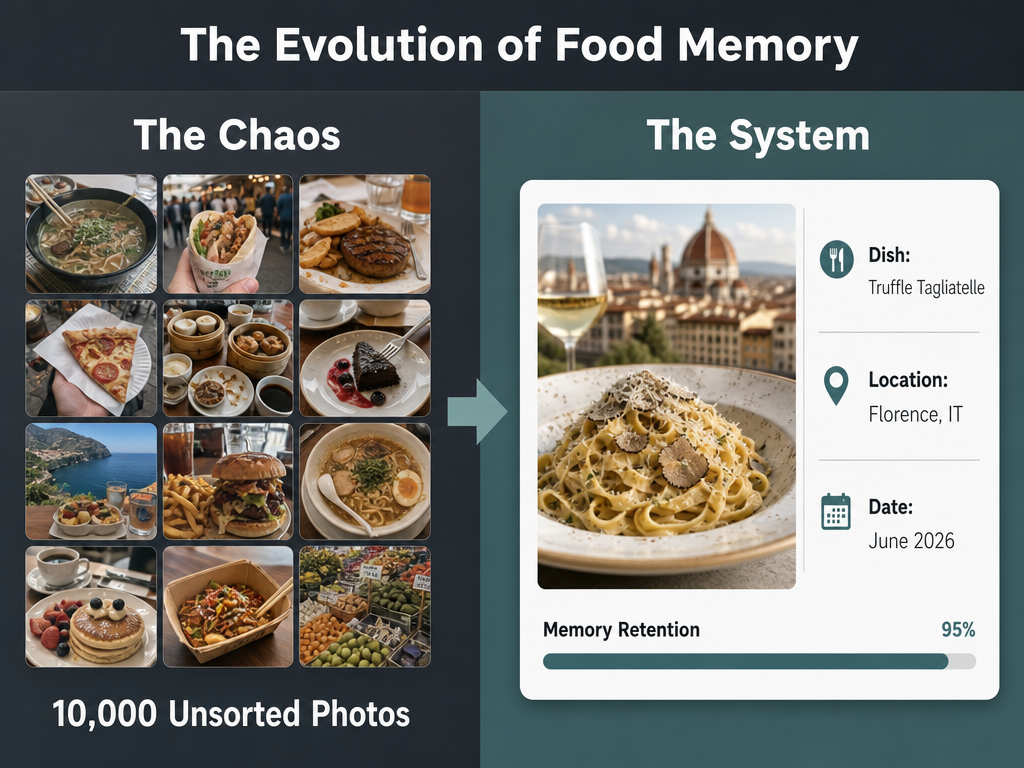 Moving beyond the camera roll graveyard: transitioning from thousands of unsearchable photos to a structured, dish-level memory system for serious foodies.
Table of Contents
- The Real Problem: You're Tracking Places, Not Plates
- Why Restaurant Ratings Can't Help You Remember What You Ate
- The Three Diner Archetypes: Which System Fits You?
- The Serious Foodie's Toolkit: Building Your Memory Protocol
- App Comparison: The Best Tools for Dish-Level Tracking
- The Legacy Log: Making Sure Your Food Memories Last
- Frequently Asked Questions
The Real Problem: You're Tracking Places, Not Plates
Most people approach food memory backward. They remember restaurants - names, neighborhoods, general vibes. But the truth is, a 4-star restaurant can serve both transcendent pasta and forgettable bread service. Averaging those experiences into a single rating is like judging a museum by the gift shop.
What you actually remember, what stays with you on the flight home and surfaces during random conversations six months later, are specific dishes. The texture of that duck confit. The way the sauce on that pasta clung to each strand. The exact interplay of spice and fat in a single taco.
Beli users utilize an ELO ranking system to build a definitive hierarchy of personal dining history, forcing you to choose between that pizza in Naples and the sushi in Osaka. It's a fundamentally different approach than rating venues - it's about building a searchable database of plates, not places.
Why Restaurant Ratings Can't Help You Remember What You Ate
Restaurant ratings optimize for discovery. They're designed to answer one question: "Should I go here?" But they're terrible at answering the question that matters three months after your trip: "What did I eat at that place in Rome, and why was it so good?"
Consider the typical Yelp or Google Maps review. Someone writes: "Great atmosphere! Service was excellent. Food was amazing!" This tells you nothing. It doesn't capture the specific brilliance of the carbonara, the way the guanciale was rendered to create little pockets of crispy fat, the precise ratio of egg to pecorino that made each bite revelatory.
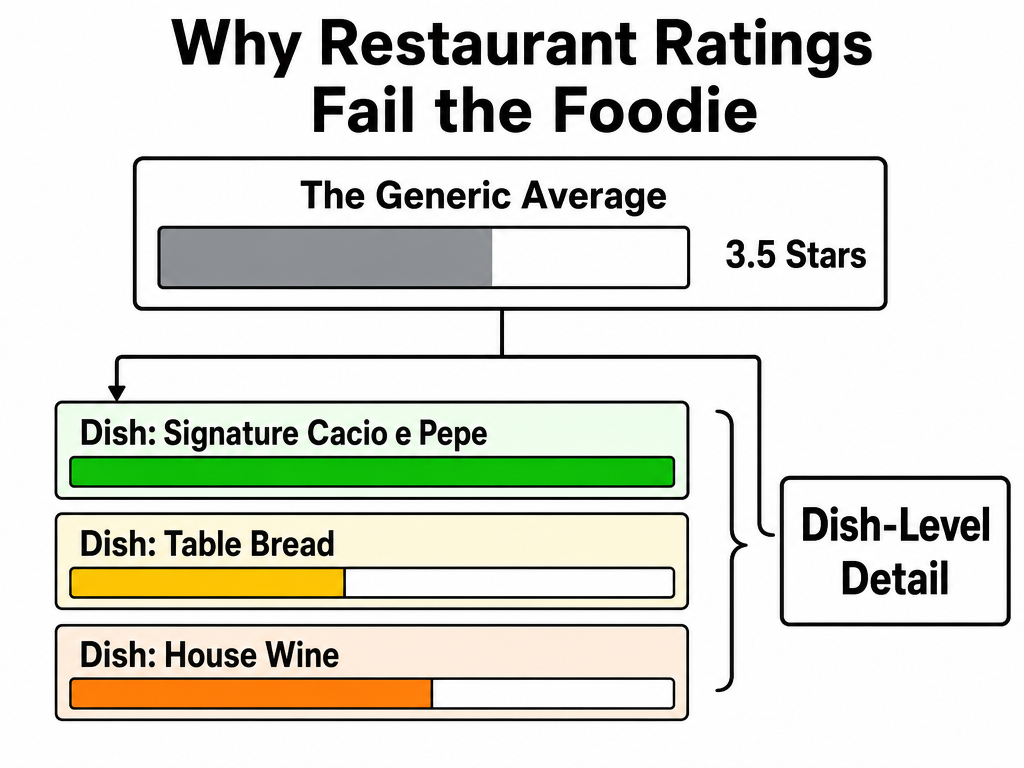 General restaurant ratings often mask the brilliance of specific plates. Dish-level tracking allows you to remember exactly what was worth the trip.
Dish-level tracking solves this. Instead of remembering that "Restaurant X was pretty good," you remember that the duck breast at Restaurant X was perfectly cooked - crispy skin, medium-rare meat, paired with a cherry gastrique that cut through the richness. That level of detail is what makes the memory searchable and, more importantly, re-creatable.
The Three Diner Archetypes: Which System Fits You?
Not all food memory systems serve the same purpose. Before you commit to an app or method, figure out which archetype describes how you actually think about food.
The Critic
You treat dining as a craft worth studying. You notice technique. You want to capture not just whether something was "good," but why it was good - the texture, the flavor layering, the execution. You're the person who asks servers about cooking methods and notices when a dish has been under-seasoned by exactly one pinch.
Best fit: Savor, Memolli, or a custom Notion database with granular rating criteria.
The Socialite
You eat out to discover and share. Your dining choices are social currency. You want to show friends where you've been, build public-facing lists, and climb some kind of implicit ranking among your crew. You're not journaling for yourself - you're curating an identity.
Best fit: Beli, World of Mouth, or specialized list-sharing apps that emphasize social features.
The Traveler
Food is your primary way of experiencing a place. You're less concerned with ranking and more focused on geography and context. When you think about a meal, you think about where you were, who you were with, what the city smelled like that day. Your ideal system organizes by location first, taste second.
Best fit: Yummi, Google Maps with custom lists, or any app that emphasizes geotagging and trip integration.
Understanding your archetype shapes everything else. The Critic needs privacy and detail. The Socialite needs performance and visibility. The Traveler needs context and portability. Choose wrong, and you'll abandon the system in three weeks.
The Serious Foodie's Toolkit: Building Your Memory Protocol
Once you know your archetype, you need a workflow that actually functions in real life - meaning it can't require ten minutes of data entry per meal. Here's the framework professionals use, adapted for serious amateurs.
The 3-Second Rule
The moment your dish arrives, take one photo and add one tag. That's it. Don't write an essay. Don't rate it on five criteria. Just capture the image and attach a single word: "Excellent," "Disappointing," "Technique," "Texture," "Spicy."
This single piece of metadata transforms your camera roll from a graveyard into a filterable archive. Later - on the plane home, during a slow afternoon - you can return and add the nuanced review.
Automation: Let Your Phone Do the Work
Modern smartphones have built-in tools most people ignore. On iOS, you can use Live Text to OCR menus and automatically extract dish names. Android's Lens feature can identify food from photos and suggest similar dishes at other restaurants.
More importantly, both platforms allow you to create smart albums based on location metadata. If you traveled to Mexico City for a week, every photo you took at a restaurant automatically sorts itself into a "Mexico City Dining" album without any manual tagging.
Private Honesty vs. Public Performance
Here's an uncomfortable truth: the most useful food notes are the ones you never post publicly. If you're writing a review knowing that the chef, your friends, or random strangers will read it, you're performing. You soften criticism. You exaggerate praise. You write for an audience instead of for future you.
The best food memory systems encourage radical honesty. That means private notes. "Undersalted but great texture." "Server was pushy." "Overpriced for portion size." This kind of candor only survives in a system where no one else is watching.
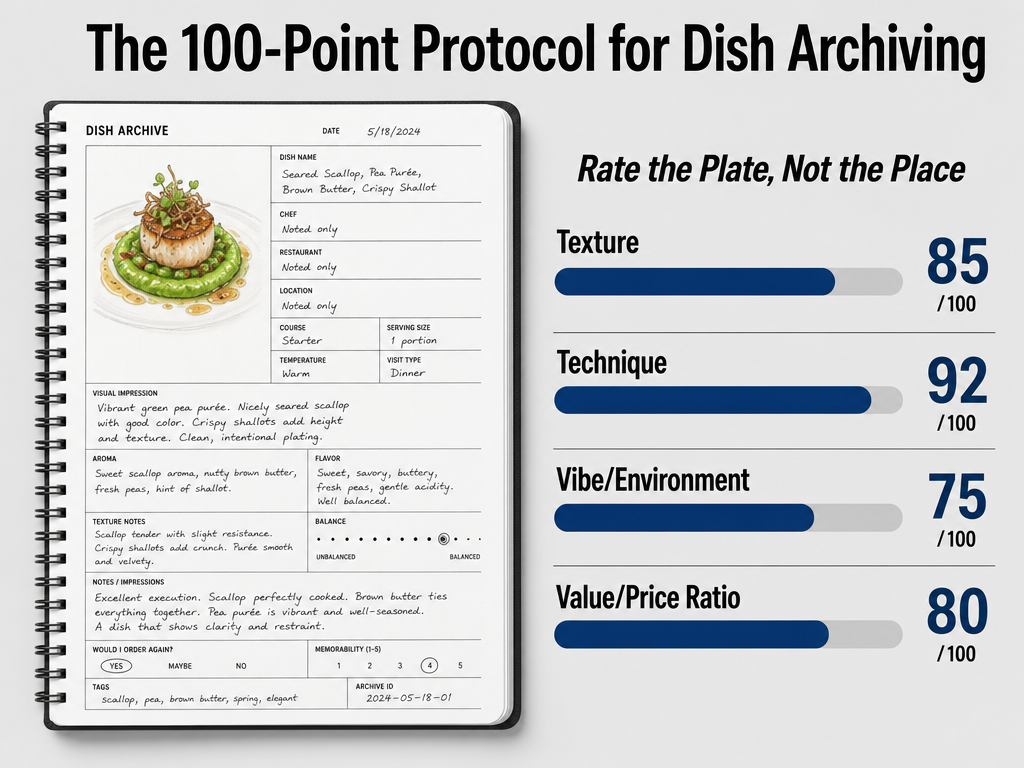 The 100-Point Protocol moves beyond stars to capture the granular details of texture, technique, and value that define a truly memorable meal.
The 100-Point Protocol
Stars are crude. A five-star system gives you exactly six possible ratings (including zero stars). That's not enough resolution to differentiate between "solid neighborhood bistro" and "legitimately transcendent."
Consider adopting a 100-point scale broken into four quadrants:
- Texture (25 points): Was the dish technically well-executed? Proper doneness, appropriate texture contrasts, structural integrity.
- Technique (25 points): Evidence of skill. Knife work, sauce consistency, timing, temperature control.
- Vibe (25 points): Context matters. Ambiance, service, how the dish fits into the meal's narrative.
- Value (25 points): Not just "Was it expensive?" but "Was it worth the price for what it delivered?"
This framework forces specificity. It's harder to retroactively invent details six months later when you have four discrete categories demanding attention.
App Comparison: The Best Tools for Dish-Level Tracking
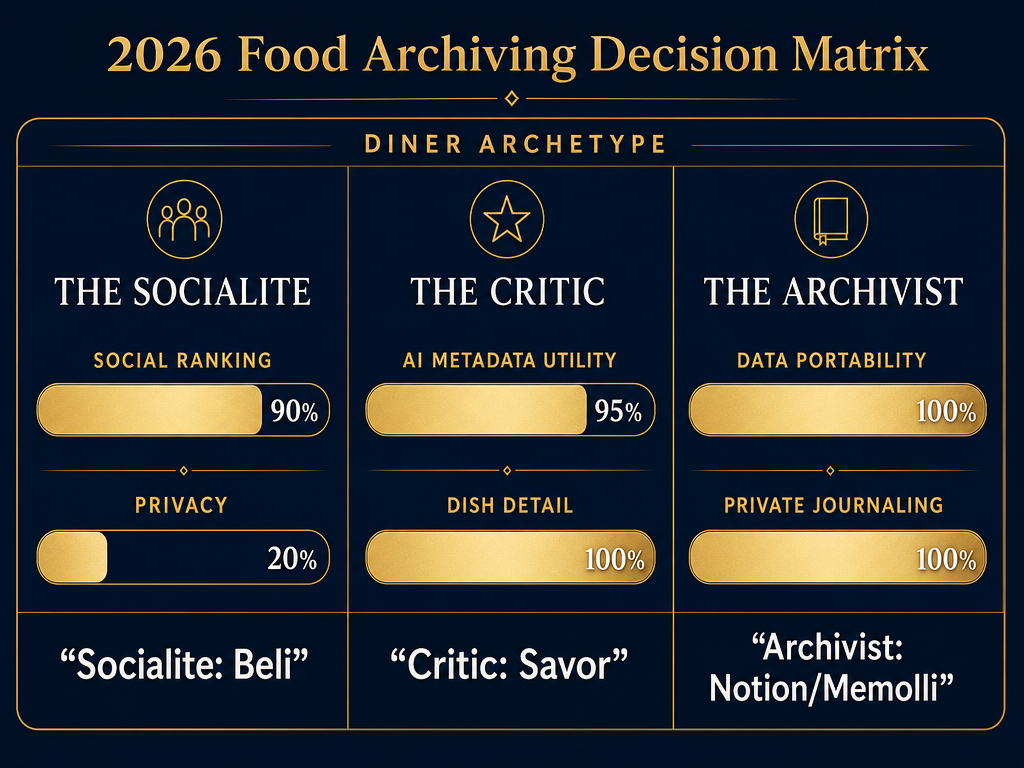 Choosing the right tool depends on your goals: whether you want to rank socially, use AI for automated logging, or maintain a private, portable archive.
| Feature | Beli | Savor | Memolli | Notion | Google Maps |
|---|---|---|---|---|---|
| Dish-Level Detail | Comparative ranking via ELO | Full notes, photos, ratings per dish | Detailed private logs | Unlimited custom fields | Limited; primarily location-based |
| Privacy | Public by default | Private by default | Fully private | Depends on workspace settings | Public lists visible to all |
| AI Features | Basic photo tagging | OCR, dish recognition | None | None | Lens integration for identification |
| Data Export | Limited | CSV/JSON available | PDF export | Full database export | KML/GeoJSON export |
| Best For | Social ranking enthusiasts | Serious critics who want granular control | Private journaling without social pressure | Power users who want ultimate flexibility | Travelers focused on location context |
The right choice depends entirely on your archetype and how you plan to use the data. If you're building a public-facing list to share with friends, Beli's ELO ranking system makes every meal a head-to-head comparison. If you're archiving for yourself and want detailed, searchable notes, Savor and Memolli prioritize depth over shareability.
World of Mouth contains over 30,000 recommendations from 800+ curated experts across 3,000 destinations, making it useful for discovery but less so for personal memory work unless you're also contributing as a recognized expert.
The Legacy Log: Making Sure Your Food Memories Last
Here's the nightmare scenario: You've spent three years meticulously logging every meal. You've built a database of 400 dishes across 18 countries. Then the app shuts down. Or gets acquired. Or pivots to NFTs. And all your data vanishes.
This happens more often than you'd think. Food apps are niche products. They live and die on funding rounds and user retention. Your memories should not be held hostage by venture capital.
Before you commit to any system, ask two questions:
Can I export my data? Look for CSV, JSON, or PDF export options. If the only way to access your reviews is through the app's interface, you don't actually own them.
Is there a backup workflow? Even apps with export features can disappear overnight. Your export from two years ago is useless if the app died 18 months ago. Set a calendar reminder to back up your data quarterly.
The most resilient system is often the simplest: a Notion database with photos stored in iCloud or Google Photos. It's not sexy. It doesn't have AI dish recognition or social ranking. But it will survive the death of any individual platform.
For travelers and critics who want the flexibility of modern apps but the durability of a manual system, consider a hybrid approach to organizing restaurant photos that separates your primary archive (Notion, Airtable) from your discovery tools (Beli, Google Maps).
Frequently Asked Questions
What is the best app for food journaling?
There's no universal "best" - it depends on your goals. If you want social sharing and comparative rankings, Beli is excellent. If you prioritize private, detailed notes with granular ratings, Savor or Memolli are better fits. For travelers who organize by geography first, Google Maps with custom lists or Yummi might work best. The key is matching the app's strengths to your archetype: Critic, Socialite, or Traveler.
How do I find a specific dish in thousands of photos without manual tagging?
Use your phone's built-in tools first. iOS Live Text can extract text from menu photos, and Android Lens can identify dishes and suggest similar items. For deeper organization, create location-based smart albums that auto-sort photos by city or neighborhood. If you're committed to a dedicated app, look for one with AI-powered dish recognition (like Savor) or robust tagging features. The average user spends 3 minutes searching their camera roll for a specific food photo from 6 months ago - automation eliminates that friction.
Can AI automatically identify a dish and find the restaurant from a photo?
Partially. Modern AI can recognize common dishes (pizza, ramen, tacos) and extract visible text from menus or storefronts. Google Lens and Apple's Visual Look Up can suggest similar dishes or identify ingredients. However, AI can't reliably name a specific restaurant from a dish photo alone unless you've geotagged the image or the photo includes identifying details like a branded plate. For accurate archiving, you still need to manually confirm the restaurant name and dish details - AI is a useful assistant, not a replacement for intentional logging.
Why is rating a dish different from rating a restaurant?
A restaurant rating averages every element of an experience: service, ambiance, all dishes, value. A dish rating isolates the thing you'll actually remember six months later. A 4-star restaurant might serve life-changing pasta and mediocre appetizers - the overall rating hides that variance. Dish-level tracking lets you pinpoint exactly what was worth ordering again, what to skip, and which specific plates justify a return visit. It's the difference between "That place was pretty good" and "Order the duck confit - crispy skin, medium-rare, cherry gastrique."
What does Gen Z use instead of Yelp?
Gen Z has largely moved away from Yelp in favor of visual-first, creator-driven platforms. TikTok and Instagram are primary discovery tools - they search hashtags and location tags for recent posts. For personal tracking, many use Beli for its social ranking features and shareable lists. World of Mouth appeals to those seeking curated recommendations from 800+ recognized experts rather than anonymous crowd reviews. The shift reflects a preference for transparent curation and creator accountability over aggregated star ratings.
How do I ensure my food memories aren't trapped in an app that shuts down?
Always choose apps with data export features - look for CSV, JSON, or PDF download options in the settings. Set a quarterly calendar reminder to back up your data. For maximum resilience, maintain a parallel system in a platform-agnostic tool like Notion or Airtable where you control the underlying database. Even better: store photos separately in iCloud, Google Photos, or Dropbox with consistent naming conventions (location, date, dish name) so your archive survives any app's demise. Treat your food app as an interface, not the source of truth.
What's the fastest way to log a meal without disrupting the experience?
Use the 3-Second Rule: take one photo and add one tag immediately. That's it. Don't write a review mid-meal. Just capture the visual and mark it with a single descriptor - "Excellent," "Skip," "Spicy," "Technique." Later, during downtime (flight home, morning coffee), return and add detailed notes. Modern apps like Savor let you batch-edit photos and add context after the fact, so you're not stuck typing paragraphs while your dining companion waits. The goal is to lower friction so much that logging becomes automatic, not a chore.
The truth is, most food memories die not from lack of appreciation, but from lack of infrastructure. You've had extraordinary meals. You remember the feeling. You just can't reconstruct the details. Building a system - whether it's an app, a Notion database, or a disciplined camera roll habit - is how you stop losing those moments. It's not about optimization. It's about respect for the experience.