
Restaurant Feedback Software: Why Foodies Are Ditching Yelp for Personal Tracking Apps
Harry the matcha king
Harry is our resident matcha obsessive. He’s tasted hundreds of bowls and tracks every cup in Savor.
Restaurant Feedback Software: Why Foodies Are Ditching Yelp for Personal Tracking Apps Most restaurant feedback software was never built for you. It was built...
Restaurant Feedback Software: Why Foodies Are Ditching Yelp for Personal Tracking Apps
Most restaurant feedback software was never built for you.
It was built for restaurant owners trying to troubleshoot service problems or push more SMS surveys. That's why searching for "restaurant feedback software" returns a wall of B2B SaaS platforms like Ovation and Tattle - tools designed to help businesses collect anonymous star ratings from strangers, not help serious diners document the roasted duck confit that changed their life.
This disconnect is widening. Restaurant industry sales are projected to reach $1.55 trillion nationwide in 2026, according to the National Restaurant Association, while average food costs remain 35% above pre-pandemic levels. With that much money and selectiveness in play, diners are done relying on vague five-star ratings from people they'll never meet. They're building personal databases instead - searchable, visual, social archives of every dish that mattered, organized with the precision of a film critic's Letterboxd library.
The future of restaurant feedback isn't anonymous crowd wisdom. It's algorithmic taste matching, dish-level tracking, and trusted circles of people whose palates you actually respect.
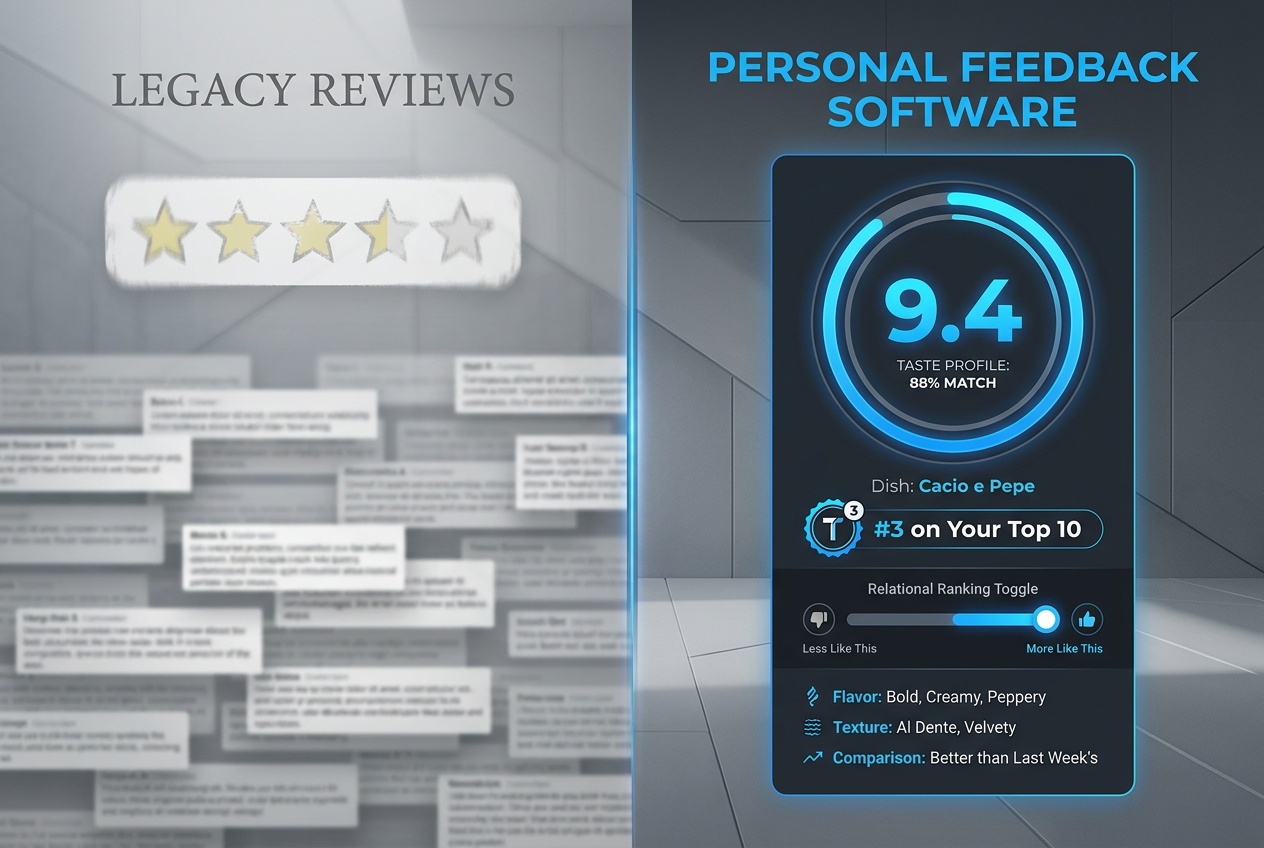 Modern foodies are moving away from anonymous star ratings toward sophisticated personal feedback software that quantifies their individual palate and creates a digital culinary portfolio.
Key Takeaways
- Personal restaurant tracking apps have become the modern "feedback software" for diners, with Beli logging 70 million restaurant ratings worldwide as of late 2025.
- 80% of current Beli users are under the age of 35, signaling a generational shift away from Yelp's anonymous reviews toward algorithmic taste matching and social authority.
- Dish-level tracking apps like Savor and Eaten allow foodies to rate individual plates rather than entire restaurants, solving the "lost in camera roll" problem.
- The "this-or-that" ranking algorithm used by apps like Beli refines your global restaurant list through repeated binary comparisons, creating a scientifically accurate personal leaderboard.
- Structured personal feedback systems help foodies build searchable culinary portfolios, turning scattered photos into a lasting, shareable record of taste.
Table of Contents
- Why Restaurant Feedback Software Is Now Personal
- What Is the App That Makes Rating Restaurants Fun Again
- Top 5 Personal Feedback Apps for Serious Foodies
- How Is Beli Different From Yelp
- Decoding the This-or-That Ranking Algorithm
- The Serious Foodie Feature Matrix
- How to Build Your Own Food Authority Status
- Frequently Asked Questions
Why Restaurant Feedback Software Is Now Personal
Personal restaurant tracking apps solve the problem that legacy review platforms can't: the "dead camera roll" syndrome and the tyranny of the generic five-star rating system.
Traditional feedback software for restaurants was designed for business intelligence - capturing aggregate sentiment to help owners troubleshoot service gaps. But diners don't need aggregate sentiment. They need to remember which specific dish at which specific restaurant justified driving 40 minutes on a Tuesday. They need a system that treats food as culture, not consumer goods.
The shift toward personal tracking systems is measurable. Beli, the app most closely associated with the "Letterboxd for food" movement, reached 30 million reviews in just 3 years, whereas Yelp took 20 years to reach 29 million monthly active users, according to LinkedIn analysis by Preston Junger. That acceleration reflects a fundamental change in how younger diners approach food documentation: they're not writing reviews for strangers - they're building portfolios for themselves.
The Problem: The Dead Camera Roll and the Generic 5-Star Rating
Your phone holds 2,000 food photos. You remember taking them. You don't remember where half of them are from, what you ordered, or why that particular plate mattered. The camera roll is a graveyard of unlabeled culinary moments, sorted only by timestamp, with no search function that understands "that pasta place near the bridge."
The five-star restaurant rating compounds the problem. It collapses every dimension of a meal - the seared scallops, the overcooked risotto, the indifferent service, the transcendent dessert - into a single number that tells you almost nothing. A three-star meal could mean "decent but forgettable" or "one spectacular dish and three disasters." You'll never know.
The Solution: Personal Tracking Systems That Treat Food as Culture
Personal feedback software reframes the question. Instead of asking "How was the restaurant?", it asks "Which specific dishes are worth remembering, and what made them special?" Instead of contributing to a public database of aggregated opinions, you're building a private archive of taste.
This approach mirrors how film enthusiasts use Letterboxd or how music fans curate Spotify playlists. The goal isn't crowdsourced authority - it's personal recall and social signaling. When 49% of surveyed chefs rank social media as the top trend expected to affect operations in 2026, according to the James Beard Foundation, the ability to document and share your culinary experiences becomes a form of cultural capital.
The best personal feedback apps let you search by dish name, ingredient, restaurant, neighborhood, or even the friend who recommended it. They turn your phone from a passive photo vault into an active culinary memory system.
What Is the App That Makes Rating Restaurants Fun Again
Beli has become the de facto answer to the question "What app makes rating restaurants fun again?" by gamifying the restaurant discovery process through its signature "this-or-that" comparison algorithm.
Instead of asking you to assign arbitrary star ratings, Beli presents two restaurants and asks: which one is better? That binary choice is faster, more intuitive, and more fun than writing a paragraph-long review. After enough comparisons, the app's algorithm generates a global leaderboard of your favorite spots, ranked with the precision of an Elo rating system borrowed from competitive chess.
The numbers tell the story of Beli's rise. The app boasts 70 million restaurant ratings worldwide as of late 2025, with users in the San Francisco Bay Area alone logging 3.6 million reviews, according to the San Francisco Chronicle. Users logged 25 million reviews in the first half of 2025 alone, according to Food Network.
Beli's viral success stems from three design choices. First, the this-or-that interface feels like a game, not homework. Second, the app leans heavily into social features, letting you follow friends and trusted critics to see their ranked lists. Third, it positions itself as the anti-Yelp: a private, taste-based platform where your palate is quantified and shared with people you actually know.
For Gen Z and Millennial foodies who grew up on TikTok and Instagram, Beli's visual, fast, and social approach feels native. 80% of current Beli users are under the age of 35, according to Food Network, reflecting a generational shift away from text-heavy legacy platforms.
If you want a tool to explore the best app for rating restaurants options, modern platforms like Beli demonstrate how personal feedback software has evolved beyond static star ratings into dynamic, social ranking systems.
Top 5 Personal Feedback Apps for Serious Foodies
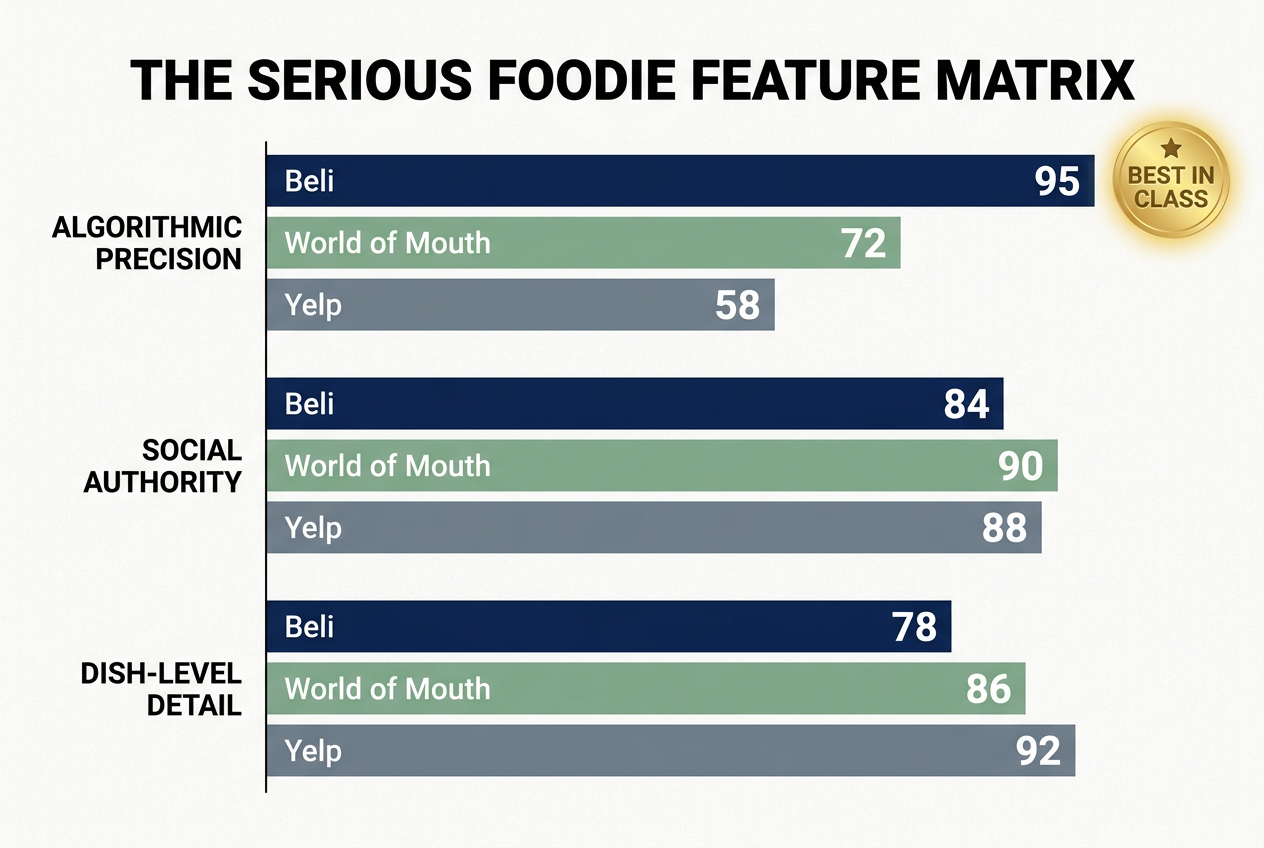 Choosing the right tool depends on your priorities: Beli leads in social ranking and algorithms, while specialized apps like Eaten offer superior dish-level tracking.
The landscape of personal restaurant feedback software has fragmented into specialized tools, each optimized for a different use case. Below are the five most relevant apps for foodies who want to move beyond Yelp's anonymous crowd wisdom into precision tracking, social authority, or dish-level documentation.
| App | Best For | Key Strength | Primary Audience | Booking Integration |
|---|---|---|---|---|
| Beli | Social ranking and algorithmic precision | This-or-that comparisons generate a global ranked list | Gen Z diners who want gamified taste matching | Yes, via Resy |
| World of Mouth | Expert-led insider recommendations | Trusted critics and local experts curate private guides | Foodie travelers seeking reliable, vetted picks | No |
| Savor | Dish-level tracking and personal memory | Individual plate ratings with photos, notes, and search | Precision critics who rate dishes, not venues | No |
| Eaten | The "visual journaler" fixing the camera roll | Dish-focused photo log with tagging and private lists | Foodies who want to organize their food photos | No |
| 80/20 | Efficiency for Asia-metro utility diners | Fast check-ins and streamlined lists for busy eaters | Urban professionals who value speed over depth | Limited |
Beli: Best for This-or-That Ranking and Gen Z Social Vibes
Beli is the app most often cited as the "Letterboxd for food." Its signature feature is the this-or-that binary comparison system, which asks users to repeatedly choose between two restaurants until the app generates a ranked global list. The more comparisons you make, the more accurate your personalized leaderboard becomes.
The app's social features are equally important. You can follow friends, see their ranked lists, and discover restaurants through trusted taste networks rather than anonymous strangers. This approach resonates with a generation that grew up curating Instagram feeds and TikTok FYPs. Beli users in the San Francisco Bay Area alone have logged 3.6 million reviews, demonstrating the platform's density in key metro areas.
Beli integrates with Resy for reservations, making it a full-stack discovery and booking tool. The app's weakness is its restaurant-level focus: you can rank places, but you can't rate individual dishes, which limits its utility for precision-obsessed foodies who want to remember that the miso-glazed black cod was perfect but the tempura was soggy.
World of Mouth: Best for Expert/Insider Recommendations
World of Mouth takes the opposite approach from Beli's crowd wisdom. The app is built around expert-led curation, where professional food writers, chefs, and local insiders create private recommendation guides for their followers. Think of it as a personalized Michelin Guide, written by people you've chosen to trust.
The app's strength is reliability. If you're traveling to a new city and don't know where to eat, World of Mouth connects you with local experts who've vetted every recommendation. The trade-off is less gamification and fewer social features. You're not building a ranked list or comparing your taste to friends - you're following a guide.
World of Mouth works best for foodie travelers who want to eliminate risk. It's less useful for documenting your own culinary journey or building a personal database, which is where dish-focused apps like Savor excel.
Savor: Best for the Dish Obsessive
Savor is purpose-built for foodies who understand that restaurants are inconsistent but great dishes are eternal. Instead of rating entire venues, Savor lets you rate individual plates - the specific pasta, the specific dessert, the specific cocktail - with photos, tasting notes, and a searchable database.
This approach solves the "camera roll graveyard" problem. Every dish you photograph gets a permanent record, tagged by restaurant, cuisine, ingredient, or custom list. You can search your history for "best pasta in San Francisco" or "dishes with burrata" and instantly retrieve every relevant plate you've ever eaten.
Savor's dish-level precision makes it ideal for foodies who want to track their culinary education. If you're learning to distinguish good ramen from great ramen, or if you're building a reference library of how different chefs execute the same dish, Savor's structure supports that level of detail in a way restaurant-rating apps can't.
The app doesn't include booking integrations or social ranking algorithms, which makes it less useful for discovering new spots. But if your goal is to remember and organize what you've already eaten, Savor is the most powerful tool available. Learn more about dish-level tracking strategies to maximize your food documentation workflow.
Eaten: Best for Visual Journaling
Eaten is a photo-first app designed for foodies whose primary pain point is the disorganized camera roll. The app lets you upload food photos, tag them by dish name and restaurant, and organize them into private visual lists. It's less about rating or social sharing and more about archiving.
The app's UI emphasizes browsing and discovery within your own collection. You can scroll through a grid of every taco you've ever photographed or every dessert you've tried in the last year. This approach works well for visual learners who want to see patterns in their eating habits or simply preserve a timeline of meals.
Eaten's weakness is its dated interface and smaller user base compared to Beli or World of Mouth. The app hasn't seen significant updates in recent years, which raises questions about long-term support. But for foodies who prioritize photo organization over social features or algorithmic ranking, it remains a solid option.
80/20: Best for Efficiency Seekers
80/20 is a streamlined app popular in Asian metro areas, designed for busy eaters who want fast check-ins and minimal friction. The app's philosophy is simple: 80% of your dining satisfaction comes from 20% of the restaurants you visit, so focus on building a short list of reliable spots rather than chasing novelty.
The app's interface emphasizes speed. Check in to a restaurant with a single tap, add a quick note if you want, and move on. There's no pressure to write reviews, upload photos, or engage with social features. This minimalist approach appeals to urban professionals who eat out frequently but don't have time for elaborate food documentation.
80/20's limitation is its narrow focus. If you want detailed tasting notes, dish-level tracking, or social discovery features, you'll need to supplement it with other apps. But for building a utilitarian list of go-to spots in your city, it's an efficient tool.
How Is Beli Different From Yelp
Beli and Yelp solve fundamentally different problems, which is why comparing them directly misses the point. Yelp is a crowdsourced discovery engine designed to help strangers find "good enough" options in unfamiliar cities. Beli is a personal taste-ranking system designed to help you quantify and share your own palate with people you know.
The structural differences are clear. Yelp aggregates anonymous reviews from millions of users and surfaces them through a star-rating system that treats all opinions as roughly equal. Beli uses a binary comparison algorithm - this-or-that - to generate a ranked list unique to each user, weighted by your own preferences rather than the crowd's.
Beli's user base reflects this difference. 80% of Beli users are under 35, according to Food Network, compared to Yelp's older, broader demographic. Younger diners prefer algorithmic precision and social circles over anonymous consensus. They want to know where their trusted friends rank a restaurant, not what 500 strangers averaging three stars think.
| Feature | Beli | Yelp |
|---|---|---|
| Rating Methodology | Binary this-or-that comparisons generating a personal ranked list | Aggregated star ratings from anonymous users |
| Social Model | Private taste networks (follow friends, see their lists) | Public reviews visible to all users |
| Primary Use Case | Quantifying and sharing your own palate | Discovering "crowd-approved" options in unfamiliar areas |
| Booking Integration | Yes, via Resy | Yes, via Yelp Reservations and partners |
| Dish-Level Tracking | No, restaurant-level only | No, restaurant-level only |
| User Demographic | 80% under age 35 | Broader age range, skews older |
| Data Ownership | Personal ranked list is yours | Your reviews contribute to Yelp's public database |
The philosophical divide is deeper than features. Yelp is a utility: you use it when you need information. Beli is a social practice: you use it to build and share your taste profile. Yelp is for tourists. Beli is for locals who want their friends to know where they stand.
For foodies who want to understand the full landscape of food review apps, the choice between Beli and Yelp comes down to whether you trust the crowd or your own calibrated palate.
Decoding the This-or-That Ranking Algorithm
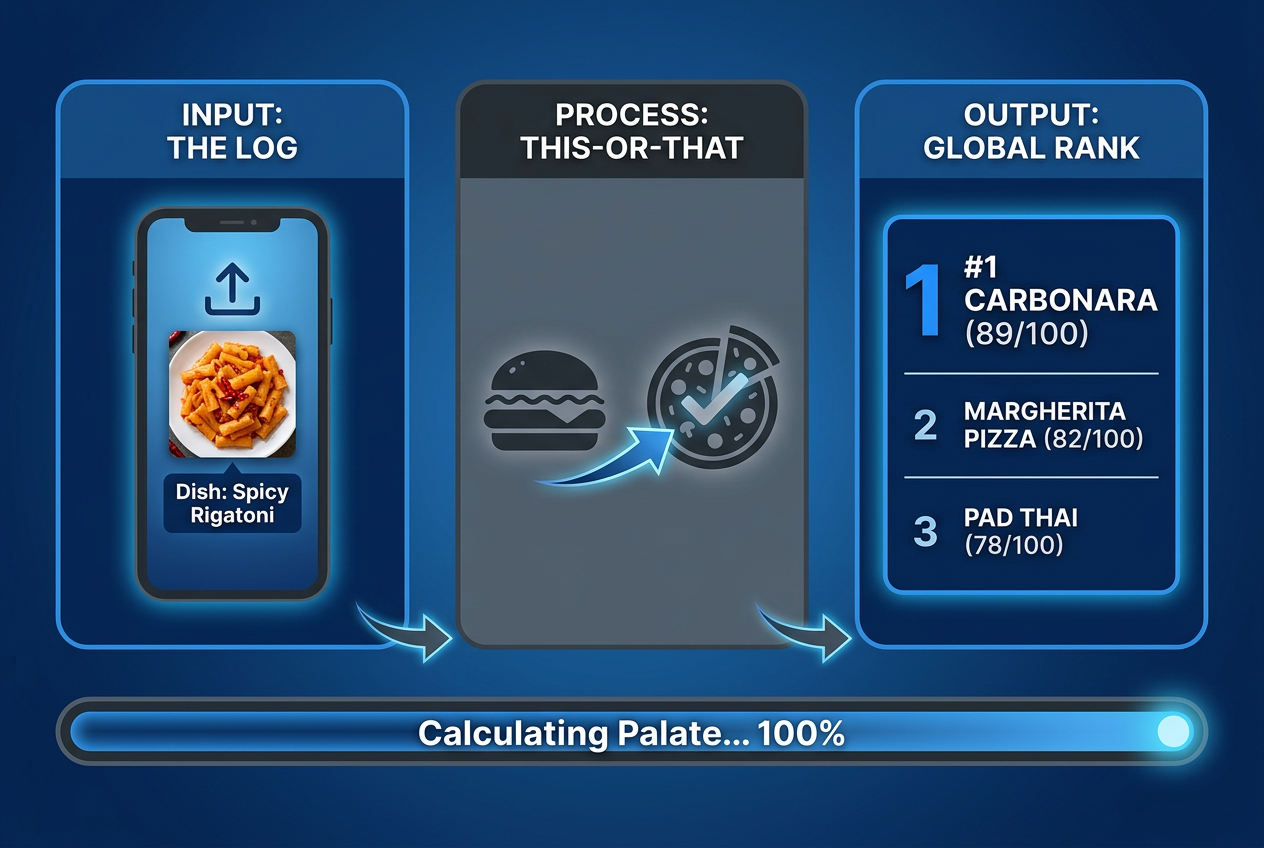 Personal feedback apps use 'this-or-that' gamification to move beyond static reviews, refining your taste profile with every interaction to build a scientifically accurate global leaderboard.
The "this-or-that" comparison algorithm is the secret weapon that makes modern restaurant feedback software feel less like homework and more like a game. Instead of asking you to assign a rating out of thin air, the algorithm presents two restaurants and asks a simpler question: which one is better?
That binary choice is faster and more intuitive than generating a numerical score. Humans are naturally better at comparative judgments than absolute assessments. You might struggle to decide whether a restaurant deserves 4.2 or 4.4 stars, but you can instantly tell which of two places you'd rather revisit.
How the Algorithm Learns Your Palate
The magic happens in the backend. Every time you choose Restaurant A over Restaurant B, the algorithm updates its model of your preferences. After dozens or hundreds of comparisons, it can infer your entire taste hierarchy - not just which restaurants you prefer, but why you prefer them, based on patterns in cuisine type, price point, neighborhood, or chef.
This approach is rooted in Elo rating systems, originally designed for chess rankings. In chess, if a highly rated player beats a highly rated opponent, their score increases slightly. If a low-rated player beats a highly rated opponent, the score shift is dramatic. The same logic applies to restaurants: beating a restaurant you've ranked highly means more than beating one you've ranked low.
Beli users have logged 70 million restaurant ratings worldwide using this method, according to the San Francisco Chronicle. The more comparisons you make, the more accurate your personalized leaderboard becomes.
Why This Works Better Than Star Ratings
Star ratings collapse too much information into a single number. A five-star rating could reflect a perfect meal or a "pretty good" experience from someone who gives five stars easily. The this-or-that model sidesteps that ambiguity by measuring relative preference, not absolute quality.
The social component matters too. When you follow a friend on Beli and see their ranked list, you're not looking at their star ratings - you're seeing which restaurants beat which other restaurants in head-to-head comparisons. That reveals more about their taste than any written review could.
For foodies interested in how to build a personal food authority, understanding how these algorithms work is essential. Your ranked list isn't just a list - it's a data-driven portrait of your palate.
The Serious Foodie Feature Matrix
Not all personal restaurant feedback software is built for the same user. Below is a feature comparison matrix designed to help serious foodies identify which app matches their priorities: algorithmic precision, social authority, dish-level tracking, or visual organization.
| Feature | Beli | World of Mouth | Savor | Eaten | 80/20 |
|---|---|---|---|---|---|
| Algorithmic Ranking | ★★★★★ (Elo-based this-or-that) | ☆☆☆☆☆ | ☆☆☆☆☆ | ☆☆☆☆☆ | ★★☆☆☆ |
| Dish-Level Tracking | ☆☆☆☆☆ | ☆☆☆☆☆ | ★★★★★ | ★★★★☆ | ☆☆☆☆☆ |
| Social Discovery | ★★★★★ (follow friends' lists) | ★★★★☆ (follow experts) | ★★☆☆☆ | ★☆☆☆☆ | ★☆☆☆☆ |
| Photo Organization | ★★★☆☆ | ★★☆☆☆ | ★★★★★ | ★★★★★ | ★☆☆☆☆ |
| Search & Recall | ★★★☆☆ (by restaurant) | ★★★☆☆ (by expert guide) | ★★★★★ (by dish, ingredient, tag) | ★★★★☆ | ★★☆☆☆ |
| Booking Integration | ★★★★☆ (Resy) | ☆☆☆☆☆ | ☆☆☆☆☆ | ☆☆☆☆☆ | ★★☆☆☆ |
| Tasting Notes | ★☆☆☆☆ | ★★★☆☆ | ★★★★★ | ★★★☆☆ | ★☆☆☆☆ |
| Data Export | ★☆☆☆☆ | ★☆☆☆☆ | ★★★★☆ | ★★☆☆☆ | ★★☆☆☆ |
Choosing Based on Your Food Documentation Style
If you prioritize algorithmic precision and social ranking, Beli is the clear winner. Its this-or-that comparison system generates the most scientifically accurate representation of your taste hierarchy, and its social features let you compare your palate with friends.
If you prioritize dish-level tracking and searchable memory, Savor is purpose-built for that workflow. You can rate individual plates, tag them with custom metadata, and retrieve them years later by searching for specific ingredients or cooking techniques. This is the tool for foodies who want a permanent, searchable record of every great dish they've eaten.
If you prioritize expert curation and travel discovery, World of Mouth connects you with local insiders whose recommendations you can trust. It's less useful for documenting your own meals but invaluable for eliminating risk in unfamiliar cities.
If you prioritize visual organization and low friction, Eaten or 80/20 offer streamlined workflows for foodies who want to preserve photos and quick notes without the overhead of detailed ratings or social features.
For a deeper dive into how modern apps handle restaurant tracking, explore the full spectrum of tools available in 2025.
How to Build Your Own Food Authority Status
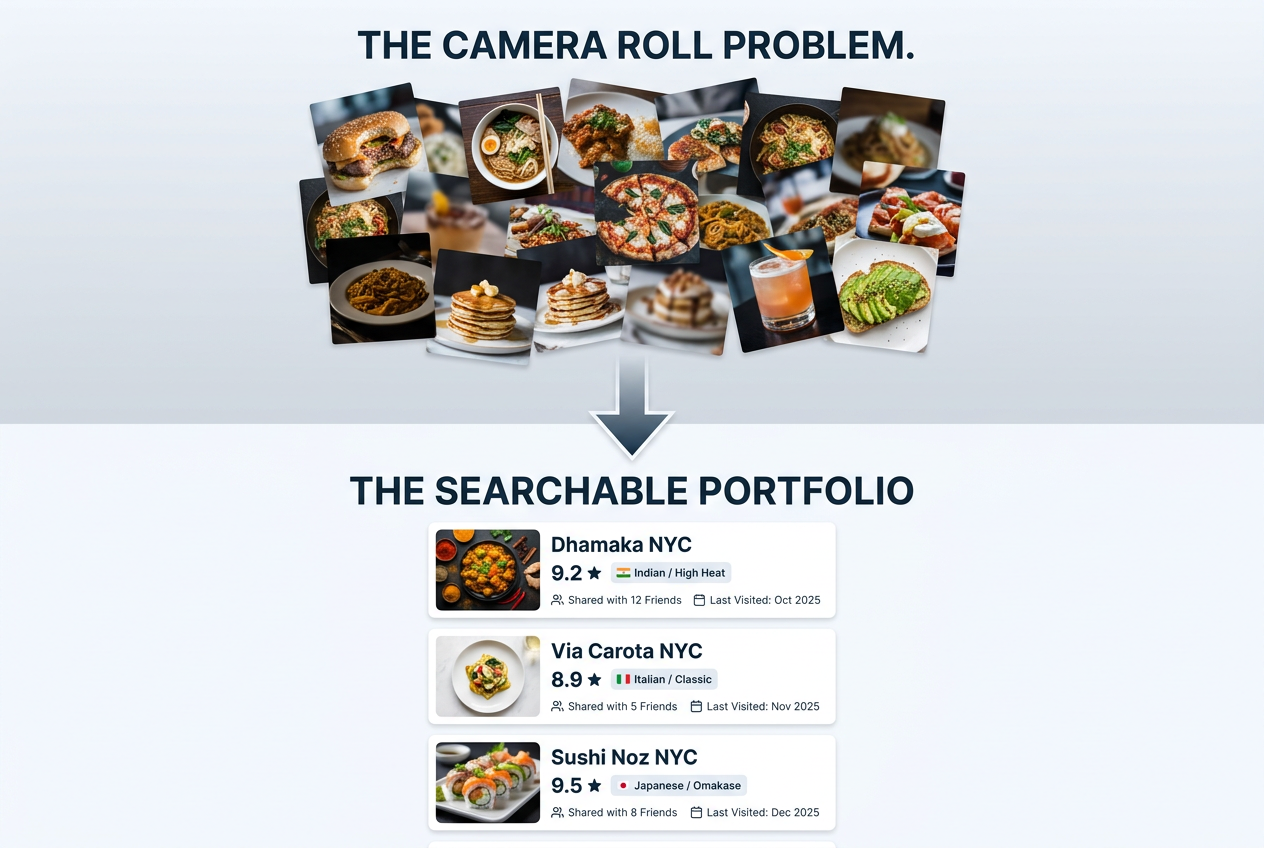 Stop losing memories in your camera roll; specialized software allows you to transform disorganized food photos into a searchable, ranked, and socialized personal database of experiences.
Building food authority status on personal feedback software isn't about accumulating followers - it's about developing a calibrated, consistent, and transparent approach to rating that makes your taste legible to others.
Here's the formula: document consistently, use a repeatable framework, and share your methodology so others can interpret your ratings in context. The goal isn't to become an influencer. It's to become a trusted reference point within your own social circle.
The Pepperoni Pizza Rule for Benchmarking
Every credible food authority needs a benchmark dish - a simple, widely available item that calibrates the rest of your ratings. For many foodies, that benchmark is a plain pepperoni pizza.
The logic is simple. If you rate a Michelin-starred tasting menu without ever establishing what a "perfect 10" pepperoni pizza looks like, your ratings exist in a vacuum. But if your followers know that you gave a 9.2 to the pepperoni at Pizzeria Bianco, they can interpret your 8.7 rating for a fancier spot in context.
Choose a benchmark dish that meets three criteria: it's simple enough that execution matters, it's common enough that you can compare across restaurants, and it's something you genuinely care about. For some foodies, that's a cheeseburger. For others, it's espresso or a Caesar salad. The specific dish matters less than consistency.
Once you've established your benchmark, rate it at multiple restaurants and make those ratings public. This creates a shared reference frame that makes your other ratings interpretable.
Integrating Your Instagram/TikTok Workflow With Your Log
Social media and personal feedback software serve different purposes, but they work best when integrated. Instagram and TikTok are broadcast channels - you're signaling your taste to a wide audience. Personal feedback apps are private archives - you're building a searchable database for yourself.
The workflow looks like this: photograph your dish for Instagram, then immediately open your feedback app (Savor, Beli, or Eaten) and log the same dish with a rating and tasting notes. The Instagram post reaches your followers. The app entry preserves the details you'll want to recall in six months when you're trying to remember the name of that pasta place.
Many serious foodies use Instagram Stories for real-time reactions and their feedback app for considered analysis. The Story captures the moment. The app entry captures the evaluation.
If you're using Beli, the integration is tighter: you can share your ranked list directly to Instagram Stories, which simultaneously broadcasts your taste and drives traffic to your Beli profile. If you're using Savor, you can export dish photos with ratings as shareable cards, bridging the gap between private documentation and public sharing.
Building a Climbing Leaderboard
The most influential food accounts on personal feedback software aren't the ones with the most reviews - they're the ones with the most thoughtful curation. A leaderboard of 20 carefully chosen restaurants, each representing a distinct category or style, is more valuable than a list of 200 undifferentiated entries.
Start by identifying categories that matter to you: best pasta, best sushi, best brunch, best date-night spot. Then populate each category with your top 3-5 picks, each with a clear explanation of what makes it special. This approach gives your followers a decision framework, not just a data dump.
As you add new restaurants, force yourself to decide: does this displace something already on the list, or does it represent a new category? That discipline keeps your leaderboard tight and your authority clear.
For foodies looking to refine their rating systems, learning how to write restaurant reviews that balance enthusiasm with critical precision is essential to building credibility.
Frequently Asked Questions
What apps do people use to review restaurants?
The most popular apps for reviewing restaurants in 2025 are Beli, World of Mouth, Savor, Yelp, and Google Maps, each serving a different use case. Beli leads the personal feedback software category with 70 million restaurant ratings worldwide, focusing on algorithmic taste ranking and social circles rather than anonymous reviews. World of Mouth emphasizes expert-led curation, connecting users with local insiders and professional food writers. Savor specializes in dish-level tracking, allowing foodies to rate individual plates rather than entire venues. Yelp and Google Maps remain dominant for general discovery and crowd-sourced reviews but are increasingly perceived as outdated by younger diners who prefer personalized taste networks. 80% of Beli users are under 35, according to Food Network, reflecting a generational shift toward apps that treat food documentation as a personal portfolio rather than a public service.
Is there an app to keep track of restaurants?
Yes, multiple apps exist specifically for tracking restaurants, with the best choice depending on whether you want to track venues or individual dishes. Beli, World of Mouth, and 80/20 focus on restaurant-level tracking, letting you build ranked lists or curated collections of your favorite spots. Savor and Eaten focus on dish-level tracking, solving the "camera roll graveyard" problem by organizing your food photos into a searchable database with ratings and notes. All of these apps outperform generic note-taking apps or spreadsheets because they're purpose-built for food documentation, with features like geolocation, photo tagging, and social sharing. If your goal is to remember which specific pasta dish was exceptional, not just which Italian restaurant was good, dish-level apps like Savor offer the most precision. For foodies who want a comprehensive system to organize their culinary history, using a dedicated restaurant tracking app provides structure that generic tools can't match.
How is Beli different from Yelp?
Beli differs from Yelp in four fundamental ways: rating methodology, social model, data ownership, and target audience. Beli uses a binary "this-or-that" comparison algorithm to generate a personalized ranked list unique to each user, while Yelp aggregates anonymous star ratings from millions of users into a crowd-sourced average. Beli's social model is built on private taste networks where you follow friends and see their ranked lists, while Yelp's reviews are public and visible to all users. Beli treats your ranked list as personal data that belongs to you, while Yelp's model treats your reviews as contributions to a public database. Finally, Beli's user base skews heavily toward Gen Z and Millennials - 80% under 35 - while Yelp serves a broader, older demographic. The result is that Beli functions as a personal taste-ranking system designed to quantify your palate, while Yelp functions as a crowdsourced discovery engine designed to surface "good enough" options for strangers in unfamiliar cities.
Is Beli still invite only?
No, Beli is no longer invite-only as of 2025. The app initially launched with an invite-only model to control growth and build exclusivity, similar to early-stage social platforms like Clubhouse or Superhuman. That exclusivity phase ended as the app scaled to support 70 million restaurant ratings worldwide. You can now download Beli from the App Store or Google Play without an invitation code. However, the app's culture still retains some of the intimacy of its invite-only era, with a user base that skews toward food-obsessed Gen Z and Millennial diners who treat the platform as a private taste network rather than a public review site. If you're new to Beli, expect to spend time building your ranked list through this-or-that comparisons before the app's algorithmic features become fully useful.
What are the Beli app alternatives?
The best Beli alternatives depend on whether you prioritize social ranking, dish-level tracking, expert curation, or visual organization. For social ranking similar to Beli's this-or-that system, 80/20 offers a streamlined Asia-metro-focused approach but lacks Beli's algorithmic depth. For dish-level tracking, Savor and Eaten allow you to rate individual plates rather than entire restaurants, solving the problem Beli doesn't address. For expert-led curation, World of Mouth connects you with professional food writers and local insiders rather than relying on algorithmic taste matching. For general discovery and booking, Yelp and Google Maps remain the largest platforms but lack the personalized ranking and social features that define modern personal feedback software. Serious foodies often use multiple apps in parallel: Beli for social ranking, Savor for dish-level documentation, and World of Mouth for travel discovery. For a full breakdown of Beli app alternatives, explore tools that prioritize different dimensions of the food documentation workflow.
What is the point of Beli?
The point of Beli is to quantify and share your personal palate through a scientifically accurate ranked list, replacing the vague and unreliable five-star restaurant rating with a binary comparison algorithm that reveals your true taste hierarchy. Instead of writing reviews for strangers or contributing to a crowdsourced database, Beli users build a private portfolio of their culinary preferences, then share that portfolio with friends and trusted critics whose taste they respect. The app's this-or-that comparison system - where you repeatedly choose between two restaurants until the algorithm generates your ranked list - is faster and more intuitive than assigning arbitrary star ratings. Beli's 70 million restaurant ratings worldwide demonstrate that the platform has successfully captured a generational shift: younger diners no longer trust anonymous crowd wisdom, and they prefer algorithmic precision and social authority over public review sites. The result is a tool that treats food documentation as a form of cultural capital, where your ranked list becomes a legible, shareable representation of your taste.
What software do most restaurants use?
Most restaurants use a combination of point-of-sale (POS) systems, reservation platforms, and feedback management tools rather than a single all-in-one solution. For POS systems, Square, Toast, and Clover dominate the market, handling transactions, inventory, and basic reporting. For reservations, Resy, OpenTable, and Tock are the industry standards, with Resy gaining ground among high-end establishments due to its integration with American Express. For customer feedback management - the B2B equivalent of consumer restaurant review apps - platforms like Ovation, Tattle, and Olo help restaurants collect real-time guest satisfaction data through SMS surveys and sentiment analysis. These tools are designed to help restaurant owners troubleshoot service problems and improve operations, not to help diners document their personal culinary journeys. That's why searching for "restaurant feedback software" returns a wall of B2B SaaS platforms rather than consumer-facing apps like Beli or Savor. The disconnect reflects the dual meaning of the term: businesses need operational feedback, while diners need personal memory systems.
What is the best app for restaurant reviews?
The best app for restaurant reviews in 2025 depends on whether you want personal taste tracking, dish-level precision, expert curation, or crowdsourced discovery. For personal taste tracking, Beli leads the category with its algorithmic ranking system and social features, generating a personalized leaderboard of your favorite restaurants through binary this-or-that comparisons. For dish-level precision, Savor allows you to rate individual plates rather than entire venues, solving the problem that most review apps ignore: restaurants are inconsistent, but great dishes are eternal. For expert curation, World of Mouth connects you with professional food writers and local insiders whose recommendations you can trust. For crowdsourced discovery, Yelp and Google Maps remain the largest platforms but are increasingly perceived as outdated by younger diners who prefer algorithmic precision over anonymous consensus. Serious foodies often use multiple apps in parallel: Beli for social ranking, Savor for dish documentation, and World of Mouth for travel discovery. For a comprehensive comparison of the best food review apps, explore tools that prioritize memory preservation over crowd wisdom.