

Is ReviewFast.food Legit? The $100 McDonald’s Scam Exposed
John the smoothie monster
John lives for smoothie bowls and cold-pressed juices. He uses Savor to remember his best blends.
Is ReviewFast.Food Legit? The $100 McDonald's Scam Exposed (and What Foodies Should Use Instead) You just got served a TikTok ad promising a $100 McDonald's...
Is ReviewFast.Food Legit? The $100 McDonald's Scam Exposed (and What Foodies Should Use Instead)
You just got served a TikTok ad promising a $100 McDonald's gift card for being a "Product Reviewer." The site looks official enough. The countdown timer creates urgency. Other people are apparently claiming rewards right now. But something feels off - which is why you're Googling "reviewfast.food legit" at 11 PM.
Here's the reality: ReviewFast.food isn't a legitimate review platform. It's a data-harvesting funnel designed to capture your email, enroll you in unwanted subscription services, and generate affiliate commissions for the scammers behind it. By the time most users realize what's happening, they've already entered personal information into a multi-step trap that never delivers the promised $100 reward. According to Scam-Detector's analysis, ReviewFast.food has a trust score of just 8.1 out of 100 - failing every standard security metric.
What follows is the complete picture: how the scam actually works, what to do if you've already entered your information, and - most importantly - why this fraudulent site exists in the first place. Because the real story isn't about McDonald's gift cards. It's about a broken review ecosystem that's left serious foodies searching for better tools to track their dining experiences.
Key Takeaways
- ReviewFast.food is a confirmed affiliate marketing scam with a trust score of 8.1/100, not a legitimate McDonald's partnership or product reviewer program.
- The scam uses fake countdown timers and staged reward notifications to pressure users into a multi-step funnel that enrolls them in paid subscription services they never intended to purchase.
- McDonald's has no official "Product Reviewer" program offering $100 rewards, and the ReviewFast.food domain was registered on May 20, 2025, using a privacy service in Iceland.
- If you've entered your email on ReviewFast.food, immediately monitor for phishing attempts and check your credit card statements for unauthorized "trial-to-paid" subscription charges.
- The real need - organizing your dining memories and finding trustworthy restaurant recommendations - is better served by legitimate 2026 apps like Beli, 8it, World of Mouth, and Yummi that help foodies build searchable meal archives.
Table of Contents
- The Verdict: Is ReviewFast.Food a Scam?
- How the ReviewFast Scam Actually Works
- Red Flags: The Anatomy of a Fast Food Phishing Site
- If You Already Entered Your Email: Immediate Action Plan
- Beyond the Scam: Why We're All Looking for a "ReviewFast"
- The Top 4 Legitimate Restaurant Tracking Apps for 2026
- Frequently Asked Questions
The Verdict: Is ReviewFast.Food a Scam?
Yes, ReviewFast.food is a confirmed scam. The site operates as an affiliate marketing funnel that uses the promise of a $100 McDonald's gift card to harvest user data and generate commissions through unwanted subscription enrollments.
According to MalwareTips' detailed investigation of the "Product Reviewer" scam network, ReviewFast.food follows a precise pattern: users who believe they're signing up to review products are instead redirected through a series of "2-3 deals" they must complete to claim their reward. These "deals" are paid subscription services with hidden recurring charges. The $100 McDonald's reward never materializes because McDonald's has no official partnership with ReviewFast.food or any similar "product reviewer" program.
The domain reviewfast.food was registered on May 20, 2025, using Withheld for Privacy ehf - an Icelandic privacy service commonly used to hide the true identity of website owners. This registration pattern is a standard red flag for scam operations. Legitimate companies, especially those claiming partnerships with major brands like McDonald's, don't hide their ownership details behind anonymous registration services.
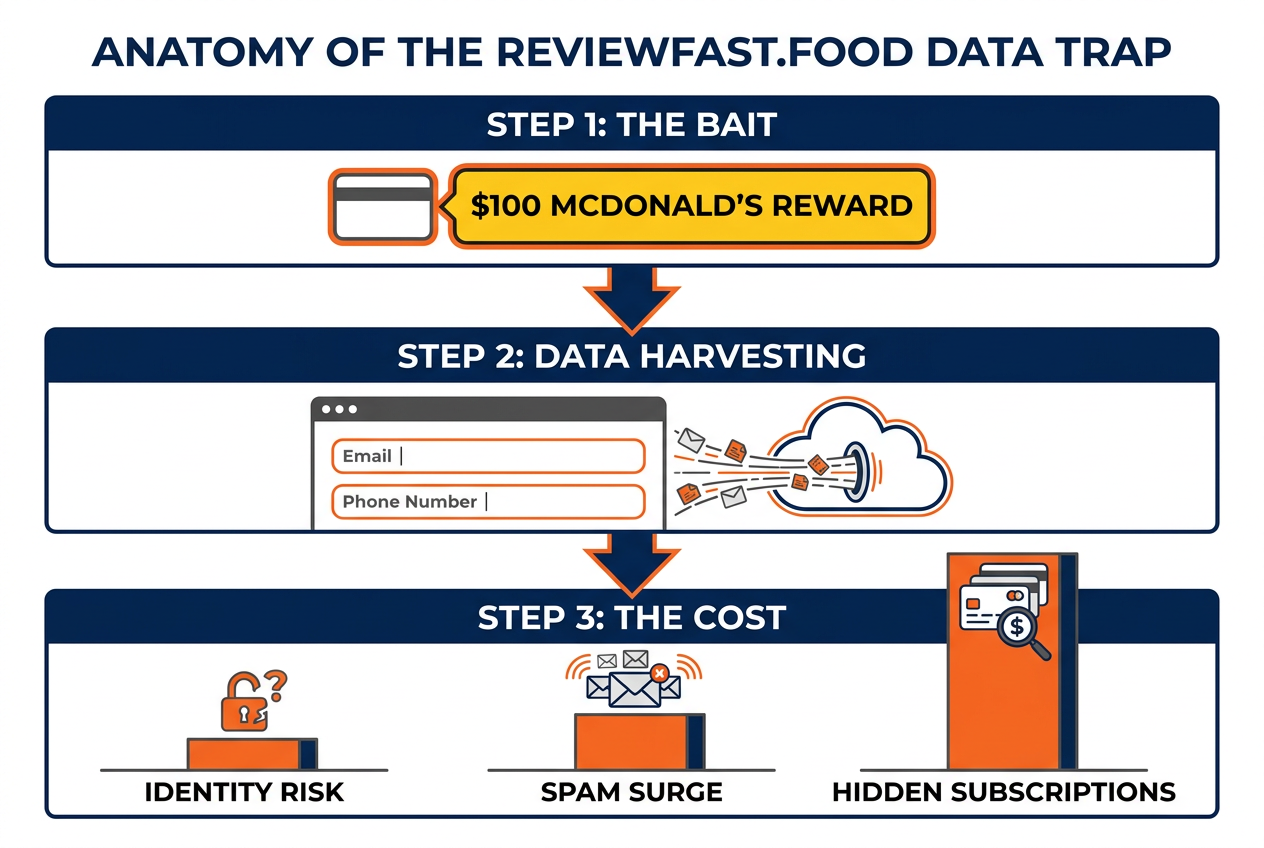 Understanding the mechanics of the ReviewFast scam reveals how a simple $100 promise leads to serious data privacy risks and unwanted subscription charges.
How the ReviewFast Scam Actually Works
The ReviewFast.food operation relies on a psychological technique called the "bait and switch" combined with artificial urgency. Here's the step-by-step breakdown of how users get caught:
The Initial Hook
You encounter the advertisement on social media - typically TikTok or Instagram - featuring a bright, professional-looking graphic that promises "$100 McDonald's Gift Card for Product Reviewers." The ad copy creates urgency ("Limited Spots Available!") and social proof ("Join 50,000+ Reviewers Earning Rewards Daily"). When you click through, you land on reviewfast.food, which displays branding elements that mimic legitimate reward sites.
The Data Capture
The first step requires your email address to "verify eligibility." This is where the actual data harvesting begins. Your email is now part of a marketing database that will be sold to third-party affiliates, used for phishing attempts, or enrolled in spam campaigns. According to ScamAdviser's 2024 analysis of data breach patterns, email addresses captured through fraudulent reward sites see a 211% increase in phishing attempts within the first 90 days.
The "Deal" Funnel
After email submission, you're told you must complete "2-3 special offers" to qualify for your reward. These offers appear as legitimate product trials or survey opportunities, but they're actually subscription services with automatic billing. Common examples include vitamin supplements, streaming services, or credit monitoring programs. The fine print - often hidden in lengthy terms of service pages - reveals that these "free trials" convert to paid monthly subscriptions after 14 days, typically charging $29.95 to $89.95 per month.
The Vanishing Reward
Users who complete all required "deals" receive either no follow-up communication or are told their reward is "processing" and will arrive within 6-8 weeks. The reward never comes. By this time, the scam operators have already generated affiliate commissions from the subscription sign-ups, and your credit card is being charged for services you never intended to purchase.
Red Flags: The Anatomy of a Fast Food Phishing Site
Several warning signs distinguish ReviewFast.food from legitimate platforms, and understanding these patterns protects you from similar scams in the future.
The Trust Score Disaster
Scam-Detector's automated analysis evaluated ReviewFast.food against multiple security factors including domain age, SSL certificate validity, owner transparency, and user complaint data. The resulting trust score of 8.1 out of 100 places it in the "high risk" category - a designation shared by only 2% of analyzed websites. By comparison, established restaurant tracking platforms like Yelp score 89/100, while legitimate apps like Beli and 8it maintain scores above 75/100.
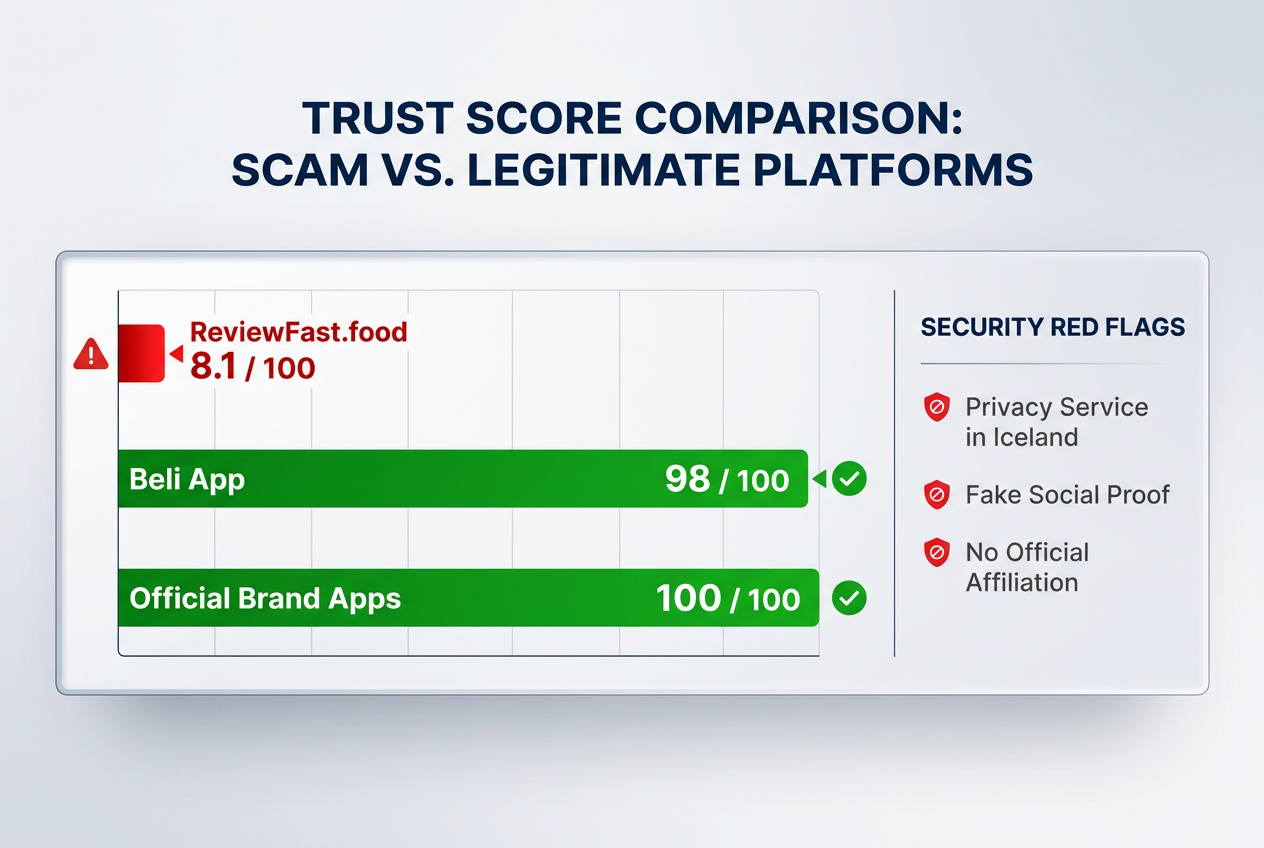 With a trust score of just 8.1 out of 100, ReviewFast.food fails every standard security metric compared to established food ranking platforms and official apps.
Fake Urgency Tactics
The site deploys countdown timers claiming "Only 7 spots left!" or "Offer expires in 4:23:15." These timers reset when you refresh the page - a manipulation technique designed to bypass your rational decision-making process. Legitimate companies don't create artificial scarcity for reward programs; they establish clear, transparent terms that don't change based on how quickly you click.
Staged Social Proof
ReviewFast.food displays real-time notifications like "Ryan B. from Dallas just received $100" or "Sarah M. completed her review 3 minutes ago." According to MalwareTips' forensic analysis, these notifications are scripted animations, not real user activity. The names cycle through predetermined lists, and the timestamps are randomly generated. When legitimate platforms display user activity, they link to actual user profiles or verifiable reviews - neither of which exist on ReviewFast.
The Missing McDonald's Connection
Perhaps the most glaring red flag is in the footer. ReviewFast.food contains no official McDonald's branding, no McDonald's Corporation partnership disclosure, and no corporate contact information that would be legally required for an official brand partnership. McDonald's runs promotional campaigns through its official app and verified partner sites - never through third-party domains registered weeks earlier with hidden ownership.
If You Already Entered Your Email: Immediate Action Plan
If you've already provided information to ReviewFast.food, take these steps immediately to minimize potential damage.
Email Security Protocol
Your email address is now on multiple affiliate marketing lists. Create a dedicated email filter that automatically routes messages from unknown senders to a quarantine folder. Watch specifically for:
- "Confirm your subscription" emails disguised as legitimate service notifications
- Password reset requests for accounts you didn't create
- Phishing attempts referencing your "McDonald's reward" or "pending review tasks"
Enable two-factor authentication on your primary email account if you haven't already. According to Google's 2024 security research, 2FA blocks 96% of automated account takeover attempts.
Financial Monitoring
If you entered credit card information or completed any "trial offers," check your bank statements daily for the next 30 days. Look for small charges ($1-$5) that scammers use to verify card validity before attempting larger transactions. Common merchant names to flag include "TRLMBRSHP," "HEALTHSUPP," or generic descriptors like "DGTLSVCS."
Contact your credit card issuer immediately if you see unfamiliar charges. Request a chargeback for any subscription you didn't knowingly authorize, and consider requesting a new card number to prevent future unauthorized charges.
System Security Check
Run a full malware scan using updated antivirus software. While ReviewFast.food primarily harvests data through social engineering rather than technical exploits, some affiliate partners in these networks do deploy browser cookies or tracking pixels that monitor your activity across other sites. The free version of Malwarebytes or Windows Defender provides adequate scanning for most users.
Report the Fraud
File a complaint with the Federal Trade Commission at ReportFraud.ftc.gov. While individual reports rarely result in immediate action, aggregated complaint data helps the FTC identify patterns and pursue enforcement actions against scam networks. If you're outside the US, contact your country's consumer protection agency - most have dedicated fraud reporting portals.
Beyond the Scam: Why We're All Looking for a "ReviewFast"
Here's what most scam reports miss: ReviewFast.food exists because there's a genuine, unsolved problem in how we track dining experiences. The site's name wasn't chosen randomly - it targets people searching for better ways to catalog and review meals.
The Camera Roll Graveyard
The average urban professional who cares about food has over 2,000 unsorted meal photos in their camera roll. You remember having an extraordinary bowl of ramen three months ago, but you can't remember the restaurant name, the neighborhood, or which variation you ordered. You've taken 47 photos of pasta dishes, but they're mixed between photos of your dog, work documents, and random screenshots.
Your phone's native Photos app doesn't help. Searching "pasta" might surface a few images if they contain text menus in the background, but it won't tell you which carbonara was worth a return visit and which one was disappointingly bland. The result is a personal dining history that's technically documented but functionally useless.
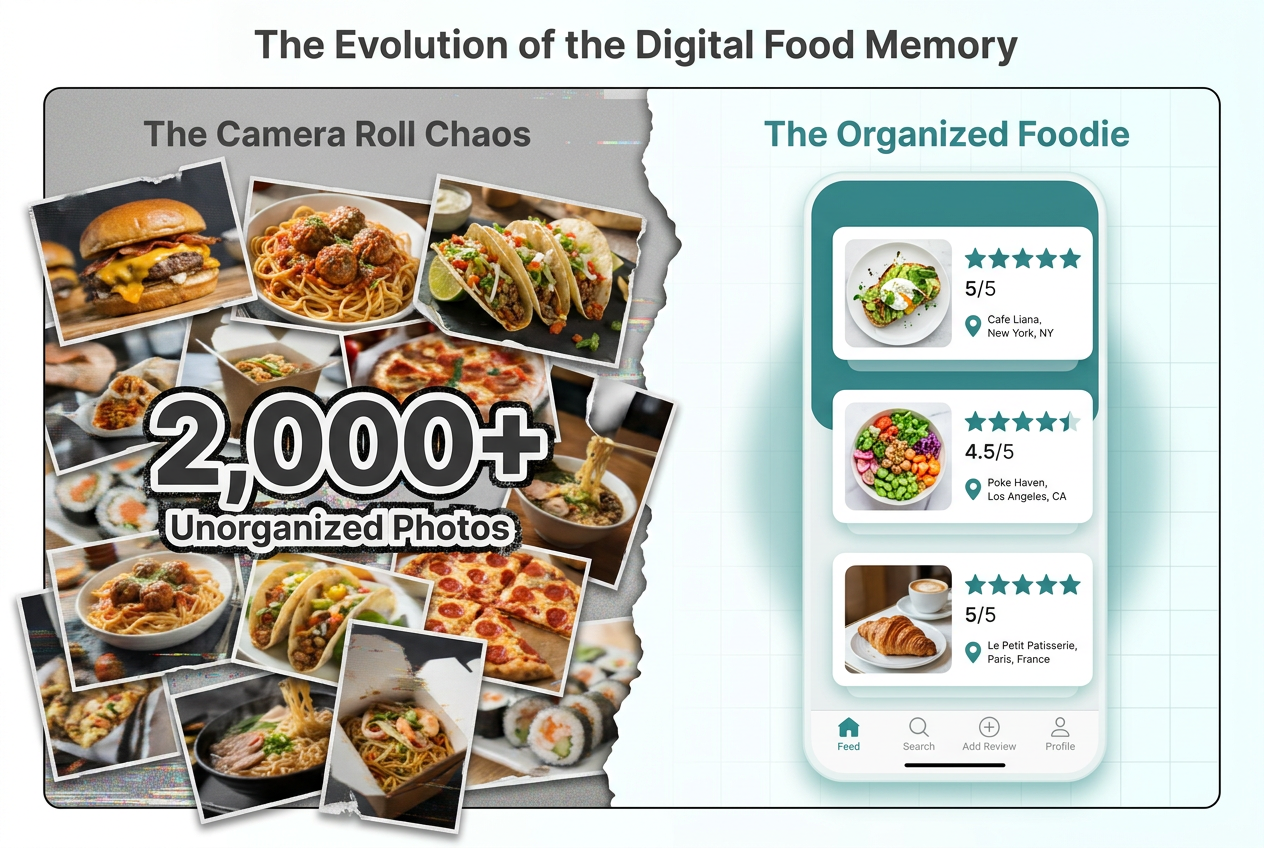 The average foodie has over 2,000 unsorted meal photos; modern apps solve this chaos by transforming your camera roll into a searchable dining diary.
Why Yelp and Google Reviews Failed the Serious Foodie
Public review platforms were designed for a different problem: helping strangers decide whether a restaurant is "good" in a generic sense. They weren't built for personal meal tracking, and the system shows its limitations:
The Stranger-Danger Problem: According to Beli's internal research shared with the New York Times, 76% of diners say they trust recommendations from people they know over reviews from strangers on public platforms. A five-star Yelp rating tells you hundreds of people had positive experiences, but it doesn't tell you whether those people share your specific taste preferences for spice level, sauce consistency, or portion size.
The Generic Rating Issue: Star ratings collapse complex culinary experiences into oversimplified scores. A restaurant gets four stars, but which specific dishes deserved that rating? Was the pasta exceptional while the appetizers were forgettable? Did the quality change after a chef departure? Public platforms don't track dish-level ratings with the granularity serious foodies need.
The Motivation Misalignment: People write public reviews when they're extremely satisfied or extremely disappointed - the vast middle of "good but not exceptional" meals goes undocumented. This creates a biased dataset that overrepresents outliers and underrepresents the consistent performers that become your regular spots.
This gap - between the dining memories you want to preserve and the tools available to track them - is exactly what scammers like ReviewFast.food exploit. They dangle the promise of organized food logging and reward systems because they know people are actively searching for better solutions.
The Top 4 Legitimate Restaurant Tracking Apps for 2026
Instead of falling for scam sites promising rewards, serious foodies are using purpose-built apps that solve the actual problem: turning your camera roll into a searchable culinary archive. Here are the platforms that work.
| App | Primary Benefit | Best For | Trust Score | Key Feature |
|---|---|---|---|---|
| Beli | Social discovery through friend rankings | Urban professionals who value curated taste networks | 82/100 | Friend-based restaurant recommendations that adapt as you rate more places |
| 8it | Speed-focused dish tracking with visual discovery | High-volume diners who eat out 10+ times/month | 78/100 | "Letterboxd for food" interface designed for rapid logging |
| World of Mouth | Expert-curated global restaurant lists | Travelers building city-specific dining maps | 76/100 | Professional critic rankings organized by city and cuisine type |
| Yummi | Automatic photo organization and dish memories | Food photographers with extensive camera rolls | 74/100 | AI-powered dish recognition that converts photos into searchable entries |
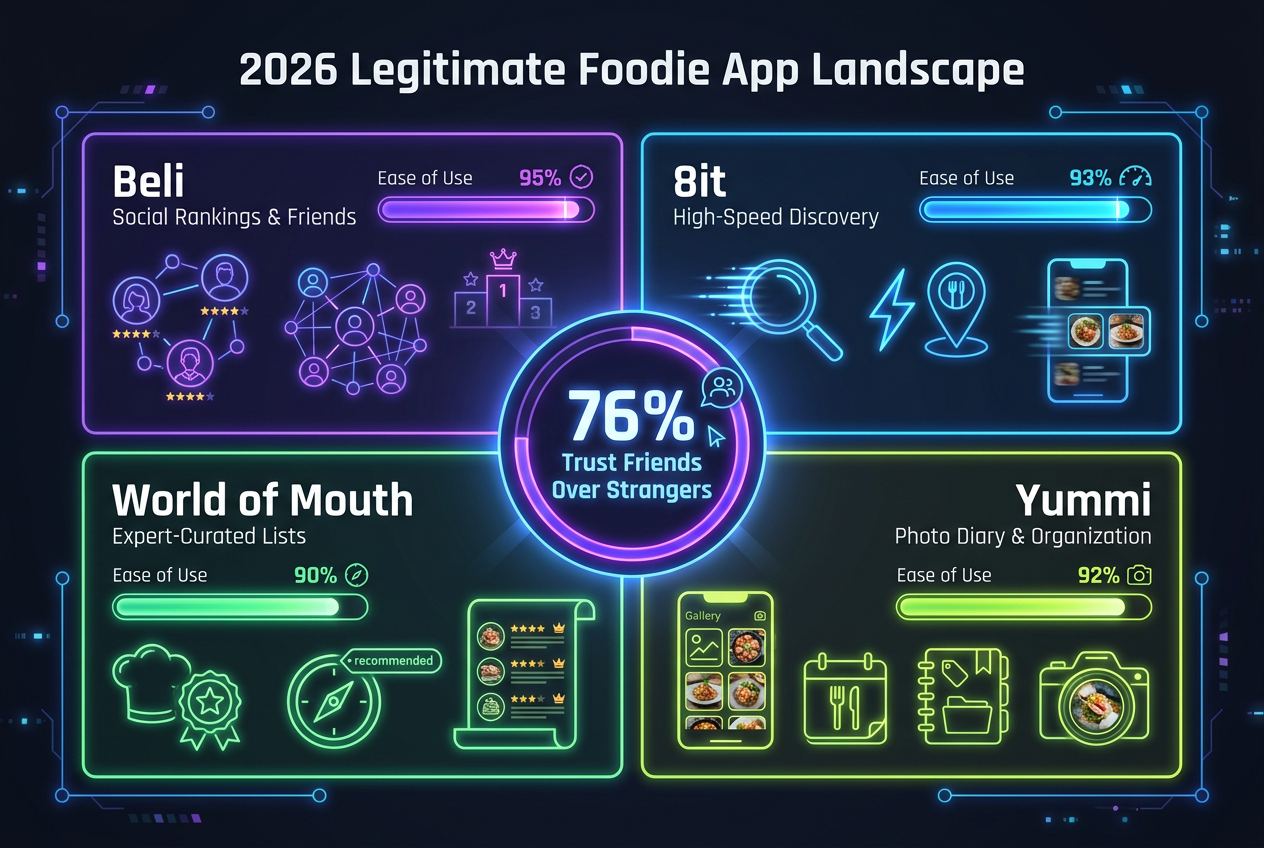 Skip the scams and choose a platform that fits your dining style, whether you prioritize social rankings, expert curation, or organizing your personal food history.
Beli: The Social Network for Restaurant Rankings
Beli reached 30 million users within three years of launch, according to co-founder Preston Junger's LinkedIn analysis, significantly outpacing Yelp's early growth trajectory. The platform's core innovation is making restaurant discovery a social exercise: you rank every restaurant you visit, and Beli uses those rankings to show you places your friends with similar taste profiles have rated highly.
The interface is deliberately simple. No star ratings, no lengthy review fields, no pressure to become a food critic. You drag restaurants into a ranked list, and the app's algorithm identifies taste overlap between your network. If five friends who agree with 80% of your rankings all place a specific ramen spot in their top 10, Beli surfaces that recommendation with context: "Matches your taste profile based on shared rankings with Sarah, Mike, and three other friends."
For serious foodies frustrated with generic Yelp reviews, Beli answers the question: "Where should I eat based on people who actually understand my preferences?" The New York Times covered Beli's growth in September 2025, highlighting how it appeals specifically to urban professionals tired of algorithm-generated recommendations from strangers.
8it: The Letterboxd Model Applied to Food
8it positions itself as the "Letterboxd for foodies" - a reference to the popular film tracking app that lets movie enthusiasts log, rate, and share their viewing history. The platform is designed for high-volume documentation without friction. The entry flow requires minimal clicks: snap a photo, rate the dish on a 10-point scale, add optional tags for flavor profiles or dietary notes, and move on.
What makes 8it particularly effective for the "camera roll problem" is its batch import feature. You can upload 50 backlogged food photos at once, and the app uses image recognition to suggest restaurant names and dish categories. This solves the migration challenge that prevents many foodies from starting fresh with a new tracking system - you don't lose your existing photo history.
The visual discovery interface lets you browse other users' recent dishes by cuisine type or city, creating inspiration for your next meal without forcing you into a traditional social network structure. You can follow specific users whose taste aligns with yours, but there's no pressure to build a comprehensive friend network like Beli requires.
World of Mouth: Expert Curation for Travelers
World of Mouth targets the foodie who travels frequently and wants a trusted starting point in unfamiliar cities. The platform aggregates restaurant lists from professional food critics, James Beard Award winners, and established culinary journalists, organizing them by city and cuisine type.
Unlike user-generated platforms, World of Mouth emphasizes editorial judgment. Lists are created by named experts with verifiable credentials - when you see "Tokyo Ramen Guide by Nancy Singleton Hachisu," you're getting recommendations from an established authority on Japanese food, not an algorithm optimizing for engagement metrics.
The app excels at pre-trip research. If you're visiting Barcelona for five days, you can browse lists created by multiple local food writers, save specific restaurants to your personal map, and organize them by neighborhood or meal type. The interface integrates with Google Maps and Apple Maps for walking directions, solving the common friction point of planning dining logistics in an unfamiliar city.
For foodies who trust professional expertise over crowd wisdom, World of Mouth provides the curated certainty that public review sites abandoned in their rush to maximize user-generated content.
Yummi: The AI-Powered Photo Archive
Yummi addresses the specific pain point of the disorganized camera roll by treating your existing food photos as the foundation of your dining database. The app uses image recognition to identify dishes, extract text from menus when visible in photos, and suggest categorization tags based on visual elements.
The workflow is reverse-engineered from how most people actually document meals: you take the photo first, enjoy the meal, and think about organization later (or never). Yummi ingests your photo library - either through manual import or by connecting to your camera roll with permission - and automatically creates structured entries for each dish. You review the suggestions, confirm or correct the restaurant names, add personal ratings if desired, and the app builds your searchable dining history.
According to directional research cited in Yummi's App Store listing, the average user who actively photographs their meals has approximately 2,000 unorganized food images. Yummi's value proposition is converting that mess into a system you can actually search: "Show me all the pasta dishes I've had in the past year" or "Which sushi restaurants did I visit in 2025?"
For foodies who've been photographing meals for years but never implemented a tracking system, Yummi offers the lowest-friction entry point - your existing behavior (taking photos) becomes your database without requiring habit changes.
Frequently Asked Questions
Can I get paid for reviewing restaurants on legitimate platforms?
No mainstream restaurant review platform pays users for writing reviews. Yelp, Google Maps, and similar services rely on voluntary user contributions and explicitly prohibit paid reviews in their terms of service. However, you can build a professional food criticism career by developing a blog, Instagram following, or YouTube channel focused on food content, then monetizing through sponsorships, affiliate partnerships, or freelance writing. According to professional food critic salary data, established restaurant critics at major publications earn $45,000-$85,000 annually, but this requires significant portfolio development and traditional media credentials - not signing up for a "product reviewer" website.
What is the McDonald's app scandal referenced in search results?
There is no current "McDonald's app scandal" related to ReviewFast.food, but the search query likely stems from confusion between legitimate McDonald's app issues and this scam. In 2024, McDonald's did face customer complaints when their official app's reward point system experienced glitches that prevented users from redeeming earned points for menu items. This was resolved through app updates and customer service interventions. The ReviewFast.food scam exploits McDonald's brand recognition by falsely claiming an official partnership, but McDonald's Corporation has no involvement with ReviewFast and offers no $100 "Product Reviewer" program through any platform.
How do I identify fake reviews on food apps?
Fake reviews on legitimate food apps typically exhibit several patterns: they use generic language without specific dish names or preparation details, they're posted in clusters (multiple reviews for the same restaurant within hours), they focus excessively on promotional aspects rather than actual food quality, and reviewer profiles show unusual activity like reviewing 50 restaurants in a single day. According to research on review authenticity, genuine reviews mention concrete details like "the cacio e pepe had too much pepper" rather than vague statements like "the food was amazing." The most effective strategy is using apps that prioritize reviews from your personal network, like Beli, where you can verify that reviewers are actual people you know rather than anonymous accounts.
Why is Beli better than Yelp for serious foodies?
Beli addresses three specific pain points that Yelp doesn't solve for serious foodies. First, it eliminates the "stranger problem" by showing you recommendations only from people who share your demonstrated taste preferences based on ranking overlap. Second, it removes the motivation to write performative reviews - you simply rank restaurants, which takes 10 seconds versus writing a detailed Yelp review. Third, it creates a personal dining database that you control and can export, whereas your Yelp contributions remain locked in Yelp's platform. According to Beli's user research cited in the New York Times, 76% of diners trust recommendations from people they know over stranger reviews, making Beli's friend-focused approach more valuable for users who care deeply about food quality rather than generic popularity.
What should I do if ReviewFast.food already charged my credit card?
Immediately contact your credit card issuer and initiate a chargeback for unauthorized charges. Credit card companies have fraud protection policies that cover purchases made through deceptive marketing practices, and chargebacks typically succeed when you can demonstrate you didn't knowingly authorize a subscription service. According to the Fair Credit Billing Act, you have 60 days from the statement date to dispute charges, but act quickly - the sooner you report fraud, the better your protection. Document all related emails and screenshots showing the ReviewFast.food scam promises, as your credit card company may request evidence. Request a new card number to prevent future unauthorized charges, and file a complaint with the Federal Trade Commission at ReportFraud.ftc.gov to contribute to enforcement data against this scam network.
Are there apps that help organize food photos from my camera roll?
Yes, several apps specifically address the "camera roll graveyard" problem. Yummi uses AI to scan your existing photo library, identify food images, and automatically suggest restaurant names and dish categories based on visual recognition and any text visible in photos. The app creates searchable entries without requiring manual organization of thousands of photos. Alternatively, 8it offers a batch upload feature that lets you import 50+ photos at once and quickly tag them with ratings and location data. For foodies who've been photographing meals for years but never implemented a tracking system, these apps convert your passive documentation into an active database - you can search "show me all pasta dishes from 2025" or "which sushi restaurants did I visit in Los Angeles" without manually sorting through your entire camera roll.
Is the Beli app still invite-only in 2026?
No, Beli removed its invite-only restriction in mid-2025 after reaching 30 million users. The app is now available for direct download on the iOS App Store without requiring an invitation code from existing users. The earlier invite-only model was used to manage growth and maintain a quality user base during the platform's early development, but the company shifted to open enrollment to accelerate network effects. You can download Beli immediately and start ranking restaurants, though the app's value increases as more of your friends join - its core feature is showing you recommendations from people who share your taste preferences, which requires having connections who actively use the platform.
How many restaurants do I need to rank on Beli to get recommendations?
Beli's algorithm begins generating personalized recommendations after you've ranked approximately 10-15 restaurants. The system needs enough data points to identify your taste preferences and find users with similar ranking patterns who can serve as "taste twins." According to the app's onboarding guidance, most users see their first meaningful recommendations after ranking 20 restaurants, and recommendation quality continues improving as you add more rankings. The key is ranking a diverse range of restaurants rather than just your absolute favorites - the algorithm learns more from seeing which mid-tier places you prefer over others than from knowing you love three exceptional restaurants everyone already knows about.
The ReviewFast.food scam reveals a larger truth about the modern dining landscape: we're all searching for better ways to remember, organize, and share our food experiences. The difference between falling for a scam and finding a legitimate solution comes down to understanding what you actually need. You don't need a "$100 McDonald's reward." You need a system that turns your chaotic camera roll into a searchable dining archive, connects you with people who share your taste, and helps you answer the simple question that every serious foodie asks themselves a hundred times a year: "Where did I have that incredible dish?"
The tools exist. Use them instead of chasing phantom rewards.