
The Free Foodie App Revolution: How to Archive Every Meal Without the Mess
Harry the matcha king
Harry is our resident matcha obsessive. He’s tasted hundreds of bowls and tracks every cup in Savor.
The Free Foodie App Revolution: Stop Losing Great Meals in Your Camera Roll You’ve taken 5,000 food photos. You remember the meal was incredible, but you can’t...
The Free Foodie App Revolution: Stop Losing Great Meals in Your Camera Roll
You’ve taken 5,000 food photos. You remember the meal was incredible, but you can’t remember what you ordered or exactly which neighborhood it was in. Generic five-star ratings from strangers don’t help. You need something better.
The search for a free foodie app in 2026 isn’t about saving money - it’s about finding a tool that respects your data, saves you time, and treats dining as the intellectual pursuit it is. This guide breaks down the best free apps for serious food lovers who want to archive, rank, and rediscover every memorable dish.
Table of Contents
- The Big Problem: Why Generic Reviews Don’t Work
- The Three Ecosystems: Finding Your Foodie Personality
- The Socialite: Beli
- The Archivist: Savor
- The Automator: Truffle
- Deep Dives: Detailed App Reviews
- The Minimalist Hack: Repurposing Standard Apps
- Decision Matrix: Which App Should You Download
- Frequently Asked Questions
The Big Problem: Why Generic Reviews Don’t Work
BLUF: Traditional restaurant reviews fail because they rate the venue, not the specific dish you loved. Personal tracking apps solve this by letting you catalog individual meals with searchable details.
The average person under 35 has abandoned Yelp’s anonymous star system. According to recent market trends, roughly 80% of younger food enthusiasts now prefer personal or social tracking systems where they control the data and trust the source.
The shift happened because we’re drowning in photos we can’t search, recommendations we can’t trust, and memories we can’t recall. You don’t need another stranger’s opinion on a restaurant’s "ambiance." You need to remember that the Uni Pasta you had in July 2024 was transcendent, and you need to find it again.
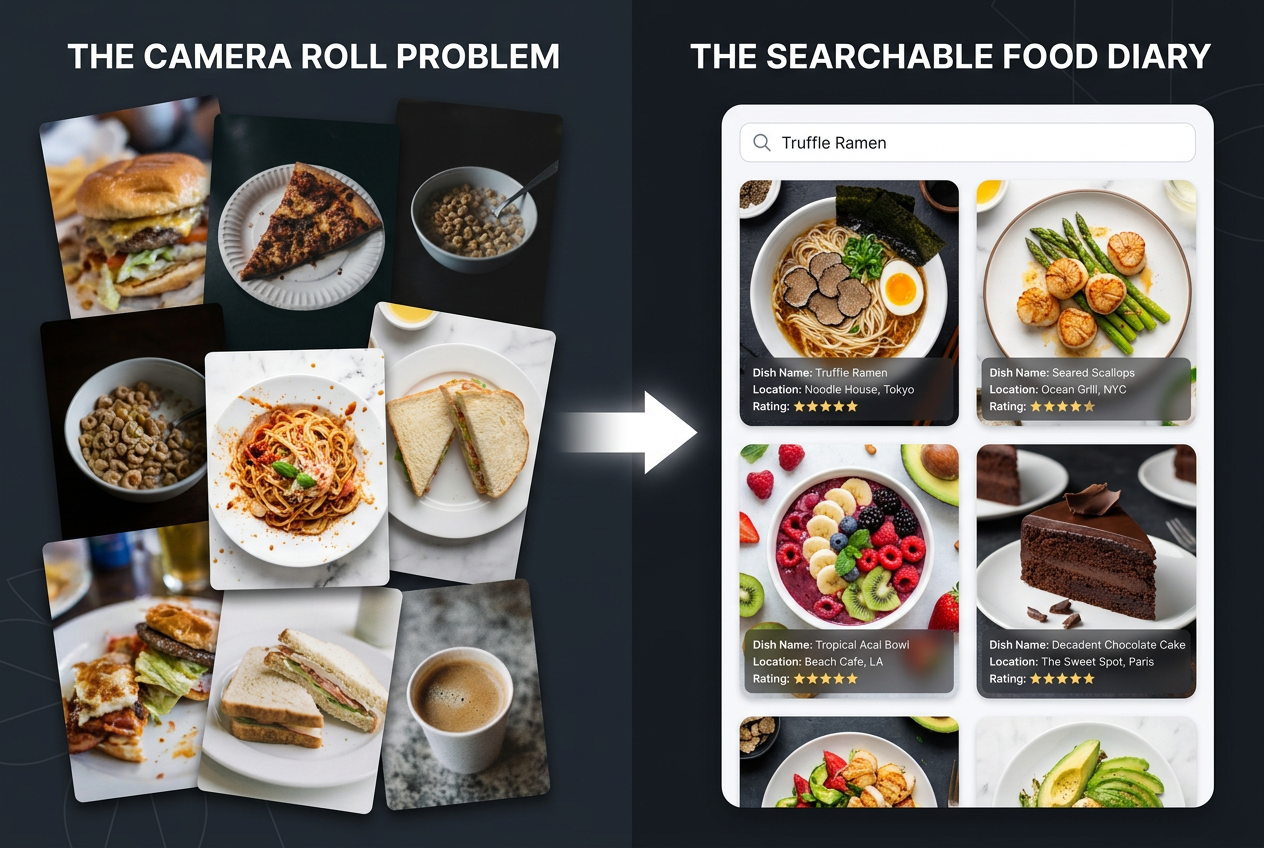 Transitioning from a messy camera roll to a structured food diary allows you to recall specific dishes and dining experiences instantly rather than scrolling through thousands of photos.
The modern foodie app isn’t about reviews. It’s about memory architecture.
The Three Ecosystems: Finding Your Foodie Personality
BLUF: Free foodie apps fall into three categories based on how you interact with food memories - social discovery (Beli), private archiving (Savor, Memolli), or automation (Truffle). Choose based on your priority.
Before diving into specific apps, understand which ecosystem fits your style:
The Socialite uses food as social currency. You want to see where friends are eating, share ranked lists, and build culinary clout. Your app is a public-facing portfolio.
The Archivist treats meals as data points in a personal database. You want searchable records of every dish, private ratings, and zero social pressure. Your app is a reference library.
The Automator wants results without work. You’re already posting food on Instagram Stories, so your app should do the logging for you. Your app is invisible infrastructure.
Each ecosystem has strengths and trade-offs. Let’s break them down.
| Ecosystem | Best For | Philosophy | Key Apps |
|---|---|---|---|
| The Socialite | Building food credibility | "Show your taste" | Beli, Mapstr |
| The Archivist | Private dish tracking | "Build your database" | Savor, Memolli |
| The Automator | Effortless logging | "Set it and forget it" | Truffle, Yummi |
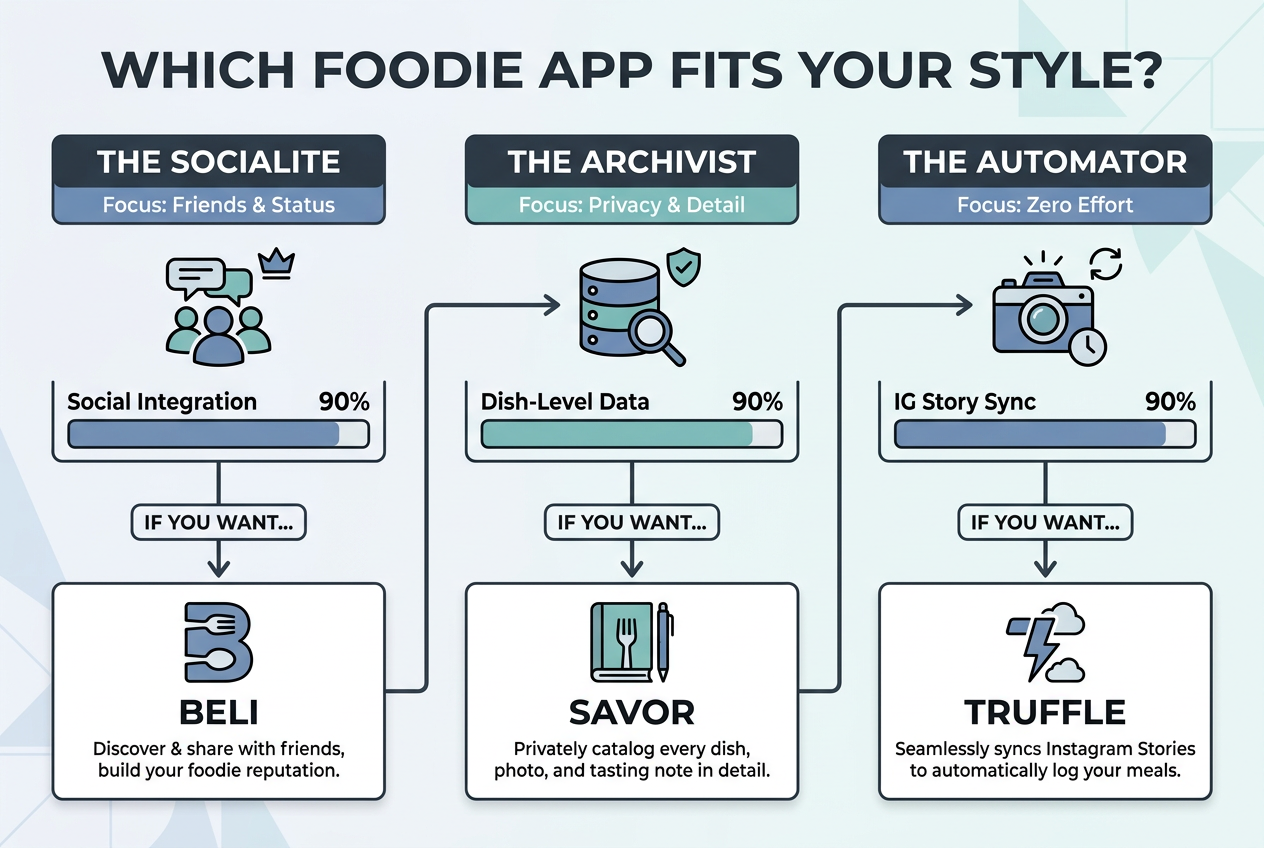 This decision matrix simplifies the landscape by matching your dining personality - whether social, archival, or automated - to the specific free app that best serves your needs.
If you’re building a personal food database that lasts decades, you’re an Archivist. If you want your friends to know you discovered that pop-up first, you’re a Socialite. If you hate manual entry, you’re an Automator.
The Socialite: Beli
BLUF: Beli is the "Letterboxd for food" - a social network where you rank restaurants, share curated lists, and follow friends’ dining adventures. Free tier offers full functionality but requires a waitlist.
Beli built its reputation by solving a specific problem: restaurant ratings from strangers are useless, but ratings from people whose taste you trust are gold.
The app revolves around ranked lists. You create definitive rankings (best pizza in Brooklyn, top ramen spots globally) and friends see where their favorite places stack up against yours. The interface is clean, map-based, and designed for competitive food lovers who treat dining like a sport.
What Works
The social feed is genuinely useful. When a trusted friend adds a new spot to their "Top 10 Sushi" list, you get notified. The map view shows you everywhere your network has eaten in a given neighborhood.
The ranking system forces you to make tough calls. You can’t just five-star everything. Deciding whether Lucali belongs above or below Paulie Gee’s requires real thought, and those decisions build a credible profile.
The Grit
Beli has a waitlist. Getting in requires an invitation or patience. Once you’re in, the app works beautifully, but the exclusivity can feel performative.
The app also assumes you care about sharing. If you want a purely private archive, Beli’s entire structure works against you. Everything is visible to your network by design.
For social food lovers who want their taste to matter in their friend group, Beli is unmatched. For private trackers, it’s the wrong tool entirely.
The Archivist: Savor
BLUF: Savor is a dish-first tracking app with AI recognition and a 10-point scoring system. It’s 100% private, iOS-only, and designed for building a searchable food database that lasts decades.
If Beli is for social status, Savor is for personal mastery. The app was built on a simple insight: you don’t remember restaurants - you remember dishes.
The Dish-Level Revolution
Most apps track restaurants. Savor tracks the Cacio e Pepe at Felice, the Omakase at Sushi Nakazawa, and the specific Croissant aux Amandes from that bakery you can never remember the name of.
Modern foodie apps move beyond generic restaurant ratings to offer granular dish-level data, allowing you to track exactly what to order on your next visit.
The AI dish recognition is the killer feature. Take a photo of your plate, and Savor suggests what you’re eating. It’s not perfect, but it eliminates the friction of manual entry when you’re trying to capture 30 dishes during a trip to Tokyo.
The 10-Point System
Savor uses a professional critic’s scale: 1-10, no half-points. The app includes a dish rating calculator and guides you through building taste notes that make every entry searchable.
A 10 is transcendent. A 7 is good. A 5 is fine. The system works because it mirrors how actual food writers think.
What Works
Privacy is absolute. No public profiles, no follower counts, no social pressure. Your database is yours.
The search functionality is surgical. You can pull up every pasta dish you’ve rated above an 8 in the last two years, filtered by region.
Exporting is built-in. Your data belongs to you. If you want to move to another system in five years, you can take everything with you.
The Grit
iOS only. If you’re on Android, you’re out of luck.
The lack of social features is a trade-off. You can’t see what your friends are eating unless they manually share screenshots.
The app requires a learning curve. You’re not just tapping stars - you’re building a personal food database with structure and rigor.
For serious foodies who view food as an intellectual pursuit and want a permanent, searchable archive, Savor is the gold standard.
The Automator: Truffle
BLUF: Truffle syncs with your Instagram Stories to automatically log restaurants. It’s ideal for people who already post food but hate manual data entry. Privacy is limited.
Truffle’s pitch is seductive: keep posting food on Instagram, and the app does the rest. It watches your Stories, extracts restaurant tags, and builds a map of everywhere you’ve eaten.
What Works
Zero-effort logging. If you’re already tagging locations in Stories, Truffle captures it automatically. No second app to remember, no duplicate work.
The social discovery is genuine. You can see where friends are eating in real-time and get notified when they post from restaurants you’ve saved.
The map view is visually satisfying. Watching your culinary footprint grow across a city feels rewarding.
The Grit
You must be an active Instagram user. If you don’t post Stories with location tags, the app has nothing to work with.
Privacy is minimal. Your dining data is as public as your Instagram account. If you want a private archive, Truffle isn’t designed for that.
The app captures restaurants but not dishes. You know you ate at Lilia, but you won’t remember whether you had the Agnolotti or the Mafaldini.
For people who treat Instagram as their primary food journal and want passive automation, Truffle is perfect. For everyone else, it’s too limiting.
Deep Dives: Detailed App Reviews
Beli: Social Currency and Competitive Ranking
Beli treats food like film criticism. Just as Letterboxd lets movie buffs create ranked lists of directors or genres, Beli lets you build definitive food rankings.
The core mechanic is the personal Top 10 list. You don’t just save restaurants - you rank them. Your "Best Pizza in New York" list is public, and friends can compare their rankings to yours.
This creates a game layer. When you visit a new pizzeria, you’re not just eating - you’re deciding whether it cracks your Top 10. That mental exercise makes you more thoughtful about what you’re tasting.
The app’s social feed shows you updates when friends modify their lists. If your most trusted food friend bumps a new spot into their Top 5 Tacos, you’re going to visit it.
The waitlist remains controversial. Some users appreciate the curation - keeping the community small maintains quality. Others find it elitist. Your mileage will vary.
If you’re the friend group’s food scout and you want that role formalized, Beli gives you a platform. If you prefer to eat in private peace, it’s the wrong choice.
Savor: The Serious Foodie’s Database
Savor was built by people frustrated with existing tools. They wanted something between a calorie tracker and a social network - something that treated food memory as a long-term intellectual project.
The app’s design reflects this. No follower counts. No badges. No gamification. Just a clean interface for capturing exactly what you ate, how it tasted, and why it mattered.
The AI dish recognition works surprisingly well. Point your camera at a plate of Pad Thai, and Savor suggests the dish name, saving you typing. It’s trained on thousands of dishes, and while it occasionally misidentifies regional cuisine, it’s right more often than not.
The real power is in the 10-point scoring system. Unlike apps with five-star scales that compress everything into 3.5-4.5 stars, Savor forces precision. A 7 is good. An 8 is excellent. A 9 is world-class. A 10 is life-changing.
This specificity makes your data actionable. When you’re visiting a new city and filtering for "dishes rated 9 or higher," you’re seeing your genuine standouts - not everything you casually enjoyed.
The app includes custom fields for tracking details like service quality, ambiance, or whether the dish is gluten-free. For people with dietary restrictions or specific tracking needs, this flexibility is crucial.
Export functionality is transparent. Your data lives in standard formats (JSON, CSV) that you can download anytime. This matters if you’re building a 20-year food archive and don’t want to worry about a startup disappearing.
The biggest limitation is platform availability. If you’re deeply invested in the Android ecosystem, you’re waiting for a version that doesn’t exist yet.
Truffle: Automation and Instagram Integration
Truffle solves a real problem: you’re already posting food content, so why should you log it twice?
The app monitors your Instagram Stories and automatically extracts restaurant data. If you post a photo from Estela and tag the location, Truffle logs it. Your culinary history builds itself.
This works beautifully if you’re an active Instagram user. You get a passive benefit (an organized food map) from content you’re already creating.
The drawback is lack of granularity. Truffle knows you visited Estela, but it doesn’t know whether you had the Ricotta Toast or the Beef Tartare. You’re tracking restaurants, not dishes.
For people who care about specific recommendations ("order the Ricotta Toast, skip the salad"), this is a dealbreaker. For people who just want a map of where they’ve eaten, it’s fine.
The social features are Instagram-adjacent. You can see where friends are dining if they’re also using Truffle and posting publicly. It’s useful for spontaneous meetups but doesn’t replace dedicated food communities.
If you’re already posting daily food content and want zero-effort logging, Truffle is the obvious choice. If you want dish-level detail or privacy, look elsewhere.
Memolli: The Visual Journaler
Memolli takes a different approach: it’s a food diary designed around photography and personal reflection.
The app emphasizes custom fields. You can track service quality, wine pairings, who you dined with, or any other detail that matters to you. It’s flexible enough to accommodate hobbyists tracking coffee roasts or wine enthusiasts logging vintages.
The offline mode is a standout feature. You can log meals without internet connectivity, which matters if you’re traveling internationally or dining in remote locations.
The UI leans heavily on photo grids and calendar views. Scrolling back through months of meals feels like flipping through a scrapbook.
What Memolli lacks is social infrastructure. There’s no friend network, no shared lists, no community features. It’s designed for solitary reflection.
This makes it ideal for people who journal about food but don’t want public-facing profiles. If you write tasting notes for your own reference and want them organized, Memolli works well.
The user base is niche. You won’t find the same network effects you get with Beli or the AI polish of Savor. But for a specific type of user - the private, detail-oriented journaler - it’s a solid tool.
Yummi: The Photo Diary Veteran
Yummi has been around longer than most competitors. It’s a straightforward photo diary with auto-organized calendars and geotagging.
The core feature is simplicity: take a photo, add a note, and the app organizes everything by date and location. You can backdate photos, which is useful if you’re importing years of camera roll history.
The interface feels dated compared to newer apps. It lacks the visual polish of Beli or the AI features of Savor. But it’s functional, stable, and has a loyal user base.
The app’s strength is reliability. It’s been updated consistently for years, and users trust it won’t disappear. For people burned by startups that shut down and delete user data, this matters.
The lack of advanced features is a trade-off. There’s no 10-point rating system, no AI recognition, no social feed. It’s a basic photo diary with minimal friction.
If you want something simple that just works and don’t need cutting-edge features, Yummi is a safe bet. If you want to push the boundaries of what a food tracking app can do, it’ll feel limiting.
Mapstr: The Geographic Organizer
Mapstr isn’t food-specific - it’s a general-purpose location saver. You can tag coffee shops, museums, hotels, or any other place you want to remember.
The interface is map-first. You drop pins for places you’ve visited or want to visit, add notes, and organize them with custom tags.
For foodies, this works if you care more about venues than dishes. You can save restaurants, but you’re not tracking individual meals. It’s closer to a personal Google Maps than a food diary.
The shared maps feature lets you collaborate with friends. If you’re planning a trip and want to pool restaurant recommendations, Mapstr is useful.
The trade-off is lack of food-specific features. No dish photos, no ratings, no meal-level detail. You’re saving places, not experiences.
If you want a single tool for organizing all your saved locations - restaurants, bars, shops, parks - Mapstr is efficient. If you want deep food tracking, you’ll need something else.
The Minimalist Hack: Repurposing Standard Apps
BLUF: Google Maps Lists and Apple Notes can work for basic restaurant tracking, but they fail serious foodies because they lack dish-level search, photos, and structured ratings. They’re fine for casual users, not archivists.
Before committing to a dedicated app, some people try to make existing tools work. Here’s what that looks like in practice.
Google Maps Lists
You can create custom lists in Google Maps (e.g., "Best Pizza NYC") and save restaurants. You can add notes to each location and share lists with friends.
This works for broad organization. You’ll know where you want to eat, and you can see everything on a map.
What breaks down is specificity. You can write "Great pasta" in the notes, but you can’t search for "all pasta dishes rated 9+ in Italy." You can’t attach multiple photos per dish. You can’t export your data in structured formats.
After six months, your Google Maps lists become cluttered and unsearchable. You remember you had great pasta somewhere in Rome, but you’re scrolling through 50 pins trying to find it.
Apple Notes
You can create notes for each restaurant with photos and text. Some people organize notes into folders by city or cuisine type.
This gives you flexibility. You can write as much or as little as you want. You can paste in receipts, menus, or screenshots.
The problem is lack of structure. Your notes are freeform text, which means you can’t filter by rating, date, or dish type. Finding specific information requires manual scrolling.
After a year of travel, you’ve got 200 notes with no easy way to surface the best dishes. You’re back to the same camera roll problem you started with.
Why They Eventually Fail
Generic tools work for casual tracking. If you eat out once a month and want to remember a handful of favorites, Google Maps is fine.
They break down for serious foodies because they lack:
- Dish-level granularity: You’re saving restaurants, not individual plates
- Structured ratings: No consistent scoring system across entries
- Searchable fields: Can’t filter by cuisine, dish type, or score
- Photo organization: Multiple dishes per restaurant become a mess
- Data portability: No clean way to export and analyze your history
The irony is that you spend more time trying to make these tools work than you would learning a purpose-built app.
If you’re eating 10+ memorable meals per month and planning to track food for years, invest in a real tool. If you’re a casual tracker, stick with what you know.
Decision Matrix: Which App Should You Download
BLUF: Choose based on your primary goal - social discovery (Beli), private archiving (Savor), or automation (Truffle). Your dining personality matters more than feature lists.
Here’s the brutally simple guide:
If you want to see where your friends are eating, download Beli. The entire app is built around social food discovery. You’ll love the ranked lists and friend activity feed. You’ll hate the waitlist and lack of privacy.
If you want a private, searchable database of every dish, download Savor. The app treats food tracking like professional criticism. You’ll love the 10-point system and AI recognition. You’ll hate that it’s iOS-only and has no social features.
If you want to do zero work, download Truffle. The Instagram integration is genuinely effortless. You’ll love the passive logging. You’ll hate the lack of dish-level detail and privacy.
If you want to journal with custom fields, download Memolli. The offline mode and flexibility are unmatched. You’ll love the personalization. You’ll hate the dated UI and tiny user base.
If you want something simple and reliable, download Yummi. It’s a no-frills photo diary that’s been stable for years. You’ll love the simplicity. You’ll hate the lack of advanced features.
If you want to organize all saved locations, not just food, download Mapstr. The map-first interface is clean. You’ll love the versatility. You’ll hate the lack of food-specific tools.
The real question isn’t "which app is best" but "which app matches how I already think about food?"
If you treat dining as a social activity where status matters, Beli is correct. If you treat dining as an intellectual pursuit where personal standards matter, Savor is correct. If you treat dining as background content for your Instagram, Truffle is correct.
Match the tool to your actual behavior, not your aspirational behavior. If you tell yourself you’ll meticulously log every dish but you know you won’t, don’t pick Savor - pick Truffle.
For most serious food lovers reading this, the real choice is between Beli and Savor. Do you care more about what your friends think or what you think? Your answer determines your app.
Frequently Asked Questions
What is a foodie app?
A foodie app is a digital tool designed to help you track, rate, and remember meals. Unlike general review platforms, foodie apps focus on personal curation - you’re building a private or semi-private archive of what you’ve eaten, not contributing to crowdsourced ratings. The best foodie apps let you log individual dishes, attach photos, add tasting notes, and search your history. Some emphasize social discovery (seeing where friends eat), while others prioritize private archiving (building a personal database). The key distinction is that these apps treat you as the primary user, not anonymous strangers.
Are free foodie apps actually free?
Yes, but with caveats. Apps like Beli, Savor, Truffle, and Yummi offer full core functionality at no cost. You can track unlimited restaurants, save photos, and build your food history without paying. The "catch" is usually limited to premium features - cloud storage upgrades, advanced analytics, or priority support. Unlike fitness or productivity apps that cripple free tiers, food tracking apps tend to be generous because they benefit from network effects (more users mean better recommendations and data). The exception is apps with waitlists (like Beli), which are free but require approval to join.
How do I export my food diary if I want to switch apps?
This depends entirely on the app. Savor and a few others offer built-in export tools - you can download your data as JSON or CSV files that include dish names, photos, ratings, and timestamps. Apps focused on privacy usually prioritize data portability. Social-first apps like Beli make exporting harder because they want to keep you in their ecosystem. Before committing to any app, check their settings or FAQ for an "export data" option. If it doesn’t exist, that’s a red flag - you’re building a years-long archive that could get trapped if the company shuts down or changes direction.
Can I track restaurants privately without social features?
Absolutely. Apps like Savor and Memolli are designed for private tracking - no public profiles, no follower counts, no social pressure. You can log every meal without anyone else seeing your history. This is ideal if you want to build a personal reference library without the performance aspect of social apps. The trade-off is losing social discovery - you won’t see where friends are eating unless they manually share recommendations. For many serious foodies, this is a feature, not a bug. Private tracking lets you be honest about ratings without worrying about offending a restaurant owner or friend.
Which app is best for tracking specific dishes instead of restaurants?
Savor is the only major app explicitly designed around dish-level tracking. While others let you add dish photos to restaurant entries, Savor treats the dish as the primary unit. You rate the Carbonara at Roscioli separately from the Cacio e Pepe. The AI dish recognition and 10-point system make this practical. Other apps force you to work around restaurant-first structures. If your goal is remembering "the best pasta dishes in Rome" rather than "good Roman restaurants," Savor’s approach makes intuitive sense. For anyone who thinks in terms of specific plates rather than venues, it’s the clear choice.
What’s the difference between a food diary and a restaurant tracker?
A food diary focuses on what you ate and how it made you feel - it’s personal and reflective. Think of it like journaling. A restaurant tracker focuses on where you ate and whether you’d return - it’s transactional and utilitarian. Most modern apps try to blend both, but their design reveals priorities. Savor and Memolli lean toward diary-style introspection with detailed notes and ratings. Beli and Mapstr lean toward tracker-style efficiency with quick saves and map views. Neither is better - they serve different needs. If you want to remember how a dish tasted and why it mattered, you want a diary. If you want to remember where to take friends next visit, you want a tracker.
Do these apps work internationally?
Most do, with caveats. Apps with strong database integration (like Beli) rely on existing restaurant data from Google or Foursquare, which works great in major cities but struggles in rural areas or countries with weak digital infrastructure. Apps that let you manually enter restaurant names (like Savor and Memolli) work anywhere - you’re not dependent on pre-existing data. Truffle only works where Instagram location tagging is reliable. If you travel frequently to less-digitized regions, prioritize apps that don’t require database lookups. Offline functionality matters too - Memolli’s offline mode is useful if you’re logging meals in areas with spotty connectivity.
Can I organize my camera roll’s food photos retroactively?
Yes, but it’s tedious. Most apps let you backdate entries, so you can import old photos and assign them to specific restaurants or dishes. Yummi and Savor both support backdating, which is useful if you’re sitting on years of unorganized food photos. The challenge is remembering details - you might know you ate great ramen in Tokyo in 2022, but do you remember the restaurant name or neighborhood? If your camera roll has location metadata (most iPhones do by default), that helps. Realistically, expect to spend a few hours doing this. The payoff is a unified archive going back years, but it’s a one-time investment of effort.
Continue Reading
Start Tracking Your Dishes Today
Transform your food photos into a searchable, ratable culinary memory bank.
Download Savor App