
Your Guide to Building a Smarter Burrito Bowl
Harry the matcha king
Harry is our resident matcha obsessive. He’s tasted hundreds of bowls and tracks every cup in Savor.
A burrito bowl can be your best friend or your worst enemy when it comes to calories. A lean, veggie-packed bowl might clock in at a sensible 400 calories ,...
A burrito bowl can be your best friend or your worst enemy when it comes to calories. A lean, veggie-packed bowl might clock in at a sensible 400 calories, but pile on the extras, and you could easily be looking at a meal north of 1,000. The real beauty of the bowl is that you’re in the driver's seat, with total control over that final number.
Why the Bowl Is a Calorie-Conscious Choice
The bowl's biggest win is what it leaves behind: the tortilla. That one simple move is a game-changer for anyone keeping an eye on calories.
Burrito vs. Bowl: The Immediate Calorie Savings
Ditching the massive flour tortilla used for a standard burrito is the single fastest way to slash calories from your meal. Let's see just how significant that one swap is.
| Meal Component | Typical Burrito (With Tortilla) | Typical Bowl (No Tortilla) | Calorie Difference |
|---|---|---|---|
| Flour Tortilla | ~320 calories | 0 calories | -320 calories |
| Chicken | 150 calories | 150 calories | 0 calories |
| White Rice | 210 calories | 210 calories | 0 calories |
| Black Beans | 130 calories | 130 calories | 0 calories |
| Mild Salsa | 25 calories | 25 calories | 0 calories |
| Total | ~835 calories | ~515 calories | -320 calories |
As you can see, simply opting for the bowl instantly saves you around 320 calories before you've even thought about toppings. It's a huge head start.
This immediate saving is a big reason why bowls often outsell their wrapped cousins at major chains. They deliver all the flavor for fewer calories and carbs. A typical bowl usually lands somewhere in the 400-700 calorie range, but every single scoop—from the rice at the bottom to the sour cream on top—tells part of the story.
Your First Step to a Smarter Meal
Building a better bowl really starts with awareness. To get a real handle on the impact of your choices, it helps to know how to read nutrition labels for the ingredients you're piling on. This simple skill helps you see past the "health halo" of a bowl and make smarter decisions scoop by scoop.
Keep these foundational points in mind:
- The Base is Key: Swapping out a bed of rice for lettuce is an instant win, saving you over 200 calories from the get-go.
- Protein Power: Lean proteins are your friend. Grilled chicken (150-200 calories) is a much lighter choice than richer options like carnitas or barbacoa (200-250 calories).
- Toppings Add Up Fast: This is where things can get out of hand. High-fat extras like cheese, sour cream, and queso can each pack on 100+ calories with just one spoonful.
Once you get these basics down, you can start building a bowl that nails your goals. It’s a lot like learning to eyeball other complex dishes, like figuring out the calories in sushi. Applying that same curiosity turns a simple lunch into a strategic—and still delicious—choice.
Breaking Down Your Bowl, Ingredient by Ingredient
Think of building a burrito bowl like playing with Legos. Every single piece you add contributes to the final structure—and the final calorie count. The real beauty is that you're the architect. You have total control over every component, which is what makes the bowl so brilliant; you can craft a lean nutritional powerhouse or accidentally assemble a calorie bomb, all depending on your choices.
Your decisions at the counter can make a massive difference. For example, a standard Chipotle burrito can easily climb to 1,085 calories. But if you take those exact same fillings and put them in a bowl instead? You're looking at around 765 calories. Just skipping that 320-calorie tortilla slashes the total by nearly 30%. It's a simple swap with a huge impact.
The image below gives you a quick visual on just how significant that single change can be.
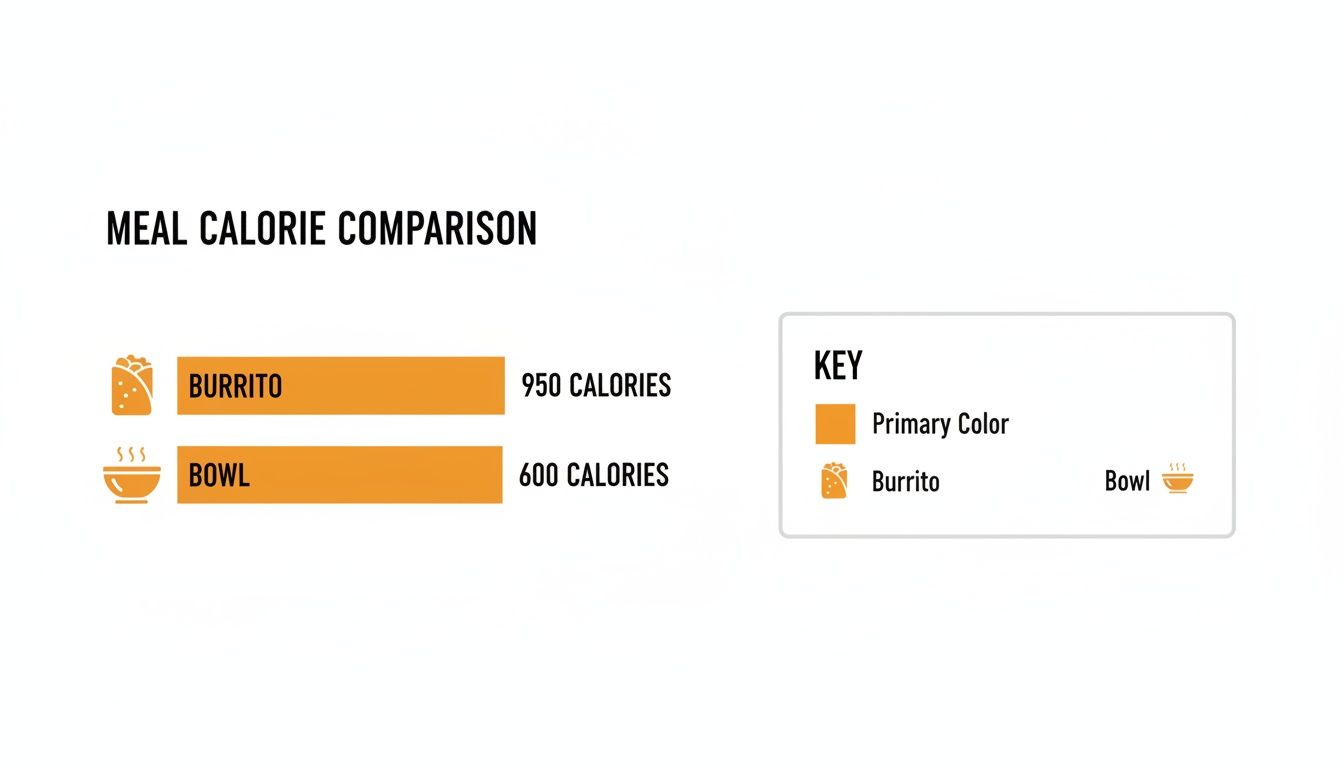
As you can see, starting with the bowl format gives you a much lower calorie baseline, leaving you more room to pile on the good stuff without going overboard.
To give you a clearer picture, let's break down the usual suspects you'll find at the counter. The table below provides a handy reference for the approximate calories in common burrito bowl ingredients.
Calorie Guide for Common Burrito Bowl Ingredients
| Ingredient Category | Item | Typical Serving Size | Estimated Calorie Range |
|---|---|---|---|
| Bases | White or Brown Rice | 4 oz scoop | 180-210 calories |
| Supergreens/Lettuce | 2-3 oz serving | 10-20 calories | |
| Proteins | Chicken (grilled) | 4 oz serving | 150-180 calories |
| Steak | 4 oz serving | 150-190 calories | |
| Carnitas / Barbacoa | 4 oz serving | 210-250 calories | |
| Sofritas (plant-based) | 4 oz serving | 150-160 calories | |
| Beans & Veggies | Black or Pinto Beans | 4 oz scoop | 130 calories |
| Fajita Veggies | 2.5 oz serving | 20-30 calories | |
| Salsas | Pico de Gallo / Fresh Tomato | 3.5 oz serving | 20-25 calories |
| Corn Salsa | 3.5 oz serving | 80 calories | |
| Tomatillo Salsas (Green/Red) | 2 oz serving | 15-40 calories | |
| Toppings | Shredded Cheese | 1 oz serving | 110 calories |
| Queso Blanco | 2 oz serving | 120 calories | |
| Sour Cream | 2 oz serving | 115 calories | |
| Guacamole | 4 oz scoop | 230 calories |
These numbers are a great starting point for understanding where the calories in your bowl are really coming from. Let's dig a little deeper into each category.
The Base and Proteins
The foundation you choose sets the stage for everything that follows. This first decision can either save you a couple hundred calories or add them right back in before you've even gotten started.
- Rice (White or Brown): A standard 4-ounce scoop will run you about ~210 calories. It adds substance and makes the bowl feel hefty, but it's a major calorie player.
- Lettuce/Greens: Starting your bowl on a bed of greens instead is a game-changer. It adds negligible calories (~10-20) while packing your meal with fiber and nutrients.
- Lean Proteins: If you're keeping things light, grilled chicken or sofritas are your best friends, typically landing in the 150-200 calorie range per serving.
- Richer Proteins: Options like steak, barbacoa, or carnitas are more indulgent. They bring more fat and flavor, but also a higher calorie count, often between 200-250 calories.
Beans, Salsas, and Veggies
This is your flavor zone—the place where you can load up on taste and texture with very little caloric downside. For the most part, these ingredients are your allies in building a smarter, more satisfying bowl.
Pico de gallo, tomatillo green-chili salsa, and roasted chili-corn salsa are all fantastic, low-impact choices, generally adding just 20-80 calories. Black beans and pinto beans are almost identical twins nutritionally, contributing around 130 calories and a solid dose of fiber. And the fajita veggies? They're a must-add for bulk and flavor, tacking on only 20-30 calories.
The High-Impact Toppings
Alright, this is where a perfectly healthy bowl can take a sharp turn into calorie-dense territory. These creamy, rich finishers are undeniably delicious, but they are also the most potent sources of calories on the entire line.
A single serving of queso can pack more calories than your entire protein choice. Being mindful of these final touches is the absolute key to mastering your burrito bowl build.
Let's break down these heavy hitters:
- Cheese: That sprinkle of shredded Monterey Jack? It adds about 110 calories. If you're looking to trim down your total, this is one of the easiest places to start. Our guide on the best cheese for Mexican food can help you find options with the most flavor bang for your buck.
- Sour Cream: A cool, creamy dollop adds roughly 115 calories to the mix.
- Guacamole: Guac is loaded with healthy fats, making it a fantastic nutritional choice. But it's also dense, adding around 230 calories for a standard scoop.
- Queso: This warm, velvety cheese sauce is the most calorific of the bunch, coming in at about 120 calories per serving.
Why We Misjudge Burrito Bowl Calories
Ever built a “healthy” burrito bowl only to feel surprisingly sluggish an hour later? You’re not alone. We’re notoriously bad at estimating the calories in customizable meals like these, and there’s a fascinating psychological reason why.
It all comes down to something called the “health halo” effect. This is a mental shortcut where our brains see a few virtuous ingredients, like lettuce and salsa, and throw a "healthy" halo over the entire meal. Once that halo is in place, we tend to ignore the calorie-dense additions like rice, cheese, and guacamole that are quietly piling up.
The Perception vs. Reality Gap
This isn't just a hunch; it's a well-documented blind spot. A landmark 2014 study in Public Health Nutrition found that people underestimated the calories in their burritos by a whopping 21%. More recent data shows the same pattern: what someone guesses is a light 410-calorie meal is often closer to 647 calories in reality.
Even though a bowl ditches the 300-calorie tortilla, the core problem remains. We see the "good" stuff and give the whole meal a pass, especially when we're the ones building it. That sense of control makes us even less likely to question the final calorie count.
Our brains are wired to take shortcuts. When we see "bowl" instead of "burrito," we automatically think "healthier," but the high-calorie toppings we add can quickly erase that initial advantage.
Moving from Guesswork to Awareness
So, how do you sidestep this mental trap? It’s not about obsessive calorie counting, but about developing a real awareness of what each ingredient brings to the table. Shifting from guesswork to intentional choices is key. If you're interested in the broader concept, learning how to eat more and lose weight without counting calories offers some great principles that apply here.
Here are a few common mental traps to watch out for when you're in line:
- The "Just a Little" Fallacy: It's easy to think a small scoop of queso or a sprinkle of cheese won't make a dent. But these are often the most calorie-dense items available, and those "little" additions can easily tack on hundreds of calories.
- Forgetting Liquid Calories: Those delicious dressings and sauces? They're often loaded with hidden sugars and fats that we don't even register as part of the meal.
- The "It's Healthy Fat" Excuse: Guacamole is fantastic for you, packed with nutrients. But its 230 calories still count. A smarter approach is to treat it as your primary fat source for the meal, instead of piling it on top of cheese and sour cream.
Turning this awareness into a practical skill is what makes all the difference. You stop guessing and start building a bowl that actually lines up with your goals.
How to Build a Smarter Burrito Bowl
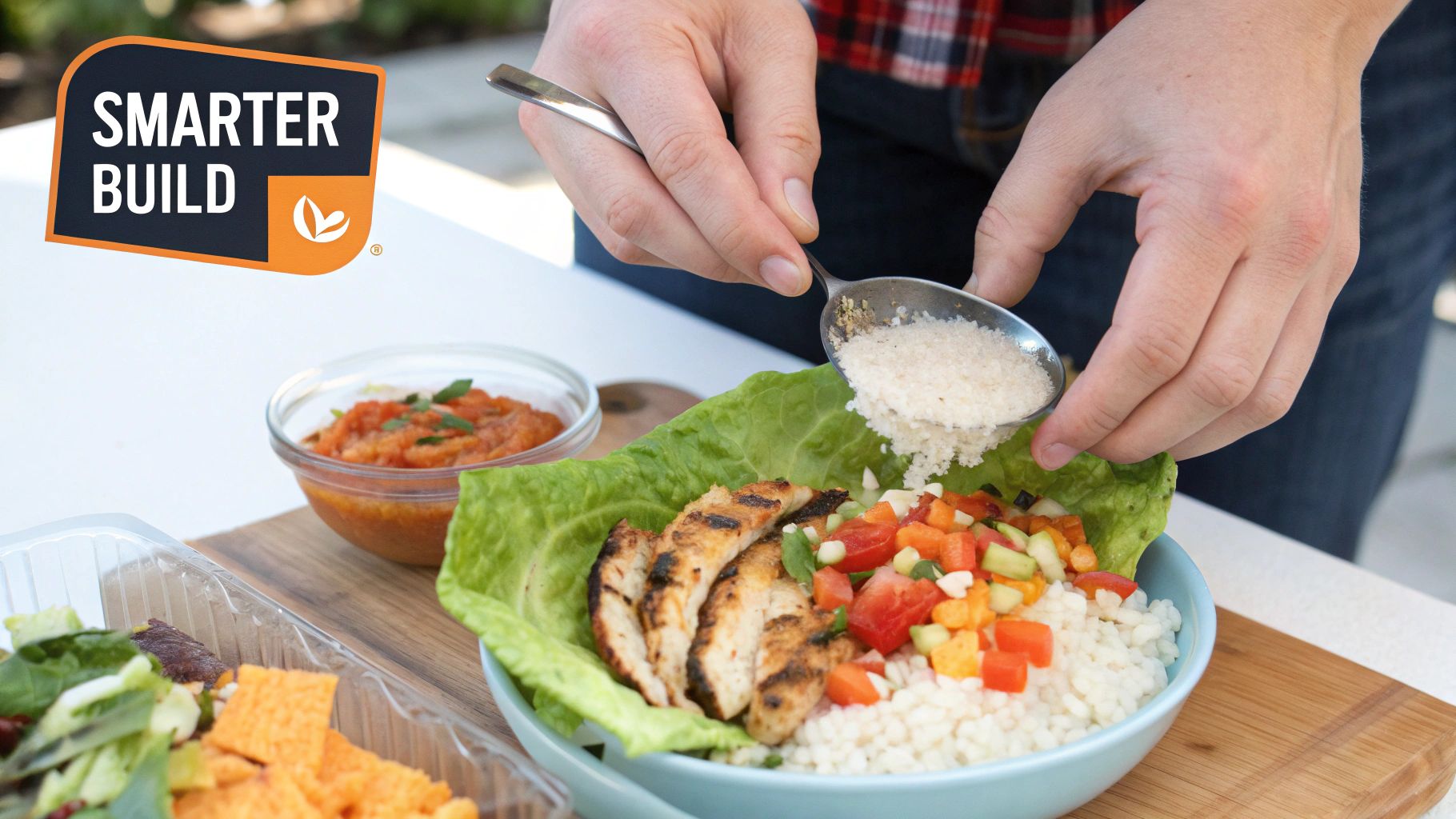
Knowing the calorie count of every ingredient is one thing. Actually putting that knowledge to work to build a better bowl? That’s where the real magic happens. Let's move from theory to a delicious reality.
You can absolutely craft a satisfying, flavor-packed burrito bowl for under 500 calories without feeling like you're missing out on a thing. The secret isn't deprivation; it's about building your bowl with a smart, strategic sequence.
By leading with high-volume, low-calorie ingredients, you create a meal that feels huge and satisfying before the heavy hitters even enter the picture. You’ll feel full and happy while keeping the total calorie count right where you want it.
The Under-500-Calorie Playbook
Follow this simple, step-by-step process. It’s all about maximizing flavor and volume while keeping a close eye on the calories.
Start with a Green Foundation (15 calories): Always begin with a generous bed of romaine lettuce or supergreens. This adds a ton of bulk and a satisfying crunch for almost no caloric cost, making your bowl feel substantial from the get-go.
Pile on the Veggies (25 calories): Next, add a full serving of fajita veggies (those sautéed peppers and onions). This step layers on even more volume and fiber, plus a smoky, savory flavor that only costs you about 25 calories.
Choose a Lean Protein (150 calories): Now it's time for protein. Opt for grilled chicken or the plant-based sofritas. Both choices give you a solid 20-30 grams of protein for around 150 calories, which is key to keeping you full for hours.
Add Beans for Fiber (130 calories): A scoop of black or pinto beans brings in more fiber and plant-based protein for roughly 130 calories. They also add a great creamy texture that makes the whole meal feel more robust.
Finish with Fresh Salsa (25 calories): Use a fresh tomato salsa, like pico de gallo, as your main source of flavor. It delivers a bright, acidic punch for a mere 25 calories and lets you skip the heavy, calorie-dense sauces.
Just like that, you've built a seriously delicious and filling bowl for only 345 calories. And the best part? You still have plenty of room in your budget for a strategic extra.
Think of your remaining calorie budget as a flavor investment. You have over 150 calories left to spend—use them on the one topping you absolutely love most, whether that's a scoop of creamy guacamole or a sprinkle of cheese.
Smart Swaps and Bowl Templates
Customizing your bowl is half the fun. Depending on your goals for the day, a few small tweaks can create the perfect meal. Here are a few templates to get you started.
- The High-Protein Power Bowl (~495 calories): Start with that 345-calorie base we just built. Then, add a half-portion of steak (~75 calories) alongside your chicken and top it with a half-serving of cheese (~55 calories).
- The Low-Carb Veggie Bowl (~420 calories): Ditch the beans and instead add a full portion of guacamole (~230 calories) to a base of lettuce, fajita veggies, and sofritas. The healthy fats from the guac will keep you just as satisfied.
- The Balanced Classic (~460 calories): Take the 345-calorie base and simply add a half-portion of guacamole (~115 calories). This gives you the best of both worlds—plenty of fiber from the beans and healthy fats from the avocado.
Track Your Tastes and Perfect Your Bowl with Savor
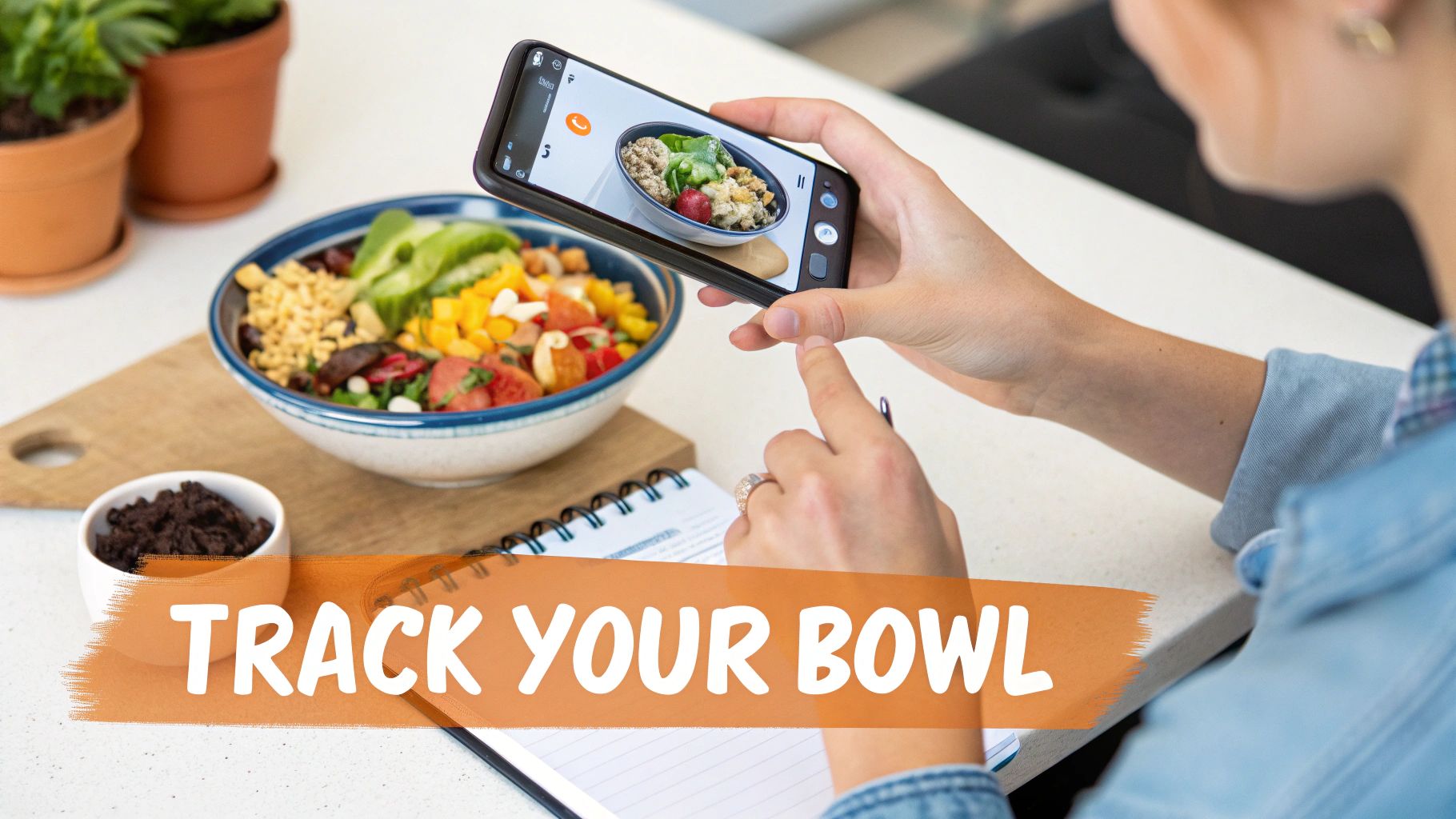
A burrito bowl is so much more than a final calorie count. It's a personal creation, a unique story about your tastes, cravings, and choices in that exact moment. While knowing the numbers is a great start, the real magic happens when you capture the full experience—the flavors, the textures, and that feeling of pure satisfaction. This is where you graduate from simple math to documenting your own culinary journey.
Instead of just logging burrito bowl calories, imagine having a private food diary where you can chronicle every single combination you build. Savor was designed for precisely this, helping you remember every delicious (or not-so-delicious) detail so you can build better bowls next time. It’s not just about the data; it’s about the discovery.
How to Log Your Bowl in Savor
Documenting your burrito bowl masterpiece is incredibly simple and takes just a few seconds. The goal is to build a personal, searchable archive of your food experiences that you can come back to anytime.
Here’s the quick-and-dirty method:
- Snap a Photo: A quick picture is the fastest way to trigger your memory. Did you go for a vibrant, veggie-heavy bowl, or was it a cheesy, creamy creation? The photo instantly brings back the visual appeal.
- Log the Key Ingredients: You don't need a full ingredient manifest. Just jot down the most important parts: "chicken, black beans, corn salsa, half guac, no cheese." This is your cheat sheet for what worked and what didn't.
- Rate It: This is the most crucial step. Give your bowl a score on a 10-point scale. Was it a perfect 10/10 that you’d order again tomorrow, or a 6/10 that was missing something? This rating is your personal truth.
By capturing these three simple things—a photo, the key components, and a personal rating—you turn a fleeting meal into a permanent, useful food memory. It's the difference between saying "I had a bowl last week" and knowing exactly what made it great.
Turning Data into Delicious Discoveries
Over time, your Savor entries become a powerful database of your own preferences. You can start comparing your homemade bowl creations to the ones from your favorite restaurants. Maybe you’ll discover that your at-home version with extra fajita veggies consistently scores higher than the one you grab for lunch. Or you might realize that every single bowl you rate a 9 or above includes guacamole.
This is the kind of insight you just can't get from a standard calorie counter. To see how Savor stacks up against other tools, you can explore our complete food app review.
This whole process transforms meal tracking from a chore into an act of mindful eating and personal discovery. It empowers you to refine your builds, identify what you truly love, and turn every bowl into another chapter in your unique food story. Rate like a critic, and build your perfect bowl every single time.
Alright, we’ve broken down the burrito bowl piece by piece and figured out how to build a better one. But a few common questions always seem to pop up.
Let's tackle them head-on. Think of this as the final cheat sheet to clear up any lingering confusion, so you can walk up to the counter and order with absolute confidence.
What Is the Lowest Calorie Protein for a Burrito Bowl?
When you’re trying to keep things light, your protein choice makes a huge difference.
Your leanest bets are almost always plain grilled chicken or plant-based sofritas. A standard 4-ounce scoop of either one typically lands somewhere between 150-200 calories. They deliver a solid dose of protein without a lot of extra fat bogging things down.
On the other hand, richer meats like steak, barbacoa, or carnitas pack more of a punch, both in flavor and calories. Thanks to their fat content and cooking methods, they often creep into the 200-250 calorie range. If a lower number is your goal, stick with the simple, grilled options.
Is Guacamole a Healthy Choice for My Burrito Bowl?
Absolutely. Guacamole is a nutritional powerhouse. It's loaded with heart-healthy monounsaturated fats, fiber, and a ton of vitamins. It's a fantastic addition that makes your meal far more satisfying.
But let's be real: it is very calorie-dense. A standard serving can easily tack on around 230 calories. If you're watching your intake, that doesn't mean you have to skip it entirely. You just need a strategy.
The smart move is to treat guacamole as your main fat source for the meal. Ask for a half-portion, or swap out the cheese and sour cream to make room for it.
This way, you get all the creamy, delicious benefits of guacamole without completely derailing your calorie budget for the day.
How Much Does Adding Rice Affect the Total Calories?
Rice is a game-changer, and not always in a good way for your calorie count. Outside of the high-fat toppings, it's often the single biggest contributor to the final number.
A standard scoop of white or brown rice adds about 200-210 calories right off the bat. It definitely makes the bowl more substantial, but it's a dense source of carbs.
For a much lighter bowl, you have a couple of great options:
- Ask for a half-scoop. This simple request instantly shaves off about 100 calories.
- Skip it altogether. Build your bowl on a bed of lettuce and fajita veggies instead. You'll save over 200 calories and pack in more fiber and volume.
Are Vegetarian Burrito Bowls Always Lower in Calories?
This is a classic misconception. While a vegetarian bowl can be incredibly light, it's not automatically the lower-calorie choice. It all comes down to what you put in it.
For instance, a bowl with beans, sofritas, fajita veggies, and fresh salsa can easily clock in under 400 calories. But if you take that same vegetarian base and load it up with a full scoop of rice, cheese, sour cream, and guacamole, the calorie count can soar past that of a simple grilled chicken and veggie bowl. The key takeaway? Customization is everything, no matter what protein you choose.
Your food journey is a collection of these small, delicious decisions. With Savor, you can do more than just count calories—you can document what you loved, compare your creations over time, and perfect your ideal bowl. "Track tastes, share discoveries" and turn every meal into a memory you can revisit. Ready to get started? Download Savor and Rate like a critic.
Continue Reading
Start Tracking Your Dishes Today
Transform your food photos into a searchable, ratable culinary memory bank.
Download Savor App