
A Guide to the Best Food Tracking Apps for Your Goals
John the smoothie monster
John lives for smoothie bowls and cold-pressed juices. He uses Savor to remember his best blends.
Food tracking apps are often misunderstood. Most people hear the term and immediately think of calorie counters and restrictive diets. But that’s a narrow...
Food tracking apps are often misunderstood. Most people hear the term and immediately think of calorie counters and restrictive diets. But that’s a narrow slice of what these tools can do.
Think of it this way: you probably use an app to track your finances, not to restrict spending, but to understand it. A food tracking app can do the same thing for your meals. Instead of logging dollars, you’re logging dishes to understand your palate, remember incredible bites, and build a completely private food diary that’s actually useful.
Understanding Food Tracking Apps and Why They Matter
Have you ever tried to remember the best burger you had last year, only to draw a blank? The memory is there, sort of, but it’s fuzzy. Or a friend asks for a restaurant recommendation in a city you visited, and you can’t recall the name of that amazing dish you still dream about.
This is the problem almost all of us face. Our most powerful food memories fade over time, leaving us with a vague sense of what we liked but none of the details that made it special. Food tracking apps are the solution. At their core, they’re tools designed to help you build a personal, searchable database of your own culinary experiences. This isn’t just for athletes or health gurus; it’s for anyone who wants to be more mindful of what they eat, for any reason at all.
The Real Purpose Behind Tracking Your Food
The “why” behind using one of these apps is deeply personal. For some, it’s about dialing in their nutrition and wellness. For others, it’s purely about capturing memories and sharpening their palate. The common thread is turning fleeting moments into lasting, useful knowledge.
This simple act of documenting brings incredible clarity. Just like journaling your thoughts can reveal patterns in your mood, logging your meals illuminates your eating habits in a way you’d never notice otherwise. You start seeing connections everywhere—how often you gravitate toward a certain cuisine or which ingredients consistently show up in your favorite dishes.
By documenting what you eat, you're not just creating a log; you're building a personal map of your palate. It’s a reference guide that helps you make more informed choices, whether you’re ordering dinner tonight or planning a culinary trip next year.
Ultimately, these apps help you move beyond vague recollections. Instead of saying, “I had some great pasta in Chicago,” you can pull up your notes and say, “The cacio e pepe at that little spot in River North, which I rated a 9/10, is the best I've ever had.” That level of detail transforms a forgotten meal into a shareable discovery. The goal is to build an honest record that serves your needs, whatever they are. Whether you're trying to understand your body better, save precious family recipes, or just remember every fantastic bite, a good app offers a structured way to do it.
Comparing Nutrition Trackers vs. Experience Journals
Not all food tracking apps are created equal. When you start looking around, you’ll quickly find they fall into two very different camps: nutrition-focused trackers and experience-focused journals. One is like a science lab for your body; the other is a private library for your palate.
Figuring out which one is right for you is the single most important step in finding a tool you’ll actually stick with. It all comes down to a simple question: what are you trying to achieve? This diagram breaks it down beautifully, showing how your primary goal—whether it's managing health, building a food memory, or discovering patterns—points you toward a specific type of app.
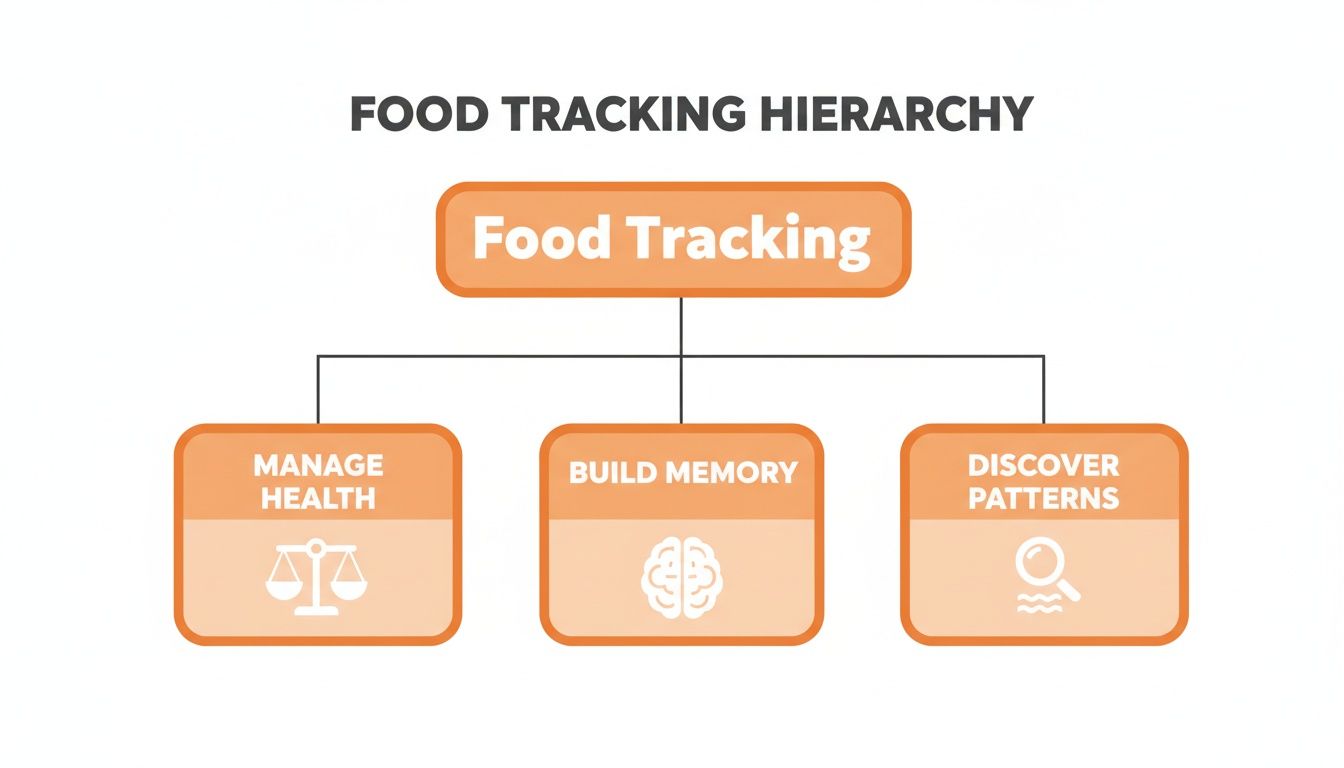
As you can see, your "why" dictates your "what." Let's dig into the two main approaches.
Nutrition Trackers: The Digital Lab
Nutrition-focused trackers are all about the numbers. Think of apps like MyFitnessPal or Cronometer. Their entire purpose is to break your food down into cold, hard data: calories, macros (protein, carbs, fat), and micros (vitamins, minerals). They treat food as fuel.
These tools are perfect for anyone with a specific, measurable health goal. Athletes dialing in their performance, people managing a medical condition, or anyone focused on weight management will find exactly what they need here. These apps are built to answer questions like, "Am I hitting my protein target?" or "How many grams of fiber have I had today?"
- Vast Food Databases: Massive libraries of packaged foods, complete with barcode scanners for quick logging.
- Macro and Calorie Counting: The star of the show, designed for precise numerical tracking.
- Wearable Integration: They sync with fitness trackers to give you a full picture of calories in vs. calories out.
- Goal-Oriented Reporting: Charts and graphs show your progress toward hitting specific health metrics.
Experience Journals: The Private Diary
Experience-focused journals, on the other hand, are built for qualitative discovery. They’re for people who see food as more than just a set of numbers. It’s about flavor, memory, culture, and the story behind a great meal. This is the world Savor lives in.
The goal here isn't to count every gram of sugar but to capture the essence of a dish. These apps are designed for the traveler documenting their culinary finds, the home cook trying to perfect a family recipe, or the foodie who just wants a reliable record of their favorite tastes. They help you answer very different questions, like, "What was that incredible ramen I had in Tokyo last year?" or "Which local spot makes the best tacos, according to my own ratings?"
An experience journal is a tool for building your personal taste profile. It helps you become the ultimate critic of your own life, creating a trusted, searchable database of what you genuinely love to eat.
Nutrition Tracker vs. Experience Journal At a Glance
So, how do you choose? This table cuts right to the chase, laying out the core differences to help you see which path aligns with your goals.
| Feature | Nutrition-Focused Tracker (e.g., MyFitnessPal, Cronometer) | Experience-Focused Journal (e.g., Savor) |
|---|---|---|
| Primary Goal | Quantitative analysis: Managing health, weight, or athletic performance. | Qualitative discovery: Building a personal library of tastes, memories, and culinary experiences. |
| Core Question Answered | "How much of X did I eat?" | "What did I eat, where was it, and how good was it?" |
| Focus | Calories, macros, and micronutrients. Food as fuel. | Flavor, texture, presentation, and personal rating. Food as an experience. |
| Ideal User | Athletes, individuals with specific dietary needs, or anyone with a goal tied to health metrics. | Foodies, travelers, home cooks, and anyone who wants to remember and compare their favorite dishes. |
| Key Features | Barcode scanner, massive food database, recipe importer for nutritional data, wearable integration. | Photo-centric logging, custom rating scales, searchable notes, and comparison tools for dishes. |
| Primary Outcome | Objective data and progress reports to help you make informed decisions about your body's needs. | A private, searchable, and highly personal "greatest hits" list of your own culinary history. |
The choice becomes pretty clear when you see it laid out like this. Your personal motivation is the only thing that matters.
Which Food Tracking App Is Right for You?
Ultimately, the decision comes down to your main objective. Are you tracking to manage your health or to build your food memory?
- Choose a nutrition tracker if: Your goal is tied to a measurable outcome like weight loss, athletic performance, or managing a dietary restriction. You value hard data and need to see a numerical breakdown of your intake.
- Choose an experience journal if: Your primary goal is to remember, compare, and relive your food discoveries. You care more about the flavor, context, and personal rating of a dish than its exact nutritional content.
There's no single "best" app—only the one that aligns with your motivations and fits seamlessly into your life. Choosing the right category from the start is the key to success.
What to Look For in a Modern Food Tracking App
A great food tracking app should make your life easier, not add another chore to your to-do list. The best ones feel less like a nagging accountant and more like an intuitive partner on your culinary journey. But with a sea of options out there, it's easy to get lost. The key is to look for tools that cut down on friction, deliver real insights, and actually adapt to how you live—whether you're a meticulous home cook, a world traveler, or just someone trying to understand your own tastes.
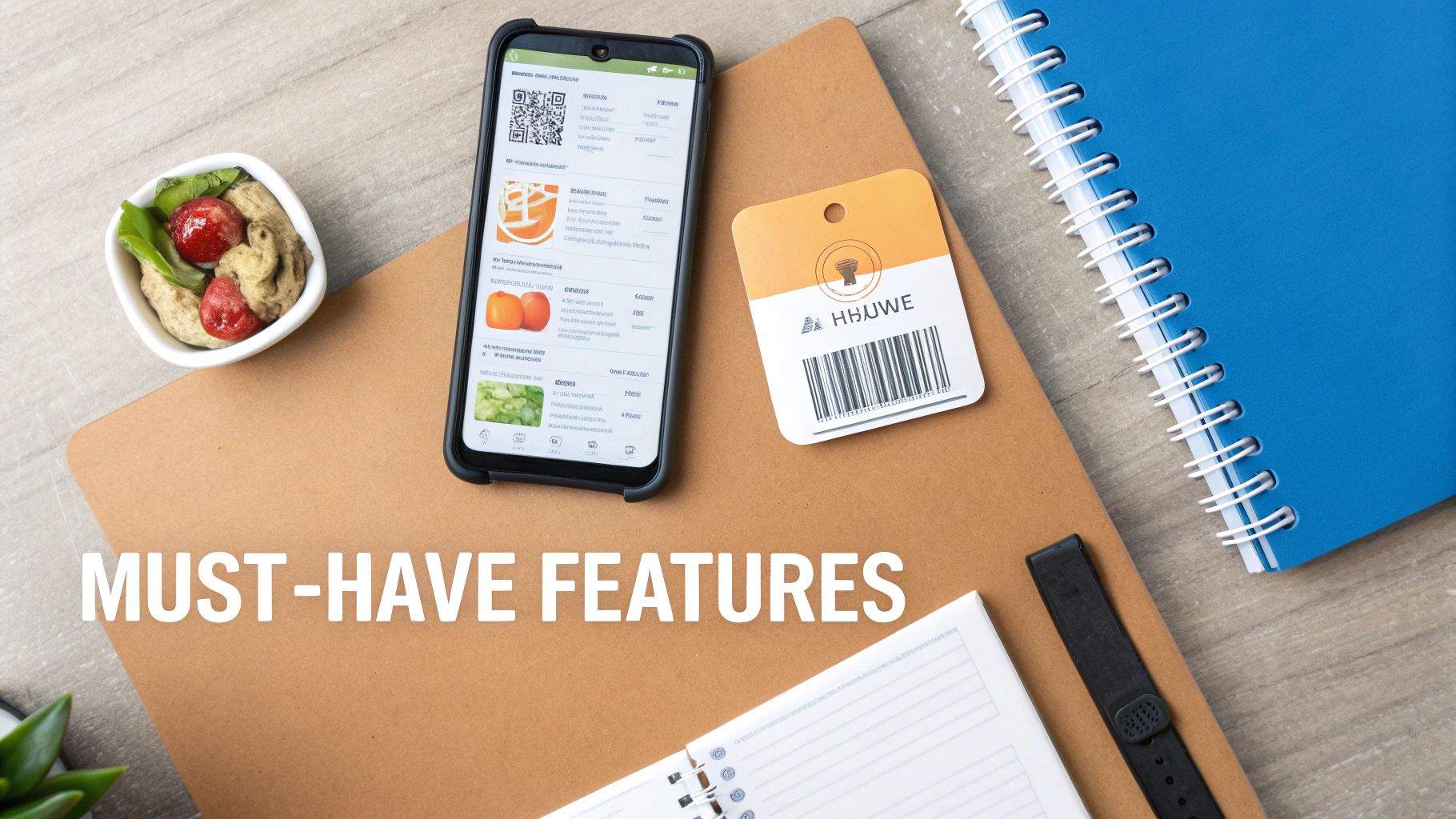
It's no surprise that this space is booming. The global market for food tracking apps is exploding, driven by a huge surge in health awareness and the fact that we all have a powerful computer in our pocket. The market is projected to hit $5.76 billion by 2025, growing at a blistering 11.97% compound annual growth rate. This isn't just hype; it's fueled by real tech advancements like AI that can recognize food from a photo and seamless integrations with wearables, making it simpler than ever to track everything from calories to taste profiles. You can discover more insights about the food tracking app market on datainsightsmarket.com.
Tools That Make Logging Effortless
Let's be honest: the biggest reason people quit tracking is the logging process itself. If it’s a pain, you'll stop. That's why the best modern apps are obsessed with making data entry as painless as possible. Tedious manual entry is dead.
Here are the game-changing features you should demand:
- Photo-Based Logging: Just snap a picture of your meal. It's fast, simple, and creates a visual record that’s far more evocative than a line of text.
- AI Food Recognition: The smartest apps use AI to identify what's on your plate from that photo. It can auto-suggest dish names and categories, saving you precious time.
- Barcode Scanning: For anything that comes in a package, a barcode scanner is an absolute must. It instantly pulls up accurate info, saving you from searching a massive database.
- Custom Recipe Builders: If you cook at home, you need a way to save your own creations. The best apps let you input your ingredients once, then log that entire meal with a single tap forever after.
Features for Gaining Deeper Insights
Just logging your food is only half the story. A truly powerful app helps you connect the dots, transforming your raw data into a personal, searchable database of your own tastes and experiences. It lets you Rate like a critic, but for an audience of one: yourself.
The goal isn't just to record what you ate, but to build a searchable food memory. The right features turn a simple log into a powerful tool for discovering patterns and making better, more informed decisions in the future.
Look for these functions that turn your log into a personal food vault:
- Robust Search and Filtering: You should be able to instantly find that amazing pasta you had six months ago in Rome. Look for apps that let you search by dish name, location, cuisine, or even your own rating.
- Data Visualization and Trends: Simple charts or graphs can reveal powerful truths. An app that can show you your highest-rated dishes or the cuisines you eat most frequently helps you understand your own palate.
- Side-by-Side Comparison Tools: The ability to pull up and compare all the cheeseburgers or ramen bowls you’ve ever eaten lets you see exactly how a new dish stacks up against your personal "greatest hits."
- Customizable Rating Systems: A simple thumbs-up or thumbs-down isn't enough. The best apps offer nuanced rating scales (like 1-10) and fields for notes on flavor, texture, and presentation.
How Food Tracking Apps Handle Your Personal Data
Your food log is a deeply personal record. It reveals far more than just what you eat; it can paint a surprisingly detailed picture of your health habits, your social life, your travel patterns, and even your cultural traditions. This is why data privacy isn't just a boring legal detail—it's one of the most important factors to consider when choosing between food tracking apps. Think of your food journal as a private diary. You should have absolute control over who gets to read it.
Some apps treat your data as a commodity, something to be sold or shared with third-party advertisers. Others build their entire foundation on privacy, ensuring your food memories remain exactly that: yours. Before you commit to an app, you have to understand its philosophy on protecting your story.
What to Look For in a Privacy Policy
Reading a privacy policy can feel like wading through legal jargon, but you don't need a law degree to spot the important parts. A trustworthy app will make this information easy to find and understand, not bury it in pages of confusing text.
Here are the critical points to hunt for:
- Data Ownership: Who owns the data you enter? The policy should state clearly that you retain ownership of your content.
- Third-Party Sharing: Does the app share your personal or aggregated data with other companies for marketing or research? Look for explicit language about whether they sell or rent user lists.
- Anonymization: If your data is used for any internal analytics, is it anonymized first? This means stripping away all personally identifiable information so your logs can't be traced back to you.
- Privacy by Default: Are your entries private from the start, or are they public unless you say otherwise? An app that respects your privacy will always require you to opt-in to sharing.
Your food story is your own. A privacy-first app operates on the principle that your data, your ratings, and your memories belong to you and you alone. It should empower you to Track tastes, share discoveries on your own terms.
The Power of Private-by-Default Entries
An app that makes your entries private by default shows a fundamental respect for your personal information. It means the platform was designed with your security as the top priority from day one. This approach ensures you never accidentally share a personal meal or a private note with a wider audience.
In a privacy-focused environment, sharing becomes an active, intentional choice. For example, instead of your entire food diary being public, you might decide to share a curated list of your favorite local taco spots with a friend. This gives you granular control, letting you be social when you want while keeping the rest of your culinary journey completely private. Choosing an app with this philosophy ensures your food diary remains a safe space where you can honestly document your experiences.
Choosing the Right App for Your Lifestyle
Theory and features are one thing, but the real test is how an app actually fits into your life. The "best" app isn't the one with the most bells and whistles; it's the one that feels like a natural extension of your own habits and passions. It should solve a real problem, whether you're a parent trying to remember kid-friendly meals or a traveler cataloging global street food.
By exploring a few distinct lifestyles, you can start to see which approach will actually work for you. The goal is to find a tool that doesn't just log data but actively supports the way you already live and eat.
The Mindful Traveler Documenting Global Finds
Meet Sarah, a solo traveler whose passion is discovering hidden culinary gems. Her goal isn't nutrition tracking; it's to build a permanent, searchable record of every incredible dish she finds on her adventures. She wants to remember the name of that noodle soup from a tiny stall in Hanoi and compare it to the one she had in Bangkok last year.
Her workflow is all about the experience:
- Snap a Photo: Before the first bite, she grabs a quick picture of the dish.
- Log Key Details: She logs the dish name, the name of the restaurant or stall, and the city.
- Rate like a critic: She uses a 1-10 scale to score the flavor, texture, and presentation, adding quick notes like "perfectly spicy, a little sweet."
- Create Curated Lists: Back at her hotel, she adds the dish to her "Best of Southeast Asia" list to share with friends later.
For Sarah, a dish-first journal like Savor is the perfect fit. It’s a private food diary that helps her Track tastes, share discoveries without getting bogged down by calorie counts.
The Family Chef Organizing Kid-Approved Recipes
Next up is David, a busy parent who handles most of the family cooking. His challenge is keeping track of what meals his picky kids actually enjoy. He’s tired of the dinner-time guessing game and wants a reliable way to remember which recipes were a hit and which were a miss.
His routine is centered on home cooking and feedback:
- Build a Recipe: The first time he makes a new dish, he enters the ingredients into his app.
- Document the Result: He takes a photo of the finished meal.
- Record the Verdict: He logs notes like, "Kids loved it, maybe less salt next time," and gives it a rating based on the family's reaction.
- Filter for Success: When planning meals for the week, he can instantly filter for "5-star family meals" or search for "kid-approved chicken."
David needs an app that handles custom recipes well and allows for detailed personal notes. An experience journal serves him far better than a strict nutrition tracker because his goal is about taste and preference, not macronutrient ratios.
The Health Optimizer Tracking Fitness Goals
Finally, there’s Maria, an athlete who is laser-focused on her fitness. She treats her body like a high-performance engine and needs precise data to fuel it correctly. Her primary goal is to hit specific macro targets to optimize her training and recovery. There's a reason user engagement in nutrition-focused food tracking apps is massive. Apps like FatSecret boast over 50 million downloads, with users logging more than a billion foods globally. Cronometer has 2 million registered users who have logged over 7 billion servings, and 80% report better diet quality. These numbers, highlighted in powerful diet and nutrition app statistics at Market.us, show just how indispensable these data-driven tools are for health-conscious individuals.
Maria’s daily workflow is all about precision:
- Barcode Scanning: She scans every packaged item for instant, accurate data entry.
- Weighing Portions: For whole foods, she weighs her portions on a food scale to ensure her macro counts are exact.
- Wearable Syncing: Her app connects to her fitness watch, automatically adjusting her calorie targets based on her workouts.
- Analyzing Reports: At the end of the day, she reviews detailed charts to see if she met her protein, carb, and fat goals.
For Maria, a nutrition tracker like MyFitnessPal or Cronometer is the only choice. These apps are designed for the quantitative analysis she needs to perform at her best.
The Power of a Dish-First Food Journal
If you believe food is more than just a set of numbers, a dish-first journal is a completely different way to think about tracking. This approach moves the spotlight away from abstract data like calories and macros. Instead, it shines a light on the dish itself—the flavor, the texture, the memory it created.
It’s a method built for anyone who has ever tried to recall the best pasta they had on vacation years ago, wishing they had a personal, trusted database to consult. It’s for the moments when a friend asks for a recommendation and your mind goes blank, even though you know you’ve had incredible meals. Savor is NOT a venue review app. Savor is NOT a coupon saving app. A dish-first journal judges the plate. This is about becoming the critic of your own culinary life, creating a private library of your tastes that you can trust completely.
Building Your Personal Taste Database
Imagine being able to instantly compare every ramen you’ve ever eaten, sorted by your own ratings. That’s the entire point of a dish-first food tracking app. It empowers you to build a reliable, searchable history of your palate. Instead of outsourcing your memory to a stranger's opinion on a public review site, you build your own "greatest hits" list that is perfectly aligned with what you love. This personal database becomes an invaluable tool for making better decisions next time you're staring at a menu.
The food tracking app world is a crowded space, dominated by health-focused titans like MyFitnessPal and Noom. As these apps help millions with preventative healthcare, a niche has emerged for a different kind of tracking—one focused purely on the experience. While others fixate on raw data, a dish-first journal solves the painful problem of forgotten feasts and the trust gap in public reviews. You can discover more insights about the evolving diet and nutrition apps market to see how this space is changing.
A dish-first journal transforms you from a passive consumer into an active curator of your own culinary life. It’s not about restriction; it’s about celebration and remembrance.
Why This Approach Resonates
A dish-first philosophy connects with the real reason so many of us love food in the first place: the stories and emotions tied to each meal. It's a more human way to document your life, providing a level of personalization that other apps simply can't match.
This style of journaling helps you:
- Remember with Clarity: Capture the specific details that made a dish special, from the perfectly crispy texture of the skin to the unique blend of spices in the sauce.
- Compare with Confidence: Objectively see how a new dish stacks up against your all-time favorites. Was that ramen really better than the one you had in Tokyo? Now you know.
- Share with Purpose: Give meaningful, trusted recommendations to friends and family based on your own vetted experiences, not a fuzzy memory.
By making the dish the hero of your food story, you create a rich, visual, and deeply personal record. It's the ultimate way to Track tastes, share discoveries on your own terms.
Common Questions About Food Tracking Apps
Jumping into the world of food tracking can feel like a big commitment, but it doesn't have to be. Getting started is easier than you think. The real key is finding a rhythm that fits your life, not the other way around. Let's tackle some of the most common questions people have when they're ready to give it a try.
How Much Time Does It Take to Log a Meal?
The biggest myth about food tracking is that it’s a time-consuming chore. While that might have been true years ago, modern apps are built for speed. With features like AI dish recognition and photo-based logging, a basic entry can take less than 30 seconds.
If you want to add more detail—say, specific notes on flavor, texture, and a custom rating—you might spend a minute or two. But the goal isn't to write an essay for every meal. It's about quickly capturing the essential details so you can get back to your life.
Are Free Food Tracking Apps Good Enough?
Absolutely—especially when you’re just starting out. Many great apps, including Savor, offer a powerful set of core features completely free. A good free version should let you log meals, add photos, write notes, and organize everything without hitting a paywall for the basics.
Premium features usually add things like advanced analytics or deeper customization, which can be fantastic for power users down the line. But a free app is more than enough to help you build the habit and see if tracking is right for you. Just start with one that respects your privacy and aligns with your goals.
How Do I Stay Consistent with Tracking?
Consistency is built on two simple things: a clear "why" and a frictionless process. First, be honest about what you want to achieve. Are you tracking to remember amazing dishes, manage your wellness, or discover your own taste patterns? Your motivation is your anchor.
Second, make it effortless. Turn on app notifications for a gentle nudge and try to log meals right after you eat, when the details are still fresh.
The secret to consistency isn't perfect, daily logging. It's about creating a low-effort habit that serves a clear purpose in your life, turning a potential chore into a rewarding ritual.
Ultimately, the best way to stick with it is to choose an app you genuinely enjoy using—one that feels less like a task and more like a trusted companion for your culinary journey.
Ready to build your own personal database of every amazing meal? With Savor, you can turn fleeting food memories into a permanent, searchable library of your tastes. Rate like a critic and start documenting your food story today.
Continue Reading
Start Tracking Your Dishes Today
Transform your food photos into a searchable, ratable culinary memory bank.
Download Savor App