
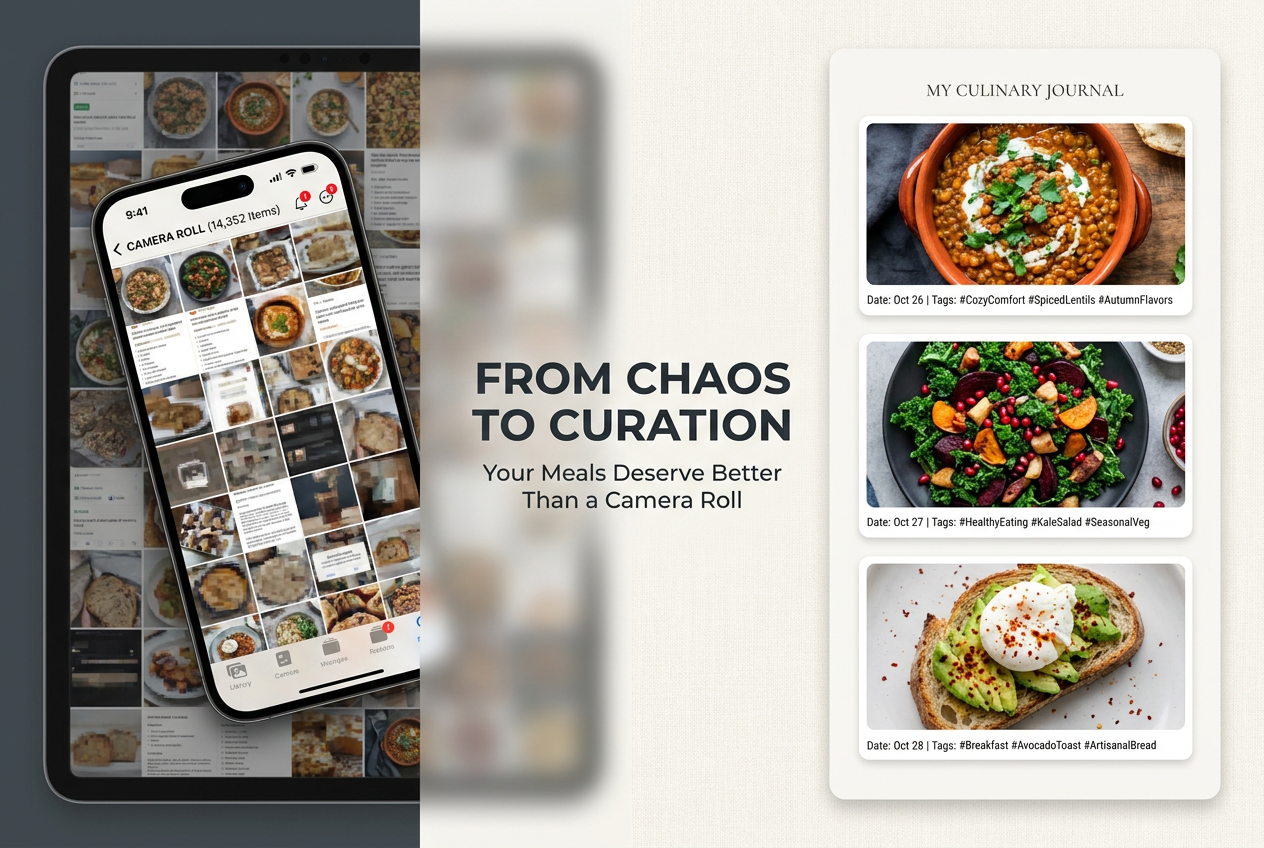
The Private Food Journal App for Foodies: Stop Losing Your Best Meals
Alex the juice queen
Alex hunts for the best juice bars and presses. She rates every sip and saves her favorites in Savor.
The Private Food Journal App for Foodies: Stop Losing Your Best Meals Your camera roll holds 2,847 photos. Somewhere in that digital chaos lives the name of...
The Private Food Journal App for Foodies: Stop Losing Your Best Meals
Your camera roll holds 2,847 photos. Somewhere in that digital chaos lives the name of that perfect ramen spot from three months ago, the one with the 63-degree egg and the broth that made you forget your own name. You scroll. You scroll some more. You give up.
This is the paradox of the modern food lover: we photograph everything and remember nothing.
A private food journal app built specifically for foodies solves this. Not another calorie counter. Not another social media performance stage. A personal, searchable archive of every meal that mattered, organized the way your memory actually works - by dish, by neighborhood, by that exact flavor that changed your perspective on what miso can do.
Table of Contents
- The Camera Roll Crisis
- Why General Apps Fail Foodies
- The 4 Pillars of a Perfect Foodie Journal
- Comparison Review: Top 5 Apps (2026 Edition)
- Implementation Guide: Moving from Chaos to Curation
- Your Taste is Your Legacy
- Frequently Asked Questions
The Camera Roll Crisis
For urban professionals aged 25-45, the camera roll has become a graveyard of culinary memories - thousands of untagged, unsearchable photos that make recalling a specific dish nearly impossible.
You’re at dinner with friends. Someone mentions Korean fried chicken. You know you had an incredible version somewhere in the East Village last spring. The place had that industrial-chic vibe, exposed brick, natural wine. The chicken had this gochujang glaze that was sweet but not cloying, spicy but not punishing. Perfect.
You pull out your phone. Start scrolling. March? April? Was it before or after that work trip to Austin? Five minutes later, you’re 800 photos deep, looking at screenshots of apartment listings and blurry concert photos. The conversation has moved on. The recommendation dies in your throat.
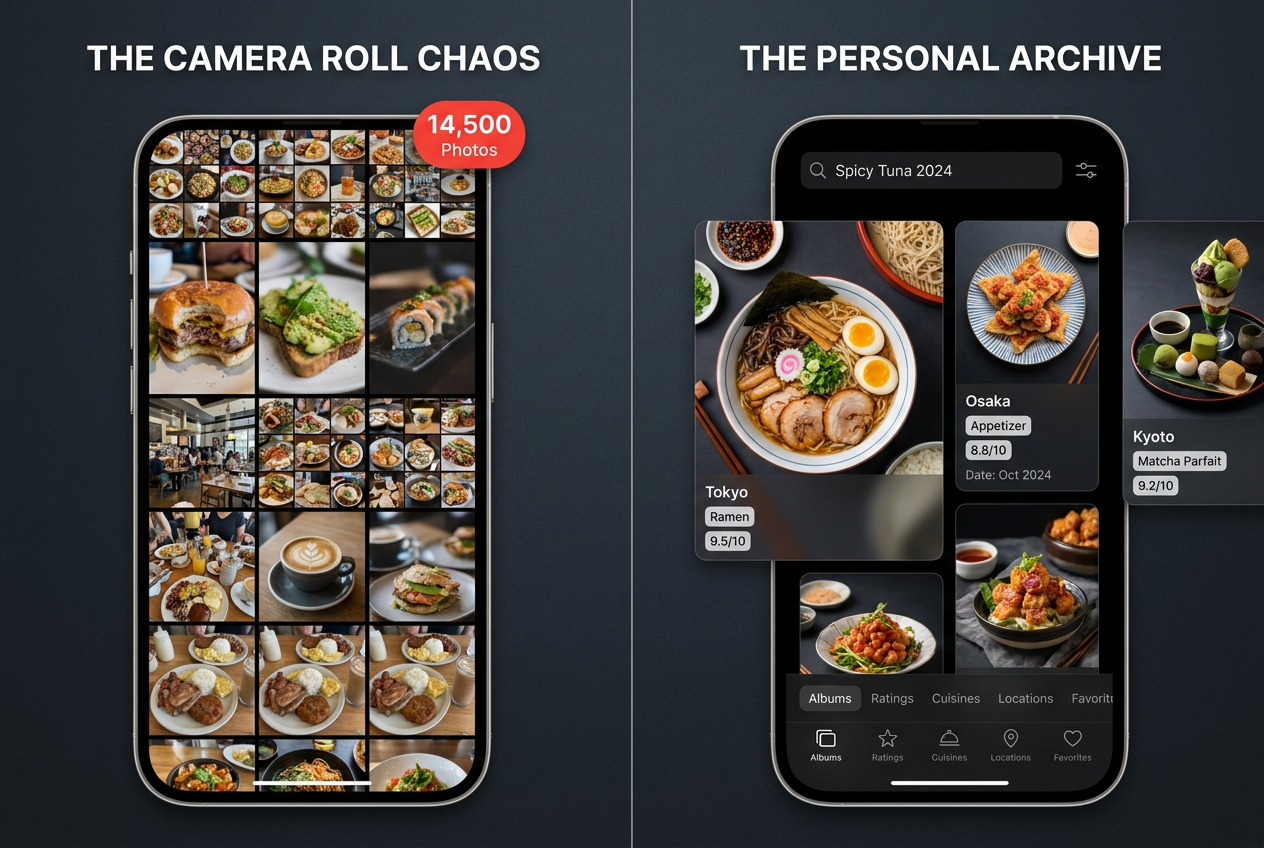 Stop scrolling through thousands of photos. Move from the chaos of a messy camera roll to a searchable, high-fidelity archive of your culinary life.
This isn’t a storage problem. It’s an architecture problem. Your camera roll was designed to hold moments, not metadata. It has no concept of cuisine, no understanding of neighborhood, no way to filter by your personal rating or the specific dish that made the meal memorable.
The serious foodie - someone who views dining as cultural exploration, not just sustenance - needs something fundamentally different. You’re not tracking food because you’re worried about calories. You’re tracking it because that handmade pasta with ’nduja and burrata at that tiny Williamsburg spot represents a moment in time, a flavor combination you want to remember, maybe even recreate.
This is memory archeology. The goal isn’t to broadcast your meals to strangers for validation. The goal is to build a searchable, private library of your own taste - a personal Michelin guide written by and for the only critic who matters: you.
The camera roll can’t do this. Neither can your Notes app with its jumbled, chronology-free mess of restaurant names and half-remembered thoughts. You need purpose-built architecture for food memory.
Why General Apps Fail Foodies
Generic apps miss what foodies actually need: dish-level granularity, genuine privacy, and intelligent organization that mirrors how we naturally remember meals - by taste, place, and feeling, not dates or calorie counts.
Let’s be honest about the tools most people try first.
The Notes App
Your Notes app is where good intentions go to die. You’ve got entries like "Amazing carbonara - West Village" next to "Buy milk" and "Password for wifi." There’s no date stamp. No photo attached. No way to search by cuisine or rating. When you’re trying to remember that spot six months later, you’re stuck with command-F and hope.
The Notes app treats your culinary life like a grocery list. It’s not built for curation, comparison, or discovery. It’s a text file with delusions of grandeur.
Instagram used to work for some of this. Past tense. You’d post a photo, tag the location, add a caption about the dish. Your feed became an accidental food diary.
Then the algorithm changed. Your posts don’t show up chronologically anymore. Finding that meal from eight months ago means scrolling through an endless feed of other people’s content, ads, suggested posts, and the strange mix of food photos, vacation snapshots, and the occasional meme you shared for reasons you can’t quite recall.
More fundamentally, Instagram is performance. Even your "casual" food posts are curated for an audience. You’re not being honest about the meal that disappointed you. You’re not tracking the mediocre dishes alongside the transcendent ones. You’re building a highlight reel, not an honest archive.
The moment you start thinking about how your review will be received - will people think I’m pretentious for critiquing a taco truck? Will this make me look uncultured? - you’ve stopped documenting for yourself.
And forget about privacy. Your Instagram food diary is a public billboard for your dining habits, available to coworkers, old classmates, that person you went on two dates with in 2019, and anyone else who searches for the restaurant’s geotag.
Yelp and Google Maps
Public review platforms serve a purpose, but they’re fundamentally hostile to the serious foodie’s needs.
First, there’s no dish-level tracking. Yelp wants you to rate the restaurant. But the restaurant might be a 4 out of 5 overall while that specific mushroom risotto is a 10. The service might be mediocre, the ambiance loud, but that dish - that singular creation - transcends the space it’s served in.
Second, everything is public and permanent. You can’t give an honest 2-star review to a neighborhood spot without worrying about running into the owner at the grocery store. Your criticism becomes a public record that follows both you and the restaurant indefinitely.
Third, and perhaps most insidious, these platforms train you to write for an audience of strangers, not for your future self. You’re performing helpfulness, demonstrating expertise, engaging in the social performance of being a "contributor." The actual content - the specific flavors, the exact dish that made the meal memorable, the personal context that made this dining experience significant - gets lost in the performance.
When you’re writing for the public, you’re not writing for you.
The dish rating app space has evolved specifically to address these shortcomings. Modern private food journals recognize that serious foodies need granular tracking, genuine privacy, and intelligent organization - not social performance metrics or calorie counters.
The 4 Pillars of a Perfect Foodie Journal
An ideal private food journal combines granular dish-level tracking, absolute privacy for honest reviews, intelligent auto-tagging of metadata, and geographic mapping that shows where your best meals live.
These aren’t nice-to-have features. They’re the foundational architecture that separates a tool that gets used from one that gets abandoned after a week.
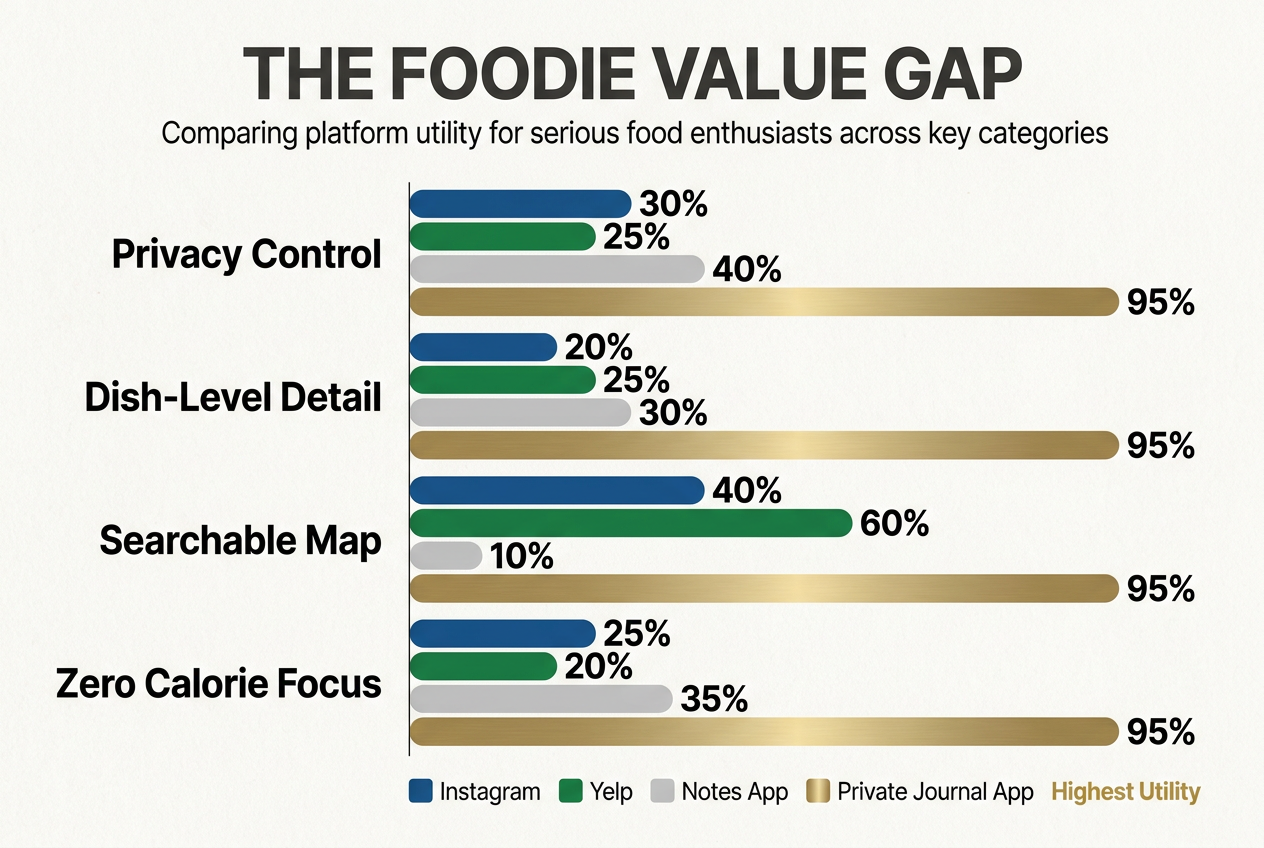 Traditional social and review platforms fail the serious foodie by prioritizing public noise over private, granular, and searchable dining insights.
Pillar 1: Granularity (The Dish, Not Just the Place)
A restaurant is an address. A dish is a memory.
This distinction matters enormously. That tiny spot in the Mission District might serve fifteen different dishes. Three of them are transcendent. Four are forgettable. Eight fall somewhere in between. If you rate the restaurant as a 7 out of 10, you’ve lost the nuance. You’ve failed to capture that their shakshuka is a religious experience while their avocado toast is aggressively mediocre.
Dish-level tracking means you’re building a map of specific flavors, not general locations. When you want to remember that perfect bowl of ramen, you’re not searching for "Ramen spots I’ve tried." You’re searching for "Tonkotsu" + "Soft egg" + "9+ rating" and instantly surfacing the three bowls that earned that score across different cities and different years.
The best private food journals let you rate and tag individual dishes within a meal. You went to dinner, ordered three dishes to share. One was extraordinary, one was solid, one missed. A good app lets you track all three with separate ratings, separate notes, separate photographs. Your memory of that night isn’t a single number. It’s a collection of distinct experiences, each worth preserving on its own terms.
Pillar 2: Privacy (Brutal Honesty Without Social Fallout)
The most valuable food journal is the one where you can be completely honest.
That neighborhood Italian place? The service is warm, the owner remembers your name, the atmosphere is perfect for date night. But the pasta is overcooked every single time, and that matters. In a private journal, you can write: "Love this place for the vibe, but the cacio e pepe is a 4/10 - too loose, not enough cheese, pasta has no bite. Order the eggplant parm instead."
That entry is useful. It’s honest. It helps future-you make better choices. But it’s not something you’d post publicly. It’s not even something you’d necessarily want to share with friends who might screenshot it or repeat it. This is intelligence for your own culinary decision-making, not content for public consumption.
Privacy also means freedom from performance anxiety. You’re not crafting prose for an audience. You’re not worried about sounding pretentious or insufficiently grateful or overly critical. You can use shorthand that makes sense only to you. You can be petty ("Great dish, but the server had an attitude"). You can be weird ("Reminded me of that thing my grandmother made, but French").
This is your space. Your rules. Your voice.
When we interviewed serious food lovers for a guide on tracking restaurant experiences, the overwhelming theme was this: public reviews are diplomatic; private notes are true.
Pillar 3: Intelligence (Auto-Tagging Location, Date, and Context)
The best food journal is the one that requires the least effort.
If an app makes you manually enter the restaurant name, the address, the date, the time, the cuisine type, and your companions every single time, you’ll stop using it. Guaranteed. Friction is the enemy of habit formation.
Intelligence means the app does the heavy lifting. You snap a photo at a restaurant. The app:
- Auto-captures the GPS coordinates and matches them to the restaurant
- Tags the date and time automatically
- Suggests cuisine type based on the location
- Lets you add a quick rating and a short note in under 30 seconds
The whole process should feel as natural as taking a photo and adding a caption - because that’s the only level of friction that doesn’t break the habit.
Some advanced apps go further, using image recognition to identify the dish itself. You photograph the plate. The app suggests "Margherita pizza" or "Pad Thai" based on visual analysis. You confirm or correct, add your rating, done. The entire interaction takes less time than writing a text message.
This intelligence extends to search and discovery. A truly smart app learns your preferences over time. It notices you give high ratings to Sichuan food, natural wine bars, and places with outdoor seating. When you’re in a new city, it can surface recommendations based on your demonstrated taste, not generic crowd wisdom.
Pillar 4: Geography (Your Personal Food Map)
Memory is spatial. When you try to remember a great meal, you often start with place. "That spot near the park." "The place we went after the concert." "Somewhere in the West Village, I think?"
A geographic interface respects how human memory actually works. You should be able to open a map view and instantly see every meal you’ve logged in a neighborhood, a city, or across your entire dining history.
This becomes especially powerful when traveling. You’re visiting Portland for a work conference. You open your food journal’s map view and realize you logged three meals there on a trip two years ago. Two were excellent, one was disappointing. You can instantly revisit the winners and avoid the mistake.
The map also reveals patterns you wouldn’t otherwise notice. "Huh, I’ve eaten at five different spots in this two-block radius, and they’ve all been great. This must be a strong food neighborhood." Or the inverse: "I’ve tried three places in this area over two years, and none scored above a 6. Time to explore elsewhere."
For the serious foodie, the geographic view transforms your journal from a chronological diary into a living, searchable database of your personal taste geography. It’s the difference between remembering meals and understanding your own palate.
Turn your dining history into a personal concierge. Use private data to instantly recall your highest-rated dishes and hidden gems across any city.
Comparison Review: Top 5 Apps (2026 Edition)
Five apps dominate the private food journaling space in 2026, each with distinct strengths for different types of foodies: Savor for dish-level precision, Beli for social curation, Memolli for extreme privacy, Yummi for visual browsing, and Truffle for Instagram integration.
Let’s evaluate them based on what actually matters: granularity, privacy, ease of capture, search capability, and that crucial geographic view.
Savor: Best for the Precision Foodie
Core Strength: Dish-level rating with professional framework
Savor is built around a single premise - the dish is the fundamental unit of food memory, not the restaurant. You can rate individual dishes on a 10-point scale, add detailed taste notes (sweet, savory, spicy, texture, creativity), attach multiple photos, and tag specific elements like "perfectly al dente" or "too salty."
The app’s interface is clean, fast, and decidedly anti-social. There’s no feed, no followers, no public sharing pressure. It’s your personal database, period.
The search is genuinely powerful. You can filter by:
- Dish type ("show me every ramen I’ve rated 8 or higher")
- Location ("what did I eat in Tokyo?")
- Specific ingredients ("all dishes with uni")
- Date range
- Personal tags
The map view is intuitive, showing pins for every logged meal with color-coded ratings. Tap a pin, see the dishes from that visit, jump directly to your notes.
Best For: Food writers, serious home cooks, anyone building a personal flavor reference library
Limitations: iOS only (though a web version is coming). No social features if you want them. The rating framework is detailed, which some users find intimidating initially.
If you’re interested in this level of dish-specific tracking, the Savor App Blog offers detailed guides on developing your rating system and building effective taste notes.
Beli: Best for the Social Curator
Core Strength: Ranked lists and tasteful semi-public sharing
Beli positions itself as "Letterboxd for food," and the comparison is apt. The app encourages you to create ranked lists of your favorite dishes or restaurants - "Best Pizza in Brooklyn," "Top 10 Breakfasts of My Life," "Dishes Worth a Flight."
These lists can be kept private or shared with friends. The social element is curated and controlled - you choose who sees what, unlike the broadcast nature of Instagram. The app has a waitlist, which creates an intentional sense of exclusivity.
The interface is beautiful, clearly designed by people who care about typography and white space. It feels more like a coffee table book than a database.
Best For: People who think in lists, those who want selective social sharing, design-conscious users
Limitations: The social layer, even if opt-in, creates subtle performance pressure. List-making is a specific cognitive style that doesn’t work for everyone. Less powerful for quick "what did I eat at this restaurant?" lookup.
Memolli: Best for the Privacy Absolutist
Core Strength: Complete privacy with offline functionality
Memolli is the Fort Knox of food journals. Everything is stored locally on your device unless you explicitly choose to back up to iCloud. There’s no account creation, no email required, no data harvested. The app works completely offline.
You can add photos, ratings, notes, and location data for restaurants and dishes. The UI is straightforward and functional rather than design-forward. This is a tool for people who deeply distrust cloud services and data collection.
Best For: Privacy advocates, international travelers in areas with spotty connectivity, anyone who wants zero social features
Limitations: Smaller user base means less frequent updates. The offline-first approach means no cross-device syncing unless you handle it manually. The interface feels utilitarian.
Yummi: Best for Visual Browsers
Core Strength: Calendar-based visual timeline
Yummi’s killer feature is its calendar view. You see a visual grid of every meal you’ve logged, organized by date, with the dish photo as the primary element. It’s immediately clear what you ate when, making it easy to browse your food history chronologically.
This works especially well for people who remember meals by time period - "What did I eat during that California trip last summer?" - rather than by category or rating.
The app includes restaurant-level and dish-level tracking, basic ratings, and a map view. The social features are minimal.
Best For: Visual thinkers, people who want to see patterns in their dining habits over time, travelers documenting food trips
Limitations: The interface can feel cluttered when you’ve logged hundreds of meals. The calendar view is great for browsing but less effective for targeted search. Some users find the design slightly dated compared to newer apps.
Truffle: Best for Instagram Power Users
Core Strength: Automatic import from Instagram Stories
Truffle solves a specific problem: you already document your food on Instagram, but Stories disappear after 24 hours, and posts get buried in your feed. Truffle automatically saves any Story tagged at a restaurant, organizing them into a private, searchable collection.
You can add ratings and notes retroactively. The app essentially transforms your existing Instagram habit into a persistent food journal.
Best For: People who already post every meal to Instagram Stories, visual storytellers who don’t want to change their workflow
Limitations: Only works if you’re active on Instagram. Your "journal" is only as detailed as your Stories - if you don’t tag locations or add text, there’s nothing to import. Privacy is limited by your existing Instagram behavior. The app is more of an archive tool than a purpose-built food journal.
The Verdict
If you’re serious about building a detailed, searchable archive of dish-level intelligence, Savor is the clear winner. Its rating framework is sophisticated, its privacy is absolute, and its search capability is unmatched.
If you value aesthetics and want controlled social sharing, Beli offers the most beautiful experience, assuming you can get off the waitlist.
If privacy is non-negotiable and you don’t trust cloud services, Memolli is your app.
For a detailed comparison of even more options, check out the best food diary apps or restaurant tracking apps specifically.
Implementation Guide: Moving from Chaos to Curation
Transforming 2,000+ messy camera roll photos into a searchable food archive takes a structured 30-minute audit session, a consistent forward-logging habit, and a simple rating framework you’ll actually use.
Knowledge without implementation is just entertainment. Here’s how to actually do this.
Step 1: The 30-Minute Camera Roll Audit
Don’t try to migrate everything at once. That’s the path to giving up entirely.
Instead, set a timer for 30 minutes. Scroll through your camera roll and cherry-pick only the absolute standouts - the meals you remember without even seeing the photo. The ones that made you text your friend immediately. The ones you still think about.
For each standout:
- Upload the photo to your chosen app
- Add the restaurant name and location (the app may auto-detect this)
- Rate the specific dish
- Add a short note: "Best carbonara outside Rome - pecorino was perfect, guanciale crispy but not dry"
You’ll probably capture 15-25 meals in that first session. That’s perfect. You’ve just created the foundation of your personal food database, and it took less time than watching an episode of a sitcom.
Don’t worry about the remaining 1,975 photos. They’re not important enough to remember, which means they’re not important enough to migrate.
Step 2: Build the Forward Habit
The real goal is capturing meals in real-time going forward. Retroactive logging is painful. Current logging is painless if you build it into your existing behavior.
The key is to attach the new habit to an existing trigger. You already photograph your food - everyone does. The new habit is: photograph, then immediately open your food journal app and add a quick rating and note while you’re still at the table.
This takes 30 seconds. It’s faster than typing a text message. The flavor is fresh in your mouth, the context is immediate, the memory is vivid.
Start with a simple rating scale you can apply instantly:
- 10 - Life-changing, would plan a trip around this dish
- 9 - Outstanding, new personal benchmark
- 8 - Excellent, would order again and recommend
- 7 - Solid, well-executed
- 6 - Fine, nothing wrong but nothing memorable
- 5 or below - Disappointing
That 10-point scale gives you enough nuance to be useful without requiring a five-minute deliberation.
For a deeper dive into professional rating systems, see the pizza scoring protocol for an example of how critics approach systematic evaluation.
Step 3: Add Context That Future-You Will Thank You For
The bare minimum - photo, rating, location - is useful. But you can make your entries exponentially more valuable with just a few extra details:
Who were you with? "Date night with Sarah" or "Solo lunch" adds emotional context that triggers richer memories later.
What was the vibe? "Loud, energetic, great for groups" or "Quiet corner table, perfect for conversation." This helps you reconstruct not just what you ate, but what the entire experience felt like.
What specifically made it great (or terrible)? "Pasta cooked perfectly, but sauce was too oily" is infinitely more useful than just "7/10." When you revisit this entry six months later, you’ll remember exactly why you gave that score.
What would you order again? "Skip the appetizer, go straight to the squid ink pasta." Future-you will appreciate this targeted intelligence.
None of this needs to be polished prose. Sentence fragments work fine. This is a tool for you, not a publication.
Step 4: Use It Before You Travel
A week before a trip, open your app’s map view for your destination. See what you logged last time. Revisit those notes. Make a short list of places worth returning to and dishes worth repeating.
This transforms your journal from a passive archive into an active planning tool. You’re no longer starting from zero every time you visit a city. You’re building on your own accumulated intelligence.
Compare this with starting from scratch with generic recommendation platforms - see how foodies are tracking meals differently compared to traditional review sites.
Step 5: Share Selectively (If You Want)
Most private food journal apps let you export individual entries or generate shareable links. When a friend asks for a recommendation, you can send them a direct link to your entry for that dish - complete with your photo, rating, and notes.
This is fundamentally different from posting publicly. You’re sharing targeted intelligence with specific people who asked, not broadcasting to an audience hoping for engagement.
Your journal remains private. Your data stays yours. But you can still be helpful when it matters.
Your Taste is Your Legacy
Building a private food journal isn’t about vanity or performance - it’s about preserving your sensory autobiography and creating a reference library that gets more valuable every year.
Think about what you’re actually building here.
Every dish you log is a data point in your personal understanding of flavor. Over time, patterns emerge. You realize you’re consistently drawn to umami-forward dishes. Or you discover that your favorite meals all involved natural wine pairings. Or you notice that you rate street food higher than fine dining, which tells you something important about your actual preferences versus your aspirational ones.
This self-knowledge has practical value. It makes you a better cook - you understand which flavor profiles resonate with you and can reverse-engineer them at home. It makes you a better dining companion - you can give genuinely informed recommendations instead of repeating generic Yelp wisdom. It makes you a more efficient traveler - you know exactly what kind of food experiences to prioritize in a new city.
But there’s something deeper happening too.
Food memory is among the most powerful forms of autobiographical memory we have. Proust wasn’t wrong about the madeleine. The taste of a particular dish can transport you back to a specific moment in time with a vividness that photographs alone can’t match.
When you build a food journal, you’re not just tracking calories or restaurant names. You’re preserving a sensory autobiography - a record of where you’ve been, who you’ve been with, what brought you joy, what disappointed you, what surprised you, what changed your understanding of what food could be.
Ten years from now, that journal will be irreplaceable. You’ll open it and remember not just the dish, but the entire context: the friend who recommended the place, the conversation that happened over that meal, the neighborhood you were just starting to explore, the version of yourself who ordered that particular combination of flavors.
Your taste is your data. Your accumulated dining intelligence is yours and yours alone. Don’t give it away to platforms that monetize your attention. Don’t let it rot in an unsearchable camera roll.
Start building your archive. Be honest. Be specific. Be consistent. Give your future self the gift of perfect memory for every meal that mattered.
The best private food journal app for you is simply the one you’ll actually use. Pick one from the list above. Spend 30 minutes migrating your greatest hits. Start logging your meals in real-time.
Your culinary memory deserves better than chaos.
Frequently Asked Questions
What is the best private food journal app for foodies?
For most serious foodies, Savor is the best private food journal app because it focuses on dish-level rating and tracking rather than restaurant-level reviews. It allows you to rate individual dishes on a detailed 10-point scale, add specific taste notes, and search your entire dining history by dish type, cuisine, location, or ingredients. The app is completely private with no social features, making it ideal for building an honest personal archive. However, the "best" app depends on your specific needs - Beli is better if you want curated social sharing, Memolli if you prioritize offline privacy, and Yummi if you prefer visual calendar-based browsing.
How is a private food journal different from Instagram or Yelp?
A private food journal app serves a fundamentally different purpose than public platforms. Instagram is designed for social broadcasting and performance - you’re curating content for an audience, which means you’re less likely to be brutally honest about mediocre meals. Yelp and Google reviews are public and restaurant-focused, not dish-focused, and every review you write becomes permanent public record. A private food journal lets you be completely honest (the pasta was overcooked, the service was slow), track individual dishes rather than entire restaurants, and search your history without worrying about social fallout or algorithmic feeds. You’re writing for your future self, not for strangers.
Do I need to log every meal, or just the memorable ones?
Log only what matters to you. Most serious foodies use a selective approach - tracking meals at new restaurants, standout dishes at familiar spots, or anything that made them immediately think "I need to remember this." You don’t need to log your Tuesday morning cereal or your rushed airport sandwich. The goal is building a reference library of memorable culinary experiences, not exhaustive life documentation. Start by logging 2-3 meals per week. If you find yourself wanting more detail, increase frequency. If it feels like a chore, you’re logging too much. The best food journal is the one you’ll actually maintain.
Can I import my existing food photos from my camera roll?
Most private food journal apps support photo uploads, so you can manually add your best meals from your camera roll. However, true bulk importing with automatic date and location data is limited. The most efficient approach is a focused 30-minute audit - scroll through your camera roll and add only the 15-25 truly memorable meals you still think about. These become the foundation of your archive. Don’t try to migrate everything; that leads to burnout and abandonment. Focus on capturing your meals going forward in real-time, which is far easier than retroactive logging.
How detailed should my food journal entries be?
The minimum viable entry is: photo, location, dish name, and a quick rating. This takes 30 seconds and provides searchable value. For meals that warrant more attention, add context that future-you will appreciate - who you were with, what made the dish memorable, what you’d order again, and any specific flavor notes ("perfectly charred crust, but underseasoned"). Avoid writing lengthy prose unless you genuinely enjoy it. Sentence fragments work fine. This is a personal reference tool, not a publication. The best entry is the one you’ll actually write, so find a detail level that feels sustainable rather than burdensome.
Are free food journal apps any good, or do I need to pay?
Several excellent free options exist for private food journaling. Savor offers a robust free tier with dish-level tracking, ratings, and search - enough for most users. Memolli is entirely free with no premium upsell. The free versions typically limit the number of entries or photos you can store, or they may lack advanced features like custom tags or data export. Paid versions (usually $3-10/month or $20-50/year) remove limits and add features like unlimited photo storage, advanced search filters, and cross-device sync. Try the free version first. Upgrade only when you hit limitations that actually bother you. A free app you’ll use consistently beats a premium app you’ll abandon.
Will switching apps later mean I lose all my data?
Most established food journal apps offer data export features, typically as CSV files or photo archives. Before committing to any app, check if it has an export function in its settings. This ensures your data isn’t held hostage. That said, switching apps is disruptive - your search history, organizational system, and accumulated habits don’t transfer smoothly. The best approach is to research thoroughly before choosing your first app, but know that you’re not permanently trapped. Your photos and notes are yours. In a worst-case scenario where an app shuts down without warning, your device photos and screenshots provide a backup. Cloud-synced apps generally offer better data portability than offline-only tools.
Can I share my food journal entries with friends without making everything public?
Yes, most modern private food journal apps offer selective sharing options that differ fundamentally from public platforms. Savor, Beli, and similar apps let you generate shareable links for individual entries or collections, which you can send directly to specific people via text or email. This is different from posting publicly - you control exactly who sees what, and sharing is pull-based (someone asks for a recommendation, you send them a link) rather than push-based (broadcasting to all followers hoping for engagement). Your overall journal remains private. You’re not building a public profile or accumulating followers. You’re simply sharing targeted culinary intelligence with people who specifically requested it.
Continue Reading
Start Tracking Your Dishes Today
Transform your food photos into a searchable, ratable culinary memory bank.
Download Savor App