
The Savor Application: Why It’s the New Standard for Dish-Level Food Memory
Alex the juice queen
Alex hunts for the best juice bars and presses. She rates every sip and saves her favorites in Savor.
The Savor Application: Why It's the New Standard for Dish-Level Food Memory (2026) You've taken 2,000 food photos this year. But when someone asks "Where was...
The Savor Application: Why It's the New Standard for Dish-Level Food Memory (2026)
You've taken 2,000 food photos this year. But when someone asks "Where was that incredible carbonara?" - you scroll through a digital graveyard of unsorted images, lose the thread, and settle for "Somewhere in Rome, I think?" Most food lovers hit this wall: meticulous documentation in the moment, total amnesia three months later. Not because the memories weren't worth keeping. Because the tool wasn't built for dish-level recall.
That's the gap the Savor application closes. The average U.S. consumer now spends approximately $1,850 per year on food delivery alone, according to Savor's 2025 research, yet most of us can't tell you which specific dishes earned that investment. Generic restaurant reviews drown the signal - Yelp's 5-star ratings apply to the venue, not the individual plate that changed your mind about Thai food. Social apps like Beli generate over 70 million ratings globally, but the focus remains on competitive ranking and public validation, not personal archival precision.
What follows is the complete picture: what the Savor application actually does, why dish-first tracking outperforms venue-first systems, and how AI-powered tools like Taste DNA and Explore Map transform scattered food photos into a searchable, shareable culinary legacy. By the end, you'll understand why serious foodies are trading generic star ratings for 10-point precision scales - and why that shift matters for anyone who considers their meals a form of personal history.
Key Takeaways
- The average user takes over 2,000 food photos per year, but most of those images become unsearchable without dish-level metadata and tagging systems.
- Savor's 10-point precision rating scale with 0.1 increments distinguishes an 8.2 meal from an 8.3, providing granular feedback that 5-star systems cannot replicate.
- Savor 2.0 introduced Taste DNA insights and an interactive Explore Map in Q1 2026, turning individual ratings into a visual profile of your evolving culinary preferences.
- Unlike social-first platforms like Beli (which uses public ELO ranking), Savor prioritizes private journaling and dish-level archiving for users who view meals as personal legacy data.
- The app currently supports iOS 15.1 or later and remains iOS-exclusive as of 2026, with no Android version announced yet.
Table of Contents
- The Crisis of the Modern Foodie: Escaping the Camera Roll Graveyard
- What Is the Savor Application?
- The Three Pillars of Savor 2.0
- Savor vs. Beli vs. Yelp: Which One Matches Your Obsession?
- Privacy First: Why a Private Journal Is More Honest Than Instagram
- Getting Started: How to Migrate Your Culinary Legacy
- Frequently Asked Questions
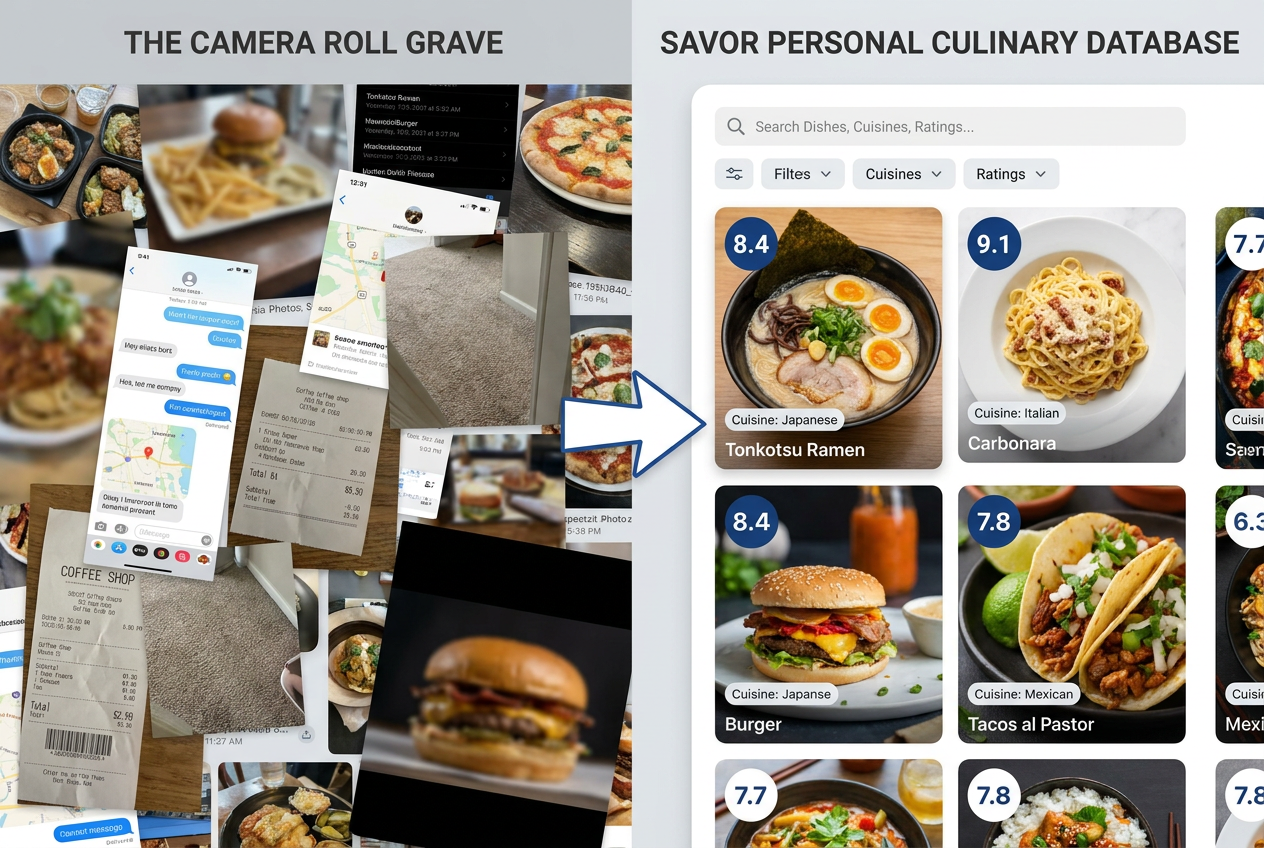 Transform your unsearchable 'camera roll graveyard' into a structured culinary database, allowing you to recall every specific dish and flavor profile with ease.
The Crisis of the Modern Foodie: Escaping the Camera Roll Graveyard
The modern foodie's biggest problem isn't access to great restaurants - it's remembering them. You document obsessively. You snap three angles of every plate. You even jot down a few thoughts in your Notes app while the flavors are still vivid. But six months later, when a friend asks "What was that ramen place in Tokyo with the perfect broth?" - you're digging through 8,000 photos, guessing at dates, and hoping the restaurant's name appears somewhere in the metadata.
This is the Camera Roll Graveyard effect. Savor's 2026 research found that the average user takes over 2,000 food photos per year, yet fewer than 3% of those images are tagged, annotated, or connected to structured data like location, dish name, or rating. Instagram Stories vanish after 24 hours. Text messages with recommendations get buried. Google Photos groups everything by date and location, but never by the dish itself - so that life-changing carbonara becomes "IMG_4729.jpg," indistinguishable from the mediocre one you had two weeks earlier.
The cost isn't just inconvenience. It's lost expertise. Every meal you document is a data point in your personal taste evolution - proof of what worked, what didn't, and why. Without structure, that knowledge dies the moment you forget where you wrote it down. The Savor application was built to solve exactly this: turning photos into searchable, filterable, shareable memory that lasts as long as you do.
What Is the Savor Application?
The Savor application is a dish-level food tracking system designed to archive every meal you eat with the precision of a professional critic and the ease of snapping a photo. It's not a restaurant discovery tool. It's not a social network. It's a personal culinary database that treats individual dishes - not venues - as the primary unit of memory.
Here's how it works: you photograph a dish, rate it on Savor's 10-point scale (with 0.1 increments), and add optional notes about texture, flavor balance, or preparation technique. The app's AI dish recognition automatically tags ingredients and cuisine type, so you never have to manually categorize a meal again. Every entry is geotagged and timestamped, creating a chronological foodprint you can filter by location, cuisine, rating, or even specific ingredients like "burrata" or "miso."
Unlike Yelp (which aggregates venue-level opinions from strangers) or Beli (which focuses on public ranking and social competition), Savor is privacy-first by design. Your ratings are private by default. Sharing is selective - you create custom lists for specific friends or occasions, not a feed for public consumption. The underlying philosophy is that food memory is personal. A dish that earned an 8.7 from you might be a 6.3 for someone else. The goal isn't consensus. It's accurate recall.
Savor is currently available only on iOS, requiring iOS 15.1 or later, per the App Store listing updated in 2026. No Android version has been announced. The app operates on a freemium model, with core features like dish logging and ratings available for free, and premium features like advanced filtering and export tools requiring a subscription.
The Three Pillars of Savor 2.0
Savor 2.0, released in Q1 2026, introduced three structural upgrades that transformed the app from a simple logging tool into a full-fledged taste intelligence platform. These features don't just help you remember meals - they help you understand your palate.
Precision Logging: Why a 10-Point Scale Beats a 5-Star Average
Savor's most distinctive feature is its 10-point precision rating scale, which allows for 0.1 increments - meaning you can rate a dish as an 8.2, 8.3, or 8.4, depending on nuance. This level of granularity is critical for serious food documentation. A 5-star system offers only five possible ratings, forcing you to round a "very good but not great" meal up to 4 stars or down to 3, losing all distinction in the middle. A 10-point scale with 0.1 precision offers 100 possible ratings, capturing the difference between "excellent" and "exceptional" without ambiguity.
Why does this matter? Because memory degrades over time, but data doesn't. Three months after a meal, you won't remember whether it was "pretty good" or "really good" - but you will have written down an 8.2 or an 8.6. That extra decimal place preserves the emotional accuracy of the moment. It's the difference between a vague recollection and a reliable benchmark.
The 10-point scale also aligns with professional restaurant criticism. The New York Times, Michelin inspectors, and Eater critics all use systems that distinguish subtle quality gradations. Generic review apps flatten that nuance into star clusters where everything above 4.0 is "good" and everything below 3.5 is "bad." Savor's system acknowledges what foodies already know: the gap between an 8.5 and a 9.1 is the gap between memorable and unforgettable.
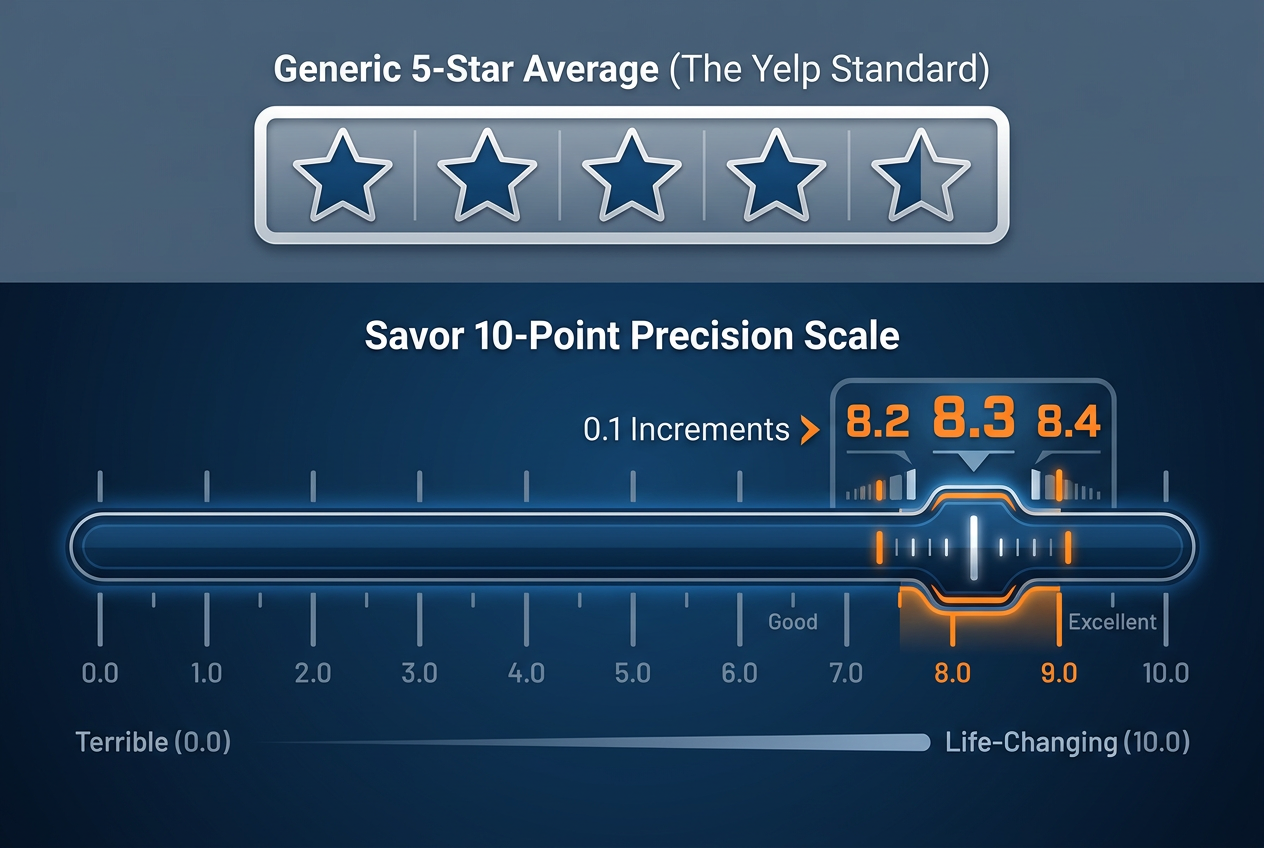 Savor's 10-point scale provides the precision serious critics need, distinguishing a great 8.2 meal from a truly exceptional 8.3 experience.
AI Dish Recognition: How the App Automatically Tags Your Ingredients
Manual tagging is where most food journals fail. You photograph a meal, intend to label it later, and never do. Savor's AI dish recognition solves this by analyzing uploaded photos and automatically identifying ingredients, cuisine type, and preparation method. Upload a photo of a bowl of ramen, and the app tags it as "Japanese," "noodles," "pork broth," "soft-boiled egg," and "scallions" without you typing a word.
This automation isn't just convenient - it's structural. Over time, those tags become searchable filters. You can pull up every dish you've rated above 8.5 that contains "truffle" or "aged beef." You can see which cuisines you favor and which ones you underexplore. You can identify patterns: maybe you consistently rate Italian pasta dishes higher than French ones, or maybe every meal with "smoked paprika" ends up above 9.0. That's Taste DNA in action - but it only works if the data is tagged correctly from the start.
Savor's AI is trained on a food-specific dataset, meaning it recognizes culinary nuance that general-purpose image recognition systems miss. It distinguishes between "grilled" and "seared." It knows the difference between "feta" and "goat cheese." It tags regional variations - "Neapolitan pizza" versus "New York-style" - without requiring you to specify. The result is a database that becomes more useful the more you use it, because every entry adds searchable metadata to your culinary history.
Taste DNA: Using Your Own Data to Map Your Culinary Evolution
Taste DNA is Savor 2.0's most ambitious feature: a visual profile of your culinary preferences built entirely from your own ratings. The system analyzes which ingredients, flavor profiles, and preparation techniques consistently earn high scores from you, then maps them into a personalized taste graph. You might discover you have a strong bias toward umami-forward dishes, or that you consistently underrate anything with raw tomatoes, or that your highest-rated meals all involve some form of fermentation.
This isn't guesswork - it's pattern recognition applied to your own data. The app tracks hundreds of variables per dish: sweetness, acidity, spice level, texture, protein type, cooking method, even ambient factors like "outdoor seating" or "communal table." Over time, it identifies which combinations produce your highest ratings and which combinations produce your lowest. The result is a profile that's far more accurate than any quiz or preference survey, because it's derived from real meals you've actually eaten and rated.
The practical value is twofold. First, it helps you understand your own palate. You might think you love "spicy food," but Taste DNA reveals you only love spicy food when it's balanced with acidity and fat - otherwise, you rate it below 7.0. Second, it improves recommendations. When a friend asks "What should I order here?" - you can filter by dishes that match your Taste DNA profile, not just your highest-rated meals overall. It's the difference between "I liked this" and "This is aligned with the patterns of everything I've ever loved."
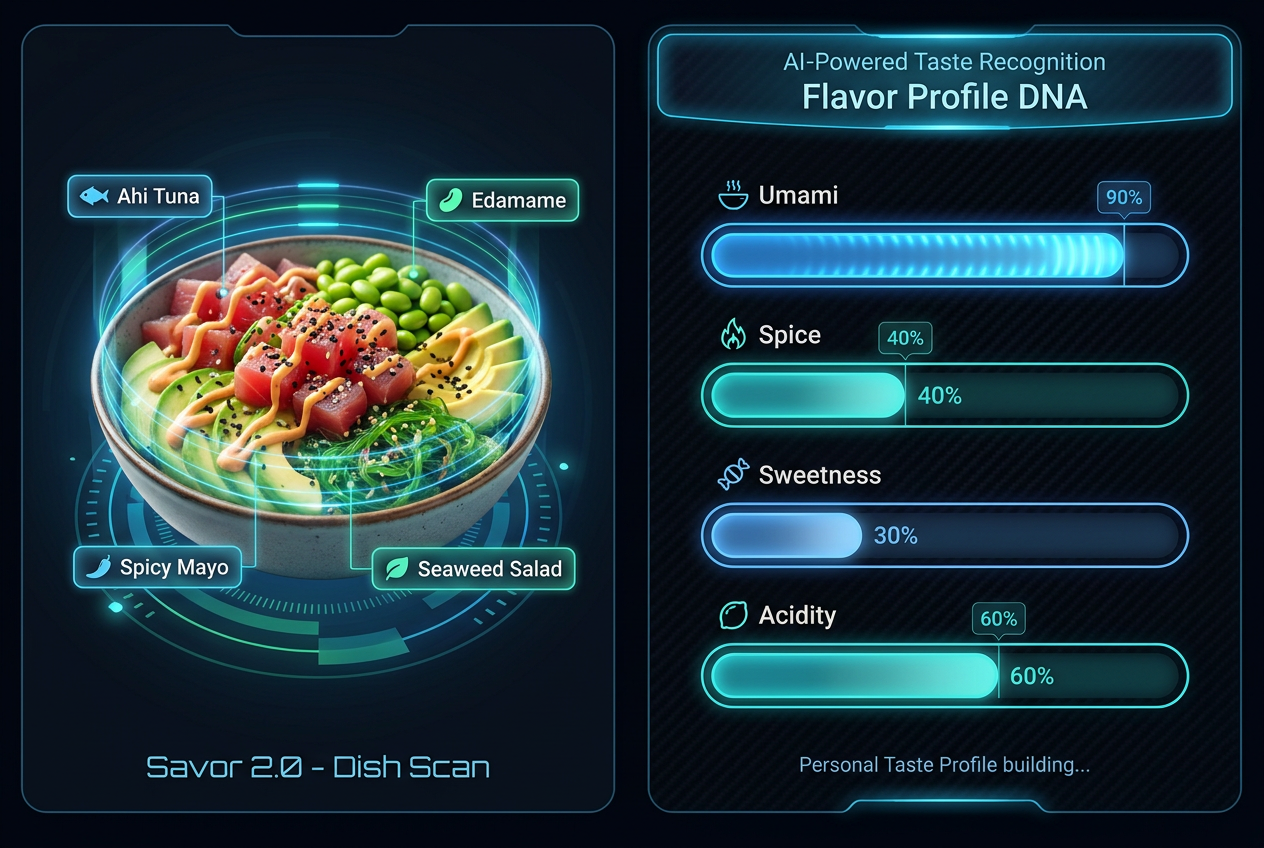 Leverage AI to automatically tag ingredients and build your 'Taste DNA,' a visual map of your evolving culinary preferences and flavor biases.
Savor vs. Beli vs. Yelp: Which One Matches Your Obsession?
Not all food apps serve the same user. Choosing the right one depends on whether you prioritize personal archival, social validation, or crowd-sourced discovery. Here's how the three major platforms compare when you strip away marketing and focus on structural design.
| Feature | Savor | Beli | Yelp |
|---|---|---|---|
| Primary Unit | Individual dish | Restaurant (with dish notes) | Restaurant venue |
| Rating System | 10-point scale with 0.1 increments | 5-point scale with public ELO ranking | 5-star venue average |
| Privacy Default | Private by default; selective sharing via lists | Public by default; profile-based social feed | Public reviews; optional anonymous posting |
| Search/Filter | Dish-level: by ingredient, cuisine, rating, date | Restaurant-level: by location, rating, friend activity | Venue-level: by category, price, neighborhood |
| AI Features | Automatic dish tagging, Taste DNA profile | None (manual entry only) | Venue categorization, photo recognition for menus |
| Core Goal | Personal culinary database and memory retention | Social discovery and competitive ranking | Crowd-sourced venue reviews and operational info |
| Best For | The Archivist - users who want dish-level precision and long-term recall | The Socialite - users who want validation and friend-based discovery | The Casual Diner - users who need hours, prices, and general consensus |
Savor is for users who treat meals as personal legacy data. If you're the type of person who keeps a spreadsheet of wine vintages or a notebook of coffee roasters, Savor is your tool. The 10-point scale, AI tagging, and Taste DNA features are built for depth, not breadth. You're not trying to review every restaurant in your city - you're trying to remember every dish that mattered.
Beli is for users who want social reinforcement. Beli reported over 70 million restaurant ratings globally as of late 2025, surpassing Yelp in worldwide rating volume, according to Eliot Frost, CTO of Beli. The app uses an ELO ranking system borrowed from chess, where your ratings affect a restaurant's competitive score. Your profile is public. Your friends see what you ate. The goal is discovery through network effects: if five people you trust loved a place, you'll try it. Beli is less about archiving your own history and more about building a shared map of "good" and "bad" within your social circle.
Yelp is for users who need operational data - hours, parking, reservation policies - and crowd-sourced consensus. With over 3.6 million restaurant reviews in the San Francisco Bay Area alone (per SF Chronicle and Patch, 2025), Yelp excels at answering "Is this place open?" and "Is it worth the drive?" But Yelp's venue-first structure means you're always rating the restaurant, not the dish. If you had one incredible entrée and two mediocre sides, your 4-star review tells future diners nothing about which item earned the stars.
The decision comes down to your relationship with food. If you're a Critic - someone who wants precision, control, and private recall - Savor is the match. If you're a Socialite - someone who wants validation, competition, and public discovery - Beli fits better. If you're a Casual Diner - someone who just needs to know if a place is good and open - Yelp still works. But once you cross the threshold from "I ate a thing" to "I need to remember this thing in detail five years from now," the tool has to change. That's why Savor exists.
 Choose the tool that fits your dining style: Savor prioritizes private, dish-level archiving for those who view their meals as a personal legacy.
Privacy First: Why a Private Journal Is More Honest Than Instagram
Public food content is performative by design. When you know your rating will appear on a feed, you adjust it - consciously or not - to align with what your audience expects. You bump up the score for a trendy spot because everyone else loved it. You hedge your language when critiquing a friend's recommendation. You optimize for engagement, not accuracy. Savor's privacy-first architecture removes that pressure.
By default, every rating you log in Savor is private. No one sees it unless you explicitly create a shareable list and send them the link. This design choice is structural, not cosmetic. Private logging produces more honest data. You're free to rate a hyped restaurant a 6.8 without backlash. You can track home-cooked experiments that failed. You can record the exact reason a dish disappointed you - "too salty," "overcooked protein," "aggressive plating covered up mediocre flavor" - without worrying about offending anyone.
This honesty extends to Taste DNA accuracy. If your ratings are distorted by social pressure, your taste profile becomes distorted too. The algorithm thinks you love spicy food because you rated every trendy Sichuan spot highly, but in reality, you were just going along with the crowd. Private logging means the data reflects your actual preferences, not the ones you perform for an audience. Over time, that accuracy compounds. A Taste DNA profile built on 500 honest ratings is far more useful than one built on 5,000 ratings optimized for likes.
Savor does allow selective sharing through custom lists - "Best Pasta in Rome," "Dishes to Try in Tokyo," "My Top 10 of 2025" - but those lists are opt-in, not automatic. You choose what to share, when to share it, and with whom. This preserves the utility of social recommendations (your friends still benefit from your expertise) without sacrificing the honesty that makes personal food logs valuable in the first place. It's the difference between a public Instagram feed (where every post is a mini-advertisement for your taste) and a private journal that happens to have an export button.
Getting Started: How to Migrate Your Culinary Legacy
Starting a new food journal feels like starting over. You've got years of history scattered across platforms - Yelp reviews, Google Maps lists, Instagram posts, Notes app entries - and the thought of consolidating it all is exhausting. The good news: you don't have to migrate everything at once. The strategy is selective archival, not bulk import.
Step 1: Identify Your Top 50 Dishes
Don't start by logging every meal you've ever had. Start with the 50 dishes that earned a place in your long-term memory. These are the meals you still think about - the ones you describe to friends, the ones you'd fly back to a city to eat again. Open your camera roll and scroll backward. When you see a photo that triggers a vivid memory, that's a candidate. Log it in Savor with as much detail as you can remember: dish name, restaurant, location, your rating, and a few notes about what made it special.
This process takes 2-3 hours, but it's the foundation of your database. Those 50 entries become your benchmarks. Every new meal you eat gets compared against them. A new pasta dish is "better than the cacio e pepe I had in Rome" or "not quite as good as the ramen from Tsuta." Over time, the database expands organically, but you've started with the signal, not the noise.
Step 2: Establish a Logging Rhythm
The hardest part of any tracking system is consistency. The trick is to log meals while you're still at the table, not later. Take the photo. Assign the rating. Add one sentence of notes. The whole process takes 90 seconds. If you wait until you get home, you'll forget the details. If you wait until the weekend to batch-log, you'll skip it entirely. The best time to capture a memory is the moment it happens.
For home cooking, the same rule applies. If you're experimenting with a new recipe or refining an old one, log it. Savor isn't just for restaurants. It's for anything you eat that's worth remembering - whether that's a Michelin-starred tasting menu or the version of chicken schnitzel you finally got right after six attempts. The goal is completeness, not perfection. A rough note is better than no note.
Step 3: Use Tags and Filters to Surface Patterns
After you've logged 100+ dishes, the real value of Savor emerges: pattern recognition. Use the filter function to pull up all dishes you've rated above 9.0. What do they have in common? Maybe they're all grilled. Maybe they all feature fermented ingredients. Maybe they're all eaten outdoors. Those patterns are your Taste DNA in raw form, before the algorithm formalizes it.
You can also filter by cuisine, location, or date to answer specific questions. "What were my favorite meals in Paris?" becomes a one-tap query, not a 20-minute scroll through photos. "Which Italian restaurants have I rated highest?" becomes a shareable list you can send to a friend who's planning a trip. The database is only as useful as your ability to query it, and Savor's filter system is built for exactly this kind of interrogation.
Step 4: Export and Back Up Your Data
Digital tools fail. Apps shut down. Platforms change hands. The most important rule of personal data archival is redundancy. Savor offers export functionality (for premium users), allowing you to download your entire database as a CSV file. Do this once a quarter. Store the file in multiple places - your computer, an external drive, cloud storage. This ensures that even if Savor disappears tomorrow, your culinary history survives.
This might seem paranoid, but it's not. How many restaurant bookmarking apps from 2015 still exist? How many review platforms have been acquired and shut down? Your food memory is too valuable to trust a single company with its long-term survival. Export early, export often, and treat your Savor data the same way you'd treat a family photo archive: something worth preserving.
Frequently Asked Questions
What is the Savor application for foodies and how does it work?
The Savor application is a dish-level food tracking system designed to help food lovers archive, rate, and recall individual meals with precision. Unlike restaurant review apps that focus on venue-level ratings, Savor treats each dish as a separate data point. You photograph a meal, rate it on a 10-point scale (with 0.1 increments), and add optional notes about flavor, texture, and preparation. The app's AI automatically tags ingredients and cuisine type, making every entry searchable. Over time, Savor builds a Taste DNA profile that maps your culinary preferences based on your actual ratings, not assumptions. It's privacy-first by design - your ratings are private by default, and sharing is selective through custom lists. The goal is to turn scattered food photos into a structured, searchable database you can rely on for years.
How does Savor differ from Beli and Yelp in 2026?
Savor focuses on dish-level archiving and private memory retention, while Beli prioritizes social discovery through public ELO rankings, and Yelp remains a venue-level review platform for crowd-sourced consensus. Savor's 10-point rating scale with 0.1 increments offers 100 possible ratings, compared to Beli and Yelp's 5-point systems. Savor's privacy-first design makes ratings private by default, whereas Beli and Yelp favor public sharing. Beli reported over 70 million ratings globally in 2025 but tracks restaurants, not individual dishes. Yelp excels at operational data (hours, parking) but lacks granular dish-level filtering. Savor is built for users who want long-term personal archival, Beli for social validation, and Yelp for quick crowd-sourced answers about whether a venue is worth visiting.
What are the key features of Savor 2.0 (Taste DNA, Explore Map)?
Savor 2.0, released in Q1 2026, introduced two major features: Taste DNA and Explore Map. Taste DNA analyzes your ratings to create a visual profile of your culinary preferences, identifying which ingredients, flavor profiles, and preparation techniques consistently earn high scores from you. It tracks hundreds of variables per dish - sweetness, acidity, spice, texture, protein type - and maps patterns over time. This helps you understand your palate beyond surface-level preferences. Explore Map is an interactive geographic interface that displays all your rated dishes on a map, filterable by location, cuisine, rating, or date. You can see every meal you've logged in Paris, filter for dishes above 8.5, or identify gaps in your culinary exploration. Together, these features transform Savor from a logging tool into a full-fledged taste intelligence platform.
Is the Savor app free or subscription-based?
Savor operates on a freemium model. Core features like dish logging, photo uploads, 10-point ratings, and basic search are available for free. Premium features - including advanced filtering, Taste DNA insights, Explore Map functionality, and data export - require a subscription. The app is designed so casual users can track meals without paying, but serious food archivists who want full analytical capabilities and backup options will benefit from upgrading. Pricing details are available in the App Store, as the subscription tiers may vary by region. The free tier is functional enough for everyday use, but the premium tier unlocks the pattern recognition and export tools that make Savor a long-term archival system rather than just a photo album.
How does AI dish recognition improve meal logging?
AI dish recognition eliminates the manual tagging burden that kills most food journals. When you upload a photo, Savor's AI analyzes it and automatically identifies ingredients, cuisine type, and preparation method without you typing a word. Upload a bowl of ramen, and it tags "Japanese," "noodles," "pork broth," "soft-boiled egg," and "scallions" instantly. This automation is critical because over time, those tags become searchable filters. You can query "all dishes with truffle" or "every Japanese meal I've rated above 9.0" in seconds. The AI is trained on a food-specific dataset, so it recognizes culinary nuance - distinguishing "grilled" from "seared," or "feta" from "goat cheese." The result is a database that becomes exponentially more useful the more you use it, because every entry adds structured metadata to your culinary history.
Can I use Savor to track home-cooked meals as well as restaurants?
Yes. Savor is designed to track any dish worth remembering, whether it's from a Michelin-starred restaurant or your own kitchen. Home cooking is where the app's precision rating system becomes especially useful - you can track recipe experiments over time, noting which adjustments improved a dish and which ones didn't. Rate your chicken schnitzel attempts across six iterations, and you'll have a clear record of when you finally nailed the breading technique. The AI dish recognition works on home-cooked food too, tagging ingredients and techniques so your personal experiments become searchable data. Over time, your Taste DNA profile will reflect both restaurant meals and home cooking, giving you a complete picture of your culinary preferences. The app doesn't distinguish between professional and amateur cooking - it only cares about the dish itself.
Is Savor available for Android users yet?
No. As of 2026, Savor remains iOS-exclusive, requiring iOS 15.1 or later, according to the App Store listing. No Android version has been announced. This is a common limitation for early-stage food apps, as iOS development cycles tend to be faster for smaller teams. Android users looking for similar functionality will need to explore alternatives like Beli (which is cross-platform) or generic food diary apps, though those lack Savor's dish-level precision and AI tagging. The iOS-only status is a significant barrier for anyone in the Android ecosystem, but the platform choice reflects Savor's current focus on depth over breadth - building a best-in-class tool for one platform before expanding.
How does Savor's 10-point precision rating system work?
Savor's 10-point scale allows for 0.1 increments, meaning you can assign ratings like 7.3, 8.6, or 9.2 - offering 100 possible values instead of the five options in a standard star system. This granularity captures subtle differences that 5-star systems flatten. An 8.2 dish is "very good," while an 8.7 is "exceptional" - and that distinction matters when you're comparing meals months or years later. The decimal precision preserves the emotional accuracy of the moment. Three months after eating a dish, you won't remember if it was "pretty good" or "really good," but you will have recorded an 8.2 or an 8.6. The scale aligns with professional restaurant criticism, where critics distinguish between "excellent" (8.5) and "near-perfect" (9.5) as meaningful categories. For serious food documentation, the 10-point scale isn't overkill - it's the minimum resolution needed to avoid losing signal.
The Savor application isn't trying to replace Yelp or compete with Beli's social features. It's solving a different problem: how do you remember the details of a meal long after the taste has faded? For food lovers who view their culinary experiences as personal history - not social currency - Savor's dish-level precision, AI-powered tagging, and privacy-first design offer a tool that finally matches the care they put into choosing what to eat. The global online food delivery market is projected to reach $1.4 trillion by 2025, according to Savor's 2025 research, yet most of us still rely on memory and unsorted photos to recall where that money went. Savor changes the equation. It turns every meal into data, every photo into a search result, and every year of eating into a searchable archive that gets more valuable the longer you use it. That's not a better review app. That's a fundamentally different relationship with food.
Continue Reading
Start Tracking Your Dishes Today
Transform your food photos into a searchable, ratable culinary memory bank.
Download Savor App