
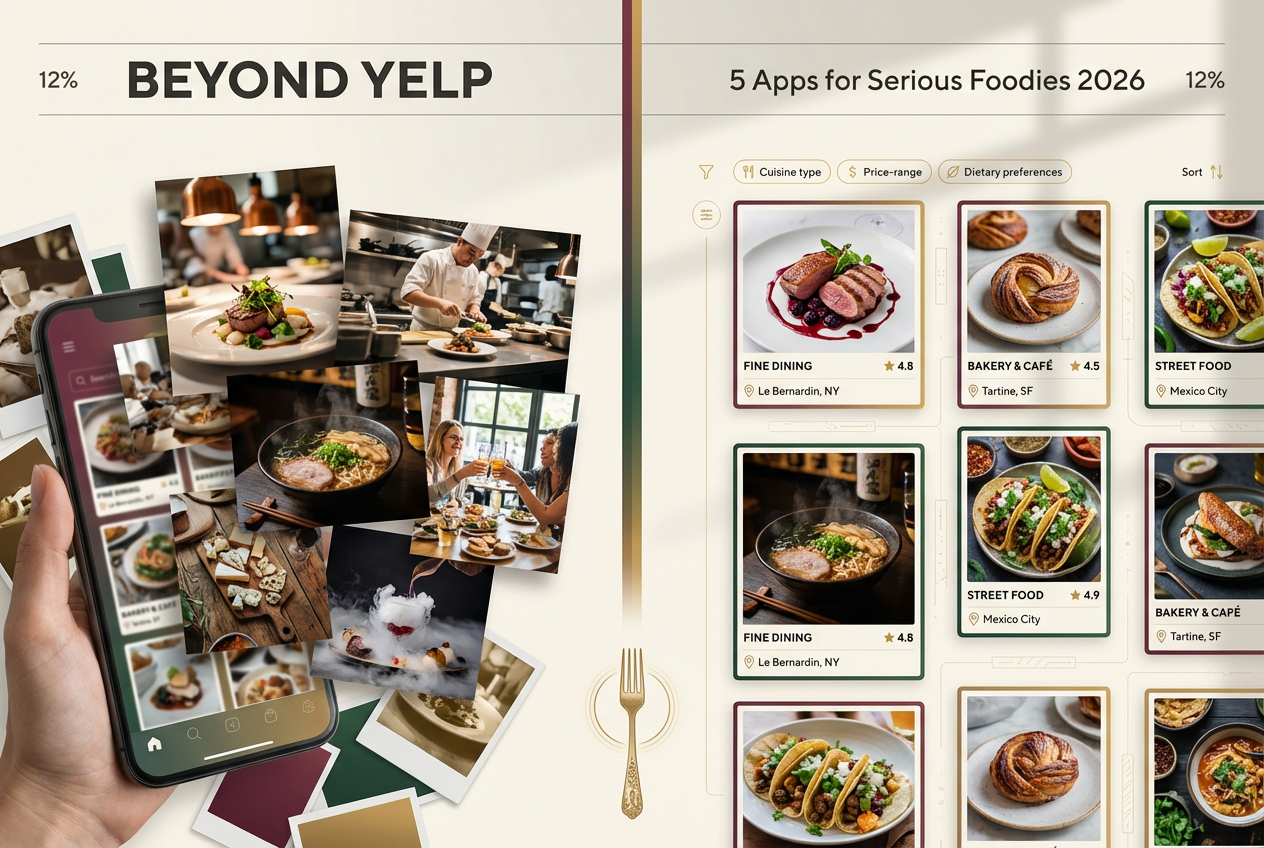
Best App for Restaurant and Business Reviews for Foodies
Alex the juice queen
Alex hunts for the best juice bars and presses. She rates every sip and saves her favorites in Savor.
Beyond Yelp: The 5 Best Apps for Serious Foodies to Track Every Meal in 2026 Your camera roll contains 847 photos of food. You remember the rigatoni was...
Beyond Yelp: The 5 Best Apps for Serious Foodies to Track Every Meal in 2026
Your camera roll contains 847 photos of food. You remember the rigatoni was perfect, but which restaurant? Was it Tribeca or the West Village? You text your dining partner, who's equally clueless. Meanwhile, that carefully composed photo of a $68 tasting menu course sits buried between screenshots and parking garage receipts.
This isn't forgetfulness. It's a structural failure of how we document the meals that matter.
In 2026, the restaurant review app landscape has fundamentally shifted. The era of crowdsourced noise - bot reviews, inflated ratings, and algorithmic manipulation - has given way to something more personal and precise. Today's serious foodie doesn't need another platform telling them where strangers ate. They need a digital taste profile, a searchable culinary archive that captures not just where they dined, but what they tasted, who they were with, and why it mattered.
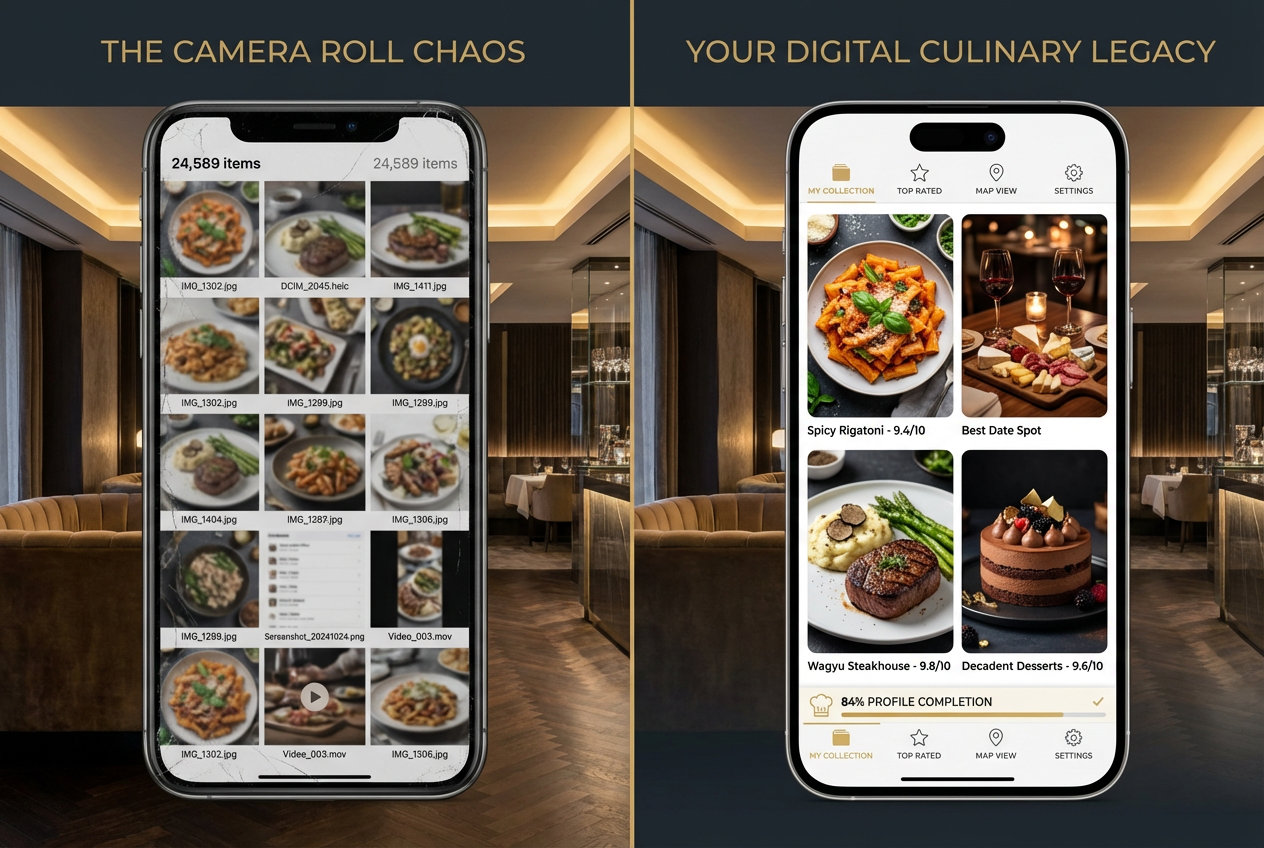 Transforming your unorganized food photos into a curated digital profile is the first step toward building a lasting culinary legacy in 2026.
This guide cuts through the app store clutter to reveal which platforms actually serve the urban diner who eats out four nights a week, values quality over quantity, and wants to find that one specific dish in three seconds while standing on a street corner.
Table of Contents
- Why Traditional Review Platforms Failed the Modern Diner
- The Three Foodie Personas: Which One Are You?
- The Complete 2026 Foodie Tech Stack Breakdown
- Feature Matrix: What Actually Matters
- The Camera Roll Migration Strategy
- How to Choose Your Primary Platform
- FAQ: Restaurant Review Apps for Serious Foodies
Why Traditional Review Platforms Failed the Modern Diner
BLUF: Generic review platforms like Yelp prioritize volume over accuracy, creating noise that obscures genuine dining intelligence and fails to capture personal context.
The 4.3-star average tells you nothing. It's an aggregate of the couple who complained about parking, the food blogger chasing affiliate revenue, the bot account posting identical reviews across 47 locations, and someone who legitimately enjoyed their meal but can't articulate why.
This system worked when information scarcity was the problem. In 2007, knowing a restaurant existed and had indoor seating constituted useful data. By 2026, existence is assumed. The real question is whether this specific dish aligns with your specific palate, dietary requirements, and occasion.
Traditional platforms also suffer from the archival problem. You can leave a review, but can you find it six months later when trying to remember the name of that Sichuan place with the exceptional dry-fried green beans? The search functionality treats your personal dining history as an afterthought, buried under algorithmic suggestions optimized for ad revenue rather than memory retrieval.
The "review fatigue" phenomenon has transformed how educated diners approach food discovery. A recent survey of urban professionals who dine out frequently showed 73% no longer trust aggregate ratings and instead rely on curated recommendations from identifiable experts or trusted friends. This isn't elitism; it's signal optimization in an environment of overwhelming noise.
The shift mirrors what happened in film criticism when Letterboxd emerged. People stopped asking "Is this movie good?" and started asking "Which people whose taste I trust think this movie is good?" Food has reached the same inflection point.
The Three Foodie Personas: Which One Are You?
BLUF: Your ideal review app depends on whether you prioritize social discovery, expert curation, or private documentation. Understanding your primary use case prevents app-hopping frustration.
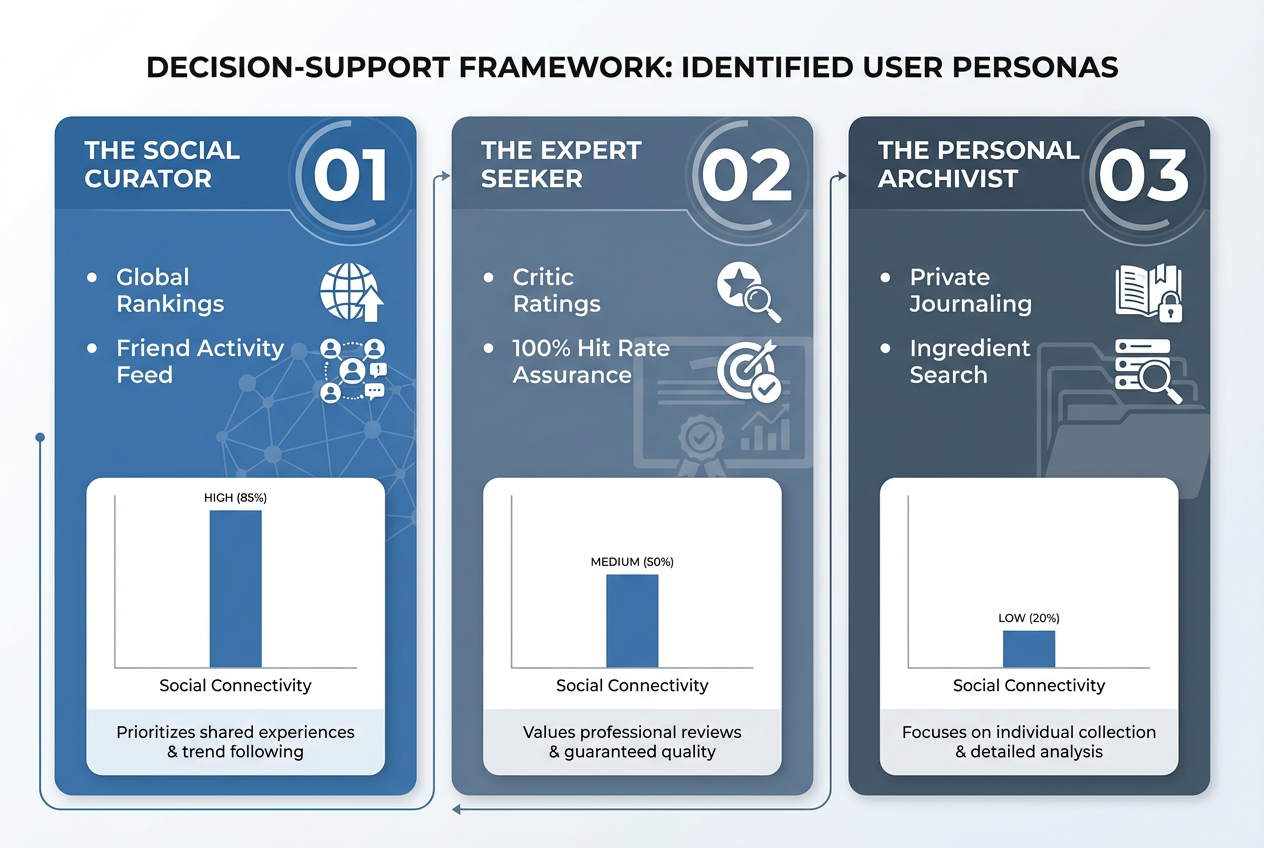 Identify your dining personality to determine which modern review platform - Beli, World of Mouth, or Savor - best aligns with your specific tracking needs.
The Social Curator
You maintain multiple ranked lists: "Downtown Lunch Rotation," "Impress the In-Laws," "Late Night When Nothing Else Is Open." Friends text you for recommendations, and you derive genuine satisfaction from introducing people to places before they appear on "Best Of" roundups.
Your dining decisions are often collaborative. You want to see what venues you and a specific friend both loved, creating instant common ground for the next meetup. The gamification element appeals to you - not in a competitive way, but as a framework for organizing your experiences into shareable narratives.
You don't need privacy. In fact, you want your meticulously curated taste on display, functioning as both personal archive and social signal.
The Expert Seeker
You're tired of doing the research. You've wasted too many Friday nights on hyped restaurants that turned out to be mediocre spaces with good lighting and aggressive PR. You want a 100% hit rate, even if that means a smaller pool of options.
You value credentials. You want to know that the person recommending this omakase counter has eaten at Sukiyabashi Jiro and can articulate the difference. You'd rather have five chef-vetted recommendations than 5,000 amateur opinions.
Your perfect platform feels like having a friend who's a James Beard Award winner on speed dial, minus the awkwardness of actually asking them where to eat every week.
The Personal Archivist
Your relationship with food is intimate and private. You don't particularly care where strangers eat, and you're not trying to build a public-facing taste profile. You want a searchable database of dishes - not just restaurants - that allows you to find "that miso cod situation from two years ago" in under 10 seconds.
You're frustrated by the ephemeral nature of food photos in your camera roll. These images represent significant experiences, often tied to specific people, occasions, and moods, but they exist in an undifferentiated mass that makes retrieval essentially random.
You want the restaurant equivalent of a personal journal: private, detailed, and optimized for your future self trying to reconstruct a specific memory or recommendation.
For those interested in exploring additional options, our comprehensive guide to the best restaurant review apps provides deeper analysis of emerging platforms and niche tools.
The Complete 2026 Foodie Tech Stack Breakdown
BLUF: Five platforms dominate the serious foodie landscape in 2026, each serving a distinct use case: Beli for social ranking, World of Mouth for expert curation, Savor for private archiving, The Infatuation for situational discovery, and Google Maps as utilitarian backup.
Beli: The Letterboxd Effect for Food
Beli succeeded by recognizing that restaurant documentation is as much about self-expression as information storage. The interface encourages list-making as a creative act: "Restaurants That Made Me Cry," "Worth the Subway Ride to Outer Brooklyn," "Dishes I Dream About."
The social mechanics are sophisticated without feeling performative. You can see mutual restaurants with specific friends, making dinner planning genuinely collaborative rather than a back-and-forth text negotiation. The scoring system (out of 10) provides more nuance than star ratings without requiring paragraph-length justifications.
The platform's viral growth came from its shareability. A well-curated Beli profile functions as both personal archive and public portfolio, appealing to the significant overlap between serious dining and aesthetic documentation.
Primary Weakness: The social feed can become overwhelming. If you follow 200 people, you'll see 200 opinions on the same hyped opening, creating the very noise problem these platforms were designed to solve. Curation requires discipline.
Best For: Diners age 25-40 who view restaurant choices as an extension of personal identity and enjoy the list-making process as much as the dining itself.
World of Mouth: The 100% Hit Rate Promise
World of Mouth approaches the problem from the opposite direction: radical curation over democratic input. The platform features recommendations exclusively from 800+ chefs, food writers, and verified industry insiders across global markets.
This creates an unusual dynamic. You're not reading reviews; you're accessing the private rolodexes of people who eat professionally. When Dominique Crenn marks a neighborhood Italian spot as essential, it carries weight that 1,000 amateur reviews cannot match.
The platform explicitly promises a "100% hit rate" - a bold claim that reflects their fundamental bet. They believe five expert recommendations are more valuable than 5,000 unfiltered opinions, and their user retention data suggests they're correct.
Primary Weakness: Coverage is limited to major food cities (New York, Los Angeles, London, Tokyo, Paris, Singapore). If you're dining in Nashville or Portland, the platform offers less utility. The expert-only model also means slower updates compared to crowdsourced platforms.
Best For: Urban diners in major metros who prioritize quality over discovery serendipity and view dining decisions as worth outsourcing to credentialed experts. For detailed analysis of rating methodologies, see our restaurant rating app guide.
Savor: The Dish-Centric Private Archive
Savor recognized that memory retrieval is fundamentally different from initial discovery. When you're trying to remember that restaurant, you don't remember the name. You remember "incredible uni pasta" or "the duck situation with the cherry thing."
The platform is built around dishes, not venues. AI-powered image recognition automatically tags ingredients, preparations, and dish types, creating a searchable database organized by what you actually remember. You can search "spicy lamb noodles" and see every example you've photographed, chronologically ordered with notes, dates, and companions.
This approach also solves the privacy problem. Many serious diners don't want their dining history public but still need better organization than their camera roll provides. Savor defaults to private while offering selective sharing options.
The AI implementation is notably sophisticated. Point your camera at a plate, and the system identifies not just "pasta" but specific shape (rigatoni, bucatini, pappardelle) and likely sauce composition. Over time, it builds a palate profile, surfacing patterns in your preferences you might not consciously recognize.
Primary Weakness: The platform is iOS-only and mobile-first, with no web interface for desktop review. The privacy focus also means you're not getting social discovery features, which some users miss.
Best For: Private documentarians who prioritize personal memory over social sharing and want dish-level granularity. If you've ever thought "I need a better system than scrolling through 2,000 photos," this is your answer. Our food diary app features guide explores how context tracking improves meal logging.
The Infatuation: Situational Intelligence Over General Discovery
The Infatuation operates as editorial content first, app second. Their strength is situational recommendations: "Seal the Deal Dinners," "Where to Take Your Parents," "First Date That Needs to Work." This approach acknowledges that context determines success more than absolute quality.
A restaurant can be simultaneously perfect for a casual Tuesday night and completely wrong for an anniversary. The Infatuation's guides are built around these scenarios, providing answers to "Where should I..." questions rather than abstract "What's good?" queries.
The recent app relaunch integrates this editorial approach with personal tracking features, allowing you to save favorites and track your own dining history within their curated framework.
Primary Weakness: Coverage is limited to major metros, and the editorial voice is distinctive to the point of polarizing. Some users love the casual, opinionated tone; others find it grating. The platform also updates relatively slowly compared to real-time user-generated alternatives.
Best For: Diners who want expert curation but need help matching restaurants to specific occasions rather than building a comprehensive personal archive.
Google Maps: The Utilitarian Fallback
Google Maps remains in every foodie's tech stack because it solves logistical problems no niche app can match: integrated navigation, real-time busy-ness data, operating hours that are usually current, and phone numbers that actually work.
The saved lists feature, while clunky, provides basic bookmarking functionality. The "want to go" designation creates a rudimentary queue for places on your radar but not yet visited.
Primary Weakness: Everything else. The review system is polluted, the personal archive features are minimal, and the interface treats food discovery as an afterthought to broader mapping functions. You'll use Google Maps, but you shouldn't rely on it as your primary dining intelligence platform.
Best For: Logistics, hours, directions, and maintaining a basic "places to try" list when you haven't yet committed to a specialized platform.
Feature Matrix: What Actually Matters
BLUF: Choose apps based on privacy level, primary use case (discovery vs. archiving), and whether you need dish-level vs. venue-level organization. Social features and AI integration are differentiators in 2026.
| Feature | Beli | World of Mouth | Savor | Google Maps | The Infatuation |
|---|---|---|---|---|---|
| Primary Hook | Social ranking | Expert curation | Private archive | Utilitarian maps | Situational guides |
| Privacy Level | Public default | Mixed | Private default | Public optional | Editorial only |
| Granularity | Venue + dishes | Venue focus | Dish-centric | Venue only | Venue + context |
| AI Integration | Basic tagging | None | Advanced dish recognition | Search only | None |
| Social Features | Strong | None | Minimal | Weak | None |
| Best For | Building public taste profile | Finding vetted recommendations | Remembering specific dishes | Logistics | Matching occasion to venue |
| Coverage | User-dependent | Major metros only | Global | Universal | Major metros only |
| Learning Curve | Medium | Low | Medium | None | Low |
The 2026 differentiation factor is AI integration at the dish level. Savor's computer vision capabilities represent where the category is heading: automatic ingredient identification, preparation method recognition, and palate pattern analysis that surfaces your preferences before you consciously recognize them.
This matters because memory is associative. You remember "that crispy fish with the herb situation" far more reliably than restaurant names or neighborhoods. Apps that organize around dish characteristics rather than venue names align with how human food memory actually works.
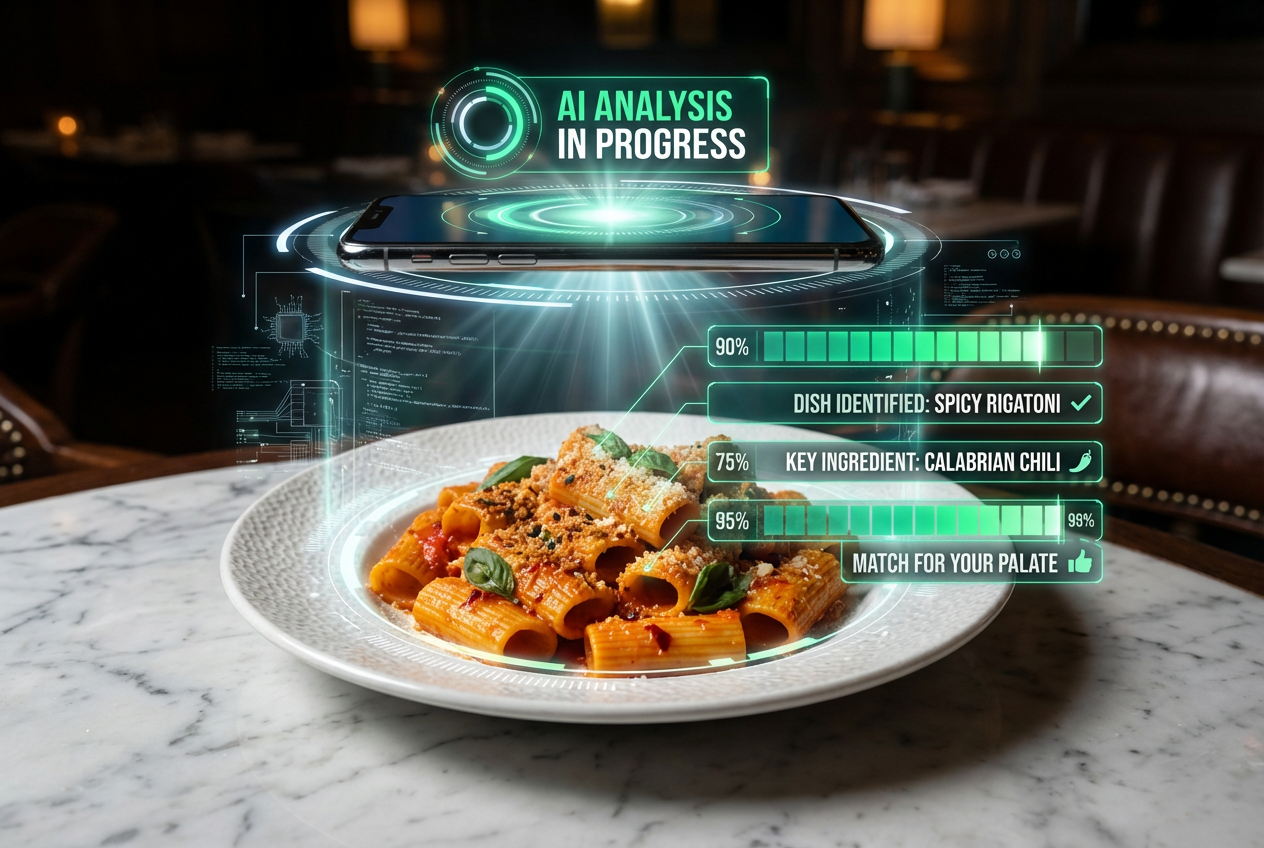 Modern foodie apps in 2026 utilize AI dish recognition to provide granular ingredient data and personalized palate matching for every meal.
Social ranking features in apps like Beli create accountability and structure. The 10-point scoring system forces you to articulate gradations in quality that star ratings compress into uselessness. The difference between a 6.5 and 7.5 is meaningful in ways that "three vs. four stars" simply isn't.
Expert curation in World of Mouth addresses review fatigue but creates dependency. You're outsourcing discovery to credentialed tastemakers, which works beautifully until you want something outside their coverage area or preference range. The platform's strength is also its limitation.
For tracking and comparison methodologies, our analysis of best food review apps explores how different platforms approach meal documentation.
The Camera Roll Migration Strategy
BLUF: Migrating existing food photos requires systematic tagging by date and location, then batch importing while adding critical context. Dedicate two hours for best results.
Your camera roll contains valuable data trapped in an unsearchable format. Migration isn't about moving every photo but rather establishing a proper archive for the meals that warrant documentation.
Phase One: Audit and Triage (30 minutes)
Scroll through your camera roll and identify the meals you actually want to remember. Not every burrito requires permanent archival status. Look for dishes that were exceptional, represented significant occasions, or introduced you to techniques or ingredients you want to track.
Create a temporary album called "Food Archive" and move selected photos there. This consolidation makes the next phase manageable. Expect to identify 50-200 photos depending on your dining frequency and photographic habits.
Phase Two: Context Reconstruction (45 minutes)
For each photo in your archive album, reconstruct the critical metadata while it's still accessible. Open the photo, check the date and location data, and immediately cross-reference your calendar for that date. Who were you with? What was the occasion? Why did you go there?
If you're choosing Savor or Beli, both apps allow photo imports with manual tagging. The key is adding this context during migration rather than treating it as a later enhancement project you'll never complete.
Text searching becomes powerful only when you've added searchable terms. Tag the photo with dish name, restaurant name, neighborhood, companion names, and preparation descriptors. "Uni pasta" is better than just "pasta," and "uni pasta Superiority Burger spinoff situation" is better still.
Phase Three: Platform Selection and Import (45 minutes)
Choose your primary platform based on your dominant use case (social, expert-guided, or private). Open the app, find the import function, and start the batch upload process.
Most platforms allow photo imports with accompanying notes. Use this opportunity to add the context you reconstructed in Phase Two. The time investment here prevents future frustration when you're trying to remember where that photo was taken.
For Savor users, the AI will handle initial ingredient tagging automatically, but you should verify and enhance its suggestions. The system gets smarter with correction and learns your terminology preferences over time.
Ongoing Maintenance
The real shift is photographic workflow going forward. Instead of photographing meals and leaving them to accumulate, process them within 24 hours. Open your chosen app immediately after dining, import the photos, add notes while the experience is fresh, and tag relevant details.
This discipline transforms your archive from a photo dump into a functional database. The goal is making your future self's life easier when they're standing on a street corner trying to remember the name of that place.
How to Choose Your Primary Platform
BLUF: Pick one primary app based on your dominant need, then use Google Maps as logistics backup. Multi-app strategies create data fragmentation and reduce the network effects that make these platforms valuable.
The temptation is to use everything: Beli for social features, Savor for private documentation, World of Mouth for expert recommendations, and Google Maps for logistics. This strategy fails because it fragments your data across platforms and creates decision paralysis about where to log each meal.
Instead, identify your primary use case and commit. If social discovery is your dominant need, go all-in on Beli and accept the tradeoff of reduced privacy. If you value expert curation, World of Mouth should be your first stop for unfamiliar neighborhoods, even if you supplement with other tools.
The network effects matter. Beli becomes more valuable as more of your friends join and populate it with their dining history. Your ability to find mutual favorites depends on comprehensive data, not selective logging of meals you remember to enter.
Decision Framework
Ask yourself: "What problem am I actually solving?" If you're trying to remember where you ate, you need Savor's dish-centric archive and AI recognition. If you're trying to impress someone with your taste, you need Beli's social signaling features. If you're trying to avoid bad restaurants, you need World of Mouth's expert curation.
Most users will end up with a two-app stack: one primary platform for tracking and discovery, plus Google Maps for logistics. This combination provides comprehensive coverage without creating data fragmentation.
The Commitment Period
Give your chosen platform 30 days of consistent use before evaluating alternatives. Log every significant meal, explore the interface thoroughly, and develop the muscle memory that makes tracking automatic rather than intentional.
These platforms get dramatically more useful once you've accumulated baseline data. An empty Beli profile doesn't tell you much; a profile with 100 logged meals reveals patterns in your preferences and creates genuine utility for friends asking for recommendations.
For platform-specific strategies in different markets, see our guide to best dining apps for foodies, which covers regional differences in app utility.
Testing Multiple Platforms
If you genuinely can't decide between two options, run a parallel test. Log every meal in both apps for two weeks, then evaluate which interface you actually opened more frequently and which archive you found more useful when trying to make recommendations or retrieve memories.
This empirical approach eliminates theoretical debates about features and reveals which platform aligns with your actual behavior rather than your aspirational behavior.
FAQ: Restaurant Review Apps for Serious Foodies
What makes 2026 restaurant apps different from Yelp?
Modern platforms prioritize personal curation over crowdsourced aggregation. Instead of averaging thousands of random opinions into a meaningless score, apps like Beli focus on your network's taste, World of Mouth surfaces expert recommendations, and Savor builds a private archive of your specific dining history. The fundamental shift is from "what did strangers think?" to "what did people whose taste I trust think?" This approach reduces noise and increases signal quality, particularly for urban diners tired of wading through bot reviews and inflated ratings.
Can I use multiple restaurant review apps simultaneously?
You can, but you shouldn't. Multi-app strategies fragment your data and reduce network effects that make these platforms valuable. Your dining history becomes less useful when it's split across three different systems with no ability to cross-reference. Pick one primary platform based on your dominant use case (social discovery, expert curation, or private archiving), then use Google Maps strictly for logistics like directions and hours. Give your chosen platform 30 days of consistent use to accumulate enough data for meaningful utility before considering alternatives.
Which app is best for remembering specific dishes rather than restaurants?
Savor is purpose-built for dish-level organization. Its AI-powered image recognition automatically identifies ingredients, preparation methods, and dish types, creating a searchable database organized by what you actually remember rather than venue names. You can search "spicy lamb noodles" and see every example you've photographed, chronologically ordered with your notes. This approach aligns with how human food memory works - you remember flavor profiles and visual characteristics far more reliably than restaurant names or neighborhoods. The platform defaults to private, making it ideal for personal archiving without social performance pressure.
How do I migrate years of food photos into these apps?
Start with a two-hour migration process in three phases. First, audit your camera roll and move memorable meals into a dedicated album (30 minutes). Second, reconstruct context for each photo - date, location, companions, occasion - while cross-referencing your calendar (45 minutes). Third, batch import photos into your chosen platform while adding descriptive tags and notes (45 minutes). Focus on meals worth remembering rather than achieving 100% coverage. The key is adding searchable context during migration, not later. Going forward, process new photos within 24 hours of dining to maintain a functional archive rather than a photo dump.
Are expert-curated apps like World of Mouth worth the limited coverage?
Yes, if you primarily dine in major metros and value quality over quantity. World of Mouth's 100% hit rate promise reflects their fundamental thesis: five chef-vetted recommendations are more valuable than 5,000 unfiltered opinions. Users in New York, Los Angeles, London, Tokyo, Paris, and Singapore get access to the private rolodexes of 800+ industry insiders, effectively outsourcing discovery to credentialed experts. The tradeoff is slower updates compared to crowdsourced platforms and zero utility outside major food cities. If you're dining in Portland, Nashville, or similar second-tier markets, Beli's user-generated content provides better coverage.
What's the best app for finding restaurants in specific situations?
The Infatuation specializes in situational intelligence - matching venues to occasions rather than providing abstract quality ratings. Their guides answer "Where should I take my parents?" or "What's good for sealing a business deal?" rather than general "What's good?" queries. This approach acknowledges that context determines success more than absolute quality. A restaurant can be perfect for Tuesday lunch and completely wrong for an anniversary. The platform works best as a supplement to your primary tracking app, used specifically when you need occasion-based recommendations in cities where they have editorial coverage.
How do social features in apps like Beli actually improve dining decisions?
Beli's social mechanics turn collaborative dining into structured data rather than text message chaos. You can see mutual restaurants with specific friends, instantly identifying common ground for your next meetup without the "where should we go?" back-and-forth. The 10-point scoring system provides nuance that star ratings compress into uselessness - the difference between a 6.5 and 7.5 is meaningful and communicates gradations in quality. List-making features encourage curation as a creative act ("Worth the Subway Ride," "Made Me Cry"), transforming your dining history from scattered data into shareable narratives. The visibility creates accountability; you're more likely to maintain comprehensive records when friends actually reference your recommendations.
Do I really need AI dish recognition in a restaurant app?
AI recognition in platforms like Savor represents a fundamental improvement in how apps organize food data. Traditional apps focus on venue names, which doesn't align with memory retrieval. You remember "incredible uni pasta" or "the duck situation with the cherry thing" far more reliably than restaurant names or neighborhoods. AI-powered ingredient identification, preparation method recognition, and automatic tagging create a searchable database organized around the characteristics you actually recall. Over time, pattern analysis surfaces your preferences before you consciously recognize them - identifying that you consistently rate dishes with specific spice profiles or preparation techniques higher. This isn't gimmicky; it's structural alignment with human food memory.