
Best App for Restaurant Reviews Compared for Real Foodies
Alex the juice queen
Alex hunts for the best juice bars and presses. She rates every sip and saves her favorites in Savor.
Beyond the Stars: Why Serious Foodies Are Abandoning Mainstream Review Apps Your phone's camera roll has 2,000 photos of pasta. You can't remember...
Beyond the Stars: Why Serious Foodies Are Abandoning Mainstream Review Apps
Your phone's camera roll has 2,000 photos of pasta. You can't remember which restaurant served the transcendent cacio e pepe and which one tasted like cafeteria food with a $28 price tag. You scroll through Yelp, where a "4.5-star Italian restaurant" could mean anything from a neighborhood gem to a tourist trap where half the reviews complain about parking.
If this sounds familiar, you're not alone. A growing community of urban professionals and dedicated food lovers is ditching the wisdom-of-the-crowd model entirely. They're migrating to a new generation of restaurant review platforms built around three core principles: dish-level precision, curated taste networks, and personal memory management.
This isn't about finding "the best app." It's about understanding which tool matches how you actually think about food. Do you want a private archive or a social leaderboard? Expert recommendations or peer discovery? Let's break down exactly what's available and who each platform serves best.
Table of Contents
- The Death of the 5-Star Scale
- The Food Diary vs. Social Review Split
- The Deep Comparison: Five Platforms Ranked
- Feature Matrix: What Actually Matters
- Building Your Searchable Food Archive
- Strategic Gaps Worth Knowing
- Frequently Asked Questions
The Death of the 5-Star Scale
For the serious foodie, a 4.5-star Yelp rating has become a warning sign, not a recommendation. Generic ratings designed for the masses filter out noise about parking and service but lose all signal about the actual food quality that matters.
Here's what happened. Mainstream platforms optimized for volume. They need millions of reviews to function, which means they cater to the broadest possible audience. The person leaving a one-star review because the restaurant didn't have high chairs contributes equally to the rating as the sommelier praising the wine program.
The result? Opinion fatigue. You're drowning in data that doesn't match how you evaluate restaurants. You don't care if a spot is "great for groups" or has "fast service." You want to know if the chef understands how to properly sear fish. You want to remember if that specific dish was worth ordering again.
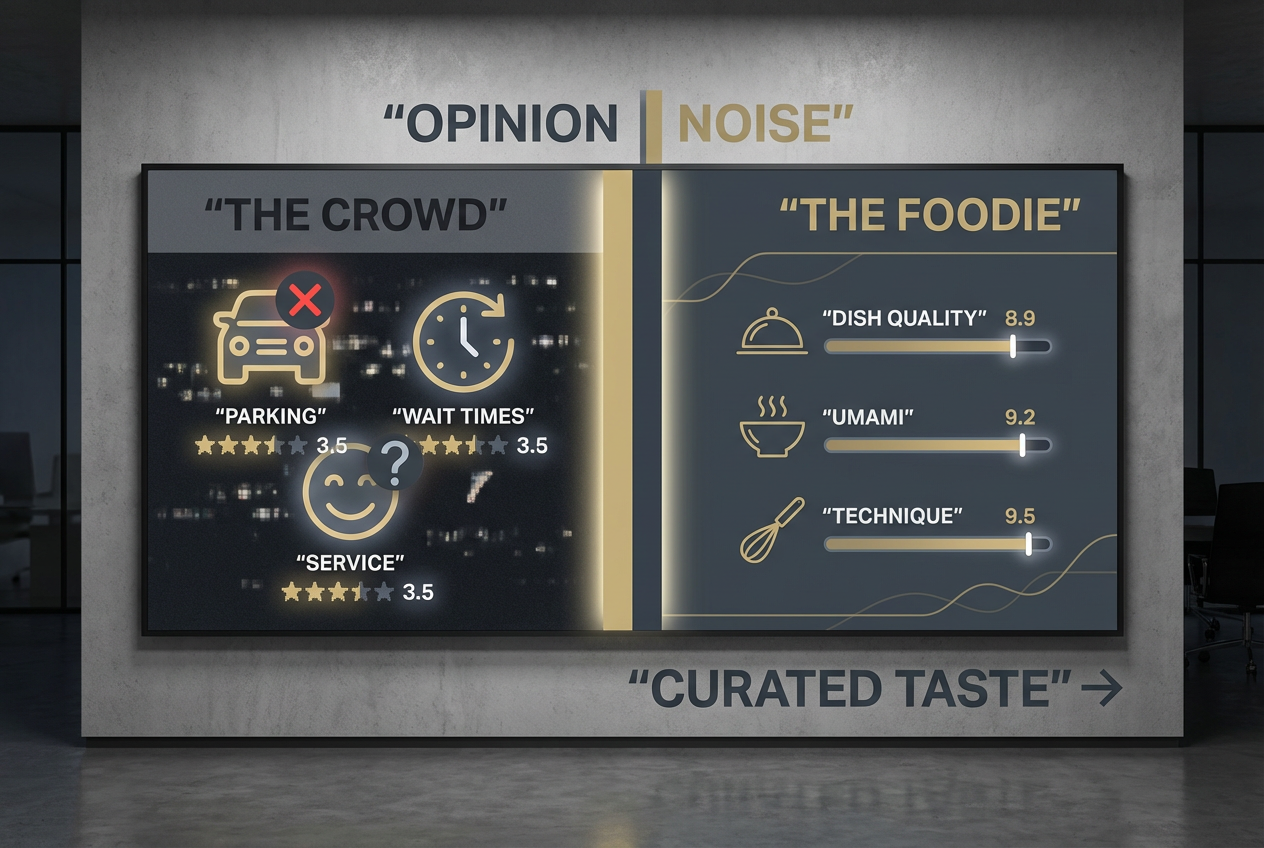 Beyond the basic star rating: why serious foodies are migrating to platforms that prioritize dish-level precision over general service complaints.
The platforms below represent a fundamental shift in how restaurant discovery works. Instead of aggregating everyone's opinion, they either curate whose opinion you see or give you tools to build your own taste database. For many urban professionals who use dining as part of business networking, this precision matters enormously.
The Food Diary vs. Social Review Split
The restaurant app landscape splits into two distinct camps: private journaling tools that help you remember what you ate, and social platforms that gamify discovery through peer networks. Understanding which camp you belong in determines which app will actually get used.
This is the first decision point. Some people want a personal archive, a searchable memory of every meal they've loved. Others want the social validation of sharing their taste, competing on leaderboards, and seeing what friends are eating. Neither approach is wrong, but mixing them creates friction.
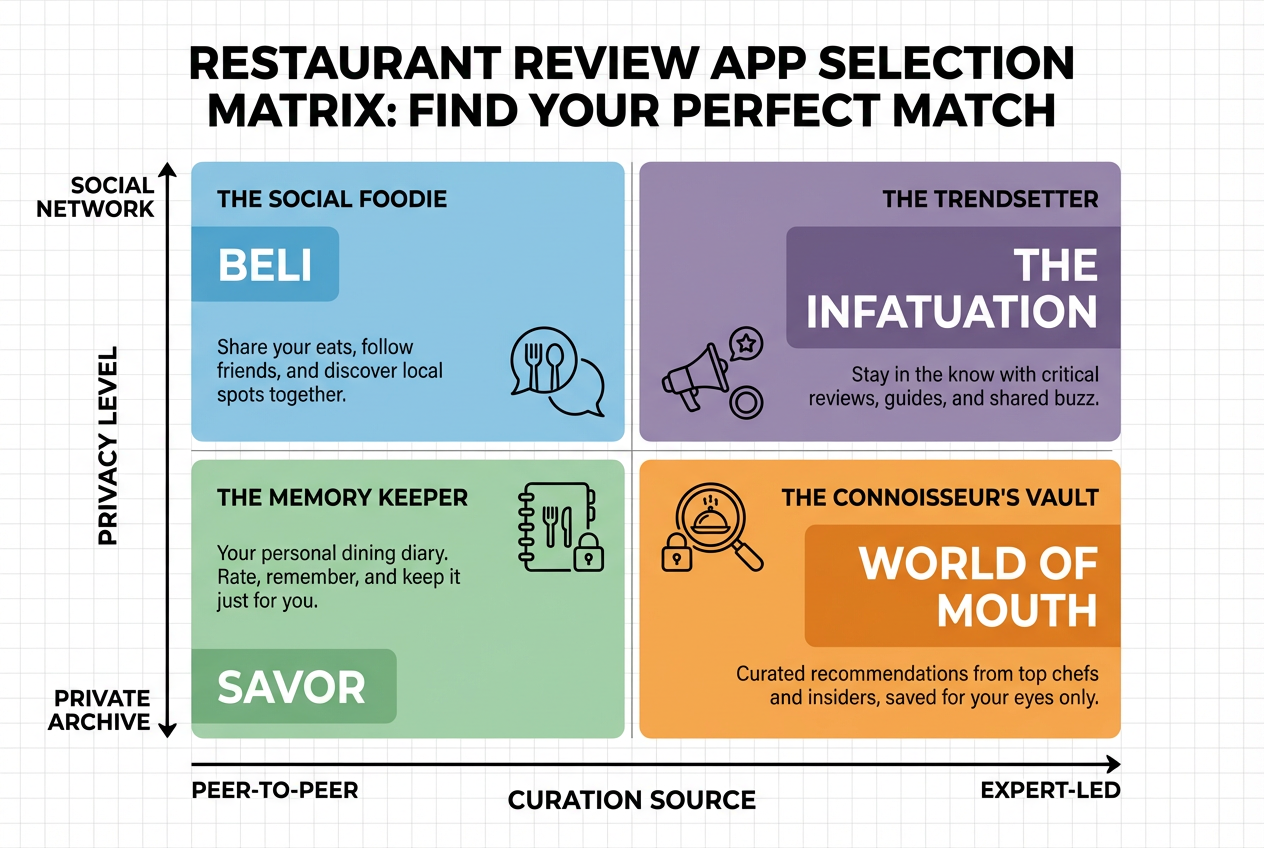 Choosing your food discovery style: use this framework to decide whether you value social gamification or private expert-led archiving.
The private journal approach (Savor, for example) treats your dining history like a personal database. You're not performing for an audience. You're building a reference library. Three months from now, when you're trying to remember that perfect Thai spot in Portland, you want precise recall: the name of the dish, what made it special, whether it's worth a return visit.
The social approach (Beli, Truffle) treats restaurant discovery as a shared experience. Your rankings are public. Your taste is visible. The app shows you what your network is eating and creates implicit competitions. Who's eaten at the most interesting places? Who has the best taste? It's Letterboxd for food, and that social dynamic drives engagement.
Then there's the expert-led model (World of Mouth, The Infatuation), which sits in a category of its own. You're not tracking your own meals. You're accessing curated recommendations from chefs, critics, and industry insiders. The value isn't in documenting where you've been but in discovering where you should go next based on people whose palates you trust.
Understanding this taxonomy matters because the wrong category will feel like work instead of utility. If you're naturally private about your food habits, a social leaderboard app will collect dust. If you thrive on community validation, a private journal won't hold your attention.
The Deep Comparison: Five Platforms Ranked
Beli: For the Social Ranker
Beli turns restaurant opinions into a competitive game with binary rankings and social feeds, making it ideal for foodies who want both a personal archive and visibility into their network's taste.
The core mechanic is brilliant in its simplicity: you don't rate restaurants on a scale. You rank them against each other using binary comparisons. "Was Restaurant A better than Restaurant B?" The app uses these head-to-head matchups to build your personal ranking of every place you've been. Over 75 million rankings have been submitted on the platform.
This approach solves the "ratings inflation" problem that plagues star-based systems. On Yelp, everything decent gets four stars, making differentiation impossible. On Beli, you're forced to make hard choices. If you've been to 50 Italian restaurants, the app will tell you exactly which one you thought was best and which one ranked 37th.
The social layer adds discovery. You can follow friends and see their rankings, creating an implicit trust network. When someone you respect puts a random taco stand at #3 on their overall list, that's a stronger signal than any five-star rating from strangers.
But here's the limitation: Beli focuses on restaurant-level rankings, not dish-level detail. You can note what you ordered, but the competitive mechanic is built around comparing venues. If you need to remember that the branzino at Restaurant X was perfect but the pasta was mediocre, you're working against the app's design.
The platform skews toward people comfortable with public-facing food opinions and competitive social dynamics. If you're the type who maintains strong opinions about the "correct" ranking of your favorite spots, Beli gives you a structured outlet for that instinct. Many users interested in tracking and discovering meals have found this binary ranking system more honest than traditional numerical scores.
World of Mouth: For the Global Explorer
World of Mouth connects you to an invite-only network of chefs, sommeliers, and food industry professionals, offering curated recommendations from people who eat for a living with a claimed 100% hit rate.
This isn't a journaling app. You're not building your own archive. You're accessing someone else's expertise. The platform positions itself as the insider's guide to dining anywhere in the world, with recommendations coming from a vetted community of professionals.
The value proposition is simple: eliminate risk. When you're traveling to a new city and have one night to eat well, you don't want to gamble on tourist traps. World of Mouth gives you the spots that industry people actually frequent. The recommendations come with context - why this chef loves this spot, what to order, when to visit.
The "100% hit rate" claim is bold, and it's worth understanding what it means. The platform isn't saying every meal will be transcendent. They're saying you won't get a bad meal, which for frequent travelers is actually the more valuable promise. Consistency matters more than occasional brilliance when you're eating in unfamiliar territory.
Access requires either an invitation from an existing member or an application process. This creates exclusivity but also ensures the recommendation quality stays high. You're not wading through opinions from casual diners. Everyone contributing has professional credibility.
The limitation is obvious: this is one-way communication. You're consuming recommendations, not building your own database. If you want to track your personal dining history or remember specific dishes, World of Mouth won't help. It's a discovery tool, not a memory tool.
The subscription model (often required for full access) positions this as a premium service. You're paying for expertise and curation. For frequent travelers and people who treat dining as a serious pursuit rather than a casual activity, the cost makes sense. For casual users, it's probably overkill.
Savor: For the Meticulous Cataloger
Savor operates as a privacy-first food journal with AI-powered logging and dish-level precision, making it the best choice for foodies who want a searchable personal archive without social performance pressure.
This is where the "camera roll crisis" gets solved. Savor is built around the premise that your phone already contains your dining history - it's just unorganized and unsearchable. The app helps you add structure: restaurant names, dish details, ratings, notes, all tied to specific photos.
The privacy angle matters. Your food journal isn't public. You're not performing for an audience or competing on leaderboards. You're building a personal reference database. Six months from now, when you're trying to remember whether that ramen spot in Brooklyn was worth a return visit, you have detailed notes and photos.
Dish-level tracking is the key differentiator. You're not rating the restaurant as a whole. You're documenting individual items. The branzino gets 8/10. The pasta gets 6/10. The tiramisu gets 9/10. This granularity matches how serious foodies actually think about restaurants - few places are uniformly excellent across the menu.
 Solve the camera roll crisis: specialized apps provide significantly higher data precision for tracking specific dishes compared to general search platforms.
The AI automation helps reduce friction. The app can extract location data, suggest restaurant names, and even help categorize dishes from photos. The goal is making logging fast enough that you'll actually do it consistently, which is where most food journaling attempts fail.
The weakness is isolation. There's no social discovery mechanism. You won't find new restaurants through Savor - you'll document the ones you visit. It's a complementary tool to something like World of Mouth or The Infatuation, not a replacement. Those interested in mastering food diary features appreciate how Savor emphasizes context over social performance.
For introverted foodies, meticulous record-keepers, and people who view their dining history as personal data rather than social content, Savor hits the mark. It respects your privacy while giving you powerful organizational tools.
The Infatuation: For the Trusted Decision-Maker
The Infatuation provides 100% anonymous, expert-written restaurant reviews with opinionated recommendations, serving foodies who want editorial curation and decision-making confidence over personal tracking.
Walk into most serious food conversations and The Infatuation comes up. It's not an app for tracking your meals. It's a destination for trusted restaurant criticism. Every review is written by paid editors who visit anonymously, a practice borrowed from traditional food journalism.
The editorial voice is distinctive: funny, opinionated, and practical. Reviews don't just describe the food. They tell you when to go, who to bring, what to order, and what the experience actually feels like. The writing assumes you care about food quality and can handle strong opinions.
The anonymous review process matters. Restaurants can't identify critics and provide special treatment. The experience being reviewed is the same experience you'll get, which isn't true for influencer-driven platforms where restaurants know exactly who's being catered to.
The Infatuation works in major cities across multiple countries, with local editorial teams covering their markets. The coverage isn't comprehensive - they curate rather than catalog - but what they review, they review thoroughly.
For decision-making, it's incredibly valuable. You're meeting clients for dinner in Austin and need a reliable spot that's impressive without being pretentious. The Infatuation will have three options with clear guidance on which one fits your specific scenario.
But it's completely one-directional. You can't track your own visits, leave your own notes, or build any kind of personal archive. It's professional criticism, not participatory community. You consume the content, you benefit from the expertise, but you don't contribute.
For people who want expert gatekeepers rather than crowd wisdom, who value editorial standards over volume of content, The Infatuation delivers. It pairs well with a personal tracking tool - use The Infatuation for discovery, use something like Savor to document your actual experiences.
8it: For the Street Food Seeker
8it gamifies restaurant discovery through social challenges and maps, targeting foodies who prioritize trendy spots, street food culture, and the social validation of hitting hyped destinations.
This platform leans hard into the "hype" factor. 8it isn't about building a comprehensive dining archive or accessing expert criticism. It's about discovering what's trending, what's new, and what's generating social buzz, particularly in the street food and casual dining space.
The app uses location-based features to show you what's nearby and what's popular with the community. There's a gamification element - checking in at locations, completing challenges, building badges - that appeals to completionists and social sharers.
The user base skews younger and more casual than platforms like World of Mouth or Beli. You're more likely to find the viral dumpling spot or the Instagram-famous burger joint than the quiet neighborhood Italian place that's been consistently excellent for 20 years.
For travelers hitting major food cities who want to experience the current scene rather than timeless classics, 8it provides value. If you're spending a weekend in Bangkok and want to hit the street food vendors that local food culture enthusiasts are talking about right now, the app points you in the right direction.
The limitation is depth. You're getting crowd wisdom again, just from a more food-focused crowd than Yelp's general audience. The reviews and recommendations are still coming from non-professionals. The signal-to-noise ratio is better than mainstream platforms but not at the expert level of World of Mouth or The Infatuation.
8it works best as a supplementary tool. Use it to find what's currently generating buzz, then use other platforms to verify quality or document your experience. It's discovery-focused, trend-focused, and socially-focused. For people who enjoy being early to popular spots and want the social credit for finding them, 8it delivers.
Feature Matrix: What Actually Matters
Privacy controls, dish-level tracking, expert curation, and offline functionality create the core feature set that determines which platform matches your actual usage patterns rather than aspirational ones.
Let's cut through the marketing and focus on the capabilities that change how you interact with these tools:
Privacy Spectrum:
- Savor: Completely private by default, your data isn't social content
- World of Mouth: Invite-only network, limited but curated audience
- The Infatuation: One-way consumption, no personal data involved
- Beli: Fully social, your rankings and taste are public
- 8it: Social and location-based, designed for sharing
Dish-Level Precision:
- Savor: Built entirely around individual dishes and items
- Beli: Restaurant rankings primary, dish notes secondary
- 8it: Restaurant check-ins focus, minimal dish detail
- The Infatuation: Editorial detail on specific dishes but read-only
- World of Mouth: Recommendations include specific dishes but not for tracking
Expert vs. Peer Curation:
- World of Mouth: 100% professional industry voices
- The Infatuation: Paid editorial staff with anonymous reviews
- Beli: Your personal network's taste preferences
- 8it: Crowd-sourced from food-focused users
- Savor: Your own expertise and memory only
Offline and Travel Functionality:
- Savor: Full offline access to your personal archive
- The Infatuation: Content works offline if pre-loaded
- World of Mouth: Requires connection for live recommendations
- Beli: Core ranking works offline, social features need connection
- 8it: Location features require active connection
Data Retention and Export:
- Savor: You own your data, exportable archive
- Beli: Your rankings stay in platform
- Others: Varies, often proprietary with limited export
The combination you need depends on how you actually use food apps, not how you imagine you'll use them. Be honest: do you consistently open apps and leave detailed reviews, or do you have good intentions that fade after two weeks? Do you care what others think of your taste, or is this purely personal reference?
For serious foodies who've tried multiple approaches to ranking and tracking meals, the feature combinations often matter more than any single capability.
Building Your Searchable Food Archive
Consistent weekly logging beats comprehensive detail. Three focused minutes per meal creates a more valuable archive than ambitious plans that collapse after two weeks of irregular 20-minute documentation sessions.
Here's the actual practice that works. Right after you finish eating (or the next morning if it's a late dinner), spend three minutes capturing the essential data:
The Core Four:
- Restaurant name and location (let GPS do the work)
- What you ordered (one sentence, be specific: "bone marrow agnolotti" not "pasta")
- Numeric rating for each dish (pick a scale and stick with it - I use 10 points)
- One observation (what made it memorable or what didn't work)
That's it. Don't write essays. Don't photograph the menu, the interior, and the street sign. Don't try to capture every element of the experience. You're building a searchable index, not composing restaurant criticism.
The photo discipline matters. One clear shot of each dish as it arrives. Food photography is its own skill, but for archival purposes you need visual recall, not Instagram aesthetics. Natural light, straight down angle, show the whole plate. Done.
The Weekly Review: Every Sunday morning, spend 15 minutes scanning the week's entries. This catches anything you forgot to log and reinforces the memory associations. You're training yourself to think about food in structured categories, which improves both your documentation and your actual palate over time.
The Tag System: Develop personal tags that match how you actually search your memory:
- Cuisine type (but be specific: "Sichuan" not "Chinese")
- Occasion ("business dinner," "date night," "solo discovery")
- Neighborhood or district
- Price category (actual dollars, not subjective "expensive")
- Notable characteristics ("late night," "BYOB," "counter seating")
Six months of consistent practice creates something genuinely valuable: a searchable external memory. You're in Chicago for work and want Japanese. Pull up your archive, filter by cuisine and city, sort by rating. You have three options you personally vetted with specific dish recommendations. That's worth more than reading 47 Yelp reviews from strangers.
The system works because it's sustainable. Three minutes per meal is low enough friction that you'll actually do it. Weekly reviews create accountability. The data compounds over time until you have something no public platform can replicate: a complete record of your personal taste, documented at the moment of experience, organized exactly how your brain wants to search it.
Strategic Gaps Worth Knowing
Current platforms excel at either discovery or memory but rarely both. Understanding what's missing helps you build a functional stack rather than expecting one app to solve everything.
The business dinner use case remains underserved. Urban professionals who use restaurants for client entertainment and networking have specific needs: appropriate venues by cuisine and price point, consistent quality, ability to track who you've taken where (so you don't repeat restaurants with the same client), and spaces that facilitate conversation rather than performance dining.
None of the reviewed platforms optimize for this. Beli's social rankings don't filter for "good business dinner spots." Savor tracks meals but doesn't categorize by professional context. World of Mouth recommends exciting food but doesn't flag which recommendations are appropriate for conservative clients. There's a gap here for restaurant and business reviews tailored to professional dining.
The AI prediction opportunity is barely tapped. You've logged 200 meals with detailed preferences. The app should be able to predict, with reasonable accuracy, whether you'll like a new restaurant based on your historical ratings of similar cuisine, price points, and preparation styles. Some platforms gesture toward this with recommendation engines, but none are using your personal archive to generate predictive scores.
International travel creates friction. You're in Tokyo for a week. Your usual apps don't have coverage. You need to learn Japan's rating systems like Tabelog, understand cultural context, and navigate language barriers, all while maintaining your personal archive. The tool stack for domestic dining doesn't translate cleanly to international discovery.
The "dead zone" problem affects serious food travelers. You're exploring rural Thailand or a wine region in Argentina. Data connections are spotty. Most discovery apps require live internet. Your carefully built network of recommendations is inaccessible exactly when you need it most. Offline capability remains a major differentiator, and most platforms treat it as an afterthought.
The private archive vs. social discovery trade-off feels artificial. Why can't one platform do both? Let me maintain a personal journal with full privacy controls while optionally sharing selected entries with a curated network. The technical challenges aren't insurmountable, but no platform has nailed the UX for toggling between modes seamlessly.
These gaps represent opportunities. If you're building a food app stack rather than relying on a single tool, understanding what's missing helps you compensate. Use World of Mouth for expert discovery internationally. Use Savor for personal archiving. Use The Infatuation for vetted decision-making in major cities. The gaps aren't flaws - they're indicators that different tools serve different purposes, and serious foodies need multiple tools.
Frequently Asked Questions
What's the best app for restaurant reviews if I'm just starting to track my meals?
Start with Savor or Beli depending on whether you want privacy or social features. Savor works best if you're building a personal archive without performance pressure. Beli makes sense if you have a network of food-interested friends and want the social motivation to keep logging. Both have low enough friction that you'll actually use them consistently, which matters more than feature completeness when you're building the habit. Don't start with expert platforms like World of Mouth - those are discovery tools, not tracking tools.
Can I use multiple restaurant review apps together or should I pick one?
Use multiple apps for different purposes. The platforms serve distinct needs, and trying to force one app to do everything creates friction. A common stack: Savor for personal tracking, World of Mouth or The Infatuation for discovery, and Beli if you want social engagement. Your camera roll goes into Savor with dish-level detail. You consult expert platforms when traveling or seeking new restaurants. You compare rankings with friends on Beli. They complement each other rather than compete.
How do these apps work for tracking restaurants outside the United States?
Coverage varies dramatically. The Infatuation and Beli work in major international cities but have limited reach. World of Mouth shines internationally because it's built on a global network of chefs and industry professionals. Savor works anywhere since it's your personal archive, not crowd-sourced data. For serious international travel, especially in Asia, you'll need region-specific apps - understanding Singapore restaurant review platforms or learning Japanese food rating systems becomes necessary. No single Western app dominates globally.
What makes these apps better than just using Google Maps or Yelp?
Precision and curation. Google Maps and Yelp aggregate everyone's opinion about everything - parking, bathroom cleanliness, whether the host was friendly. For serious foodies, that's noise. These specialized apps either filter for food-focused opinions (Beli, 8it), provide expert curation (World of Mouth, The Infatuation), or let you build dish-level archives (Savor). A 4.5-star rating on Google Maps tells you the crowd liked it. A ranking on Beli tells you someone with similar taste preferences ranked it highly. That's a stronger signal for food quality specifically.
Do I need to pay for these restaurant review apps?
It depends on the platform. Savor and Beli offer robust free tiers that handle most personal tracking needs. World of Mouth often requires subscription or invitation for full access, positioning itself as a premium service. The Infatuation is free to read but monetizes through affiliate partnerships and branded content. 8it is generally free with optional premium features. For casual tracking, free versions work fine. For frequent travelers or people who treat dining as a serious pursuit, paid tiers of expert platforms deliver value through curated recommendations that reduce wasted meals.
How much time does it take to maintain a food journal using these apps?
With the right approach, three minutes per meal for logging plus 15 minutes weekly for review. The friction comes from trying to capture too much detail. Focus on the essentials: restaurant name, dish name, rating, one observation. Take one clear photo per dish. That's sustainable long-term. If you're trying to write paragraph-long reviews or capture perfect photos, you'll burn out in two weeks. The apps with AI-powered features like Savor reduce time further by auto-suggesting restaurant names and extracting location data. Consistency beats completeness - logging 80% of your meals with basic detail creates more value than perfectly documenting 20%.
Can these apps help me remember specific dishes I've eaten months or years ago?
That's exactly what dish-level tracking apps like Savor are designed for. Instead of rating "the restaurant," you rate individual items. Six months later, you search for "branzino" and see every version you've tried with photos, ratings, and notes. This is impossible with restaurant-level platforms like Yelp or traditional rating apps. The camera roll crisis - having photos of food you can't identify - gets solved when you add structured metadata at the time of eating. Building this searchable archive takes discipline, but after a year you have something genuinely valuable: complete recall of your dining history organized exactly how you want to search it.
Are restaurant review apps useful for finding places while traveling internationally?
For international travel, you need a multi-app strategy. Expert platforms like World of Mouth provide vetted recommendations from local industry professionals, which is incredibly valuable in unfamiliar cities. Your personal archive apps like Savor help you remember what you ate, but won't discover new places. Regional platforms become critical - you can't effectively navigate Tokyo food culture without understanding Tabelog, just as you need local knowledge for Singapore street food. Download relevant apps before you travel, understand the local rating conventions, and maintain your personal archive throughout. The combination of expert local discovery plus personal documentation works better than relying on Western apps with thin international coverage.