
Food Rating Apps: Compare 5 Best Tools for Serious Foodies
John the smoothie monster
John lives for smoothie bowls and cold-pressed juices. He uses Savor to remember his best blends.
Beyond the Camera Roll: The 5 Best Food Rating Apps for the Serious Foodie You just had the best Cacio e Pepe of your life. The pasta was silken, the cheese...
Beyond the Camera Roll: The 5 Best Food Rating Apps for the Serious Foodie
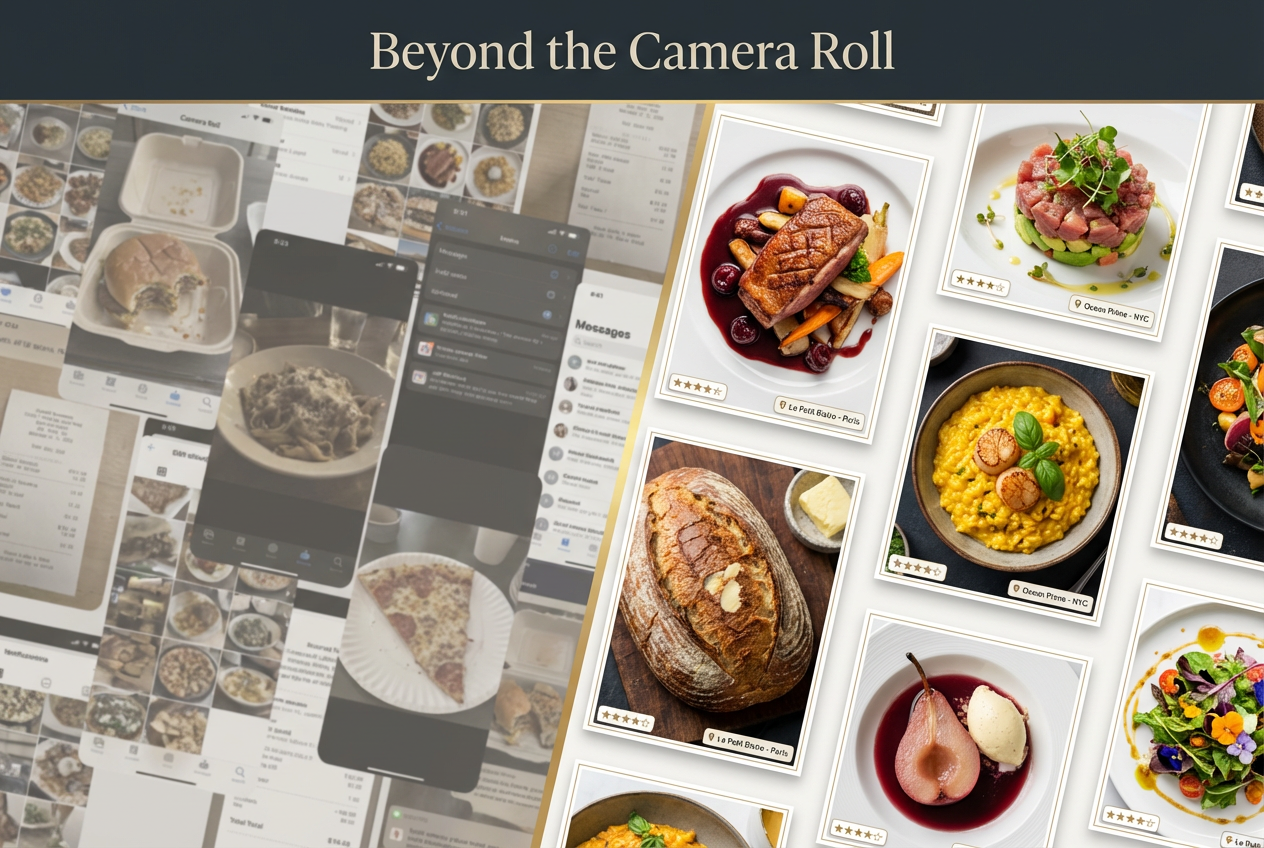
You just had the best Cacio e Pepe of your life. The pasta was silken, the cheese ratio perfect, the black pepper had actual bite. You snapped a photo, maybe posted it to Instagram, and moved on with your evening. Three months later, a friend asks where to get the best pasta in your neighborhood. You remember the dish. You remember the feeling. But the restaurant name? Lost somewhere between 2,000 photos of meetings, receipts, and random screenshots.
This is the problem with treating your camera roll like a food journal. And it's the exact frustration that's killing Yelp and Google Maps for people who actually care about food. You're not looking for the nearest place with 4.2 stars and "great ambiance!" reviews from people who think Olive Garden is Italian cuisine. You need something built for the way you actually eat: frequently, thoughtfully, and with a memory that deserves better than chaos.
The serious foodie has moved past discovery. You've already found your favorite ramen spot, your reliable date-night sushi joint, your secret Sunday morning bagel place. What you need now is a system that helps you remember, compare, and share those experiences with people whose taste you actually trust.
Table of Contents
- The Death of the 5-Star Review
- Feature Matrix for the Serious Foodie
- App Deep Dives: Finding Your Perfect Match
- Comparison Guide: Beli vs. Yelp vs. Google Maps
- Pro Tips for Migrating Your Food Life
- FAQs
The Death of the 5-Star Review
Legacy review platforms like Yelp and Google Maps were built for a different era. Modern food rating apps solve the real problem: turning your dining experiences into a searchable, personal archive that actually respects your palate and your privacy.
The fundamental issue with crowdsourced ratings isn't just that they're unreliable (though they absolutely are). It's that they're solving the wrong problem entirely. When Yelp launched in 2004, the internet was still figuring out how to help people find businesses. The question was simple: "Is this place good or bad?" The answer was a star rating and some photos of the dining room.
But you don't eat dining rooms. You eat dishes. And the person who gave that restaurant five stars because the server was nice and the bathroom was clean has completely different standards than you do. Their opinion isn't helping you remember whether the duck confit was oversalted or if the wine pairing actually worked.
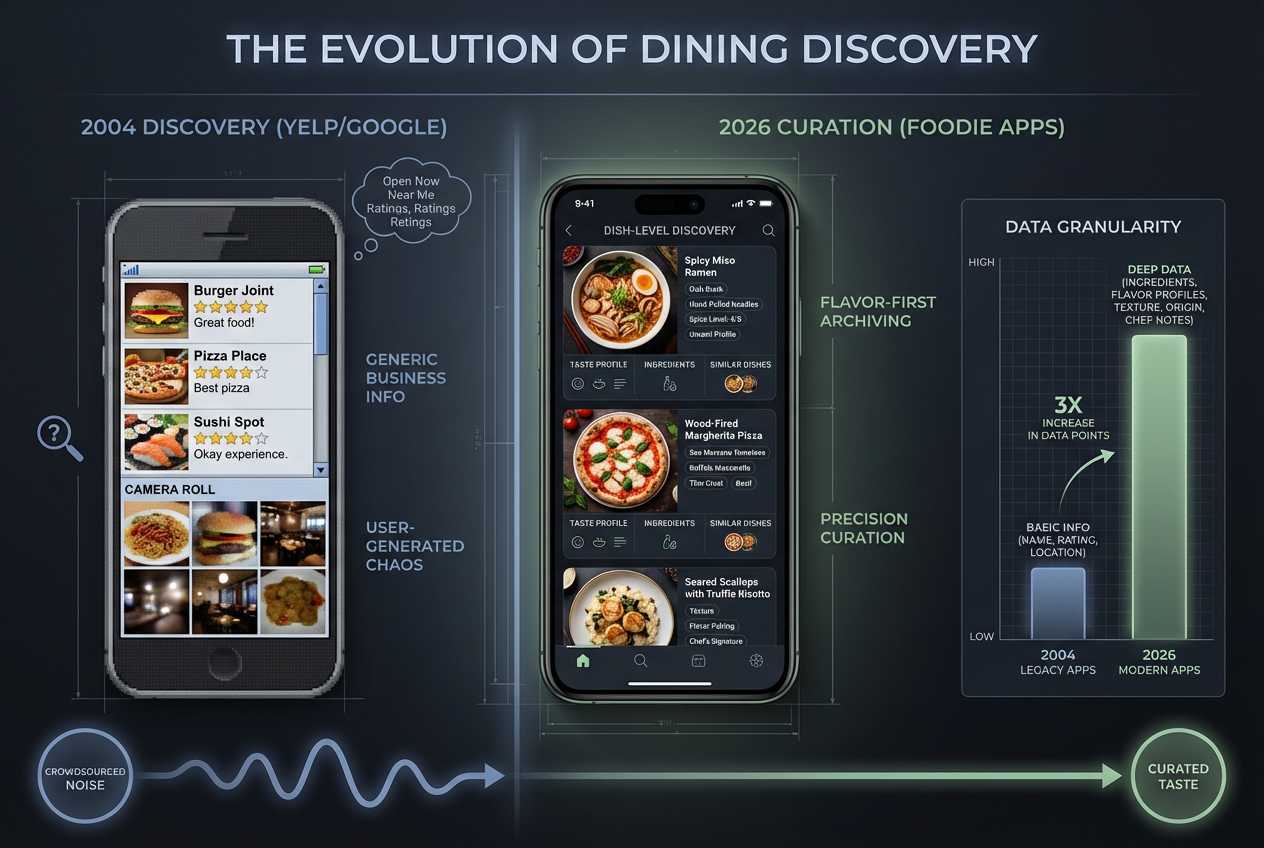
The shift happening right now in food apps is from discovery to curation. You're not trying to find the nearest Thai restaurant anymore. You're trying to build a personal archive of culinary experiences that you can actually search, compare, and share with people who get it. The new generation of apps understands this. They're built around three principles that Yelp will never adopt:
Dish-level granularity. You don't rate "Momofuku Ko" as a whole. You rate the shaved foie gras versus the frozen apple. This matters because restaurants are inconsistent, menus change, and your taste evolves.
Trust-based social networks. You don't want recommendations from strangers who think Applebee's has "great vibes." You want input from your friend who spent three months eating through Tokyo, or that chef whose Instagram you've been following for years.
Personal memory retention. The real value isn't telling other people what's good. It's remembering what you thought was good six months ago when you're back in that neighborhood and trying to decide where to eat.
If you've ever found yourself scrolling through hundreds of photos trying to remember the name of that place with the incredible octopus, you already know why this matters. Your camera roll is where food memories go to die. What you need is a system.
Feature Matrix for the Serious Foodie
Modern food rating apps prioritize searchability, privacy, and dish-level granularity over crowd-pleasing generic ratings. The best tools let you track specific dishes, curate personal lists, and share experiences only with people whose taste you trust.
Not all apps are solving the same problem. Some are focused on social curation, turning your dining life into a performative ranking system that your friends can follow. Others are intensely private, designed for personal journaling and memory retention without any social pressure. A few exist purely to surface expert opinions, cutting through the noise of amateur reviews entirely.
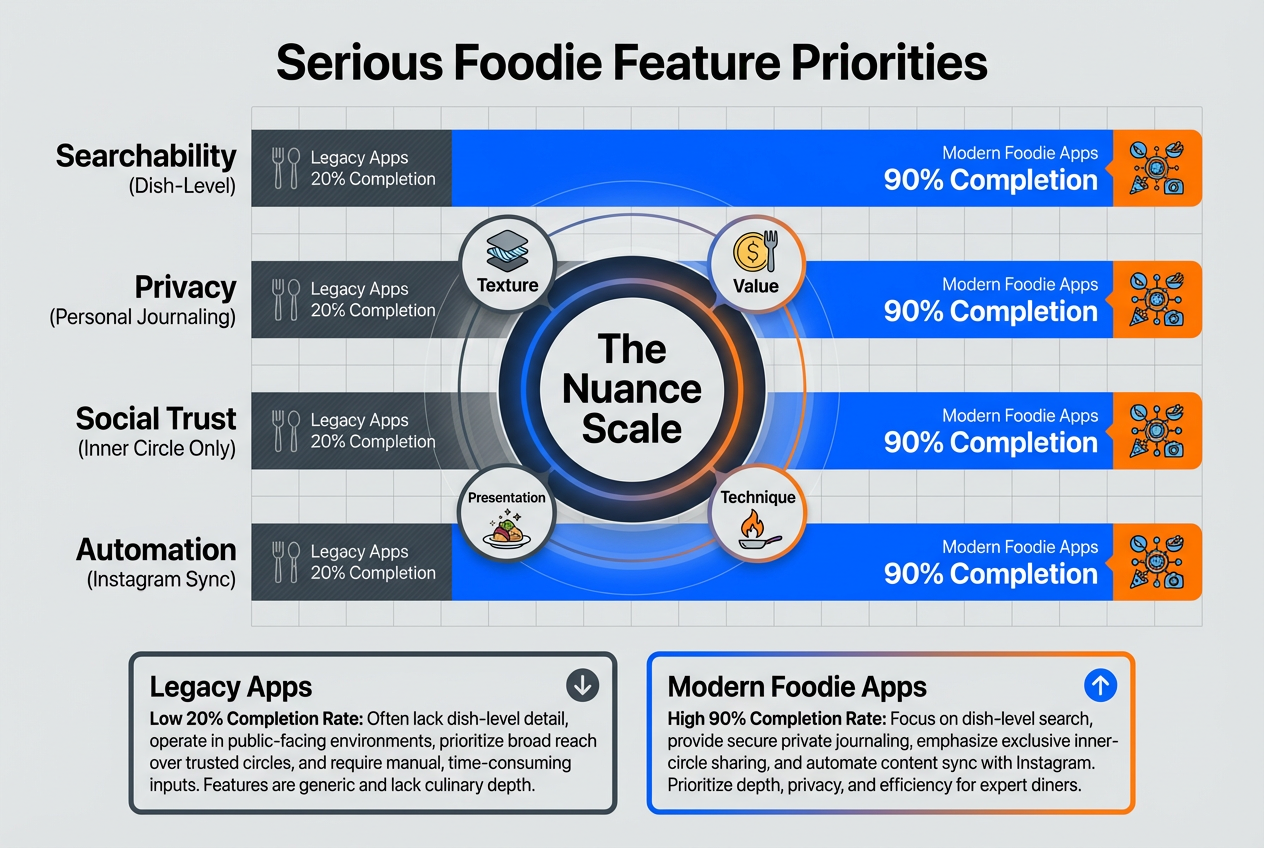
Here's what actually matters when you're evaluating which app deserves space on your home screen:
| Feature | Why It Matters | Apps That Nail It |
|---|---|---|
| Dish-Level Ratings | You need to remember the bucatini, not just the restaurant. Menus change, execution varies, and your taste is too refined for restaurant-wide averages. | Savor, Beli, 8it |
| Searchable Archive | If you can't search "Truffle Pasta" and see every version you've tried across 30 restaurants, what's the point? | Savor (AI photo recognition), Beli (tagging system) |
| Privacy Controls | Sometimes you want to be honest about a disappointing dish without publicly dragging a restaurant. Private notes let you maintain relationships while keeping real records. | Savor (fully private mode), Beli (friend-only sharing) |
| Friend-Based Trust | Generic crowd ratings are useless. You want recommendations from people whose taste you know and respect, not from tourists who think ketchup is spicy. | Beli, Truffle (Instagram sync) |
| Granular Scoring | A 5-star system doesn't let you differentiate between "very good" and "transcendent." You need more nuance to track your evolving standards. | Savor (10-point scale), Beli (forced ranking, no ties) |
| Export/List Creation | Being able to create "Best Ramen in LA" or "Date Night Spots" lists is how you become the person friends ask for recommendations. | Beli (curated lists), World of Mouth (bookmark collections) |
| Map Integration | You're standing in a new neighborhood. You need to see your saved spots, not Yelp's sponsored results and tourist traps. | Most apps integrate basic mapping, but Savor and Beli excel at overlaying your archive onto real navigation. |
The apps that win are the ones that solve for curation over discovery. You're not looking for new restaurants every day. You're building a personal culinary identity and you need tools that respect that process.
For a deeper look at how modern platforms compare to legacy review systems, consider how your specific use case aligns with each app's core strength. Are you a social ranker who wants to compete with friends over who has better taste? Or are you a private archivist who just wants to remember what you ate without performing for an audience?
App Deep Dives: Finding Your Perfect Match
Each app serves a distinct user profile. Beli excels at social curation and ranking, Savor offers private journaling with AI assistance, World of Mouth surfaces expert opinions, Truffle automates tracking through Instagram, and 8it delivers unfiltered food-first reviews.
The landscape of food rating apps isn't one-size-fits-all. Your ideal tool depends entirely on whether you're motivated by social status, personal memory, expert guidance, convenience, or unfiltered opinions. Let's break down each app by its core audience and use case.
Beli: The Social Curator
Best for: The Competitive Foodie
Beli is the Letterboxd of food apps. If that reference means something to you, this is probably your app. It's built around the idea that your taste in food is part of your identity, and you want a platform where you can flex that identity among friends who care.
The core mechanic is simple but brilliant: you rank restaurants. Not rate, rank. No ties allowed. You can't give three places 4.5 stars and call it a day. You have to decide whether the omakase at Sushi Note is better than the one at Kurumazushi, and you have to live with that choice publicly.
This forced ranking creates genuine discussion. Your friends can see your list and argue with your choices. When someone visits your city, they're not asking "where should I eat?" They're looking at your top 10 and planning their weekend around it.
The social layer is what makes Beli compelling. You follow friends whose taste you respect (and ignore acquaintances whose taste is suspect). When someone you trust adds a new spot to their top rankings, you know it's worth checking out. This is the kind of curation that generic crowd ratings can never provide.
The downside? It can feel performative. If you're the type who wants to log a mediocre Tuesday lunch without worrying about how it affects your public rankings, Beli might add pressure you don't need. The app encourages a certain level of social signaling that not everyone wants to engage with constantly.
Ideal user profile: You dine out 3-5 times a week, you have strong opinions about food, and you enjoy debating those opinions with friends who share your standards. You see food as both a hobby and a social activity.
Savor: The Private Journal
Best for: The Meticulous Archivist
Savor is what happens when someone builds a food app for people who actually want to remember things. It's not about social proof or public rankings. It's about creating a searchable archive of everything you've eaten so you never lose a memory to your camera roll again.
The killer feature is AI-powered photo recognition. You take a photo of your dish, and Savor analyzes it to help you tag the ingredients, cooking method, and key flavors. Over time, you build a database that you can search. "Show me every pasta dish I've rated above an 8." "Find all the restaurants where I had truffle." This is the kind of functionality that turns scattered memories into actionable knowledge.
The 10-point scoring system gives you the granularity to differentiate between "very good" and "excellent" and "one of the best things I've ever eaten." You're not stuck with star ratings that make everything blend together. You can track your evolving standards over years.
Privacy is built in. You can keep everything completely private, or share selectively with specific friends. There's no pressure to maintain a public profile or compete for followers. This is your personal food journal that happens to have powerful search and organization tools.
The trade-off is that Savor requires more effort. You're manually logging dishes, adding notes, and building your database. If you want something that just works passively in the background, this isn't it. But if you're someone who keeps detailed notes anyway, Savor turns that habit into something much more valuable.
Ideal user profile: You take detailed notes about meals, you care about tracking your evolving taste, and you prioritize memory retention over social validation. You're probably the person friends text when they need a restaurant recommendation because they know you remember everything.
World of Mouth: The Expert Guide
Best for: The High-End Diner and Traveler
World of Mouth isn't trying to be your personal archive. It's trying to be the opposite of Yelp's noise by only surfacing opinions from people who actually know what they're talking about: 800+ chefs, critics, and culinary professionals from around the world.
The premise is simple. You're traveling to Copenhagen or Bangkok or Mexico City, and you don't want recommendations from tourists. You want to know where the local chefs eat. World of Mouth gives you that information, curated and organized by neighborhood, occasion, and price point.
There's no advertising, no sponsored results, no restaurants gaming the algorithm. Just trusted recommendations from people whose professional reputation depends on having good taste. When David Chang says a place is worth visiting, that carries more weight than 500 anonymous five-star reviews.
The app also works as a discovery tool for finding new restaurants in your home city. You can follow specific experts whose taste aligns with yours and get notifications when they add new recommendations. It's like having a personal concierge service, except the concierge is a Michelin-starred chef.
The limitation is obvious: this is not about your memories. You're consuming expert opinions, not building your own archive. If you're someone who wants to track every meal and rate every dish personally, World of Mouth doesn't solve that problem. It's a complementary tool, not a replacement for personal food tracking apps.
Ideal user profile: You travel frequently, you dine at high-end restaurants, and you value expert curation over personal archiving. You'd rather discover one perfect meal than log 50 mediocre ones.
Truffle: The Effortless Tracker
Best for: The Instagram-First Foodie
Truffle solves a specific problem: you're already sharing your meals on Instagram Stories, so why should you have to log them separately in a food app? The app automatically scans your Stories, identifies restaurant mentions and food photos, and builds a timeline of everywhere you've eaten.
The appeal is pure convenience. You're not changing your behavior at all. You keep posting to Instagram like you always do, and Truffle runs in the background creating a searchable archive. It's passive tracking for people who don't want another app demanding their attention.
The social layer is built around Instagram's existing network. You can see where your friends are eating (if they use Truffle) and get recommendations based on your actual social circle, not random strangers. This makes the data more relevant than generic crowd ratings.
The massive downside is data quality. If you don't tag restaurants in your Stories, Truffle can't log them. If you're eating at home or at a friend's place, nothing gets tracked. And because it's working off Instagram's data, you're limited to whatever information Instagram provides. There's no dish-level detail, no personal notes, no scoring system beyond what you choose to write in your Story captions.
Truffle is best as a supplement, not a primary tool. It captures the meals you were already planning to share publicly, but it can't replace a dedicated food journal if you're trying to build a comprehensive archive.
Ideal user profile: You're very active on Instagram Stories, you share most of your meals publicly anyway, and you want something that works without extra effort. You value convenience over completeness.
8it: The No-BS Food Critic
Best for: The Anti-Hype Skeptic
8it positions itself as the antidote to Instagram food culture. No carefully styled photos of the dining room. No "ambiance" ratings. Just short, direct reviews focused entirely on whether the food is actually good. The app encourages a certain bluntness that feels refreshing after years of overly diplomatic Yelp reviews.
The format is inspired by TikTok and Twitter: quick hits, strong opinions, no filler. You rate the food on a 10-point scale, write a few sentences about what worked or didn't, and move on. There's no pressure to write an essay or perform for an audience. Just honest feedback about the only thing that matters: taste.
The community skews toward people who are tired of food influencer culture. You're not going to find sponsored content or restaurants trying to manipulate rankings. The user base is small enough that it still feels like a community of people who genuinely care about food rather than social media engagement.
The geographic limitation is real. 8it has strong coverage in major food cities like New York, Los Angeles, and San Francisco, but if you're eating in smaller markets, you're not going to find much useful information. And because it's relatively new, the database isn't as comprehensive as established platforms.
Ideal user profile: You're skeptical of food hype, you value honest opinions over pretty photos, and you live in a major metro area with strong 8it coverage. You probably roll your eyes at Instagram food trends and just want to know if the pasta is good.
Comparison Guide: Beli vs. Yelp vs. Google Maps
Yelp and Google Maps handle logistics (hours, directions, basic existence). Specialized food rating apps handle curation, memory, and taste-based social networks. The tools solve different problems and belong in different parts of your workflow.
The question isn't really "which app should I use?" It's "what role does each app play in how I interact with food?" Because the truth is, you probably need more than one tool. They're solving fundamentally different problems.
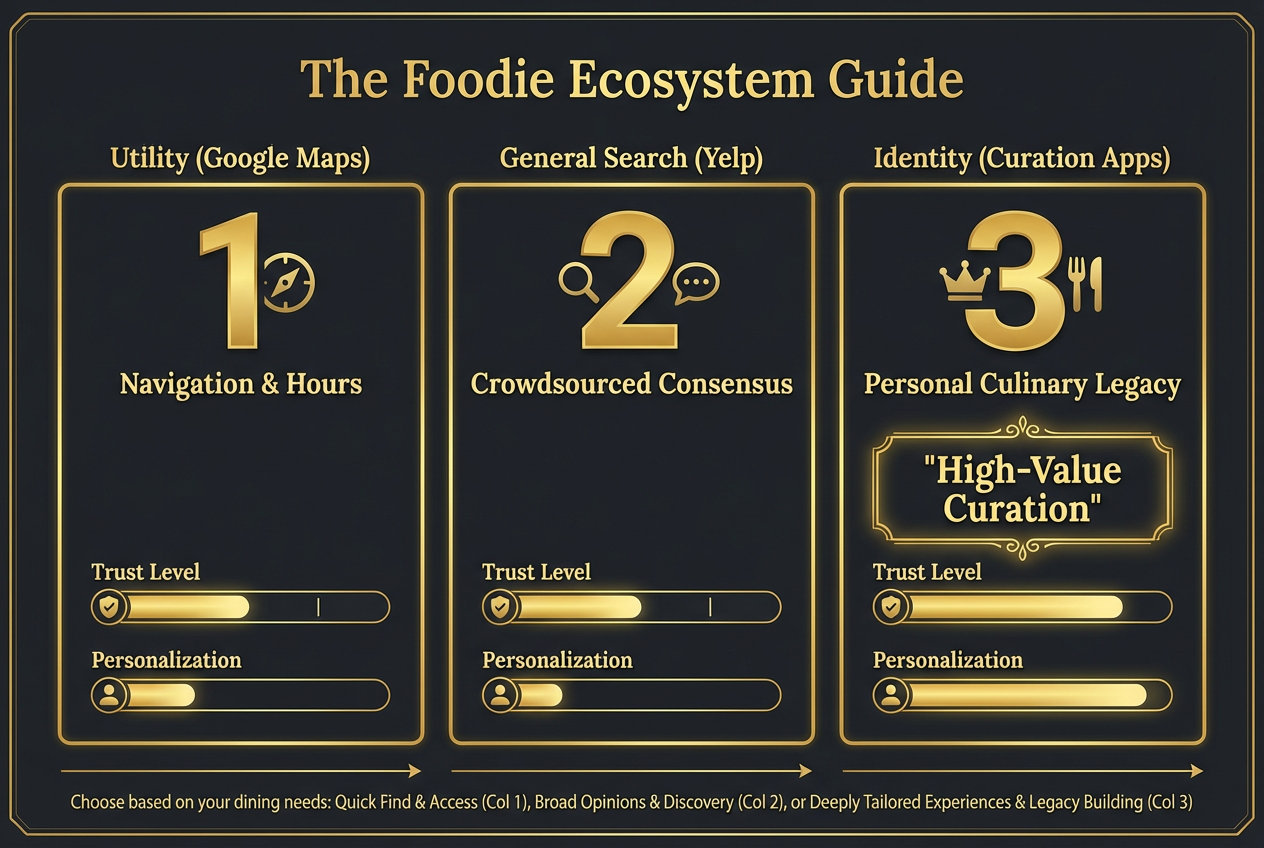
Google Maps is for getting there. You need an address, hours, and a phone number. You want to know if the place is open right now and how long it'll take to walk there. Google Maps is infrastructure. It's not trying to tell you if the food is good. It's trying to make sure you don't show up to a closed restaurant.
This is actually valuable! The worst dining experience is showing up hungry to a place that closed six months ago because you relied on an outdated blog post. Google Maps handles real-time information better than any specialized app ever will.
Yelp is for checking the basics and avoiding disasters. You're traveling, you don't know the area, and you need to find somewhere safe to eat. Yelp's crowd ratings are actually useful for answering low-stakes questions: "Is this place an actual scam?" "Will I get food poisoning?" "Does the bathroom exist?"
What Yelp can't do is tell you whether the food matches your specific standards. A 4.5-star rating tells you that most people didn't actively hate their experience. It doesn't tell you whether the chef understands acid balance, whether the pasta is cooked properly, or whether the sourcing is worth the price premium. For those questions, you need people whose taste you know.
Specialized food rating apps are for building your identity as a diner. This is where you log dishes, create lists, track your evolving preferences, and share recommendations with people who understand your standards. You're not trying to help random strangers find lunch. You're building a personal archive and a trust-based social network.
The comparison breaks down like this:
| Scenario | Best Tool | Why |
|---|---|---|
| You're in a new city and need dinner reservations | Google Maps + OpenTable | You need logistics, not opinions |
| You want to avoid obviously bad restaurants | Yelp | Crowd wisdom prevents disasters |
| You're trying to remember that amazing duck dish from six months ago | Savor | Searchable personal archive |
| You want to create a "Best Pizza in Brooklyn" list to share with friends | Beli | Social curation and ranking |
| You're traveling to Tokyo and want to eat where chefs eat | World of Mouth | Expert curation beats crowd ratings |
| You just had an incredible meal and want to log it before you forget | Any specialized app | Immediate capture prevents memory loss |
The real power move is using these tools in combination. Check Google Maps for hours and location. Glance at Yelp to make sure the place isn't a health code violation waiting to happen. Then use your specialized food app to decide whether it matches your taste based on trusted opinions or your own past experiences.
For more context on how restaurant rating systems differ from traditional reviews, consider how your decision-making process changes when you prioritize personal curation over generic crowd consensus.
Pro Tips for Migrating Your Food Life
Transitioning from scattered notes and camera roll chaos to a structured food rating system requires a methodical approach. Start by auditing your current data, choose one primary app for consistency, and develop logging habits that fit your actual dining routine.
Making the switch from passive photo-hoarding to active food curation takes some initial effort, but the payoff is enormous. Here's how to do it without losing your mind or abandoning the project after two weeks.
Start with a memory audit. Go through your camera roll from the past six months and identify the meals you actually want to remember. Don't try to log everything. Just capture the ones that mattered: the birthday dinner, the incredible hole-in-the-wall discovery, the disappointing hyped restaurant that taught you something about your own taste. This gives you a foundation to build on.
Export those photos with dates and locations if possible. Most phones let you see photo metadata. Use that information to reconstruct what you ate and where. This is tedious, but it's a one-time project that transforms scattered data into usable knowledge.
Pick one primary app and commit for 90 days. Tool-hopping kills momentum. Choose the app that best matches your use case (social curator, private journalist, expert follower, or convenience tracker) and use it exclusively for three months. This gives you enough data to evaluate whether it's actually serving your needs.
During those 90 days, log everything. Quick lunches, coffee shops, fancy dinners, takeout. You're building a habit, and habits require repetition. The app that seems annoying on day five might feel effortless on day sixty once muscle memory kicks in.
Develop a personal scoring system that stays consistent. If you're using a 10-point scale, define what each level means before you start rating things. Otherwise you'll end up with score inflation where everything is an 8 or 9 because you felt good that day.
One approach: Reserve 1-4 for genuinely bad food (you wouldn't order it again), 5-6 for acceptable but forgettable, 7-8 for legitimately good (you'd recommend it), 9 for excellent (you'd go out of your way to return), and 10 for transcendent (top 20 dishes you've ever eaten). Adjust to your taste, but document your system and stick to it.
Use tags and notes aggressively. The whole point of these apps is searchability. Generic entries like "Had sushi. It was good" won't help you six months later. Instead: "Toro was fatty and melted instantly. Rice temperature perfect. Tamago too sweet but everything else flawless. Omakase progression well-paced."
Tag by ingredient, cuisine, occasion, neighborhood, price point, whatever categories matter to you. The more specific your metadata, the more useful your archive becomes. When you're trying to find "all the times I had perfect pasta carbonara," detailed tags make that possible.
Migrate your Google Maps saved places strategically. You probably have hundreds of pins in Google Maps marked "Want to Try" or "Favorites." Don't just copy them all blindly. Use this migration as an opportunity to audit what actually matters.
Go through each saved place and ask: "Would I realistically eat here in the next six months?" If no, delete it. If yes, move it to your new app with context. Why did you save it? Who recommended it? What specific dish are you interested in? This curation process is valuable in itself.
Create a system for immediate capture. The biggest risk with food journaling is forgetting to log things in the moment. By the time you get home, details fade. You remember the meal was good, but you can't recall whether the sauce was beurre blanc or hollandaise.
Take photos during the meal (you're already doing this). Add a quick voice note on your phone if needed. Some apps let you create draft entries that you can flesh out later. The goal is to capture enough information in real-time that you can write detailed notes within 24 hours while memory is fresh.
Build weekly review habits. Spend 15 minutes every Sunday reviewing what you logged during the week. Add any missing details, adjust ratings if reflection changes your opinion, and export your top meals to lists you can share.
This weekly ritual turns logging from a chore into actual reflection. You start noticing patterns: you consistently love dishes with acid balance, you're disappointed by restaurants that prioritize Instagram aesthetics over technique, you have strong preferences about sourcing that affect your ratings. These insights improve your taste and your decision-making.
Share selectively and authentically. If you're using a social app like Beli, don't feel pressure to share everything publicly. Your personal food journey is yours. Share the meals that genuinely excited you, create curated lists when friends ask for recommendations, and keep the rest private if that feels right.
Authenticity matters more than frequency. One thoughtful recommendation based on your actual experience is worth more than 50 generic "it was good!" posts. Your credibility with friends comes from being genuinely helpful, not from performing curation for an audience.
For more tactical approaches to building a comprehensive food tracking system, consider how adding meal context and environmental factors can enrich your archive beyond simple ratings.
FAQs
What is the best food rating app for serious foodies?
It depends on your primary use case. If you want social curation and ranking with friends, Beli is the strongest choice. If you prioritize private journaling with AI-assisted search, Savor excels at memory retention. For expert-curated recommendations while traveling, World of Mouth provides unmatched quality. If you're already active on Instagram and want passive tracking, Truffle requires zero behavior change. Choose based on whether you value social validation, personal archiving, expert guidance, or convenience most.
How do dish-level ratings differ from restaurant ratings?
Restaurant ratings average your experience across multiple dishes, service, ambiance, and other factors that don't directly affect taste. Dish-level ratings let you specify that the carbonara was transcendent while the tiramisu was mediocre. This granularity matters because menus change, execution varies by day, and your goal is to remember specific items worth reordering, not generic impressions of an entire venue. When you search "best pasta I've ever had" six months later, dish-level tracking gives you actionable answers.
Can I migrate my existing Google Maps saved places to these apps?
Most specialized food apps don't have direct Google Maps import functionality, which means migration is manual. The best approach is to treat this as an audit opportunity rather than a tedious task. Export your Google Maps saved places, review each one, and only migrate venues you'd realistically visit in the next six months. Add context during migration: why did you save this place? Who recommended it? What specific dish interests you? This transforms scattered pins into curated knowledge. Some apps like Savor allow CSV imports if you're comfortable with spreadsheet manipulation.
Why should I use a specialized food app instead of Instagram?
Instagram is optimized for social engagement and visual aesthetics, not memory retention or searchability. Your food photos get buried in a chronological feed mixed with every other aspect of your life. You can't search "show me all the ramen I've eaten" or "find restaurants where I had amazing duck." Instagram Stories disappear after 24 hours unless you manually save them. Specialized apps are built for archiving, searching, and curating culinary experiences. Use Instagram for sharing in the moment and a dedicated app for building a permanent, searchable archive you'll actually reference months later.
How do 10-point rating scales compare to 5-star systems?
Five-star systems lack the nuance to differentiate between "very good" and "exceptional." Most people cluster ratings at 4-5 stars, making it hard to track your true favorites. A 10-point scale gives you granularity: 7 is "genuinely good, would order again," 9 is "excellent, would go out of my way to return," and 10 is "top 20 dishes I've ever eaten." This precision lets you track evolving standards over years. When you look back at your archive, you want to distinguish between meals that were pleasant and meals that were truly memorable. Broader scales make that possible.
Are these apps worth paying for?
If you dine out frequently (3+ times per week) and find yourself frustrated by memory loss or poor recommendations, yes. The value proposition is time and money saved by avoiding disappointing meals and never forgetting a great dish. A premium subscription to apps like Savor or Beli typically costs $3-8 per month. If that investment prevents even one mediocre $60 dinner per month because you have better personal data, it pays for itself. The question isn't whether the app costs money; it's whether your dining life warrants better tools than free generic platforms built for casual users.
Can I use these apps for home cooking and recipe tracking?
Most food rating apps are designed for restaurant dining, but some offer functionality for home cooking. Savor allows custom entries where you can log home-cooked meals with photos, ingredients, and notes. This is useful if you're experimenting with recipes and want to track what worked. However, dedicated recipe apps like Paprika or Whisk are better optimized for that use case. The ideal setup for serious home cooks is using a recipe manager for cooking and a food rating app for dining out. If you want comprehensive food memory tracking that includes both contexts, consider running both tools in parallel and treating each as specialized for its domain.
Do these apps work well for international travel and non-English restaurants?
Coverage varies significantly by app. World of Mouth has strong international coverage because it's built around global expert recommendations. Savor and Beli work anywhere since you're creating your own entries, but you'll need to manually input restaurant names and details if they're not in the database. Truffle depends entirely on whether restaurants have Instagram presence and geotagging. For serious international travel, particularly in markets like Japan or Singapore where local review platforms dominate, you might need to supplement these apps with region-specific tools. The advantage of personal archiving apps is that they work regardless of local platform adoption since you control the data.
Your camera roll has been a terrible food journal. It's time to admit that 2004 tools like Yelp aren't built for how you actually eat in 2026. The good news is that better options exist, each optimized for different aspects of the serious foodie lifestyle. Whether you're ranking restaurants with friends, building a private culinary archive, following expert recommendations, or passively tracking through Instagram, there's an app designed for your specific needs. Pick one that matches how you think about food, commit to using it consistently for 90 days, and watch your scattered memories transform into a searchable knowledge base that actually serves your taste. The meals you've loved deserve better than chaos.