
How to Find the Best Places to Eat: A Framework for Serious Foodies
John the smoothie monster
John lives for smoothie bowls and cold-pressed juices. He uses Savor to remember his best blends.
Beyond the Generic: A Serious Foodie's Guide to Finding (and Remembering) the World's Best Places to Eat You've been there. It's 6 PM on a...
Beyond the Generic: A Serious Foodie's Guide to Finding (and Remembering) the World's Best Places to Eat
You've been there. It's 6 PM on a Tuesday, you're starving, and you're scrolling through the same mediocre 4.5-star Italian spot that somehow ranks above the neighborhood gem where the chef's grandmother still makes fresh pasta in the back. The algorithmic churn of generic ratings has failed you again. You're not looking for "food." You're looking for a moment - the kind that justifies the taxi ride across town, the kind you'll remember three years from now when someone mentions burrata.
This isn't another list of "top 10 places to eat." This is a decision framework. A dining operating system. Because the real problem isn't finding restaurants. It's filtering signal from noise, matching venues to moments, and building a personal archive that doesn't disappear into the void of your camera roll.
Table of Contents
- The "Yelp Fatigue" Crisis
- Phase 1: High-Signal Discovery
- Phase 2: Situational Decision Making
- Phase 3: Solving "Camera Roll Amnesia"
- Your Dining Life as a Library
- Frequently Asked Questions
The "Yelp Fatigue" Crisis
The crowd-sourced rating era has collapsed under its own weight. Generic 4.5-star ratings no longer distinguish between competent and transcendent, leaving serious diners to navigate an ocean of algorithmic noise without a compass.
Here's the thing about democracy in restaurant ratings: it assumes all palates are created equal. They're not. The person who rates Olive Garden five stars because "the breadsticks were unlimited" is diluting the same pool you're using to find a chef who spent three years staging at Noma. The math doesn't care about context. It doesn't know you've trained your palate to detect the difference between good dashi and great dashi. It doesn't understand that you view dining as a cultural pursuit, not a biological necessity.
The frustration runs deeper than bad recommendations. It's the cognitive load of sifting through hundreds of reviews to find the three that were written by someone who actually knows what umami means. It's the realization that the algorithm is optimizing for engagement, not for excellence. It's reading "best pasta in the city" and finding out they're talking about penne alla vodka from a jar.
You've developed an immune response to certain phrases. "Hidden gem" now means "mediocre but photogenic." "Authentic" means "the owner's cousin is from that country." "Must-try" means "I took a picture for Instagram and left after one bite." The language of food writing has been so thoroughly democratized that it's lost all semantic value.
The Serious Foodie operates in a different information ecosystem. You're not looking for consensus. You're looking for vetted signals from people who share your standards. You want to know where the line cooks eat on their day off, where the sommeliers go for natural wine, where the pastry chefs get their croissants. You want curation, not aggregation.
This is where most guides fail. They give you lists without context, recommendations without frameworks, photos without philosophy. They treat dining as a transaction rather than an experience that deserves documentation and deliberate curation.
Phase 1: High-Signal Discovery
Ditch generic platforms and build a discovery stack using three high-signal sources: expert-vetted guides for breaking news, situation-based platforms for vibe matching, and community-filtered forums for unvarnished local intel.
The first step in building your dining operating system is recognizing that not all data sources are created equal. You need a hierarchy. A filter. A way to prioritize professional culinary judgment over amateur enthusiasm.
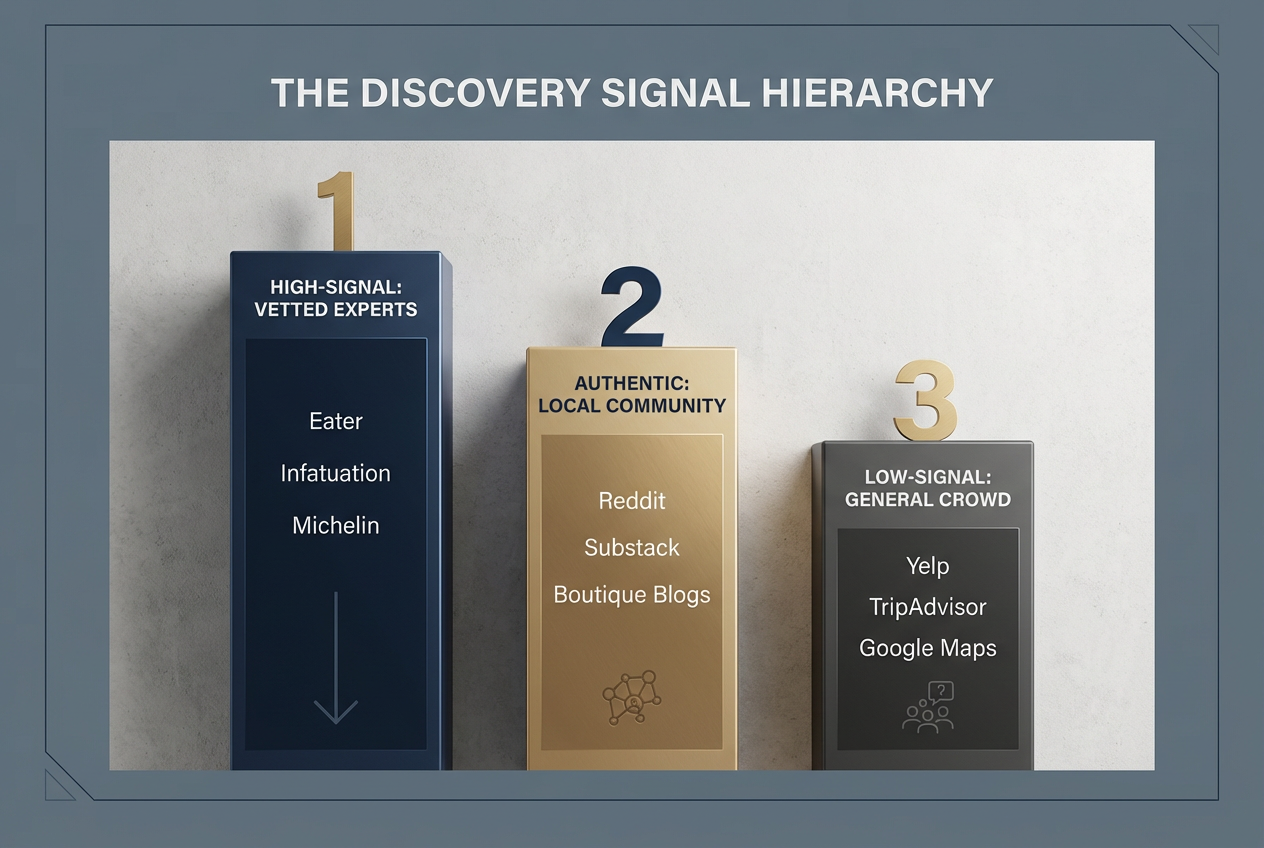
Not all data is created equal. Use this hierarchy to filter through the noise and prioritize high-signal sources that align with professional culinary standards.
The Vetted Trio: Your Core Discovery Stack
Start with Eater for temporal awareness. Their city-specific heatmaps aren't comprehensive guides - they're momentum indicators. When a restaurant appears on an Eater heatmap, it means something is happening right now. A chef has moved from an established kitchen to open something personal. A neighborhood that was a food desert six months ago suddenly has three openings worth your attention. Use it for reconnaissance, not for routine dining decisions.
The Infatuation solves a different problem: situational matching. Their guides are organized around use cases, not neighborhoods. "Where to impress your parents" is a fundamentally different query than "where to eat alone at the bar," and they understand that. Their decimal rating system (8.7, not just 4 stars) creates a gradient that actually means something. The difference between 8.2 and 8.7 is the difference between "good" and "I will plan my travel around eating here again."
Then there's the Michelin framework - not just the stars, but the Bib Gourmand category and the inspector notes. Michelin still represents something: technical excellence, consistency, a certain philosophy about service and progression. When you're in an unfamiliar city and you want a guaranteed exceptional experience, this is your foundation. The inspectors aren't perfect, but they're trained to evaluate the same technical elements you've learned to appreciate.
The Reddit Filter: Finding the Locals' Secret
But here's where it gets interesting. The absolute highest-signal source for ground truth is often hiding in plain sight: city-specific food subreddits. The trick is using the right search syntax. Try this: site:reddit.com [city name] best [cuisine type] -tourist -overrated.
What you're doing is filtering for community consensus among people who actually live there, who've eaten at these places multiple times, who know what the restaurant was like before it got featured in that travel magazine. The locals on r/FoodNYC or r/TokyoFood aren't trying to sell you anything. They're arguing with each other about whether the sushi at that counter in Shinjuku is still good now that the original chef retired.
Read the comment threads, not just the top post. Pay attention to disagreement - when someone says "that place fell off two years ago," that's valuable signal. Look for specific dishes, not general praise. "The duck ragu on Tuesday when Chef Sarah is working the line" is worth ten generic "great Italian food" recommendations.
The Pattern Recognition Layer
After six months of using these sources in parallel, you'll develop pattern recognition. You'll notice that certain chefs' names keep appearing. You'll recognize when a restaurant group has a consistent philosophy across multiple concepts. You'll spot the difference between hype and substance. You'll build a mental map of which food writers' taste profiles align with yours.
This isn't passive consumption of lists. This is active intelligence gathering. You're not asking "where should I eat?" You're asking "what's the signal telling me about this particular dining ecosystem right now?"
And when you find those high-signal sources, you need a system to track them. That's where the serious work begins, which is exactly what serious tools like a restaurant rating app can help you organize into something searchable and useful.
Phase 2: Situational Decision Making
Match dining choices to specific contexts using a three-point framework: vibe alignment, chef pedigree, and cultural value beyond the plate.
You've filtered the noise. You've identified high-signal sources. Now comes the harder question: which of these excellent options is right for this specific moment?
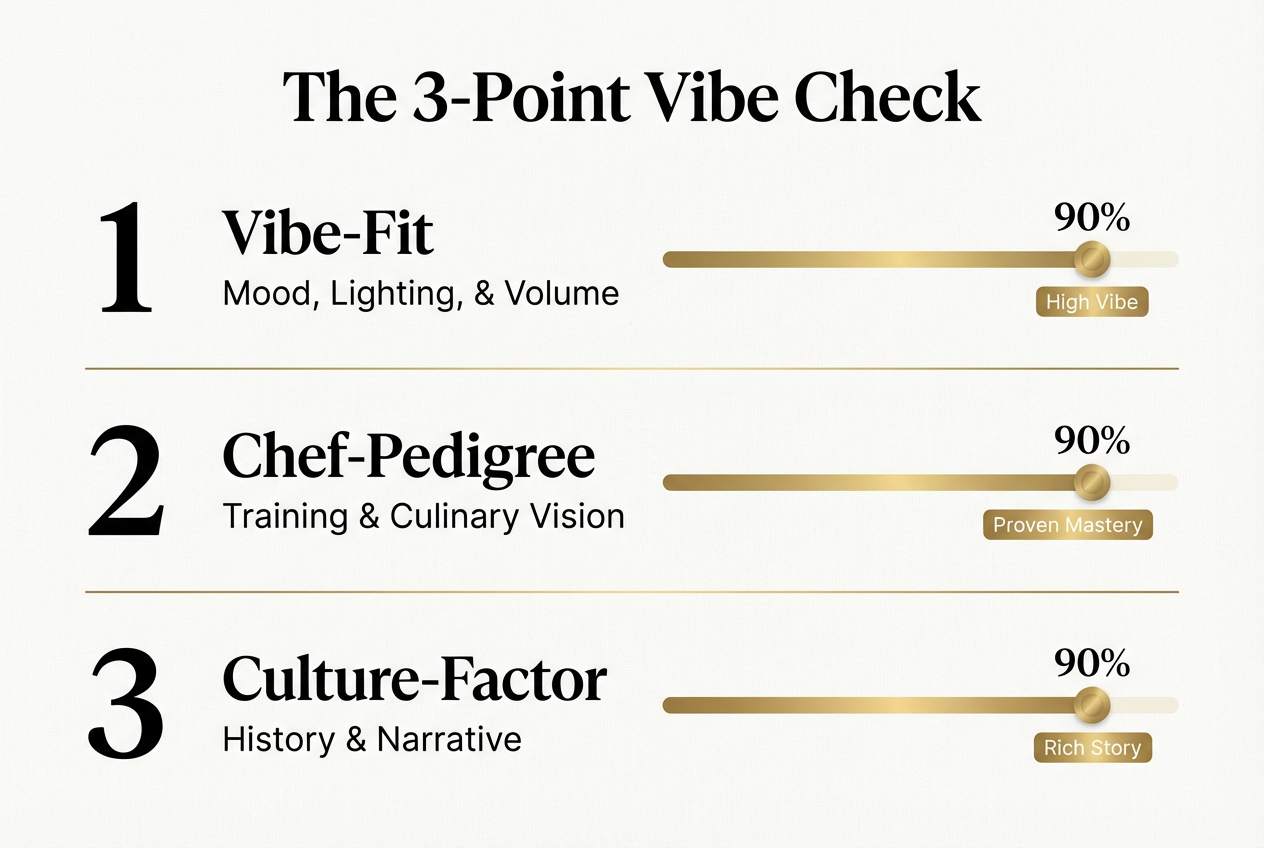
Move beyond the star rating. Use this three-point framework to ensure your chosen venue matches both your situational needs and your culinary expectations.
The Three-Point Check
This is where most people fail. They choose restaurants based on aggregate quality without considering context. But a transcendent omakase experience is wrong for a first date. A natural wine bar with small plates is wrong for your parents' anniversary. A Michelin-starred tasting menu is wrong for Thursday night when you just want to eat something delicious without ceremony.
Point One: Vibe-Fit
Ask yourself what kind of experience you're building. Are you looking for theater (tasting menu with progression and surprises) or comfort (the neighborhood spot where they know how you take your martini)? Do you want to be challenged (unusual ingredients, unfamiliar techniques) or do you want to taste a platonic ideal of something familiar (the best version of a classic dish)?
The physical space matters. Counter seating at a sushi bar is an entirely different experience than a table at the same restaurant. You're watching knife work, you're having micro-conversations with the chef between courses, you're part of the performance. A communal table at a wine bar means you're open to spontaneous conversation with strangers who might become friends. A corner booth means you're prioritizing privacy.
Time of day changes everything. The same restaurant at lunch and dinner can be two different concepts. Lunch service is often faster, less formal, sometimes a different menu entirely. Late-night service attracts industry people, the vibe shifts, the kitchen might be more willing to make you something off-menu if they recognize you as someone who understands food.
Point Two: Chef Pedigree
Where did the kitchen team train? This isn't snobbery - it's pattern recognition. A chef who staged at Eleven Madison Park and then opened a neighborhood bistro is bringing a specific technical vocabulary to casual food. Someone who came up through the Momofuku system has a different approach to flavor intensity than someone trained in classical French technique.
Look at the sous chef too. Often, the sous is doing the majority of the actual cooking, especially at mid-tier spots. If they've got someone from a Michelin kitchen working under a celebrity chef who's rarely on the line, that tells you something about what's actually going to arrive at your table.
Check if there's a dedicated pastry chef. If a restaurant takes dessert seriously enough to have a specialist rather than having the line cooks make three rotating options, that's a signal about overall ambition and attention to detail. The pastry department is often where you see the most creativity because it's less constrained by tradition.
Point Three: The "Third Space" Factor
This is the distinction between a restaurant and a dining experience. Does this place offer something beyond calories? Is there a cultural argument being made? Is the chef exploring their heritage, pushing a technique forward, making a statement about seasonality or sustainability?
The best places to eat offer what sociologists call a "third space" - neither work nor home, but a place where culture happens. The kind of spot where you might overhear a conversation that changes how you think about something. Where the playlist is carefully curated, not algorithmically generated. Where the staff can tell you why they're serving this particular natural wine with that specific dish, and the explanation reveals someone's actual thinking rather than marketing copy.
Look for restaurants with a philosophy, not just a menu. The ones that change their offerings based on what's actually in season rather than serving "summer vegetables" in January because customers expect them. The ones that are willing to serve you smaller portions if you want to taste more dishes. The ones that treat wine as part of the conversation, not an afterthought.
Making the Match
With these three points mapped, decision-making becomes clearer. You're not asking "is this restaurant good?" You're asking "is this restaurant right for what I need from this specific meal?"
Solo Tuesday night after a frustrating day at work? Counter seating at the izakaya where the chef recognizes you and will send over something interesting. Anniversary dinner? The tasting menu where they'll coordinate the whole experience so you don't have to think about anything except each other. Impressing a client? The Michelin spot with impeccable service and a wine list deep enough to show you know what you're doing.
When you start thinking this way, you realize you need different kinds of places in your rotation. The discovery spot where you're trying something new. The anchor where you're a regular. The special occasion venue you save for moments that deserve ceremony. Each serves a purpose, and understanding tools like the best restaurant review apps for foodies can help you build and maintain that rotation.
Phase 3: Solving "Camera Roll Amnesia"
Stop losing dining memories to the void. Build a searchable personal archive using tools that match your documentation style - minimalist narrative, social gamification, or obsessive data tracking.
Here's the painful truth: you've eaten at least fifty exceptional meals in the past three years that you can no longer remember clearly. You have vague sense-memories of a perfect piece of hamachi, but you couldn't tell someone where you ate it or what else was on that menu. You've got 237 photos of plates in your camera roll with no context, no date, no ability to search for "that place in Barcelona with the sea urchin."
This is the final piece of the dining operating system, and it's the one most people completely ignore. Discovery and decision-making are worthless if you can't build institutional memory. You need a system for capture, organization, and retrieval.
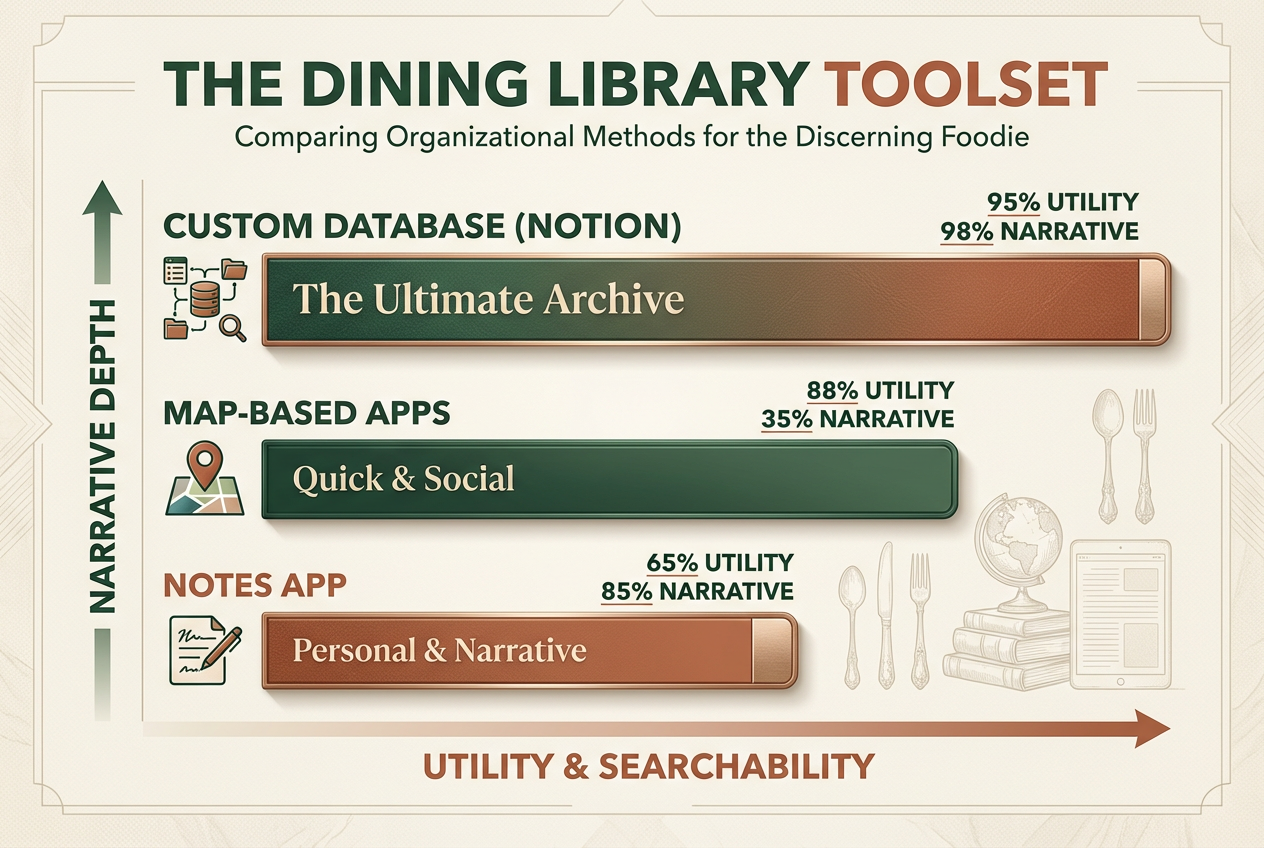
Selecting the right tool for your 'Dining Operating System' depends on whether you value quick social sharing or long-form culinary archiving.
Tool Evaluation: Find Your System
The tools you choose should match how your brain actually works. There's no universal solution. Some people are visual thinkers who need map-based organization. Others are narrative writers who want to capture stories. Some are data obsessives who want to track every variable.
The Notes App Approach: Minimalist Narrative
This is for the writers. The people who want to remember not just what they ate, but how they felt, who they were with, what conversation happened over dessert. Open a note immediately after the meal - before you pay the check, before you walk outside - and spend sixty seconds capturing three things: the standout dish, the context (who you were with, why you chose this place), and one specific detail you want to remember (the way the waiter described the wine, the texture of that sauce, the view from the table).
The strength of this approach is narrative richness. You're not just building a database, you're building a personal food memoir. The weakness is searchability. Six months later, you'll remember eating incredible ramen somewhere in Tokyo, but good luck finding which note contains that experience among two hundred entries.
You can improve this with consistent formatting. Start every entry with the restaurant name and neighborhood in bold. Add hashtags for cuisine type and occasion (#omakase #clientdinner). But you're still fighting against the limitations of a tool that wasn't designed for structured data.
Map-Based Apps: Visual and Social
Apps like Beli and Mapstr organize around geography. You can see all your saved places clustered on a map, which is incredibly useful when you're planning a trip or trying to remember what's in a specific neighborhood. These platforms add social layers - you can see where your friends ate, follow people with similar taste, build collaborative lists.
The social component is both strength and limitation. If you want to share recommendations with your dining crew, these tools are perfect. But if you're someone who views your dining archive as deeply personal, the constant nudge toward public sharing can feel intrusive. And the gamification elements (badges for trying new cuisines, streaks for regular logging) might motivate some people while annoying others who don't want their culinary journey reduced to achievement metrics.
These apps excel at the "where should we eat tonight?" use case. You're in a new neighborhood, you pull up the map, you see that you saved three spots nearby and your trusted friend marked two others. Decision made. But they're less useful for deep reflection or for tracking specific dishes rather than entire restaurants.
The Custom Database: Obsessive Documentation
For the true zealots, there's Notion or Airtable - tools that let you design exactly the data structure you want. You can create fields for restaurant name, neighborhood, cuisine type, price point, date visited, specific dishes ordered, wine pairings, who you went with, overall rating, dish-specific ratings, chef name, whether you'd return, and any other variable that matters to your decision-making.
This approach requires significant upfront design work and ongoing discipline. You're essentially building your own restaurant management system. But the payoff is incredible. You can search for "all the 10-point pasta dishes under $30 that I ate in 2024" and get an instant ranked list. You can track how your taste has evolved over time. You can build weighted scoring systems that account for different factors.
The barrier is commitment. If you're not naturally inclined toward systematic documentation, you'll abandon this after two weeks. But if you're the kind of person who keeps detailed travel journals or has a color-coded spreadsheet for your vinyl collection, this is your system. When you want to go deeper than consumer apps allow, exploring what makes the best restaurant tracker app can show you what's possible.
The One-Minute Post-Meal Reflection
Regardless of which tool you choose, the habit matters more than the platform. The critical moment is before you leave the restaurant. Before the experience blurs into generality. Before you forget which dish you ordered first or how the server described the preparation.
Here's the protocol: Before the check arrives, pull out your phone and capture three data points. One: the specific dish that will be the memory anchor for this meal. Not "the pasta was good" - "the cacio e pepe had a black pepper intensity that made my sinuses clear, the cheese emulsion was perfect, the pasta texture was just past al dente exactly how I like it." Two: one contextual detail about the experience beyond the food. The architecture, the music, the conversation you overheard, the way the kitchen was visible from your seat. Three: a simple decision - would you return, would you recommend this, is this a special occasion spot or a regular rotation place?
This takes 60 seconds. Maybe 90 if you're also snapping a photo. But it's the difference between having a record and having a void. It's the foundation of your personal culinary library.
Some people batch their documentation - they spend Sunday morning writing up the four meals they had that week. This works if you have exceptional memory and discipline. Most people don't. The longer you wait, the more the experiences blend together, the less distinctive each memory becomes. Document in real-time, even if it's just quick notes you expand later.
Your Dining Life as a Library
Transform dining from a series of isolated transactions into a curated collection of experiences you can search, revisit, and share with people who understand what makes a meal worth remembering.
The compound effect of this system reveals itself slowly. After six months, you've documented fifty meals with enough detail that you can actually remember them. After a year, you've got a personal database that rivals most published restaurant guides for the cities you frequent. After two years, you've built something genuinely valuable - not just to you, but to the small circle of people who share your standards.
You start noticing patterns you couldn't see before. You realize you've given 10-point scores to five different pasta dishes, and four of them came from chefs trained in a specific region of Italy. You discover that your favorite meals cluster around a particular price point - not the most expensive, but not cheap either - where ambition exceeds resources and creativity fills the gap. You see that you consistently rate solo counter dining experiences higher than table service, which maybe tells you something about how you want to relate to food.
Your archive becomes a tool for other people. When a friend visits your city, you don't send them a generic list. You ask three questions - what's the occasion, what's their budget, what did they think of that restaurant you both went to two years ago - and you pull up the three spots in your database that match those parameters. You send screenshots of your notes with specific dish recommendations. You've become a more useful resource than any published guide because you've calibrated your recommendations to their specific taste profile.
You stop having amnesia about your own culinary history. Someone mentions a restaurant, and instead of that vague "I think I went there once?" uncertainty, you can pull up your notes and say "Yeah, March 2023, I had the duck confit, it was technically perfect but underseasoned for my taste, I gave it an 8.2." You can track how restaurants evolve over time, noticing when a chef change affects quality or when a spot that was transcendent becomes merely good.
The relationship to dining itself changes. You become more present during meals because you know you're going to document them. You pay closer attention to technique, to flavor balance, to how a dish is structured. You ask more questions of servers and chefs because you want to understand the thinking behind the food. You start recognizing specific purveyors' ingredients at different restaurants because you've been documenting sourcing.
This is the evolution from casual diner to serious foodie - not defined by how much you spend or how many Michelin stars you collect, but by the intentionality of your engagement with food culture. You're not consuming, you're participating. You're not chasing novelty, you're building a library. You're treating your dining life as something worth curating, documenting, and preserving.
And when you do find those exceptional places - the ones that make you rethink what's possible, the ones you'll remember for years - you have a system to ensure they don't disappear into the fog of memory. You've built infrastructure for the moments that matter. That's what separates casual eating from a serious practice.
The tools exist. The frameworks work. The only remaining question is whether you're ready to stop losing your dining history to the void and start building something permanent. Whether you're ready to treat your relationship with food as something that deserves the same systematic attention you give to your career, your fitness, your other cultural pursuits.
For those looking to implement this system immediately, platforms focused on helping serious diners track and rank their meals offer ready-made infrastructure. The architecture is there. You just need to commit to using it.
Frequently Asked Questions
What makes a restaurant "high-signal" versus generic?
High-signal sources have three characteristics: editorial gatekeeping by people with culinary training or extensive dining experience, specific rather than general recommendations, and a clearly articulated point of view about what makes food excellent. Generic sources optimize for engagement and advertising revenue, leading to the "4.5 stars for everything decent" problem. The difference is curation versus aggregation - someone made active choices about what to include rather than letting an algorithm surface whatever gets the most clicks.
How do I know if a restaurant is worth documenting in my archive?
Document everything initially, then develop your own threshold over time. Some people archive every meal; others only record experiences that score above a certain threshold or introduce them to something new. The key question is "will I want to remember this six months from now?" If the answer is yes - either because it was exceptional or because it taught you something about your taste - it belongs in your archive. Over time, you'll develop intuition for what's worth the documentation effort.
Should I use different tools for discovery versus documentation?
Yes, and this is where most people's systems break down. Discovery tools (Eater, The Infatuation, Reddit) are optimized for finding new places to eat. Documentation tools (notes apps, mapping platforms, databases) are optimized for remembering where you've been. Trying to use Yelp for both discovery and personal tracking leads to confusion and abandonment. Build a deliberate workflow: discover on expert platforms, decide using your situational framework, document in your chosen archive tool. The separation keeps each tool focused on what it does best.
How can I avoid the "too many bookmarks" problem where I save everything but go nowhere new?
Implement a conversion rate goal. If you're bookmarking 20 restaurants per month but only actually visiting 2, your discovery-to-action ratio is broken. The fix is adding friction to bookmarking - only save places that pass your three-point framework, not everything that sounds vaguely interesting. Better yet, create a "next five" list that you commit to visiting before adding anything new. The point isn't to accumulate possibilities; it's to have curated experiences. Resources focused on organizing your dining discoveries can help you maintain that discipline.
What should I do when my favorite restaurant declines in quality?
Document the decline specifically. Note what changed - new chef, different suppliers, altered menu - and adjust your rating accordingly. This is valuable data. If a restaurant that was consistently excellent drops to merely good, that tells you something about what made it special in the first place. Update your archive, inform your trusted dining circle, and decide whether to give them another chance in six months or move on. Your archive isn't static; it's a living document that reflects the reality of how restaurants evolve.
How do I build a dining community with similar standards?
Start by sharing your documentation selectively with people whose taste you respect. When someone recommends a place you love, that's a signal of alignment. Build your circle gradually, prioritizing quality over quantity. The best dining communities are small - five to ten people who've calibrated their communication so that when someone says "this is exceptional," everyone else knows what that means relative to their shared reference points. Focus on reciprocity: share your discoveries, visit their recommendations, and be honest about what works for your palate and what doesn't.
Is it worth tracking individual dishes or just restaurants?
Track both, but with different levels of detail. Every restaurant entry should include your overall impression and whether you'd return. But for the standout dishes - the ones that make you stop mid-bite - add granular notes. These become your actual search targets six months later when you're trying to remember where you had that perfect uni or that incredible duck. Dish-level documentation is what transforms a restaurant list into a genuine culinary archive. When you're ready to implement this level of detail, exploring comprehensive food diary app features shows you what's possible beyond basic logging.
How often should I revisit and update my restaurant archive?
Review quarterly at minimum, more often if you're eating out frequently. Look for patterns in your ratings, identify restaurants you haven't visited recently but used to love, and purge places that have closed or permanently declined. Your archive should reflect current reality, not historical enthusiasm. This review process also helps you notice gaps - maybe you've been overindexing on Italian and ignoring Japanese, or you've been avoiding a neighborhood that actually has three saved spots you've never visited. The archive is a tool for decision-making, not just passive record-keeping.