
The Connoisseur's Guide to Fast Food: Treating Drive-Thrus Like Dining Destinations
John the smoothie monster
John lives for smoothie bowls and cold-pressed juices. He uses Savor to remember his best blends.
The Connoisseur's Guide to Fast Food: Treating Drive-Thrus Like Dining Destinations Fast food deserves more than dismissive sneers from serious food...
The Connoisseur's Guide to Fast Food: Treating Drive-Thrus Like Dining Destinations
Fast food deserves more than dismissive sneers from serious food lovers. When you approach a Culver's ButterBurger or Popeyes spicy chicken sandwich with the same analytical rigor you'd apply to a $200 tasting menu, you discover something remarkable: fast food can deliver genuine culinary moments worth documenting, remembering, and repeating. This guide shows you how to evaluate, customize, and archive your fast food experiences using professional food criticism frameworks.
Table of Contents
- The Camera Roll-Worthy Hierarchy: 15 Items Ranked by Foodie Cred
- The Pro-Move Matrix: Customization Beyond Secret Menus
- The Documentation Method: Building a Searchable Food Archive
- April 2026 Trend Report: Culture vs. Fuel
- The Fast Food Metadata Index: Lore Worth Knowing
- Frequently Asked Questions
The Camera Roll-Worthy Hierarchy: 15 Items Ranked by Foodie Cred
BLUF: These 15 fast food items earn their place in your culinary memory based on texture integrity, visual consistency, and actual innovation, not price or convenience.
The problem with most fast food rankings is they evaluate the wrong metrics. You don't care if something costs $2.99 or arrives in 90 seconds. You care whether the experience is worth the caloric investment and whether you'll remember it three months from now when your camera roll has been buried under 2,000 new photos.
This hierarchy uses three weighted criteria: Mouthfeel Complexity (40%), Photogenic Consistency (30%), and Culinary Innovation (30%). These aren't arbitrary. They reflect what actually makes a fast food item memorable for someone who thinks critically about food.
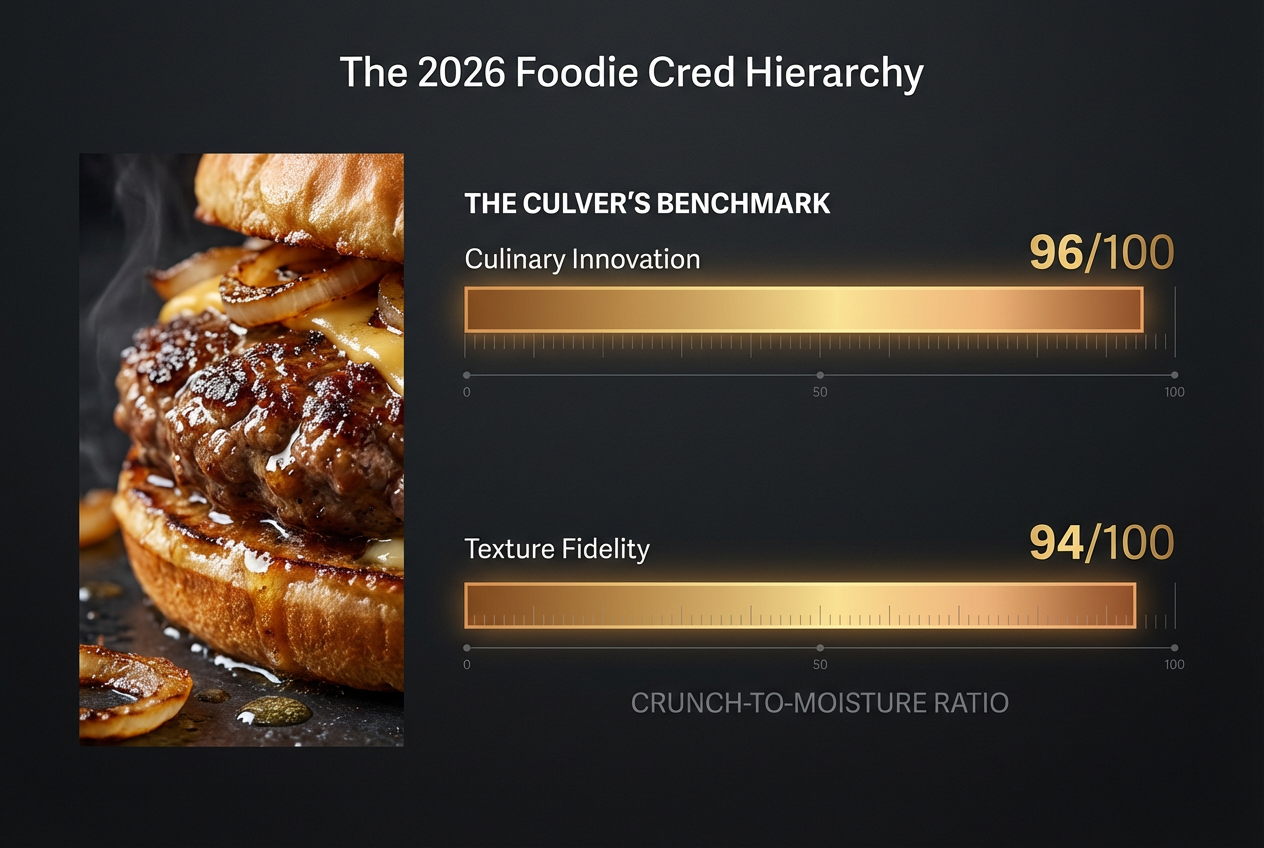 Evaluate your next meal with the 'Foodie Cred' hierarchy. This framework ranks iconic items based on analytical culinary metrics rather than just price or speed.
Tier 1: The Pantheon (9.0-10.0 Foodie Cred Score)
1. Culver's ButterBurger Deluxe (9.8/10)
The ButterBurger represents Midwestern restraint meeting technical excellence. The patty receives a proper sear on a flat-top griddle, creating actual Maillard reaction complexity rather than the gray steamed texture you get at most chains. The bun gets buttered and toasted, adding a textural counterpoint that matters.
What makes this Pantheon-worthy is consistency. Order this in Madison or Miami and you'll get the same craggy crust, the same butter-soaked bun structure, the same clean beef flavor. For food documentation purposes, this item photographs identically across locations, making it perfect for comparison tracking.
Technical Note: The beef is never frozen, which affects the moisture gradient during cooking. You get actual juice rather than released ice crystals.
2. Popeyes Spicy Chicken Sandwich (9.7/10)
This isn't hyperbole: Popeyes engineered a better fried chicken sandwich than most standalone restaurants. The breading-to-meat ratio sits at roughly 1:4, which is the professional standard for maintaining crunch without overwhelming the protein.
The craggy texture comes from a buttermilk marinade that creates uneven coating adhesion, exactly like you'd do at home if you were serious about fried chicken. The pickles provide genuine acidity, not the faint vinegar suggestion you get elsewhere.
Cultural Context: Introduced August 2019, this sandwich sparked actual supply shortages and a cultural moment documented by The New York Times food section. That's rare for fast food.
3. In-N-Out Double-Double Animal Style (9.5/10)
The Double-Double works because In-N-Out understands something most chains ignore: beef quality matters even when you're serving it in a paper wrapper. The meat is never frozen, hand-leafed lettuce is used instead of shredded iceberg, and the sauce recipe hasn't changed since 1948.
Animal Style adds grilled onions (actual caramelization, not raw), extra sauce, and pickles. The modification creates a third texture layer between the meat and the bun, preventing the structural collapse that ruins most loaded burgers.
Why It Photographs Well: The cross-section reveals distinct strata: bun, sauce, lettuce, meat, cheese, onions, meat, bun. This visual clarity makes it archivable.
Tier 2: The Worthy (7.5-8.9 Foodie Cred Score)
4. Shake Shack ShackBurger (8.8/10)
Shake Shack brought the smash burger technique to fast food before it became ubiquitous. The patty gets pressed hard onto a flat-top at high heat, creating maximum crust surface area. The potato bun has enough structure to handle the juice without dissolving.
The ShackSauce (a riff on Russian dressing) actually complements rather than masks the beef. This sounds basic, but most fast food condiments exist to cover up mediocre ingredients.
5. Chick-fil-A Original Chicken Sandwich (8.6/10)
The original remains superior to all the spicy/deluxe variants they've introduced. The chicken gets a pressure-fryer treatment that keeps it genuinely moist while maintaining exterior crunch. The pickle-bun-chicken simplicity is a case study in restraint.
Technical Achievement: Chick-fil-A's supply chain maintains cold-chain integrity from farm to restaurant, which is why the chicken tastes consistent rather than freezer-burned.
6. McDonald's Hash Brown (8.5/10)
Introduced in 1977, the McDonald's hash brown is essentially a perfect rösti executed at industrial scale. The exterior achieves genuine crispness through a par-frying process, while the interior maintains potato structure rather than turning to mush.
What makes this documentation-worthy is the golden ratio: roughly 60% crispy exterior surface area to 40% fluffy interior. Most hash browns are either all crust or all mush.
7. Taco Bell Crunchwrap Supreme (8.3/10)
The Crunchwrap is an engineering marvel. It's a hexagonal grilled tortilla containing a tostada shell, seasoned beef, nacho cheese, lettuce, tomato, and sour cream, all folded using a specific origami-style technique that prevents structural failure.
From a food documentation perspective, the cross-section is spectacular: you can identify every component layer in a single photo.
8. Five Guys Cajun Fries (8.1/10)
Five Guys cuts potatoes in-house daily, which is unusual enough in fast food to merit attention. The Cajun seasoning isn't subtle, but that's the point. The fry structure maintains integrity even under heavy seasoning because they're blanched before frying.
Portion Note: Five Guys deliberately overfills the cup and dumps extra fries in the bag, which affects the value calculation but also impacts temperature retention and crispness decay.
Tier 3: The Solid (6.0-7.4 Foodie Cred Score)
9. Wendy's Spicy Chicken Nuggets (7.3/10)
Wendy's uses actual chicken breast pieces rather than mechanically separated poultry paste. The spice blend includes cayenne and jalapeño, providing heat that builds rather than hitting all at once.
10. Chipotle Carnitas Bowl (7.1/10)
Chipotle's carnitas represent fast-casual done right: pork shoulder braised until it shreds, then crisped on a flat-top. The twice-cooked technique is legitimate, not a shortcut.
11. Raising Cane's Chicken Fingers (6.9/10)
Raising Cane's does exactly one thing, which means they've optimized it. The chicken is hand-battered and cooked to order. The Cane's Sauce is basically fancy mayonnaise, but the consistency is notable.
12. Del Taco Beyond Tacos (6.7/10)
Del Taco's plant-based offering is interesting because they treat it like actual meat rather than a novelty. The Beyond meat gets proper seasoning and searing, which many fast food chains skip.
13. White Castle Sliders (6.5/10)
These tiny burgers have been essentially unchanged since 1921. The patties are steamed over onions, creating a distinctive texture and aroma. You either love this or hate it, but the consistency across a century is worth documenting.
14. Arby's Classic Roast Beef (6.3/10)
Arby's roasts actual beef in-house and slices it to order. This sounds basic, but most "roast beef" fast food is pre-sliced and reheated. The Arby's Sauce provides a tangy counterpoint to the salty beef.
15. KFC Original Recipe (6.0/10)
The 11 herbs and spices remain a trade secret, but what matters more is the pressure-frying technique. KFC's chicken has a specific texture memory for anyone who grew up eating it, which gives it cultural value beyond pure culinary merit.
The Pro-Move Matrix: Customization Beyond Secret Menus
BLUF: Secret menus are marketing stunts. Real customization requires understanding the underlying ingredients and kitchen capabilities at each chain.
The "secret menu" phenomenon is mostly nonsense. Most fast food workers don't know these supposed secret items, and even when they do, the execution varies wildly. What actually works is understanding the component inventory at each chain and requesting logical combinations that don't disrupt kitchen workflow.
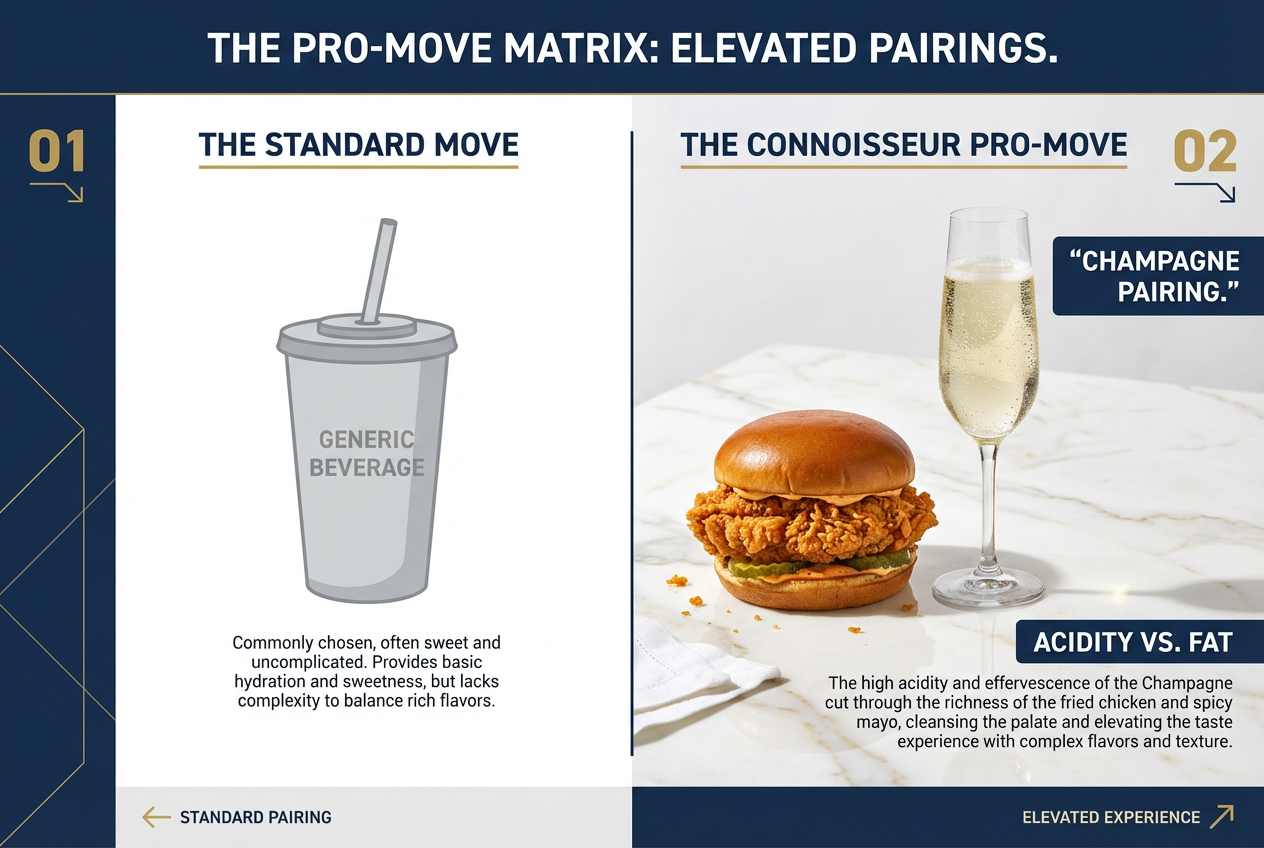 Upgrade your experience with the Pro-Move Matrix. By pairing high-end acidity with traditional fats, you can transform a standard drive-thru meal into a culinary event.
In-N-Out: Beyond Animal Style
The Whole Grilled Onion Hack: Request whole grilled onions instead of the standard chopped version. The larger pieces provide more pronounced sweetness and better textural contrast. They take longer to cook, so order this when you have time.
The Well-Done Fries + Chopped Chilis: In-N-Out fries are notoriously inconsistent because they're cut fresh and fried only once. Request "well-done" to ensure crispness, then add chopped yellow chilis for heat and acidity. This combination masks the occasional undercooking while adding complexity.
The Protein Style with Mustard Grilled Patty: If you're skipping the bun, request a mustard-grilled patty (they apply mustard during cooking, creating a slight crust). The lettuce wrap becomes less sad when the meat has actual flavor development.
Popeyes: The Louisiana Kitchen Advantage
The Biscuit + Blackened Ranch Pairing: Popeyes biscuits are aggressively buttery, which means they pair beautifully with high-acid beverages. If you're being serious about this, bring a split of Champagne or a crisp Albariño. The yeast and butter in the biscuit mirror the autolytic character in good Champagne.
Technical Note: Popeyes biscuits are best consumed within 10 minutes of purchase. The butter content means they go stale faster than typical fast food breads.
The Red Beans and Rice as Sauce: Order a side of red beans and rice, then use it as a condiment for your chicken sandwich. The creaminess and spice complexity elevate the sandwich beyond its standard configuration.
Chipotle: The Build Order Matters
The Strategic Layering Technique: Most people let Chipotle workers pile ingredients randomly. Request this order: rice (barrier layer), beans (second barrier), meat, salsa, cheese, sour cream, guacamole, lettuce. This prevents bottom-layer sogginess and ensures structural integrity.
The Sofritas with Carnitas Mix: Request half sofritas, half carnitas. The tofu soaks up the pork fat while maintaining its texture, creating a superior protein experience to either ingredient alone.
The Beverage Pairing Framework
Fast food deserves better than whatever's in the soda fountain. Here's what actually works:
Fried Chicken + High-Acid Whites: Popeyes or Chick-fil-A chicken pairs with Champagne, Chablis, or Grüner Veltliner. The acidity cuts through the fat while the minerality complements the salt.
Burgers + Amaro: A proper smash burger pairs beautifully with Fernet-Branca or Cynar. The herbal bitterness cleanses the palate between bites while the alcohol helps dissolve fat molecules.
Breakfast Items + Coffee (But Specific Coffee): McDonald's hash browns pair with Ethiopian natural-process coffee. The berry notes complement the potato sweetness while the acidity balances the salt.
The Documentation Method: Building a Searchable Food Archive
BLUF: Your camera roll is a graveyard for food memories. This three-photo framework plus a structured note template transforms random snapshots into a searchable culinary database.
The real problem with fast food appreciation isn't the food, it's the memory problem. You eat something exceptional at a Culver's in Milwaukee, take a blurry photo, and six months later you can't remember which location it was or what made it special. Your camera roll contains 47 burger photos that all look identical.
Professional food critics solve this with structured documentation. You can do the same thing with your phone if you commit to a simple framework. Much like the best food review apps help you organize restaurant experiences, this method ensures your fast food discoveries never get lost.
Never lose a food memory again. This three-shot framework ensures your camera roll becomes a searchable, professional-grade database of your cultural culinary discoveries.
The Three-Photo Standard
Photo 1: The Cross-Section
Cut the item in half and photograph it straight on with good lighting. This reveals structure, ingredient ratios, and execution quality. A cross-section shows you whether the burger patty is actually medium or just gray, whether the chicken sandwich has proper breading adhesion, whether the burrito maintained proper layering.
Technical Requirements:
- Natural light or warm artificial light (avoid fluorescent)
- Shoot at eye level to the cut surface
- Include a reference object for scale (a standard fork works)
- Focus on the center of the cross-section
Photo 2: The Wrapper/Packaging
Photograph the branded packaging before you unwrap it. This seems obvious but most people skip it. The wrapper provides crucial metadata: chain name, location (if printed), date codes, and item specifics.
Six months later when you're trying to remember where you had that perfect spicy chicken sandwich, the wrapper photo tells you it was Popeyes, not Chick-fil-A. This matters more than you think.
Photo 3: The Context
Photograph where you ate it. The car interior, the specific restaurant exterior, the street corner, the beach parking lot. Context triggers memory more powerfully than the food itself.
When you're building a personal food archive, environmental context separates generic experiences from specific memories. That In-N-Out burger tastes different when you ate it in your car overlooking the Pacific versus in a parking lot in Phoenix.
The Notes App Template
Copy this template into your phone's notes app. Fill it out immediately after eating, while the experience is fresh.
ITEM: [Specific menu item name]
CHAIN: [Restaurant name]
LOCATION: [City, State, Specific address if notable]
DATE: [MM/DD/YYYY]
TIME: [Helps identify which shift prepared it]

FOODIE CRED SCORE: [Your rating out of 10]

TEXTURE NOTES:
- Crust/exterior:
- Interior/filling:
- Structural integrity:

FLAVOR PROFILE:
- Primary flavors:
- Seasoning level:
- Notable ingredients:

MODIFICATIONS REQUESTED:
[List any customizations]

WOULD I REORDER: Yes/No
SPECIFIC NOTES: [What made this memorable or forgettable]

PHOTO NUMBERS: [Note which photos correspond to this entry]
This template forces you to think analytically about what you're eating rather than just consuming it mindlessly. The act of filling it out trains your palate to notice details you'd otherwise miss.
The Searchability Trick
After you complete the template, copy it into a cloud-based document or use a dedicated food tracking app. Many serious food lovers use restaurant tracking apps to organize their dining histories, but a simple Google Doc works if you're consistent about updating it.
The key is making your notes searchable. When you want to remember that perfect hash brown you had somewhere in the Midwest two years ago, you can search "hash brown AND crispy AND 9/" and find it instantly.
The Anti-Yelp Philosophy
Generic review platforms fail fast food because they treat everything the same way. A one-star review of McDonald's because "it's fast food" tells you nothing. A five-star review because "the fries were hot" tells you nothing.
Your personal documentation system should focus on specifics: the sear on that particular burger, the breading crunch on that specific batch of chicken, the temperature of those exact fries. This is closer to how professional critics work, focusing on execution details rather than vague impressions.
If you're interested in more sophisticated approaches to food reviews, building a personal archive with technical standards will transform how you eat and remember food.
April 2026 Trend Report: Culture vs. Fuel
BLUF: Most limited-time offerings are marketing noise. Here's how to identify the few items worth documenting versus the forgettable calorie delivery systems.
Fast food chains release dozens of new items monthly. Most are reconfigured versions of existing ingredients designed to generate social media buzz rather than advance the culinary conversation. Your job as a discerning eater is to separate Culture (items worth your attention and documentation) from Fuel (items that exist only to fill stomachs).
The "Big Arch" Analysis (McDonald's, April 2026)
McDonald's recently introduced the "Big Arch," a supersized burger targeting the same market as the Big Mac but with different architecture. The question isn't whether it's good (it's fine), but whether it's culturally significant enough to document.
Culture or Fuel Verdict: Fuel
The Big Arch uses the same beef patties, same special sauce, same cheese as existing menu items. The only innovation is scale and configuration. Unless you're specifically researching McDonald's menu evolution, this doesn't merit space in your culinary archive.
Exception: If you're doing a comparative study of McDonald's burger architecture across decades, the Big Arch represents their 2026 attempt to compete with Five Guys and Shake Shack portion sizes.
The "Crispalupa" Analysis (Taco Bell, March 2026)
Taco Bell's Crispalupa wraps a chalupa shell in a layer of crispy cheese, essentially creating a taco with a Parmesan crisp exterior. This is interesting from a textural engineering perspective.
Culture or Fuel Verdict: Culture (Tentatively)
The Crispalupa represents actual innovation in fast food texture layering. The cheese crisp adds a legitimate third texture dimension that doesn't exist in standard Taco Bell items. Worth trying once and documenting if the execution is consistent across locations.
Caveat: Limited-time items often suffer from inconsistent execution because employees haven't mastered the technique. Order this early in the promotional period when training is fresh.
The Framework for Evaluating New Items
When a new fast food item launches, ask these questions before deciding whether to document it:
1. Does it introduce a genuinely new texture or flavor combination?
- Example: When Popeyes introduced their chicken sandwich, the answer was yes (buttermilk-brined chicken on a potato bun with pickles was uncommon in fast food).
- Counter-example: Most "spicy" versions of existing items just add cayenne to the same base recipe.
2. Does it require new kitchen equipment or techniques?
- Items that force chains to change their cooking process often represent meaningful innovation.
- Items that just recombine existing ingredients rarely do.
3. Will this exist in six months?
- If it's genuinely good, chains usually keep it. The Popeyes chicken sandwich was supposed to be limited-time; customer demand made it permanent.
- If it disappears after the promotional period, it was probably just marketing.
4. Does it photograph distinctively?
- Your future self needs to be able to distinguish this item from similar ones in your archive.
- If the cross-section looks identical to three other items, it's probably not worth documenting.
Current Items Worth Tracking (April 2026)
Shake Shack Hot Chick'n (Permanent Addition, February 2026) This is Shake Shack's first permanent spicy chicken sandwich. The differentiator is the proprietary hot sauce blend and a shatteringly crisp coating. Worth documenting because Shake Shack's supply chain quality typically ensures consistency across locations.
Chipotle Smoked Brisket (Limited Regional Test) Currently available only in select California locations. The brisket receives actual smoking rather than just liquid smoke flavoring. If you're in the test market, document this because if it goes national, the quality may decline.
Culver's Pretzel Bites with Wisconsin Cheese Sauce (Seasonal) These appear periodically and represent Culver's commitment to Wisconsin food culture. The cheese sauce is real Wisconsin cheddar, not processed cheese product. Document if you care about regional fast food variations.
The Fast Food Metadata Index: Lore Worth Knowing
BLUF: Knowing when items were introduced, who designed them, and their regional origins transforms eating into cultural literacy.
Professional food critics know provenance. The same standard applies to fast food if you're serious about it. These historical details aren't trivia, they're context that deepens your appreciation and helps you understand why certain items taste the way they do.
Introduction Dates That Matter
McDonald's Egg McMuffin (1972): Invented by Herb Peterson, a McDonald's franchise owner in Santa Barbara. Peterson was trying to create a portable version of eggs Benedict. The English muffin, Canadian bacon, cheese, and egg structure remains essentially unchanged after 54 years.
Taco Bell Crunchwrap Supreme (2005): Developed in Taco Bell's test kitchen to create a handheld item that wouldn't fall apart. The hexagonal fold pattern is engineering-driven, not aesthetic.
Shake Shack ShackBurger (2004): Danny Meyer's attempt to create an "enlightened" burger stand. The original location in Madison Square Park was a summer-only hot dog cart that evolved into a permanent structure due to demand.
Popeyes Spicy Chicken Sandwich (2019): Launched after internal testing showed it consistently beat competitor sandwiches in blind tastings. The initial shortage wasn't a marketing stunt; Popeyes genuinely underestimated demand.
Regional Origin Stories
In-N-Out (Baldwin Park, California, 1948): The first drive-thru burger stand in California. The limited menu philosophy (burgers, fries, drinks, nothing else) has remained constant for 78 years.
Culver's (Sauk City, Wisconsin, 1984): Founded by the Culver family to showcase Wisconsin ingredients. The ButterBurger concept came from Wisconsin's butter culture, not from trying to differentiate in a crowded market.
Whataburger (Corpus Christi, Texas, 1950): The oversized burger format reflected Texas portion expectations. The distinctive A-frame architecture was designed to be visible from highways.
Chef/Developer Attribution
Most fast food items are developed by corporate test kitchen teams rather than individual chefs, but some have specific creators worth noting:
Jim Delligatti (Big Mac inventor, 1967): A Pittsburgh franchise owner who created the Big Mac to compete with the Big Boy double-decker burger popular in the region.
Herb Peterson (Egg McMuffin inventor, 1972): The same franchise owner who later helped develop McDonald's breakfast platform.
Glen Bell (Taco Bell founder, 1962): Observed long lines at a Mexican restaurant across from his hot dog stand, reverse-engineered the recipes, and created an assembly-line format for Mexican-inspired fast food.
The Supply Chain Details That Affect Taste
In-N-Out's Centralized Distribution: In-N-Out only operates within a few hundred miles of their California distribution centers because they refuse to freeze beef. This geographic limitation is a feature, not a bug.
Chick-fil-A's Vertical Integration: Chick-fil-A contracts directly with specific chicken farms and monitors the entire supply chain. This is why their chicken tastes consistent rather than generic.
Five Guys' Potato Sourcing: Five Guys displays signs showing which farm supplied that week's potatoes. The variety changes based on seasonal availability, which is why fries taste slightly different throughout the year.
Understanding these details helps you evaluate quality variations. If your In-N-Out burger tastes off, it's not a corporate-wide problem; it's that specific location. If your Chick-fil-A chicken tastes different than usual, something unusual happened in their supply chain.
Similar to how Japan food review apps help you understand regional food cultures, knowing fast food metadata transforms eating from consumption into cultural education.
Frequently Asked Questions
What makes a fast food item worth documenting versus just eating?
An item earns documentation when it demonstrates consistent execution quality, distinctive flavor or texture profiles, or cultural significance beyond basic sustenance. The documentation test is simple: if you wouldn't remember this specific meal three months from now without photos and notes, it's probably just fuel rather than culture. Items worth documenting typically score above 7.0 on the Foodie Cred scale and show meaningful differentiation from generic versions of the same food type.
How do you evaluate fast food objectively when everyone has nostalgic preferences?
Nostalgia is legitimate context, not a bias to eliminate. Professional evaluation separates execution quality (how well was this specific item prepared) from personal preference (do I like this style of food). Document both dimensions separately. You might give McDonald's fries a 9.0 for execution consistency while noting you personally prefer hand-cut fries. Your archive should capture both the objective quality and your subjective response, making it more useful than generic five-star ratings.
Which fast food chains maintain the most consistent quality across locations?
In-N-Out and Chick-fil-A demonstrate the highest consistency, primarily because both maintain strict supply chain control and limited geographic expansion. Culver's runs a close third due to their franchise training systems. Chains with the most variation include Burger King, Taco Bell, and KFC, where execution quality depends heavily on individual location management and staffing. When building your food archive using approaches similar to restaurant review apps for foodies, always note the specific location, not just the chain.
How do you customize fast food orders without annoying the kitchen staff?
Request modifications that use existing ingredients and don't disrupt workflow timing. Good customizations: extra pickles, well-done fries, grilled versus raw onions, sauce on the side. Problematic customizations: items from different menu sections combined, ingredient substitutions requiring new prep, complex multi-step modifications during rush periods. The key is understanding what's already in the kitchen versus what would require special preparation. Most workers appreciate specific, polite requests rather than vague demands like "make it better."
What's the best way to photograph fast food for documentation purposes?
Use the three-photo framework: cross-section (reveals structure and ingredient quality), packaging (provides identifying metadata), and context (captures environmental details that trigger memory). For the cross-section, cut cleanly with a sharp knife, shoot in natural light at eye level to the cut surface, and ensure focus on the center layers. Avoid overhead shots unless the item is intentionally designed for that angle (like a pizza or salad bowl). Most importantly, shoot immediately before eating, as fast food deteriorates rapidly.
How do limited-time offerings factor into a serious fast food documentation strategy?
Most limited-time offerings are reconfigured existing ingredients designed for social media buzz rather than culinary innovation. Document them only if they introduce genuinely new textures, require new cooking equipment or techniques, or represent meaningful regional variations. The Popeyes blackened chicken tenders (requires a separate seasoning blend and different cooking time) merited documentation. The McDonald's "Travis Scott Meal" (existing items with custom packaging) did not. Your archive should focus on items with staying power or genuine innovation.
Should you use apps to track fast food or just maintain manual notes?
Dedicated food tracking systems work best when you're documenting across multiple restaurant types, not just fast food. For fast food specifically, a structured notes template in a searchable cloud document provides sufficient organization without platform lock-in. The advantage of manual notes is customization: you can track metrics that matter to you (crispness retention after 10 minutes, packaging sustainability, drive-thru wait times) rather than being limited to star ratings. If you do want app-based tracking, look for platforms that allow custom fields and rich media uploads similar to food diary apps with context features.
What beverage pairings actually work with fast food beyond soda?
High-acid white wines (Champagne, Chablis, Albariño) pair exceptionally with fried chicken because the acidity cuts fat while minerality complements salt. Amaro and herbal liqueurs (Fernet-Branca, Cynar) work with burgers by providing palate-cleansing bitterness between bites. For breakfast items, match coffee roast profiles to food: Ethiopian natural-process coffees pair with hash browns, while darker roasts complement sausage items. Beer is obvious but often wrong: most fast food is already heavy and salty, so light lagers or sour beers work better than IPAs or stouts.