
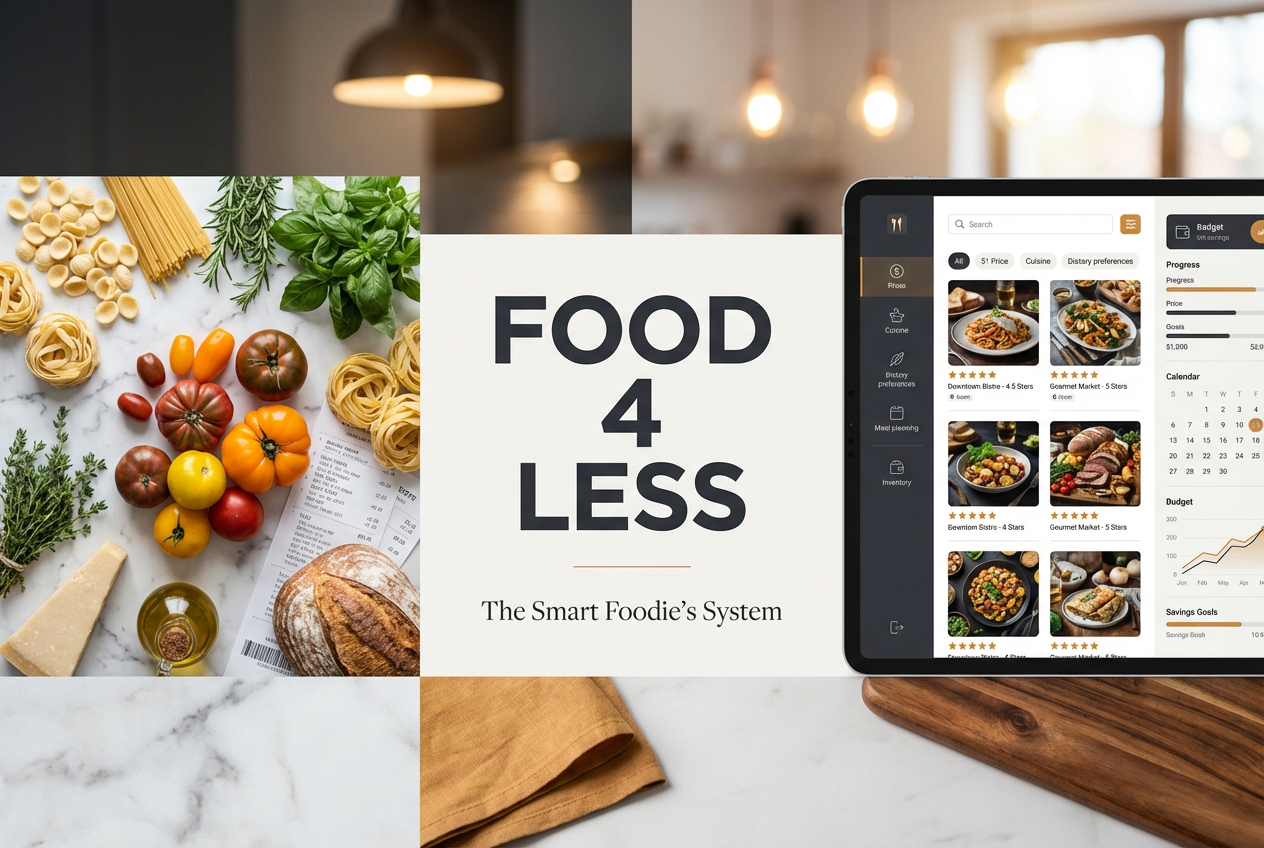
The Serious Foodie's Guide to Food 4 Less: Dining Smart Without the Burnout
Alex the juice queen
Alex hunts for the best juice bars and presses. She rates every sip and saves her favorites in Savor.
The Serious Foodie's Guide to Food 4 Less: Dining Smart Without the Burnout You've got 4,000 photos of pasta on your phone, but ask yourself which one...
The Serious Foodie's Guide to Food 4 Less: Dining Smart Without the Burnout
You've got 4,000 photos of pasta on your phone, but ask yourself which one was from that hidden gem in the West Village, and you'll spend five minutes scrolling through thumbnails before giving up. Meanwhile, your friends keep asking for recommendations, and all you can offer is "somewhere near the park, I think?" This isn't a memory problem. It's a system problem.
The phrase "Food 4 Less" typically conjures images of discount grocery aisles, but for the serious foodie who dines out four times a week, it represents something more profound: a philosophy of eating exceptionally well without the financial hemorrhaging or mental clutter that usually accompanies this lifestyle. This guide bridges the gap between value-conscious sourcing and maintaining a rigorous culinary archive that actually serves you.
Table of Contents
- The Camera Roll Crisis: Why Your Food Memories Are Dying
- Sourcing Like a Pro: The Grocery Arbitrage Strategy
- The Digital System: Organizing Your Food Culture
- The Economics of the Serious Foodie
- Frequently Asked Questions
The Camera Roll Crisis: Why Your Food Memories Are Dying
BLUF: Serious foodies lose 80% of meal specifics within 30 days because photos lack context, searchability, and ratings, making your camera roll a graveyard of forgotten experiences.
The average person dining out four times weekly accumulates over 200 restaurant photos per year. By year three, you're looking at 600+ images with zero organizational structure. You remember the octopus was incredible, but was it at the Spanish place on 3rd Street or the Mediterranean spot downtown? The saffron aioli made the dish, but which dish was it?
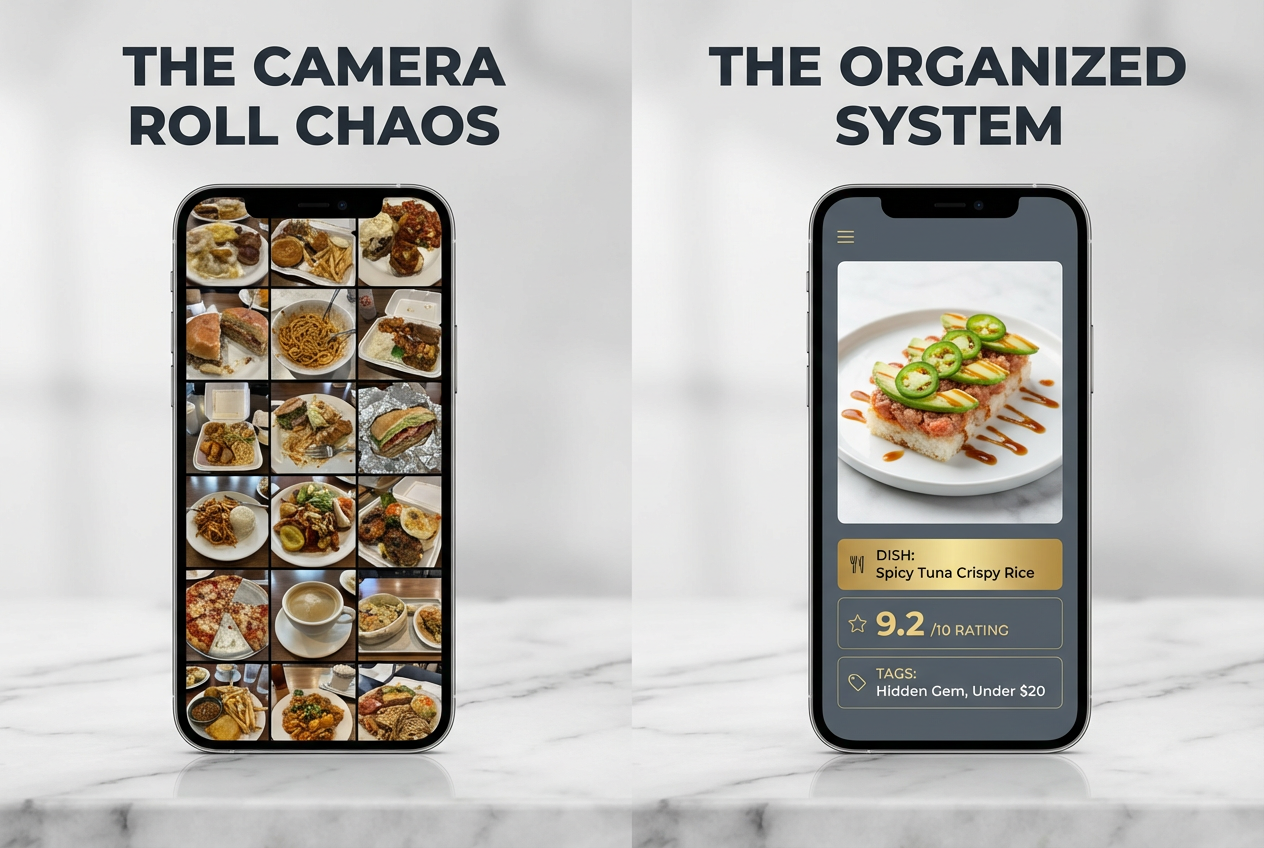
Transform your chaotic photo gallery into a structured culinary archive. Move from disorganized snapshots to a searchable system that tracks every dish and rating.
This is Camera Roll Fatigue, and it's costing you more than nostalgia. When you can't recall which restaurants delivered and which disappointed, you make expensive mistakes. You revisit mediocre spots because the name sounds familiar. You skip returning to that perfect neighborhood bistro because you forgot it existed.
Generic review platforms don't solve this. Yelp aggregates thousands of opinions from people whose taste profiles don't match yours. The guy who gave five stars to that tourist trap steakhouse probably thinks Olive Garden serves authentic Italian. Google Maps shows you what's nearby, not what you personally loved three months ago when the seasonal menu featured that life-changing agnolotti.
The friction isn't in taking photos. It's in the three-to-five-minute search process every time someone asks for a recommendation. It's in the cognitive load of trying to remember whether the Korean fried chicken was better at the strip mall spot or the trendy downtown counter. It's in the complete absence of dish-level detail when you're trying to recreate what you ate at home.
Professional food critics maintain notebooks, spreadsheets, or private databases. They don't rely on their camera roll because they understand that context dies without active preservation. The serious foodie needs this same discipline, but the barrier to entry has historically been too high. Until recently, your options were manual note-taking (time-intensive and inconsistent) or generic social platforms (performative and unreliable).
Sourcing Like a Pro: The Grocery Arbitrage Strategy
BLUF: Discount grocers carry restaurant-quality ingredients at fraction costs - bulk spices, specific cuts for braises, and high-turnover produce rival specialty shops when you know what to buy.
The foodie arbitrage isn't about eating cheap. It's about allocating your budget strategically so the money you save on ingredients funds the restaurants that genuinely matter. Food 4 Less and similar discount chains aren't just for people pinching pennies. They're for people who understand that a $40 ribeye at home, cooked properly, leaves room in the monthly budget for that $85 omakase experience.
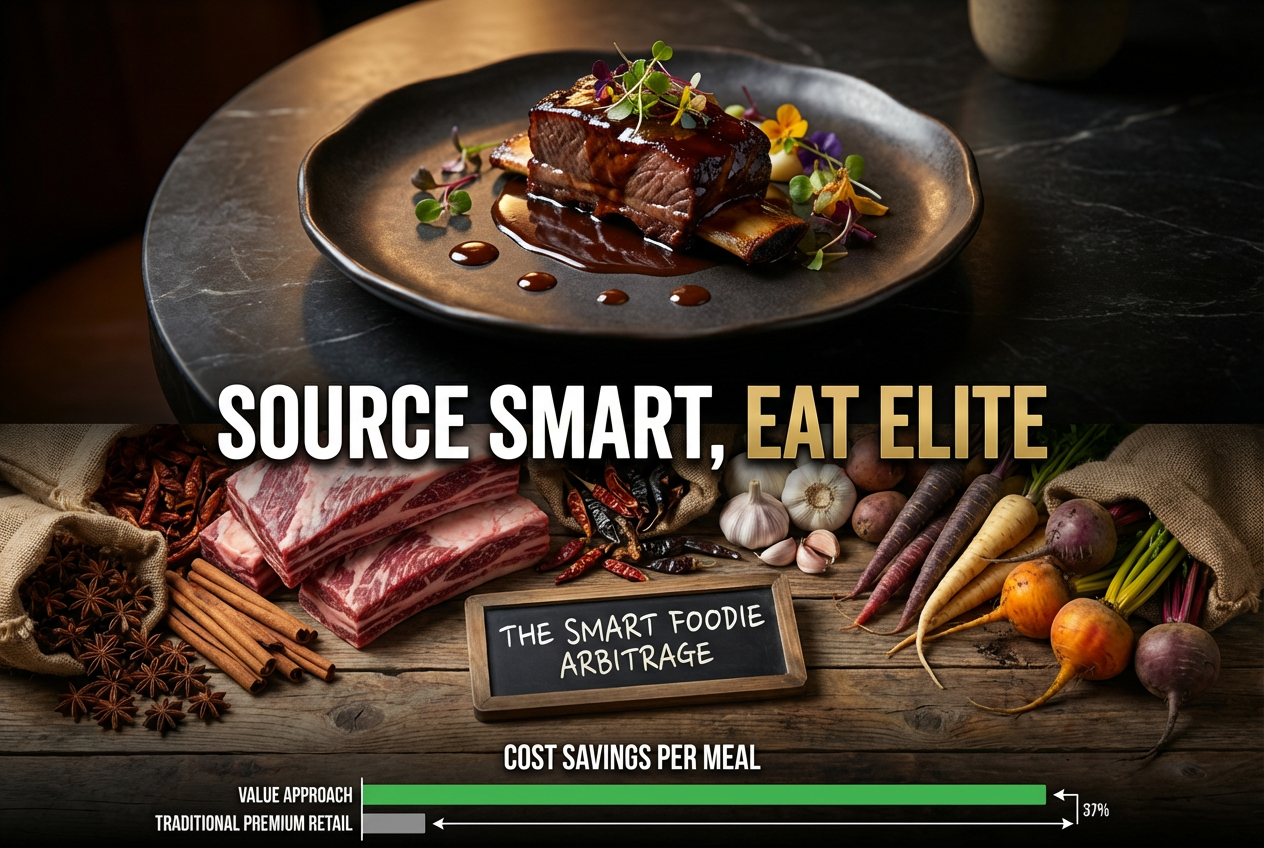
Learn the art of the foodie arbitrage. High-quality bulk ingredients from value stores can be the foundation for sophisticated, chef-level dining at home.
Here are five items even high-end foodies should source from discount grocers:
Bulk Spices for Dry Rubs: Whole cumin, coriander, and fennel seeds at Food 4 Less cost one-third what specialty shops charge. The turnover rate means they're often fresher than those dusty jars at boutique markets. Toast them yourself, grind them fresh, and you've got the foundation for restaurant-quality spice blends.
Specific Cuts for Long Braises: Chuck roast, pork shoulder, and beef shanks don't need to come from heritage breeds to produce exceptional results after 12 hours of low heat. The connective tissue breaks down the same way. Save the $30-per-pound difference for dry-aged steaks where the quality differential actually matters.
High-Turnover Produce: Onions, carrots, celery, and potatoes move fast at discount chains. They're identical to what you'd pay double for at Whole Foods. The organic label doesn't improve mirepoix, and the conventional versions cook the same in stocks and soups.
Canned Tomatoes: San Marzano-style tomatoes (even the domestic versions) at discount grocers are chemically identical to premium brands. You're paying for marketing, not quality. The same goes for tomato paste, which forms the backbone of countless sauces and braises.
Dried Pasta and Rice: De Cecco pasta and basmati rice cost half as much at discount stores. The cooking properties don't change based on where you bought them. Invest in hand-rolled pasta for special occasions, but your weeknight cacio e pepe doesn't need artisanal noodles.
This strategy only works if you're tracking what you cook and eat at home with the same rigor you'd apply to restaurant meals. Without a system, you'll forget which discount ingredients worked and which fell short. The best cooking classes online can teach you technique, but ingredient literacy comes from documentation and reflection.
The philosophy extends beyond groceries. When you're dining out, the "Food for Less" mindset means seeking hidden gems over celebrity chef restaurants. It means finding the neighborhood Thai spot where the chef-owner has been making the same curry for 20 years instead of dropping $200 at the Instagram-famous place that opened last month.
The Digital System: Organizing Your Food Culture
BLUF: Specialized food tracking apps capture dish-level details with tags, ratings, and searchability, turning your dining history into a queryable database that actually serves your memory.
Manual note-taking fails because it's too slow to maintain consistency. You start strong, documenting every meal with enthusiasm, then life intervenes. Two weeks later, you've got 30 undocumented meals and the friction of catching up kills your momentum. Generic social platforms fail because they're designed for public performance, not personal memory. You're curating for an audience, not building an archive for yourself.
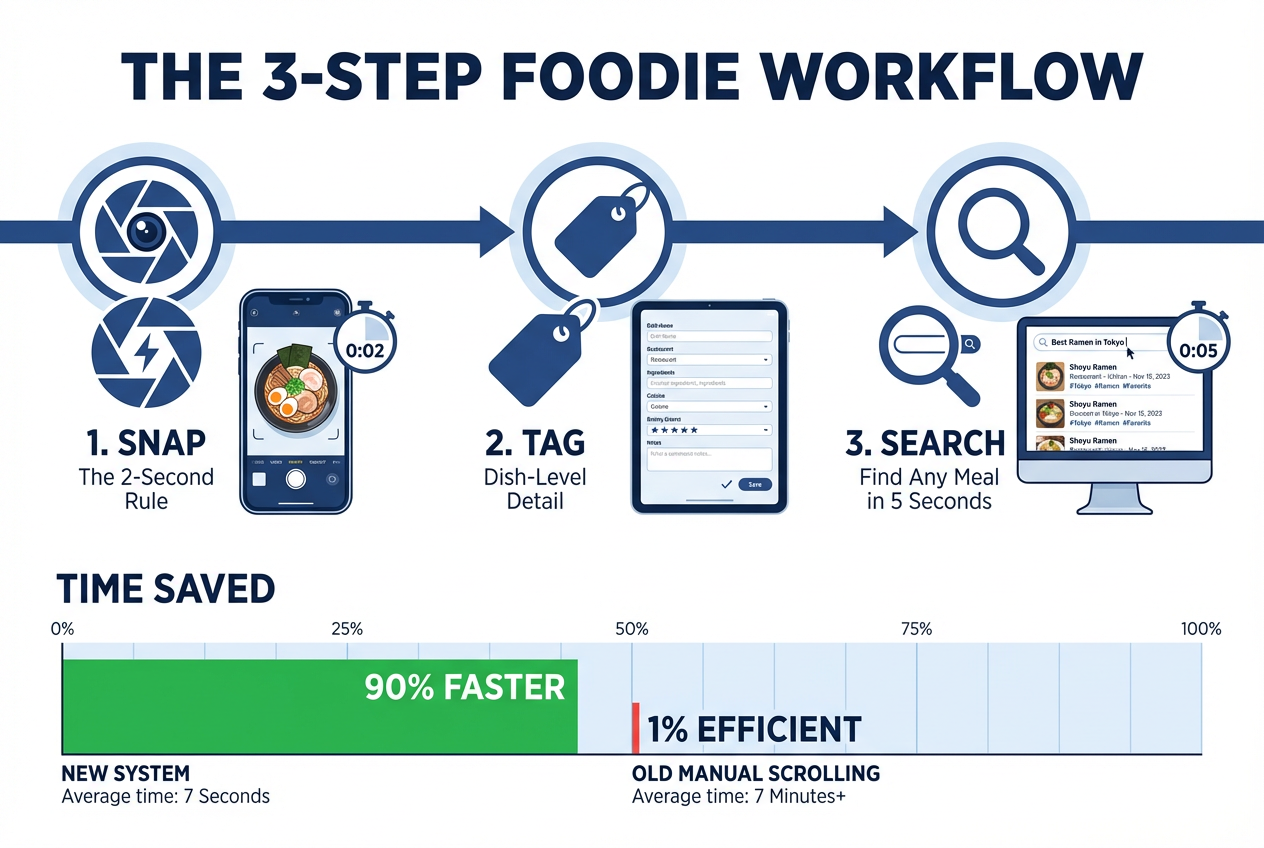
Efficiency is the key to maintaining a consistent food journal. This three-step workflow ensures you capture every culinary memory without the mental fatigue.
The solution lies in specialized tools designed specifically for serious foodies who need to track dishes, not just restaurants. The best restaurant review apps offer different approaches to the same problem: how to make food memory preservation effortless enough that you'll actually do it.
The Three-Step Workflow:
Snap: The two-second photo rule applies here. You're not shooting for Instagram. You're creating a visual anchor for your memory. One well-lit shot that shows the dish composition is sufficient. No need for multiple angles or styling. The goal is documentation, not art.
Tag: This is where most systems diverge. Dish-level tagging beats restaurant-level ratings because your memory works at the granular level. You don't remember "that Italian place was good." You remember "the cacio e pepe had the perfect pecorino-to-pepper ratio, but the carbonara was too creamy."
Quality tagging systems let you mark cuisine type, price point, occasion, companions, and specific preparation notes. When the pasta was al dente, you note it. When the sauce needed salt, you note that too. These micro-observations compound into a personal knowledge base that generic reviews can never replicate.
Search: The ultimate test of any system is retrieval speed. When someone asks for a spicy ramen recommendation, you should find your answer in under 10 seconds. That requires full-text search across dish names, restaurant names, notes, and tags. It requires filtering by rating, price, cuisine, and location.
Compare this to scrolling your camera roll, which averages three to five minutes per successful memory retrieval. Over a year, that's hours of cognitive friction. Over a decade, it's days of your life spent searching for information you already collected.
For foodies exploring international dining systems, understanding local rating cultures matters just as much as having the right tracking tool. The Japan food review app guide demonstrates how different markets require different evaluation frameworks, and your personal archive needs to accommodate these nuances.
Feature Comparison:
Modern food tracking tools fall into four categories based on their core value proposition:
Dish-First Systems: These prioritize individual dishes over restaurants. You rate the bluefin toro separately from the uni separately from the hamachi. When you search "best sushi I've had," you're querying a database of specific pieces, not restaurants. This granularity matters when you're trying to remember which spot nailed the fattiness balance in their otoro.
Social-First Platforms: These emphasize community, lists, and public profiles. You're building a portfolio of taste that others can browse. The advantage is discovering people with aligned palates and mining their archives. The disadvantage is the performative pressure that skews honest documentation toward impressive-looking meals.
Privacy-First Journals: These are locked-down, personal memory vaults. No social features, no public profiles, just you and your notes. The minimalism appeals to people who want zero friction and zero performance anxiety. The trade-off is missing out on discovery features and community recommendations.
Visual-First Diaries: These auto-organize photos into calendar views, map-based browsing, and chronological timelines. The interface mimics looking through a physical photo album, which feels intuitive. The weakness is often limited tagging depth and search sophistication.
The best restaurant tracker app for you depends on whether you prioritize privacy over discovery, granular detail over quick entry, or visual browsing over text search.
The Economics of the Serious Foodie
BLUF: Tracking prevents order regret by identifying which restaurants and dishes deliver value, saving you hundreds annually by redirecting spend from overhyped celebrity spots to consistent hidden gems.
The average serious foodie dining out four times weekly spends $12,000 to $20,000 annually on restaurants. Within that budget, perhaps 30% goes to genuinely memorable meals that you'd happily repeat. Another 40% is fine but forgettable. The remaining 30% is order regret - meals that disappointed relative to cost.
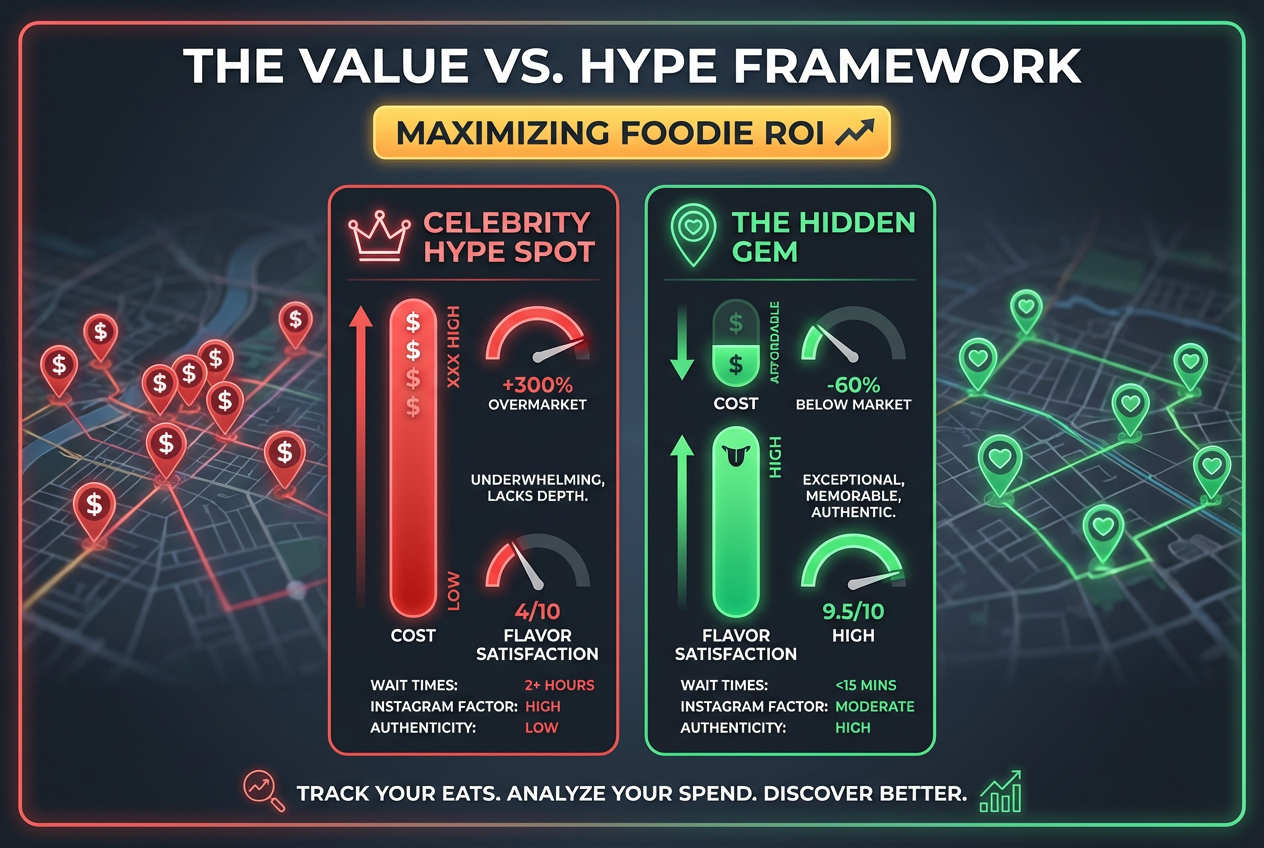
Stop paying for hype and start investing in flavor. Use data-driven tracking to identify the hidden gems that offer the best return on your dining investment.
Order regret happens when you can't remember what worked. You visit the new celebrity chef opening because it's buzzy, drop $150 per person, and walk out thinking "that was fine, I guess." Meanwhile, the neighborhood Vietnamese spot you visited once six months ago serves pho that lives in your memory, but you can't recall the name or location.
A functioning tracking system solves this by creating accountability. When you see patterns in your ratings, you stop making the same mistakes. You notice that tasting menus under $100 rarely satisfy you, so you stop booking them. You discover that your highest-rated meals cluster around specific cuisine types or preparation styles, so you lean into those preferences instead of chasing trends.
The hidden gem versus celebrity spot comparison is stark when you run the numbers:
Celebrity Chef Restaurant: $150 per person average, 7-point score on your personal 10-point scale, 30-minute wait despite reservation, menu changes every season so you can't return for the same dish.
Hidden Gem: $45 per person average, 9-point score, no wait, consistent menu where you can order your favorite dish every time.
Over 50 meals annually, choosing the hidden gem saves you $5,250 while delivering higher satisfaction. The catch is you need to find these spots and remember them. Generic review platforms bury them under promoted listings and tourist traps with hundreds of reviews.
Your personal archive, built over months and years, becomes your most valuable dining asset. It's a curated database of places that specifically match your taste, at price points you've verified, with dish-level detail about what to order. When you're traveling and researching Singapore restaurant review platforms, this same tracking discipline helps you cut through generic tourist advice.
The "Food for Less" philosophy isn't about eating cheaply. It's about eating intelligently. It's about recognizing that price and quality don't correlate linearly. The $200 tasting menu might score an 8, while the $40 neighborhood bistro scores a 9. Without tracking, you'll keep gravitating toward expensive mediocrity because it feels "serious."
Tracking also prevents duplicate mistakes. When you've documented that the upscale Italian place overcooks their pasta, you won't return three months later because you forgot. When you've noted that the fancy burger joint uses pre-ground meat that tastes like cardboard, you won't waste another $18 finding out again.
This data-driven approach transforms dining from random experiences into optimized decisions. You're building what professional critics maintain: institutional knowledge about what works and what doesn't, captured in a format you can query instantly.
For foodies who also cook seriously at home, understanding ingredient quality variations matters just as much as tracking restaurant performance. The feta vs goat cheese differences in cooking guide exemplifies the kind of technical knowledge that compounds with tracking, creating a comprehensive food education.
Frequently Asked Questions
What's the difference between restaurant tracking apps and Yelp?
Restaurant tracking apps are personal archives for your taste, while Yelp aggregates crowd opinions from strangers whose palates don't match yours. Tracking apps focus on dish-level detail, private notes, and searchable history. Yelp shows you what's popular, but can't tell you which specific menu items you personally loved six months ago. The best food review apps prioritize memory preservation over social validation.
How do discount grocers compare to specialty food shops for quality?
Discount grocers excel at commodity ingredients with high turnover - produce, dried goods, canned items, and bulk spices. Specialty shops win on unique items like heritage meats, artisanal cheeses, and rare spices. Smart sourcing means buying staples at discount stores and specialty items where quality gaps justify the premium. The farm to table dining guide explores how to evaluate sourcing claims and identify when premium pricing actually reflects quality.
How long does it take to build a useful food tracking habit?
Most people reach consistency after 30 logged meals, which takes two weeks at four meals weekly. The key is reducing friction during the logging process. Apps that allow one-tap photo capture with quick tagging work better than systems requiring extensive manual entry. Once the habit solidifies, you're looking at 15-30 seconds per meal to document what matters.
Can I use food tracking apps for home cooking too?
Absolutely. Many serious foodies track both restaurant meals and home experiments using the same system. This creates a complete culinary record showing what you've learned, which recipes worked, and how your skills evolved. Tag home meals differently so you can filter by source, but the memory benefits apply equally. The best cooking classes online guide pairs well with tracking to document your technical progression.
What should I track beyond just photos and ratings?
Essential elements include dish name, price, occasion, dining companions, specific preparation notes (temperature, doneness, seasoning), and context (why you chose this restaurant, what you were celebrating). Advanced tracking adds tags for cuisine type, dietary restrictions, service quality, and ambiance. The food diary app features guide breaks down which context markers provide the most memory value.
How do I find hidden gem restaurants instead of tourist traps?
Stop using generic ratings as your primary filter. Instead, look for neighborhood spots with consistent multi-year operation, modest online presence, and specific menu specialization. Track your own discoveries aggressively so you build a personal database. When traveling internationally, learn local rating systems - the Japanese food rating app guide shows how different cultures evaluate quality differently.
Is it worth paying for premium food tracking apps?
Free tiers work fine for casual tracking, but premium features (unlimited entries, advanced search, export capabilities, photo storage) become essential for serious foodies logging 200+ meals yearly. Calculate your annual dining spend - if it's over $10,000, a $50 annual app subscription is a rounding error that prevents thousands in order regret. The restaurant rating app guide compares free versus paid feature sets across major platforms.
How do food tracking apps handle privacy concerns?
Privacy-focused apps store data locally on your device or in encrypted cloud storage with no public profiles. Social platforms offer private account options but default to public sharing. Choose based on whether you want community features or complete privacy. Most serious foodies prefer private tracking systems to avoid the performative pressure of social media. The best dining apps for foodies breakdown includes privacy feature comparisons.