
Master Food Reviews with a Professional Taste Archive
Harry the matcha king
Harry is our resident matcha obsessive. He’s tasted hundreds of bowls and tracks every cup in Savor.
The Serious Foodie's Guide to Food Reviews: From Messy Camera Rolls to a Searchable Taste Archive You've taken 847 photos of perfectly plated dishes...
The Serious Foodie's Guide to Food Reviews: From Messy Camera Rolls to a Searchable Taste Archive
You've taken 847 photos of perfectly plated dishes this year. Can you name what you ate three Thursdays ago? Probably not. Your camera roll has become a digital graveyard of untagged culinary experiences, and that "starred" location on Google Maps tells you nothing about whether the agnolotti was worth the 90-minute wait.
The problem isn't that you don't appreciate food. It's that the tools designed for "finding a place to eat" were never built for people who treat dining as a cultural practice. You're not looking for the nearest pizza joint. You're building a personal archive of taste.
This is the guide for people who understand that the specific dish matters more than the restaurant's aggregate score. For urban professionals who've moved past Yelp's noise and want a system that captures the nuance between "good pasta" and "hand-rolled orecchiette with a 12-hour lamb ragù finished with high-acid oil that cuts through the richness."
We're going to dismantle the 5-star charade, teach you the vocabulary of professional dining documentation, and show you how to build what I call a "Taste Archive" - a searchable, metadata-rich record of your culinary life.
Table of Contents
- The Death of the 5-Star Review
- The 3 Levels of Culinary Archiving
- How to Write a Food Review Like a Pro
- Tool Comparison: The Letterboxd for Food
- The Serious Foodie Checklist for Your Next Meal
- FAQ
The Death of the 5-Star Review
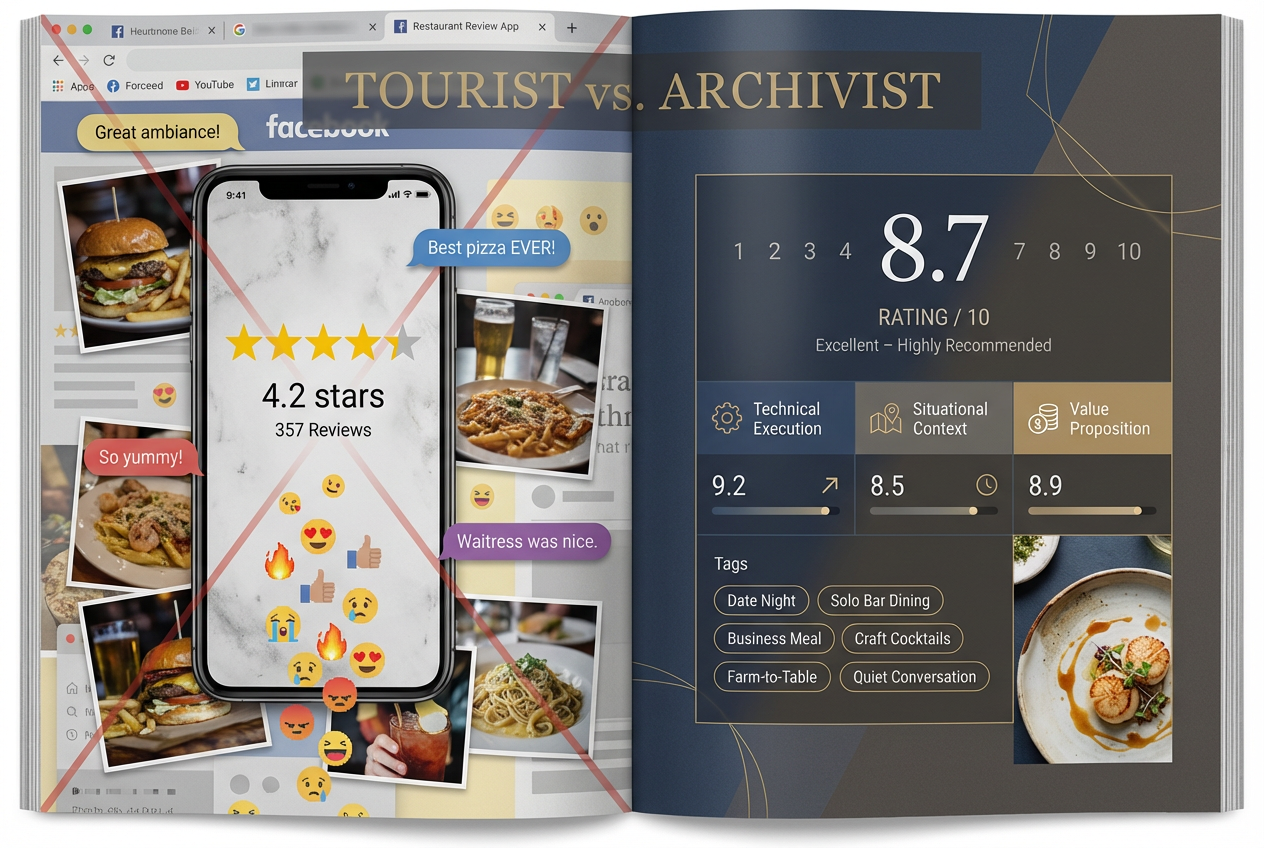
The traditional 5-star rating system is a relic designed for tourists making binary decisions. Serious diners use ranked lists and 10-point scales that capture technical execution, situational utility, and the specific context that makes a restaurant worth your time and money.
Stars are for people who need to know if a place is "good" or "bad." That's not you. You need to know if the kitchen can nail a medium-rare ribeye, if the acoustics allow actual conversation, and whether this spot deserves your corporate card or just qualifies for a Tuesday solo dinner at the bar.
The problem with Yelp, Google Reviews, and their star-based descendants isn't just review inflation (though that's real - everything's somehow 4.2 stars now). It's that they flatten complexity into a single number. A 4-star review tells you nothing about whether the reviewer values the same things you do. Did they dock a star because the host didn't smile enough? Because the portions were "too small" (read: appropriately sized)? Because they fundamentally don't understand that tartare is supposed to be raw?
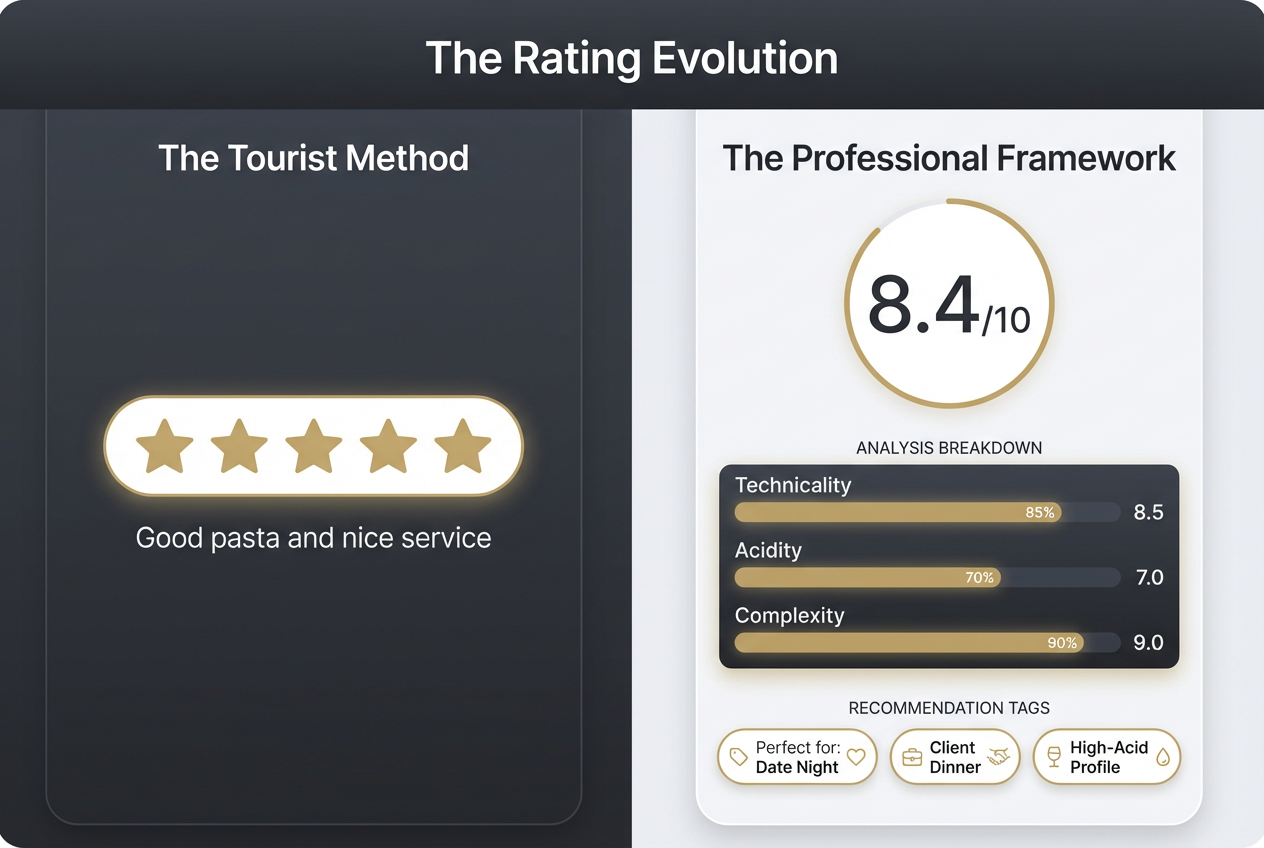 Moving beyond the binary star system allows serious foodies to capture nuance, technical execution, and the specific situational utility of a restaurant.
Here's what professionals use instead:
The 10-Point Scale: Borrowed from wine criticism and film review culture, this gives you room to differentiate between "technically proficient but uninspired" (6.5) and "career-defining meal that rewired my palate" (9.8). The Infatuation uses this. Eater's critics work on similar scales. It's not arbitrary - it's about having enough granularity to be honest.
Comparison-Based Ranking: Apps like Beli have adopted ELO-style ranking (borrowed from chess ratings) where you compare restaurants head-to-head. "Would I rather eat at A or B?" This forces you to make concrete choices rather than assign abstract numbers. It's how your brain actually works when someone asks for a recommendation.
Situational Tags: This is the innovation that separates useful reviews from noise. The same restaurant might be a 9/10 for a corporate dinner (private room, accommodating service, impressive wine list) and a 5/10 for a first date (too loud, aggressively hovering servers, no intimacy). The Infatuation pioneered the "Perfect for" tag. You should steal this framework.
The review inflation problem is real and structural. When 87% of restaurants on major platforms sit between 3.5 and 4.5 stars, the rating becomes meaningless. You're not getting signal - you're getting noise with a patina of consensus. For anyone who has a best restaurant review app to track their personal dining history, generic aggregated scores just don't cut it anymore.
What actually matters: Can you find this review in 18 months when you're trying to remember if this was the place with the exceptional duck or the place with the disappointing duck that looked beautiful but arrived lukewarm? Stars won't help you. Specificity will.
The 3 Levels of Culinary Archiving
Most diners operate at Level 1 (unsearchable camera rolls) or Level 2 (basic map pins with no context). Level 3 - a structured Taste Archive with dish-level notes, situational metadata, and comparative rankings - is where dining becomes a documented practice rather than a series of forgotten experiences.
Let me walk you through the evolution of how people track their food experiences, because wherever you are on this spectrum, there's a better system waiting.
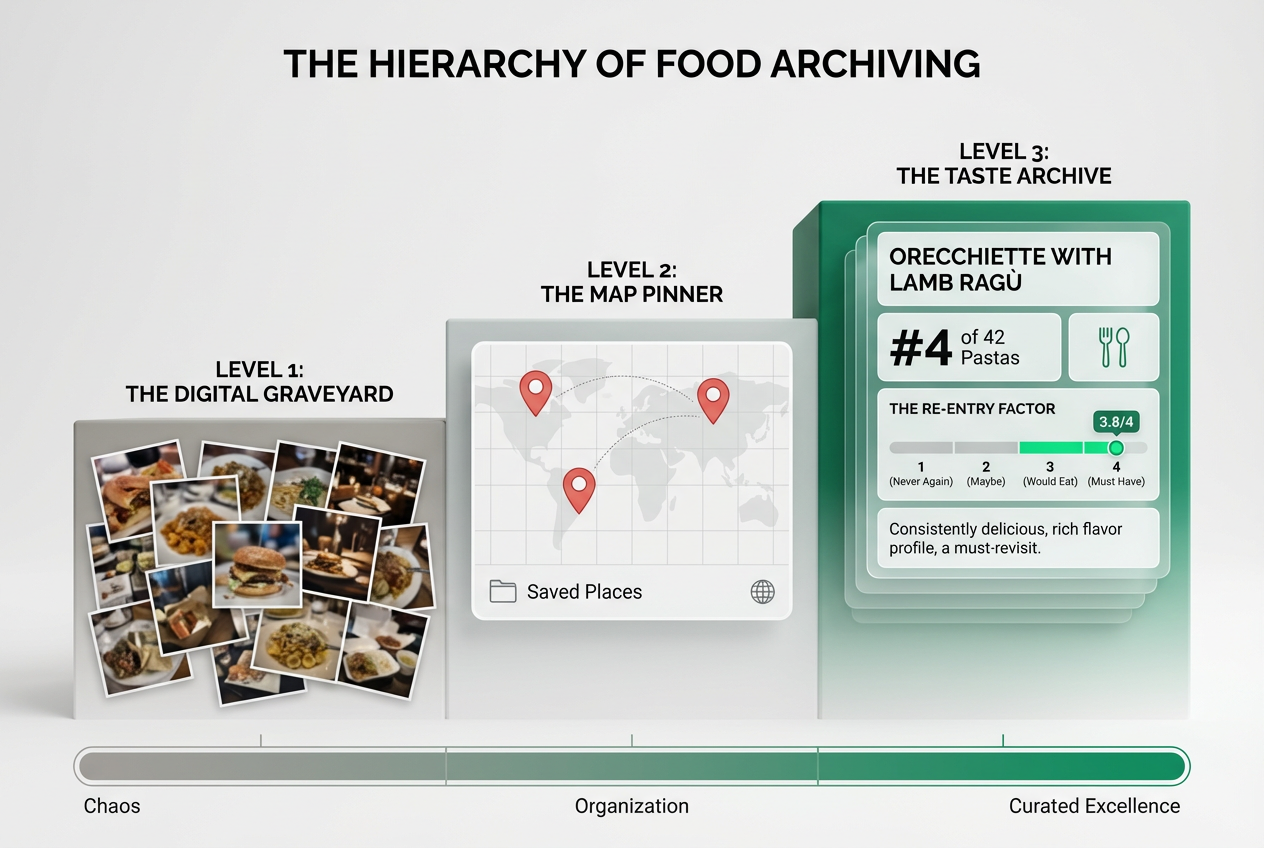 Transform your dining history from a cluttered camera roll into a searchable, data-driven archive that tracks your personal culinary journey.
Level 1: The Digital Graveyard
This is where 90% of people live. You take photos of every dish because it looks incredible in that specific lighting, or because you want to remember it, or because everyone at the table is doing it and you don't want to be the only person not documenting the moment.
Then those photos disappear into your camera roll, mixed in with screenshots of parking spots, photos of your friend's dog, and fourteen nearly identical shots of the same plate because you couldn't decide which angle captured the char on the octopus.
Three months later, someone asks you about that Italian place you went to, and you spend seven minutes scrolling through hundreds of images trying to find it. You remember it was good. You think it was in the West Village. Or maybe Nolita? The pasta was incredible. Or was that the other place?
This is the unsearchable archive. You have the data - you just have no way to retrieve it.
The problems compound:
- No date metadata you can actually search by (because Apple Photos' search is aspirational at best)
- No way to distinguish between the restaurant and the dishes
- No notes about who you were with, what you ordered, what worked, what didn't
- No connection to the location or the name of the place
- Zero ability to rank or compare experiences
You're collecting without curating. It's the culinary equivalent of hoarding.
Level 2: The Map Pinner
You've graduated. You now star or save restaurants in Google Maps or Apple Maps. Some people maintain a "Want to Go" list and a "Been There" list. The more organized among you might have multiple lists: "Date Spots," "Client Dinners," "Solo Bar Seats."
This is better. At least you have location data. At least you can remember where the place actually is when you're trying to recommend it to someone.
But the metadata ends there. You have:
- A pin on a map
- Maybe a star rating (which, as we've established, tells you nothing)
- Possibly a one-line note if you were particularly diligent that day
You don't have:
- What you actually ordered
- What was exceptional and what was forgettable
- Who you were with (context that shapes every dining memory)
- The specific situational utility (was this the place with the quiet back room, or the place with the excellent bar seating?)
- Any way to search by dish, cuisine type, or the specific craving you're trying to satisfy
The map pin is a bookmark without annotations. It's a reminder that a place exists, not a record of your experience there.
Level 3: The Taste Archive
This is the system serious diners build. It's not about being precious or obsessive (though it can look like that from the outside). It's about treating your dining experiences as data worth preserving with the same rigor you'd apply to any other domain you care about.
The Taste Archive has specific characteristics:
Dish-Level Granularity: You're not just saving "Lilia" as a starred location. You're documenting that the Cacio e Pepe Agnolotti was a 9.2, the Spicy Rigatoni was good but not worth the hype (7.8), and the Panna Cotta was technically perfect but too safe (7.0). The restaurant isn't the unit of value - the specific plate is.
Searchable Metadata: You can filter by:
- Cuisine type
- Specific dishes ("Show me every steak I've eaten in the past year")
- Price point
- Situational tags ("Places where I can actually hear the person across from me")
- Who you were with (because meals with certain people are different than solo dinners)
- Whether you'd pay your own money to return (the ultimate test)
Comparative Rankings: You're not assigning isolated scores. You're building a ranked list that answers questions like "What's the best pasta in New York that I've personally eaten?" Not according to some critic or aggregate review - according to your palate, your standards, your documented history.
Rich Context: Each entry has notes. Not just "great pasta" - but "hand-rolled orecchiette, brown butter sage, perfectly al dente, portion size appropriate for sharing, service was attentive without hovering, acoustics allowed conversation."
This is what separates documentation from archiving. Anyone can take a photo. You're building a searchable memory.
The best food review apps understand this distinction. They're not trying to be Yelp with prettier design - they're giving you architecture for your culinary life.
How to Write a Food Review Like a Pro
Professional food reviewing uses the "Bite Framework" - Aesthetics (plating and presentation), Technicality (cooking execution and knife work), and the Vibe Score (service, acoustics, and situational appropriateness). Move from generic praise to specific, sensory language that captures what made a dish memorable or forgettable.
Let me teach you the vocabulary and structure that separates "This was amazing!" from actual useful documentation of what you ate and why it mattered.
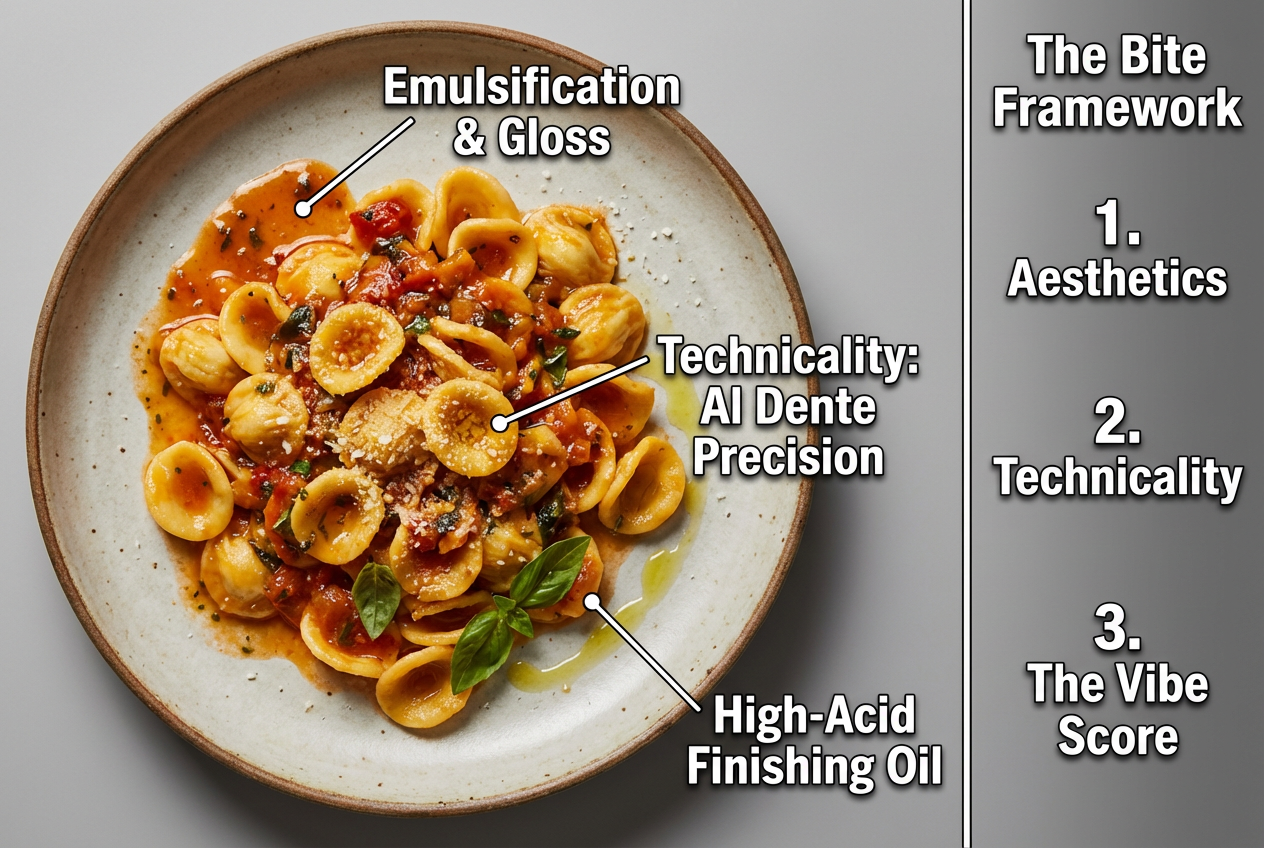 Professional food reviewing requires looking past the surface to evaluate technical execution, sauce emulsification, and the balance of flavor profiles.
The Bite Framework: Breaking Down a Dish
This is the three-part structure I use for every dish worth documenting. It forces you to look at different dimensions of the experience and gives you a repeatable system for analysis.
1. Aesthetics: What You See Before You Taste
Don't just write "it looked good." That tells you nothing when you're trying to remember this meal in eight months. Instead, evaluate:
Plating Style: Is this modernist (deconstructed, geometric, tweezered microgreens)? Rustic (family-style, served in the pan it was cooked in)? Classic (centered protein, sauce artfully spooned around it)? The style tells you about the kitchen's identity and whether it matches the food itself.
Intentionality: Does the plating serve the dish, or is it trying to be Instagram-ready at the expense of function? I've eaten too many dishes where the vertical architecture collapsed the moment you tried to actually take a bite. That's not good plating - that's insecurity.
Color and Contrast: Professional kitchens think about this. The char on a protein against a white plate. The deep green of properly cooked greens against the richness of brown butter. If it looks muddy or monotone, that's information.
Example: Don't write "The steak looked great." Write: "14oz ribeye, hard sear with pronounced crosshatch marks, served on warmed stoneware with a small ramekin of bone marrow butter on the side. Minimalist plating that highlighted the char - no garnish nonsense."
2. Technicality: What the Kitchen Actually Did
This is where most amateur reviews fall apart. People don't have the vocabulary to describe what they're tasting beyond "delicious" or "perfectly cooked."
Here's what to pay attention to:
Cooking Temps: If you ordered medium-rare, did you get medium-rare? Edge to edge pink with a warm red center, or that gray band of overcooked meat around the perimeter? This isn't being picky - it's basic competence.
Knife Work: Are the vegetables cut uniformly so they cook evenly? Is the brunoise actually brunoise or just "small dice"? You can tell a lot about a kitchen by whether they respect the fundamentals.
Sauce Work: This is where technique becomes obvious. Is the sauce properly emulsified or is it broken and greasy? Is there enough acid to cut through richness, or does everything taste flat and heavy three bites in? Does the sauce cling to the pasta or pool at the bottom of the bowl?
Seasoning: The number one problem in most cooking, professional or otherwise. Undersalting is timidity. Oversalting is carelessness. Proper seasoning makes every other flavor more vivid.
Texture Contrast: Great dishes have multiple textures. Crispy skin against tender meat. Crunchy breadcrumbs over silky pasta. Creamy interior with a hard sear. If everything is the same texture, it's boring no matter how good it tastes.
Example: Don't write "The pasta was perfect." Write: "Hand-rolled orecchiette, cooked 30 seconds past al dente (intentional - better for catching the sauce). Lamb ragù with a 12-hour braise, meat fully broken down, sauce properly emulsified with a high-acid finishing oil that cut through the richness. Generous grating of Pecorino that melted into the residual heat. Texture contrast from toasted breadcrumbs on top."
See the difference? One tells you nothing. The other is a recipe for memory.
3. The Vibe Score: Everything That Isn't the Food
You don't eat in a vacuum. The context shapes the experience, sometimes more than the food itself. A technically perfect meal in a room where you can't hear yourself think is still a bad experience.
Service Quality: Are the servers knowledgeable about the menu? Can they answer questions about preparation without running to the kitchen? Do they hover or disappear entirely? Great service is invisible until you need it.
Acoustics: I cannot overstate how important this is. Hard surfaces, high ceilings, and no sound absorption turn dining rooms into echo chambers. If you have to shout to be heard across a two-top, that's a situational dealbreaker for certain meals. This matters for farm-to-table dining experiences where conversation is part of the experience.
Pacing: Did courses arrive at a reasonable interval or were you waiting 40 minutes between plates? Did they rush you out when the next seating was coming?
The "Perfect For" Tag: This is the most useful piece of metadata you can add. The same restaurant might be:
- Perfect for: Corporate dinners (private room available, impressive wine list, accommodating service)
- Perfect for: Solo dining (excellent bar seating, comfortable being alone)
- Perfect for: Anniversary dinners (romantic lighting, attentive but not intrusive service)
- NOT perfect for: First dates (too loud, too expensive for the portion sizes)
Example: Don't write "Great atmosphere." Write: "Exposed brick, Edison bulbs, concrete floors - aggressively hard surfaces made conversation difficult above 75dB. Service was knowledgeable but overly familiar. Perfect for: groups of 4-6 who don't mind noise. Not ideal for: business dinners requiring discretion or dates where you actually want to talk."
Why Specificity Wins
Here's the test: If you read your review in 18 months, will you actually remember the meal? Or will it sound like every other generic "great food, good service, nice atmosphere" review clogging the internet?
Specificity is the only thing that survives time. "Great pasta" means nothing six months later. "Hand-rolled orecchiette with a 12-hour lamb ragù and high-acid finishing oil" is a memory you can taste.
This is the difference between collecting photos and building an archive. If you want to use a food rating app that actually helps you remember meals, you need this level of detail.
Tool Comparison: The Letterboxd for Food
Beli excels at social ranking and comparative ELO scoring. Savor focuses on private, dish-level precision with AI-powered archiving. The Infatuation provides expert-led discovery and situational guidance. Choose based on whether you value social status, personal memory, or professional curation.
The "Letterboxd for food" doesn't exist yet - not exactly. But several tools come close, each with different philosophies about what matters. Here's the honest breakdown.
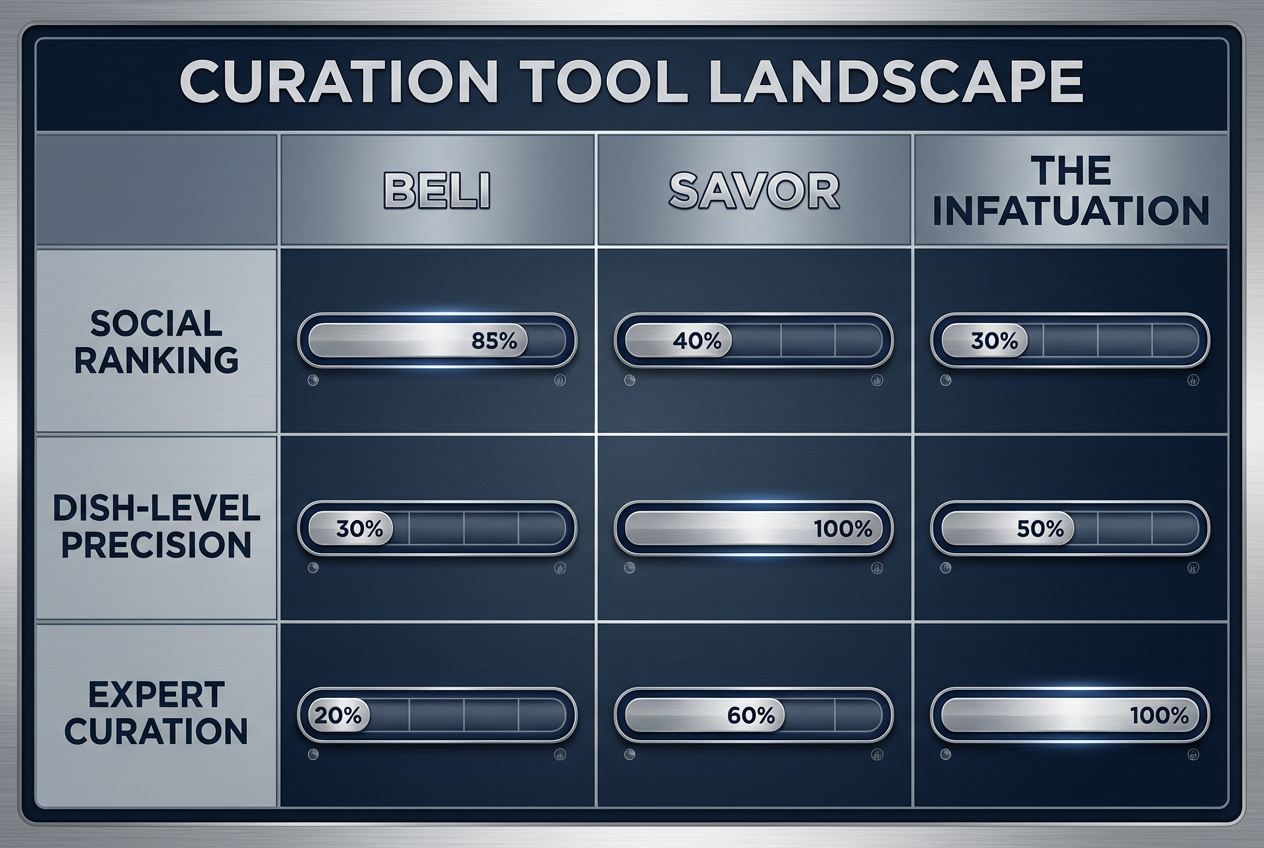 Choosing the right tool depends on your goals: whether you value social status, personal precision, or professional expert guidance.
Beli: The Social Status Archive
Best For: People who care about ranking restaurants against each other and want a public-facing profile of their dining history.
Beli uses an ELO-style ranking system borrowed from chess. Instead of assigning arbitrary scores, you compare restaurants head-to-head: "Would I rather eat at A or B?" Over time, this builds a ranked list that reflects your actual preferences.
The interface is clean. The social features are well-executed - you can follow other users with similar taste profiles and see their ranked lists. It's genuinely useful for answering questions like "What's the best Italian restaurant in Brooklyn according to people whose palate I trust?"
The Limitations: Beli operates at the restaurant level, not the dish level. You can't distinguish between "I loved 3 out of 5 dishes here" and "Every single thing was exceptional." It's binary in a different way than stars - the place is either ranked higher or lower than another place.
Also, it's social by design. If you want a private archive without the performance aspect, this isn't it. Everything you rank is visible to your followers.
Who This Is For: People who treat dining as a social practice and want their "food resume" to be public. If you like the idea of being known for your taste, Beli gives you the platform.
Savor: The Private Dish Archive
Best For: People who want dish-level precision and a searchable personal archive without social features.
Savor treats the dish as the fundamental unit, not the restaurant. You can log multiple items from the same meal and rate them separately. The AI-powered features help with metadata - it can extract location and date from your photos, suggest tags, and make searching easier.
The interface prioritizes function over aesthetics. It's not trying to be beautiful - it's trying to be useful. You can filter by cuisine, dish type, date, location, and custom tags. You can search for "every steak I've eaten in the past year" and get actual results.
The Limitations: It's not social. There's no discovery engine for finding new restaurants. It's purely archival. You're documenting experiences you've already had, not discovering new ones.
The AI features are helpful but not perfect. You still need to manually input a lot of detail if you want rich metadata.
Who This Is For: People who value privacy and precision over social status. If you want a searchable memory of your dining life without broadcasting it, Savor is the strongest option. It's essentially a food diary app with advanced features built specifically for serious diners.
The Infatuation: Expert-Led Discovery
Best For: Pre-dining research when you're planning where to eat, not post-dining documentation.
The Infatuation isn't an archive tool - it's a curated guide. What makes it valuable is the "Perfect For" situational tagging and the 10-point scoring system that actually captures nuance.
Their reviews are specific: "Perfect for: first dates, outdoor dining, industry people." They tell you how to get a table (because for serious restaurants, access matters as much as the food). They're honest about weaknesses - if the acoustics are terrible, they'll say so.
The Limitations: You can't add your own reviews or build a personal archive. You're consuming their expertise, not documenting your own.
Who This Is For: The discovery phase. When you're traveling to a new city or looking for a specific situational need, The Infatuation gives you expert-vetted options. But you'll need a separate tool for documenting your own experiences.
The Notes App / Spreadsheet Problem
Some people try to build their own system using Apple Notes or Google Sheets. I respect the impulse - you have complete control over the data structure.
Why This Fails:
- No map integration. You can't filter by location or proximity.
- Search is terrible. Finding specific dishes or restaurants requires scrolling or hoping you remember exactly what you titled the entry.
- No photo management. Photos live separately from notes.
- High friction. The effort required to document each meal means you won't actually do it consistently.
Manual systems only work if you have the discipline of a monk. Most people don't.
If you're committed to the DIY approach, at least use a structured template for each entry so your notes are consistent. But honestly, there are restaurant rating apps designed specifically to solve these problems - use them.
What We're Still Missing
The actual "Letterboxd for food" would combine:
- Beli's comparative ranking system
- Savor's dish-level precision and searchable archive
- The Infatuation's expert curation and situational tagging
- Social features that are optional, not mandatory
- Integration with reservation systems so you can track where you're going, not just where you've been
That tool doesn't exist yet. Until it does, you're probably using a combination of platforms. I use Savor for personal archiving, check The Infatuation when I'm planning where to eat, and occasionally look at Beli to see what people with similar taste are excited about.
The tools are getting better. The important thing is having some system - any system - that's more sophisticated than "starred location on Google Maps with no context."
The Serious Foodie Checklist for Your Next Meal
Use this four-part template to document meals worth remembering: The Hero Dish (what was exceptional), The Skip (what wasn't worth ordering), The Situation (who is this restaurant for), and The Re-entry Factor (would you pay your own money to return).
Here's the practical framework. Copy this into whatever tool you're using and fill it out while the meal is still fresh in your memory. Waiting until you get home means you lose the details that matter.
The Hero Dish
What was the standout? Not just "the pasta was good" - which specific dish justified the reservation, the price, the time spent getting there?
Be specific:
- Exact name from the menu
- Key ingredients or preparation method
- What made it technically impressive (if anything)
- The specific flavor or texture that made it memorable
- Portion size (because this affects value)
- Would you order it again?
Example: "Dry-aged duck breast, rendered skin crisped to the point of shattering, meat cooked to perfect medium-rare with a cherry gastrique that provided necessary acid. Came with roasted sunchokes that were correctly seasoned (rare). Portion size appropriate for one person. Would absolutely order again - this is what I'd recommend to anyone coming here."
The Skip
What wasn't worth the menu price? Every restaurant has weaker dishes. Documenting them prevents you from making the same mistake twice.
Be fair but honest:
- What you ordered and why it disappointed
- Was it a concept problem (the dish itself is poorly designed) or an execution problem (good idea, bad cooking)?
- Would you try it again on a different visit or is it fundamentally not worth ordering?
Example: "Octopus appetizer looked promising on paper (grilled, salsa verde, fingerling potatoes) but arrived lukewarm with zero char, underseasoned across the board. This was an execution problem, not concept - I might try it again if I came back, but wouldn't prioritize it. The potatoes were good though."
The Situation: Perfect For...
Who is this restaurant for? Context is everything. The same spot might be ideal for one situation and terrible for another.
Consider:
- Noise level and acoustics (can you have a conversation?)
- Service style (formal, casual, somewhere in between?)
- Pacing (lingering encouraged or table turnover prioritized?)
- Price point (corporate card territory or reasonably affordable?)
- Dress code (stated or unstated)
- Bar seating quality (is solo dining comfortable?)
- Group size (does this work for 2, 4, 8?)
Example: "Perfect for: Groups of 4-6, casual celebrations, people who don't mind noise. Excellent for: Solo dining at the bar - bartender was knowledgeable and attentive without being intrusive. NOT ideal for: Business dinners requiring privacy, first dates where conversation is important (acoustics are brutal), anyone with mobility issues (no elevator to second-floor dining room)."
This is the metadata that makes your archive searchable. When someone asks for a recommendation for a specific situation, you can actually give them a useful answer.
The Re-entry Factor
Would you pay your own money to come back? This is the ultimate test. Strip away the hype, the social media buzz, the fact that you used a corporate card or someone else paid. Would you return on your own dime?
Be honest:
- Yes, absolutely (and what would you order?)
- Maybe for a special occasion (what would justify it?)
- No, once was enough (why?)
Example: "Would I return? Yes, but only for the duck and maybe one of the pasta dishes. The price point is high enough ($75-100 per person before drinks) that this is a special occasion spot, not a regular rotation place. Would I recommend it? Absolutely, with the caveat that people should skip the seafood and focus on the meat and pasta preparations."
This is the question that cuts through all the noise. Some restaurants are impressive but not repeatable. Some are technically perfect but soulless. Some are flawed but deeply compelling. The re-entry factor tells you which category you're dealing with.
If you're using best restaurant review apps for foodies, this framework adapts to most platforms. The specific fields might differ, but the underlying questions remain the same.
FAQ
What makes a good food review different from a Yelp review?
A good food review provides specific, sensory detail about what you ate and why it was memorable or forgettable. Yelp reviews typically focus on generic service complaints or vague praise ("everything was delicious!"). Professional-quality reviews evaluate technical execution (cooking temps, knife work, sauce emulsification), describe specific dishes with enough detail that someone reading the review months later can recall the meal, and include situational context about acoustics, pacing, and who the restaurant serves best. The difference is between "great pasta" and "hand-rolled orecchiette with a 12-hour lamb ragù, perfectly emulsified sauce, and high-acid finishing oil that cut through the richness."
Why should I use a 10-point scale instead of 5 stars?
A 10-point scale gives you the granularity to differentiate between "technically competent but uninspired" (6.5) and "career-defining meal" (9.8). With 5 stars, everything collapses into the 3.5 to 4.5 range where you lose meaningful distinction. You can't express the difference between "this was good" and "this was exceptional" when your only options are whole stars or half-stars. The 10-point system, used by professional critics and platforms like The Infatuation, mirrors how wine and film criticism work - it gives you room for honest, specific evaluation rather than forcing you into binary good/bad categories.
How do I organize my dining history without spending hours on data entry?
Start with dish-level documentation using a dedicated app like Savor that captures photos, location metadata, and basic notes with minimal friction. Use voice-to-text immediately after the meal while details are fresh - don't wait until you get home. Create a simple template with four fields: Hero Dish, The Skip, The Situation, and Re-entry Factor. This takes 90 seconds per meal and gives you searchable metadata. Don't try to retroactively document every meal you've ever had - that's paralyzing. Start with your next dinner and build the archive forward. The key is consistency over comprehensiveness.
What's the difference between reviewing a restaurant versus reviewing a dish?
Restaurant reviews evaluate the entire experience - service, ambiance, consistency across the menu, value proposition. Dish reviews focus on the specific plate in front of you: technical execution, flavor balance, portion size, whether you'd order it again. Serious diners care more about dish-level detail because the same restaurant might serve exceptional pasta and mediocre seafood. If you rate the restaurant as a whole, you lose that nuance. Platforms like Savor and the best food review apps for tracking let you document individual dishes with separate ratings, which creates a more honest and useful archive.
How do I know if a restaurant review site is trustworthy?
Look for three signals: named critics with transparent backgrounds (not anonymous crowdsourcing), consistent evaluation criteria across reviews (do they use the same framework every time?), and editorial transparency about potential conflicts of interest. Eater publishes their ethics guidelines. The Infatuation uses a clear 10-point scale with situational tags. Platforms that rely entirely on user-generated content without curation (Yelp, Google Reviews) are useful for finding consensus but terrible for nuanced evaluation. Trustworthy review sources also document meals with specific dish names, preparation methods, and concrete observations rather than generic adjectives.
Should I take notes during the meal or after?
Take minimal notes during - use your phone to capture dish names, one-line impressions, and photos while you're eating. Don't be the person writing paragraphs at the table; it's distracting and changes the experience. Immediately after the meal (in the car, on the walk home, within the next hour), expand those notes into fuller documentation using voice-to-text if typing is a barrier. Details fade fast - by the next day, you'll struggle to remember whether the sauce was properly emulsified or exactly what made the dish work. The sweet spot is quick captures during the meal and full documentation within an hour.
What should I include in a food review for my personal archive?
Include dish-level specifics (exact menu name, key ingredients, preparation method), technical evaluation (cooking temps, seasoning, sauce work, knife skills), situational context (who is this restaurant perfect for, acoustics, pacing), and your personal re-entry factor (would you return on your own money). Add metadata like date, who you dined with, and price point. The goal isn't to write for an audience - it's to preserve enough detail that you can search and recall the meal months later. Skip generic praise and focus on concrete observations: not "delicious," but "properly salted with high-acid elements that cut through the richness."
How do I compare food review apps to find the right one?
Determine what you value most: social ranking (Beli), private dish-level archiving (Savor), or expert curation (The Infatuation). Test each platform's search and filter functions - can you actually find specific dishes or restaurants months later? Check if the app supports the metadata you care about: situational tags, who you dined with, custom notes fields. Look at friction level: how many taps does it take to log a meal? Some apps auto-populate location and date from photos; others require manual entry. If you want detailed comparisons, explore reviews of dining apps for foodies that break down features by use case.