
The Best List Sharing Apps for Foodies: Stop Losing Your Favorite Meals
John the smoothie monster
John lives for smoothie bowls and cold-pressed juices. He uses Savor to remember his best blends.
The Best List Sharing Apps for Serious Foodies in 2025 Table of Contents The Crisis of the Disappearing Meal The 3 Layers of Food Tracking Deep Dive: The Best...
The Best List Sharing Apps for Serious Foodies in 2025
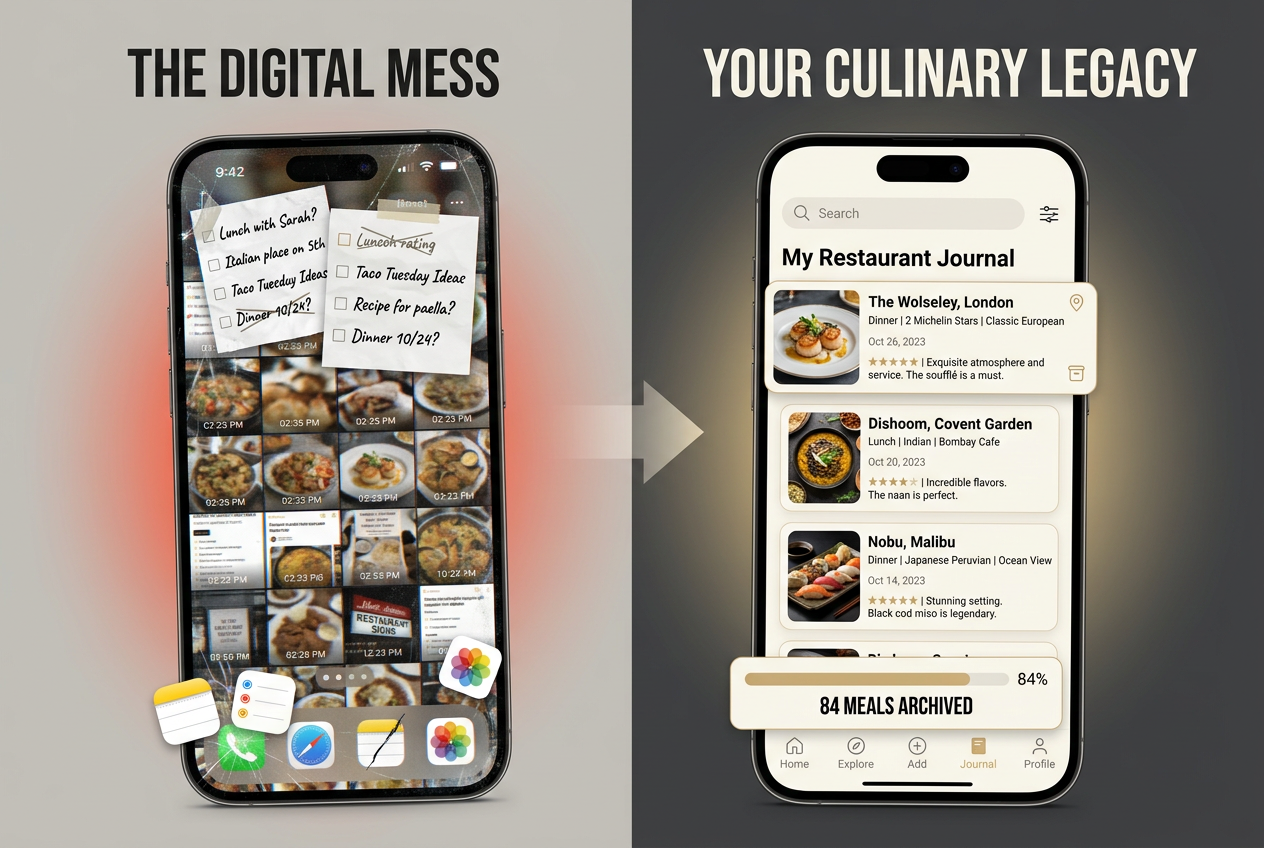
Table of Contents
- The Crisis of the Disappearing Meal
- The 3 Layers of Food Tracking
- Deep Dive: The Best Specialized Apps
- Feature Matrix for the Serious Foodie
- The ’Dish-First’ Rule
- The Sharing Economy: Curating for Friends
- Choosing the Tool That Fits Your Culinary Persona
- Frequently Asked Questions
The Crisis of the Disappearing Meal
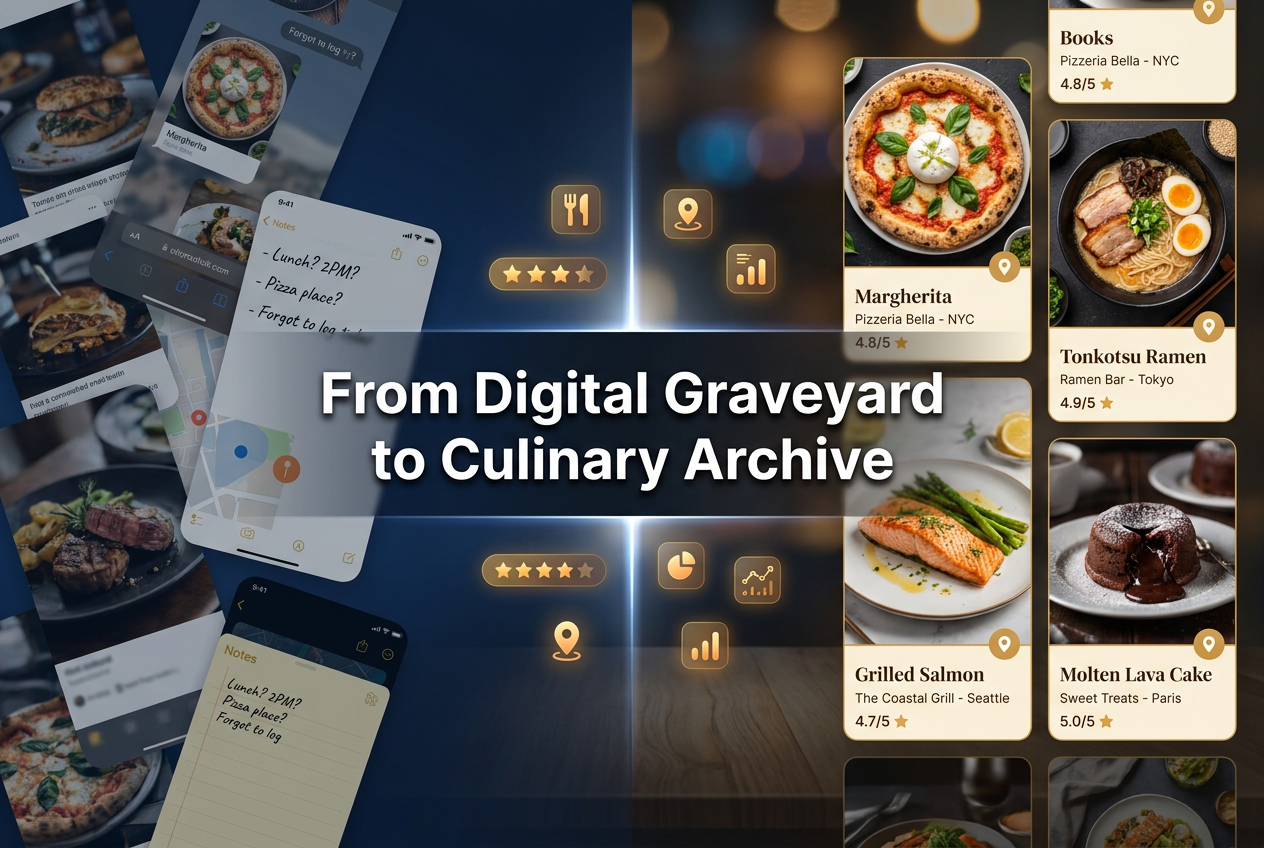
Your camera roll is a graveyard of forgotten meals. Hundreds of photos - pasta in Rome, ramen in Tokyo, that life-changing taco truck in Austin - all slowly dissolving into digital noise. When your friend asks for recommendations before their trip, you freeze. Was it Trattoria something? Near the Spanish Steps? And what was the name of that dish again?
This isn’t a memory problem. It’s a systems problem. The average urban professional eats out 4-5 times per week, generating roughly 250 dining experiences annually. Without a structured approach, that knowledge simply evaporates. Generic review platforms like Yelp weren’t built for personal archiving - they’re public megaphones optimized for crowd-sourced consensus, not individual taste memory. Your phone’s Notes app offers privacy but zero searchability. Google Maps lets you star locations, but what about the specific dish that made the restaurant worth visiting?
The modern foodie needs a different kind of tool: a list sharing app designed not for broadcasting to strangers, but for building a personal culinary database that can be selectively shared with trusted friends. This is about creating a second brain for food - searchable, mappable, and meaningful.
The 3 Layers of Food Tracking
BLUF: Food tracking serves three distinct purposes: personal memory (archiving your dining history), social discovery (learning from trusted friends), and practical coordination (sharing actionable lists). The best app depends on which layer matters most to you.
Understanding what you actually need from a list sharing app starts with recognizing these three fundamental use cases:
Layer 1: Personal Archiving
This is about relief from the anxiety of forgetting. You’re not trying to become a food influencer - you’re building a private record of where you’ve been and what you loved. The core need here is searchability at the dish level. Six months from now, you want to remember not just "that Italian place," but specifically the cacio e pepe that changed your understanding of pasta.
The implicit desire is creating a culinary legacy, treating food as a subject worthy of serious study rather than just fuel. When a dish-level memory tool lets you score the agnolotti separately from the tiramisu, you’re no longer just eating - you’re curating.
Layer 2: Social Validation
Here, the driver is FOMO mitigation. You don’t want algorithmic recommendations from TikTok or anonymous five-star ratings from people whose taste you don’t trust. You want to know where your actual friends - the ones whose palates you respect - are eating right now. This mirrors what Letterboxd did for film and Goodreads did for books: creating a social graph around a shared obsession.
Seventy-eight percent of diners trust recommendations from friends over influencers. That’s not surprising. Your college roommate who introduced you to natural wine has infinitely more credibility than a lifestyle blogger with 100K followers you’ve never met.
Layer 3: Utility and Coordination
The third layer is pure logistics. Your partner wants date night ideas. Friends are visiting from out of town and need a "Best Ramen in NYC" guide they can reference on the go. You need something mappable, shareable, and immediately actionable - not an essay, but a vetted shortlist.
This is the "30-second log" benchmark: can you capture the essential information (restaurant, dish, score, quick note) while the server is processing your card? If the app demands ten minutes of data entry, you won’t use it consistently.
Deep Dive: The Best Specialized Apps
BLUF: Beli dominates social ranking, Savor excels at private dish-level journaling, Truffle automates tracking through Instagram, and traditional tools (Notes app, Google Maps) remain viable for ultra-private, low-tech users. Each serves a different culinary persona.
The Social Powerhouse: Beli
Beli positions itself as "the Letterboxd for food," and that comparison is earned. The app’s core mechanic is simple: you rank restaurants, friends see your rankings, and the algorithm surfaces places your trusted circle loves. It’s gamified in the best sense - you can see where you stand compared to friends in terms of restaurants visited, build curated lists, and follow the dining adventures of people whose taste you admire.
Where Beli wins is social pressure as a motivator. The leaderboard dynamics and visible activity feed create genuine engagement. You’re not shouting into the void; you’re participating in an active community of people who care about the same things you do.
Where it falls short is granularity. Beli is restaurant-first, not dish-first. You can note what you ordered, but the app’s structure is built around venue rankings rather than individual menu item memory. If you had three outstanding dishes and one mediocre one at a tasting menu, Beli forces you to average them into a single score. For the serious foodie who treats each dish as a discrete experience, this feels reductive.
Beli is ideal if your primary goal is social discovery and you enjoy the competitive aspect of food tracking. It’s less suited for private, granular archiving.
The Private Dish Journal: Savor
Savor inverts Beli’s model entirely. It’s private by default, dish-centric by design, and treats your food history as a personal database rather than a social feed. The foundational logic is that the dish - not the restaurant - is the atomic unit of a meal. You score the carbonara, the tiramisu, the wine pairing independently, building a granular record that actually reflects how you experienced the dinner.
This is where Savor shines for the obsessive chronicler. You can attach photos to individual dishes, add detailed tasting notes, and search your archive by cuisine type, score threshold, or even specific ingredients. The interface is clean, the tagging system is flexible, and the AI-powered memory prompts help you recall context months later.
Savor’s map integration is strong. When you’re in a new neighborhood, the app shows you not just restaurants you’ve saved, but the specific dishes you loved at each one. That’s the kind of utility that turns a food diary into a genuine decision-making tool.
The trade-off is social features. Savor isn’t designed for broadcasting or building follower counts. You can share individual lists with friends, but there’s no public profile or activity feed. If validation and discovery through a social network matter to you, Savor will feel isolating.
Savor is the right choice if you’re an introvert, a data nerd, or someone who values precision over popularity. It’s a food journal app for people who want to intellectualize their hobby.
The Automation King: Truffle
Truffle’s pitch is seductive: stop manually logging meals and let the app do it for you. Connect your Instagram account, and Truffle automatically imports your food Stories, extracting location data and building a visual map of everywhere you’ve eaten. It’s frictionless tracking for people who already post their meals on social media.
The upside is obvious - zero additional work. If you’re already documenting your dining life on Instagram, Truffle turns that content into a searchable archive. The map view is beautiful, and the ability to see a chronological feed of your food year is genuinely delightful.
The downside is equally obvious: your privacy is now entirely dependent on your Instagram habits. Every restaurant you log becomes a public post. There’s no way to track a meal discreetly. If you’re visiting that hole-in-the-wall spot you don’t want to blow up, or having a quiet anniversary dinner, Truffle forces you to choose between documentation and discretion.
Truffle is perfect for extroverts and heavy Instagram users who treat their food life as inherently public. It’s a non-starter for anyone who values a private archive or dislikes the performative aspects of social media.
The Status Quo: Notes App and Google Maps
Don’t discount the low-tech incumbent solutions. The Notes app on your phone costs nothing, works offline, and gives you total control over format and privacy. It’s just text and photos - simple, portable, and immune to app shutdowns or subscription price hikes.
The limitation is searchability. Finding "that place with the great mole" six months later means scrolling through chronological entries or hoping your past self was disciplined about headers. There’s no map view, no tagging system, no ability to filter by cuisine or score.
Google Maps starred locations offer geographic visualization but even less detail. You can save a restaurant and add a note, but there’s no space for dish-level granularity, no scoring system, and no way to organize your stars into thematic lists beyond basic labels.
These tools work if your needs are minimal or you have excellent organizational discipline. But for anyone building a serious culinary archive, they’re training wheels you’ll eventually outgrow.
Feature Matrix for the Serious Foodie
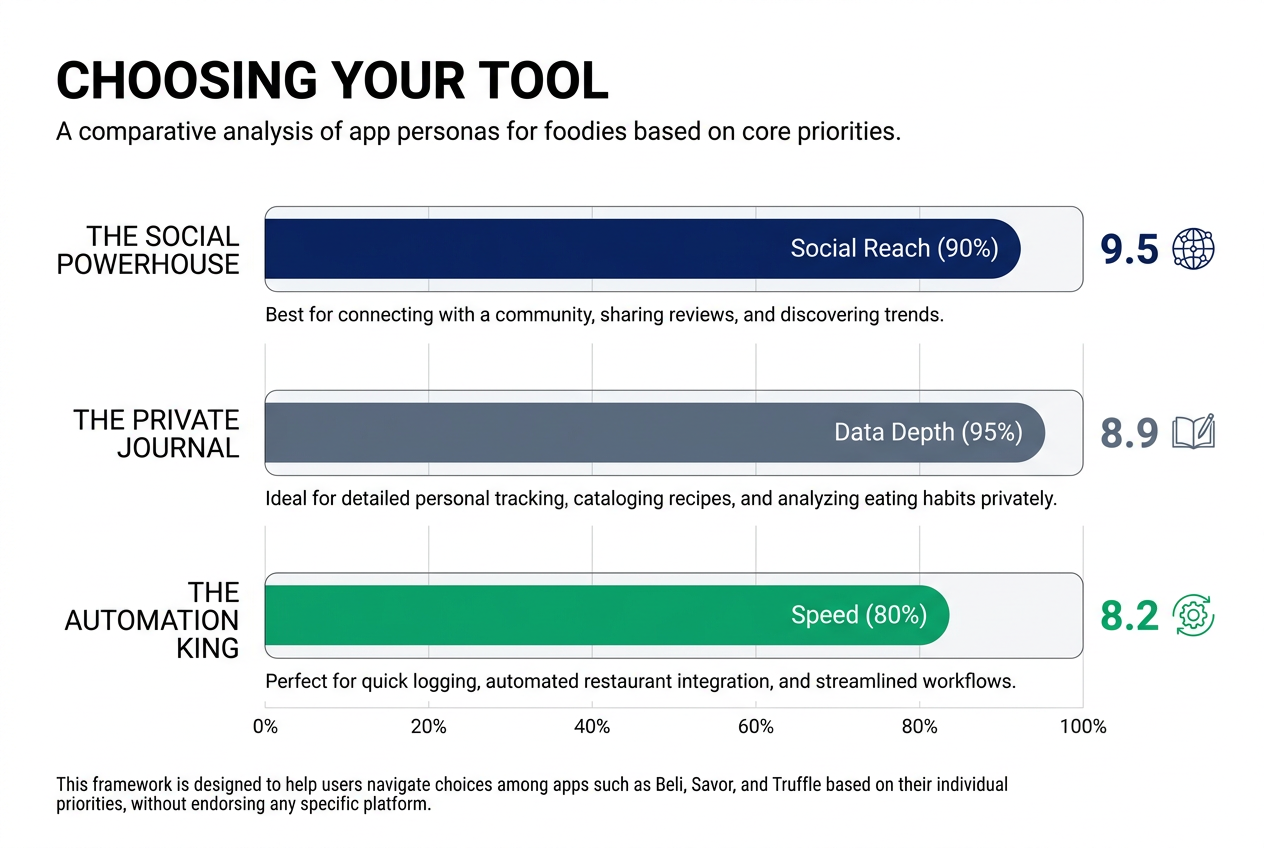
BLUF: Choose based on priorities: if social discovery matters most, pick Beli. If dish-level detail and privacy are non-negotiable, pick Savor. If you want zero friction and already live on Instagram, pick Truffle. For ultra-low-tech needs, stick with Notes or Maps.
| Feature | Beli | Savor | Truffle | Notes App | Google Maps |
|---|---|---|---|---|---|
| Dish-Level Ratings | Partial (notes only) | Full (independent scoring per dish) | No (venue-based) | Manual (no structure) | No |
| Privacy Control | Public by default, private lists available | Private by default, opt-in sharing | Public via Instagram | Fully private | Semi-private (visible to contacts) |
| Search by Dish | Limited | Yes (by name, cuisine, ingredient) | No | Text search only | No |
| Social Feed | Yes (core feature) | No | Yes (via Instagram) | No | No |
| Map View | Yes | Yes | Yes | No | Yes (primary interface) |
| Offline Access | Limited | Yes | No (requires Instagram connection) | Yes | Limited |
| Photo Storage | Per restaurant | Per individual dish | Imported from Instagram | Unlimited (local storage) | Per pin (limited) |
| Sharing Lists | Yes (public or friend groups) | Yes (custom private lists) | No (posts are public) | Manual (copy/paste or screenshot) | Basic labels only |
| Tasting Notes | Brief text field | Extensive note field per dish | No | Unlimited | Brief note field |
| Learning Curve | Low | Moderate | Very low | None | None |
| Best For | Social foodies, competitive rankers | Obsessive archivers, serious palate developers | Instagram-first users, visual chroniclers | Minimalists, privacy extremists | Casual savers, geographic planners |
This matrix reveals a truth: there’s no universal "best" list sharing app. The right tool depends entirely on your culinary persona and primary use case. If you thrive on social validation and friendly competition, Beli’s leaderboard will motivate you to explore more restaurants. If you’re building a reference library for your own palate development, Savor’s granular data model is essential. If you view food documentation as an extension of your social media presence, Truffle eliminates friction.
The worst mistake is choosing based on features alone. Apps with the longest feature lists aren’t necessarily the ones you’ll actually use six months from now. Consistency beats comprehensiveness. The app that aligns with how you already think about food will always outperform the one that demands you change your habits.
The ’Dish-First’ Rule
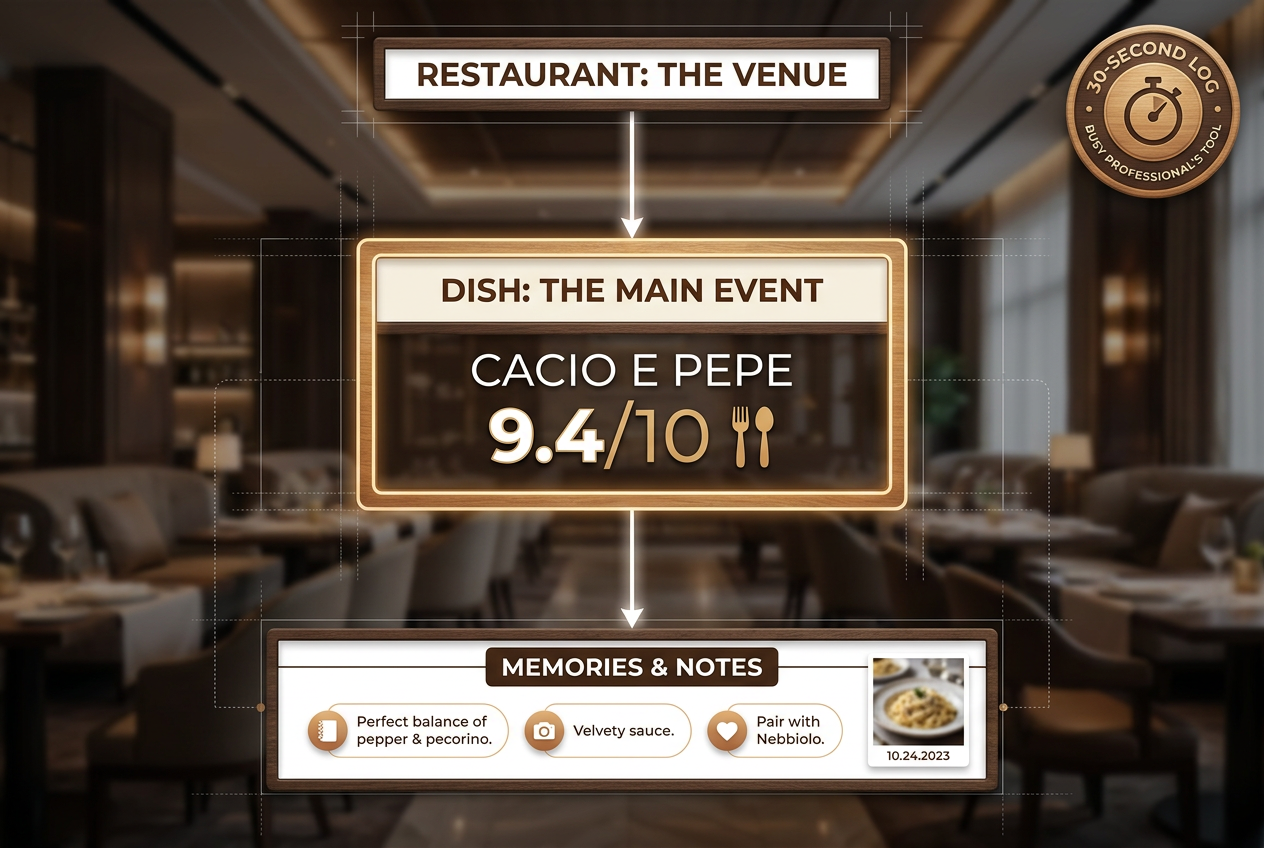
BLUF: For serious foodies, the dish is the meal. A restaurant is just a venue. Apps that force venue-level ratings miss the entire point of documenting culinary experiences. Track dishes independently to build a useful personal database.
Here’s why dish-first logic matters: imagine you visit a Michelin-starred restaurant for a tasting menu. The first three courses are transcendent - the kind of food that recalibrates your understanding of technique and flavor. But the dessert is uninspired, and the final savory course overreaches, muddling its own concept. How do you score that restaurant?
Venue-centric apps force you to average your experience into a single number. Maybe you give it four stars because the highs were so high. Maybe three stars because the lows were disappointing. Either way, you’ve lost the nuance. Six months later, when you’re trying to remember which specific dishes were worth the money, that aggregate score tells you nothing.
Dish-first tracking preserves the detail that actually matters. You log the duck course as a 9, the fish as a 10, the dessert as a 6. Now your archive reflects reality. When your friend asks if the restaurant is worth visiting, you can give a real answer: "Absolutely, but skip dessert and double down on the seafood courses."
This approach also creates a more useful decision-making tool for yourself. If you’re craving a perfect bowl of ramen, you don’t need to remember which ramen shop was "best overall" - you need to remember which specific bowl gave you that ideal balance of broth richness, noodle chew, and toppings. That’s dish-level data, and it’s what separates casual restaurant-goers from people who truly study food.
The restaurant is context. The dish is the experience. Most restaurant tracking apps miss this fundamental distinction, which is why they fail to serve serious foodies who want more than just a digital bookmark collection.
The Sharing Economy: Curating for Friends
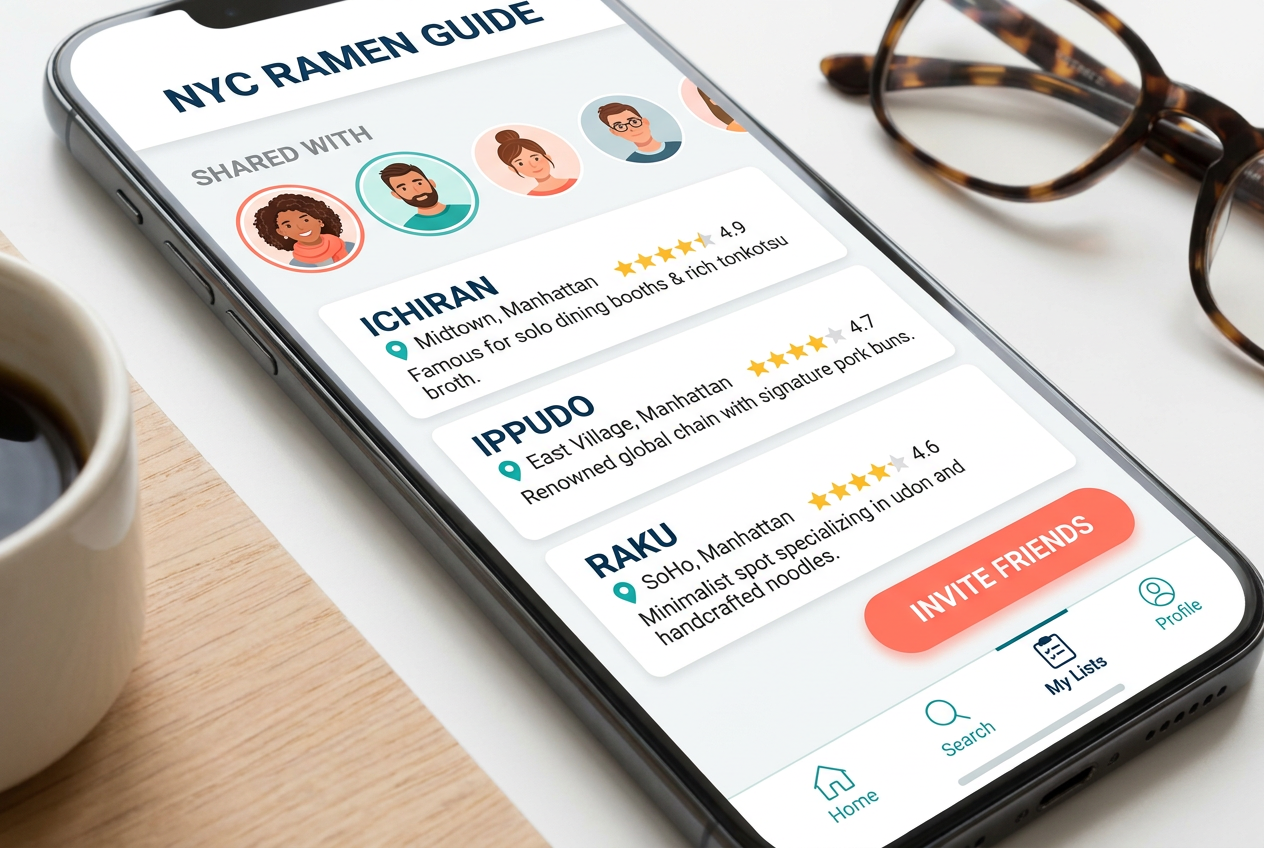
BLUF: The real value of a list sharing app isn’t broadcasting to everyone - it’s curating for the right people. Build specialized lists for specific audiences (out-of-town guests, date night with your partner, work lunch spots) and share them privately. Quality over reach.
The performative era of food social media is exhausting. You don’t need 5,000 followers seeing your breakfast. What you need is a tight circle of trusted friends who share similar taste, and the ability to give them genuinely useful recommendations without sounding like a food tour guide reciting a script.
This is where selective sharing becomes powerful. Instead of a public feed where every meal becomes content, you build private, purposeful lists:
The Out-of-Town Guest Guide: Your friend is visiting Chicago for a conference. You create a curated list of seven restaurants within walking distance of their hotel, each with a specific dish callout. Not "try Alinea" (useless advice - everyone knows Alinea). Instead: "Girl and the Goat - get the wood-fired pig face, sit at the bar if you’re solo, and go on a weeknight because weekends are a zoo."
The Date Night Rotation: You and your partner maintain a shared list of spots that meet specific criteria: romantic ambiance, consistently excellent food, takes reservations, within your budget. When Saturday rolls around and you’re too tired to debate options, the list is already vetted.
The Lunch Hour Shortlist: Everyone in your office constantly asks "where should we go?" Build a collaborative list with colleagues of places within a 10-minute walk that serve food fast enough for a lunch break. No more decision paralysis at noon.
The Single-Dish Pilgrimage: Sometimes a list is hyperfocused. "Best pizza in New Haven" becomes "Bar vs. Pepe’s vs. Sally’s: the white clam pie showdown" with scoring and notes for each specific pie. Now when your pizza-obsessed friend visits, you’re not giving generic advice - you’re sharing expert reconnaissance.
The key is matching the list to the audience and the context. A sprawling, unorganized collection of 200 saved restaurants helps no one. A tight 8-spot guide to natural wine bars in Paris, shared with the friend who just booked a flight, is genuinely valuable.
This approach also forces you to articulate why you’re recommending something, which deepens your own understanding of your taste. When you have to write "The duck ragu is the only reason to visit - skip everything else," you’re crystallizing knowledge that would otherwise remain vague intuition. That’s how casual dining becomes deliberate expertise.
Choosing the Tool That Fits Your Culinary Persona
BLUF: Don’t chase features. Choose based on whether your food documentation is primarily social (Beli), private (Savor), automated (Truffle), or minimalist (Notes/Maps). The best app is the one you’ll actually use consistently.
Let’s cut through the noise and get specific about who should use what:
Choose Beli if:
- You thrive on social motivation and friendly competition
- Your friends are also active food enthusiasts who want to share discoveries
- You prefer venue-level rankings and don’t need granular dish-by-dish detail
- You enjoy building and curating public lists
- You don’t mind the pressure of maintaining an active public profile
Choose Savor if:
- Your primary goal is personal memory and reference, not social validation
- You want to track individual dishes with independent scores and detailed notes
- Privacy matters more than social features
- You’re building a serious culinary knowledge base for palate development
- You value searchability and filtering by dish characteristics
- You read articles like how to keep a food journal and think "yes, that’s me"
Choose Truffle if:
- You already document most meals on Instagram Stories
- You want zero friction in logging (automation over control)
- Public sharing doesn’t bother you
- Visual, map-based browsing appeals more than detailed data
- You care more about the act of documentation than deep analysis
Stick with Notes/Maps if:
- You’re philosophically opposed to food-specific apps
- Your tracking needs are minimal (just addresses and quick thoughts)
- Total privacy and data ownership are non-negotiable
- You have strong personal organizational systems already in place
- You don’t want another subscription or account to manage
There’s no shame in the low-tech route. Some of the most knowledgeable food people I know keep meticulous Apple Notes files organized by city and cuisine type. The system works because they use it consistently, not because it has features.
The real failure mode is downloading three apps, using none consistently, and ending up with fragmented data scattered across platforms. Pick one, commit for at least three months, and build the habit. You can always migrate data later if your needs change, but habit formation requires focus.
And here’s the uncomfortable truth: the sophistication of your tracking system doesn’t make you a better eater. Taste development happens at the table, not in the app. The tool is there to preserve memory and facilitate sharing, not to substitute for actually paying attention to what you’re eating. A beautifully organized but thoughtlessly logged database is worthless. A simple Notes file paired with genuine curiosity and attention will serve you far better.
Frequently Asked Questions
What is a list sharing app for food?
A list sharing app for food is a digital tool that lets you create, organize, and share collections of restaurants or dishes with friends, family, or a broader community. Unlike generic review platforms that broadcast to everyone, these apps focus on personal curation and selective sharing. The best ones let you build private lists (like "Best tacos in Austin" or "Date night spots"), tag them by category, and send them to specific people who’ll actually use them. For serious foodies, the key feature is dish-level tracking - logging not just the restaurant, but the specific menu items worth ordering, often with personal ratings and tasting notes. Think of it as your personal food encyclopedia that you can open up to trusted friends when they need real recommendations, not crowd-sourced noise from strangers.
How is a food tracking app different from Yelp or Google Reviews?
The fundamental difference is purpose and audience. Yelp and Google Reviews are public platforms designed for crowd-sourced consensus - you’re writing for strangers, and reading reviews from people whose taste you can’t verify. A dedicated food tracking app is your private archive first, with optional social features second. You’re documenting meals for your own reference and future decisions, not performing for an audience. The interface reflects this: instead of star ratings and lengthy public reviews, you get structured fields for quick logging (dish name, score, brief note, photo). The social element, when it exists, connects you only with your actual friends or chosen community, creating a trust network rather than an anonymous crowd. Plus, serious tracking apps let you score individual dishes independently, which Yelp’s venue-centric model doesn’t support. You’re building a personal database, not contributing to a public directory.
Can I export my data from these apps if I want to switch later?
Data portability varies dramatically. Savor offers full export of your entire database (dishes, photos, notes, scores) in standard formats, reflecting its philosophy that your data belongs to you. Beli allows export of your restaurant lists and rankings, though photo extraction may require extra steps. Truffle’s automation comes with a downside: since it pulls from Instagram, you don’t technically own a separate data set within the app - your backup is whatever you’ve posted publicly. Notes app and Google Maps data lives in your respective Apple or Google ecosystem, easily exported through native backup systems. Before committing to any platform, check the settings menu for export options. The best practice is occasional manual backups anyway - screenshot key lists, save photos to your camera roll, copy important notes. No app is permanent, but your memories should be. If a platform makes export difficult or impossible, that’s a red flag about their business model.
Do I need to use a specialized app, or can I just stick with my phone’s Notes?
You absolutely can stick with Notes, and many organized people do. The question is whether the trade-offs align with your goals. Notes gives you total privacy, offline access, and zero subscription costs. It’s simple, reliable, and you control the format. The downsides: no structured search (you can’t easily filter by "Italian restaurants rated 8+ that I visited in 2024"), no map visualization, no photo organization beyond manual insertion, and no built-in sharing beyond copy-paste or screenshots. If your tracking needs are basic - just addresses and quick thoughts - Notes works fine. But if you’re visiting 50+ restaurants annually and want to actually remember specific dishes months later, a food diary app designed for that purpose saves significant time and frustration. The specialized tool earns its place when searching your archive becomes frequent enough that manual scrolling becomes a bottleneck. Start with Notes if you’re unsure, then migrate when you hit its limits.
How do I decide between Beli and Savor?
The decision comes down to whether your primary motivation is social or personal. Choose Beli if you want to see where your friends are eating, enjoy the gamification of food tracking, and value a community aspect. Beli is optimized for discovery through social validation - it assumes you care about leaderboards, shared lists, and what your network is ranking highly. Choose Savor if your focus is building a detailed, private reference library of dishes you’ve loved. Savor is optimized for palate development and memory preservation - it assumes you want granular control, independent dish scoring, and searchability over social features. A telling question: if no one else ever saw your food tracking, would you still do it? If yes, Savor fits. If the social element is half the fun, Beli fits. You could also use both: Beli for the social/discovery layer, Savor as your private detailed archive. Just know that maintaining two systems requires discipline most people don’t sustain long-term.
Can I keep my food tracking private while still sharing some lists?
Yes, and this is one of the most important features to look for. Savor handles this elegantly: everything is private by default, but you can create specific shareable lists (like "Tokyo 2024 highlights" or "Anniversary dinner ideas") and send those to chosen people via link. The rest of your database stays private. Beli offers private list options too, though its social feed encourages public sharing. Truffle is fully public by design since it mirrors your Instagram activity - if you’re uncomfortable with that, it’s not the right tool. Notes app and Google Maps are as private as your phone’s security settings allow. When evaluating apps, look for granular privacy controls: can you make some lists public, others visible only to friends, and others completely private? Can you share a specific restaurant entry without exposing your entire archive? This flexibility is crucial for people who want to be generous with recommendations without feeling like they’re performing their food life for an audience.
What’s the 30-second log benchmark?
The 30-second log benchmark is a practical test of whether a food tracking app will survive real-world use. Can you capture the essential information - restaurant name, dish, quick score, brief note - in roughly 30 seconds while you’re still at the table? If the app demands extensive data entry, multi-step navigation, or mandatory fields that don’t matter to you, friction kills consistency. You’ll skip logging that Tuesday lunch, then Wednesday dinner, and within two weeks you’ve abandoned the system entirely. The best apps streamline the core capture process: snap photo, add dish name, assign quick score (even just a thumbs up/down), optional note field. Done. You can add detailed tasting notes later if you want, but the essential data is captured while it’s fresh. This is why heavily structured apps with 15 required fields fail despite impressive feature lists. Speed and simplicity at the moment of logging matter more than comprehensive data architecture. Test this during your first week with any new app: if you’re regularly thinking "I’ll log it later," the friction is too high.
Is it worth paying for a food tracking app subscription?
The answer depends on volume and seriousness. If you eat out once or twice a month and casually save a few favorites, free tools suffice. But if you’re dining out multiple times weekly and genuinely want to remember those experiences - if food is a serious hobby, not just sustenance - a modest subscription often pays for itself in reduced decision fatigue and eliminated regret. Think about it economically: if the app helps you avoid even one mediocre $50 dinner by directing you to a dish you know you’ll love, it’s covered a year of subscription costs. The real value compounds over time as your database grows into a genuine reference library. That said, evaluate the business model. One-time purchases or very low annual fees are safer bets than aggressive monthly subscriptions, which can pressure you to overshare just to feel like you’re getting your money’s worth. Try free tiers first when available, then upgrade only when you’ve confirmed consistent usage over at least three months.