
The Best Restaurant Apps for Serious Foodies: Beyond the Camera Roll
John the smoothie monster
John lives for smoothie bowls and cold-pressed juices. He uses Savor to remember his best blends.
Beyond the Camera Roll: The Best Restaurant Apps for Serious Foodies in 2025 Your phone’s camera roll holds 2,000 food photos. You remember the feeling of that...
Beyond the Camera Roll: The Best Restaurant Apps for Serious Foodies in 2025
Your phone’s camera roll holds 2,000 food photos. You remember the feeling of that perfect bowl of ramen, but you can’t recall the name of the restaurant. You scroll back through six months of images, searching for that one shot of Neapolitan pizza that changed your understanding of what crust could be.
This is the problem with treating Instagram as your food memory system. It wasn’t built for curation. It was built for broadcasting.
The modern serious foodie exists in a strange digital limbo. We use Google Maps for navigation, Instagram for discovery, and our camera rolls as an accidental archive. But none of these tools were designed to answer the question that actually matters: "What should I order when I come back here?"
Table of Contents
- The Crisis of the Foodie Camera Roll
- Why Generic Review Apps Fail the Serious Foodie
- The Big Four: Personal Tracking Archetypes
- Category Breakdown: Which App Fits Your Dining Style
- The Socialite’s Choice: Beli
- The Professional Journaler’s Choice: Savor
- The Anti-Algorithm Purist: World of Mouth
- The Automation Specialist: Truffle and Yummi
- Migrating Your Data: From Notes App to Unified Ledger
- The Serious Foodie Checklist
- Frequently Asked Questions
The Crisis of the Foodie Camera Roll
BLUF: Your camera roll can’t answer "where did I have that incredible carbonara?" because photos lack searchable metadata, organization, and context.
Let’s be honest about what your camera roll actually is: a digital graveyard of half-eaten pasta dishes, poorly lit sushi boats, and that one blurry photo of a Michelin-starred dessert you took after three glasses of wine.
The average food enthusiast dines out three to four times per week. Over a year, that’s 150+ unique dining experiences. Most of us can’t remember what we ate last Tuesday, let alone which specific Bangkok street vendor made that transcendent pad kra pao six months ago.
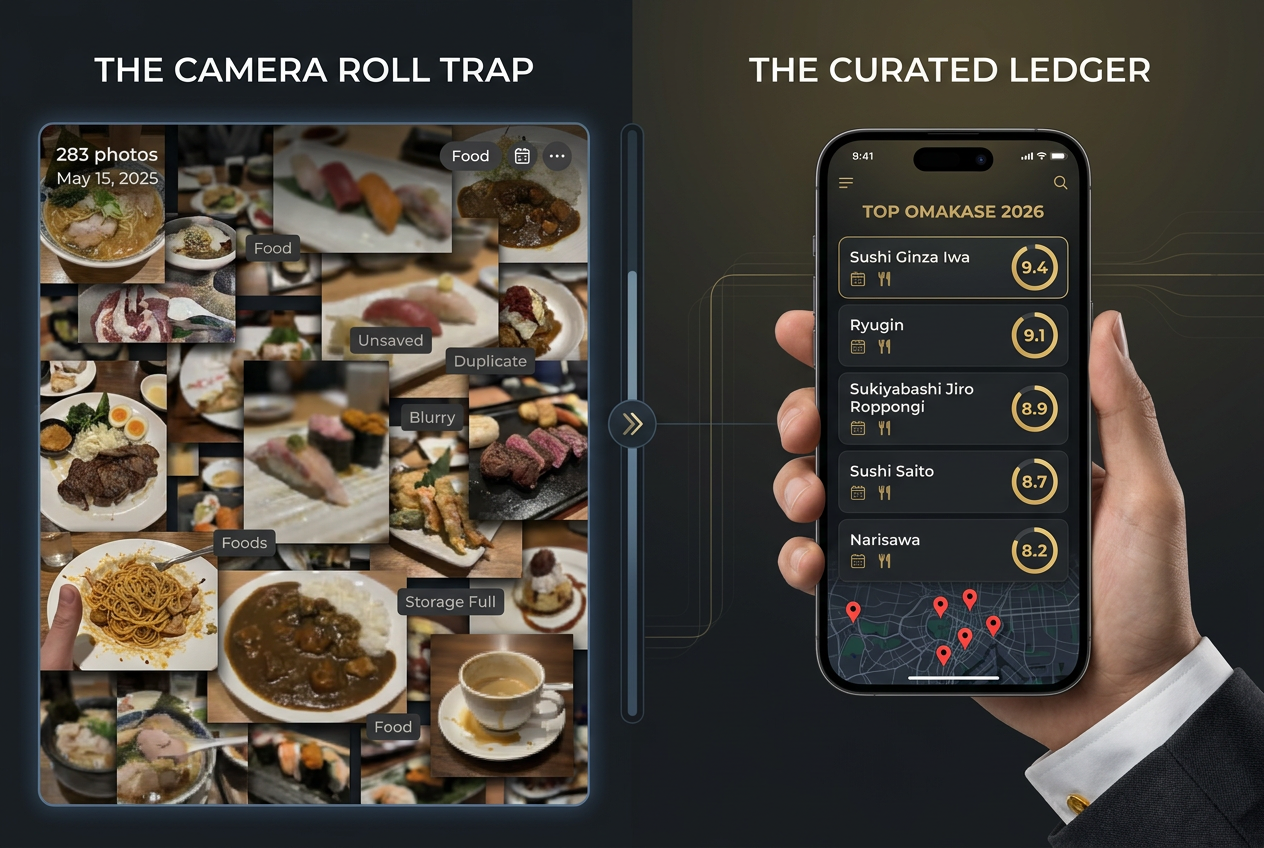 Transition from digital chaos to a structured culinary history by moving beyond the camera roll and into a dedicated restaurant ledger designed for memory management.
Traditional photo apps organize by date, which is fundamentally useless for food memory. You don’t think "I had that amazing meal on March 14th." You think "I had that amazing tonkotsu ramen somewhere in the East Village." Date-based organization is the wrong framework entirely.
This is where dedicated restaurant tracking apps enter the picture. They’re not trying to replace your camera roll. They’re trying to make it searchable, meaningful, and actionable.
Why Generic Review Apps Fail the Serious Foodie
BLUF: Yelp and Google Reviews prioritize crowd consensus over personal taste, lack dish-level granularity, and drown signal in noise through fake reviews and paid placement.
You’ve been there. You open Yelp, see a restaurant with 4.2 stars based on 847 reviews, and you still have no idea what to order.
Generic review platforms operate on the fundamental assumption that aggregated public opinion equals truth. But serious foodies know better. The crowd that gives Olive Garden four stars isn’t the same crowd evaluating whether a restaurant properly executes a traditional French demi-glace.
The problems with mainstream review apps break down into three categories:
Curation Fatigue: Sorting through hundreds of reviews to find the three people who actually know what they’re talking about is exhausting. Most reviews are noise: "Great service!" or "Came here for my birthday!" These tell you nothing about the food.
Venue-Level Reviews vs. Dish-Level Memory: A restaurant can have a transcendent hamachi crudo and a mediocre tiramisu. Star ratings for the entire venue obscure the granular truth. You don’t need to know if the restaurant is "good." You need to know if the specific dish is worth ordering.
The Trust Problem: Yelp’s business model creates perverse incentives. Restaurants can pay to promote reviews or suppress negative ones. Fake reviews proliferate. When monetary incentives contaminate the signal, the entire system becomes suspect.
The serious foodie doesn’t want democratic consensus. They want curatorial precision. They want to know what Marco, their trusted friend with a refined palate, thinks about the agnolotti, not what 47 strangers think about the restaurant’s "vibe."
The Big Four: Personal Tracking Archetypes
BLUF: The four leading personal food tracking apps divide into distinct archetypes: social ranking (Beli), private journaling (Savor), expert curation (World of Mouth), and automated tracking (Yummi/Truffle).
Here’s the real landscape of food tracking apps in 2025. These aren’t trying to be the next Yelp. They’re trying to be the "Letterboxd for food", a comparison that appears repeatedly in foodie circles for good reason.
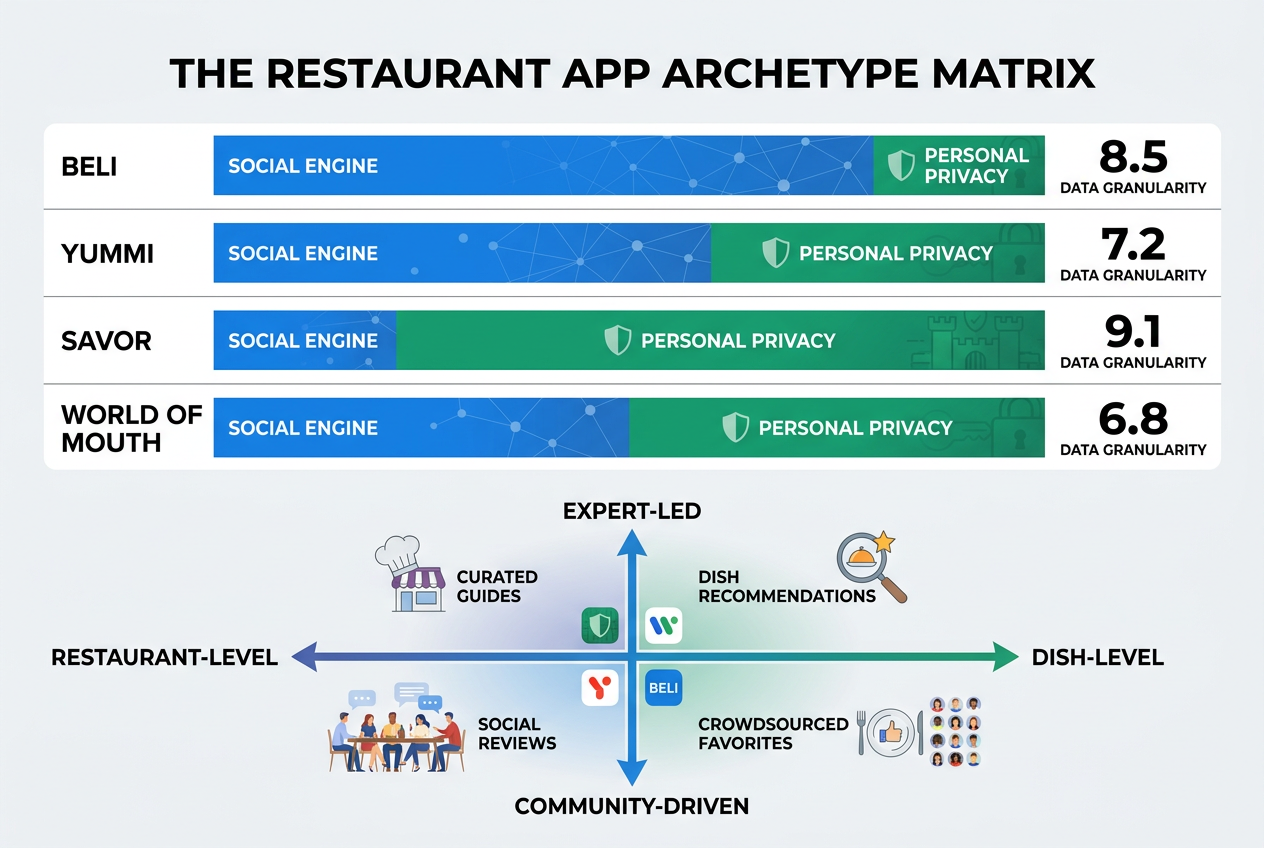 Evaluate which app fits your dining style by comparing privacy levels, social connectivity, and whether the platform prioritizes expert reviews or community feedback.
| App | Core Value Proposition | Best Feature | Privacy Level | Social Engine | Pricing |
|---|---|---|---|---|---|
| Beli | "Letterboxd for Food" | Ranked Lists & Feed | Public First | Follow/Feed Model | Free |
| Savor | Private Dish Journaling | 10-Point Scoring System | Private First | No Social | Free |
| World of Mouth | Expert-Only Discovery | 800+ Chef Recommendations | Semi-Private | Expert-Curated | €9.90/month |
| Yummi | Auto-Organized Food Log | Location-Based Tagging | Private | Minimal | Free/Ad-Supported |
The fundamental question isn’t "which app is best?" The question is "which mental model matches how I think about food?"
Do you want to share your finds and see what friends are eating? That’s Beli. Do you want a private archive where you can ruthlessly score every dish without social pressure? That’s Savor. Do you trust professional chefs more than your own network? That’s World of Mouth. Do you want zero friction and automatic organization? That’s Yummi.
Each app represents a different philosophy about what food memory should be.
Category Breakdown: Which App Fits Your Dining Style
BLUF: Choose based on whether you prioritize social discovery, private curation, expert guidance, or automated convenience.
Understanding your own behavior pattern is the key to picking the right tool. Here are the four archetypes of serious foodies and the apps built for them.
The Social Butterfly
You dine out to discover and share. You want to know where your trusted circle is eating, and you want them to know about your finds. You value the communal aspect of food culture.
For you, food tracking is inherently public. It’s about building reputation, contributing to a community, and having your taste validated by peers. The dopamine hit of seeing someone add your recommendation to their list is part of the experience.
Best App: Beli (followed by Truffle for Instagram automation)
The Private Critic
You view your food journal as a personal reference library, not a social media feed. You want to score dishes with brutal honesty without worrying about offending a restaurant owner or looking pretentious to casual diners.
Your perfect app has zero social features. No followers, no likes, no public profiles. Just a clean, searchable database of everything you’ve ever eaten, rated on your personal scale.
Best App: Savor (with Yummi as a backup for photo organization)
The Expert Seeker
You don’t trust crowd wisdom, and you’re skeptical of your own network’s taste. You want recommendations from people who’ve dedicated their lives to understanding food: Michelin-starred chefs, James Beard winners, serious food writers.
You’re willing to pay for curation because amateur opinions are worse than useless. They’re actively misleading.
Best App: World of Mouth
The Convenience Maximalist
You want perfect documentation with near-zero effort. You’ll take a photo anyway, so the app should automatically handle tagging, location, and organization. Manual data entry is a non-starter.
Your ideal system works invisibly in the background, turning your existing behavior (taking photos and posting to Instagram) into a searchable archive.
Best App: Yummi or Truffle
The Socialite’s Choice: Beli
BLUF: Beli is the "Letterboxd for food," offering ranked lists, social feeds, and a waitlist-driven community of serious food enthusiasts who share recommendations.
Beli understood something critical: food people are list people. We don’t just want to remember what we ate. We want to rank it, organize it, and share those rankings with people who care.
The app’s killer feature is the ranked list system. You can create a list called "Best Ramen in Tokyo" and then drag dishes into your personal order of preference. These aren’t star ratings. These are head-to-head comparisons. "Is the tonkotsu at Ichiran better than the shoyu at Afuri?" Beli forces you to answer.
The social feed shows you what your friends are adding to their lists in real time. It’s aspirational without being performative. You’re not seeing "Instagrammable" dishes. You’re seeing what the people whose taste you respect are actually eating and ranking.
The waitlist exclusivity was genius marketing. Beli created artificial scarcity during its launch, which attracted exactly the audience it wanted: people who take food seriously enough to wait for access to a food tracking app. The result is a community with remarkably consistent standards.
The downside? If you value privacy, Beli is the wrong choice. Everything is public by default. There’s no private mode for scoring that mediocre dish at your friend’s new restaurant. For those interested in exploring different approaches to food tracking, the 10 best dish tracking apps guide offers a comprehensive comparison of alternatives.
The Professional Journaler’s Choice: Savor
BLUF: Savor is a privacy-first app for dish-level ratings using a 10-point system, AI photo tagging, and searchable notes - designed for foodies who view their journal as a personal archive, not a social feed.
Savor takes the opposite approach from Beli. It’s aggressively private, has zero social features, and focuses entirely on granular dish-level tracking with a professional scoring system.
The 10-point rating scale is borrowed from wine criticism and Michelin guide methodology. It’s not "three stars" or "thumbs up." It’s a nuanced framework where an 8.5 means something specific and different from an 8.7. This precision matters when you’re trying to remember whether the duck at Restaurant A was marginally better than the duck at Restaurant B.
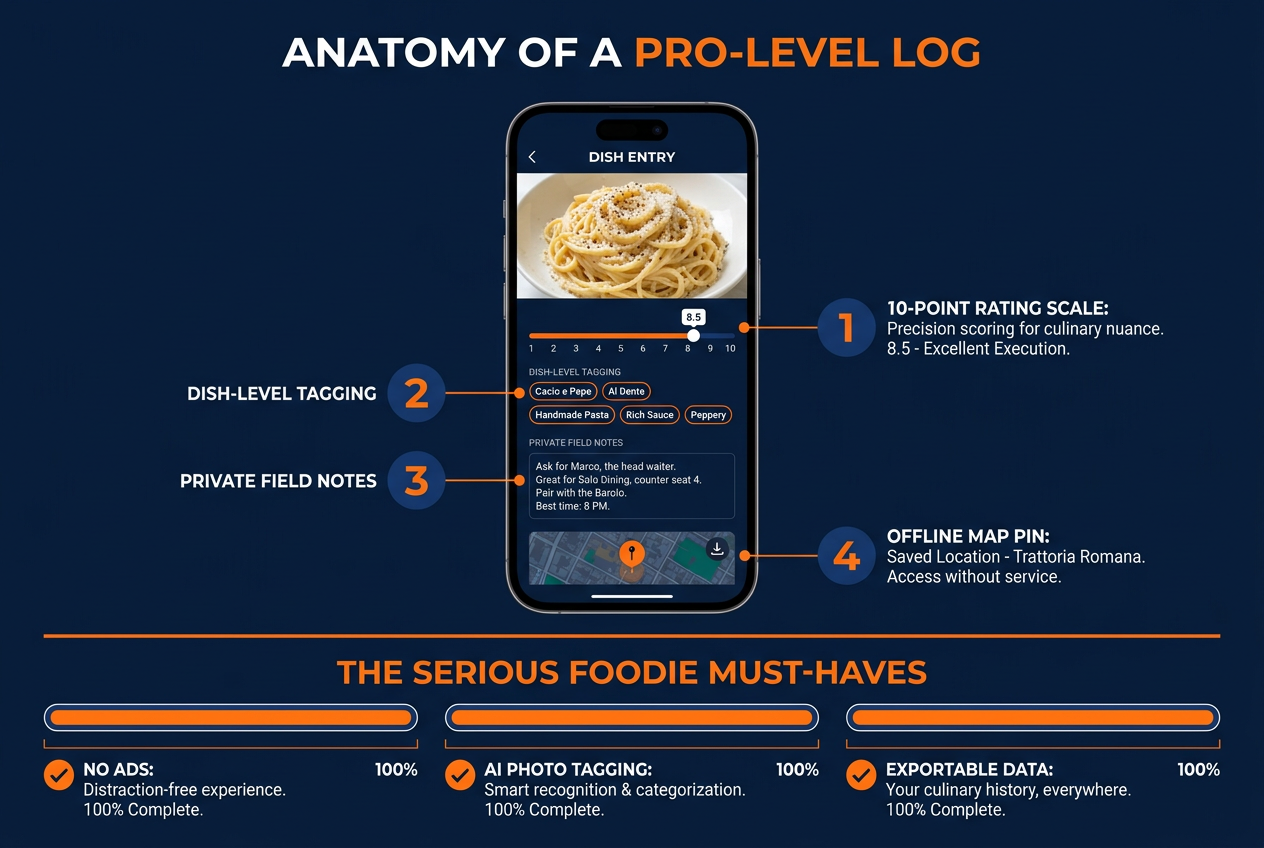 A pro-level food log captures specific dish details and personal notes that generic review sites ignore, ensuring you never forget a perfect meal.
Savor’s AI tagging feature analyzes your food photos and automatically suggests dish names, ingredients, and even cuisine types. You take a photo of pasta carbonara, and the app suggests "Pasta, Carbonara, Italian" as tags. You can accept, edit, or ignore these suggestions, but the automation dramatically reduces friction.
The note-taking system is where Savor shines for serious users. You can record specific observations: "Ask for Marco as your server," "The natural wine selection changes weekly," "Skip the dessert menu, order the cheese course instead." These notes are fully searchable, which means six months later you can search "Marco" and immediately find every restaurant where you made that notation.
The map visualization lets you see every dish you’ve logged by location. Planning a trip to Paris? Open the map, zoom to the city, and see every restaurant where you’ve logged a memorable meal. It’s your personal culinary GPS.
The downside? If you want social validation or community recommendations, Savor offers none of that. It’s designed for the person who views their food journal as a private reference library, period. Those seeking to understand the full landscape of food tracking apps can explore a broader comparison of available options.
The Anti-Algorithm Purist: World of Mouth
BLUF: World of Mouth offers recommendations from 800+ Michelin-starred chefs and food professionals with no ads, no algorithms, and no crowd-sourced noise - at €9.90/month.
World of Mouth made a radical bet: what if serious foodies would pay for curation from actual experts, instead of wading through free but unreliable crowd-sourced reviews?
The app’s premise is simple. Over 800 professional chefs, sommeliers, and food writers contribute their personal recommendations. You’re not getting "what Yelp users think." You’re getting "where Daniel Humm eats when he’s in Copenhagen" or "what dish Massimo Bottura orders at his favorite local trattoria."
The anti-algorithm stance is genuine. There’s no personalization engine trying to predict what you’ll like based on your browsing history. There’s no paid placement. There’s no advertising. You get a searchable database of expert recommendations, organized by city and cuisine type.
The €9.90 monthly subscription acts as a filter. It keeps out casual users and creates a community of people who take dining seriously enough to pay for quality information. This is the Criterion Collection approach to food apps.
The downside? You’re dependent on expert taste, which may not align with your own preferences. Just because a Michelin-starred chef recommends something doesn’t mean you’ll love it. The app works best as a supplement to your own judgment, not a replacement for it. For those interested in building their own evaluation system, understanding what is a flavor profile can help develop more sophisticated personal tracking methods.
The Automation Specialist: Truffle and Yummi
BLUF: Truffle automatically converts Instagram Stories into a searchable restaurant map, while Yummi uses AI to organize your camera roll by location - both minimize manual data entry.
These apps solve the fundamental problem: manual data entry sucks. You’re not going to spend 20 minutes after every meal logging dishes. You want documentation without effort.
Truffle: The Instagram Integration
Truffle watches your Instagram Stories. When you post about a restaurant, it automatically captures the location, photos, and any text you’ve written. These get stored in a private map that only you can see.
The brilliance is that it requires zero behavior change. You’re already posting Instagram Stories about food. Truffle just makes those Stories searchable and permanent, rather than disappearing after 24 hours.
The private archive means you can post casual, unpolished content without worrying about your feed aesthetic. The Story disappears publicly, but Truffle keeps it in your personal map.
Yummi: The Camera Roll Organizer
Yummi takes a different approach. It scans your camera roll, uses location data and AI image recognition to identify food photos, and automatically groups them by restaurant.
You don’t need to do anything. Just take photos like you normally would, and Yummi creates a map showing everywhere you’ve eaten. Tap a location, and you see all the photos from that restaurant.
The feature that sets Yummi apart is the automatic timeline. It shows your food photos in chronological order, which becomes a visual diary of your eating habits. You can see that you’ve been to your favorite ramen place seven times in two months, or that you haven’t tried a new restaurant in three weeks.
The downside for both? Automation means less precision. Truffle can only capture what you post to Instagram Stories. Yummi can only work with geotagged photos. Neither offers the granular dish-level scoring or detailed note-taking of apps like Savor. The tradeoff is convenience for depth.
Migrating Your Data: From Notes App to Unified Ledger
BLUF: Successful migration requires an initial time investment to categorize existing food photos, import saved locations from Google Maps, and establish a consistent tagging system.
You’ve been using your Notes app, Google Maps stars, and camera roll as a makeshift food tracking system. Now you want to consolidate everything into a unified platform. Here’s how to make the transition without losing your history.
Phase One: The Audit
Start by exporting your Google Maps saved places. Most dedicated food apps can import this data directly. In Google Maps, go to "Your places," select "Saved," and you’ll find an export option. This gives you a CSV file with every restaurant you’ve starred.
Next, go through your camera roll systematically. Don’t try to process everything at once. Set a timer for 30 minutes and work chronologically, starting with your most recent food photos. Use your chosen app’s photo upload feature to backfill dishes you want to remember.
If you’ve been keeping notes in Apple Notes or Evernote, copy-paste the critical observations into your new app. Don’t aim for perfection. Capture the highlights: the restaurants you’ll definitely return to, the dishes you’d order again, the specific recommendations ("ask for the corner table," "order off-menu specials").
Phase Two: Establish Your System
Decide on your personal rating scale and stick to it. If you’re using Savor’s 10-point system, write down what each score means to you. Does 7.0 mean "solid but not memorable" or "would order again"? Your scale only works if it’s consistent.
Create a tagging taxonomy. Common tags might include cuisine type, neighborhood, price point ("$$$ splurge"), occasion ("date night," "business lunch"), or specific attributes ("natural wine list," "outdoor seating," "late-night kitchen").
Set a habit trigger. The best time to log a meal is immediately after eating, when the sensory memory is fresh. Many serious users set a phone reminder 30 minutes after typical dinner time, prompting them to log the meal before memory fades.
Phase Three: The Six-Week Test
Give your chosen app six weeks of consistent use before evaluating whether it’s working. This is enough time to build a meaningful database and test the search/recall functionality.
After six weeks, ask yourself: Can I quickly answer "where did I have that incredible steak?" Has the app made me more intentional about what I eat? Do I actually use it, or am I forcing myself to engage with a system that doesn’t fit my behavior?
If the answer is "this isn’t working," switch to a different app. The best food tracking system is the one you’ll actually use. There’s no virtue in struggling with an app that doesn’t match how your brain organizes food memory. For those considering multiple options, exploring best food tracking app iPhone choices can help identify the most compatible tool.
The Serious Foodie Checklist
BLUF: The essential features for a professional food tracking system include dish-level granularity, offline access, visual map organization, advanced search, export capabilities, and zero algorithmic interference.
Not all food tracking apps are created equal. Here’s what separates a professional tool from a glorified photo album.
Dish-Level Tracking, Not Just Restaurant-Level
You need the ability to rate and remember specific dishes, not just venues. The scallop crudo at Restaurant X might be transcendent while the steak is mediocre. A generic five-star rating for the restaurant obscures this critical granularity.
Offline Access
If you travel internationally for food (and serious foodies do), offline access is non-negotiable. You should be able to pull up your notes and map without a data connection. Standing in the middle of Kyoto, trying to remember which tempura place your Tokyo friend recommended three months ago, is not the moment to discover your app requires internet access.
Map Visualization
Your food tracking app should show every logged meal on a visual map. This is critical for trip planning. You’re headed to Barcelona for a week? Zoom to the city and see everywhere you’ve logged a memorable dish. This is infinitely more useful than scrolling through a chronological list.
Searchable Notes
The ability to search your notes transforms your food journal from a static archive into a dynamic reference system. You should be able to search for "ask for Marco," "natural wine," or "late-night" and instantly see every restaurant where you noted these details.
Export Capabilities
Your data belongs to you. Any serious food tracking app should let you export everything: ratings, photos, notes, locations. This protects you if the app shuts down and allows you to migrate to a different platform if needed.
No Algorithmic Recommendations
Paradoxically, the best food tracking apps don’t try to tell you what to eat. They just help you remember what you’ve already eaten and organize that information intelligently. Algorithmic recommendations based on "users like you" introduce the same noise problem that makes mainstream review apps unreliable.
Privacy Controls
You should be able to choose whether each entry is private or public. Sometimes you want to share a find with friends. Other times you want to document a mediocre meal at someone’s new restaurant without the awkwardness of a public negative review. Granular privacy controls matter.
For those who value the ability to document meals without friction, learning how to keep a food journal that actually works is essential to developing sustainable habits.
The Real Question: What Problem Are You Solving?
Here’s the truth most food tracking app reviews won’t tell you: you don’t have a technology problem. You have a memory problem masquerading as a technology problem.
The camera roll chaos, the forgotten restaurant names, the inability to recall what you ordered six months ago - these are symptoms of trying to use general-purpose tools (Instagram, Google Photos, Notes app) for a specific purpose they weren’t designed for.
A dedicated food tracking app isn’t magic. It’s specialized infrastructure for a specific use case: building a searchable, visual archive of your culinary life. The app that works best is the one whose mental model matches how you naturally think about food.
If you think in terms of rankings and lists, use Beli. If you think in terms of granular scores and private notes, use Savor. If you trust expert curation over your own network, use World of Mouth. If you want zero-friction automation, use Yummi or Truffle.
But here’s what you can’t do: continue treating your camera roll like a filing system and expect different results. That incredible meal you had last month is already fading from memory. The restaurant name is already slipping away. The specific pasta shape, the perfect seasoning, the recommendation to "order the regional wine" - all of it will be gone soon.
The best food tracking app is the one you start using today, not the perfect one you’ll research for another six months while your memories evaporate.
Your food life deserves better than a chaotic camera roll. Pick your tool and start building your personal culinary archive. The meal you’ll forget a year from now is the one you don’t document today.
Frequently Asked Questions
What is the best app for tracking restaurants?
The answer depends entirely on your priorities. Beli excels for social discovery and ranked lists, functioning as the "Letterboxd for food" with a community-driven feed. Savor is ideal for private, granular dish-level tracking with a professional 10-point rating system and zero social features. World of Mouth offers expert-curated recommendations from over 800 Michelin-starred chefs for those who prefer professional guidance over crowd opinions. Yummi and Truffle prioritize automation, organizing your existing photos and Instagram Stories with minimal manual effort. The best app is the one whose philosophy matches how you naturally think about food memory.
How do food tracking apps differ from Yelp or Google Reviews?
Mainstream platforms like Yelp and Google Reviews focus on venue-level ratings aggregated from crowd consensus, which creates three fundamental problems: they lack dish-level granularity (you can’t tell if the specific carbonara is excellent while the tiramisu is mediocre), they’re contaminated by fake reviews and paid placement, and they prioritize what strangers think over your personal taste memory. Dedicated food tracking apps like Savor or Beli function as personal archives, letting you document what you thought about each specific dish, creating a searchable reference library based on your palate rather than crowd opinion. They’re private culinary journals, not public review platforms.
Can I import my existing Google Maps saved places into these apps?
Yes, most serious food tracking apps support importing your Google Maps saved places, though the process varies by platform. Export your saved locations from Google Maps by navigating to "Your places" > "Saved" and selecting the export option, which generates a CSV file. Savor, Beli, and similar apps typically offer direct CSV import functionality. However, this only transfers basic information like restaurant names and addresses. You’ll still need to manually add dish-level details, ratings, and personal notes, which is why many users treat the import as a starting foundation rather than a complete migration. The initial time investment pays dividends once you have a fully populated personal database. For guidance on building these detailed records, how to keep a food diary offers practical strategies.
Do these apps work offline for international travel?
Offline functionality varies significantly. Savor offers full offline access to your entire database, including maps, ratings, and notes, making it ideal for food-focused international travel. Beli requires internet connectivity for its social feed but caches your personal lists for offline viewing. World of Mouth needs connectivity to access expert recommendations. Yummi and Truffle both rely on cloud syncing and location services, which limits offline utility. If you’re planning culinary travel to regions with spotty connectivity (rural Italy, Tokyo subway system, Southeast Asian markets), prioritize apps with robust offline modes. The worst-case scenario is standing in Kyoto trying to remember which tempura shop your friend recommended, only to discover your app requires data access.
How long does it take to build a useful food tracking database?
Plan for six weeks of consistent logging before your database becomes genuinely useful as a reference tool. In the first two weeks, you’re learning the app’s mechanics and establishing your rating scale consistency. Weeks three and four begin to show patterns - you’ll start seeing repeat restaurants and can begin comparing dishes. By week six, you’ll have 30-50 logged meals (assuming 5-7 entries per week), which is the minimum threshold where search functionality and visual mapping provide real value. The breakthrough moment comes when you successfully recall a restaurant name by searching your notes for a specific detail ("natural wine" or "ask for corner table") that you would have forgotten otherwise. Don’t expect immediate payoff. Think of it like compound interest - small daily deposits that become invaluable over time. For those developing more sophisticated evaluation frameworks, understanding what is a flavor profile helps build more detailed, useful entries.
Are these apps worth paying for versus using free options?
Free apps like Beli, Savor, and Yummi offer robust functionality without cost, supported by either voluntary contributions or minimal advertising. Premium options like World of Mouth (€9.90/month) charge for expert curation - essentially paying for quality information from professional chefs rather than crowd-sourced noise. The calculation is simple: if you dine out seriously 3-4 times per week, spending roughly $150-300 per week on meals, is $10/month for better recommendations a worthwhile investment? For casual diners, free apps provide more than sufficient functionality. For those building extensive culinary archives or traveling specifically for food experiences, premium curation can pay for itself with a single excellent recommendation you wouldn’t have found otherwise. The real cost isn’t the subscription - it’s the opportunity cost of mediocre meals based on unreliable information.
Can I make my food tracking private, or is everything public?
Privacy models differ dramatically across platforms. Savor is private-by-default with zero social features - everything you log is visible only to you, period. Beli is public-by-default, operating as a social network where followers see your additions to lists and rankings. World of Mouth exists in the middle ground: your bookmarks and notes are private, but you can optionally contribute recommendations to the community. Yummi and Truffle keep your data private but extract value from aggregate anonymized usage patterns. If you want the freedom to brutally rate your friend’s new restaurant without social awkwardness, or document business lunch mediocrity without public judgment, privacy-first apps like Savor are non-negotiable. Public platforms work beautifully for sharing discoveries but create social pressure that can contaminate your honest ratings.
What happens to my data if the app shuts down?
Data portability is critical and often overlooked. Savor offers full data export in standard formats (CSV, JSON), ensuring you own your culinary archive regardless of the platform’s longevity. Beli provides export functionality for your lists and ratings. World of Mouth allows bookmark exports but not the underlying expert recommendations (which remain proprietary). Yummi and Truffle sync to your photos, so even if the app disappears, your original images remain in your camera roll. Before committing to any platform, test the export process - actually generate an export file and verify it contains everything you expect. The nightmare scenario is losing three years of detailed food memories because a startup shut down and provided no data migration path. Treat your food tracking app like any critical data system: assume it will eventually fail and plan accordingly.