
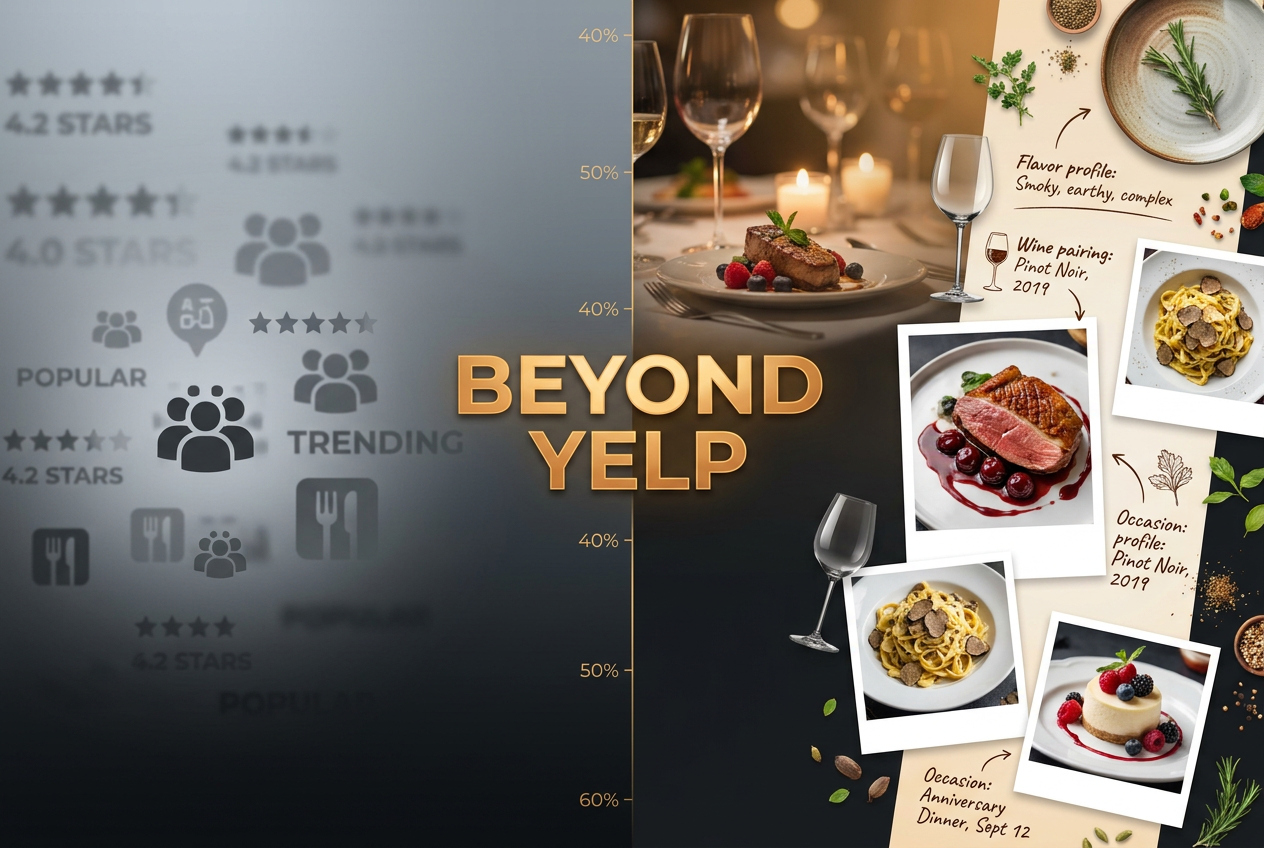
The Best Restaurant Apps for Foodies: Stop Googling and Start Curating
Harry the matcha king
Harry is our resident matcha obsessive. He’s tasted hundreds of bowls and tracks every cup in Savor.
Beyond Yelp: The Best Restaurant Apps for Serious Foodies (2026 Edition) Your camera roll tells a story: 2,400 food photos from the last three years, each one...
Beyond Yelp: The Best Restaurant Apps for Serious Foodies (2026 Edition)
Your camera roll tells a story: 2,400 food photos from the last three years, each one a fleeting memory of a perfect bite. That life-changing pasta in Rome. The sushi that redefined what tuna could taste like. The neighborhood taco stand you stumbled upon at midnight. But when you try to recall where you had that incredible cacio e pepe, or which vintage that sommelier recommended, your memory fails you. The restaurant name? Gone. The specific dish? A blur. All you have is an unsearchable photo labeled "IMG_4372."
If this sounds familiar, you’re experiencing what I call the "Dining Memory Crisis" - the gap between experiencing extraordinary food and actually remembering it. The problem isn’t that you don’t care about what you eat. The problem is that generic restaurant apps like Yelp and Google Maps were built for crowd consensus, not personal curation. A 4.2-star average tells you nothing about whether you’ll love a dish. It certainly doesn’t help you remember the texture of that perfectly crispy pork belly or the exact wine that made the meal transcendent.
The good news? A new generation of restaurant apps has emerged for people who treat dining like an art form rather than a transaction. These aren’t review platforms. They’re dining operating systems - personal food databases that help you track every memorable bite, build searchable archives of flavor, and never forget another great meal.
This guide will help you choose the right system for how you actually eat, think, and remember food.
Table of Contents
- The Death of the Generic Review
- The Big Three: Social, Expert, or Private?
- Feature Showdown: What Actually Matters
- The If/Then Decision Guide
- Building Your Food Second Brain
- The Dish-Level Revolution
- International Dining: The Travel Sync Test
- AI Conversational Search: Does It Actually Work?
- Frequently Asked Questions
The Death of the Generic Review
BLUF: Serious foodies are abandoning crowd-sourced ratings because a 4-star average can’t capture why you loved a specific dish. The future belongs to personalized tracking systems.
The 4.2-star restaurant on Google Maps doesn’t tell you what you need to know. It doesn’t tell you that the octopus appetizer is revelatory while the pasta is forgettable. It doesn’t capture that the wine list is exceptional but the service is inconsistent. Most importantly, it doesn’t help you remember your own experience six months later when you’re trying to decide if it’s worth a return visit.
Generic review platforms optimize for the average opinion of hundreds of strangers. But your palate isn’t average. Your memory of that perfect meal isn’t a crowd-sourced data point - it’s a personal story that deserves to be preserved with the same care you’d give to a great photograph or a meaningful journal entry.
This is why discerning diners are moving toward what I call the "Dining OS" model: apps that function less like Yelp and more like a private museum for your taste memories. These systems acknowledge a fundamental truth that generic review sites ignore: the quality of a restaurant is far less important than the quality of individual dishes.
The shift is already happening. Urban professionals who once relied on Yelp now maintain private lists in Savor, track chef recommendations through World of Mouth, or compete with friends using Beli’s ranking system. The common thread? These users have stopped outsourcing their taste to the crowd.
The Big Three: Social, Expert, or Private?
BLUF: Restaurant apps now fall into three distinct categories based on your primary goal: social competition (Beli), editorial authority (Eater/World of Mouth), or private archiving (Savor). Choose the category that matches your dining personality.
The modern landscape of restaurant apps can be understood through a simple framework. Every tool falls into one of three camps, each serving a fundamentally different purpose:
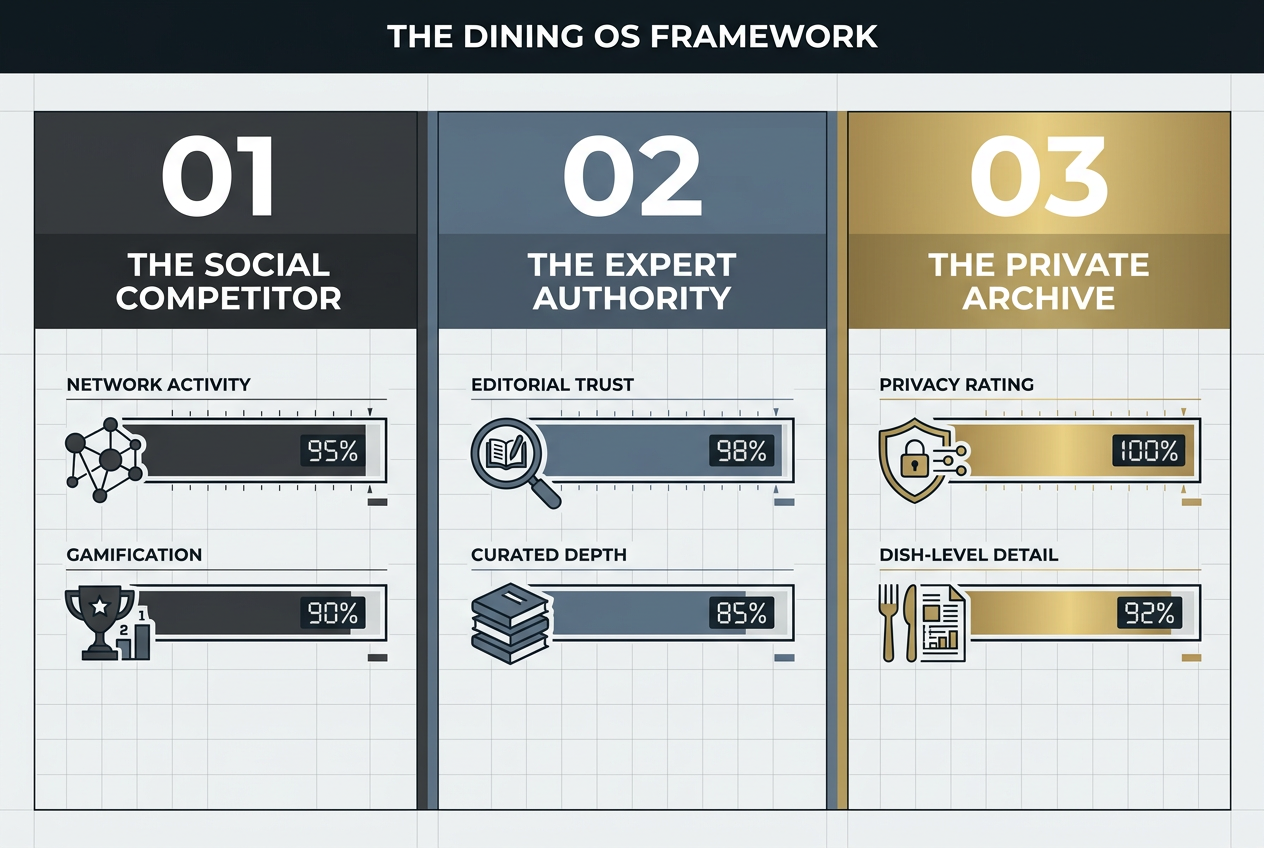 Choosing your restaurant app depends on your primary goal: social competition, expert curation, or private journaling. This framework helps you identify which ’Dining OS’ fits your lifestyle.
The Social Leader: Beli
Think of Beli as Letterboxd for food. If you treat dining like a sport and love the ritual of ranking experiences against your friends, this is your platform. The core mechanic is beautifully simple: you create ranked lists of restaurants, dishes, or experiences, then share them within your social circle.
What makes Beli compelling isn’t the reviews - it’s the competition. When your friend ranks the top 10 ramen spots in Los Angeles, you’re compelled to build your own list. When someone places a controversial choice at number one, the group chat lights up. This social pressure transforms casual dining into a curated project.
The downside? Beli optimizes for performance, not privacy. Every list you create is inherently public within your network. If you’re the type who wants to quietly document meals without the social theater, this app will feel exhausting.
The Expert Authority: Eater App and World of Mouth
For diners who trust editors and chefs more than algorithms, these apps offer a return to curatorial authority. The Eater App’s 2026 relaunch introduced conversational AI search trained on years of editorial content. You can ask "Find me a vibe like Polo Bar but with better seafood" and receive recommendations backed by professional food writers rather than random users.
World of Mouth takes this concept even further by building its database entirely from chef and sommelier recommendations. When a Michelin-starred chef tells you where they eat on their night off, that information carries weight that no crowd-sourced rating can match.
The trade-off? These apps excel at discovery but lack personal memory. They’re brilliant for finding your next meal, less useful for remembering the last one. You can browse endless expert recommendations, but you can’t easily log your own experiences or build a private archive of favorites.
The Private Archive: Savor and Memolli
This category represents a fundamental rethinking of what a food diary app should do. Instead of broadcasting opinions to strangers, these tools help you build a private, searchable database of every dish you’ve loved.
Savor approaches this through dish-level granularity. Rather than rating restaurants as a whole, you rate individual dishes with the kind of detail a food critic would use: texture, flavor balance, presentation, value. Over time, you build a personal taste archive that actually helps you remember why you loved something.
This is the category for people who view their dining history as a form of personal data - valuable, private, and worth organizing. These apps don’t gamify your food life or push you to share. They simply help you remember.
Feature Showdown: What Actually Matters
BLUF: When comparing restaurant apps, focus on three critical capabilities: dish-level search, offline functionality, and automation. Everything else is secondary.
Here’s what separates a useful dining app from digital clutter:
| Feature | Beli | Eater App | World of Mouth | Savor | What It Actually Means |
|---|---|---|---|---|---|
| Dish-Level Ratings | No | No | Partial | Yes | Can you rate the carbonara separately from the tiramisu? |
| Offline Maps | No | Yes | Yes | Yes | Will it work in a basement bistro in Paris? |
| Instagram Sync | No | No | No | No | Does it automatically pull from your Stories? |
| AI Dish Recognition | No | No | No | Yes | Can it identify dishes from photos? |
| Private by Default | No | Yes | No | Yes | Who can see your data? |
| Custom Tags | Limited | No | No | Yes | Can you create your own organization system? |
| Export Your Data | No | No | No | Yes | Can you leave with your memories intact? |
The most revealing test? Ask yourself: "If I wanted to find that specific duck dish I had 18 months ago, could this app help me?" Most can’t. They’re optimized for real-time discovery, not long-term memory.
The If/Then Decision Guide
BLUF: Choose your app based on your primary frustration, not generic features. If you can’t remember dishes, you need different tools than if you can’t find new restaurants.
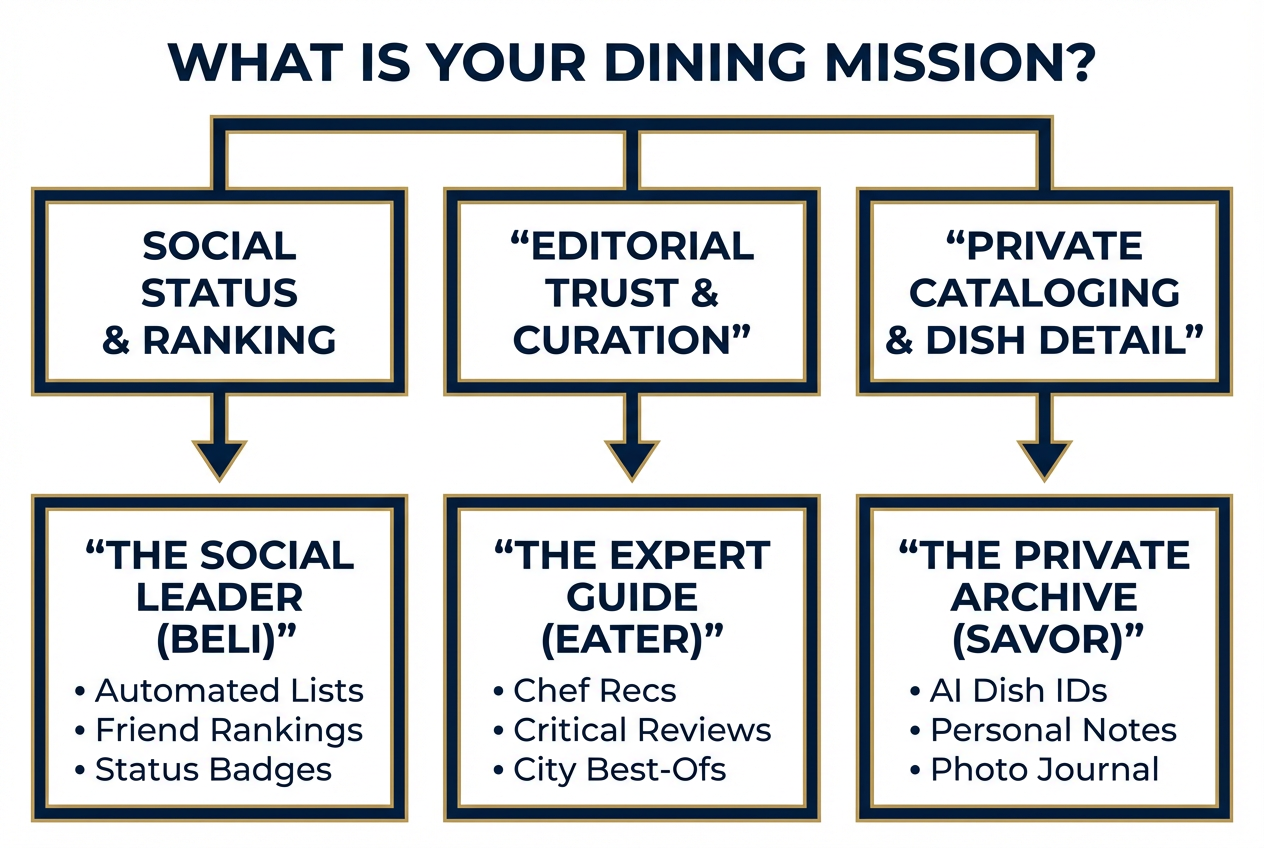 This decision matrix simplifies your choice based on your dining intent: whether you value social ranking, editorial authority, or private data-driven cataloging.
Let’s cut through the noise with simple if/then logic:
If you treat dining like a competitive sport and want to rank restaurants with friends...
→ Choose Beli. The social mechanics and list-based structure turn every meal into a rankable data point. You’ll love building top-10 lists and arguing about placement with your foodie crew.
If you want to eat where the world’s best chefs eat...
→ Choose World of Mouth. The curated recommendations from industry professionals give you access to an insider’s perspective you can’t find elsewhere. This is your golden ticket to the kind of spots that don’t advertise.
If you just want to find the best table tonight using AI...
→ Choose Eater App. The conversational search interface trained on professional food writing will give you smart, context-aware recommendations without wading through amateur reviews.
If you’re tired of forgetting the details of amazing meals...
→ Choose Savor. The dish-level tracking and private database model means you’re building a searchable archive of your taste memory, not performing for an audience.
If you want effortless tracking without manual input...
→ Choose Truffle. The automatic sync from Instagram Stories means zero friction - but also zero depth. You get convenience at the cost of detail.
The pattern here? Most apps solve for discovery (finding new places) rather than memory (preserving your experiences). Only the private archive category treats your dining history as valuable data worth preserving.
Building Your Food Second Brain
BLUF: The best food apps function as external memory systems. Use AI dish recognition to tag old photos, create "must-try" lists that actually get used, and build a private database that grows more valuable over time.
Think of your ideal restaurant app as a second brain for food - a system that remembers what you can’t and surfaces the right information at the right time. Here’s how to build one that actually works:
Start with Historical Data
Your camera roll already contains years of dining memories. The question is whether you can access them. Apps with AI dish recognition, like Savor, can help you retroactively tag and organize old photos. Spend an hour going through your greatest hits from the past year and rate them properly. This gives your system a foundation to work from.
Create Actionable Lists, Not Aspirational Ones
Everyone has a "Places to Try" list with 47 restaurants they’ll never visit. The difference between a useful list and a graveyard? Specificity. Instead of "Great Italian," create "Date Night Italian Under $100." Instead of "Tokyo Trip," build "Sushi-Ya That Accept Walk-Ins." The more specific the list, the more likely you are to actually use it.
Rate by Dish, Not by Restaurant
This is the fundamental insight that separates serious food tracking from casual reviewing. A restaurant isn’t a monolithic entity - it’s a collection of dishes, some transcendent and others forgettable. When you track at the dish level, you build a database that actually helps future you. Six months from now, you won’t remember that the restaurant was "pretty good." You will remember that the duck confit was worth ordering twice.
Use Custom Tags for Your Personal Vocabulary
Generic categories like "Italian" or "Seafood" aren’t how you actually think about food. You think in terms of "Dishes I’d Fly For," "Perfect Rainy Day Comfort," or "Bring Visitors Here." Apps that let you create custom tags - like Savor’s personalized organization system - give you the flexibility to build categories that match your actual mental model.
Export Your Data (or Be Trapped Forever)
If an app doesn’t let you export your data, you don’t own your memories - they do. Before committing to any platform, check whether you can download your ratings and notes. This isn’t paranoia. It’s recognizing that your dining history has value independent of any single app.
The Dish-Level Revolution
BLUF: The future of restaurant apps is dish-level tracking. Generic restaurant ratings can’t capture the reality that most places serve both incredible and mediocre food.
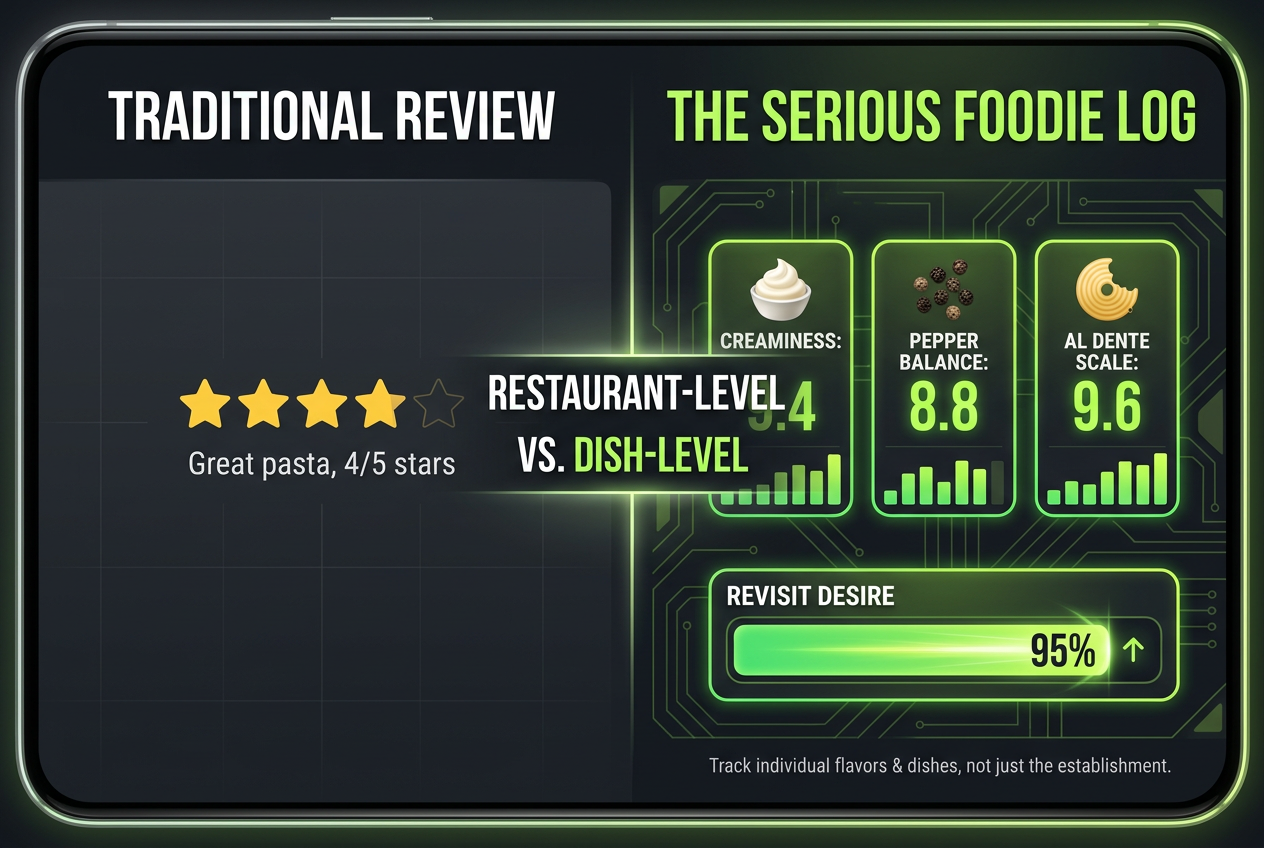 The gap between generic reviews and foodie logs is dish-level granularity. Tracking specific flavors and textures allows for a more accurate ’Second Brain’ for dining.
Here’s a truth that most restaurant apps refuse to acknowledge: the concept of rating a restaurant as a unified entity is fundamentally flawed. A single establishment can serve the best pasta you’ve had all year alongside a forgettable dessert. Generic star ratings flatten this complexity into meaningless averages.
The shift toward dish-level tracking represents a philosophical change in how we think about food memory. When you rate restaurants, you’re making a broad, often unhelpful generalization. When you rate dishes, you’re capturing specific, actionable information.
Consider two scenarios:
Scenario A (Restaurant-Level Thinking):
You visit a new Italian spot and give it 4 stars. Six months later, a friend asks if it’s worth visiting. You remember it was "good" but can’t recall specifics. You end up just repeating that it’s "solid."
Scenario B (Dish-Level Thinking):
You visit the same restaurant and rate five dishes individually. The cacio e pepe gets a 9/10 for texture and flavor balance. The tiramisu gets a 6/10 for being too sweet. The house wine gets an 8/10 for value. Six months later, your friend asks about it and you tell them exactly what to order and what to skip.
Which memory is more useful?
Apps like Savor have built their entire philosophy around this distinction. The platform encourages you to rate taste, presentation, value, and overall experience for each individual dish. Over time, you build a database that functions less like a collection of restaurant opinions and more like a personal culinary encyclopedia.
This granularity pays off in surprising ways. You start noticing patterns: maybe you consistently rate duck dishes highly but are disappointed by chicken. Maybe you realize you’re willing to pay premium prices for exceptional pasta but not for steak. This self-knowledge is impossible to develop when you’re just slapping star ratings on restaurants.
International Dining: The Travel Sync Test
BLUF: Offline functionality isn’t optional for serious food travelers. If your app fails in a basement restaurant in Paris, it’s useless. Test offline maps, translation features, and data sync before your next trip.
The real test of a restaurant app reveals itself the moment you step off a plane in a foreign country. You’re standing in a narrow Tokyo alley with spotty Wi-Fi, trying to remember which yakitori place was recommended. Your phone’s international data plan is glacially slow. This is where most apps fail spectacularly.
For food-focused travelers, offline capability isn’t a nice-to-have feature - it’s the baseline. The best dining experiences often happen in basement izakayas, countryside trattorias, and tucked-away bistros where cellular service is nonexistent. If your app requires constant connectivity, you’re locked out of the places that matter most.
Here’s what actually works:
Download Regional Data Before You Go:
Apps like Eater and World of Mouth let you download city-specific guides that work offline. Before you board your flight to Rome, download the entire Rome database. When you land, every recommendation is accessible regardless of connection.
Test the Interface in Airplane Mode:
Before trusting an app for international travel, put your phone in airplane mode and try to navigate it. Can you still view your saved lists? Can you add new entries that will sync later? Many apps claim offline functionality but actually require connectivity for basic features.
Use Photo-Based Memory Aids:
If you’re traveling somewhere with a language barrier, photo-based apps become essential. Savor’s dish tracking system lets you photograph dishes and add notes later, which is invaluable when you’re at a street food stall in Bangkok with no common language.
Check Data Export Options:
International travel creates the most valuable dining memories. Make sure you can export those memories from the app. If your account gets locked or the service shuts down, you don’t want three years of travel dining data trapped in a failed platform.
The harsh reality? Most popular restaurant apps are built for domestic use with constant connectivity. They assume you’re finding restaurants in your home city with reliable LTE. This assumption breaks down the moment you board an international flight. For serious food travelers, this limitation makes them fundamentally useless.
AI Conversational Search: Does It Actually Work?
BLUF: AI-powered restaurant search is impressive for discovery but terrible for memory. It excels at finding new places based on vibes and preferences but can’t help you remember your own experiences.
The 2026 trend in restaurant apps is "conversational discovery" - the ability to type something like "Find me a date spot with great natural wine and a lively atmosphere, nothing too fancy" and receive smart recommendations. The Eater App’s recent relaunch built this feature on years of editorial content, and the results are genuinely impressive.
But here’s the uncomfortable truth about AI-powered food discovery: it’s optimized for novelty, not memory. These systems are brilliant at helping you find your next meal and useless for remembering your last one.
When you ask an AI to "find something like that bistro in Paris but in Brooklyn," the algorithm has no idea what you actually loved about the Paris experience. Was it the duck? The zinc bar? The specific vintage of Burgundy? The way light filtered through the windows at sunset? AI can pattern-match on categories and vibes, but it can’t capture the specificity of personal memory.
This is why the most effective approach combines multiple tools:
- Use AI-powered apps like Eater for discovery and exploration
- Use dish-level tracking apps like Savor for memory and personalization
- Use social apps like Beli for competitive ranking with friends
The idea that one app should do everything is appealing but unrealistic. Discovery requires algorithms trained on massive datasets. Memory requires personal curation and privacy. Social ranking requires network effects and gamification. These are fundamentally different use cases that require different tools.
The future isn’t a single super-app that does everything. It’s a dining OS built from multiple specialized tools that work together. Your AI-powered discovery layer finds new restaurants. Your private tracking system remembers what you loved. Your social platform lets you compete with friends. Each tool does one thing exceptionally well.
Frequently Asked Questions
What is the best app for tracking dishes instead of restaurants?
Savor is specifically built for dish-level tracking, allowing you to rate individual dishes with detailed criteria like taste, texture, presentation, and value. Unlike restaurant-focused apps that give you one star rating for an entire venue, Savor lets you build a granular database of which specific plates are worth reordering. This approach makes it the best choice for serious foodies who recognize that most restaurants have standout dishes alongside forgettable ones.
Can I use these apps offline while traveling internationally?
Offline functionality varies significantly. Eater App and World of Mouth allow you to download regional guides before travel, making recommendations accessible without connectivity. Savor lets you photograph and rate dishes offline, syncing data when you reconnect. Beli, however, requires internet access for most features. Before any international trip, download relevant city guides and test core features in airplane mode to avoid disappointment.
How do I migrate my dining history from Yelp or Google Maps?
Most specialized food apps don’t offer automatic import from Yelp or Google Maps. The migration process is manual but worthwhile. Start by exporting your Google Maps saved places (via Google Takeout) or screenshotting your Yelp favorites. Then spend an hour adding your most memorable spots to your new system, focusing on dishes rather than restaurants. This process feels tedious but forces you to think critically about what’s actually worth preserving from years of generic reviews.
Are these apps worth paying for?
Free versions typically limit core functionality like the number of dishes you can track, export options, or offline access. If you’re serious about building a long-term dining database, paid tiers ($3-8/month) are worthwhile. Savor’s premium features include unlimited dish ratings, advanced search, and full data export. Beli offers free basic lists but charges for advanced social features. Consider the paid version an investment in preserving culinary memories that would otherwise fade.
Can AI actually identify dishes from photos?
AI dish recognition has improved dramatically but remains imperfect. Savor’s implementation can identify common dishes (pasta, sushi, pizza) with decent accuracy and suggest appropriate tags. However, complex or unusual preparations often confuse the system. The real value isn’t perfect identification - it’s the time saved on manual entry. Even 70% accuracy means you’re tagging most dishes automatically, with occasional corrections for unusual items. Think of it as a smart assistant, not a replacement for your own expertise.
Should I make my food ratings public or private?
This depends entirely on your goals. If you’re building a social reputation as a food authority and enjoy the performance aspect, public sharing on Beli makes sense. If you’re creating a personal reference system for your own taste memory, private tracking in Savor is more appropriate. Many serious foodies maintain both: a public persona on social platforms and a detailed private database for actual decision-making. Your public lists can be curated highlights; your private archive is comprehensive.
How detailed should my dish ratings be?
The level of detail should match your goals. If you just want to remember whether you liked something, a simple 10-point score works fine. If you’re trying to develop your palate and understand your preferences, detailed notes on texture, flavor balance, and presentation become valuable. Start simple and add complexity as you develop the habit. The worst approach is creating an overly complex system that you abandon after two weeks. Consistency beats comprehensiveness.
What happens to my data if the app shuts down?
This is why data export matters. Apps that let you download your ratings, notes, and photos in standard formats (CSV, JSON) protect you from platform risk. Before committing to any food tracking system, verify that you can export your data. Savor, recognizing this concern, built export functionality into their core product. Social platforms like Beli, which rely on network effects, rarely offer meaningful export options. If you can’t export it, you don’t truly own it.
The dining landscape in 2026 offers more ways than ever to remember, discover, and share great food. But the abundance of options creates a new problem: you can spend more time managing apps than actually enjoying meals. The solution isn’t to use every tool - it’s to be deliberate about which tools serve your specific needs.
If you’re building a private archive of taste memories, if you want to rate dishes rather than restaurants, if you value detail over performance, then Savor is your answer. If you’re competing with friends through ranked lists, Beli offers unmatched social mechanics. If you trust editorial curation more than crowd wisdom, Eater and World of Mouth provide professional guidance.
The common thread among all these tools? They recognize that serious diners need something more sophisticated than a star rating and a comment box. They understand that food memory is valuable, personal, and worth preserving with intention. Choose the system that matches how you actually think about food, then commit to using it consistently. Your future self, standing in a restaurant six months from now trying to remember whether the duck was worth ordering, will thank you.