
A Better Way to Compare Dishes Across Different Countries Traveled
John the smoothie monster
John lives for smoothie bowls and cold-pressed juices. He uses Savor to remember his best blends.
The Global Dish Comparison Framework: How to Systematically Track and Compare Meals Across Countries Your camera roll is a graveyard. Somewhere between photo...
The Global Dish Comparison Framework: How to Systematically Track and Compare Meals Across Countries
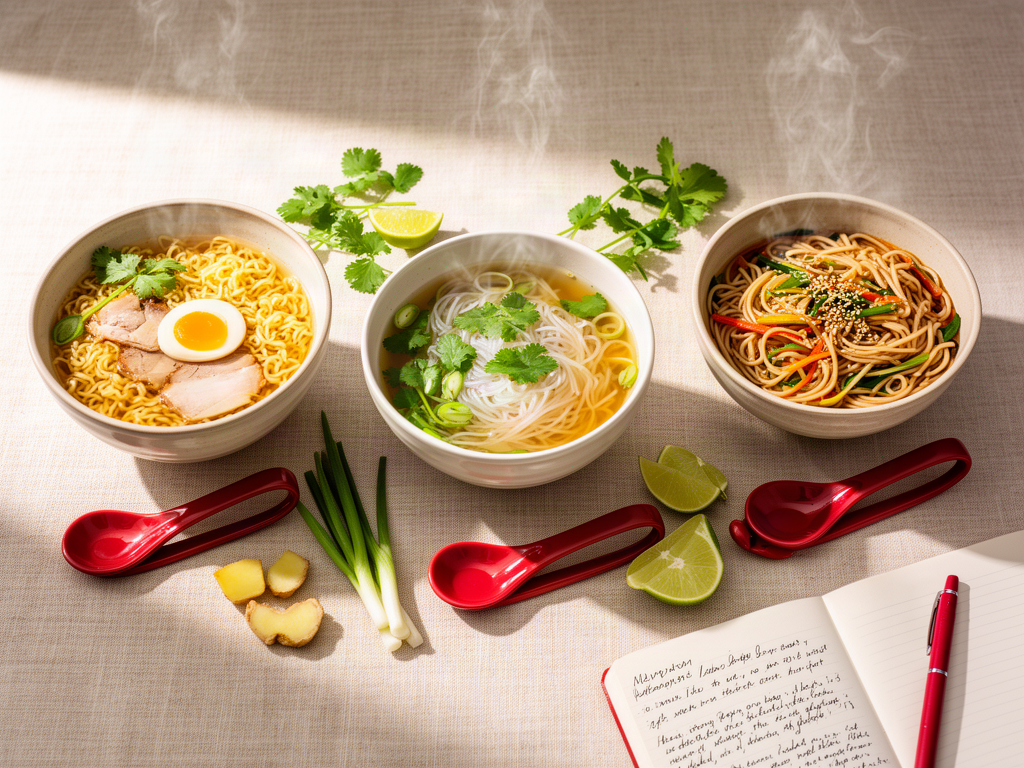
Your camera roll is a graveyard. Somewhere between photo 2,847 and 2,848 lies that life-changing bowl of ramen you had in Tokyo - or was it Osaka? You remember the broth was rich, almost creamy, but you can't recall whether the chashu was pork belly or shoulder. Three months later, you're trying to explain to a friend why Japanese ramen is fundamentally different from the stuff you get in London, and you're fumbling for words.
This isn't a memory problem. It's a systems problem.
If you're a serious foodie who travels, you've probably encountered this frustration: you eat extraordinary food across different countries, but you have no systematic way to document, analyze, or retrieve these experiences. Generic travel tips tell you to "ask locals" or "walk away from tourist spots." Food apps like Yelp and TripAdvisor are designed to rate restaurants, not individual dishes. And your camera roll? It's just a chronological dump that tells you nothing about what made that dish special.
This guide is different. It's a methodology for building a personal, searchable culinary intelligence database - one that captures not just what you ate, but why it mattered, how it compared to similar dishes elsewhere, and what made it authentic to its place of origin.
Table of Contents
- Why "Dish-First" Tracking Changes Everything
- The Culinary Fingerprint Method: Understanding Why Cuisines Taste Different
- Building Your Tech Stack: Tools for Dish-Level Memory
- The 10-Point Precision Framework: Moving Beyond Star Ratings
- Using UNESCO as Your Authenticity Benchmark
- Your 5-Step Workflow for Tracking Dishes Across Borders
- How to Compare the Same Dish Across Different Countries
- Frequently Asked Questions
Why "Dish-First" Tracking Changes Everything
Most food apps are built around restaurants. You log a visit to a place, maybe give it a star rating, perhaps write a sentence or two. But here's the problem: when you're comparing culinary experiences across countries, the restaurant is almost irrelevant. What matters is the dish.
The dumpling you had in Shanghai is not the same as the dumpling you had in Taipei, even if both restaurants have five stars. The carbonara in Rome follows a different canon than the version in New York. A proper Neapolitan pizza adheres to specific criteria that most pizzerias outside Naples ignore entirely.
A dish-first approach means you're cataloging and rating specific preparations - not just meals, not just venues, but individual dishes that can be analyzed, compared, and ranked against their counterparts worldwide. This shift in perspective transforms your food tracking from passive documentation into active culinary intelligence.
When you track by dish rather than by restaurant, you can:
- Search your archive by dish type (e.g., "show me all the ramen I've had")
- Compare the same dish across multiple cities and countries
- Identify what makes an exceptional version stand out
- Build a personal canon of gold-standard dishes as reference points
Instead of asking "Where should I eat in Bangkok?" you can ask yourself, "What's the best Pad Thai I've ever had, and how does it compare to the versions I tried in London and New York?"
This is the difference between being a food tourist and being a food anthropologist.
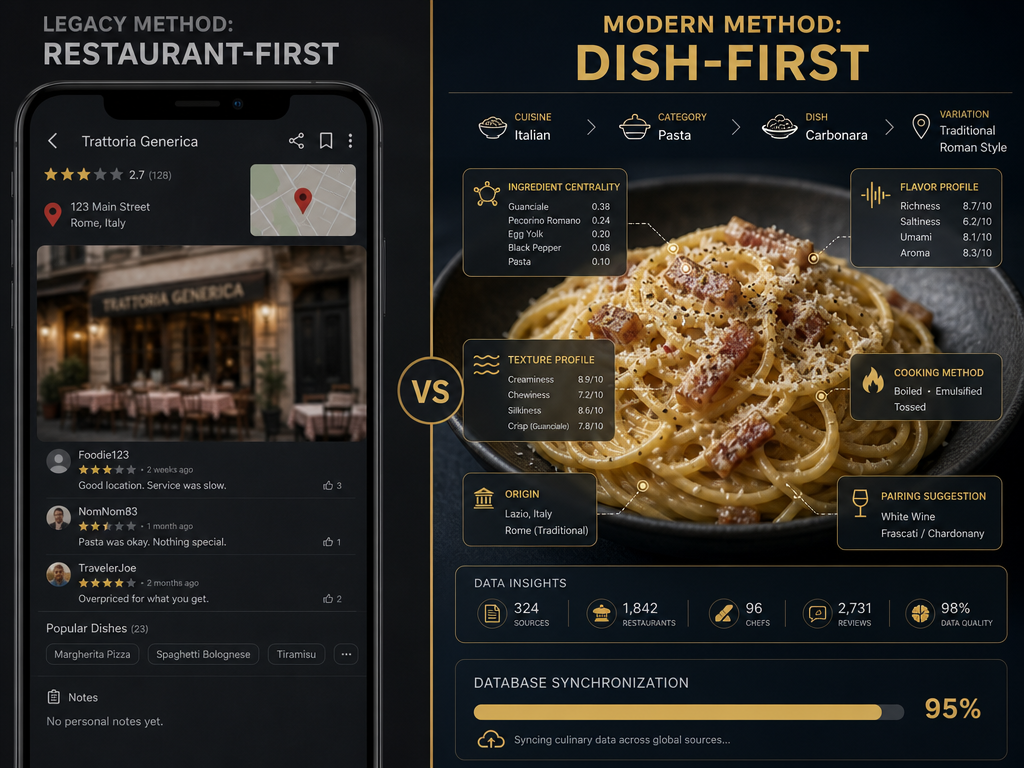 Transition from disorganized camera rolls to a systematic dish-first database to identify subtle culinary nuances across different countries and cultures.
The Culinary Fingerprint Method: Understanding Why Cuisines Taste Different
Here's a question: why does Indian cuisine taste fundamentally different from French cuisine? You might say "spices," but that's not the whole story. The real answer lies in ingredient networks - the specific combinations of ingredients that define a culinary tradition.
Recent research has given us a scientific framework for understanding these differences. A study published in 2025 achieved 95% accuracy in identifying cuisines from recipe samples using network analysis of ingredient combinations. The researchers mapped out how ingredients cluster together in different culinary traditions, revealing what they call "culinary fingerprints."
The findings are striking. Indian cuisine is characterized as a "star-shaped" network centered heavily on spices - think turmeric, cumin, coriander, and garam masala forming the core around which everything else orbits. European cuisines, by contrast, show a distributed pattern with no single dominant ingredient category. Italian cooking might center on tomatoes in one region and seafood in another. French cuisine in Provence looks different from French cuisine in Normandy.
This isn't just academic theory - it's a practical tool for understanding what you're tasting. When you eat a dish in its country of origin, you're experiencing the authentic ingredient network. When you eat that same dish abroad, you're often experiencing a modified network where key ingredients have been substituted, diluted, or omitted entirely.
How to Apply the Fingerprint Method
When you're tracking a dish across countries, look for three things:
Ingredient Centrality: What's the dominant ingredient or flavor? In Thai cooking, fish sauce and palm sugar create a sweet-salty-umami base that appears across many dishes. In Japanese cooking, dashi provides the foundational umami layer. When you taste a Thai dish in Thailand versus a Thai restaurant in Chicago, ask yourself: is the ingredient hierarchy the same?
Structural Complexity: How many ingredients are in play? Traditional dishes often have surprisingly short ingredient lists because the technique is doing the heavy lifting. A proper carbonara has five ingredients: pasta, eggs, guanciale, Pecorino Romano, and black pepper. If your carbonara has cream, peas, and chicken, you're not eating carbonara - you're eating a pasta dish inspired by carbonara.
Flavor Architecture: What sensory layers are present? A well-made Vietnamese pho balances sweet (star anise, cinnamon), savory (bone broth, fish sauce), fresh (herbs, lime), and textural (noodles, meat). When components are missing or out of balance, the dish loses its fingerprint.
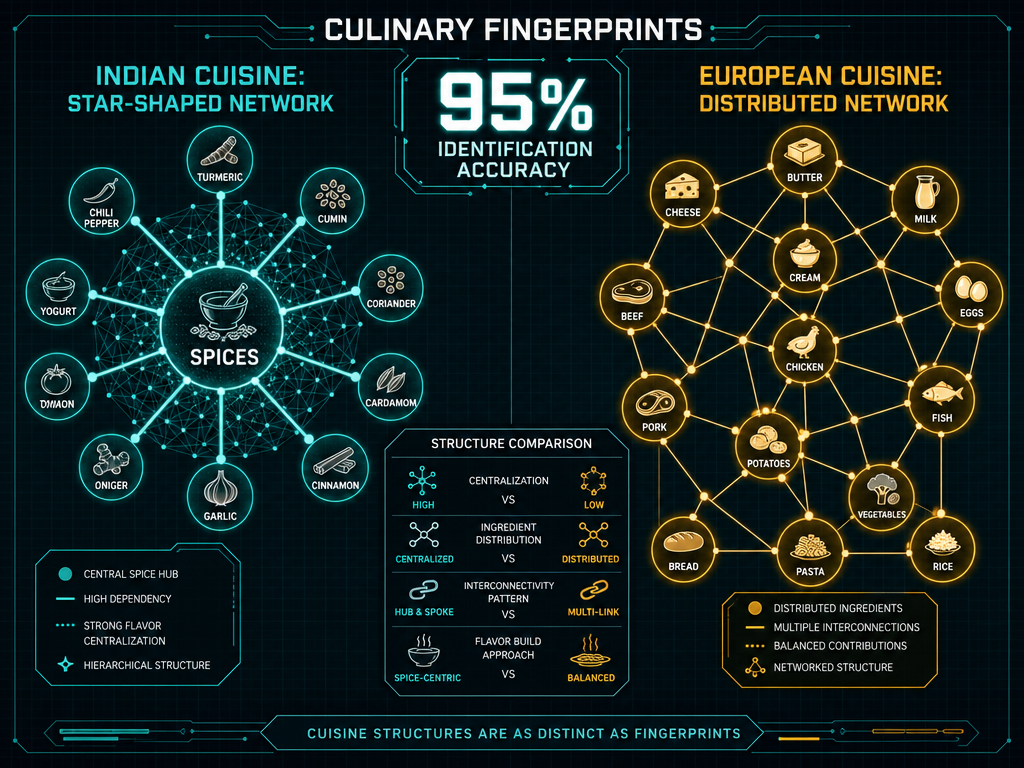 Visualizing ingredient networks reveals why cuisines taste distinct, with 95% accuracy in identifying origins based on ingredient centrality and structural combinations.
Building Your Tech Stack: Tools for Dish-Level Memory
The right tools don't just help you remember what you ate - they help you build a searchable database that gets smarter over time. Here's what you need in your tech stack.
Savor: The 10-Point Precision System
Savor is built specifically for dish-level tracking with a 10-point scale that uses 0.1 increments. This level of precision matters when you're trying to distinguish between a "good" and "great" version of the same dish. You can rate texture, aroma, and complexity separately - not just assign a vague "taste" score.
The app lets you tag by dish archetype (#Dumpling, #Fermented, #StreetMeat) so you can filter your entire culinary history by category. When you're in Warsaw and want to compare the pierogi you just had to the dumplings you ate in Shanghai, you can pull up both entries instantly.
For serious foodies who need more than a camera roll to remember their best meals, Savor provides a dish-first architecture that treats restaurants as metadata rather than the primary object.
Yummi: Auto-Organized Temporal Tracking
Yummi uses what they call "Foodprints" - an auto-organized calendar that tracks not just where you ate, but when, creating a geographic and temporal map of your dining history. This is particularly useful for travelers who want to reconstruct a trip's culinary narrative or compare seasonal variations of the same dish.
The app's strength is in its automatic geo-tagging and timeline organization. If you ate at five different ramen shops during a week in Tokyo, Yummi will create a chronological sequence you can review later.
Mapstr: Pre-Trip Dish Mapping
Mapstr is less about tracking what you've already eaten and more about planning what you want to eat. You can create custom maps of dishes you're hunting for - say, a map of "Authentic Carbonara in Rome" or "Best Sushi in Osaka" - and mark locations as you discover them.
The tool is particularly useful for building your "dish comparison itinerary" before you travel. If you want to compare Pad Thai across Bangkok, you can pre-mark five or six highly-rated spots and methodically work through them during your trip.
The 10-Point Precision Framework: Moving Beyond Star Ratings
Five-star ratings are functionally useless for serious food analysis. A restaurant might get five stars for ambiance, service, or value, but that tells you nothing about whether the signature dish was executed well.
The 10-point precision framework solves this by isolating individual sensory dimensions. Here's how to use it:
Texture (1.0-10.0): Is the dish texturally complex or one-note? A great dumpling has contrast - a slight resistance from the wrapper giving way to a yielding filling. Score this independently from flavor.
Aroma (1.0-10.0): Does the dish announce itself before you taste it? Some cuisines prioritize aromatic intensity (Thai, Indian), while others favor subtlety (Japanese, Scandinavian). Rate aroma against the dish's own tradition, not against your personal preference.
Complexity (1.0-10.0): How many flavor layers are present? A simple dish like cacio e pepe has only three ingredients but achieves remarkable complexity through technique. Rate the dish's ability to deliver depth, whether through ingredient variety or skillful preparation.
Overall (1.0-10.0): This is your holistic score, accounting for how well the dish executes its intent. A perfect score doesn't require Michelin-level refinement - it requires that the dish delivers exactly what it promises at the highest level.
Using 0.1 increments forces you to think critically about subtle differences. A 7.8 ramen isn't the same as an 8.2 ramen, and articulating why trains your palate over time.
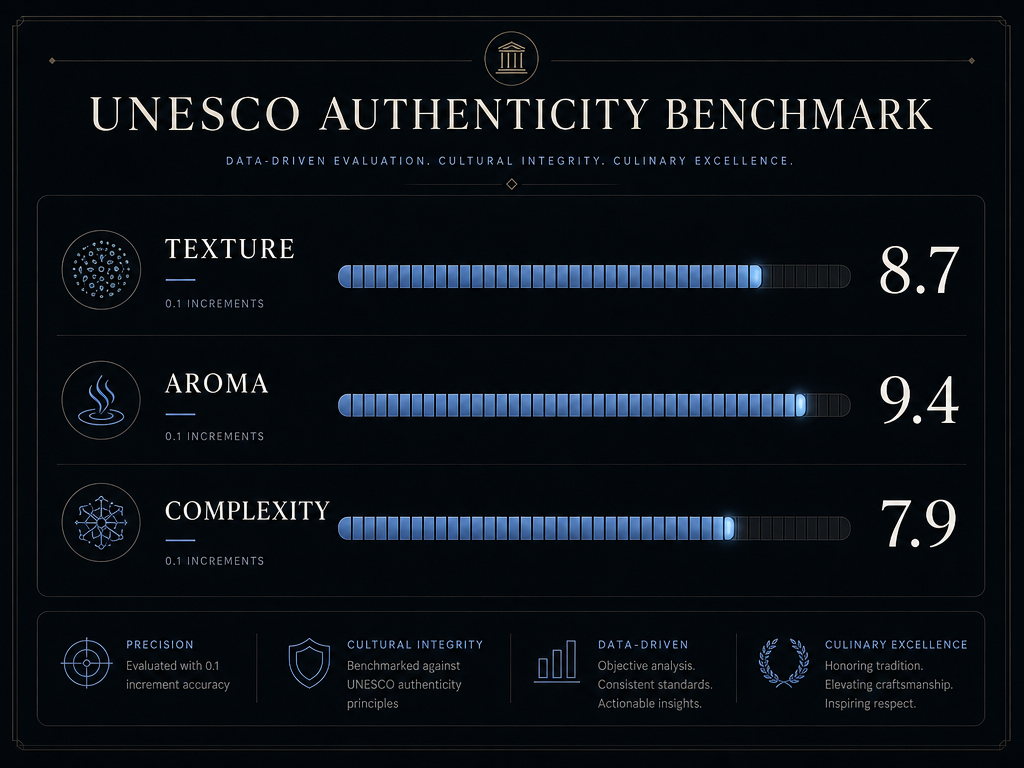 Utilize high-precision 10-point scales to quantify sensory experiences, allowing for objective comparisons of the same dish across multiple international borders.
Using UNESCO as Your Authenticity Benchmark
When you're comparing dishes across countries, you need an external standard to determine what constitutes "authentic." This is where UNESCO's Lists of Intangible Cultural Heritage become invaluable.
Currently, 849 elements corresponding to 157 countries are inscribed on UNESCO's Lists of Intangible Cultural Heritage, including numerous food traditions. These listings aren't just symbolic - they come with detailed documentation of traditional preparation methods, ingredient specifications, and cultural context.
For example, Italian cooking was proposed/included for UNESCO recognition specifically focusing on sustainability and biocultural diversity. The documentation specifies what distinguishes traditional Italian cooking practices from modern adaptations.
How to Use UNESCO as a Research Tool
Before you travel, check whether the cuisine you're exploring has UNESCO-recognized elements. If you're going to Naples, research the criteria for authentic Neapolitan pizza (which has its own UNESCO designation). If you're visiting Korea, look up the specifications for kimjang (kimchi-making).
When you encounter a dish abroad that claims to be "authentic," you can cross-reference it against the UNESCO criteria. Does the "Neapolitan pizza" in New York meet the dough fermentation standards? Is the "traditional kimchi" in Los Angeles following the proper fermentation timeline?
This doesn't mean food outside its country of origin is automatically inferior - adaptation can be creative and delicious. But having the UNESCO standard gives you a reference point for analysis. You can note in your tracking system: "Carbonara in London - creamy sauce with peas, deviates from traditional egg-and-cheese emulsion, but executed well within its own context."
Your 5-Step Workflow for Tracking Dishes Across Borders
Here's the systematic process for capturing dishes in a way that makes them searchable and comparable later.
Step 1: Geo-Tag on the Spot
As soon as you sit down (or while you're eating), open your tracking app and create the entry. Record:
- Exact location (city, neighborhood, venue name)
- Date and time (for seasonal variations)
- Dish name in both the local language and English
- Price (helps you assess value over time)
Don't wait until you get back to your hotel. Memory degrades rapidly, and you'll forget details that seem obvious in the moment.
Step 2: Use the 10-Point Scale for Multiple Dimensions
Rate the dish immediately, while the sensory experience is fresh. Use separate scores for texture, aroma, complexity, and overall impression. If you're comparing variations of the same dish across cities, consistency in rating matters more than perfect accuracy.
Step 3: Tag by Dish Archetype
This is what makes your database searchable. Tag the entry with relevant categories:
- Dish type (#Ramen, #Pizza, #Dumpling)
- Preparation method (#Grilled, #Fermented, #Braised)
- Key ingredient (#Pork, #Seafood, #Vegetarian)
- Culinary tradition (#Japanese, #Italian, #Thai)
Multiple tags are fine. A dish can be both #Seafood and #Fermented if it's fermented fish.
Step 4: Write Comparative Notes
This is where the magic happens. Don't just write "delicious" or "amazing." Write comparative notes that reference other dishes:
"Richer broth than the shoyu ramen in Shibuya (rated 7.8), but less complex than the miso ramen in Sapporo (rated 9.1). Chashu here is fattier, almost melts on the tongue. Noodle texture is slightly softer than I prefer - 8.2 overall."
These notes create a web of cross-references in your database. When you're trying to remember which city had the best ramen, you can search your comparative notes rather than relying on memory.
Step 5: Take a Reference Photo
Yes, take the photo - but do it with purpose. Capture the dish from an angle that shows its structure and components. If it's a multi-element dish (like a rice bowl with various toppings), make sure all elements are visible.
More important: caption the photo in your app with the dish name and a one-sentence flavor note. "Tantanmen at Nakiryu - nutty sesame, serious heat, perfectly balanced." Three months later, when you're scrolling through your archive, that caption will trigger the full memory.
How to Compare the Same Dish Across Different Countries
Let's put the framework into practice. Say you want to systematically compare dumplings as you travel. Here's how to do it rigorously.
Define Your Comparison Criteria
Not all dumplings are trying to do the same thing. Before you start comparing, establish categories:
- Wrapper type: Wheat-based (Chinese jiaozi), rice-based (Vietnamese banh bot loc), potato-based (Polish pierogi)
- Filling composition: Meat-based, vegetable-based, or mixed
- Cooking method: Boiled, steamed, pan-fried, deep-fried
- Sauce/accompaniment: What's served alongside (soy-vinegar, sour cream, broth)
Chinese soup dumplings (xiaolongbao) have a fundamentally different structure than Polish pierogi, so comparing them directly would be meaningless. But comparing xiaolongbao in Shanghai to xiaolongbao in New York is productive.
Create a Reference Benchmark
Eat the dish in its country of origin first, if possible. This becomes your "gold standard" reference point. When you rate that first Shanghai xiaolongbao at 9.3, you're establishing the ceiling against which all future versions will be measured.
Document everything about that reference experience: the thickness of the wrapper, the temperature of the soup inside, the ratio of meat to soup, the quality of the vinegar accompaniment. These details become your comparison checklist.
Use Differential Scoring
When you eat the dish elsewhere, don't just give it a standalone score - note how it differs from your reference:
"Xiaolongbao in San Francisco (7.8). Wrapper is thicker than Shanghai version (9.3), soup is less flavorful, vinegar too mild. Filling is well-seasoned but missing the ginger punch. Solid execution within limitations."
This approach keeps your ratings calibrated. You're not comparing every dumpling to some abstract ideal - you're comparing it to specific, documented experiences.
For serious foodies looking to organize their growing catalog of meals, creating a reference benchmark system is the most effective way to maintain consistency across hundreds of dishes.
Track Ingredient Substitutions
Pay attention to what's different at the ingredient level. That Thai curry in London might taste "off" not because the chef is unskilled, but because galangal isn't available and they substituted ginger. The carbonara in Tokyo might use bacon instead of guanciale because Italian cured meats are difficult to import.
Note these substitutions in your database. Over time, you'll build an understanding of which substitutions matter (guanciale vs. bacon significantly changes carbonara) and which are negligible (one type of rice noodle vs. another in pho).
Map Flavor Profiles Visually
Some serious foodies create simple radar charts for complex dishes. Draw a five-point star with axes for:
- Sweetness
- Saltiness
- Acidity
- Spiciness
- Umami
Rate each dimension on a 1-10 scale, then connect the points. The shape becomes a visual fingerprint. When you compare two versions of the same dish, you can see at a glance how the flavor profiles differ.
Frequently Asked Questions
What is the easiest way to track food?
The easiest approach depends on what you're trying to capture. If you just want a quick visual record without much detail, a dedicated photo album on your phone works - but you'll lose searchability within weeks. For systematic tracking, a dish-first app like Savor or Yummi requires only seconds per entry (geo-tag, snap a photo, assign a quick rating), yet builds a searchable database over time. The key trade-off is immediacy versus long-term utility. The "easiest" method that actually helps you remember and compare dishes requires capturing structured data at the point of consumption.
What are the best apps for foodies?
The best apps for serious foodies prioritize dish-level tracking over restaurant reviews. Savor uses 10-point precision scoring with 0.1 increments and lets you tag by dish archetype, making cross-country comparisons straightforward. Yummi offers "Foodprints" with auto-organized calendars for temporal and geographic tracking. Mapstr excels at pre-trip planning, letting you create custom dish-hunting maps before you travel. Generic platforms like Yelp and TripAdvisor are restaurant-first, which makes them less useful for tracking specific dishes across multiple locations. The best food review apps for dish-level memory separate the venue from the plate.
Which cuisines have been recognized by UNESCO?
UNESCO's Intangible Cultural Heritage lists include culinary traditions from around the world. Specific recognitions include Neapolitan pizza (Italy), kimjang (Korea's kimchi-making tradition), washoku (Japanese cuisine), Mediterranean diet (shared across multiple countries), and gingerbread craft (Northern Croatia). The full list spans 849 elements across 157 countries, with food traditions representing a significant portion. These recognitions come with documented preparation methods and ingredient specifications, making them valuable benchmarks for authenticity when comparing dishes across borders. Check the UNESCO Intangible Heritage database before traveling to research whether your destination cuisine has official recognition.
Is food an Intangible Cultural Heritage?
Yes, many food traditions are recognized as Intangible Cultural Heritage by UNESCO. The designation covers not just recipes, but the entire cultural practice around food - how it's prepared, who prepares it, when it's consumed, and its social significance. Italian cooking, for example, was recognized for its sustainability and biocultural diversity, emphasizing the cultural ecosystem around food rather than individual dishes. This distinction matters when comparing dishes across countries: you're not just evaluating taste, but how well a dish maintains its cultural context and preparation traditions outside its origin point.
How can I compare the same dish across different countries?
Effective cross-country dish comparison requires three things: a defined reference benchmark, consistent rating criteria, and documentation of ingredient-level differences. First, eat the dish in its country of origin and document everything - wrapper thickness, sauce composition, cooking method, texture, flavor balance. That becomes your gold standard (say, 9.3 for Shanghai xiaolongbao). When you encounter the dish elsewhere, use differential scoring: note how the London version (7.8) differs in wrapper thickness, soup flavor, and seasoning. Track ingredient substitutions (bacon vs. guanciale in carbonara, ginger vs. galangal in Thai curry) and note which ones significantly alter the dish. Use a 10-point scale with separate scores for texture, aroma, and complexity so you can isolate what changed. Apps designed for dish-level tracking make this process searchable.
The camera roll graveyard is a solvable problem. You don't need a better memory - you need a better system. By shifting from restaurant-first to dish-first tracking, applying the culinary fingerprint method, and using UNESCO benchmarks as authenticity standards, you transform passive food tourism into active culinary intelligence.
The next time you're explaining to a friend why that ramen in Tokyo was different, you won't be fumbling for words. You'll open your database, pull up your comparative notes, and show them exactly why the broth in Shibuya had more depth than the version in London - complete with ingredient analysis, texture ratings, and photos that actually help you remember.
That's the difference between eating well and building a personal culinary archive that gets smarter with every meal.