
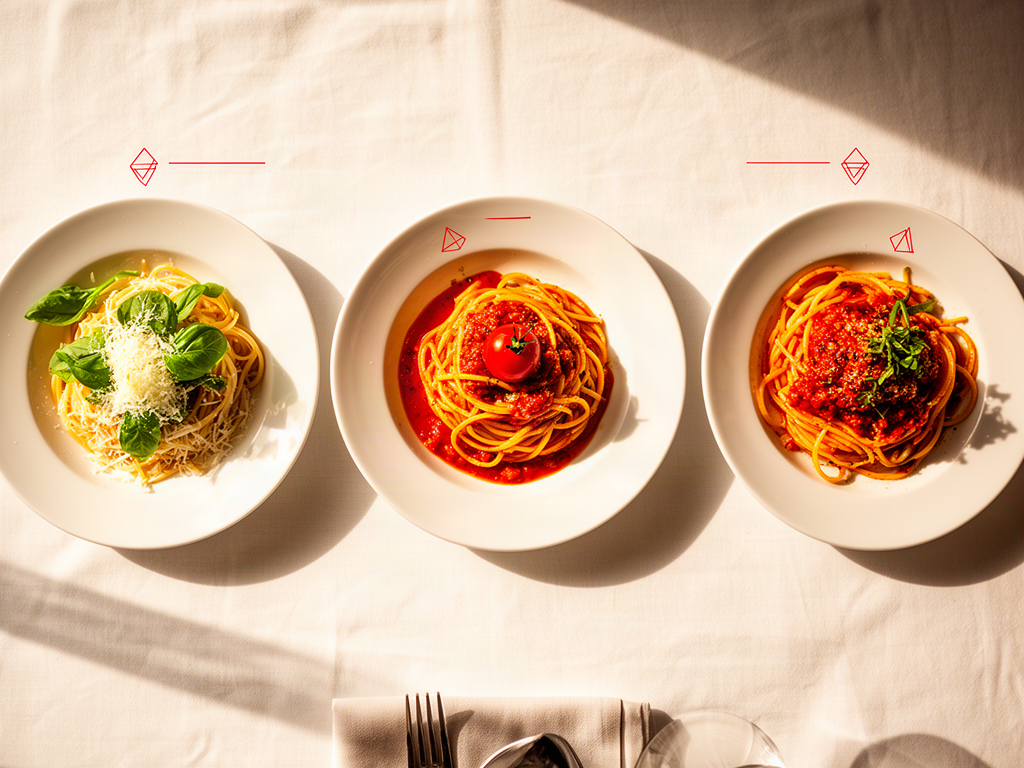
How Dish-First Apps Are Fixing the Star-Rating Problem
Harry the matcha king
Harry is our resident matcha obsessive. He’s tasted hundreds of bowls and tracks every cup in Savor.
How Dish-First Apps Are Fixing the Star-Rating Problem Your phone's camera roll holds 2,847 food photos. You spent $180 on omakase in Tokyo, $92 on a tasting...
How Dish-First Apps Are Fixing the Star-Rating Problem
Your phone's camera roll holds 2,847 food photos. You spent $180 on omakase in Tokyo, $92 on a tasting menu in Copenhagen, and $34 on what might have been the best fried chicken of your life at some nameless place in Nashville. Three months later, you can barely remember which restaurant it was, let alone what made the chicken so exceptional.
The problem isn't your memory. It's that we've been using the wrong tools.
Yelp has over 244 million reviews, most of them offering the same useless insight: "Great atmosphere! Service was a bit slow. 4 stars." But you don't care if the bartender smiled or if parking was easy. You care about one thing - was that specific dish worth ordering again?
Traditional restaurant review apps treat the meal like a monolith. A compare same dish different restaurants app does something fundamentally different: it isolates the plate from everything else. No ambient lighting scores. No service ratings. Just the flavor, execution, and whether you'd cross town to have it again.
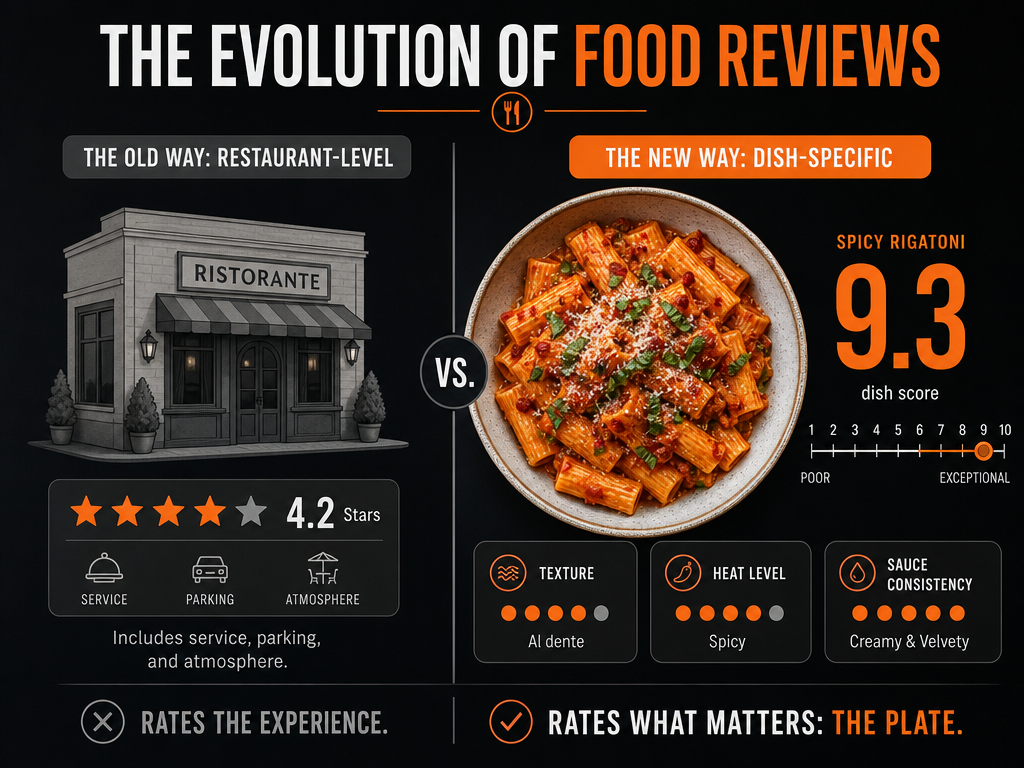 Beyond the 5-star review: Modern foodies are moving away from generic restaurant ratings toward item-level granularity and precision scoring.
Table of Contents
- What Is a Dish-First Food App?
- Why Restaurant Ratings Fail the Serious Foodie
- The Three Types of Dish-First Apps
- How to Actually Use These Apps
- The Elo vs. 10-Point Scale Question
- Building Your Personal Dish Portfolio
- The AI Solution for Your Camera Roll
- Comparison Matrix
- Frequently Asked Questions
What Is a Dish-First Food App?
A dish-first food app is exactly what it sounds like: a tool that tracks individual dishes instead of lumping everything into a restaurant-level rating.
Traditional platforms like Yelp or Google Reviews operate on a simple premise - rate the experience. The food, service, ambiance, and sometimes even the bathroom cleanliness get averaged into a single number. A restaurant with mediocre food can earn 4.5 stars because the staff was friendly and the patio had string lights.
Dish-first apps flip that model. They let you log, rate, and search for specific items. Want to compare the Spicy Rigatoni at three different Italian spots in Brooklyn? You can. Need to remember which version of Cacio e Pepe you liked better in Rome? You've got a searchable record.
The mechanism is straightforward. You visit a restaurant, photograph the dish, name it, and assign it a score. Some apps use a 10-point scale with decimal precision. Others rely on head-to-head comparisons where you pick which of two dishes was better, generating an Elo-style numerical score over time. The result is a personal culinary database that answers one simple question: Which version of this dish should I order?
The limitation is equally clear. These apps require manual input. If you forget to log a meal, it's gone. And if you're comparing dishes across apps (one friend uses Savor, another uses Beli), the data doesn't sync. You're building a siloed archive.
Why Restaurant Ratings Fail the Serious Foodie
Here's the truth about restaurant reviews: they're optimized for the wrong decision.
A restaurant's star rating on Google tells you little about whether a specific dish is worth ordering. It tells you that many people had an above-average experience. Maybe the server was attentive. Maybe the bathroom was clean. Maybe someone gave five stars because their date went well.
The problem compounds when you're searching for a specific dish. Let's say you're craving the best burger in Manhattan. A traditional search pulls up restaurants - not burgers. You read dozens of reviews hoping someone mentions the patty blend, the bun texture, or whether the bacon was crispy. Most don't. You find one review that says "burger was good," another that says "burger was dry," and a third that complains about parking.
Dish-first apps solve this by isolating the signal. When you search for "burger," you see actual burger ratings from people who logged that specific item. No ambient noise about decor. No complaints about wait times. Just data on the thing you're trying to eat.
The serious foodie isn't looking for a "vibe." They're building a palate archive - a searchable record of which Margherita pizza in Naples had the best char, which Uni Pasta in Tokyo balanced richness without becoming cloying, which Nashville Hot Chicken had the right ratio of spice to crunch.
Traditional review platforms can't do this because their data structure was never designed for it. They aggregate experiences. You need to aggregate dishes.
The Three Types of Dish-First Apps
Not all dish-tracking apps operate the same way. They fall into three distinct categories, each built for a different type of foodie.
The Technical Tracker (Savor)
Built for the precision obsessive. Savor 2.0 uses a 10-point precision scale with 0.1 increments, which means you can rate a dish 8.3 or 9.7. The app includes AI dish detection (photograph your meal, and it auto-tags the item) and generates "Taste DNA" insights over time, showing patterns in your preferences.
This is private-first architecture. Your ratings aren't published to a social feed. You're not competing with friends for the most exotic meal. You're building a personal reference system - a Wikipedia of your own palate.
Ideal for: The foodie who wants a detailed portfolio of every meal. The person who needs to remember that the Oxtail Ragu in Bologna was a 9.2, but the one in Brooklyn was only a 7.8.
The Social Sniper (Beli, Plately)
These apps flip the script on traditional ratings by using comparison-based scoring. Beli generates numerical scores based on head-to-head comparisons - you don't rate the burger on a scale, you swipe left or right to decide whether it's better than the last burger you had. Over time, the app builds an Elo ranking that reflects relative preference, not absolute scoring.
Plately allows users to check in, add a specific dish, and rate it independently of the restaurant. You can see your friends' rankings, compare notes, and build shared lists of where to eat next.
Ideal for: The competitive foodie. The person who wants to see how their taste stacks up against their crew. The social element is the point - these apps are designed for discovery through peer comparison.
The AI Optimizer (ForkFox)
This is the speed-dating version of dish tracking. Instead of logging every meal manually, ForkFox uses AI to scan existing reviews (from Yelp, Google, TikTok, and other sources) and generates aggregated dish-level scores. Want to know which Pad Thai in your neighborhood has the best reviews? The app pulls data from thousands of mentions and ranks them for you.
The trade-off is authenticity. You're not building a personal archive - you're trusting an algorithm to synthesize other people's opinions. It's fast, but it lacks the calibration of your own palate.
Ideal for: The efficiency-focused foodie. The person who wants the best answer now, without the manual work of journaling.
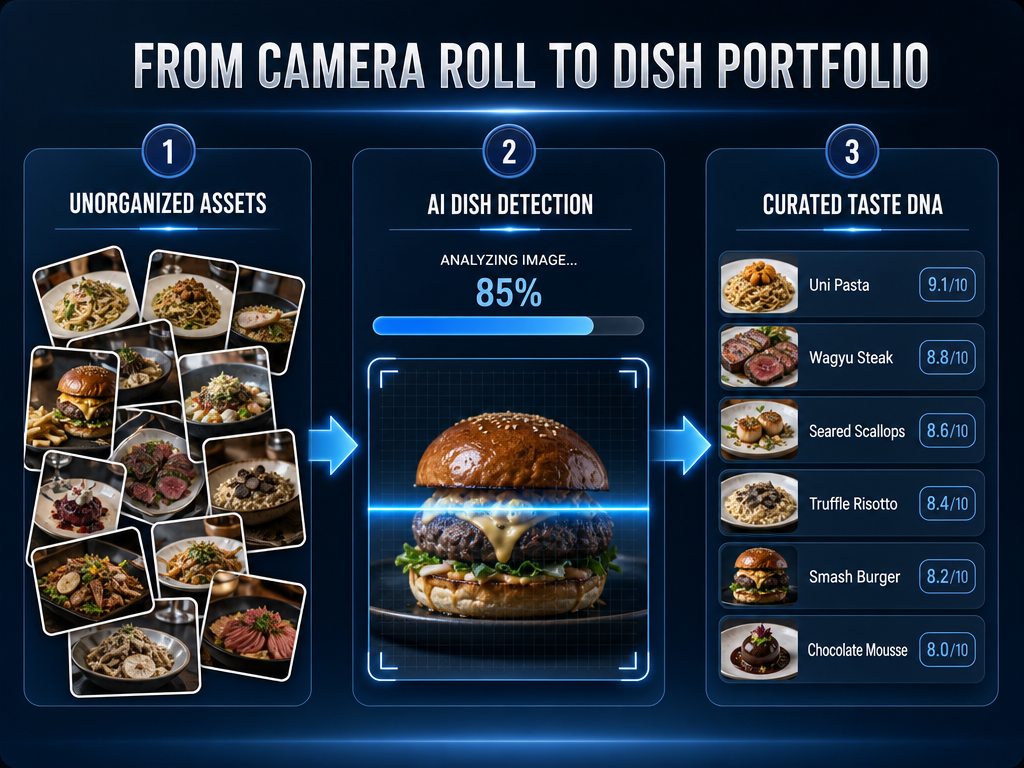 Turn your disorganized food photos into a searchable database. AI-driven apps can now scan your library to categorize and rank every meal automatically.
How to Actually Use These Apps
The gap between downloading a dish-tracking app and actually using it consistently comes down to workflow. Here's the system that works.
Step 1: Standardize your input method. Decide whether you're logging meals in real-time (at the table, immediately after ordering) or retroactively (at the end of the day, scrolling through photos). Real-time logging is more accurate. Retroactive logging is more realistic.
Step 2: Pick your rating criteria. Most apps let you score multiple dimensions - taste, presentation, value, creativity. Don't. Pick one dimension (taste) and commit to it. Adding complexity makes you inconsistent. A 9.2 on taste is useful. A 9.2 on "overall vibe" is not.
Step 3: Write tasting notes immediately. This is where most people fail. They photograph the dish, assign a number, and move on. Six months later, they have no idea why they gave the Tonkotsu Ramen an 8.7. Was the broth too salty? Was the pork belly undercooked? Add one sentence. It's the difference between data and memory.
Step 4: Tag by ingredient, cuisine, and location. Apps with robust search functions let you filter by multiple criteria. If you tag every dish properly, you can answer questions like "What was my highest-rated pasta dish in Italy?" or "Which restaurant in San Francisco made the best duck confit?"
Step 5: Review your archive quarterly. This is the move that separates casual users from serious foodies. Every three months, scroll through your top 10 highest-rated dishes. Notice patterns. Did you consistently rate rich, fatty dishes higher? Do you prefer bright, acidic flavors? Your archive becomes a mirror for your palate.
Looking for more ways to organize your culinary life? Check out our guide on how to organize restaurant photos in your library.
The Elo vs. 10-Point Scale Question
This is the philosophical divide in dish-rating methodology.
A 10-point scale (or any numeric system) is absolute scoring. You're comparing the dish to some imagined ideal. A perfect Margherita pizza is a 10. Everything else falls below.
Elo-style comparison is relative scoring. You're not asking "How good is this burger?" You're asking "Is this burger better than the last burger I had?" The app tracks those binary decisions and generates a ranking over time.
Which system is better? It depends on what you're trying to build.
Use a 10-point scale when:
- You want a personal reference system that remains stable over time
- You're willing to calibrate your palate (a 9.0 today should mean the same thing as a 9.0 six months from now)
- You want to make comparisons across different cuisines (e.g., "My highest-rated Thai dish was better than my highest-rated Italian dish")
Use Elo-style comparison when:
- You want to avoid "rating inflation" (where everything becomes a 7 or 8)
- You're building a social ranking system with friends
- You care more about relative preference than absolute scoring
The limitation of Elo is that it requires volume. If you've only ranked three burgers, the system hasn't calibrated. You need dozens of comparisons before the rankings stabilize. The limitation of a 10-point scale is consistency. Your standards drift. A dish you rated 8.5 last year might feel like a 7.5 today if your palate has evolved.
For more on rating systems, explore our professional 100-point pizza scoring protocol.
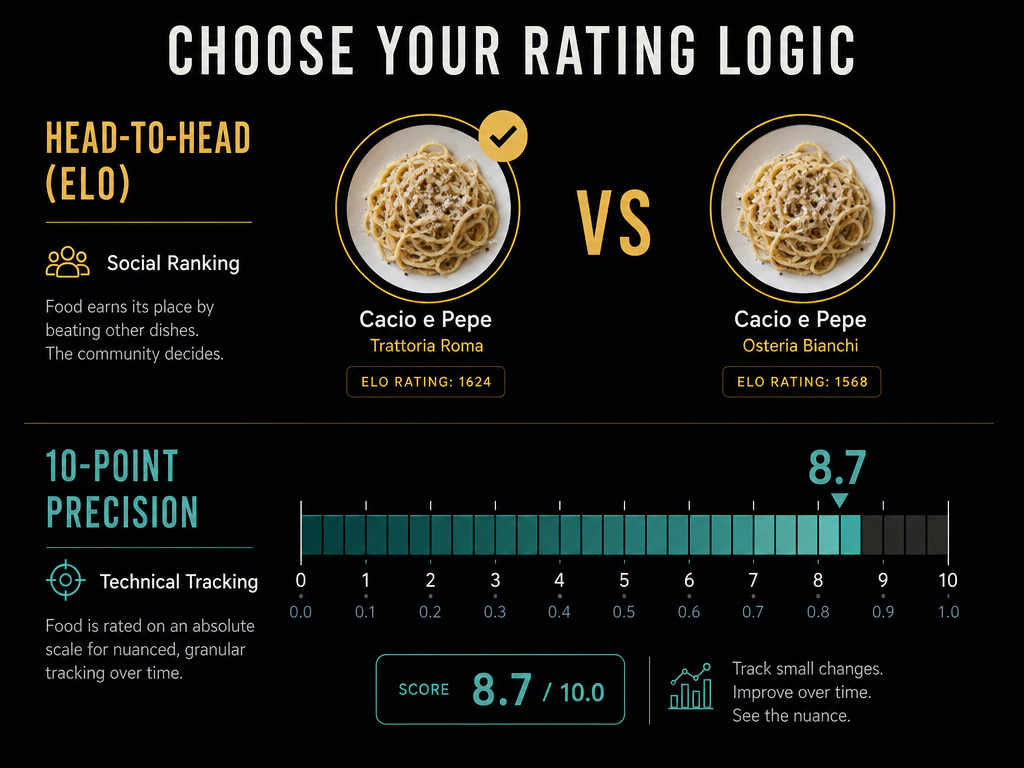 Choosing the right methodology: Use Elo-style comparisons for social competition or 10-point precision scales for detailed technical food journaling.
Building Your Personal Dish Portfolio
The endgame of dish-first tracking isn't just a log of meals. It's a searchable, actionable portfolio of your culinary life.
Think of it like a wine cellar, but for dishes. You're not collecting bottles - you're collecting memories, indexed by flavor, location, and context. The portfolio answers questions like:
- "What's the best version of X dish I've ever had?"
- "Which restaurant should I take a visitor to for Y cuisine?"
- "What did I eat in Tokyo that I need to recreate at home?"
Building this archive requires three layers of data.
Layer 1: The Rating. This is the raw score (10-point scale, Elo ranking, or simple thumbs up/down). It's the minimum viable input.
Layer 2: The Context. Where was the dish? When did you eat it? Who were you with? This layer turns data into narrative. A 9.5 Carbonara in Rome hits differently than a 9.5 Carbonara at a strip-mall Italian spot in Ohio. Both might be technically excellent, but the context matters.
Layer 3: The Sensory Detail. This is where most people quit. But it's also where the portfolio becomes useful. What made the dish memorable? Was it the texture of the pasta? The ratio of pecorino to guanciale? The char on the Brussels sprouts? Write one sentence. It's the difference between knowing you liked something and understanding why.
Over time, your portfolio reveals patterns. You discover you're a sucker for rich, fatty dishes with acidic brightness. You realize you consistently rate Japanese food higher than French. You notice that your favorite meals weren't at Michelin-starred restaurants - they were at unassuming spots where the chef nailed one specific technique.
Want to take your dish tracking to the next level? Learn more about apps to remember every dish you've eaten.
The AI Solution for Your Camera Roll
Your camera roll is a graveyard. Somewhere between photo 847 and photo 2,291, there's a blurry shot of the best bowl of ramen you've ever had. You took the photo. You meant to log it. You forgot.
This is the problem AI dish detection is trying to solve.
Modern dish-first apps now include photo-scanning features that analyze your camera roll, identify food photos, and auto-tag them by dish name. The technology isn't perfect (it sometimes confuses Pad Thai with Chow Mein), but it's improving rapidly.
Here's how the workflow actually works:
Step 1: Grant camera roll access. The app scans your library for food-related images. Most apps use machine learning models trained on millions of dish photos to identify common items (pizza, burgers, sushi, pasta, etc.).
Step 2: Review the auto-tagged results. The app presents a list of identified dishes. You confirm or correct the tags. This is critical - AI makes mistakes, and a mis-tagged dish corrupts your archive.
Step 3: Add ratings and notes retroactively. Once the dishes are tagged, you go through them one by one, assigning scores and adding context. This is tedious, but it's the only way to turn a photo library into a useful database.
Step 4: Set up auto-import for future meals. Some apps now offer real-time tagging - you take a photo, the app auto-detects the dish, and prompts you to rate it immediately. This is the gold standard for consistency.
The limitation is that AI can't capture intent. If you photographed a dish because the plating was beautiful (but the taste was mediocre), the algorithm doesn't know that. You still need to add the human layer - the tasting note that explains why the photo exists.
If you're drowning in food photos, read our guide on the best apps to organize food photos by restaurant.
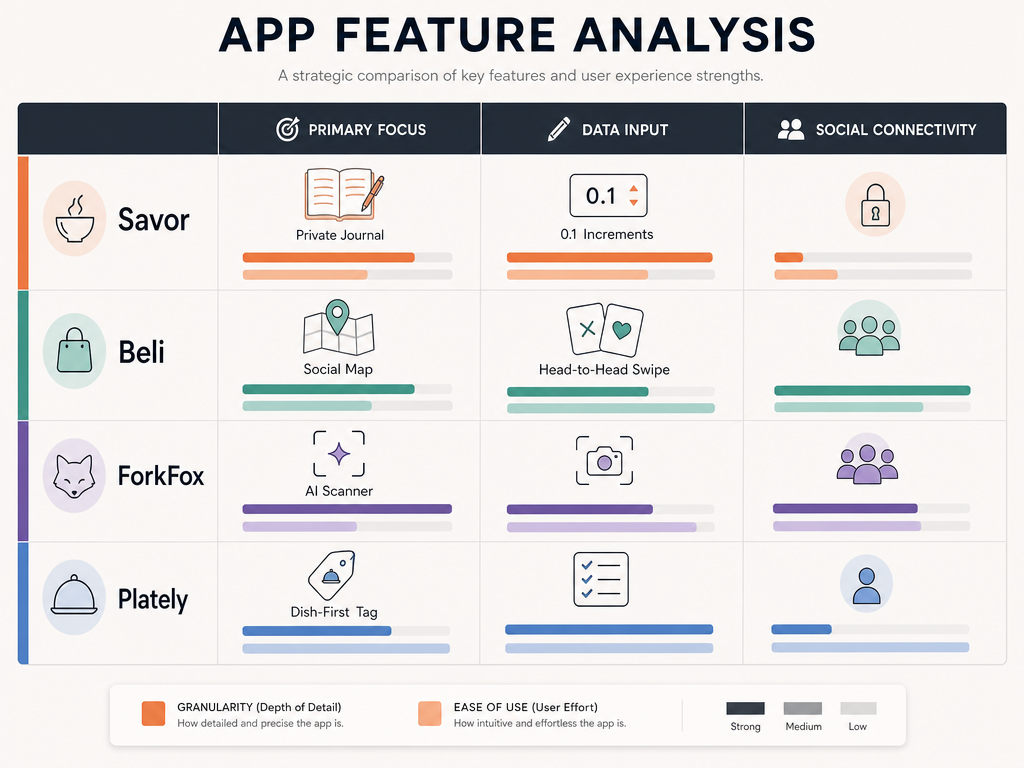 Every foodie has a different style. Whether you prefer the privacy of a personal database or the social thrill of ranking with friends, there is a dish-first app for you.
Comparison Matrix
| App | Primary Focus | Rating System | Social vs. Private | Input Method | Notable Feature |
|---|---|---|---|---|---|
| Savor | Personal Database | 10-point scale (0.1 increments) | Private-first | Photo + Manual Entry | AI dish detection & "Taste DNA" insights |
| Beli | Social Ranking | Elo-style Comparison | Social-first | Swipe (A vs. B) | Maps and ranked lists relative to friends |
| Plately | Dish Journaling | 5-star dish-level | Social-optional | Check-in + Dish Name | "Rate the dishes, not the restaurants" tagline |
| ForkFox | AI Discovery | Aggregated from reviews | Discovery-focused | Auto-scraped | Reads thousands of reviews to rank dishes |
Which app should you use? It depends on what you value.
- Choose Savor if you want a private, technical archive with decimal-point precision.
- Choose Beli if you want social competition and peer-driven discovery.
- Choose Plately if you want a middle ground - light social features with independent dish ratings.
- Choose ForkFox if you want speed over personalization and trust aggregated data.
For a deeper comparison, check out our comprehensive guide to the best food review apps for tracking and discovering meals.
Frequently Asked Questions
What is the best food comparing app?
There's no single "best" app - it depends on whether you prioritize privacy, social features, or speed. Savor excels at private, technical dish tracking with a 10-point scale. Beli is better for social discovery and Elo-based comparison. ForkFox is fastest for finding highly-rated dishes without manual logging. The best app is the one you'll actually use consistently.
Is Beli a safe app?
Beli is a legitimate food tracking app with standard privacy practices. It stores your dish ratings and location data to generate personalized recommendations. If you're concerned about data privacy, review the app's permissions before granting access to your location or camera roll. No major security issues have been reported.
What does Gen Z use instead of Yelp?
Many Gen Z foodies are shifting to dish-first apps (Beli, Plately) and visual platforms like TikTok and Instagram for restaurant discovery. The move reflects a preference for peer recommendations over crowd-sourced reviews and a desire to track specific dishes rather than entire restaurants.
Which app is better, Beli or Savor?
Beli is better if you want social discovery and head-to-head dish comparisons with friends. Savor is better if you want a private, precision-focused archive with a 10-point rating scale and AI dish detection. Both apps prioritize dishes over restaurants, but they serve different use cases - social competition versus personal documentation.
What is the highest rated restaurant on Beli?
Beli doesn't rank restaurants - it ranks individual dishes. The highest-rated items on the platform vary by region and user network. Your Beli feed is personalized based on your friends' ratings and your own comparison history, so the "best" dish in New York might be entirely different from the "best" dish in Los Angeles.
Who are Beli's main competitors?
Beli's primary competitors include Savor (private dish tracking), Plately (social dish journaling), and ForkFox (AI-driven dish discovery). Each app takes a slightly different approach to the same problem: isolating individual dishes from restaurant-level ratings.
What is the best app to store all my recipes?
For recipe storage and management (rather than dish tracking), consider specialized tools like Paprika, Mela, or Samsung Food. These apps focus on saving, organizing, and searching recipes from the web, not logging meals at restaurants. If you want to track dishes you've eaten out, use Savor or Beli instead.
For more on managing your food memories, explore our guide on how to keep a food diary.
The serious foodie isn't optimizing for the most Instagram-worthy meal. They're building a searchable archive of flavor - a personal reference system that turns thousands of meals into a coherent narrative. The camera roll graveyard is over. Your culinary legacy deserves better than 2,847 unlabeled photos and a vague memory of "that really good pasta place."
Start tracking dishes, not restaurants. You'll thank yourself in six months when you can actually remember what you ordered.