
Meat Restaurant Barcelona: Best Steaks & Grills (2026)
John the smoothie monster
John lives for smoothie bowls and cold-pressed juices. He uses Savor to remember his best blends.
The Carnivore's Map: Best Meat Restaurants in Barcelona (2026 Edition) You're standing in Barcelona's Eixample district, camera roll already bloated with 900...
The Carnivore's Map: Best Meat Restaurants in Barcelona (2026 Edition)
You're standing in Barcelona's Eixample district, camera roll already bloated with 900 photos from this trip, trying to find a restaurant that serves actual Galician Blond beef - not the generic "entrecôte" most tourist traps peddle. The tapas bars are great, the seafood is sublime, but you're here for one thing: to understand what makes Barcelona's meat scene different from every other European capital.
Here's the problem nobody talks about: Barcelona has spent decades being defined by jamón and butifarra, while its steakhouse culture quietly evolved into one of Europe's most technically sophisticated meat scenes. By the time most visitors figure this out, they've already wasted their first two dinners on mediocre cuts in Gothic Quarter tourist traps, and their camera roll is full of meals they can't even remember ordering.
The answer isn't another generic "Top 10 Steakhouses" list. It's understanding the technical hierarchy of Spanish beef - the aging protocols that separate 30-day standard cuts from 365-day extreme-aged ox, the breed distinctions that determine whether you're eating commodity Frisona or the real Rubia Gallega, and the cooking methods that make Basque high-heat chuletón taste nothing like Argentine slow-charcoal asado.
Key Takeaways
- Barcelona's meat scene has evolved beyond tourist-trap grills into a technically sophisticated network of breed-specific restaurants, dry-aging specialists, and regional-method asadors.
- Rubia Gallega (Galician Blond) cattle represent the gold standard for Spanish beef, with superior marbling and flavor development that justify 40-60% price premiums over standard Frisona.
- Dry-aging timeframes create distinct flavor profiles: 30-45 days deliver tenderness with mild funk, 60-120 days produce nutty complexity, and 365-day "extreme aging" yields intense, cheese-like flavors found at only a handful of Barcelona venues.
- The Basque chuletón method (high-heat, salt-crusted, bone-in) produces fundamentally different results than Argentine asado technique (slow charcoal, chimichurri, boneless cuts).
- Fixed-price 1kg chuletón deals at venues like Maison Carne (€34) and O'Chispa Taberna (€30 on Wednesdays) offer accessible entry points into premium beef dining despite 2023 food inflation rates of 10.4%.
- Josper ovens and specific charcoal types (Holm Oak vs. standard briquettes) measurably affect final flavor profiles through controlled heat distribution and smoke composition.
Table of Contents
- What Is Barcelona's Meat Scene Actually Known For?
- The Breed Index: Why Cattle Origin Matters More Than the Cut
- The Aging Spectrum: From 30-Day Standard to 365-Day Extreme
- The Style Pillars: Meat Bar vs. Basque Grill vs. Luxury Steakhouse
- The Technology of the Burn: Josper Ovens and Charcoal Chemistry
- Neighborhood Intelligence: The Eixample Steak Strip vs. Hidden Peripheral Gems
- The 1kg Club: Value Plays in a High-Inflation Market
- Group Dining and Private Room Logic
- Frequently Asked Questions
What Is Barcelona's Meat Scene Actually Known For?
Barcelona's meat culture centers on three distinct traditions: the Basque chuletón (massive bone-in rib steaks cooked at extreme heat), the Catalan asador (whole roasted meats over open flame), and increasingly, the dry-aged specialist steakhouse that sources premium Galician and Sayaguesa cattle. Unlike Madrid's more traditional approach or San Sebastian's pure Basque orthodoxy, Barcelona's meat restaurants operate in a hybridized space - incorporating Argentine asado techniques, French steakhouse service standards, and Japanese Wagyu offerings into what was historically a regional grilling tradition.
The city's restaurant sector grew by 0.8% in 2023 even as food price inflation spiked by 10.4%, according to WifiTalents 2026 industry data. This expansion reflects increased international business travel (up 7.6% in receipts supporting restaurant demand) and a consumer base willing to pay premiums for provenance and aging transparency. Barcelona's meat venues have responded by turning technical specifications - breed origin, aging protocols, heat sources - into primary marketing differentiators rather than afterthoughts.
What makes Barcelona's approach distinct is the transparency. Restaurants like Lomo Alto publish exact aging timeframes (20 days for standard "hanging" veal, 365 days for their extreme-aged ox) rather than vague "aged to perfection" claims. This technical specificity appeals to the modern food traveler who wants to understand what they're paying for and why a 120-day dry-aged Rubia Gallega chuletón commands €85 while a standard 30-day entrecôte costs €28.
The scene breaks into three consumer tiers: the casual meat bar (small plates, chef-led, minimal pretense), the traditional Basque grill (high-volume, family-style, salt-crusted technique), and the luxury steakhouse (tableside service, extensive wine programs, private dining rooms). Each serves a different use case, and understanding which category a restaurant occupies prevents the common mistake of booking a loud, communal asador for a quiet business dinner or expecting white-tablecloth service at a neighborhood meat bar.
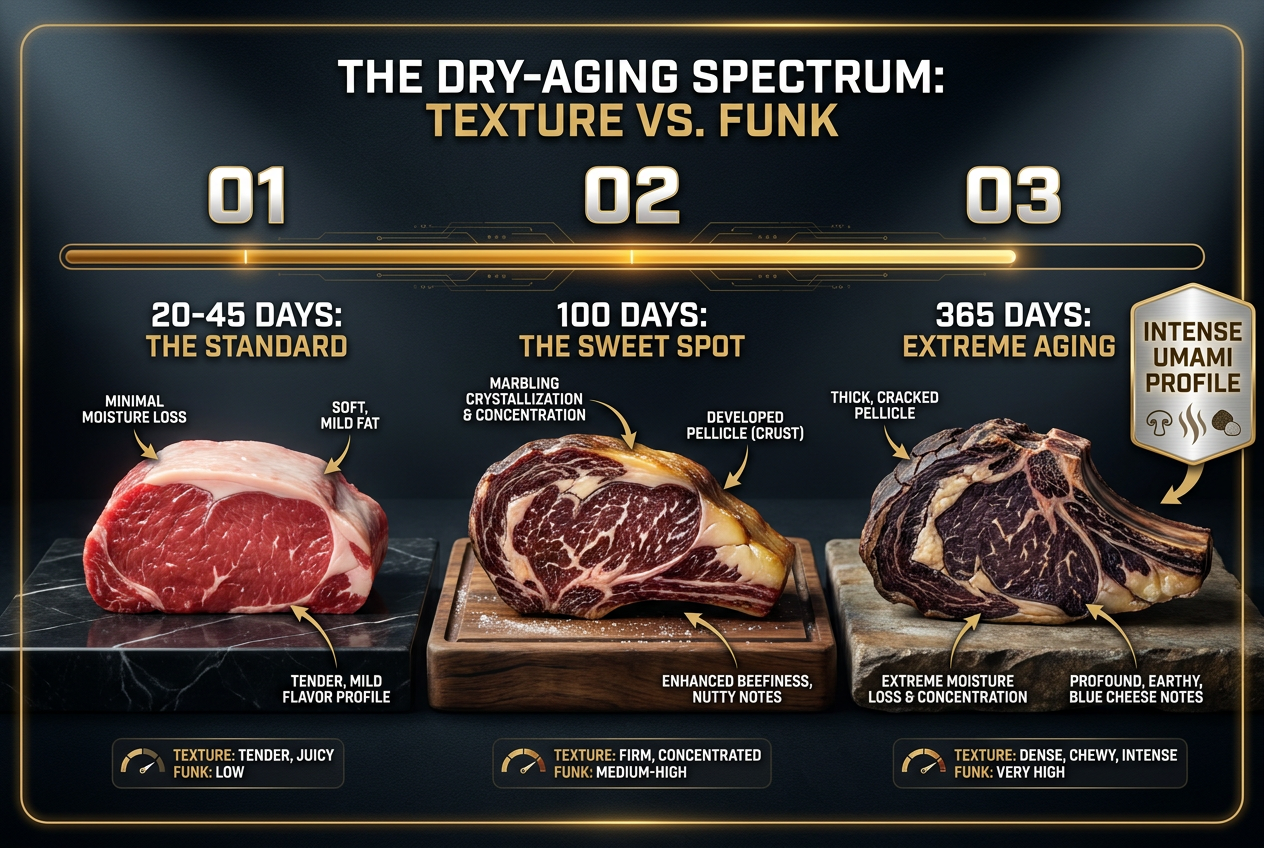 Understanding the technical evolution of beef: This spectrum illustrates how flavor profiles shift from tender standard cuts to the intense, funk-forward profiles found in Barcelona's elite steakhouses.
The Breed Index: Why Cattle Origin Matters More Than the Cut
The breed determines the baseline: marbling potential, fat composition, flavor intensity, and optimal aging timeframe. A perfectly cooked ribeye from commodity Frisona cattle (the dairy-beef crossbreed that dominates Spanish supermarkets) will never develop the nutty, umami-rich complexity of a Rubia Gallega raised in Galicia's Atlantic pastures. Breed is the foundation; everything else - cut, aging, cooking method - builds on that genetic and environmental starting point.
Rubia Gallega (Galician Blond)
The gold standard for Spanish beef. This ancient breed from Galicia produces heavily marbled meat with a distinctive yellow fat cap (from beta-carotene in grass-fed diets) and a flavor profile that deepens significantly during extended dry-aging. Rubia Gallega cattle are typically slaughtered at 8-10 years old (versus 18-24 months for standard beef), which creates dense, complex muscle fibers that respond exceptionally well to aging protocols of 60+ days. In Barcelona's top meat restaurants, you'll pay 40-60% premiums for Rubia Gallega over standard cuts, but the difference is structural, not cosmetic.
Sayaguesa
A less common but equally prized heritage breed from the Zamora region. Sayaguesa cattle are smaller-framed than Rubia Gallega and produce leaner cuts with a more pronounced mineral quality. The fat is whiter (less yellow) than Galician breeds, and the optimal aging window is shorter - typically 45-75 days rather than 90+. Sayaguesa excels in preparations that highlight the meat's inherent flavor rather than funk from extended aging. If you see Sayaguesa on a Barcelona menu, it's a signal the restaurant is sourcing from specialty suppliers rather than commodity distributors.
Frisona
The workhorse of Spanish beef production. Frisona (Holstein-Friesian dairy crosses) dominate because they're economically efficient - fast-growing, high-yield, and adaptable to industrial finishing. The meat is leaner, milder, and less expensive. It's perfectly adequate for standard bistro preparations but lacks the marbling and complexity that justify premium steakhouse pricing. If a Barcelona restaurant doesn't specify breed on the menu, you're almost certainly getting Frisona. That's not inherently bad, but it's important to know what you're paying for.
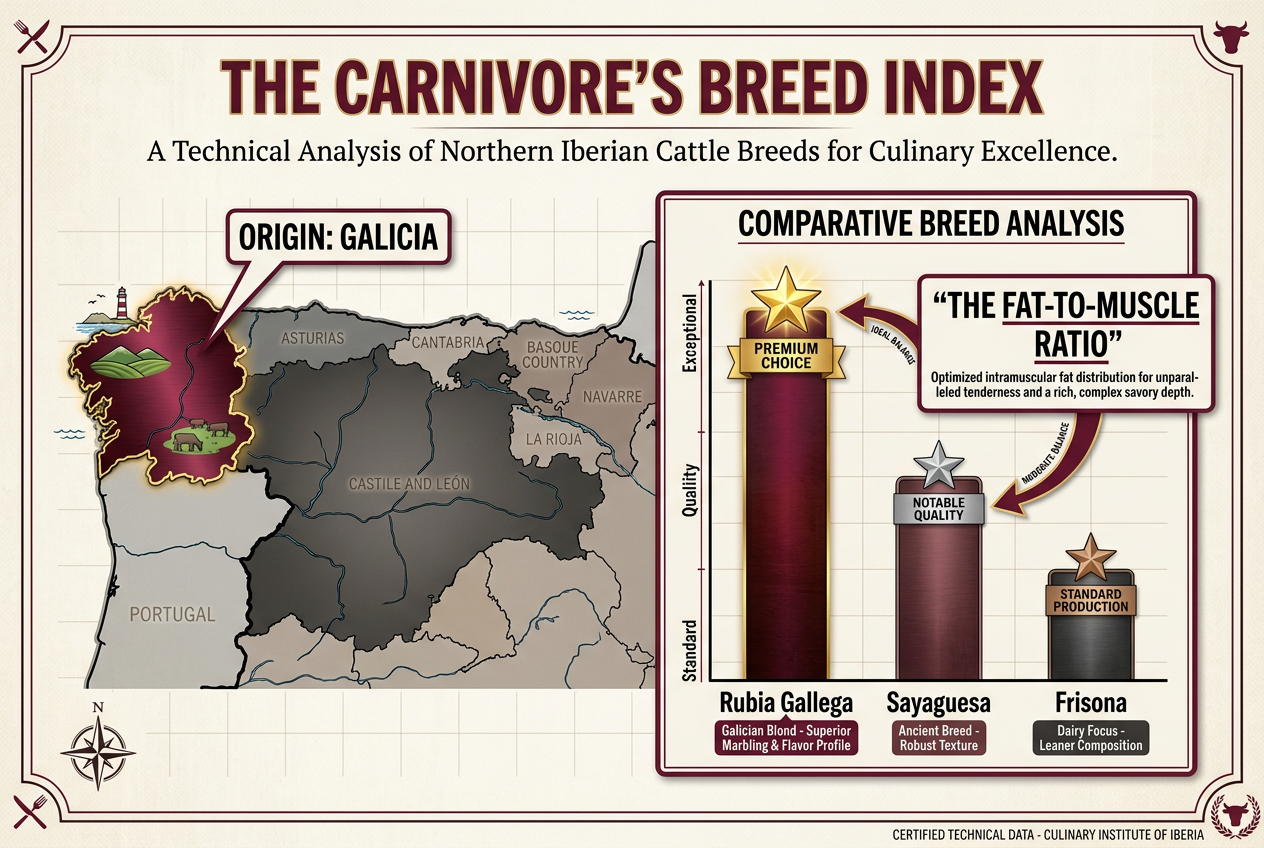 The Breed Index: Superior marbling and age-matured flavor profiles make Rubia Gallega the gold standard for serious foodies exploring Barcelona's high-end meat scene.
The breed distinction becomes especially important when evaluating dry-aging claims. A 90-day Frisona isn't going to develop the same depth as a 90-day Rubia Gallega because the baseline fat content and muscle density are fundamentally different. This is why Barcelona's best meat specialists lead with breed transparency - it's the clearest signal they understand the product they're serving.
For food travelers building a personal restaurant library, noting breed alongside dish names creates a useful framework for comparing experiences. That 60-day Sayaguesa chuletón you had at Brabo becomes a reference point for evaluating every other dry-aged steak you encounter, but only if you remember which breed you actually ate.
The Aging Spectrum: From 30-Day Standard to 365-Day Extreme
Dry-aging removes moisture, concentrates flavor, and allows enzymatic breakdown to tenderize the meat and develop funk. The timeframe determines intensity. A 30-day ribeye tastes like a refined version of fresh beef - tender, mild, approachable. A 120-day ribeye tastes like an entirely different protein - nutty, earthy, almost cheese-like. At 365 days, you're in extreme territory: polarizing, intense, an acquired taste even for serious meat enthusiasts.
20-30 Days: The Standard Window
This is the baseline for most "dry-aged" claims in Barcelona. At this stage, the meat has lost approximately 10-15% of its water weight, which concentrates the beefy flavor without introducing significant funk. Texture improves noticeably - the enzymatic process has begun breaking down connective tissue, making even tougher cuts like sirloin more tender. This is a safe, crowd-pleasing range. If a restaurant simply says "dry-aged" without specifying days, assume 30-40 and you'll rarely be disappointed. Lomo Alto defines this as the minimum "Hanging" period for veal before it even enters their aging program.
45-75 Days: The Sweet Spot
This window is where dry-aging starts to differentiate itself. Moisture loss reaches 20-25%, and the flavor shifts from "concentrated beef" to "complex beef with nutty undertones." The exterior develops a harder pellicle (the dried crust that gets trimmed before cutting), and the interior takes on a deeper red color. For most diners, including serious food enthusiasts, this range delivers the optimal balance of tenderness, complexity, and approachability. It's aged enough to taste different, but not so aged that it alienates anyone at the table. Barcelona restaurants targeting knowledgeable locals tend to cluster their offerings in this range.
90-120 Days: Advanced Territory
Now you're eating something fundamentally different. Moisture loss exceeds 30%, and the trimming losses become significant (which is why restaurants charge premiums). The flavor profile turns earthy, funky, almost blue-cheese-adjacent for some palates. This is where breed really matters - Rubia Gallega handles extended aging beautifully, developing umami depth without crossing into unpleasant. Lesser breeds can taste sour or overly gamy. If you're paying for 90+ day aging, verify the breed. A 90-day Frisona is a waste of money; a 90-day Rubia Gallega is a revelation.
365 Days: Extreme Aging
Lomo Alto's signature offering: beef aged for an entire year. At this stage, the exterior is almost jerky-like before trimming, and the flavor is intensely funky, divisive, and unforgettable. This isn't a meal; it's a tasting experience. The meat develops a Parmigiano-like sharpness, and the texture becomes almost creamy from the level of enzymatic breakdown. This appeals to a narrow audience - experienced meat enthusiasts who want to push boundaries - and it requires specific pairing knowledge (big, tannic reds or aged spirits). It's the culinary equivalent of a 30-year whisky: impressive, expensive, and definitely not for everyone.
The aging spectrum explains why Barcelona's meat scene has stratified. Casual meat bars operate in the 30-45 day range, where aging improves quality without requiring extensive customer education. Serious steakhouses like Lomo Alto and select cuts at Sagardi push into 90+ days because their audience understands what they're paying for. The 365-day offerings are marketing tools as much as menu items - they signal technical capability and draw press coverage, even if most diners order something in the 60-90 day range.
The Style Pillars: Meat Bar vs. Basque Grill vs. Luxury Steakhouse
Barcelona's meat restaurants cluster into three distinct service and atmosphere categories, each optimized for different dining scenarios. Understanding these categories prevents the common mistake of expecting fine-dining service at a casual meat bar or showing up to a high-volume Basque grill expecting an intimate date-night atmosphere.
The Meat Bar: Bardeni and the Small-Plate Specialists
The meat bar format prioritizes chef-driven preparations, small plates, and minimal pretense. Think Barcelona's answer to Tokyo's standing yakitori bars - tight spaces, high turnover, focused execution. Bardeni exemplifies this: a compact venue in Sant Antoni where the chef works a charcoal grill visible from every seat, serving precise cuts (often smaller than traditional steakhouse portions) with minimal accompaniments. The advantage is accessibility - you can sample multiple cuts and preparations in one sitting without committing to a €70 chuletón. The disadvantage is atmosphere - these are loud, casual, not ideal for quiet conversation or business meetings. For solo diners or small groups who prioritize the food over the scene, meat bars deliver the highest quality-to-pretense ratio in the city.
The Basque Grill: Sagardi, Brabo, and the Chuletón Temples
The Basque asador tradition centers on one thing: massive, bone-in cuts cooked over extremely high heat and finished with coarse salt. Sagardi represents the orthodox approach - whole chuletones (often 1kg+) served family-style with minimal seasoning, designed for groups to share. The cooking method is non-negotiable: the exterior develops an aggressive char while the interior stays rare, and the bone conducts heat to create a temperature gradient from seared to raw within the same steak. This is communal dining optimized for 4-6 people who want a single dramatic centerpiece rather than individual plated courses. The atmosphere is boisterous, the service is efficient rather than refined, and the wine lists emphasize quantity over curation. Brabo operates in a similar space but with slightly more modern plating and a willingness to cook steaks to medium (still heretical by Basque standards, but tolerated for international guests).
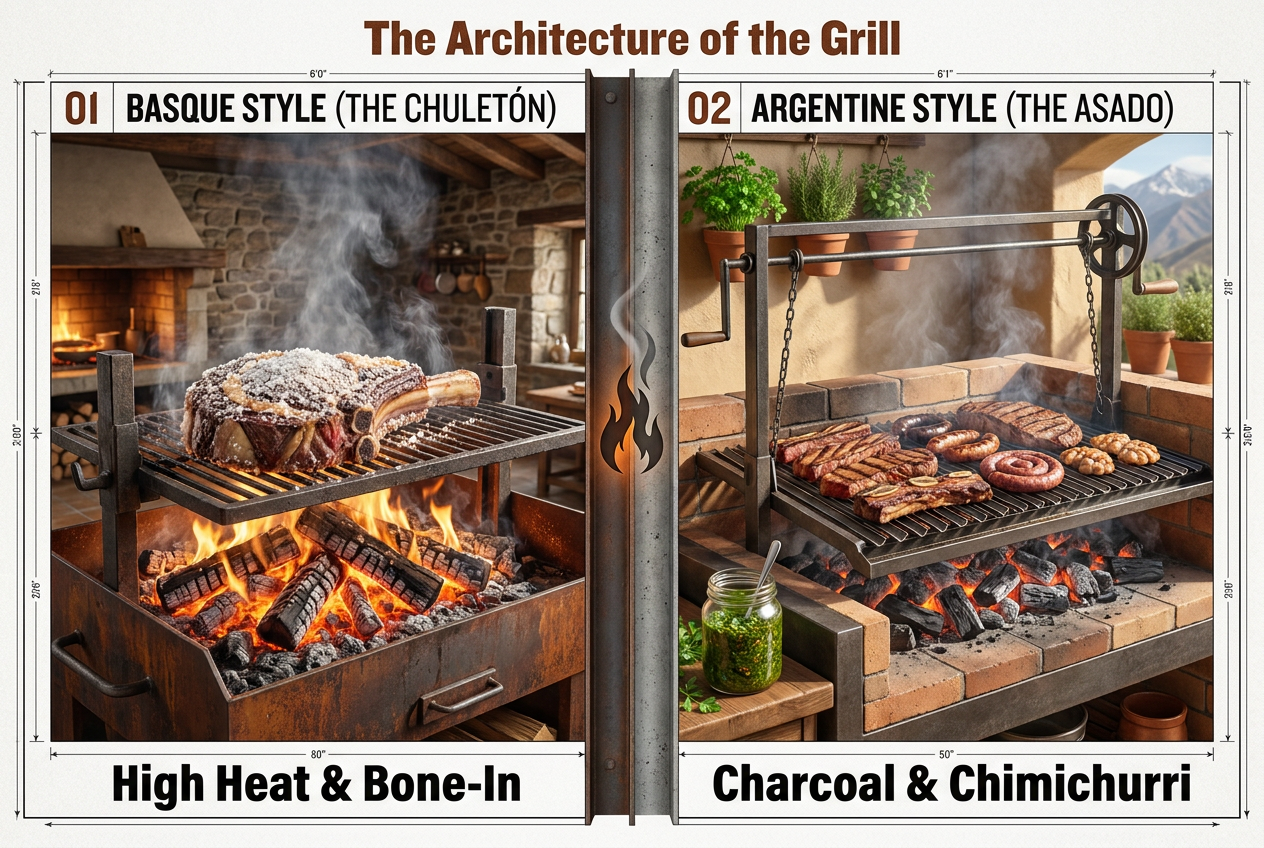 Choosing your flame: While Basque grills focus on high-heat salt crusts, Argentine asadors prioritize slow charcoal heat and herbaceous marinades for a different flavor profile.
The Luxury Steakhouse: Lomo Alto, Mr. Porter, and the Full Experience
This category adds white tablecloths, tableside carving, sommelier service, and private dining rooms to the equation. Lomo Alto positions itself as Barcelona's answer to aging specialists like Goodman in London or Hawksmoor - extreme transparency on sourcing and aging, a wine program that justifies the €12-18 glass pours, and a reservation system that requires booking days in advance for prime slots. Mr. Porter operates in a similar tier but emphasizes the scene as much as the steak - this is where you go when the dinner is as much about being seen as it is about the beef. These venues charge 40-50% premiums over Basque grills for the same cuts because they're selling an experience package: ambiance, service, wine knowledge, and the social signaling that comes with dining somewhere selective.
The practical implication: match the venue to the occasion. A solo business traveler wanting to try excellent dry-aged Rubia Gallega should book a meat bar, not a luxury steakhouse. A group celebration for eight people needs a Basque grill with communal tables, not an intimate 20-seat meat bar. A client dinner where the meal matters less than the impression requires a luxury steakhouse, even if the beef at a casual asador might be objectively better.
For travelers using food review apps to track their dining history, categorizing venues by style pillar (not just cuisine or price) creates much more useful data. "Barcelona meat restaurants" is too broad; "Barcelona Basque grill for groups" or "Barcelona dry-aging specialist for solo dining" are queries your archive can actually answer six months later.
The Technology of the Burn: Josper Ovens and Charcoal Chemistry
The cooking method determines what happens to the meat after aging and butchering are complete. A perfectly sourced, expertly aged Rubia Gallega chuletón can still be ruined by an improperly heated grill or the wrong charcoal selection. The serious meat restaurants in Barcelona differentiate themselves not just by what they buy, but by how precisely they apply heat.
Josper Ovens: The Controlled-Chaos Advantage
A Josper oven is a Spanish-made hybrid: a charcoal grill enclosed in an oven chamber, allowing chefs to achieve wood-fired flavor while maintaining temperature precision impossible with open-flame grilling. The key advantage is heat distribution - the enclosed design creates radiant heat from all sides while the charcoal base provides direct searing. This means a 6cm-thick chuletón can develop a proper crust without the interior overcooking, a near-impossible feat on a standard open grill. Barcelona Secreta notes that several of the city's top meat venues use Josper technology specifically for this reason - it allows them to serve steaks that most traditional asadors couldn't execute properly.
The trade-off is flavor nuance. A Josper delivers consistency, but some purists argue it sacrifices the smoke complexity of an open-flame grill. The enclosed chamber limits the amount of wood smoke that actually contacts the meat, producing a cleaner (some say blander) result than a Basque-style open grill where the steak sits directly above burning oak or holm oak coals.
Charcoal Types: Holm Oak vs. Standard Briquettes
Not all charcoal is functionally equivalent. Holm oak (encina) charcoal burns hotter and longer than standard briquettes, with a distinct aromatic profile that traditional Basque asadors consider non-negotiable. The wood imparts a subtle, almost nutty smoke that complements beef fat without overwhelming it. Standard lump charcoal or briquettes burn faster, require more frequent replenishment, and produce a more neutral smoke profile. Restaurants using holm oak typically advertise it - it's a signal they're investing in traditional methods rather than cutting costs.
The chemistry matters because different charcoals produce different volatile compounds when they combust. Holm oak smoke contains specific phenolic compounds that interact with beef fat in ways that create the "classic" chuletón flavor profile. Switch to briquettes, and you get heat and char, but you lose that aromatic layer.
High-Heat Technique: The 800°F+ Threshold
Basque chuletón cooking operates at extreme temperatures - 800-900°F surface temp - for a reason. At that heat level, the Maillard reaction (the chemical browning of proteins and sugars) happens almost instantaneously, creating a thick, flavorful crust before the interior has time to overcook. This is why Basque steaks are served rare to medium-rare even when heavily charred: the exterior char develops in 90 seconds per side while the interior barely rises above room temperature.
Lower-heat grilling (400-600°F, common in home cooking) can't replicate this. You get gradual cooking, which produces even doneness but weak crust development. The serious meat restaurants in Barcelona have spent years optimizing their grill stations to maintain these extreme temperatures throughout service - a logistical challenge in a high-volume environment where constant cooking draws heat from the fuel bed.
Understanding the technology helps explain why two restaurants serving the same cut at the same aging period can produce wildly different results. A 60-day Rubia Gallega cooked on a Josper at 850°F tastes fundamentally different from the same steak cooked on a gas grill at 500°F. The first develops a complex crust and rare interior; the second ends up uniformly medium with minimal browning. Barcelona's top meat venues have invested in equipment and technique that home cooks and casual restaurants simply can't replicate.
Neighborhood Intelligence: The Eixample Steak Strip vs. Hidden Peripheral Gems
Barcelona's meat restaurants cluster predictably in Eixample - the grid-planned district where wide boulevards, high foot traffic, and affluent residents create ideal conditions for high-end dining. But the city's best value and most distinctive meat experiences often hide in peripheral neighborhoods where rents are lower and chefs can take creative risks without tourist-quarter pricing pressures.
Eixample: The Concentration Zone
Eixample hosts the highest density of premium meat restaurants in Barcelona, including Lomo Alto (near Passeig de Gràcia), multiple Sagardi locations, and most of the luxury steakhouses targeting business travelers and expense-account diners. The advantage is convenience - if you're staying in central Barcelona, you're within walking distance of a dozen serious meat options. The disadvantage is homogeneity. These venues compete for the same customer base (affluent locals, international business travelers, food tourists) and tend to converge on similar offerings: dry-aged Galician beef, extensive wine programs, reservations-required service.
Barcelona Food Experience notes that Eixample's meat restaurants excel at specific dishes - solomillo con foie, high-end chuletones, tableside carving - but the neighborhood's focus on premium cuts means you'll rarely find the experimental small plates or regional specialties that define peripheral venues.
Sant Antoni and Poble Sec: The Meat Bar Ecosystem
These adjacent neighborhoods west of Eixample have emerged as Barcelona's meat bar district - casual, chef-driven venues serving high-quality cuts in stripped-down formats. Bardeni operates in Sant Antoni, and several competitors have opened nearby, creating a micro-scene of standing-room or minimal-seating meat specialists. The draw is quality-to-price ratio: you're often eating the same Rubia Gallega or Sayaguesa as Eixample steakhouses, but in a €12 small plate format rather than a €65 full steak. The trade-off is atmosphere - these are loud, tight, designed for quick turnover rather than lingering dinners.
Horta and Sant Andreu: The Hidden Specialists
Barcelona's northern peripheral districts see far fewer tourists but host several under-publicized meat specialists serving local crowds. These venues operate on different economics - lower rents allow them to serve premium cuts at moderate prices, and the predominantly local clientele means they don't have to explain basic concepts like dry-aging or breed distinctions. EatingOutorIn highlights specific deals like O'Chispa Taberna's €30 Wednesday 1kg chuletón offer - a promotion that would be economically impossible in Eixample.
The challenge with peripheral neighborhoods is discovery. These restaurants don't advertise internationally, rarely show up on tourist-focused listicles, and often require navigating Barcelona's metro system rather than walking from central hotels. But for food travelers willing to invest the effort, the payoff is access to authentic neighborhood dining at significantly lower price points than the Eixample steak strip.
Strategic neighborhood selection depends on your priorities. If convenience and atmosphere matter more than price, Eixample delivers. If you're optimizing for quality-to-cost and don't mind a 20-minute metro ride, the peripheral districts offer better value. If you want the full Barcelona meat experience - covering multiple styles and price tiers - plan a mix: one luxury steakhouse dinner in Eixample, one meat bar lunch in Sant Antoni, and one neighborhood asador in Horta or Sant Andreu.
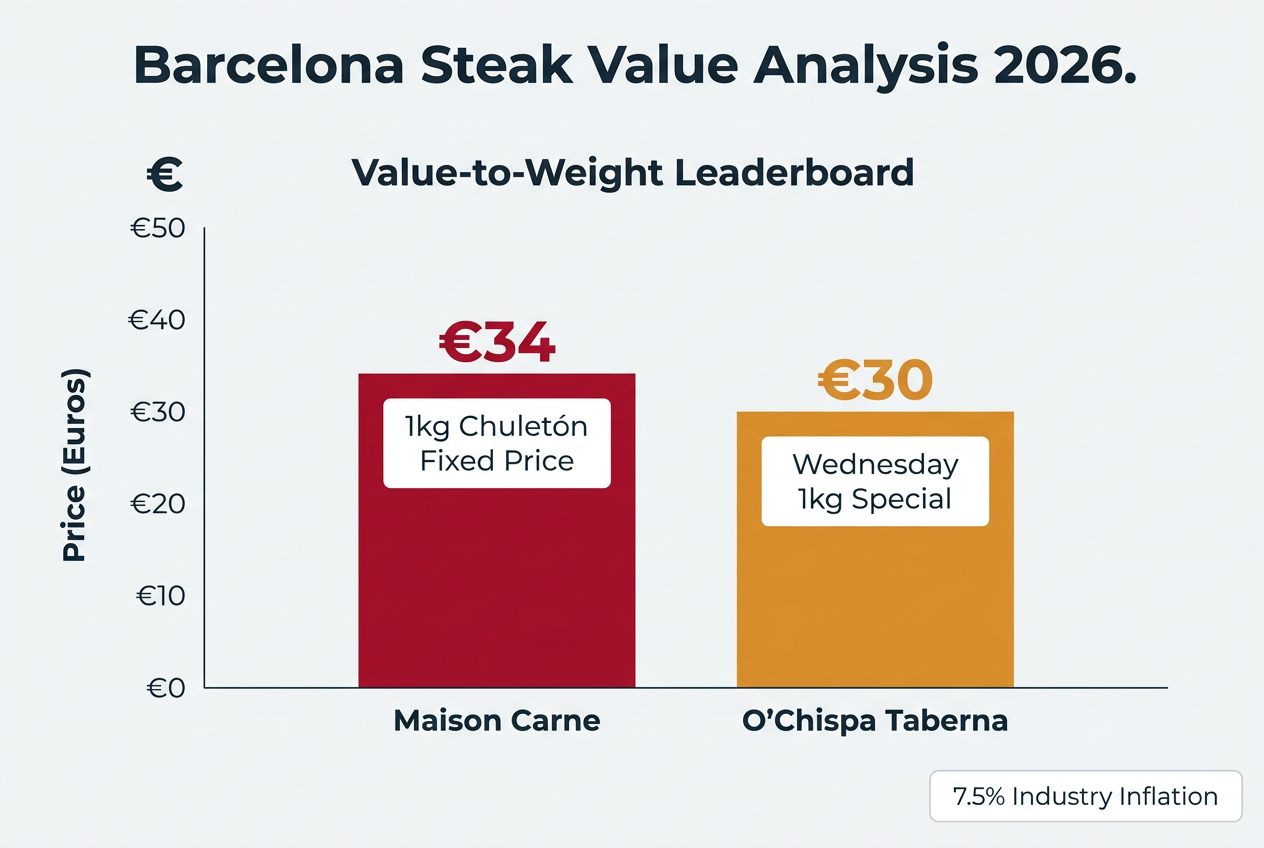 Navigating the 1kg Club: Despite rising industry inflation, select Barcelona venues offer high-value fixed pricing for massive cuts, providing an accessible entry point for premium dining.
The 1kg Club: Value Plays in a High-Inflation Market
Spain's restaurant sector faced significant economic pressure in 2023: food price inflation spiked 10.4%, overall restaurant-hotel component inflation rose 7.5%, and total restaurant sector turnover hit €41.6 billion as operators passed costs to consumers. In this environment, fixed-price 1kg chuletón deals represent rare value stability - restaurants absorbing some inflation impact to maintain price-point appeal for volume-conscious diners.
Maison Carne: The €34 Standard
Maison Carne offers a fixed €34 price for a full 1kg chuletón, according to Barcelona Secreta's 2025 reporting. At 2026 market rates, this represents approximately €3.40 per 100 grams - significantly below the €5-7 per 100g standard at premium Eixample steakhouses. The cut is typically 45-60 day dry-aged Galician beef (breed unspecified, likely a mix of Rubia Gallega and Frisona depending on availability), cooked over charcoal, and served with minimal accompaniments.
The value proposition is straightforward: two diners splitting a 1kg steak pay €17 each for premium beef that would cost €35-45 per person at a luxury venue. The trade-offs are atmosphere (casual, high-turnover), service (efficient but not refined), and the lack of extensive wine or side dish options. This is a pure beef play - if you're optimizing for grams of quality meat per euro spent, Maison Carne delivers.
O'Chispa Taberna: The €30 Wednesday Special
O'Chispa Taberna operates in Barcelona's peripheral districts and offers a €30 Wednesday deal for a 1kg steak, as documented by EatingOutorIn. This pricing reflects neighborhood economics - the venue serves a predominantly local customer base rather than international tourists, and Wednesday is a historically slow service day that benefits from promotional pricing to drive traffic.
The Wednesday special represents the absolute floor for premium beef pricing in Barcelona's current market: €3 per 100 grams for a restaurant-quality, charcoal-grilled chuletón. The catch is availability (one day per week), location (requires navigating to peripheral neighborhoods), and potential quality variation (the venue likely uses less expensive cuts or shorter aging periods to hit this price point sustainably).
The Economic Context
These fixed-price offers exist in tension with broader market forces. When food inflation runs at 10%+ and Barcelona's restaurant sector grew enterprise count by only 0.8%, operators face pressure to either raise prices or maintain margins through volume. The 1kg club venues choose volume - high turnover, minimal service, reliance on local traffic rather than tourist premiums.
For the value-conscious food traveler, these deals create an opportunity: access to the same cooking techniques and similar (if not identical) beef sourcing as luxury venues, at 40-50% lower cost. The experience is stripped-down, but for diners who prioritize the actual meat over ambiance, that's a feature, not a bug.
Tracking these value plays requires local knowledge that standard tourist guides rarely provide. This is where tools like apps to organize food photos by restaurant become valuable - documenting not just what you ate, but what you paid and which specific deal or promotion made it possible. Six months later, that Wednesday €30 chuletón becomes a repeatable strategy rather than a one-time lucky find.
Group Dining and Private Room Logic
Corporate dinners, celebration meals, and large group gatherings have fundamentally different requirements than solo or couple dining. Barcelona's meat restaurants stratify sharply on their ability to accommodate groups, with venue selection mistakes resulting in either awkward service (trying to seat 8 at a meat bar designed for 15 total) or wasted spend (booking a private room when a communal table would have worked better).
Private Dining Capacity: The Luxury Steakhouse Advantage
Lomo Alto and similar luxury venues invest in private dining rooms specifically to capture corporate and celebration business. These spaces typically seat 8-16 guests, offer dedicated service staff, and allow pre-set menus or family-style ordering that simplifies logistics for large parties. The cost premium is significant - private room minimums often start at €100-150 per person when wine and full courses are included - but the value proposition is control: no ambient noise from the main dining room, no service delays from competing tables, and the ability to customize pacing for business presentations or extended celebrations.
This option makes sense when the dinner's purpose extends beyond the meal itself - client entertainment, team celebration, anniversary dinners where privacy enhances the experience. For pure food-focused gatherings where cost matters more than exclusivity, private rooms are usually overkill.
Communal Tables: The Basque Grill Solution
Sagardi and traditional Basque asadors optimize for group dining through communal table design and family-style service. A party of 8 orders 2-3 massive chuletones, sides are served in large bowls for sharing, and the bill is split evenly. This format delivers the lowest per-person cost for large groups while maintaining the authentic Basque dining experience - loud, convivial, centered on a single dramatic protein rather than individual plated courses.
The challenge is atmosphere control. Communal dining is inherently social and noisy, which makes it perfect for celebrations but potentially problematic for business dinners where conversation clarity matters. Sagardi's Eixample locations are loud enough that holding a detailed business discussion across a table of 8 becomes difficult without raising voices.
The Meat Bar Limitation
Small-format meat bars like Bardeni typically cap at 12-15 total seats, making them functionally unusable for groups larger than 4-5. Attempting to book a party of 8 at a 15-seat venue either monopolizes the entire restaurant (often not possible) or requires splitting across separate tables, which defeats the purpose of group dining. These venues excel at solo travel or small intimate groups, not celebrations or corporate entertaining.
The decision tree is straightforward: groups of 6+ requiring privacy and custom service need a luxury steakhouse with private rooms. Groups of 6-10 prioritizing value and traditional experience should book communal tables at Basque grills. Groups of 2-5 wanting chef-driven quality can access meat bars. Mismatching the venue type to group size is one of the most common booking mistakes food travelers make, and it's entirely preventable with basic research.
For travelers building comprehensive dining records, noting venue capacity and group-friendliness alongside dish ratings creates valuable filtering criteria. That incredible 90-day Rubia Gallega you had at a 12-seat meat bar might be perfect for your next solo Barcelona trip, but it's irrelevant for planning a group celebration dinner - unless your notes specifically indicate the venue can't accommodate parties larger than 4.
Frequently Asked Questions
What meat is Barcelona known for?
Barcelona's meat reputation centers on three primary elements: Basque-style chuletón (massive bone-in rib steaks cooked over high heat), traditional Catalan asador preparations (whole roasted meats), and increasingly, advanced dry-aging programs featuring Galician Blond (Rubia Gallega) cattle. The city's meat culture operates at the intersection of Basque grilling tradition, Catalan regional cuisine, and modern steakhouse techniques influenced by international dining trends. Unlike Madrid's focus on cochinillo (suckling pig) or Valencia's rice-centric meat preparations, Barcelona has evolved into Spain's primary hub for breed-specific, aging-focused beef dining. The technical sophistication - detailed breed transparency, precise aging protocols, equipment like Josper ovens - distinguishes Barcelona's approach from more traditional Spanish meat regions.
What is the number one steakhouse in Spain?
Defining a single "number one" steakhouse in Spain is functionally impossible because the market stratifies by style, region, and customer priorities rather than operating on a linear quality scale. That said, Etxebarri in the Basque Country (Atxondo, near Bilbao) consistently ranks as Spain's most internationally acclaimed meat-focused restaurant, holding a Michelin star and regularly appearing on World's 50 Best lists. However, Etxebarri operates more as a wood-fire temple than a traditional steakhouse - the menu emphasizes seasonal ingredients grilled over custom wood fires rather than beef-forward service. For pure steakhouse experience within Spain's major cities, Madrid's La Vaca y La Huerta and Barcelona's Lomo Alto represent the high-water marks for aging transparency and breed-specific sourcing, though both serve different audiences (the former more traditional, the latter more international). The practical answer depends on criteria: best aging program, best Basque orthodoxy, best luxury service, or best value - each yields a different venue.
What is a must eat in Barcelona?
From a meat-specific perspective, the must-eat dish in Barcelona is a properly executed Basque chuletón - a bone-in rib steak (often 1kg+) from Galician Blond cattle, dry-aged 45-90 days, grilled over holm oak charcoal at 800°F+, and finished with coarse salt. This preparation represents the convergence of Spanish beef culture: the breed (Rubia Gallega), the regional method (Basque high-heat technique), and Barcelona's unique willingness to push aging protocols further than traditional Basque grills. The dish is designed for sharing, served family-style, and delivers an experience impossible to replicate outside Spain's premium meat ecosystem. Beyond chuletón, calcots (spring onions grilled whole and served with romesco sauce) represent Barcelona's indigenous grilled vegetable tradition, while jamón ibérico de bellota (acorn-fed Iberian ham) remains the baseline Spanish meat experience. However, for serious food travelers, the chuletón specifically showcases what makes Barcelona's meat scene distinctive rather than just good.
Is there a difference between Argentine and Basque steakhouses in Barcelona?
Yes, the difference is fundamental and affects everything from meat selection to cooking technique to final flavor profiles. Argentine asados use boneless cuts (often tira de asado or entraña), slow-cook over low-temperature charcoal or wood fires (4-6 hours for larger cuts), and emphasize chimichurri and other herbaceous marinades to complement the meat. The Argentine method produces tender, evenly cooked beef with pronounced smoke flavor and herb integration. Basque chuletón, by contrast, uses massive bone-in cuts, cooks at extreme high heat (800°F+ for 90 seconds per side), and uses only coarse salt - no marinades or sauces. The bone conducts heat and adds flavor, while the high-heat method creates a thick char crust with a rare interior. The final products are not interchangeable: Argentine asado tastes herbaceous, smoky, and tender; Basque chuletón tastes intensely beefy, char-forward, and rare. Barcelona hosts both traditions, but they serve different dining occasions and palates. Argentine venues tend to be more casual and group-oriented; Basque grills range from traditional asadors to luxury steakhouses.
Where can I find authentic Galician Blond (Rubia Gallega) beef in Barcelona?
Lomo Alto explicitly sources and ages Rubia Gallega cattle as their signature offering, with detailed aging protocols (up to 365 days) published on their menu. Sagardi's Barcelona locations serve traditional Basque chuletón from Galician cattle, though specific breed transparency varies by location - confirm Rubia Gallega sourcing when ordering. Brabo similarly sources Galician beef for their high-end steak program. Beyond named luxury venues, the reliable identifier is menu transparency: restaurants serving authentic Rubia Gallega almost always specify breed, region, and aging period on the menu because these details justify premium pricing. Generic menu descriptions like "aged beef" or "premium steak" without breed specification typically indicate Frisona or mixed-breed sourcing. Barcelona's peripheral neighborhood meat bars sometimes source Rubia Gallega for specific dishes (particularly weekend specials), but you need to ask directly - these venues don't always print detailed sourcing on casual menus. For guaranteed Rubia Gallega access, book at Lomo Alto, Sagardi, or similar established specialists where breed sourcing is core to their brand rather than an occasional offering.
Which Barcelona meat restaurants offer 100+ days dry-aging?
Lomo Alto operates the city's most extreme aging program, with offerings ranging from 120 days to their signature 365-day extreme-aged ox. This is the only Barcelona venue publicly advertising year-long aging, making it the default destination for experiencing ultra-extended aging protocols. Sagardi's flagship locations occasionally offer 100-120 day cuts as premium menu additions, though availability varies seasonally and by location - call ahead to confirm current aging offerings. Beyond these two, Barcelona's 100+ day aging landscape is limited. Most serious steakhouses cluster in the 60-90 day range, which represents the optimal balance between complexity and approachability for mainstream dining audiences. The scarcity of extreme-aged beef reflects both supply economics (trimming losses exceed 35% for 100+ day aging, requiring significant price premiums) and demand constraints (the intensely funky flavor profile appeals to a narrow customer segment). For travelers specifically seeking 100+ day experiences, Lomo Alto is effectively the only guaranteed option; treat any 100+ day offerings elsewhere as rare specials rather than consistent menu items.
Do any meat restaurants in Barcelona have private rooms for groups?
Lomo Alto offers private dining rooms accommodating 8-16 guests with dedicated service, custom menus, and wine pairing options - designed for corporate dinners and high-end celebrations. Mr. Porter similarly features private room capacity targeting business entertainment and special occasions. Most luxury steakhouses in Eixample offer some form of private or semi-private dining space, though capacity and amenities vary - confirm specific room size, minimum spend requirements, and menu customization options when booking. Traditional Basque grills like Sagardi typically lack private rooms but offer large communal tables that can be reserved for groups of 8-12, providing group exclusivity without full room separation. Meat bars like Bardeni do not offer private dining options due to compact venue size and high-turnover business models. The private room market in Barcelona's meat scene skews heavily toward luxury steakhouses with €100+ per person minimums when wine and full service are included; budget-conscious groups should explore communal table reservations at Basque grills rather than expecting private room access at moderate price points.
Is there a sustainable or grass-fed meat restaurant in Barcelona?
Barcelona's meat restaurant scene lags behind northern European capitals in explicit sustainability messaging, but several venues prioritize traditional extensive farming practices that align with grass-fed and sustainable production. Rubia Gallega and Sayaguesa cattle are pasture-raised by definition - these heritage breeds require extensive grazing systems rather than feedlot finishing, meaning any restaurant serving authentic Galician or Zamoran beef is inherently sourcing from more sustainable production systems than commodity beef. However, few Barcelona meat restaurants explicitly market "grass-fed" or "sustainable" certifications because the domestic market doesn't demand this terminology - Spanish consumers prioritize breed and aging over organic or sustainability labels. Barcelona Food Experience notes that some Eixample venues highlight organic or biodynamic sourcing for specific cuts, though this represents a minority of offerings rather than comprehensive menu commitments. For travelers prioritizing verified sustainable sourcing, the practical approach is researching breed transparency (Rubia Gallega/Sayaguesa imply extensive farming) and directly asking restaurants about production methods rather than expecting standardized sustainability certifications on menus.
Your Barcelona meat education doesn't end when you leave the city. Every 90-day Rubia Gallega chuletón, every Josper-grilled Sayaguesa cut, every €30 Wednesday special becomes part of your personal food database - but only if you document it properly. That's where food tracking apps designed for serious foodies transform a great meal into a repeatable reference point rather than another forgotten photo in your camera roll.