
How to Organize Tasting Notes by Dish: A System for Foodies
Harry the matcha king
Harry is our resident matcha obsessive. He’s tasted hundreds of bowls and tracks every cup in Savor.
How to Organize Tasting Notes by Dish: A Complete System for Serious Foodies Your camera roll tells a story: 2,847 food photos, each one a memory of an...
How to Organize Tasting Notes by Dish: A Complete System for Serious Foodies
Your camera roll tells a story: 2,847 food photos, each one a memory of an exceptional meal. But three months later, you're scrolling through a sea of unidentifiable plates, trying to remember if that incredible agnolotti was in Rome or Milan, whether the duck confit had cherries or figs, or if you even saved the restaurant's name.
You're not alone. 47% of diners check apps before choosing a restaurant, but almost none of us have a system for remembering what we actually ate.
Here's the truth: organizing tasting notes by dish transforms your dining life from passive consumption into an active, searchable personal archive. This guide shows you exactly how to build that system, from choosing the right platform to developing a professional tasting protocol that captures every detail worth remembering.
Table of Contents
- Why Organize by Dish Instead of Restaurant
- The Professional Tasting Protocol
- Choosing Your Organization System
- The Complete Implementation Workflow
- Building Your Personal Taxonomy
- Comparison: Top Tools for Dish-Level Organization
- Expert Note-Taking Techniques
- Frequently Asked Questions
Why Organize by Dish Instead of Restaurant
Most food apps organize by venue, giving you a single rating for an entire restaurant. But anyone who's had an exceptional pasta and forgettable dessert at the same place knows the problem: quality varies wildly within a single menu.
A dish-first system solves three critical problems:
Memory precision. When you rate individual dishes, you're building a searchable database of exactly what worked. Six months later, you won't just remember the restaurant was "good" - you'll know the pappardelle was a 9/10 while the tiramisu barely earned a 6.
Real reordering decisions. You're back in that neighborhood. Do you return? With venue-level ratings, you're guessing. With dish-level notes, you know precisely which plates are worth a second visit.
Pattern recognition. After tracking 50+ dishes, you'll start to see your own preferences emerge. You thought you loved all ramen, but your notes reveal you consistently rate tonkotsu higher than shoyu. You can finally articulate why certain ingredients or preparations resonate with your palate.
The shift from restaurant ratings to dish ratings isn't just more detailed - it's fundamentally different. You're not building a public recommendation engine. You're creating a personal taste archive that gets more valuable every time you add to it.
The Professional Tasting Protocol
Professional food critics don't just eat and assign stars. They follow a systematic evaluation framework that ensures consistency across hundreds of meals. Here's the protocol you can use at any restaurant, from street food to Michelin-starred temples.
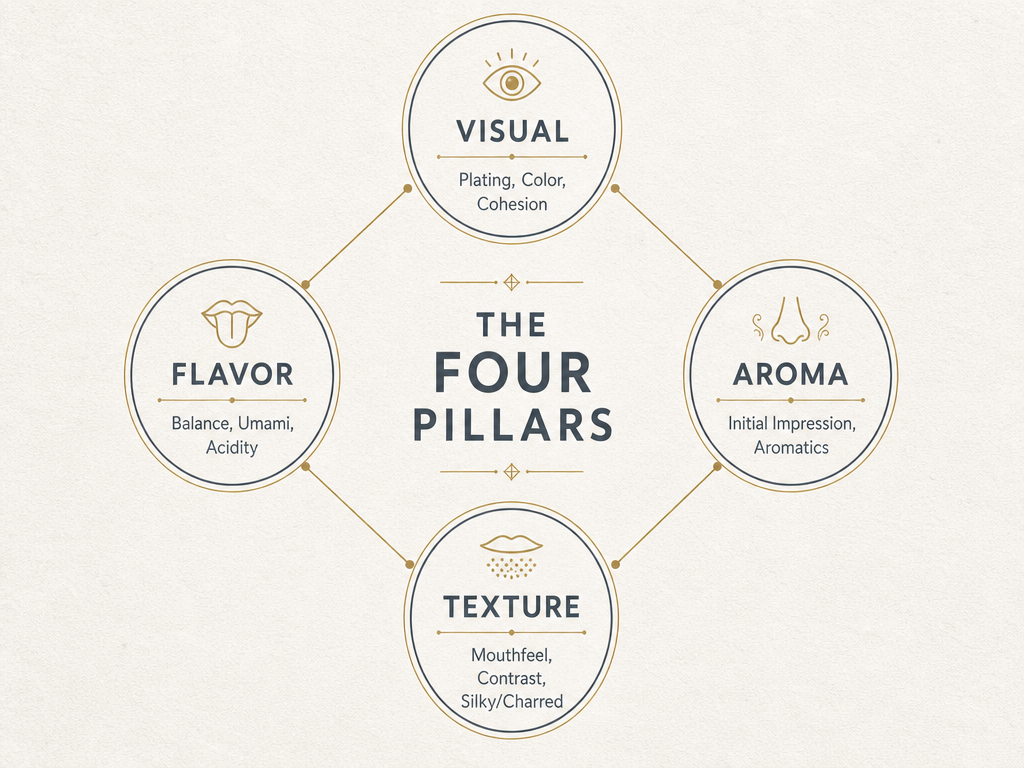
The Four-Point Evaluation Framework
Visual (Plating and Presentation). Before you taste anything, evaluate what's in front of you. Is the plating thoughtful or careless? Does the color palette suggest freshness or staleness? Are portions appropriate for the price and context? A composed dish should have visual balance - not just Instagram appeal, but actual compositional logic.
Aroma (First Impression). Your nose processes thousands of volatile compounds before your first bite. Take 10 seconds to actually smell the dish. Are the aromatics pronounced or subtle? Can you identify specific ingredients (garlic, herbs, char)? Does the smell promise what the menu described?
Texture (Mouthfeel and Contrast). This is where amateur reviews fall apart. Professionals evaluate textural contrast - the interplay between crispy and creamy, tender and crunchy, silky and coarse. A great dish almost always offers textural complexity. Note the dominant sensation (silky, chewy, brittle) and whether different elements play off each other.
Flavor (Balance and Finish). Break down the five basic tastes: sweet, salty, sour, bitter, and umami. Is any one overwhelming? Great dishes achieve balance or intentional imbalance (like the aggressive funk of aged cheese). Note the finish - does the flavor linger pleasantly or disappear? Does it evolve as you chew?
The 30-Second Capture Habit
The protocol means nothing if you don't use it consistently. Here's the workflow that actually works at the table:
Before eating: Snap the photo, but don't just move on. Add three keywords immediately - the dominant flavor, the standout texture, and one ingredient you want to remember (e.g., "Yuzu, Silky, Charred").
During the meal: If a dish is exceptional or terrible, take 30 seconds to open your note-taking tool and log a quick reaction. You're not writing a review - you're capturing the immediate sensory hit before it fades.
After the meal: Within 24 hours, expand your notes. This is when you add the restaurant name, specific details about preparation, and your numerical rating. Memory degrades fast - what feels vivid at the table becomes hazy by morning.
The goal isn't to turn every meal into homework. It's to build a reflex that captures the most memorable dishes before they dissolve into your camera roll's black hole.
Choosing Your Organization System
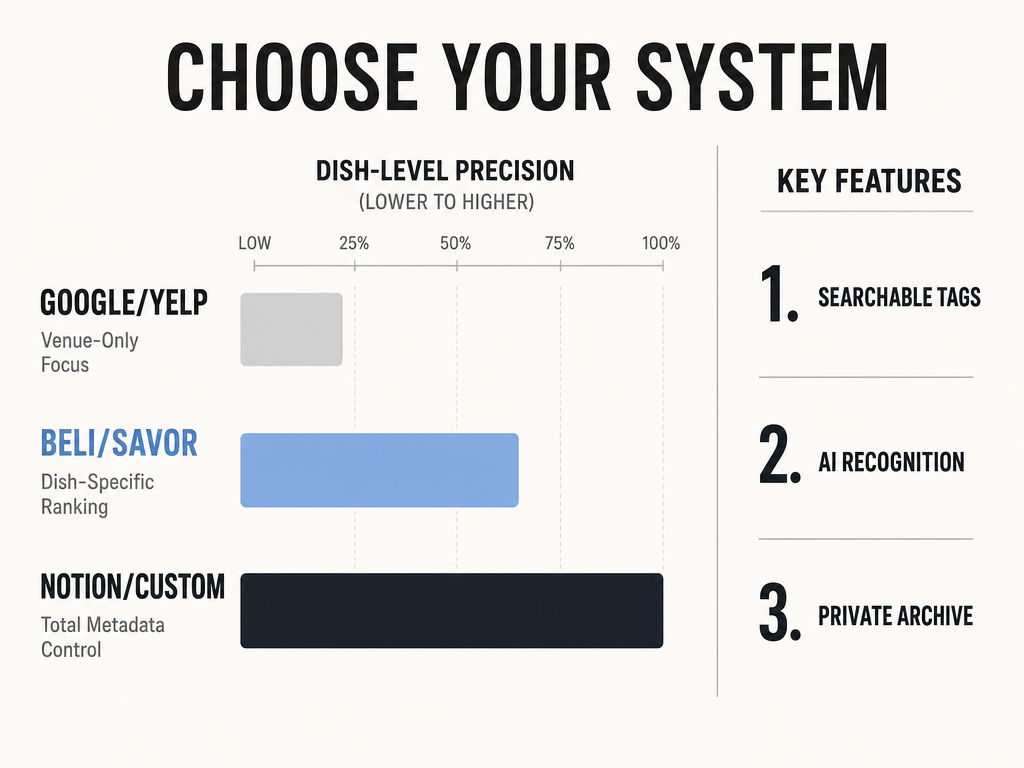
You've got three fundamental options: dedicated food apps, general productivity tools, or hybrid analog/digital systems. Each serves different needs, and the wrong choice will kill your momentum before you've logged 20 dishes.
Dedicated Food Apps
Best for: People who want a purpose-built tool with minimal setup.
Apps like Savor and Beli exist specifically for dish-level tracking. They typically offer photo-first interfaces, built-in rating systems, and automatic organization by restaurant or location. The advantage is speed - you're not building infrastructure, you're using theirs.
The tradeoff is flexibility. You're locked into their rating scale (usually 10-point or star-based), their organizational logic, and their future as a company. If they shut down or pivot, your archive goes with them unless they offer robust export options.
Key features to demand:
- Dish-level granularity (not just restaurant ratings)
- Photo storage without compression
- Searchable tags or labels
- Export functionality (CSV or similar)
- Private by default (not social-first)
General Productivity Tools
Best for: Power users who want complete control and don't mind setup time.
Notion, Obsidian, or Airtable let you design a custom database from scratch. You decide every field, every tag, every relationship. Want to link dishes to a separate "Restaurants" table with address, neighborhood, and price range? You can. Want to track seasonality, cooking technique, or whether you'd reorder? You control it all.
The cost is time. You'll spend hours building your system before you log your first dish. And if you're not naturally inclined toward database design, you'll either over-engineer it (dozens of fields you never fill out) or under-engineer it (realizing six months in that you can't search by cuisine type).
Notion-specific advantages:
- Relational databases (link dishes to restaurants, restaurants to cities)
- Custom views (gallery view for photos, table view for ratings)
- Formulas for calculated fields (average ratings, visit frequency)
- Templates for consistent entry
If you go this route, start simple: Restaurant name, Dish name, Rating (1-10), Date, Photo, Notes. Add complexity only when you've proven you'll actually use it.
Analog-Digital Hybrids
Best for: People who want tactile rituals or distrust pure digital systems.
Some serious foodies swear by physical notebooks for tasting notes, then digitize later. The act of writing by hand forces slower, more thoughtful observation. You can sketch plating, create flavor wheels, or paste in printed photos.
The obvious downside is searchability. Unless you're transcribing everything into a digital system later (doubling your work), you're left flipping through pages to find "that duck dish in Barcelona."
A middle path: use a pocket notebook at the table for quick captures, then transfer to digital within 24 hours. The physical note-taking helps with discretion (you're not scrolling on your phone during a tasting menu), and the transfer process forces you to review and expand your initial impressions.
The Complete Implementation Workflow
Theory is useless without execution. Here's the step-by-step system for going from "I should remember this" to a searchable archive you'll actually use.
Step 1: The Table (Immediate Capture)
Timing: 30-60 seconds per dish
When the plate arrives, your first instinct is to photograph it. Good. But don't stop there.
Take the photo - Natural light if possible, 45-degree angle, no flash. You're not trying to win photography awards; you need clear, recognizable documentation.
Log three keywords immediately - Open your chosen app or notebook and capture:
- One flavor descriptor (bright, rich, smoky, delicate)
- One texture word (crispy, silky, chewy, tender)
- One standout ingredient (uni, miso, truffle, yuzu)
Note one surprise - What didn't you expect? The subtle heat, the unusual pairing, the technique you hadn't seen before. This captures what makes the dish memorable beyond the menu description.
Example immediate capture: "Agnolotti / Sage butter / Silky, rich, nutty / Unexpectedly light despite butter weight"
That's it. You're done in 30 seconds. If you're at a tasting menu with 12 courses, this system won't disrupt the flow or annoy your dining companions.
Step 2: The Archive (Structured Entry)
Timing: Within 24 hours, 3-5 minutes per dish
Memory degrades fast. Within a day, your sensory impressions start to blur. This is when you open your system and create the full entry.
Required fields for every dish:
- Restaurant name and location
- Dish name (as written on menu)
- Price (if à la carte)
- Date
- Your numerical rating (use your chosen scale consistently)
- Photo
Optional but powerful fields:
- Cooking technique (grilled, sous vide, fermented)
- Primary protein/ingredient
- Cuisine type (Neo-bistro, Traditional Japanese, Modern Italian)
- Mood/occasion (Date night, Solo exploration, Business meal)
- Reorder likelihood (Yes/Maybe/No)
The optional fields become searchable gold six months later. You're trying to remember where you had great fermented anything - search "fermented." You want date-night-worthy restaurants - filter by occasion.
Step 3: The Search (Retrieval and Pattern Analysis)
Timing: Ongoing
This is where your system justifies itself. You're not building an archive for its own sake - you're building a tool that answers real questions:
- "What were my highest-rated pasta dishes?" (Filter: Rating 9+, Ingredient: Pasta)
- "Where should I take my parents in San Francisco?" (Filter: Location: SF, Occasion: Family)
- "Show me every dish with uni I've tried" (Search: Uni)
- "What restaurants have I visited multiple times?" (Group by: Restaurant, Sort by: Visit count)
If your system can't answer these questions quickly, it's not working. Every entry should make future searches more valuable.

Building Your Personal Taxonomy
The difference between a useful archive and a digital junk drawer is your tagging system. Professional food critics use consistent terminology - not because they're pretentious, but because precision enables comparison.
Core Tag Categories
Cuisine tags organize by tradition and style. Start broad (Italian, Japanese, Mexican), then add specificity as your archive grows (Neo-bistro, Kaiseki, Oaxacan). Avoid getting too granular too fast - "Contemporary American with French technique" is less useful than "Modern American."
Ingredient tags track proteins, produce, and signature components. This is where you capture recurring obsessions. If you realize you've logged 15 uni dishes, you've discovered something about your palate. Common ingredient tags: Pork, Duck, Mushroom, Citrus, Fermented, Aged.
Technique tags document preparation methods. This level of detail separates casual tracking from serious analysis. Tags like Wood-fired, Sous vide, Dry-aged, Fermented, Smoked, Raw help you understand not just what you like, but how you like it prepared.
Occasion tags provide context filtering. Solo-dining, Date-night, Business-meal, Family-friendly, Special-occasion. Six months later, you're planning an anniversary dinner - filter by occasion and rating to surface your most romantic wins.
Mood tags capture harder-to-quantify qualities. Comforting, Adventurous, Refined, Rustic, Playful, Minimalist. These become valuable when you're searching not for a specific cuisine but a feeling.
The Tag Evolution Problem
Here's what happens to most people: Week one, they create 50 tags. Week four, they've used 12 of them. Week twelve, they've forgotten which tags they even created.
The solution is staged taxonomy. Start with five tags per category (five cuisines, five ingredients, five techniques). Use them consistently for 30 entries. Only add new tags when you've logged three dishes that truly don't fit your existing categories.
This discipline prevents tag sprawl - the phenomenon where you have 80 tags but most dishes only use three of them. A smaller, well-used taxonomy is infinitely more valuable than a sprawling, inconsistent one.
Naming Consistency Rules
Be specific but searchable. "Pasta" is better than "Carbs" but worse than "Fresh Pasta" if you're trying to distinguish factory-made from handmade. Find the level of specificity that serves your actual search behavior.
Use the same term every time. Don't tag one dish "Grilled" and another "Char-grilled" - pick one convention and stick with it. Inconsistency destroys searchability.
Avoid redundancy. If you've already tagged cuisine as "Japanese," you don't need separate tags for "Sushi," "Sashimi," and "Maki" - those can be dish name components instead. Tags should add information, not repeat it.
Think in plurals. You're building a system for 500+ dishes, not 50. A tag that works for three entries might become useless at scale. Ask yourself: "Will I want to filter by this category when I have 200 dishes logged?"
Comparison: Top Tools for Dish-Level Organization
Each platform serves a different archetype of serious foodie. Choose based on your tolerance for setup time, your need for customization, and whether you value social features or private curation.
| Feature | Savor | Beli | Notion | Memolli |
|---|---|---|---|---|
| Primary Focus | Private dish-level tracking with AI-assisted photo tagging | Social ranking and friend-based recommendations | Fully customizable personal database | Visual map-based private diary |
| Setup Time | Minimal - start logging immediately | Minimal - social features guide structure | High - requires database design | Low - template-driven |
| Rating Scale | 10-point for nuance | Ranking (Best to Worst) | Custom (you decide) | Stars or custom |
| Searchability | Strong - tags and AI photo recognition | Moderate - relies on friend circles | Excellent - unlimited custom fields | Good - location and visual-based |
| Photo Handling | Unlimited high-res storage | Optimized for social sharing | Storage depends on plan | Unlimited |
| Export Options | CSV/JSON export available | Limited | Full database export | PDF/Image export |
| Privacy | Private by default | Public/friends focus | Completely private | Private by default |
| Best For | Serious foodies building a personal culinary database | Social diners who trust their circle more than algorithms | Power users who want total control | Visual thinkers who organize by place and aesthetics |
| Price | Freemium model | Free with premium features | Free personal plan, paid for teams | One-time purchase |
When to Choose Savor
You want to start immediately without setup overhead. You value a 10-point scale over binary "good/bad." You need AI assistance to search old photos by visual content (finding "that pasta with burrata" from two years ago). You want private tracking with optional sharing, not social-first design. Discover how Savor helps organize food photos.
When to Choose Beli
Your friend circle's taste matters more than critic reviews. You're comfortable with ranking (this was better than that) rather than absolute scores. You want discovery features - seeing what people in your network are eating. You're building a social reputation through your food taste.
When to Choose Notion
You're a database person who loves custom fields and relational structures. You want to link dishes to restaurants, restaurants to neighborhoods, neighborhoods to cities. You need advanced filtering to find highly rated dishes by specific criteria in particular locations. You're willing to invest several hours in setup for years of customized use. Learn how to build your restaurant library in Notion.
When to Choose Memolli
You think in maps and timelines. You want to see where you've eaten geographically, not just scroll a list. You value beautiful presentation as much as data utility. You're documenting travel eating more than local routine dining.
Expert Note-Taking Techniques
Professional critics have developed discreet methods for capturing notes without disrupting the dining experience or advertising their presence. You don't need to be undercover, but you also don't need to look like you're filing a lab report.
The Voice-to-Text Method
Your phone's voice memo app is the critic's secret weapon. Step away to the restroom, record 30 seconds of impressions: "Bone marrow agnolotti, sage butter, incredibly silky, maybe slightly undersalted, beautiful plating with fried sage leaf." Transcribe later when you're converting to structured notes.
Advantages: Fast, hands-free, captures your immediate reaction in your own voice. You can note details you'd forget by the time you're typing later - the specific way the pasta was cut, the ratio of filling to dough, the exact moment the butter sauce broke.
Disadvantages: Requires leaving the table. Not feasible during long tasting menus with rapid pacing. Background noise can make transcription difficult.
The Napkin Sketch Method
For dishes with complex plating or architectural elements, a quick sketch captures spatial relationships better than photos. You don't need artistic skill - rough circles and arrows work fine. Draw the plate composition, note ingredient placement, add labels for textures or techniques.
This method has an unexpected benefit: people assume you're being appreciative, not critical. It reads as enthusiasm rather than journalism. Some chefs have even approached diners who were sketching to explain their plating logic.
The Strategic Photo Session
Take multiple photos immediately when the dish arrives - different angles, close-ups of specific elements, wide shots showing context. Do it fast and be done. Nothing screams "amateur Yelper" like spending five minutes repositioning your plate and adjusting lighting while food gets cold.
Master food photography techniques that don't disrupt dining. The professional move: two photos in 10 seconds, then put the phone away. You can select the best shot later when you're building the archive entry.
The Companion Note-Taker
If you're dining with someone who understands your system, divide duties. One person orders dishes specifically for evaluation, the other handles the logistics of documentation. Between courses, compare impressions. Two perspectives on the same dish create richer notes than solo dining.
The key is finding a dining companion who shares your documentation philosophy. If they think you're being pretentious or obsessive, the dynamic becomes awkward. If they're equally invested, it becomes collaborative.
How do professional food critics take notes discreetly?
Professional critics rely on immediate memory capture rather than visible note-taking during meals. The standard workflow: mental bookmarking during the meal (noting 2-3 key details per dish), then full documentation immediately after leaving the restaurant - either in the car or at a nearby coffee shop while impressions are fresh.
The voice memo trick is universal. Critics step outside between courses or visit the restroom to record 30-second reactions. The notes are rough: "Octopus overcooked. Texturally disappointing - rubbery not tender. Paprika nice but can't save it. 5/10."
Some critics use code systems in pocket notebooks - shorthand symbols for texture, temperature, seasoning levels. A simple "++" might mean "exceptionally well-seasoned" while "-" indicates undersalted. These codes are meaningless to casual observers but trigger complete memories during later transcription.
The professional secret isn't about note-taking technique - it's about trained memory. After evaluating thousands of dishes, critics develop pattern recognition that lets them hold complex impressions until documentation is appropriate. They're not trying to remember everything; they're identifying the 3-4 details that distinguish this dish from similar versions.
What criteria should I use to rate a dish beyond good or bad?
The five-criteria framework captures what actually matters in professional evaluation:
Execution measures technical skill. Was the dish cooked properly? Is the pasta al dente? Is the protein seasoned through its center or just on the surface? Is the sauce emulsified or broken? This is objective craft, independent of your personal taste.
Balance evaluates harmony among elements. Do flavors complement or compete? Is there textural contrast (crispy with creamy, tender with crunchy)? Are portions appropriate for the dish's role (appetizer vs. entrée)? A dish can be technically perfect but fundamentally unbalanced.
Originality considers creativity within context. A classic bistro shouldn't be judged on innovation - faithful execution is the point. But a restaurant promising "modern American" needs to demonstrate some creative voice. Rate originality against the establishment's stated ambitions, not an absolute standard.
Value compares experience to cost. An affordable bowl of ramen and an expensive omakase both deserve high ratings if they deliver appropriate quality for their price point. You're not comparing them to each other - you're asking whether each dish justifies its specific cost.
Reorderability is the ultimate test: knowing what you know now, would you order this dish again? This captures everything the other criteria miss - the ineffable satisfaction factor. Some dishes check every technical box but leave you unmoved. Others have flaws you notice but don't care about.
Rate each criterion on your chosen scale (1-10 or 1-5), then calculate the overall score. This prevents the common trap of letting one exceptional element (amazing plating) overshadow significant problems (underseasoned, overcooked). Discover structured approaches to rating restaurant meals.
What are the best tags for searchable food photos?
Effective tags serve three retrieval patterns: ingredient-based searches, mood-based browsing, and technical filtering.
Ingredient tags should be specific enough to matter. "Mushroom" helps you find fungus-forward dishes, but "Wild Mushroom" or "Truffle" creates more useful subsets. The test: if you'd never search for that specific ingredient, don't tag it. You probably won't search for "onions" but you might search for "caramelized onions."
Cuisine tags need two levels. Broad classification (Italian, Japanese, Mexican) plus regional specificity (Sicilian, Kyoto-style, Oaxacan) when you know it. The broad tag ensures nothing gets lost; the specific tag enables deep dives into regional styles.
Technique tags capture how, not what. Wood-fired, Fermented, Dry-aged, Sous-vide, Smoked, Raw, Charred. These tags help you recognize patterns in preparation methods you consistently rate highly. You might discover you rate all wood-fired dishes substantially higher on average than conventional oven - that's valuable self-knowledge.
Occasion tags provide context filtering. Date-night, Business-meal, Solo-dining, Celebration, Casual-weeknight. These tags answer "what should I recommend for..." questions. When a friend asks for anniversary dinner suggestions, filter by "Date-night" and high ratings.
Mood tags are subjective but powerful. Comforting, Adventurous, Refined, Rustic, Rich, Light, Spicy. These capture qualities that don't fit other categories but matter for recommendations. Sometimes you want "comfort food" regardless of cuisine type.
The disciplined approach: start with 20 total tags (five per category). Use them for 50 dishes before adding more. Most people's archives need a manageable set of well-chosen tags, not hundreds of rarely-used ones. Learn advanced restaurant photo organization methods.
How do I build a food database in Notion versus using a dedicated app like Savor?
The fundamental tradeoff is time versus control.
Notion requires significant upfront investment. You're building infrastructure from scratch - creating databases, defining properties, setting up relations, designing views. Budget several hours minimum for a functional system, more if you want advanced features like formulas or linked databases.
The payoff is complete customization. You decide every field, every rating scale, every organizational logic. Want to track seasonality? Add a "Season" property. Want to link dishes to wineries for pairing notes? Create a "Wine" database and establish relations. You're constrained only by Notion's capabilities and your database design skills.
Dedicated apps like Savor eliminate setup but constrain structure. You're using their rating scale, their categories, their organizational philosophy. The advantage is immediate utility - you're logging dishes within minutes of downloading, not hours of configuration.
The hidden cost is exit strategy. If the app shuts down or pivots away from dish-level tracking, your archive's value depends entirely on their export functionality. Notion guarantees export - you can always extract your entire database. Dedicated apps vary wildly in this regard.
The hybrid approach works well: Use a dedicated app for daily capture (speed and convenience), then periodically export to Notion for advanced analysis and permanent archival. You get the best of both: fast logging in the moment, powerful analysis for pattern recognition.
If you're a database person who loves tinkering with systems, Notion rewards that investment. If you want to start capturing dishes immediately and worry about infrastructure later, dedicated apps are the pragmatic choice. Most serious foodies either commit fully to one approach or eventually migrate from dedicated apps to custom systems as their archives grow substantially.
How to build a personal food database
Building a functional personal food database requires answering four design questions before you write a single entry.
Question 1: What's your primary access pattern? Will you search by location ("show me everything I've eaten in Tokyo"), by ingredient ("find all my uni dishes"), by rating ("what are my highest-rated dishes"), or by date ("what did I eat last spring")? Your most common question determines your database structure. If you search by location constantly, make location a required field with controlled vocabulary (predefined city names, not free text). If you search by ingredient, you need robust tagging or a separate ingredients table.
Question 2: How much detail will you realistically capture? The enthusiast's trap: designing dozens of fields per entry, then abandoning the system after 10 entries because it's too much work. Start minimal: Restaurant, Dish, Rating, Date, Photo, Brief Notes. Track 50 dishes with just those fields. Then add complexity based on what questions you can't answer. Discovered you need cuisine type? Add it. Still don't care about serving temperature? Leave it out.