
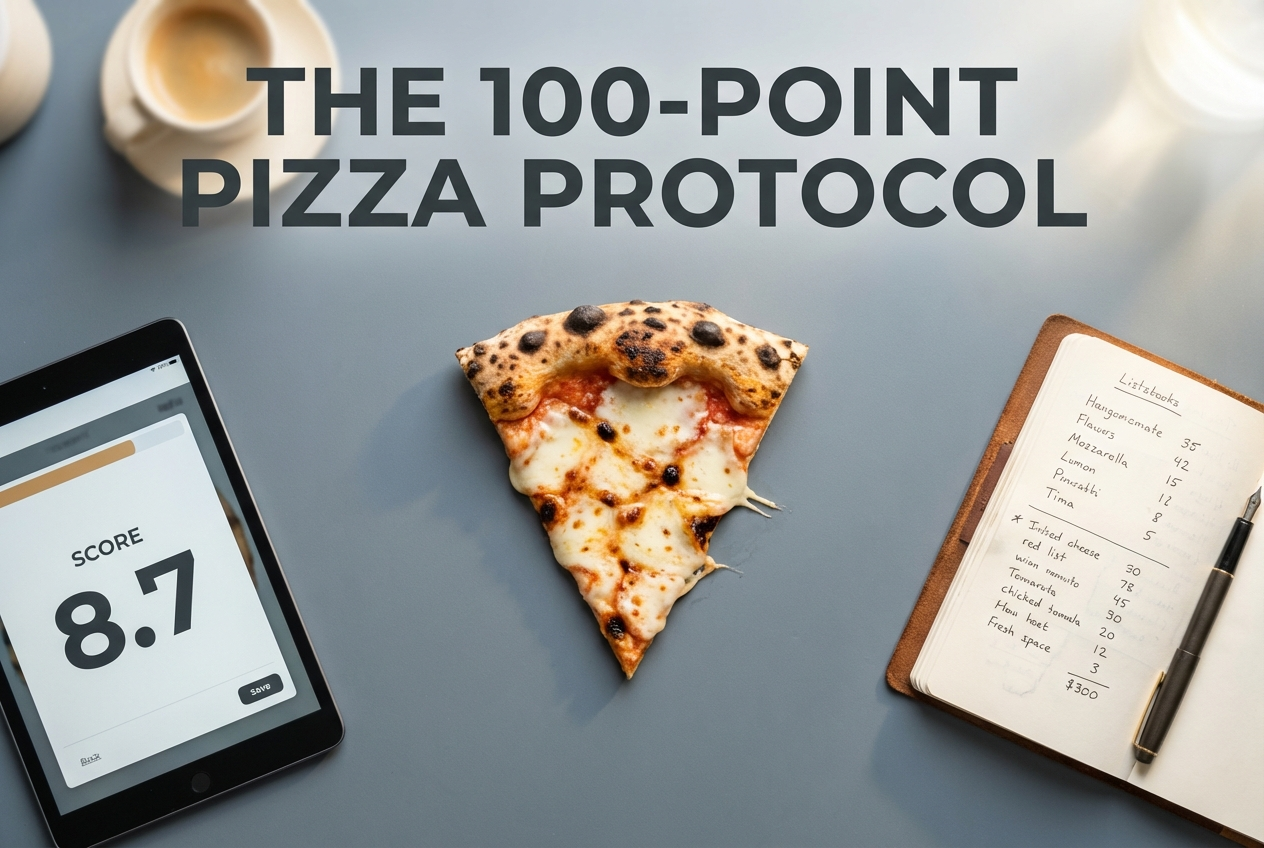
Professional 100 Point Pizza Scoring Protocol Guide
Harry the matcha king
Harry is our resident matcha obsessive. He’s tasted hundreds of bowls and tracks every cup in Savor.
The 100-Point Pizza Protocol: How to Score Your Slice Like a Professional Critic That slice from a random pizzeria in Brooklyn three years ago? You can still...
The 100-Point Pizza Protocol: How to Score Your Slice Like a Professional Critic
That slice from a random pizzeria in Brooklyn three years ago? You can still taste it. The char on the crust, the perfect cheese pull, the way the sauce had just enough acidity to cut through the fat. But can you remember the name? The cross street? Whether it scored higher than the margherita you had last month?
This is the pizza paradox. We remember the feeling, but we lose the data. And data is what separates someone who eats pizza from someone who actually knows pizza.
The fix isn't another folder in your camera roll or a vague "it was really good" text to a friend. It's a scoring system that treats your pizza experiences the way they deserve to be treated: with precision, structure, and the ability to pull up your top 10 slices across three cities in under 10 seconds.
Table of Contents
- Why the 5-Star Scale is Dead
- The 100-Point Pizza Protocol: Your New Framework
- The Big Four Scoring Pillars
- The Pre-Bite Ritual
- The Scoring Tiers: The Truth Table
- Technical Vocabulary That Makes You Sound Like You Know Pizza
- How to Archive Your Pizza Scores
- FAQ
Why the 5-Star Scale is Dead {#why-the-5-star-scale-is-dead}
Let's be honest about the star system. Five stars only gives you 20 increments if you're using quarter-stars. That means the difference between "solid neighborhood pizza" and "I would drive an hour for this" is a single quarter-star. That's not precision. That's guessing.
The problem with generic star ratings is they force you to choose between categories that are too broad. A three-star pizza could be "decent drunk food" or "almost great but the crust was undercooked." A four-star could be "best pizza in this specific neighborhood" or "good enough to recommend but not to rave about."
You're compressing a complex sensory experience into five buckets. That's not reviewing. That's just sorting.
The 10.0 decimal scale changes everything. An 8.4 is fundamentally different from an 8.7. That difference might be the quality of the mozzarella, the char on the undercarriage, or the fact that one pizzeria uses a wood-fired oven and the other uses gas. These details matter. They're the reason you remember certain slices years later.
If you can't objectively compare the margherita you had last night to the one from that tiny place in Rome, you're just eating, not experiencing. Real pizza knowledge requires a scoring system that captures nuance.
Using a dish rating app like Savor makes this process seamless—snap a photo, score to the first decimal, add your notes, and never lose track of a great slice again.
The 100-Point Pizza Protocol: Your New Framework {#the-100-point-pizza-protocol}
The 100-Point Pizza Protocol is simple: every pizza starts at zero and earns its way to 10.0 based on four weighted categories. This isn't arbitrary. It's adapted from professional judging rubrics used at pizza competitions, simplified for real-world use.
Here's the breakdown:
- 2.5 points max for the Foundation (Crust)
- 2.5 points max for the Undercarriage & Integrity
- 2.5 points max for the Sauce-to-Cheese Ratio
- 2.5 points max for the X Factor (Intangibles)
Each category is scored independently, then summed to produce your final score. This structure forces you to evaluate each component on its own merits, not just give a vibe-based rating because the lighting was good or you were really hungry.
The decimal scale gives you 100 possible scores between 0.0 and 10.0. That's 100 ways to differentiate between "good" and "exceptional." Compare that to the 20 increments of a five-star system. The precision matters when you're trying to remember whether the pizza at Luigi's was better than the one at Antonio's six months ago.
This system doesn't just help you rate pizza. It helps you build a personal database of taste memory. Over time, you'll develop your own internal calibration. You'll know that an 8.2 means "worth a detour on a road trip" and a 9.1 means "plan your vacation around this."
The Big Four Scoring Pillars {#the-big-four-scoring-pillars}
1. The Foundation (Crust): 2.5 Points Max
The crust is the chassis. Everything else is just payload. A great pizza can survive mediocre toppings, but bad dough kills the entire experience.
What to look for:
- Leopard spotting: Those small, irregular charred bubbles across the surface. They're a sign of high-heat fermentation and proper oven temperature. No leopard spots usually means low heat or under-fermented dough.
- The cornicione: That's the raised outer rim. It should be airy, with visible bubbles in cross-section. If it's dense and bready, the dough wasn't proofed correctly.
- Salt balance: The dough should taste like bread, not cardboard. Good dough has enough salt to enhance the flour without overwhelming it.
- Chew vs. crack: Neapolitan-style wants soft, foldable chew. New York-style wants structure that snaps when you bend it. Roman wants a thin, cracker-like crispness. Know the style, then judge accordingly.
A perfect crust scores 2.5. Anything less than 1.5 means the dough is either undercooked, over-proofed, or made from inferior flour.
2. The Undercarriage & Integrity: 2.5 Points Max
The undercarriage is where most casual eaters fail to look, and it's where most bad pizza reveals itself.
Flip the slice over. Look at the bottom. This is where you see:
- Char patterns: A good bottom has irregular charring from direct contact with the oven surface. If it's uniformly pale or uniformly burnt, the oven temperature is wrong.
- The fold test: Pick up the slice. Does the tip sag? Does it flop over completely? A slice with structural integrity should hold horizontal or have just a slight bend. Excessive "tip sag" means too much moisture, too thin a dough, or both.
- The Maillard reaction: That golden-brown color on the underside is the Maillard reaction—the chemical process that creates savory flavor. If you don't see it, the pizza is undercooked.
This category separates good pizza from great pizza. A soggy undercarriage is a 1.0 at best. A perfectly charred, structurally sound bottom earns the full 2.5.
For tips on how to capture these details visually, check out this guide on how to photograph food.
3. The Sauce-to-Cheese Ratio: 2.5 Points Max
This is where balance lives or dies. Too much cheese and you're eating a dairy bomb. Too much sauce and the crust turns into a soggy mess.
What to evaluate:
- Sauce sweetness: Is the sauce too sweet? Cheap tomato sauce is often loaded with sugar to mask acidity. Great pizza sauce tastes bright and slightly acidic, not like ketchup.
- Cheese moisture: Is the cheese "weeping"? If you see puddles of milky liquid, that's excess water from low-quality or improperly drained mozzarella. High-quality fior di latte or buffalo mozzarella should have a creamy texture without turning greasy.
- Coverage: Is every bite balanced? Some pizzerias pile cheese in the center and leave the edges bare. Consistency matters.
A perfect sauce-to-cheese ratio earns 2.5. Anything below 1.5 means the pizza is out of balance and one component is dominating the others.
4. The X Factor (Intangibles): 2.5 Points Max
This is the wildcard category. It's where you account for everything that doesn't fit neatly into the first three categories:
- Aroma: Does the pizza smell like charred dough and fresh basil, or does it smell like cardboard and grease?
- The first bite impact: Sometimes a pizza just hits different. Maybe it's the quality of the olive oil. Maybe it's the fresh basil added after baking. Maybe it's something you can't quite name.
- Grease management: A little grease is expected. But if the slice leaves a translucent oil slick on the plate, that's a problem.
- Temperature: Was the pizza served at the right temperature? Cold pizza is a different food entirely.
This category rewards pizzas that go beyond technical execution and deliver something memorable. A technically perfect but soulless pizza might score a 2.0 here. A pizza that makes you close your eyes after the first bite earns the full 2.5.
To understand how to articulate these intangibles, learning what is a flavor profile can help sharpen your palate vocabulary.
The Pre-Bite Ritual {#the-pre-bite-ritual}
Professional pizza judges don't just grab a slice and start chewing. They follow a process. So should you.
Step 1: The Photo Session
Take two photos before you touch the pizza:
- The top-down shot: Capture the entire pizza or slice. Show the char, the cheese distribution, the basil placement.
- The undercarriage shot: Flip the slice and photograph the bottom. This is where you see the leopard spotting and the crust structure.
If you're serious about tracking your pizza scores, you need visual evidence. Your memory will fade. The photo won't.
Using a food diary app like Savor makes this process effortless—you can attach both photos to a single entry and never lose the context.
Step 2: The Palate Cleanser
Professional pizza judge Scott Wiener swears by this: sparkling water (Pellegrino or similar) or a lemon rind between slices. It resets your palate and prevents flavor fatigue.
If you're doing a multi-pizza tasting session, this step is mandatory. Without it, everything after the third slice starts to taste the same.
Step 3: The "Tip and Lip" Method
Don't just bite the middle of the slice. That's amateur hour.
- Bite the tip first: This is where you taste the sauce-to-cheese ratio without the interference of the crust.
- Bite the "lip" (the cornicione) second: This is where you judge the dough in isolation. Is it airy? Is it salty enough? Is it charred?
By separating these two bites, you force yourself to evaluate each component on its own merits. This is how you move from "I liked it" to "The crust was a 2.3 but the sauce was only a 1.8."
For more structured approaches to mindful eating, explore how to eat mindfully.
The Scoring Tiers: The Truth Table {#the-scoring-tiers}
Now that you understand the framework, here's how to interpret your final score. These tiers are calibrated based on hundreds of pizza reviews from professional critics and competition judges.
9.0 – 10.0: The Pilgrimage Pizza
This is Holy Grail territory. You would fly across the country for this pizza. You would plan a vacation around it. These are the slices that change your understanding of what pizza can be.
Examples: Da Michele in Naples, Lucali in Brooklyn, Pizzeria Bianco in Phoenix.
A 10.0 is nearly impossible to achieve. It requires perfection in all four categories, plus an X Factor that transcends technical execution. Most people will only encounter a handful of 10.0 pizzas in their lifetime.
8.0 – 8.9: Exceptional
This is the "Best in City" contender. It's pizza you tell out-of-town friends about. It's pizza you return to monthly, not yearly.
An 8.5 might have a minor flaw—maybe the sauce was a touch too sweet, or the cheese was slightly over-salted—but the overall experience was still outstanding. These are the pizzas that end up on your personal "Top 10" list.
7.0 – 7.9: The Workhorse
This is reliable, high-quality pizza. It's not going to blow your mind, but it's never going to disappoint you either.
A 7.5 is the neighborhood spot you hit twice a month because the quality is consistent and the price is right. It's the pizza you recommend when someone asks "where should we order from tonight?" but not when they ask "where's the best pizza in the city?"
5.0 – 6.9: Average
This is "Football Pizza." It's fine for feeding a crowd at a party, but it's not something you'd seek out on your own.
A 6.0 is what you get at most chain restaurants or generic delivery places. It's technically pizza, but there's nothing memorable about it. You won't regret eating it, but you won't remember it either.
Below 5.0: Culinary Malpractice
This is pizza that actively offends. Undercooked dough, burnt crust, cheese that tastes like rubber, sauce that tastes like sugar water.
Anything below a 5.0 means someone failed at a fundamental level. These are the pizzas you warn your friends about, not recommend.
If you're tracking scores across multiple restaurants, a tool like Savor lets you compare your ratings side-by-side so you can see at a glance which spots consistently deliver 8.0+ experiences.
Technical Vocabulary That Makes You Sound Like You Know Pizza {#technical-vocabulary}
If you want to be taken seriously as a pizza critic, you need the vocabulary to justify your scores. Here's the essential lexicon:
- Cornicione: The raised outer edge of the pizza. The crust. If you call it "the crust," you're technically correct, but you sound like a tourist.
- Leopard spotting: The small charred bubbles on the surface of the pizza. Named because the pattern resembles a leopard's spots. This is a visual indicator of high-heat cooking and proper fermentation.
- The undercarriage: The bottom of the pizza. This is where you see the real char and the structural integrity of the dough.
- Fior di latte vs. buffalo: Two types of mozzarella. Fior di latte is made from cow's milk and has a mild, creamy flavor. Buffalo mozzarella is made from water buffalo milk and has a tangier, richer taste with higher moisture content.
- Tip sag / Flop: When the pointed end of the slice fails to stay horizontal. Excessive tip sag indicates too much moisture or insufficient dough structure.
- Maillard reaction: The chemical process that creates the golden-brown color and savory flavor on the underside of the crust. If you don't see it, the pizza is undercooked.
- The fold: The act of folding a New York-style slice in half lengthwise to create structural integrity and prevent tip sag. A good New York slice should hold its fold.
Using these terms in your reviews signals that you're serious about pizza. It's the difference between "the crust was good" and "the cornicione had excellent leopard spotting and the undercarriage showed clear evidence of the Maillard reaction."
For a deeper dive into articulating these experiences, understanding what is umami flavor can help you describe the savory depth that separates great pizza from average pizza.
How to Archive Your Pizza Scores {#how-to-archive-your-pizza-scores}
Scoring pizza is pointless if you can't retrieve your scores later. The goal isn't just to rate the slice in front of you. The goal is to build a searchable, sortable database of every pizza you've ever eaten so you can answer questions like:
- "What was the best margherita I had in Naples?"
- "Which New York pizzerias scored above 8.5?"
- "What was that place with the incredible undercarriage?"
Here's how to build a system that actually works:
Option 1: The Manual Archive (iOS/Android Smart Folders)
If you prefer to keep things simple and local, you can use your phone's native photo app with a strict naming convention.
The naming convention:
[Score]_[Name]_[Style]_[Date]
Example: 8.7_Luigis_Neapolitan_021526.jpg
This format makes your pizza photos instantly searchable. Open your Photos app, type "8.7" and every pizza you've ever scored at 8.7 appears. Type "Neapolitan" and every Neapolitan-style pizza appears.
The downside: This system only works if you're disciplined about naming photos immediately after taking them. Miss one, and your archive starts to fall apart.
Option 2: The Smart Archive (Dedicated Food Apps)
If you want something more robust, use a dedicated food tracking app. The right tool will let you:
- Store multiple photos per entry (top-down and undercarriage)
- Add a numerical score
- Tag by style (Neapolitan, New York, Detroit, Roman)
- Add tasting notes (sauce acidity, cheese quality, char level)
- Search and filter by score, style, or location
Savor is built specifically for this use case. It's not a restaurant review app—it's a dish-level tracking tool. You rate the pizza, not the pizzeria. That distinction matters when one spot makes a perfect margherita (9.2) but a mediocre pepperoni (6.8).
Other options include Beli and 8it, but they focus more on venue tracking than individual dish scoring. If you want decimal precision and the ability to compare specific dishes across cities, Savor is the better fit.
For a comprehensive breakdown of similar tools, see this comparison of the best food review app options.
The Smart Folder Strategy
If you're using Savor or a similar app, you can also create smart lists:
- "9.0+ Club": Only pizzas that scored 9.0 or higher
- "Neapolitan Masters": Every Neapolitan pizza above 8.5
- "Underrated Gems": Pizzas that scored 8.0+ from places you didn't expect
These lists become your personal pizza pilgrimage map. When you're visiting a new city, you open your "8.5+ Pizza" list, filter by location, and instantly see the slices worth seeking out.
This is what separates casual eaters from people who actually build expertise. The score is just data. The archive is the knowledge base.
FAQ {#faq}
What's the difference between rating the pizza and rating the restaurant?
The pizza. Always the pizza.
A restaurant can have a great margherita (9.2) and a mediocre pepperoni (6.5). If you only rate the restaurant, you lose that nuance. Rate the dish, not the venue. That's how you build a database that's actually useful six months later when you're trying to remember which place had the incredible undercarriage but the forgettable sauce.
How do I handle regional style differences when scoring?
Judge the pizza against the standards of its own style, then apply your personal preference.
A perfect Neapolitan pizza (soft, foldable, slightly charred) is fundamentally different from a perfect New York slice (crisp, foldable lengthwise, grease-wicking). Both can score a 9.0, but they're achieving excellence in different ways.
The key is understanding the style first. Don't penalize a Roman pizza for being cracker-thin if that's what Roman pizza is supposed to be.
Can I use this system for other foods?
Absolutely. The 100-Point Protocol works for any dish with multiple components.
You'd adjust the four pillars to match the dish. For ramen, it might be: Broth (2.5), Noodles (2.5), Toppings (2.5), X Factor (2.5). For tacos, it might be: Tortilla (2.5), Filling (2.5), Salsa (2.5), X Factor (2.5).
The principle remains the same: break the dish into weighted components, score each independently, then sum for your final rating.
For more ideas on applying this system to other cuisines, explore guides like what to eat in Tokyo or best street food Singapore.
How do I calibrate my scores when I'm just starting?
Start by scoring pizzas you already know well.
Go to your regular neighborhood spot and score their margherita. Then go to a place you know is objectively better and score that one. The goal is to establish your internal baseline.
Over time, you'll develop a sense of what an 8.0 tastes like versus an 8.5. The more pizzas you score, the more consistent your calibration becomes.
Is it pretentious to score pizza to the first decimal point?
Only if you think precision is pretentious.
Surgeons don't round their measurements. Engineers don't approximate their calculations. Critics don't guess.
If you care enough about pizza to read an article about how to score it, you care enough to score it accurately. Decimal precision is the difference between "really good" and "I would plan a trip around this."
How do I avoid letting external factors (hunger, mood, ambiance) skew my scores?
You can't eliminate bias completely, but you can minimize it.
The Pre-Bite Ritual helps. Taking photos, using a palate cleanser, and following the Tip and Lip method forces you to slow down and evaluate the pizza on its technical merits, not just your current mood.
Also, track context in your notes. If you were extremely hungry, note that. If the ambiance was incredible, note that. Over time, you'll learn to separate the food from the experience.
Should I tell the pizzeria my score?
Only if they ask, and only if you're willing to explain your methodology.
Most pizzerias don't want unsolicited numerical ratings from random customers. But if you're a regular and they ask for feedback, a decimal score backed by specific observations (e.g., "The cornicione was a 2.4 but the sauce was only a 1.9 because it was too sweet") is far more useful than "it was pretty good."
How do I remember to score every pizza?
Make it part of the meal.
The moment the pizza arrives, take your two photos (top-down and undercarriage). As soon as you finish eating, pull out your phone and enter the score. If you wait until you get home, you'll forget half the details.
Using an app like Savor makes this effortless—photo, score, notes, done. The entire process takes under 60 seconds.
What if I disagree with a friend's score?
Good. That means you're both actually thinking about the pizza.
Scoring isn't about consensus. It's about building your personal taste database. If your friend scores a pizza at 8.2 and you score it at 7.8, you've both learned something about your individual palates.
The conversation that follows—why did you score the sauce higher? Did you taste the sweetness I tasted?—is where the real learning happens.
The difference between eating pizza and knowing pizza is simple: data. The 100-Point Pizza Protocol gives you a framework to capture, compare, and recall every slice that matters. Not because scoring is fun (though it is), but because six months from now, when someone asks you where to find the best margherita in Naples, you won't have to guess. You'll pull up your 9.1-rated entry from February, show them the undercarriage photo, and send them to the exact address.
That's not obsessive. That's organized. There's a difference.