
How to Review Fast Food Like a Serious Food Critic
John the smoothie monster
John lives for smoothie bowls and cold-pressed juices. He uses Savor to remember his best blends.
Beyond the Camera Roll: How to Review Fast Food Like a Serious Food Critic You’ve just polished off a genuinely transcendent chicken sandwich. The breading was...
Beyond the Camera Roll: How to Review Fast Food Like a Serious Food Critic
You’ve just polished off a genuinely transcendent chicken sandwich. The breading was perfectly crisp, the bun-to-patty ratio was flawless, and that pickle brine tang cut through the richness like a knife. You snap a photo, post it to your story, and by tomorrow morning, it’s buried under 47 other food pics with zero context. Three months later, you can’t remember where you ate it, what made it special, or whether it was actually better than the overhyped spot everyone raves about.
This is the problem with treating fast food like it doesn’t matter. We apply critical thinking to our fine dining experiences, tracking every detail of that $200 tasting menu, but somehow a $10 burger that brings us actual joy gets the same treatment as a receipt we’ll never look at again.
The truth is, your casual dining experiences deserve the same analytical rigor as your Michelin-starred adventures. Not because you need to justify eating a chicken nugget, but because these are the meals you eat most often, the flavors that actually shape your everyday life, and the experiences worth remembering when you’re craving something specific.
This guide will show you how to build a systematic review framework for fast food, choose the right tracking tools, and finally answer the question "where should we eat?" with actual data instead of scrolling through your camera roll for 20 minutes.
Table of Contents
- The Death of the Searchable Meal
- Introducing the Fast Food Review Framework
- The Tool Shootout
- How to Build Your Definitives
- Why Dish-Level Ratings Beat Restaurant Stars
- Building Your Want to Go List That Actually Gets Cleared
- Frequently Asked Questions
The Death of the Searchable Meal
BLUF: Generic restaurant reviews fail serious foodies because they don’t capture specific dishes, and your camera roll has become an unsearchable digital graveyard where great meals go to be forgotten.
I pulled out my phone the other day to find that incredible burger spot from six months ago. You know the one I mean, even though you’ve never eaten it. The burger with the house-made pickles and the pretzel bun that was somehow both soft and structurally sound enough to hold everything together without falling apart halfway through.
I scrolled through 900 food photos. I found it eventually, but only because I remembered I’d eaten it the same weekend I went to that concert. The photo itself told me nothing. No name, no location data I could actually use, no notes about what made it special. Just a slightly blurry shot of a burger that looked like every other burger in my camera roll.
This is what I call the Digital Graveyard problem, and if you take food seriously, you’re probably drowning in it right now.
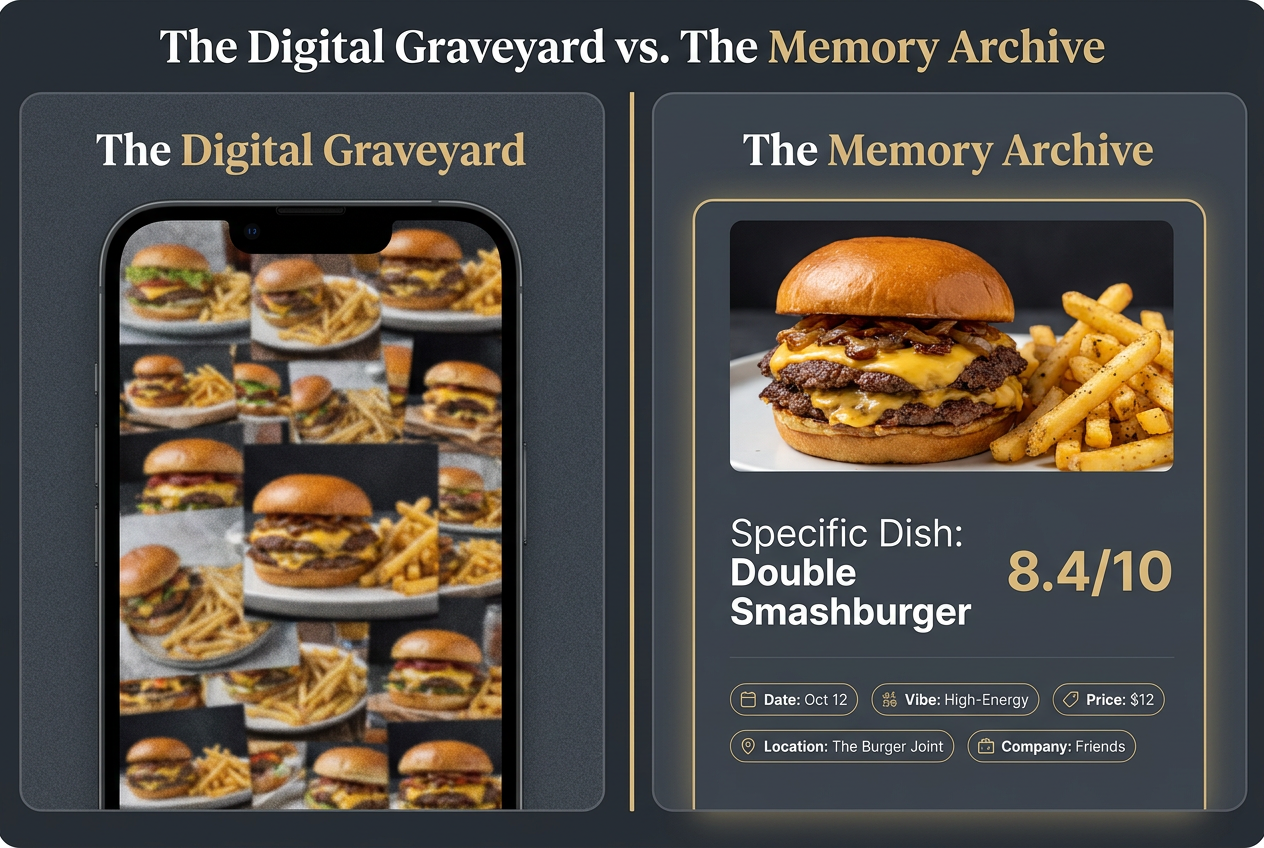
Stop letting your culinary experiences disappear into your camera roll. Transitioning to a structured archive allows you to recall specific dish details and rankings instantly.
The problem with platforms like Yelp isn’t that they’re useless - it’s that they’re optimized for the wrong thing. They’re built for discovering new restaurants, not for remembering what you actually liked about a specific meal. A 4.5-star average tells you nothing about whether the spicy chicken sandwich is better than the classic, or whether the fries are worth ordering, or if the quality has stayed consistent since that rating was posted eight months ago.
And here’s the thing that really gets me: We accept this for fast food and casual dining, but we’d never tolerate it for wine. Imagine if wine critics just said "this winery gets 4 stars" without telling you which vintage, which varietal, or what food to pair it with. That would be absurd. Yet that’s exactly how we treat the food we eat most often.
The serious foodie knows something the average diner doesn’t: A great meal is made of specific, repeatable elements. It’s not magic. It’s the quality of the beef, the ratio of sauce to protein, the temperature the dish is served at, and whether they can execute it consistently 1,000 times. These are things you can measure, compare, and track - if you have the right system.
Introducing the Fast Food Review Framework
BLUF: Professional food evaluation uses three core metrics - Consistency, Craveability, and Utility - scored on a 10-point scale to create objective, comparable ratings for any casual dining experience.
Let me tell you about the worst food review I ever wrote. I was sitting in a taco shop in San Diego, having just eaten what I thought was a perfect carne asada taco. I opened my notes app, typed "amazing tacos, definitely coming back," and called it done. Six months later, I couldn’t tell you what made it amazing, whether it was the marinade or the tortillas or the salsa, or if it was actually better than the place three blocks away.
That review was useless because it was just emotion with no structure.
The framework I use now comes from watching how professional critics evaluate everything from street food to haute cuisine. They’re not just reacting to flavor - they’re breaking down specific, measurable components that make a dish work. For fast food and casual dining, three metrics tell you everything you need to know.
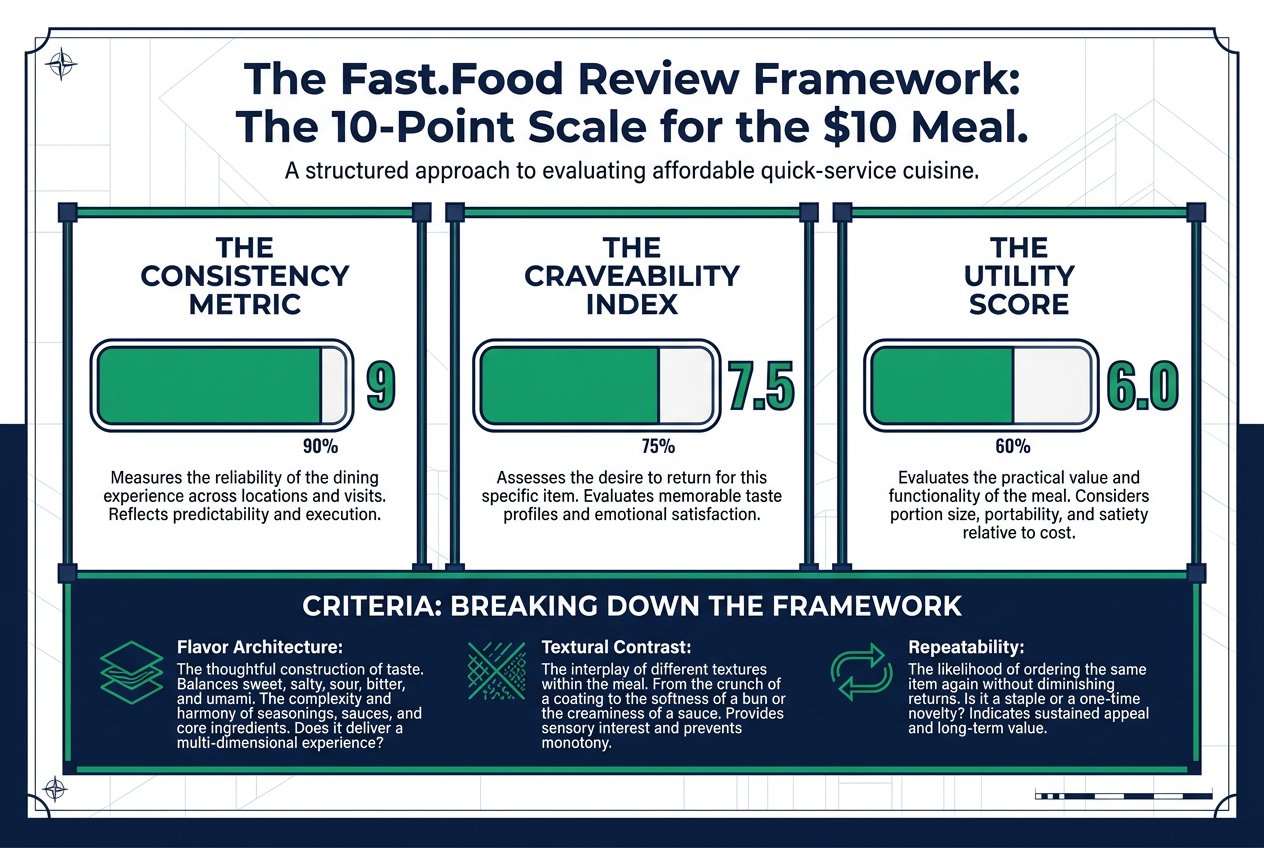
Professionalize your casual dining reviews using our standardized framework that evaluates the architecture, consistency, and biological craving response of every meal.
The Consistency Metric: Can They Do It 1,000 Times?
This is the single most important factor for fast food evaluation, and it’s the one most amateur reviewers ignore. A restaurant can nail a dish once by accident. Great fast food operations nail it every single time.
What you’re measuring:
- Structural integrity: Does the sandwich fall apart? Do the toppings slide off? Is the ratio of ingredients the same in every bite?
- Temperature consistency: Is it served at the right temperature every time, or do you get lucky on good days?
- Execution stability: If you order this dish three times in one week, will it taste the same each time?
Score this on a 10-point scale. A 10 means you could order this blindfolded at any location and get an identical experience. A 1 means every visit is a coin flip.
The best fast food operations treat consistency like a religion. In-N-Out gets high consistency scores not because their burgers are revolutionary, but because you can order a Double-Double in San Francisco or Los Angeles and get the exact same product. That’s harder than it sounds.
The Craveability Index: Does It Trigger a Biological Response?
This is where we separate "pretty good" from "I need this in my life right now." Craveability isn’t just about whether something tastes good in the moment - it’s about whether your body remembers it and actively seeks it out later.
What you’re measuring:
- Umami depth: Does it hit multiple flavor notes, or is it one-dimensional?
- Textural contrast: Are there multiple textures at play, or is everything the same mouthfeel?
- Flavor memory: Three days later, does thinking about this dish make you want to go back?
This is the metric where what is umami flavor really comes into play. A truly craveable dish hits multiple taste receptors simultaneously and creates a kind of flavor architecture that your brain files away as "significant."
A 10 on the craveability scale means you’ll drive out of your way to get it. A 1 means you’ll eat it if it’s in front of you but won’t seek it out.
The Utility Score: Speed vs. Quality
Fast food exists in a specific context: You need something good, and you need it now. The utility score measures how well a dish delivers on that promise.
What you’re measuring:
- Time to table: How long from order to first bite?
- Portability: Can you eat this in a car, at a desk, on the move?
- Value proposition: Is the quality-to-price ratio actually worth it?
This is where fast food can legitimately compete with fine dining on different terms. A perfect 10 on utility means you got something genuinely delicious in under 10 minutes for a reasonable price, and it didn’t require a fork and knife. That’s a specific kind of excellence that a $200 tasting menu can’t offer.
Putting It All Together
Once you’ve scored all three metrics, you’ve got a composite picture that’s way more useful than "4 stars." You can compare across different restaurants, different cuisines, and different price points using the same framework.
A chicken sandwich from Popeyes might score 8/10 on Consistency, 9/10 on Craveability, and 9/10 on Utility. That’s an 8.7 composite - genuinely elite fast food. Meanwhile, that hyped burger spot everyone’s talking about might score 6/10 on Consistency (great when it’s fresh, mediocre when it’s been sitting), 8/10 on Craveability, and 4/10 on Utility (you waited 45 minutes). Suddenly that 6.0 composite tells you it’s worth trying once but isn’t going into your regular rotation.
The point isn’t to turn eating into homework. The point is to have a language for why you liked something, so six months from now you can actually remember what made it special.
If you’re serious about tracking these details systematically, Savor offers a dedicated dish rating app built specifically for this kind of granular food evaluation.
The Tool Shootout
BLUF: Beli excels at social curation and status, Savor dominates private dish-level tracking, and Truffle automates through Instagram, but choosing depends on whether you prioritize community, detail, or convenience.
The ecosystem of food tracking apps has exploded in the last few years, and not all of them are built for the same person. If you’re reading this, you’re probably not looking for another calorie counter or generic review platform. You want something that respects the fact that you care about the specifics.
Let me break down the real differences between the major players, because the marketing copy won’t tell you this.
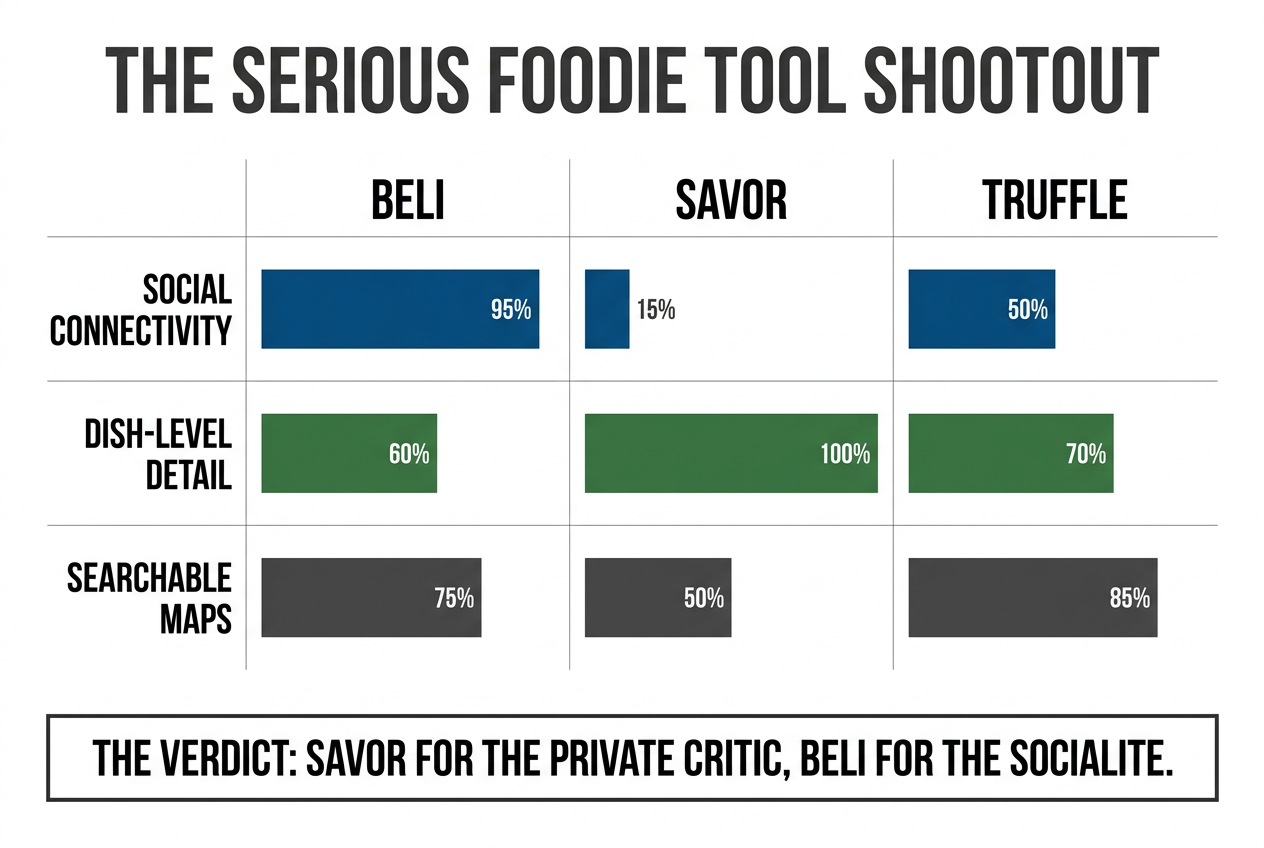
Choosing the right tool depends on your goals. Use this matrix to decide if you value social status, private data granularity, or automated Instagram logging.
Beli: The Letterboxd for Food (If You’re Here for the Social Game)
Core Value Proposition: Beli is built for people who want their food taste to be public record. It’s positioning itself as the social network for serious food people, and if that’s your vibe, it delivers.
What Works:
- The social ranking system is genuinely clever. You’re not just rating restaurants - you’re seeing how your taste aligns with people whose opinions you trust.
- The "Top 10" lists are clean, shareable, and designed to look good when you post them.
- The community aspect means you’re discovering places through trusted sources, not through ads or promoted content.
The Gaps:
- The waitlist barrier is real. If you’re not already in, you’re locked out of the network effect that makes the app valuable.
- Everything is public by default. If you’re someone who wants a private archive of your food experiences, this isn’t built for you.
- It’s restaurant-level ratings, not dish-level. That means you’re still losing the granularity that makes tracking actually useful.
Best For: The foodie who treats their taste as social currency and wants to build a public-facing culinary identity. Think of it as Instagram for people who actually care about what they’re eating.
Savor: Private, Dish-Level Obsession
Core Value Proposition: Savor is built around one core idea - every dish deserves its own entry. Not the restaurant, not the meal, the dish. It’s a private food memory vault designed for people who care about the details.
What Works:
- Dish-level ratings mean you’re not lumping the incredible pasta and the mediocre appetizer into one score. You can track exactly which menu items are worth ordering.
- It’s completely private. Your food diary is yours, not a performance for an algorithm.
- The tagging and search functionality is built for people who want to find that specific octopus dish they had eight months ago without scrolling through 1,000 photos.
- iOS-native design means it feels like an extension of your phone, not a web app forced into mobile.
The Gaps:
- iOS only, which locks out Android users entirely.
- No social feed. If you want to share your discoveries, you’re exporting and posting elsewhere.
- The private-first approach means you’re not discovering new places through the app itself.
Best For: The serious eater who treats their food history like a personal research project. If you’ve ever wished you had a searchable database of every meal you’ve ever loved, this is it. Learn more about how to keep a food journal that actually serves your memory.
Truffle: Instagram Automation for the Influencer
Core Value Proposition: Truffle plugs into your existing Instagram activity and auto-logs meals based on what you post and where you tag. It’s "Strava for dining," which is either genius or gimmicky depending on how you use social media.
What Works:
- Zero friction. If you’re already posting your food to Instagram, Truffle builds your log automatically.
- The social integration means you’re not maintaining two separate feeds.
- Great for people who want to track their food life without thinking about it.
The Gaps:
- You’re only tracking what you post publicly. If you don’t Instagram every meal, your log is incomplete.
- The reliance on Instagram means you’re locked into that platform’s algorithm and policy changes.
- It’s less about serious critique and more about social documentation. The depth isn’t there for someone who wants detailed tasting notes.
Best For: Content creators and influencers who are already documenting their food life on Instagram and want a secondary layer of organization.
The Real Question: What Are You Actually Trying to Do?
Most people pick a food tracking app based on the wrong criteria. They download the one with the prettiest UI or the biggest user base, then wonder why it doesn’t stick.
The right app depends on what you’re optimizing for:
- If you want social validation and community discovery, go with Beli.
- If you want a private, detailed archive of every dish you’ve ever cared about, go with Savor.
- If you’re an Instagram-first creator, go with Truffle.
None of these are wrong answers. They’re just different tools for different goals. The mistake is thinking one app can do everything.
For a deeper dive into comparing food review apps, check out comprehensive breakdowns of how each platform handles different use cases.
How to Build Your Definitives
BLUF: Building a ranked "Top 10" list requires forced comparisons (not arbitrary scores), consistent evaluation criteria, and the discipline to update rankings as you eat new dishes that challenge your current favorites.
Here’s the thing nobody tells you about building a definitive ranking: The first version will be wrong. Not wrong like you made a mistake, but wrong like it’s incomplete. A great ranked list isn’t something you create once - it’s something you refine over years as you eat more, learn more, and develop a more sophisticated palate.
But you have to start somewhere, and that somewhere is with a systematic process for comparison.

Move beyond basic ratings with forced rankings. Compare every new meal against your current favorites to build a mathematically sound Top 10 list.
Step 1: Define Your Category Ruthlessly
A "Top 10 Burgers" list is useless if you’re comparing a smash burger to a steakhouse burger to a gourmet creation with foie gras and truffle aioli. Those are three different categories pretending to be the same thing.
Start by defining exactly what you’re ranking:
- Fast food burgers (sub-$10, under 10 minutes)
- Casual sit-down burgers ($10-20, full-service restaurants)
- Premium burgers ($20+, gourmet ingredients)
Within each category, you need consistent rules:
- Are toppings included in the evaluation, or just the core components?
- Do you judge based on optimal preparation, or average consistency?
- Are you ranking best single experience, or best reliable option?
These decisions matter because they determine whether you’re building a "special occasion" list or an "any Tuesday" list. Both are valid, but they’re not the same thing.
Step 2: Use Forced Comparisons, Not Arbitrary Scores
This is where most people’s rankings fall apart. They eat a great burger, give it an 8.5, and move on. Two months later they eat another one, give it an 8.5, and now they’ve got two items with the same score and no way to differentiate them.
The solution is forced ranking: Every new entry has to be compared directly against your current list.
Here’s how it works:
- Eat a new burger (or whatever you’re tracking).
- Pull up your current ranked list.
- Ask: "Is this better than #5 on my list?" If yes, move up. If no, move down.
- Keep comparing until you find its exact slot.
This forces you to make hard choices. You can’t just say "this is good" - you have to say "this is better than X but worse than Y." That specificity is what makes the ranking useful.
Step 3: Track the Metrics That Matter
A ranked list is only as good as the criteria you’re using. For burgers, I track:
- Patty quality (beef blend, grind, seasoning, cook)
- Bun architecture (structural integrity, flavor contribution, toasting)
- Toppings integration (do they enhance or distract?)
- Sauce strategy (complementary vs. overpowering)
- Consistency score (how reliable is this experience?)
Every item in my top 10 has detailed notes on each of these factors. That way, when I’m comparing a new burger, I’m not just relying on vibes - I’m looking at specific components and making data-driven decisions.
This is where a dedicated dish rating app becomes invaluable. You need somewhere to store these details that isn’t just a notes app or a spreadsheet.
Step 4: Build Supporting Lists for Context
Your "Top 10" is the headline, but it’s supported by secondary lists that provide context:
- "Want to Try": Places you’ve heard about but haven’t visited yet.
- "Solid Options": Good but not top-tier. These are your #11-20.
- "Overhyped": Popular spots that didn’t live up to the buzz.
- "Avoid": Self-explanatory.
These supporting lists serve a purpose. When someone asks "where should we get burgers?", you’re not just saying "go to my #1" - you’re considering their location, their budget, and whether they want your absolute best or just a reliable option near them.
Step 5: Review and Revise Quarterly
Your palate changes. Restaurants change. A spot that was #3 two years ago might have new ownership, or your tastes might have evolved to prefer something different.
Set a reminder to review your top 10 every three months. Don’t change rankings arbitrarily - only adjust if you have specific reasons based on new data (you revisited and it wasn’t as good, or you discovered something that legitimately belongs higher).
This practice keeps your list current and useful, rather than a snapshot of what you thought two years ago.
The Map Strategy: Never Ask "Where Should We Eat?" Again
Once you’ve built your ranked lists, you need a visual system to organize them. This is where mapping comes in.
The best food tracking apps let you pin locations with tags:
- "Top Tier": Your ranked #1-3 in each category
- "Reliable": Solid options you’d confidently recommend
- "Want to Try": The research list that keeps growing
- "Avoid": Lessons learned the hard way
When you’re standing on a street corner trying to decide where to eat, you pull up your map, see what’s nearby, and make an informed decision based on your own historical data. No scrolling through Yelp, no second-guessing, no decision fatigue.
That’s the point of building definitives. It’s not about being a snob or treating eating like a competition. It’s about respecting your own experience enough to remember what you actually liked, so you can find it again when you want it.
Why Dish-Level Ratings Beat Restaurant Stars
BLUF: Restaurant-wide ratings hide critical information by averaging excellent dishes with mediocre ones, while dish-level ratings let you know exactly what to order and what to skip, making every dining decision smarter.
Let’s talk about why the traditional 5-star restaurant rating system is fundamentally broken for anyone who actually cares about food.
You walk into a restaurant with a 4.5-star average on Yelp. You’re excited. The reviews are glowing. You order three dishes. One is legitimately great, one is fine, and one is actively bad. What happened?
What happened is that you just experienced the averaging problem, and it’s the reason restaurant-wide ratings don’t work for serious eaters.
The Averaging Problem
Here’s the math: A restaurant serves 30 items on their menu. Five of them are genuinely exceptional - the chef’s signature dishes, the things they’ve perfected over years. Another ten are solid - well-executed, nothing special. The remaining fifteen range from forgettable to actively disappointing.
But when you rate the restaurant, you’re averaging all of those together. Someone who happened to order the five great dishes gives it 5 stars. Someone who ordered three of the mediocre ones gives it 3 stars. The result is a 4.0 average that tells you absolutely nothing about which category your meal will fall into.
Dish-level ratings solve this immediately. Instead of one score for the whole restaurant, you get granular data:
- The carbonara: 9.5/10
- The margherita pizza: 8.0/10
- The tiramisu: 4.0/10 (skip this, it’s premade)
Now you actually know what to order. You’re not gambling on whether you’ll luck into the good dishes - you have a map.
Why This Matters More for Fast Food
This problem is even more pronounced in fast food and casual dining, where menu breadth is huge and quality varies wildly by item.
Take a typical fast food chain. They’ve got burgers, chicken sandwiches, salads, breakfast items, sides, and seasonal specials. Some of these are legitimately good. Many are mediocre. A few exist only to fill out the menu board.
If you’re rating "McDonald’s" as a restaurant, what are you even measuring? The breakfast is solid, the burgers are whatever, the salads are depressing, and the seasonal McRib is a cult item with its own dedicated fanbase. These are not comparable experiences - they shouldn’t share a rating.
But if you rate the McRib as a dish, you can have a meaningful conversation about whether it’s actually good or just nostalgia-driven hype. (For the record, it’s both.)
This is why platforms like Savor are built around dish-level ratings instead of restaurant-level ones. The unit of measurement isn’t the business - it’s the specific thing you put in your mouth.
The "Order This, Not That" Use Case
The practical value of dish-level ratings becomes obvious the moment you’re standing in line trying to decide what to order.
Scenario: You’re at a taco spot for the first time. You pull up your tracking app. You see:
- Carne asada taco: 8.5/10 (you’ve had this before, it’s reliable)
- Al pastor taco: 9.2/10 (multiple entries, consistently great)
- Fish taco: 6.0/10 (you tried it once, wasn’t worth it)
- Quesadilla: 7.5/10 (solid backup option)
You order two al pastor tacos and one carne asada. You skip the fish. You just used your own historical data to optimize your meal in real-time.
Compare that to walking in blind, ordering based on menu descriptions, and ending up with the mediocre fish taco because it sounded good on paper. That’s the difference between guessing and knowing.
Building Your Personal Flavor Database
Over time, dish-level tracking builds something more valuable than a list of restaurants: It builds a database of flavors and preparations you actually like.
You start noticing patterns:
- You consistently rate smash burgers higher than thick patty burgers.
- You prefer thin-crust pizza to deep dish by an average of 2 points.
- Anything with house-made pickles gets a boost in your ratings.
These insights let you make better decisions even at restaurants you’ve never visited. You see "smash burger with house pickles" on a new menu, and you know there’s a high probability you’ll like it based on your own historical preferences.
This is the kind of self-knowledge that generic restaurant reviews can’t give you. Yelp doesn’t know that you prefer a specific preparation style. But your personal dish-level database does.
If you want to understand more about how flavor profiles work, check out this guide on what is a flavor profile and how to identify them.
The Social Proof Trap
Here’s the uncomfortable truth: Most restaurant ratings are social proof, not culinary evaluation.
People rate restaurants high because they waited two hours to get in, or because everyone’s talking about it, or because they want to be seen as someone who knows about the hot new spot. The food quality is almost secondary.
Dish-level ratings force you to get specific. You can’t hide behind "the vibe was great" or "it’s popular so it must be good." You have to evaluate whether the actual food - the physical thing you ate - was worth eating again.
That specificity cuts through the noise. It’s harder to justify a high rating for a mediocre dish just because the restaurant is trendy. And it’s easier to acknowledge when a random strip mall spot is doing something legitimately great with their bánh mì, even if it’ll never show up on a "best of" list.
Building Your Want to Go List That Actually Gets Cleared
BLUF: A functional "Want to Go" list requires ruthless prioritization, geographic clustering, and regular accountability reviews to prevent it from becoming a graveyard of good intentions you’ll never act on.
I used to keep a running list of restaurants I wanted to try. At one point it had 87 entries. I’d been to exactly 4 of them. The rest just sat there, growing stale, becoming less relevant as restaurants closed or changed chefs or got replaced by newer, shinier options.
Sound familiar?
The problem with most "Want to Go" lists is that they’re designed for collecting, not for doing. They’re aspiration engines that make you feel productive without actually helping you eat better food.
Here’s how to build one that you’ll actually use.
Rule 1: Cap Your List at 20 Active Entries
The psychological research is clear: When you have too many options, you make worse decisions. A list of 87 restaurants is paralyzing. A list of 20 is actionable.
Set a hard cap. When you hit 20 entries, you can’t add a new spot unless you either visit one (clearing space) or delete one (admitting you’re never going).
This forces prioritization. Is that trendy ramen spot really more interesting than the Moroccan place you’ve been meaning to try for six months? Make a choice.
Rule 2: Add Context to Every Entry
A restaurant name by itself is useless. You need context to make it actionable.
Every entry should include:
- Specific dish to try: Not just "Italian place" - "the cacio e pepe everyone talks about"
- Source: Who recommended this? A friend whose taste you trust? A critic? Instagram hype?
- Priority level: High (clear soon), Medium (within 3 months), Low (eventually)
- Occasion fit: Casual weeknight? Special occasion? Group dinner?
This context makes your list filterable. When it’s Tuesday and you want something quick, you’re not scrolling through fine dining spots. You’re filtering for "Priority: High, Occasion: Casual weeknight" and seeing exactly what fits.
Rule 3: Geographic Clustering
One of the biggest barriers to clearing your list is logistics. That amazing spot is 30 minutes away in a neighborhood you never visit. Rationally, you know you should go. Practically, it never happens.
Solution: Organize by geography, and batch your visits.
If you’ve got three spots you want to try in the same neighborhood, schedule a dedicated food crawl. Hit all three in one trip. Order appetizers at the first place, mains at the second, dessert at the third. Turn it into an event instead of waiting for the perfect moment that never comes.
This is where mapping features become critical. Being able to see your "Want to Go" spots on a map, clustered by area, makes the logistics obvious. You’re not just maintaining a list - you’re planning routes.
Rule 4: The Quarterly Purge
Every three months, go through your list and ask one brutal question about every entry: "Am I actually going to go here?"
If the answer is no - if you’ve been saying you’ll try it for eight months and still haven’t - delete it. Not with guilt, not with regret. Just delete it.
Your list should reflect your actual priorities, not your aspirational fantasy of becoming the person who visits every restaurant that gets mentioned on Eater. Some spots are genuinely interesting to you. Others you added because you thought you should care. Let those ones go.
Rule 5: Accountability Through Tracking
The best way to ensure you’re actually clearing your list is to track your clear rate over time.
Set a goal: "Visit 2 Want to Go spots per month." Then track whether you hit it. If you’re not clearing at least one entry every two weeks, your list isn’t working as a tool - it’s just a digital pile of good intentions.
This is where a dedicated restaurant tracking app becomes useful. You need something that shows you not just what’s on your list, but how long items have been sitting there and whether you’re making progress.
The "Been There" Archive
Once you visit a spot on your list, don’t delete it - archive it. Move it to a "Been There" category with your rating and notes about what you ordered.
This serves two purposes:
- You can reference it later when someone asks for recommendations.
- You can track whether spots lived up to the hype or were overhyped disappointments.
Over time, your "Been There" archive becomes more valuable than your "Want to Go" list. It’s the proof that you’re not just collecting ideas - you’re actually experiencing them and building knowledge.
The Anti-Hype Filter
Here’s a pro tip: If a restaurant is generating massive hype right now, wait three months before adding it to your list.
The initial wave of buzz is rarely about the food. It’s about being first, being seen, being part of the conversation. That energy is fun, but it’s not a reliable signal of quality.
Wait for the hype to die down. If the restaurant is still getting mentioned after the initial frenzy passes, then add it. That’s a signal that it’s actually good, not just trendy.
This filter has saved me from wasting countless meals on spots that were fun to talk about but mediocre to eat at. The good ones stick around. The hype-driven ones fade.
Building a functional "Want to Go" list isn’t about having the biggest collection or being the first to try every new opening. It’s about having a manageable, actionable system that actually helps you eat better food instead of just making you feel bad about all the places you haven’t visited yet.
Twenty thoughtfully chosen entries that you’ll actually visit will teach you more about your taste than 100 random spots you saved because someone mentioned them once.
Frequently Asked Questions
What is the best app for tracking individual dishes instead of just restaurants?
Savor is purpose-built for dish-level tracking rather than restaurant-level reviews. Unlike Yelp or Google Reviews, which rate entire businesses, Savor lets you log specific dishes, rate them individually, and build a searchable database of exactly what you’ve eaten. This means you can remember that the carbonara at Restaurant X was incredible while the tiramisu was forgettable - information that gets lost in traditional restaurant rating systems. Other options like Beli focus more on social curation of restaurant lists, while Savor prioritizes private, granular food memory.
How do I rate fast food using the same standards as fine dining?
Apply the same analytical framework - Consistency, Craveability, and Utility - but adjust your expectations for context. A $6 burger isn’t competing with a $45 steak; it’s competing with other $6 burgers. Judge execution relative to price point and category. Ask: Is this the best possible version of what it’s trying to be? Does it deliver consistent quality? Would I actively seek this out again? The metrics remain the same; the scale adjusts to the category. A perfectly executed McDonald’s hash brown can score 9/10 within its category because it achieves near-perfection for what it is.
Why should I track meals I eat regularly instead of just special occasions?
Your everyday meals shape your palate and eating habits far more than occasional fine dining experiences. Tracking regular meals builds a database of reliable options, helps you identify patterns in what you actually enjoy (not what you think you should enjoy), and prevents the problem of forgetting where you had that perfect breakfast burrito three months ago. Plus, fast food and casual dining operate on consistency models - tracking them over time reveals whether quality holds or degrades, which is valuable information.
What’s the difference between a food diary app and a dish rating app?
Food diary apps typically focus on nutrition tracking, calorie counting, or health goals. They’re built around "what did I eat and how does it affect my body?" Dish rating apps are built around "what did I eat and did I love it?" The former is data for health optimization; the latter is data for pleasure optimization and memory preservation. If you want to remember every great meal you’ve had and build a personal flavor database, you need a dish rating app like Savor, not a nutrition tracker like MyFitnessPal.
How do I prevent my Want to Go list from becoming overwhelming?
Cap it at 20 active entries and enforce a rule: to add something new, you must either visit an existing entry or delete one you’re never going to try. Add context to every entry (specific dish, priority level, occasion fit) so you can filter meaningfully. Organize geographically and batch your visits by neighborhood. Do a quarterly review where you ruthlessly delete anything you’ve been "meaning to try" for six months but haven’t prioritized. Your list should be a tool for action, not a monument to good intentions.
Can I use the same review framework for home cooking and restaurant meals?
Absolutely. The Consistency, Craveability, and Utility metrics work just as well for your own cooking. Consistency becomes "can I replicate this recipe reliably?" - a critical question when you’re trying to dial in a new technique. Craveability tells you which of your home recipes are worth keeping in rotation versus which ones you made once and never craved again. Utility measures effort-to-reward ratio: Is this dish worth the three hours it takes to make, or should you reserve it for special occasions? Tracking your home cooking with the same rigor as restaurant meals turns you into a better cook faster.
How often should I revisit and update my top 10 rankings?
Review your rankings quarterly, but only make changes when you have data-driven reasons. Don’t adjust arbitrarily - change rankings when you revisit a spot and it’s declined in quality, when you discover something legitimately better, or when your palate has evolved in a measurable way. The goal isn’t to constantly churn your list; it’s to maintain accuracy. Some dishes might hold the #1 spot for years if they’re genuinely exceptional and consistent. Others might drop after a chef change or ownership transition. Let the food quality dictate the changes, not restlessness.
What should I do with food reviews from apps I no longer use?
Export them if possible, archive them in a centralized system, and use them as historical data rather than active guides. Old reviews from Yelp or Google can be valuable for seeing how your taste has evolved, but they’re often trapped in platforms that don’t let you search or compare meaningfully. If you’ve been reviewing food on Instagram, Yelp, or Google for years, consider downloading that data and importing it into a dedicated dish tracking system where it becomes searchable and useful rather than just sitting in an algorithmic feed you’ll never scroll back through.