
How to Build Dish-Specific Taste Memory: A Practical Guide for Foodies
Alex the juice queen
Alex hunts for the best juice bars and presses. She rates every sip and saves her favorites in Savor.
How to Build Dish-Specific Taste Memory: A Guide for Serious Foodies You've had extraordinary meals. That perfect tonkotsu ramen in Tokyo, the burrata that...
How to Build Dish-Specific Taste Memory: A Guide for Serious Foodies
You've had extraordinary meals. That perfect tonkotsu ramen in Tokyo, the burrata that changed your understanding of cheese, the precise acidity in a leche de tigre that made your taste buds sing. You took photos. You remember the moment. But can you actually recall the taste?
Most food lovers hit the same wall: we can visualize a dish months later, but we can't "re-taste" it. Our camera rolls hold thousands of food photos we'll never look at again, while the specific nuances that made a dish exceptional - the exact level of funkiness in that aged Comté, the herbal complexity in that mole verde - fade into a vague memory of "really good."
Building dish-specific taste memory isn't about having a better palate. It's about training your brain to catalog complex sensory experiences the way wine professionals remember thousands of vintages, or how sommeliers can recall the precise mineral character of a Chablis they tasted three years ago.
This guide will teach you the active tasting techniques and documentation frameworks that move you from passive eating to intentional culinary cataloging.
Table of Contents
- Why You Can't Remember What Food Tastes Like
- The Seven Variables Framework
- Strategy 1: Temporal Flavor Mapping
- Strategy 2: The Simplified SAT Grid
- The Anti-Journaling Method
- Table-Side Drills for Active Tasting
- Digital Tools and Documentation Systems
- Frequently Asked Questions
Why You Can't Remember What Food Tastes Like
Visual and auditory memories are significantly easier to recall "on demand" than taste and olfactory memories, according to research on sensory memory accessibility. Your brain prioritizes what kept our ancestors alive: remembering what a predator looks like matters more than recalling exactly how a berry tasted.
This creates what professional sensory analysts call the "stimulus bridge" problem. You can conjure the image of a dish instantly, but you need a trigger - a smell, a taste, even a word - to access the full sensory memory. Without that bridge, the taste fades.
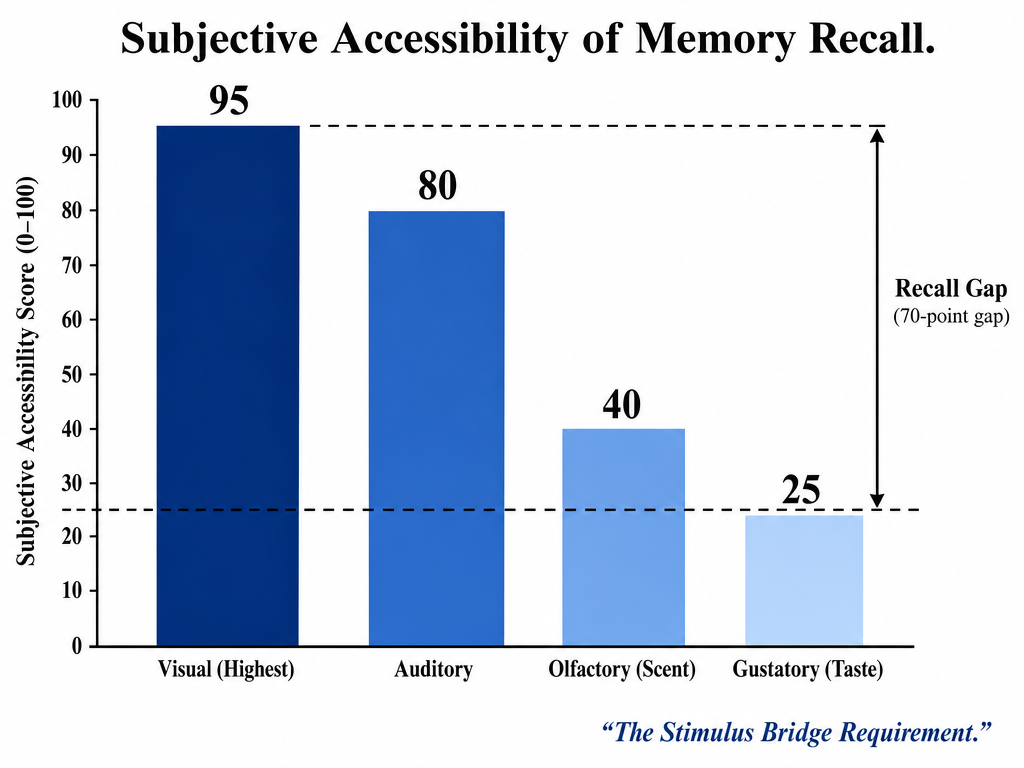 Research proves that taste and smell are significantly harder to recall on demand than visual data, necessitating the use of 'stimulus bridges' to anchor memories.
The good news: genetics account for only approximately 20% of our perception of taste; the remaining 80% can be influenced by training and environment, according to Bob Holmes in "Flavor: The Science of Our Most Neglected Sense." Your ability to build and recall taste memories is a trainable skill, not a genetic lottery.
But here's where most people get it wrong: they try to combat fading memories by writing longer descriptions. This often backfires.
Cornell hospitality researchers found that experts can be trained to improve recall by "Visualizing a Story" - drawing a shape to show how flavor changes from the "initial encounter" to the "finish." Verbose descriptions sometimes trigger what scientists call "verbal overshadowing," where putting words to a sensory experience actually distorts or erases the original memory.
The solution isn't more words. It's better architecture.
The Seven Variables Framework
Before you can remember a dish, you need to know what you're actually tasting. Professional sensory analysts break complex food experiences into seven distinct variables:
- Taste (sweet, salty, sour, bitter, umami)
- Aroma (both front-of-nose and retro-nasal)
- Temperature (serving temp and how it changes)
- Texture (mouthfeel, structure, consistency)
- Color (visual cues that set expectations)
- Shape (architecture, how components interact)
- Quantity (portion size, ingredient ratios)
The power of this framework is that it forces you to move beyond "delicious" or "amazing" and identify what specific variable made the dish memorable.
That tonkotsu ramen you can't forget? Maybe it wasn't the taste at all - it was the texture contrast between the silky broth and the springy noodles, or the way the temperature shifted as you added cold toppings to the hot bowl. The burrata? The shape matters: those creamy curds suspended in the outer shell create a specific mouthfeel that's impossible to replicate in pre-mixed spreads.
Humans have approximately 350 aroma receptors, but only about half are shared between any two individuals, making taste highly subjective, according to The Zag's palate training guide. This means your experience of a dish is fundamentally personal. You're not building a universal rating system; you're creating a map of your own palate.
When you're learning to keep a food journal for memories, not macros, this framework becomes your foundation.
Strategy 1: Temporal Flavor Mapping
Most people describe a dish as if it's a static experience. In reality, every composed dish tells a story over time.
Draw a simple horizontal line on your phone or in a notebook. Mark three points: Initial Encounter, Mid-Palate, and Finish.
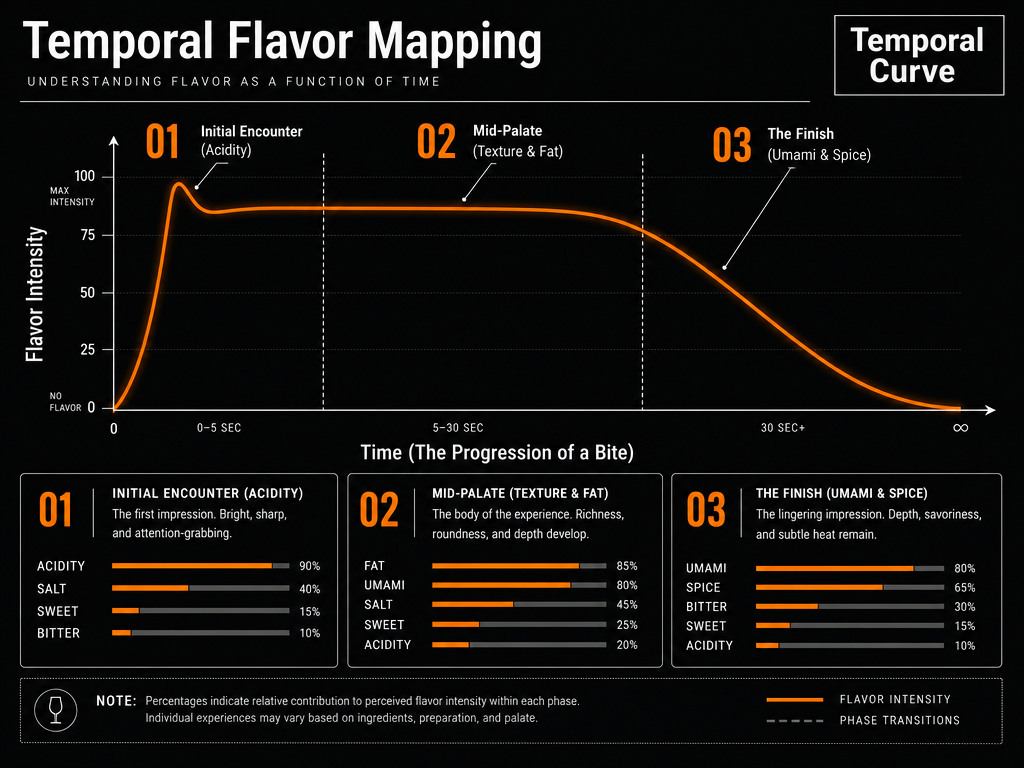 Temporal mapping helps you visualize how flavor evolves over time, allowing you to anchor specific sensations to the start, middle, and end of the tasting experience.
For that perfect ceviche:
- Initial Encounter: Sharp citrus acidity hits first, almost aggressive
- Mid-Palate: The acidity mellows, fish sweetness emerges, chili heat builds
- Finish: Lingering umami from the fish, residual heat, a whisper of cilantro
This isn't about writing a novel. It's about creating a visual "flavor curve" that your brain can actually store and retrieve later.
This technique comes directly from professional wine education. When you're trying to build a personal restaurant library of exceptional dishes, temporal mapping lets you capture the essence of a dish in a way that static descriptions can't.
The key insight: a dish that hits you with umami immediately, then fades into pleasant but unremarkable territory, creates a completely different memory than one that builds complexity over time. Mapping this progression lets you recall not just what you tasted, but how you experienced it.
Strategy 2: The Simplified SAT Grid
Wine professionals use the Systematic Approach to Tasting (SAT), a structured framework developed by the Wine & Spirit Education Trust. We can adapt it for composed dishes.
Create a simple grid with five categories:
1. Architecture (Appearance & Shape)
- How is the dish composed?
- What's the visual hierarchy?
- How do components interact spatially?
2. Aroma Intensity
- Front-of-nose (what you smell before tasting)
- Retro-nasal (what you smell while chewing)
- Dominant aroma families (fruity, earthy, nutty, marine, etc.)
3. Taste Balance
- Which of the five basic tastes dominate?
- Is there harmony or intentional imbalance?
- Acidity level (low, moderate, high)
4. Texture & Mouthfeel
- Primary texture (creamy, crispy, chewy, etc.)
- Contrasts within the dish
- How texture changes as you eat
5. Finish & Persistence
- What lingers after you swallow?
- How long does the flavor persist?
- Does the dish improve or deteriorate with each bite?
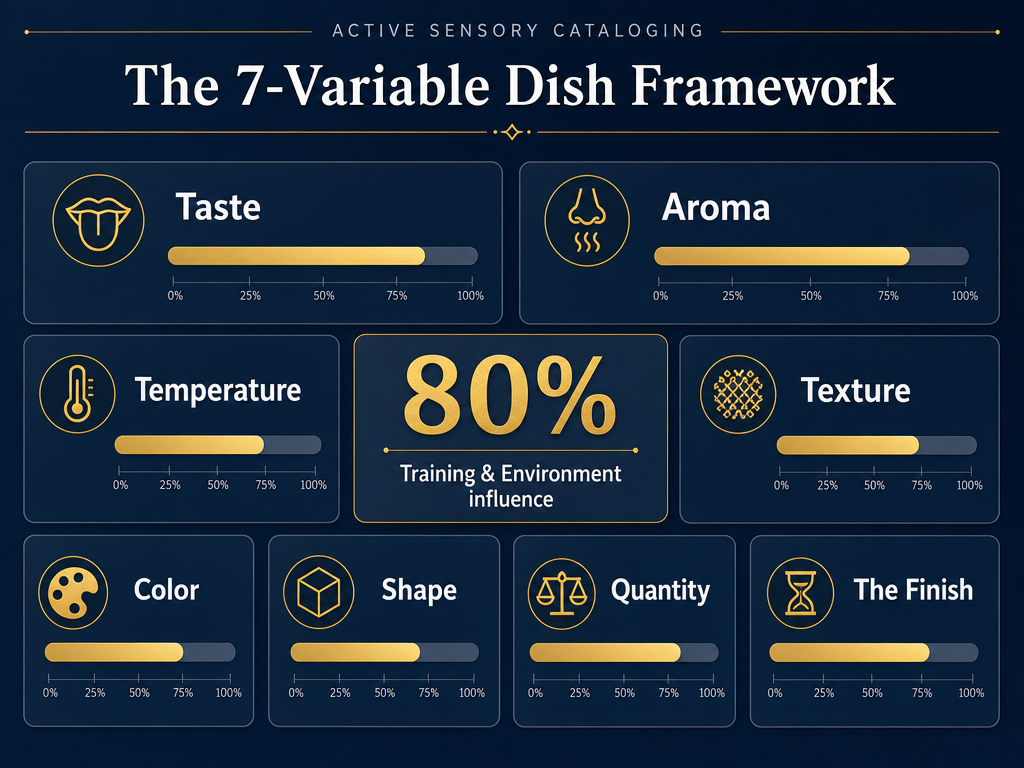 By categorizing a dish into seven distinct variables, you create a structured mental filing system that makes complex culinary experiences easier to recall months later.
This systematic approach does two critical things: it gives you a repeatable framework (so you're not starting from scratch with every meal), and it creates distinct mental "hooks" for recall.
When you're documenting meals in the best food diary apps, this grid structure makes your entries scannable and searchable. You're not scrolling through paragraphs trying to remember which restaurant served that dish with "incredible acidity" - you've tagged it explicitly.
The Anti-Journaling Method
Here's what doesn't work: opening your notes app and writing, "Amazing duck confit at Le Comptoir. The skin was super crispy and the meat was really tender and flavorful. The sauce was rich and went really well with the potatoes. Would definitely come back."
This description contains zero retrievable information. What made the skin crispy - technique, temperature, rendering? What kind of rich - butter-rich, liver-rich, wine-rich? Which potatoes - pommes purée, fondant, gratin?
The paradox: trying to capture everything often means you capture nothing.
The Anti-Journaling Method uses exactly three elements:
- Three-Word Anchor: Choose three specific, non-generic words that capture the dish's essence
- One Temporal Note: Where did the intensity peak - start, middle, or finish?
- One Visual Sketch: Draw a simple shape showing how components relate (even if you can't draw)
Example for that duck confit:
- Anchor: Glass-crisp, liver-forward, butter-glazed
- Temporal: Intensity front-loaded (crispy skin impact immediate, then steady richness)
- Sketch: Circle (confit) next to wavy line (potato purée) with dots above (sauce droplets)
This system works because it forces specificity without demanding prose. You can complete it in 90 seconds while still at the table, which means you'll actually do it.
When serious foodies are looking for the best apps to track favorite dishes, they need tools that support this kind of rapid, structured capture - not elaborate essay forms that require 10 minutes of typing.
The three-word anchor becomes your search term. Months later, when you're trying to remember that exceptional duck, you can search "glass-crisp" and instantly recall the exact dish, because almost nothing else earns that specific descriptor.
Table-Side Drills for Active Tasting
Building taste memory requires practice, but not the kind you do at home with flashcards. You need to train your palate in real-world dining situations.
The Basil Test
Order a dish with fresh herbs (basil, cilantro, mint). Before tasting, pinch your nose completely closed and take a bite. Chew thoroughly while holding your nose. What do you taste? Probably very little - maybe some bitterness, texture.
Now release your nose while the food is still in your mouth. The flavor should explode. What you're experiencing is the difference between taste (your tongue) and aroma (retro-nasal olfaction). This drill teaches you to separate the two, which massively improves your ability to identify what's actually happening in a dish.
Most people think they're "tasting" basil when they're actually smelling it. Understanding this distinction helps you build more accurate flavor memories.
The Deconstruction Challenge
When eating a composed dish - especially sauces or complex preparations - try to identify the hidden fat or acid source. Is that velvety texture from cream, butter, olive oil, or bone marrow? Is the brightness from lemon, vinegar, wine, or tomato?
This isn't about being right; it's about training your brain to ask specific questions instead of passively experiencing "delicious."
The Progression Protocol
Take your first bite. Note your immediate reaction. Wait. Take your third bite. Has anything changed? By the fifth bite, are you experiencing the dish differently - is richness building, is acidity cutting through, is heat intensifying?
This simple drill reinforces temporal awareness and fights "palate fatigue," where you stop actively tasting because your brain has categorized the dish and moved on.
If you're working on how to practice mindful eating, these drills are the practical application - they turn vague intentions about "being present" into concrete sensory exercises.
Digital Tools and Documentation Systems
Your documentation system needs three qualities: it must be fast enough that you'll use it in restaurants, structured enough to be searchable later, and visual enough to bypass the verbal overshadowing trap.
For iPhone Users: The Photos app's built-in search is remarkably powerful, but only if you use it correctly. When you take a food photo, immediately add a note with your three-word anchor and the restaurant name. The OCR in iOS will index this text, making it searchable.
If you're trying to organize food photos by restaurant, consider creating albums by cuisine type or flavor profile instead of chronologically. Your brain doesn't remember "That dish I had in March" - it remembers "That incredibly funky aged cheese."
For Structured Logging: Apps designed for dish-level tracking - not restaurant reviews - let you create repeatable templates. Look for tools that support:
- Custom tags (flavor profiles, techniques, ingredient combinations)
- Quick-capture voice notes (faster than typing while dining)
- Photo annotation (draw directly on images to mark key components)
- Export capability (your data should be portable)
Many serious foodies are moving toward personal food databases rather than public review platforms. The goal isn't to tell others what to order; it's to build a searchable reference library for your own palate development.
The Hybrid System: Use your phone's camera for immediate visual capture. Use voice notes for rapid three-word anchors and temporal observations. Transfer to a structured app or spreadsheet weekly, when you have time to add the systematic grid details.
This separation prevents the "I'll fill this out later" trap (you won't) while ensuring you don't lose the critical in-the-moment sensory data.
If you're exploring restaurant tracking apps, prioritize ones that make rapid capture frictionless over those with elaborate features you'll never use.
Frequently Asked Questions
How do I increase my taste palate?
Train your palate by systematically exposing yourself to a single category of flavors before expanding. Start with one domain - coffee, chocolate, cheese, wine - and taste multiple variations side-by-side to build your mental reference library. Professional tasters don't have "better" taste buds; they have more organized mental filing systems from repeated comparative tasting.
Can you develop your taste buds?
You can't physically create new taste receptors, but you can train your brain to notice and categorize flavors more precisely. Focus on building vocabulary and reference points. Taste the same ingredient prepared different ways (raw tomato vs. roasted vs. sundried) to understand how technique affects flavor. Keep a running log of new flavors you encounter, using specific descriptors instead of generic terms like "good" or "interesting."
What is the most powerful memory trigger?
Scent is the most powerful memory trigger because the olfactory bulb has direct connections to the hippocampus (memory) and amygdala (emotion). This is why a whiff of a specific spice can instantly transport you to a meal from years ago. To harness this, pay explicit attention to aroma before tasting - smell your food, identify the dominant scent families, and create that initial olfactory anchor before the taste experience begins.
What are the three types of sensory memory?
The three main types are iconic memory (visual), echoic memory (auditory), and haptic memory (touch/texture). For food, the critical fourth category is chemosensory memory (taste and smell combined), which is the most difficult to recall on demand. Understanding that taste memory is fundamentally different from visual memory explains why you can picture a dish perfectly but struggle to remember its exact flavor.
What is the best way to keep a food journal?
The best food journal prioritizes speed over completeness and structure over prose. Use the three-word anchor method: capture the dish in three specific, non-generic descriptors, note the temporal flavor curve (when did intensity peak?), and add a simple visual element (even a rough sketch). Complete your entry within 90 seconds while still at the table. Detailed notes can be added later, but the critical sensory data must be captured immediately, before your taste memory fades.
What are the 5 main senses used in a sensory analysis?
Professional sensory analysis uses sight (appearance, color), smell (front-of-nose aroma), taste (the five basic tastes on the tongue), touch (texture, temperature, mouthfeel), and sound (crunch, sizzle, sometimes the ambient noise of a dish). Food memory is fundamentally multi-sensory - the crackle of crispy skin or the visual glossiness of a sauce creates memory hooks just as powerful as the taste itself.
How do I develop my wine palate?
Start by tasting the same wine varietal from different regions to understand how terroir affects flavor. Use the comparative method: taste three Pinot Noirs side-by-side, noting differences in acidity, tannin, fruit character. Build a systematic vocabulary instead of relying on vague impressions. The professional wine tasting framework (look, smell, taste, conclude) works because it creates repeatable mental pathways - apply the same structure to food, and you'll see similar improvements in recall and discrimination.
Can you provide some examples of how to write a good food review?
A useful food review focuses on specific, reproducible elements rather than subjective enjoyment. Instead of "The pasta was amazing," write "The cacio e pepe had aggressive black pepper heat that built through the dish, with Pecorino sharpness balanced by precise pasta water emulsion - texture stayed creamy through the last bite." Good reviews answer the question: could someone else order this dish and know what to expect? Include concrete details about technique, ingredient quality, and how the dish changes from first to last bite.
Building dish-specific taste memory is not about memorizing food the way you memorize facts. It's about creating a structured, personal system for translating ephemeral sensory experiences into retrievable knowledge.
Start small. Choose one framework from this guide - temporal mapping or the simplified grid - and use it consistently for two weeks. You're not trying to document every meal; you're training the habit of active tasting instead of passive eating.
The goal isn't a perfect archive. It's developing the skill to actually remember the meals that matter, so that extraordinary bowl of ramen in Tokyo doesn't fade into "I think it was really good" six months later.