
How to Keep a Food Diary for Dining Out: The Personal Culinary Database Guide
Harry the matcha king
Harry is our resident matcha obsessive. He’s tasted hundreds of bowls and tracks every cup in Savor.
How to Keep a Food Diary for Dining Out: The Personal Culinary Database Guide Your camera roll holds 2,847 food photos. You remember taking them. You don't...
How to Keep a Food Diary for Dining Out: The Personal Culinary Database Guide
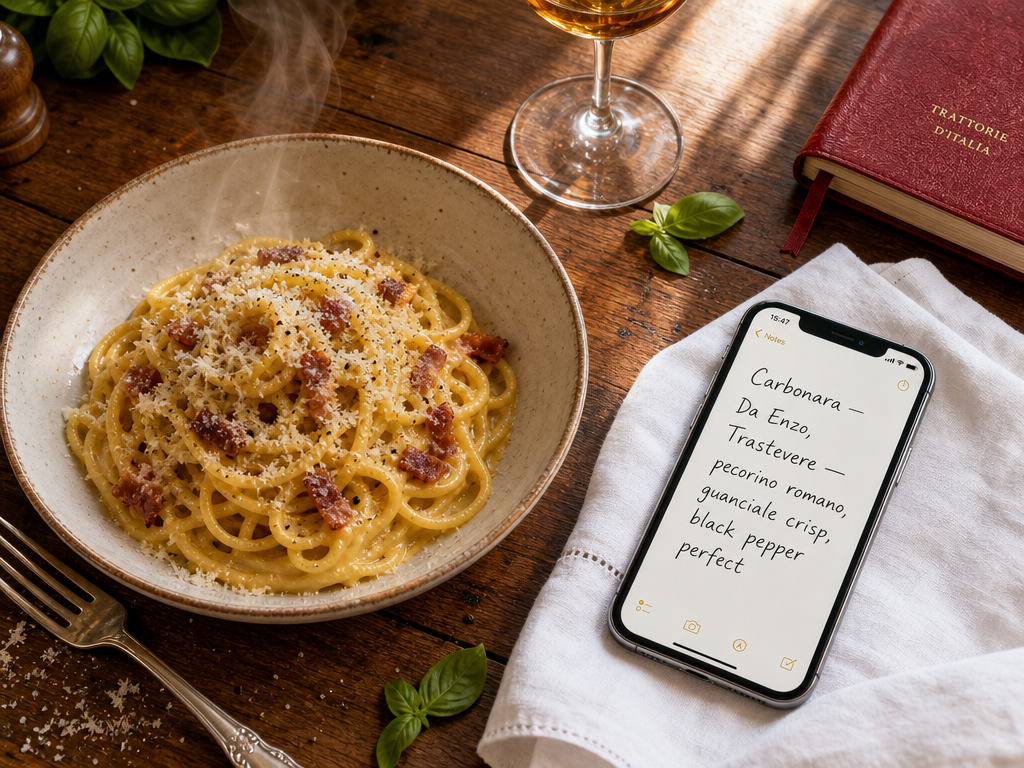
Your camera roll holds 2,847 food photos. You remember taking them. You don't remember which pasta was from Rome and which was from Brooklyn. You can't recall the name of that perfect wine pairing, or the side dish that elevated the entire meal. That life-changing carbonara? Lost somewhere between photos 1,247 and 1,249.
This isn't about counting calories. This is about culinary preservation - building a searchable, meaningful archive of every exceptional dish you've ever eaten.
Table of Contents
- Why Your Camera Roll Is Failing You
- The Restaurant vs. Dish-Level Distinction
- Select Your Archetype: Three Systems for Different Foodies
- The Serious Foodie Metadata Checklist
- Dining Etiquette Protocol: How to Log Without Being Rude
- The 50-Meal Cleanup: Organizing Your Existing Photos
- Building Your Personal Rating Framework
- The Privacy Advantage: Why Private Journals Work Better
- Frequently Asked Questions
Why Your Camera Roll Is Failing You
Over 90% of all photographs are now taken with smartphones, according to research published by the NIH. That same convenience creates a new problem: 54% of smartphone users find it overwhelming to search their camera roll for specific photos from the past, according to PhotoAid's 2025 mobile photography statistics.
Your camera roll wasn't designed to be a database. It has no categories, no search filters for "best duck confit" or "Tokyo ramen spots." It's a chronological dump where extraordinary meals vanish into the noise of airport selfies and parking garage screenshots.
A food diary for dining out transforms that chaos into a searchable archive where you can instantly recall:
- Which dishes you ordered at which restaurants
- Your personal ratings and tasting notes
- Key details like wine pairings, dining companions, and specific flavor profiles
- Geographic patterns (the best sushi in three different cities)
- Reorder-worthy dishes vs. one-time experiments
The goal isn't documentation for its own sake. It's building a personal reference library that makes every future dining decision smarter.
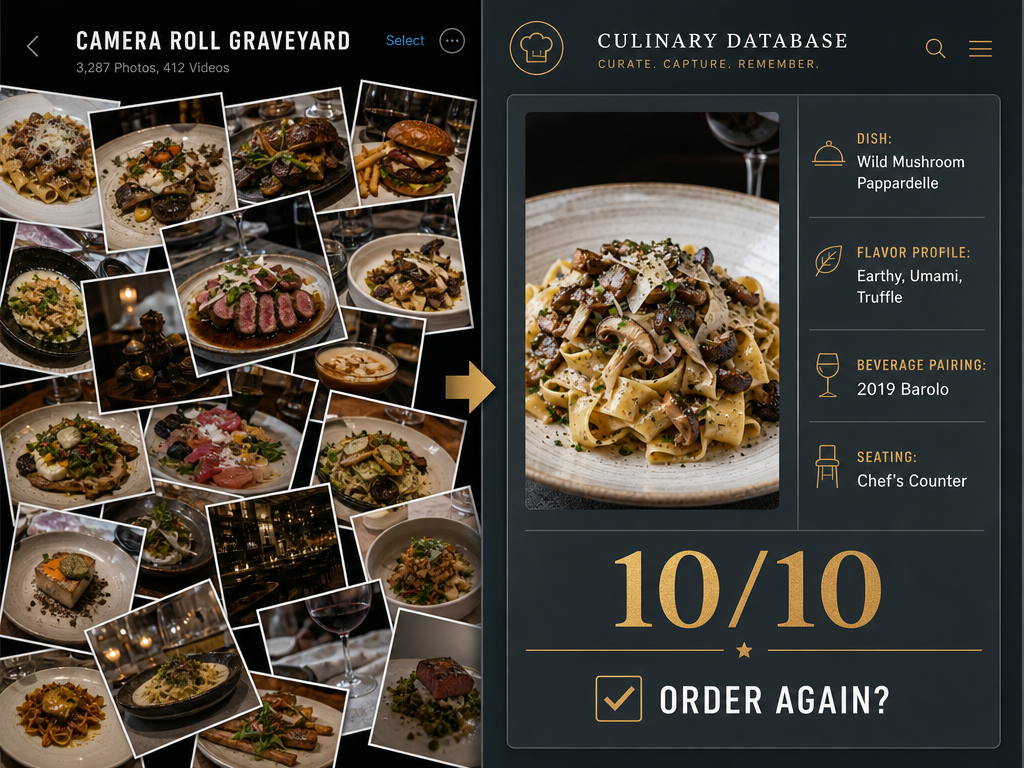
Transform your dining records from a 'Camera Roll Graveyard' into a searchable culinary database by capturing specific metadata beyond just a photo.
The Restaurant vs. Dish-Level Distinction
This is where most food tracking systems fail. Yelp, Google Maps, and traditional review platforms focus on restaurant-level ratings. You give a venue 4 stars, write a paragraph, and move on. But here's the problem: a 4-star restaurant can serve a 2-star steak and a 10-point dessert.
Restaurant-level tracking tells you where to go. Dish-level tracking tells you exactly what to order when you get there.
Consider this scenario: You visit a highly-rated Italian restaurant and order three dishes - an exceptional cacio e pepe, a mediocre saltimbocca, and a forgettable tiramisu. A restaurant review captures none of that nuance. Six months later, you return and accidentally order the saltimbocca again because you forgot which dish was the winner.
Dish-level tracking solves this. You're not archiving restaurants; you're archiving specific culinary experiences with the precision needed to recreate or avoid them in the future.
For serious foodies who dine out frequently - three to four times per week or more - the volume of meals quickly makes restaurant-level tracking inadequate. You need granular data.
Select Your Archetype: Three Systems for Different Foodies
Not every food diary system fits every lifestyle. Your choice depends on three factors: how much data you want, how much effort you're willing to invest, and whether you're tracking for yourself or sharing with others.
The Archivist (Savor, Memolli)
Best for: Private, detailed tasting notes with ingredient-level tagging and AI-assisted organization.
Effort level: Medium to high (intentional logging with structured metadata).
Core features:
- Dish-level ratings with searchable tags (cuisine type, key ingredients, flavor profiles)
- AI photo recognition to auto-populate dish names
- Private archives with natural language search ("show me all the duck dishes I've had in France")
- Export functionality for long-term data ownership
Ideal user: You dine out 150+ times per year, travel for food, and want a permanent, searchable record of every exceptional dish. You prioritize honest critiques over social performance.
The best dish tracking apps offer this level of detail, turning scattered memories into a structured culinary database.
The Socialite (Beli, Yummi)
Best for: Building status, competitive rankings, and sharing recommendations with friends.
Effort level: Medium (requires regular check-ins and social engagement).
Core features:
- ELO-style comparative rankings ("Is this burger better than the one I had last month?")
- Social discovery feeds showing what friends are eating
- Public lists and map-based sharing
- Gamification elements (badges, leaderboards)
Ideal user: You enjoy the social aspect of food culture. You want to see what your circle is eating, get credit for discovering new spots, and build public-facing lists. You're comfortable with your dining history being visible.
The best food spotting apps lean into this social-first model, emphasizing discovery and community over deep archival functionality.
The Minimalist (Notes App, Simple Spreadsheet)
Best for: High-speed logging with minimal friction.
Effort level: Low (one sentence per dish, no app dependencies).
Core features:
- Plain text notes organized by date or location
- "Single Best Item" method (record only the standout dish from each meal)
- Zero learning curve, works offline, never shuts down
Ideal user: You want to remember the highlights without fussing over tags, photos, or detailed ratings. You're willing to trade searchability for speed. You trust your future self to remember context from a short phrase like "Duck confit - Marseille, Oct 2025."
This approach won't give you a filterable database, but it prevents the most common failure mode: taking a photo and never writing anything down at all. As detailed in our guide to keeping a food journal, even minimal notes dramatically improve recall.
Identify your foodie archetype to determine which logging system balances your need for deep culinary data with the effort you are willing to invest.
The Serious Foodie Metadata Checklist
If you're building an archival system (not just snapping photos), you need a metadata framework. These are the fields that turn a photo into a searchable record:
| Field | Why It Matters | Example |
|---|---|---|
| Dish Name | The most basic identifier, but get the exact menu description | "Cacio e Pepe" not just "pasta" |
| Restaurant Name & Location | Essential for geographic sorting and revisiting | "Da Enzo, Trastevere, Rome" |
| Date | Tracks seasonality and helps you recall dining companions | "March 15, 2025" |
| Key Flavor/Ingredient | Enables searches like "show me all dishes with truffle" | "Black truffle, pecorino, cracked pepper" |
| Beverage Pairing | Wine, cocktail, or tea that elevated the dish | "2019 Barolo from Piedmont" |
| Order Again? | The single most important decision signal | ✓ Yes / - Maybe / ✗ No |
| Personal Rating | Your 1-10 or 100-point score (see section below) | 8.5/10 or 87/100 |
| Contextual Notes | Seating, service, occasion, who you were with | "Outdoor table, birthday dinner, perfect temperature" |
You don't need every field for every dish. But having this checklist ensures you capture the details that actually matter for future decisions.
The metadata also determines how useful your archive becomes over time. A photo with no notes is useless. A photo with "great pasta" is slightly better. A photo with "Cacio e Pepe, Da Enzo, Rome, March 2025, 9/10, reorder immediately" is a permanent reference.
Dining Etiquette Protocol: How to Log Without Being Rude
You're at the table. The food arrives. You want to capture the moment, but you don't want to be the person everyone rolls their eyes at. Here's the professional protocol:
1. Take the photo immediately (before anyone touches the plate).
Food looks best in its first 30 seconds. Don't wait. Don't apologize. One clean shot, natural light if possible, no flash. Put your phone down.
2. Choose your logging window strategically.
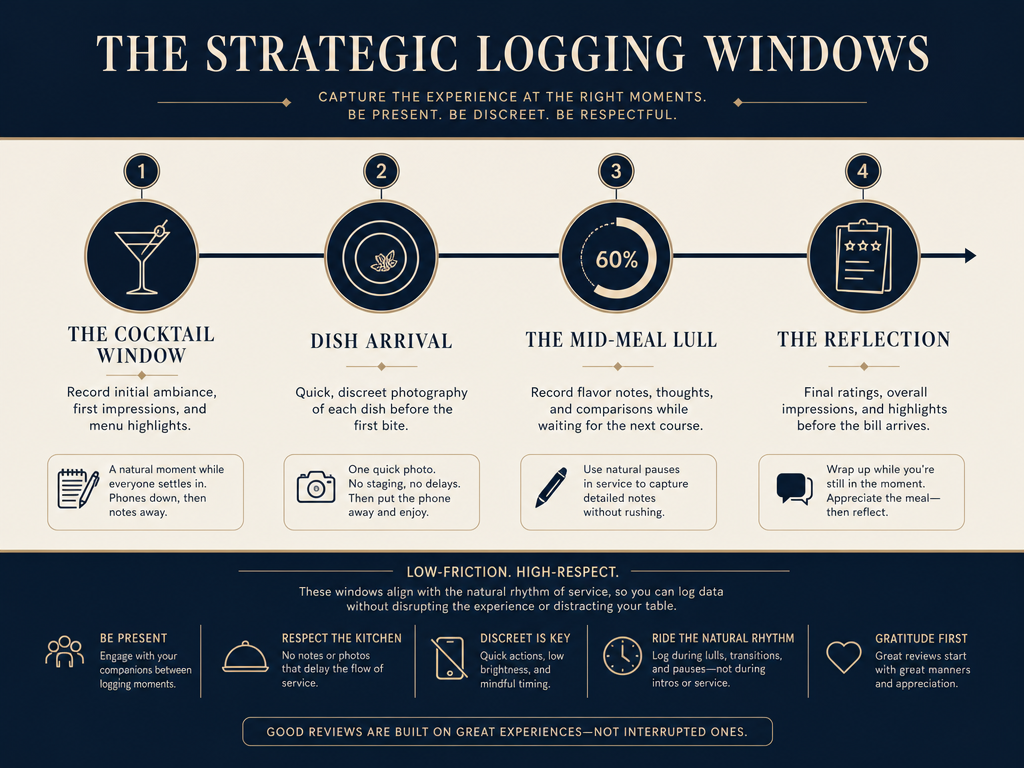
There are three natural breaks in a meal where you can write notes without disrupting conversation:
- The cocktail window: While drinks are being poured and menus are studied, before food arrives.
- The mid-meal lull: After initial reactions, before dessert. People are sipping wine, leaning back, digesting.
- The post-meal debrief: After the plates are cleared but before the check arrives.
Do not type on your phone while others are mid-story or mid-bite. Individuals check their phones an average of 58 times each day, according to smartphone usage statistics, but there's a difference between reflexive checking and intentional note-taking. Be intentional.
3. Use voice-to-text discreetly if dining solo.
If you're alone, activate voice-to-text, hold your phone low, and speak quietly. "Carbonara. Al Moro. Rome. Perfect ratio of egg to cheese. Guanciale crispy. Nine out of ten." Then review and clean up the transcription later.
4. Never photograph other diners or staff without permission.
Your food diary is not a documentary. Respect privacy. Focus on the plate, not the person across the table.
5. If dining with other serious foodies, make it a shared ritual.
Say, "I'm keeping notes on what we order. Want me to send you the list?" Most food lovers appreciate this. It legitimizes the practice and turns documentation into a group activity.
Master the etiquette of food journaling by utilizing natural breaks in service, such as the cocktail window or mid-meal lull, to record your critiques.
The 50-Meal Cleanup: Organizing Your Existing Photos
You've already got thousands of food photos. Don't bulk-import them into a new system. That's a recipe for clutter and decision paralysis. Instead, use the Selective Migration Strategy.
Step 1: Identify your "Core 50" meals.
Scroll through your camera roll and mark the 50 most memorable dining experiences from the past year. These are the meals you genuinely want to revisit or recommend to others. Ignore everything else for now.
Step 2: Log those 50 with full metadata.
For each of the 50, write down:
- Restaurant name and location
- Dish name
- Date (approximate is fine)
- Your rating and key tasting notes
This shouldn't take more than two hours. You're not archiving every mediocre sandwich; you're preserving the highlights.
Step 3: Create a "Review Later" folder for the next tier.
Maybe there are another 100 photos you're unsure about. Don't delete them. Move them into a dedicated album called "Food - Review Later." Set a reminder to revisit quarterly. Most will lose relevance over time, and that's fine. The ones that still stand out are worth logging retroactively.
Step 4: Let the rest go.
If a meal wasn't memorable enough to make your Core 50 or your Review Later folder, it doesn't belong in your archive. Accept that you won't remember every meal, and that's by design. Your food diary should be a curated highlight reel, not a comprehensive ledger.
This approach mirrors the strategy used by professionals in organizing food photos by restaurant, focusing on quality over volume.
Building Your Personal Rating Framework
A rating system gives your food diary structure and makes comparisons meaningful. But you need to choose a system that fits your decision-making style.
Absolute Rating (1-10 or 1-100 scale)
How it works: You evaluate each dish on its own merits against an internal standard.
Best for: Archivists who want to measure quality independently of other meals. A 9/10 carbonara in Rome and a 9/10 ramen in Tokyo are both exceptional within their categories.
Example framework:
- 10: Life-changing. You'd travel to eat this again.
- 9: Exceptional. Reorder immediately.
- 8: Very good. Solid choice, worth repeating.
- 7: Good. Enjoyable but not remarkable.
- 6: Fine. Wouldn't reorder.
- 5 and below: Actively disappointing.
Comparative Rating (ELO or head-to-head)
How it works: You rank dishes relative to each other. "Was this burger better than the one I had last month?" Over time, your best dishes rise to the top of the leaderboard.
Best for: Socialites and competitive personalities who enjoy building "best of" lists. Useful when you want a definitive answer to "What's the single best pizza I've ever had?"
Limitation: Comparing across categories can feel arbitrary. Is a perfect slice of Neapolitan pizza "better" than a perfect bowl of ramen? The question may not be meaningful.
Binary Rating (Order Again / Don't Order Again)
How it works: Forget scores. Track only one thing: would you order this dish a second time?
Best for: Minimalists who want fast logging and clear signals. This strips away the complexity of trying to distinguish between an 8.2 and an 8.4.
Example workflow: Take photo. Write dish name. Add checkmark (✓) or X (✗). Done in 15 seconds.
The system you choose should match your goals. If you're building a reference library for high-stakes dining decisions, use absolute ratings. If you want to settle debates about the best tacos in town, use comparative rankings. If you just need to remember what to reorder, go binary.
As explored in our guide to rating food effectively, the most important factor is consistency - use the same framework for every entry.
The Privacy Advantage: Why Private Journals Work Better
Public reviews - Yelp, Google, Instagram posts - suffer from a fundamental problem: they're performances. You're writing for an audience, not for yourself. That changes what you say and how you say it.
When your food diary is private, you can be ruthlessly honest:
- "The lobster roll was overpriced and underseasoned."
- "Service was slow and inattentive."
- "I only liked this because I was drunk."
That honesty makes your archive more useful. You're not curating a public persona; you're documenting ground truth for your own future reference.
Private journals also eliminate social pressure. You don't need to justify why you gave a Michelin-starred restaurant a mediocre score, or why you loved a strip-mall taco stand. The only opinion that matters is yours.
Research from the Georgia Restaurant Association found that 40% of diners visit a restaurant specifically after viewing online food photos, highlighting how much public posts influence decisions. But those same posts are often sanitized, aspirational, and disconnected from actual meal quality. Your private notes don't have that problem.
If you do want to share recommendations occasionally, you can do so selectively - pull a specific dish from your archive and send it to a friend. But the default mode is private, which keeps the data clean and the incentives aligned.
Frequently Asked Questions
What is the best way to keep a food journal?
The best method is dish-level tracking in a digital system that allows searchability by cuisine, location, and rating. Use consistent metadata (dish name, restaurant, date, personal score, reorder decision) for every entry. Avoid relying solely on photos without notes - your memory will fail you. If you want detailed archival functionality, use a dedicated app like Savor or Memolli. If you want minimal friction, use your phone's Notes app with a simple one-sentence-per-dish format.
Is there an app for keeping a food diary?
Yes, several apps specialize in food journaling. Savor focuses on dish-level tracking with AI-assisted metadata and private archival. Beli emphasizes social sharing and competitive ELO rankings. Yummi creates visual timelines and "Foodprints" maps. Memolli offers minimalist, map-based private logging. Traditional calorie-tracking apps like MyFitnessPal focus on nutrition data rather than culinary memory. Choose based on whether you prioritize privacy (Savor, Memolli) or social discovery (Beli, Yummi).
How do foodies share their experiences?
Serious foodies increasingly use a combination of private archival systems and selective public sharing. Private dish-tracking apps allow honest, detailed notes without performance pressure. When they do share publicly, it's often through curated lists ("My Top 10 Pasta Dishes in Rome") sent directly to friends or posted on Instagram. Some use collaborative features in apps like Beli to maintain shared recommendation lists with trusted dining companions. The trend is away from generic Yelp reviews and toward more intentional, personal communication.
What are some good etiquette rules for dining out?
Take food photos quickly when dishes arrive, before anyone starts eating. Use natural light and no flash. Don't type notes during active conversation - wait for the mid-meal lull or post-meal debrief. If dining solo, use voice-to-text discreetly. Never photograph other diners or staff without permission. If you're with other food lovers, frame note-taking as a shared ritual: "I'm keeping notes - want me to send you the list?" This legitimizes documentation and often turns it into a group activity rather than a distraction.
How can I take notes while dining out without being rude?
Use the three strategic logging windows: the cocktail window (while drinks are being poured), the mid-meal lull (after initial reactions, before dessert), and the post-meal debrief (after plates are cleared but before the check arrives). Keep notes brief - five to ten seconds per entry. Voice-to-text works well if you're alone and can speak quietly. If dining with others, wait until there's a natural pause in conversation. Never prioritize note-taking over engaging with your dining companions. The goal is to capture just enough detail to trigger your memory later, not to write a restaurant review at the table.
What specific details should I record beyond the dish name?
Capture restaurant name and location, date, your personal rating (1-10 or 100-point scale), key flavor notes or primary ingredient (e.g., "truffle, pecorino"), beverage pairing, and a binary "order again?" decision. Optional but useful: seating area (outdoor patio, bar seat), dining companion, price, and one-sentence contextual note (e.g., "perfect after a long walk"). Avoid overly long descriptions - your future self needs triggers, not essays. The metadata should answer: "Where was this?" "When was this?" "Would I eat this again?" and "What made it special?"
How do I organize my existing food photos retroactively?
Use the Selective Migration Strategy. First, scroll through your camera roll and identify your "Core 50" most memorable meals from the past year. Log those 50 with full metadata (restaurant, dish name, date, rating, notes). Second, create a "Review Later" folder for another 100 uncertain photos and revisit quarterly. Third, let the rest go - if a meal wasn't memorable enough to make the Core 50 or Review Later list, it doesn't belong in your archive. This approach prioritizes quality over volume and prevents decision paralysis from trying to organize thousands of mediocre images.
Is it a good idea to keep a food diary?
Yes, but only if your goal is culinary memory rather than calorie counting. A food diary helps you remember exceptional dishes, identify patterns in your preferences, make better ordering decisions on return visits, and build a reference library for travel planning. It's especially valuable for frequent diners (150+ meals out per year) who struggle to recall details from previous visits. The key is keeping it dish-focused, not restaurant-focused, and maintaining consistency with your logging format. If you only dine out occasionally, a diary may be unnecessary - your memory is probably sufficient.
Your camera roll is not a food diary. It's a photo dump. The difference is metadata, intentionality, and a system that survives longer than your phone's next software update. Whether you choose an app like Savor, a social platform like Beli, or a simple Notes app workflow, the goal is the same: stop losing your best meals to a digital graveyard. Start building a personal culinary database that actually serves you.