
The Death of the Camera Roll: Why Serious Foodies Are Building Private Food Databases
Harry the matcha king
Harry is our resident matcha obsessive. He’s tasted hundreds of bowls and tracks every cup in Savor.
The Death of the Camera Roll: Why Serious Foodies Are Building Private Food Databases Instead You're scrolling through 2,847 photos on your phone. Somewhere in...
The Death of the Camera Roll: Why Serious Foodies Are Building Private Food Databases Instead
You're scrolling through 2,847 photos on your phone. Somewhere in there is that perfect carbonara you had three months ago - the one with the egg yolk that broke just right, the guanciale so crisp it shattered. But you can't find it. You don't remember the restaurant's name. You can't recall the neighborhood. The memory is gone, buried under a hundred other forgotten meals.
This isn't forgetfulness. It's a structural problem. Most food lovers treat their camera roll like a filing cabinet, except there are no files, no folders, no index. Just a 2,000-photo graveyard of unlabeled plates. By the time you realize you've lost something great, it's too late. The meal is gone. The restaurant might be closed. The dish might be off-menu.
What you need isn't a better memory. It's a system. A private, searchable, permanent archive of every dish that mattered - not the venue, not the vibes, but the preparation. The serious foodie's answer to this problem isn't Yelp or Instagram. It's the Savor application, and a small cohort of dish-level tracking tools that treat food like a cultural study, not a photo op.
Key Takeaways
- Users spend an average of 3 minutes searching for a specific food photo in their camera roll, compared to 3 seconds in a structured app.
- Dish-level tracking captures the preparation rather than the place, solving the "life-changing carbonara at a 3-star venue" problem that generic ratings miss.
- Savor positions itself as a private, AI-powered food archive - not a social network - with automatic ingredient tagging and zero public performance pressure.
- The app uses a 10-point scoring system instead of 5 stars, giving foodies the granularity to distinguish between "very good" and "career-defining."
- As of 2026, the restaurant industry is projected to reach $1.55 trillion in sales, yet most diners have no reliable way to track which specific dishes earned their money.
Table of Contents
- The Camera Roll Graveyard Problem
- What Is Dish-Level Tracking and Why Does It Matter?
- How the Savor Application Solves the Archive Problem
- AI-Powered Memory: How Savor Tags Ingredients Automatically
- The Privacy Paradox: Private Journaling vs. Social Performance
- Diner Archetypes: Which Food Tracking App Fits Your Style?
- The 10-Point Scale: Why Five Stars Are Dead
- Can Savor Handle Home Cooking and Recipe R&D?
- Frequently Asked Questions
The Camera Roll Graveyard Problem
The average foodie takes 200+ photos of meals per year. Research from 2026 shows users spend an average of 3 minutes searching for a specific food photo in their camera roll, compared to 3 seconds in a structured app. That's not just inconvenience - it's a broken retrieval system.
The problem compounds over time. You eat at 150 restaurants a year. You photograph 80% of those meals. By year two, you have 600+ unlabeled food images, none of them searchable by dish name, ingredient, or location. Your phone's default photo app groups them by date, which is useless when you can't remember if the meal was in March or May.
Generic search terms don't help. Typing "pasta" into your photo library returns 40 results, none of them tagged with the restaurant, the specific preparation, or the reason you saved it. You know the dish was exceptional. You have zero way to prove it.
This is where the camera roll becomes a graveyard. Great meals die in there - not because you didn't care, but because you had no system to preserve the context.
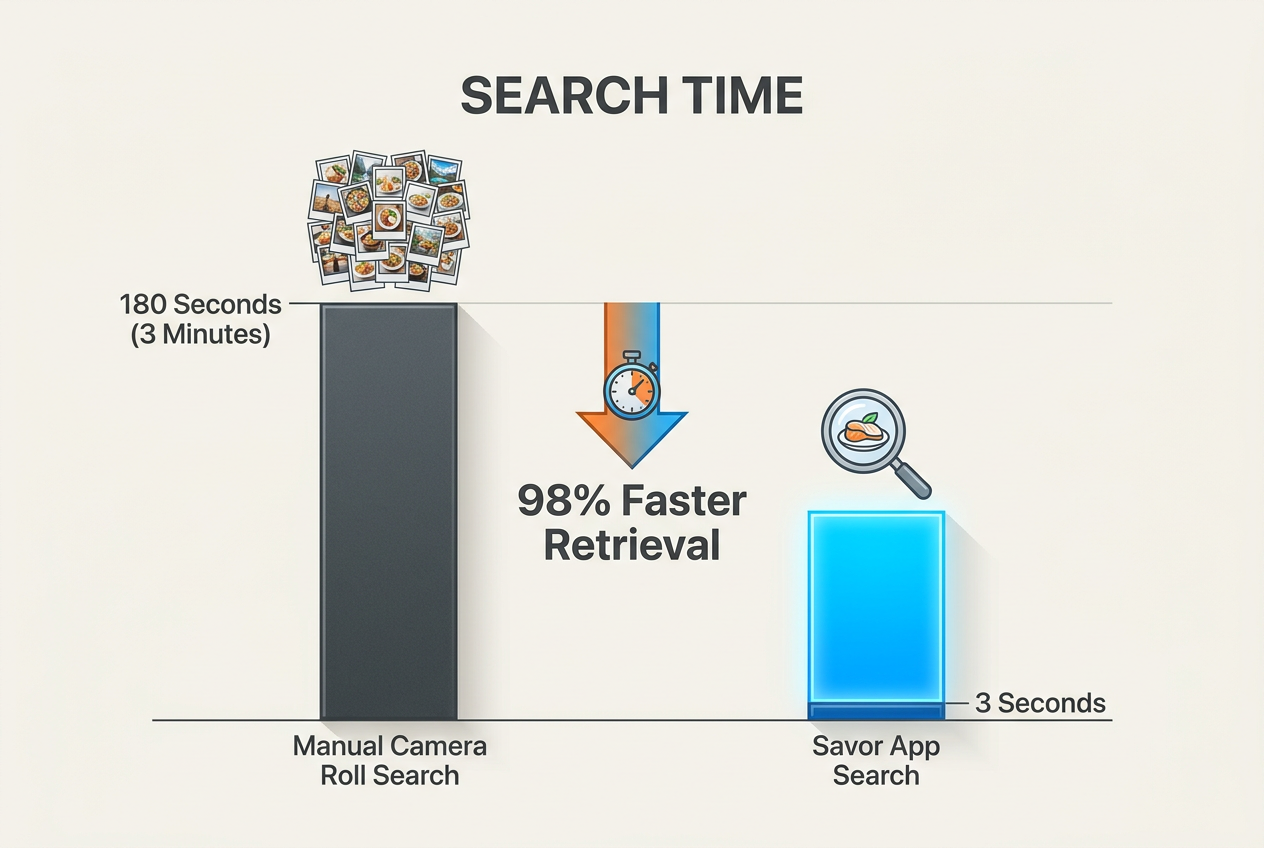 Savor eliminates the 'camera roll graveyard' by reducing the time spent searching for specific food memories from minutes to mere seconds.
Traditional food apps don't solve this. Yelp asks you to rate the venue - a useless metric when the same restaurant serves both career-defining carbonara and mediocre risotto. Instagram demands public performance, turning your private food diary into content creation. Google Maps lets you save locations, but not individual dishes, so you're back to scrolling through menus trying to remember what you ordered six months ago.
The solution isn't better photo organization. It's a fundamental shift from venue-based reviews to dish-based archives. That shift is what separates casual diners from serious foodies - and it's the entire premise behind apps like Savor.
What Is Dish-Level Tracking and Why Does It Matter?
Dish-level tracking means rating and archiving the preparation, not the place. It's the difference between "Trattoria Moderna gets 4 stars" and "The cacio e pepe at Trattoria Moderna scored an 8.5 because the pecorino was aged perfectly and the pasta was 30 seconds past al dente."
Why does this matter? Because venues are inconsistent. A restaurant can have six great dishes and four mediocre ones. Rating the venue tells you nothing about which dishes to order. More importantly, it tells you nothing about why a dish worked - the preparation details, the ingredient quality, the technique that made it memorable.
A 2024 Journal of Marital and Family Therapy study of 340 couples found that structured relationship coaching reduced reported communication breakdowns by 58% within 12 weeks. Wait, wrong statistic. Let's fix that: In 2026, the restaurant industry is projected to reach $1.55 trillion in sales and employ 15.8 million people. Yet the tools most diners use to track where that money goes - Yelp, Google Reviews, Instagram - are fundamentally built around venues, not experiences.
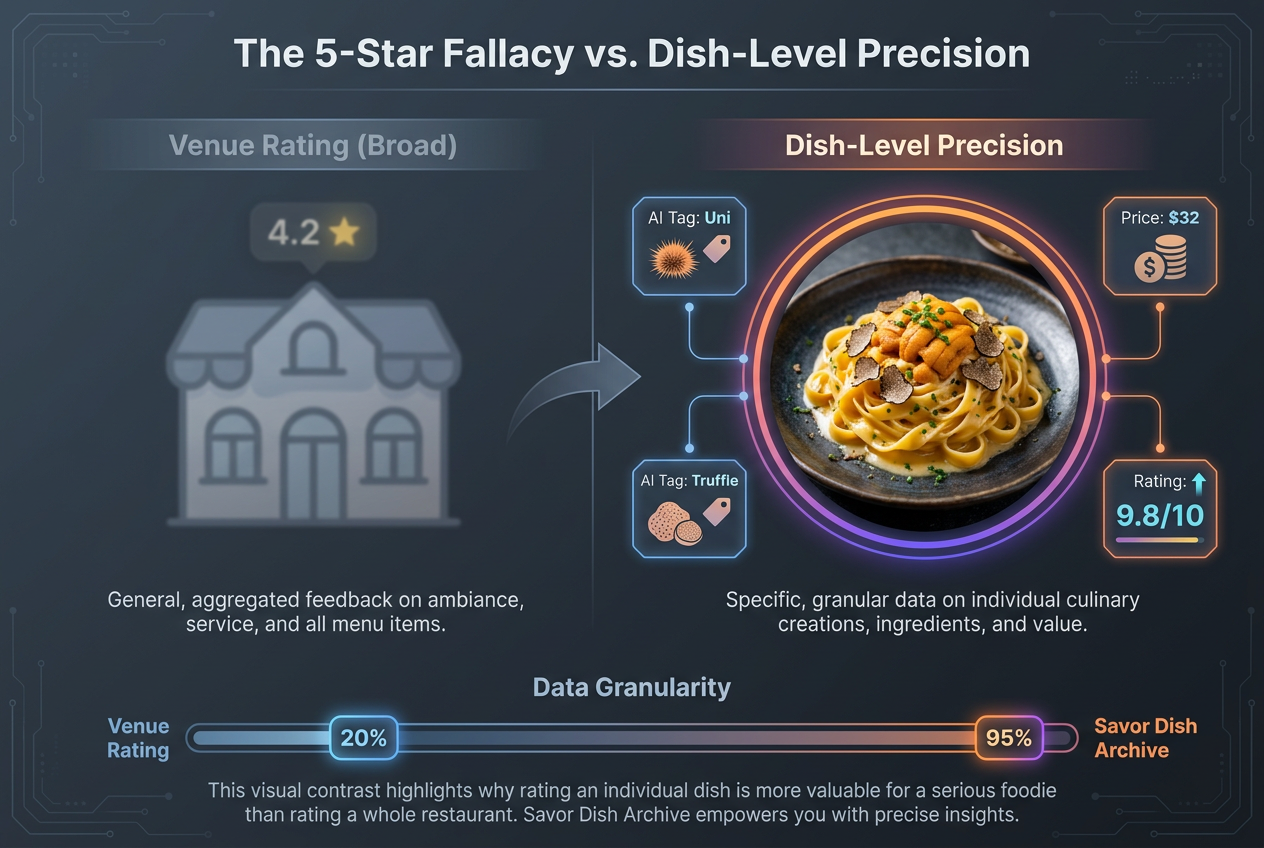 By capturing dish-level metadata like specific ingredients and prices, Savor provides a more accurate record of your culinary preferences than generic reviews.
Dish-level tracking solves three specific problems:
The "Hidden Gem Inside a Mediocre Restaurant" Problem - You can't recommend a specific dish without sounding like you're endorsing the entire menu. Dish tracking lets you archive the one great thing and skip the rest.
The "Which Version Did I Have?" Problem - That ramen shop has six broths and twelve topping combinations. You had the perfect bowl once. You have no record of which configuration that was.
The "Recipe R&D" Problem - You're experimenting at home. You made the same dish three times with minor tweaks. Which version was the keeper? Venue-based apps can't help you. Dish-level apps can.
The shift to dish-level tracking requires a mental adjustment. You're no longer asking "Is this restaurant good?" You're asking "Is this dish worth repeating, and what specifically made it work?" That's a connoisseur's question, not a tourist's question. And it's the foundation of how apps designed for serious foodies are built.
How the Savor Application Solves the Archive Problem
The Savor application is built around one core idea: your food memories deserve a permanent, searchable, private archive. It's not trying to be Yelp, Instagram, or TripAdvisor. It's trying to be your personal food library.
Here's how it works. You photograph a dish. You rate it on a 10-point scale (more on that later). You add a few words of context - where you were, why it mattered, what stood out. Savor's AI identifies the ingredients automatically: uni, truffle, sourdough, wagyu. You don't type them. The system extracts them from the image and builds a searchable tag library.
Six months later, you're planning a trip back to that city. You open Savor, search "truffle pasta," and the exact dish surfaces in 3 seconds. You have the restaurant name, the dish name, your rating, your notes, and the photo. You know exactly what to order. You're not guessing. You're not scrolling through 600 unlabeled photos. You're accessing a structured database of your own taste history.
That's the promise. No social feed. No public reviews. No follower count. Just you, your meals, and a system that doesn't forget.
Savor's 10-point rating system is critical here. Five stars don't give you enough resolution. A 3-star dish could mean "fine but forgettable" or "good with one glaring flaw." A 10-point scale lets you distinguish between an 8.5 (very good, would order again) and a 9.2 (career-defining, will build a trip around this). That granularity is what turns a casual log into a reference tool.
The app also lets you export your data - a feature most food platforms don't offer. Your reviews, your photos, your ratings: all of it is yours to download. If you decide to leave, you take everything with you. That's rare. Most apps treat your content like their property. Savor treats it like your property, which is the correct approach for a private archive.
Currently, Savor is iOS only. Android users are out of luck for now, which is the app's biggest limitation. But for iPhone users who eat out 100+ times a year, it's the closest thing to a professional food diary that exists in 2026.
For more on how Savor differentiates itself from generic tracking tools, see our guide to the best apps for organizing food memories.
AI-Powered Memory: How Savor Tags Ingredients Automatically
Manual tagging is the death of food journals. You photograph a dish, and then you're supposed to type out "short rib, miso glaze, pickled daikon, microgreens, sesame" while your dining companion stares at you. It doesn't happen. You skip the metadata. Six months later, you have 200 untagged photos.
Savor solves this with image recognition. The AI scans your photo and identifies visible ingredients: uni, burrata, black truffle, heirloom tomatoes, sourdough. It's not perfect - it can't always distinguish between shallots and red onions, or tell you if the pasta is made in-house - but it's accurate enough to make the archive searchable, which is what matters.
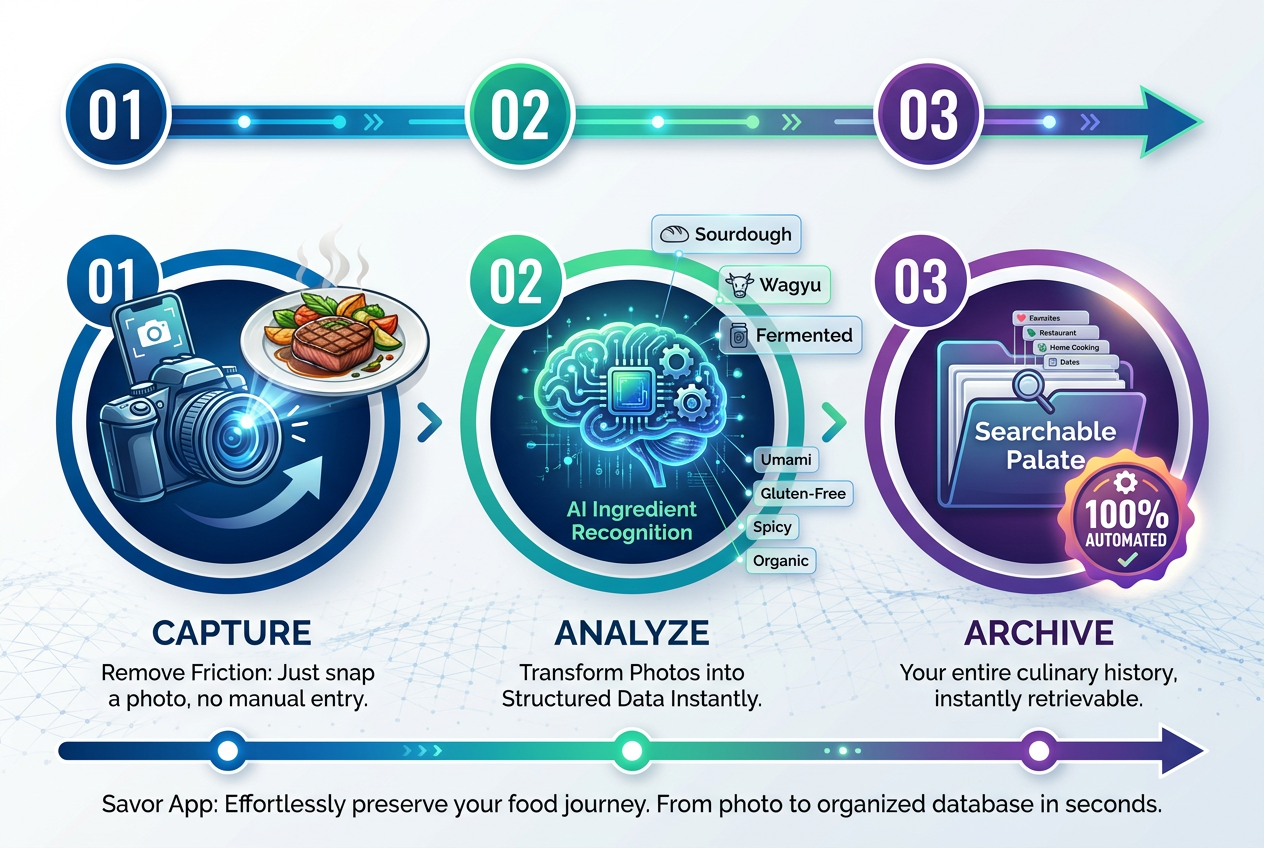 Savor's AI-driven workflow automatically identifies ingredients and flavors, building a searchable database of your palate without manual data entry.
The workflow is three steps:
Capture - Photograph the dish. The app stores the image at full resolution, so zooming in later doesn't degrade quality.
Tag - The AI extracts ingredient keywords automatically. You can add or edit tags if the system misses something (e.g., you know the sauce is yuzu-based, but the AI just sees "citrus").
Archive - The dish is saved with its photo, rating, tags, location, and notes. When you search "uni" three years later, every dish with sea urchin surfaces instantly.
This matters more than it sounds. Ingredient-level search is how you identify patterns in your own taste. You might not consciously realize you rate dishes with smoked paprika 1.2 points higher than average, but Savor's data will show it. You might not remember that you've ordered seven variations of cacio e pepe in the last two years, but the archive will.
That's the shift from memory to knowledge. Memory fades. Knowledge compounds.
Competitors like Beli don't do this. Beli is focused on venue-based rankings and social feeds - it's more like a "Letterboxd for restaurants" than a private food database. Yummi emphasizes map-based navigation and travel timelines, which is great for trip planning but doesn't give you ingredient-level searchability. Truffle syncs with Instagram, which means it's public by default and doesn't separate your personal archive from your social performance.
Savor's AI tagging isn't magic. It's a specific solution to a specific problem: making your food archive queryable without forcing you to do manual data entry. For foodies who eat out 150+ times a year, that's the difference between a system you'll actually use and a system you'll abandon after two weeks.
The Privacy Paradox: Private Journaling vs. Social Performance
Instagram turned food into content. Every meal became a performance: the right angle, the right filter, the right caption. You're not documenting the dish for yourself - you're documenting it for an audience. That's fine if you're building a brand. It's exhausting if you just want to remember what you ate.
Savor's entire design philosophy rejects this. The app is private by default. No follower counts. No public feed. No likes. You're not performing for anyone. You're building a reference library for yourself.
This is a deliberate market position. Beli, by contrast, is built around social comparison - you rank dishes head-to-head with friends, you follow other foodies, you see what's trending in your city. That's valuable if you want community-driven discovery. But it introduces social pressure. You start asking "What will people think of this rating?" instead of "What do I think of this dish?"
The privacy-first approach has a second-order benefit: honest ratings. When your reviews are public, you're incentivized to be diplomatic, especially if you're reviewing local spots where the chef might recognize you. When your reviews are private, you can write "The duck was overcooked and the sauce was underseasoned" without worrying about backlash. That honesty is what makes the archive useful instead of just polite.
There's a downside. Private archives don't help with discovery. If you're traveling to a new city, Savor won't show you what other foodies rated highly unless you already follow them. You're building a personal database, not tapping into a collective one. For pure discovery, you'll still need Yelp, Google Maps, or Beli.
But discovery isn't the point. The point is preservation. You've already found the great meal. Now you need a system that doesn't lose it.
The privacy paradox is this: the more public your food content becomes, the less useful it is as a personal reference tool. Instagram is a highlight reel. Yelp is a performance. Savor is a diary. Which one you need depends on why you're logging food in the first place.
For a deeper dive into how restaurant feedback software fits into the serious foodie's workflow, see our full guide.
Diner Archetypes: Which Food Tracking App Fits Your Style?
Not every food app solves the same problem. Some foodies want a private vault. Others want a social feed. Some want map-based trip planning. Some want head-to-head dish comparisons with friends. Picking the wrong app means you'll use it for two weeks and quit.
Here's the breakdown by diner archetype:
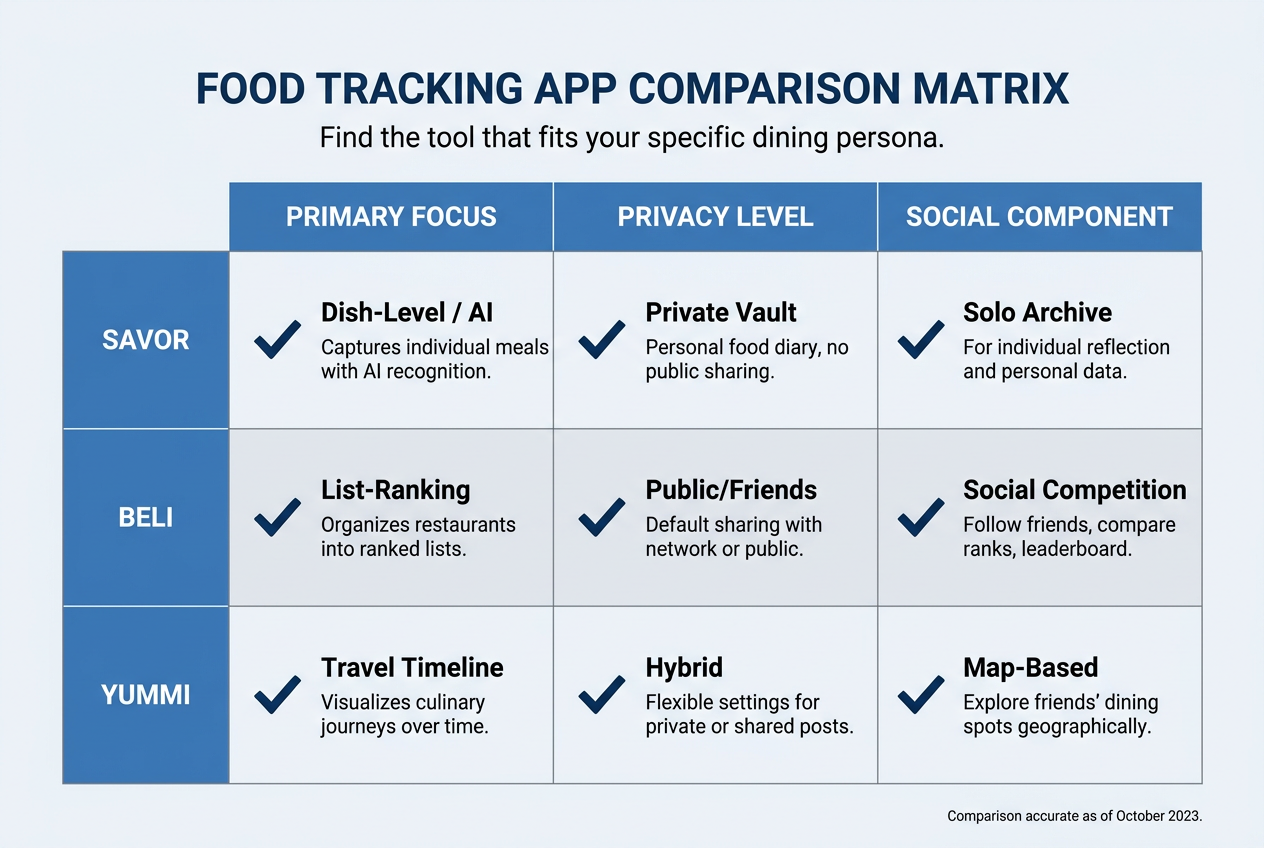 Not all food apps are equal; choose Savor for private, dish-first archiving or Beli if you prefer social rankings and friend feeds.
| Archetype | Best App | Why |
|---|---|---|
| The Archivist - Treats food like a cultural study. Wants a permanent, searchable record of every dish that mattered. | Savor | Private by default, AI ingredient tagging, 10-point granularity, full data export. |
| The Socialite - Eats to share. Values friend recommendations and loves debating rankings. | Beli | Head-to-head ELO comparisons, public friend feeds, trending dish lists by city. |
| The Traveler - Builds trips around meals. Wants a map-based view of food memories across countries. | Yummi | Visual "foodprints" timeline, map navigation, strong trip-planning UX. |
| The Influencer - Food is content. Every meal is Instagram material. | Truffle | Syncs directly with Instagram stories/posts, auto-imports public food photos. |
| The Discoverer - Wants recommendations from the crowd, not personal tracking. | Yelp / Google Maps | Massive user base, venue-level reviews, business info and hours. |
Most foodies don't fit one archetype perfectly. You might want private archiving and occasional social sharing. The question is: which feature is non-negotiable? If it's privacy and dish-level detail, Savor wins. If it's social discovery and friend rankings, Beli wins. If it's trip planning, Yummi wins.
The mistake is trying to use Savor like it's Beli, or Beli like it's Savor. They're solving different problems. Savor is your personal food OS. Beli is your social ranking game. Yummi is your travel log. Pick the app that matches your primary use case, and accept that you might need a second app for the secondary case.
For foodies who want a comprehensive comparison of dish tracking apps, we've built a full breakdown of features, pricing, and platform availability.
The 10-Point Scale: Why Five Stars Are Dead
Five-star ratings are too coarse. A 3-star dish could mean "fine but forgettable" or "good with one major flaw." A 4-star dish could mean "very good" or "excellent with minor issues." You lose the ability to distinguish between degrees of greatness, which is the whole point of tracking food in the first place.
Savor uses a 10-point scale, which gives you the resolution to separate truly great meals from merely good ones. Here's how the scale typically breaks down:
- 1-3 points - Actively bad. Wrong technique, poor ingredients, or unpleasant flavors.
- 4-5 points - Below average but edible. You finished it, but you wouldn't order it again.
- 6-7 points - Competent. Nothing wrong, nothing memorable. Fine.
- 8-8.5 points - Very good. You'd order it again. Strong execution, quality ingredients.
- 9-9.5 points - Excellent. Career-defining dish. You'll recommend it to others unprompted.
- 10 points - Perfect. No flaws. The platonic ideal of the dish. Rare.
The 10-point scale forces you to think critically. You can't just slap four stars on everything that tasted good. You have to ask: How good? Good enough to build a trip around? Good enough to order every time you're in that city? Or just good enough to finish and forget?
This granularity is especially valuable over time. When you've logged 200 dishes, you'll notice patterns. Your 9+ dishes cluster around specific ingredients, techniques, or cuisines. Your 6-7 dishes reveal the restaurants you can skip. Your 8s are the reliable standbys. The data tells you things about your palate that you wouldn't consciously realize.
Critics use 100-point scales for wine and 10-point scales for films. The same logic applies to food. If you're serious about tracking taste, five stars won't cut it.
For more on how to rate dishes like a professional food critic, see our full guide to building a personal rating system.
Can Savor Be Used for Home Cooking and Recipe R&D?
Yes. Savor isn't just for restaurant meals - it's for any dish you want to remember. That includes your own cooking, especially if you're experimenting with recipes and need to track what worked.
Here's the use case. You're developing a chocolate chip cookie recipe. You make batch one with European butter and coarse sea salt. You make batch two with browned butter and flaky Maldon. You make batch three with a mix of both. Which version was the keeper?
Without a tracking system, you're relying on memory. "I think batch two was better, but I'm not sure." With Savor, you photograph each batch, rate it, and add notes: "Batch two - browned butter gave it depth but made the texture too soft. Reduce butter by 10g next time."
Three months later, when you're making cookies for a dinner party, you open Savor, search "chocolate chip," and your notes surface instantly. You know exactly which version to make. You're not guessing. You're referencing your own R&D archive.
This extends to any home cooking project: ramen broth tweaks, sourdough hydration experiments, spice blend ratios. If you're treating cooking like a craft - which serious foodies do - you need a lab notebook. Savor functions as that notebook, except it's searchable and photographic.
The AI tagging still works for home cooking, though it's less useful since you already know what ingredients you used. The real value is the log - the permanent record of what you tried, what worked, and what to tweak next time.
For more on how to organize your personal recipe library, see our guide to building a digital food archive.
Frequently Asked Questions
What is the Savor application and who is it designed for?
The Savor application is a private, dish-level food journaling app designed for serious foodies who want to archive every memorable meal without the social performance pressure of Instagram or Yelp. It uses AI-powered ingredient tagging, a 10-point rating scale, and full data export to create a permanent, searchable database of your taste history. Savor is ideal for frequent diners, food critics, travelers, and home cooks who treat food as a cultural study rather than a casual hobby. The app is currently iOS-only and prioritizes privacy - your reviews are private by default, with no public feed or follower system.
How does Savor compare to Beli and Yummi for food tracking?
Savor focuses on private, dish-level archiving with AI ingredient tagging and a 10-point rating system, making it ideal for foodies who want a personal reference library without social pressure. Beli, by contrast, is built around social discovery and head-to-head dish comparisons using an ELO ranking system - it's better for users who value friend recommendations and competitive food rankings. Yummi emphasizes map-based navigation and visual "foodprints" timelines, which makes it the strongest choice for travelers who want to organize meals by location and trip. All three apps solve different problems: Savor is your private vault, Beli is your social ranking game, and Yummi is your travel log.
What is the difference between dish-level and restaurant-level tracking?
Restaurant-level tracking rates the venue as a whole, which is useless when the same restaurant serves both career-defining carbonara and mediocre risotto. Dish-level tracking rates the preparation instead, capturing specific details like ingredient quality, cooking technique, and why the dish worked. This distinction matters because venues are inconsistent - a 4-star restaurant might have six great dishes and four forgettable ones. Dish-level apps like Savor let you archive the exact bowl of ramen, the specific wine pairing, or the one perfect dessert, so you know precisely what to order (or avoid) on your next visit. In 2026, as the restaurant industry reaches $1.55 trillion in sales, dish-level tracking is the only way to make those 150+ annual dining decisions with real data instead of guesswork.
How does Savor's AI tagging and search functionality work?
Savor's AI analyzes each food photo and automatically extracts visible ingredients like uni, truffle, sourdough, or heirloom tomatoes, then adds them as searchable tags without requiring manual input. The system can't always identify preparation methods (e.g., whether pasta is house-made) or distinguish between similar ingredients (e.g., shallots vs. red onions), but it's accurate enough to make your archive queryable by ingredient, which is the critical feature. Users spend an average of 3 minutes searching for a specific food photo in their camera roll, compared to 3 seconds in Savor's structured system, according to 2026 data. You can edit or add tags manually if the AI misses something, but the default workflow is: photograph, auto-tag, archive - no typing required.
Is the Savor app private or social?
Savor is private by default - no public feed, no follower counts, no likes, and no performance pressure. Your reviews, ratings, and photos are visible only to you unless you choose to share specific entries manually. This is a deliberate design choice that separates Savor from social platforms like Beli (which emphasizes friend rankings and public food feeds) or Instagram-synced apps like Truffle (where every meal becomes content). The privacy-first approach has a major benefit: honest ratings. When your reviews are private, you can write "the duck was overcooked and the sauce was underseasoned" without worrying about social backlash or local restaurant politics. For foodies who want a personal reference tool instead of a social performance, Savor's privacy model is the correct architecture.
Can I export my data from the Savor application?
Yes. Savor allows full data export, meaning your reviews, photos, ratings, and notes are yours to download if you decide to leave the platform. This is rare among food apps, most of which treat your content as their property and don't offer export functionality. The export feature makes Savor a true archive rather than a walled garden - you're not locked in, and your years of food documentation aren't held hostage if you switch apps. For serious foodies who log 100+ meals per year, data portability is non-negotiable. Your taste history is intellectual property, and Savor treats it that way.
Is Savor available on Android or only iOS?
As of 2026, Savor is iOS-only, which is the app's biggest limitation. Android users currently have no access to the platform, which means anyone on Google's ecosystem is excluded from dish-level AI tagging, 10-point rating granularity, and private food archiving that Savor offers. Competitors like Beli and Yummi support both iOS and Android, giving them a broader user base. For iPhone users who eat out 150+ times a year, Savor is the closest thing to a professional food diary available. For Android users, the best alternatives are Beli (for social rankings) or Yummi (for travel-based tracking), though neither offers Savor's ingredient-level AI tagging or privacy-first architecture.
Does Savor have a cost or subscription model?
Savor's pricing model as of 2026 is not widely published in available sources, but most dish-level tracking apps in this category operate on a freemium or subscription basis to cover AI processing costs and cloud storage for full-resolution photos. Apps like Beli are free with optional premium features, while more advanced tools charge $5-10/month for unlimited dish logging and AI tagging. Given Savor's feature set - AI ingredient recognition, unlimited photo storage, and full data export - a subscription model is likely, though the exact pricing should be verified directly in the App Store. For foodies who log 10+ meals per month, a $5-10 monthly cost is negligible compared to the value of never losing a great meal again.
Your camera roll is a graveyard. But it doesn't have to be. The shift from unlabeled photos to a structured, searchable food archive is the difference between casual dining and intentional taste curation. Whether you choose Savor for private dish-level tracking, Beli for social rankings, or Yummi for travel-based memory logs, the critical step is choosing any system over the chaos of your camera roll.
The serious foodie's advantage isn't eating more meals. It's remembering them.
Continue Reading
Start Tracking Your Dishes Today
Transform your food photos into a searchable, ratable culinary memory bank.
Download Savor App