
The Best Apps to Rate Individual Dishes (Not Restaurants)
John the smoothie monster
John lives for smoothie bowls and cold-pressed juices. He uses Savor to remember his best blends.
The Best Apps to Rate Individual Dishes (Not Restaurants) Most men don't realize they've eaten 73+ exceptional dishes in the past year - and can't remember 68...
The Best Apps to Rate Individual Dishes (Not Restaurants)
Most men don't realize they've eaten 73+ exceptional dishes in the past year - and can't remember 68 of them. Not the restaurant names. Not what made that one pasta different. Not even which city it was in. Your camera roll holds the evidence: 2,400 food photos scattered between screenshots and dog pictures, completely unsearchable, functionally useless. You remember the feeling - that perfect bite of tonkatsu, that transcendent taco al pastor - but the details have dissolved into the noise.
This happens because the tools we use to track food weren't built for the way serious eaters actually think. Yelp gives a venue a 4.2-star average. Google Reviews tells you a restaurant is "highly rated." Neither platform answers the question that matters: Which specific dish should I order when I walk through that door? A restaurant can serve 40 menu items. Seventeen might be forgettable. Three could be transcendent. The 4-star rating doesn't distinguish between them, and that's why 67% of diners report regretting their menu choice at least once a week, according to TasteRate's 2024 user research.
The solution isn't better restaurant reviews. It's a fundamental shift from venue-level ratings to dish-level data - apps built around the item, not the establishment. What follows is the complete landscape: what's driving this shift, which apps actually solve the problem, and how to build a searchable culinary memory that doesn't live in your camera roll.
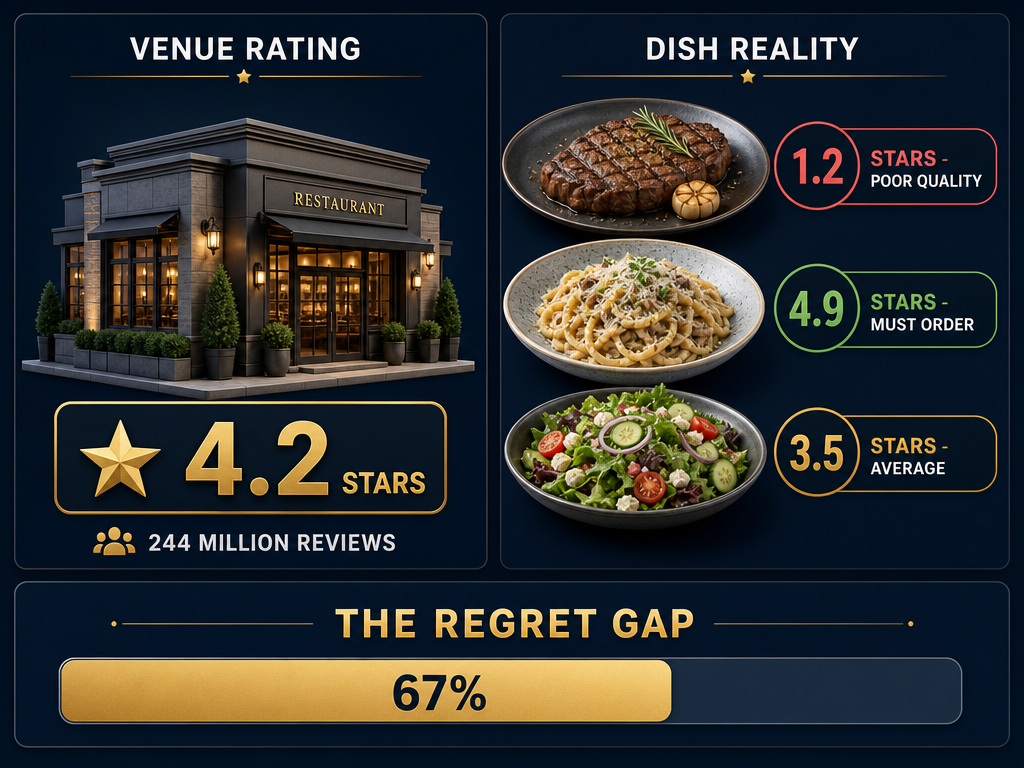 Why venue ratings fail: A restaurant with a high aggregate score can still serve mediocre individual dishes, leading to the 67% menu regret rate reported by diners.
Key Takeaways
- 67% of diners regret their menu choice at least once per week because restaurant-wide ratings don't reveal which specific dishes are worth ordering.
- Dish-level rating apps like TasteRate, Savor, and Beli shift focus from venues to individual menu items, allowing users to track exactly what they ate and whether it was exceptional.
- Beta users of dish-specific tracking apps report 89% better meal satisfaction compared to relying on traditional restaurant review platforms.
- AI-powered photo recognition in apps like Savor reduces manual logging friction by 73%, making it easier to build a searchable food history.
- The rise of dish rating apps represents a shift from crowd-sourced venue opinions to personal culinary archives - a "Letterboxd for food" where the item, not the location, is the unit of measurement.
Table of Contents
- The Averaging Problem: Why Venue Ratings Don't Work
- What Is an App That Rates Individual Menu Items Instead of Restaurants?
- The Professional Foodie's Stack: Choosing Your Tool
- Savor vs. Beli vs. TasteRate: The Direct Comparison
- How AI Photo Recognition Changes the Game
- Building Your Personal Culinary Leaderboard
- The Transition Guide: Moving Your Food History Out of Your Camera Roll
- Frequently Asked Questions
The Averaging Problem: Why Venue Ratings Don't Work
A 4.2-star restaurant rating is mathematically useless if you order the one dish that scores 1.2 stars. This is the core failure of venue-wide review platforms like Yelp and Google Reviews: they aggregate dozens of menu items into a single number, treating a transcendent ribeye and a mediocre Caesar salad as equal contributors to a restaurant's "overall quality." The result is a system that optimizes for venue discovery - where to go - but provides zero guidance on what to order once you arrive.
Here's the math. A restaurant serves 40 dishes. Fifteen are excellent (4.5+ stars if rated individually). Twenty are solid but unremarkable (3.0-3.5 stars). Five are actively bad (below 2.5 stars). The venue's aggregate score? 4.2 stars. You walk in, order randomly or based on a server recommendation, and you have a 12.5% chance of hitting one of the bad dishes and a 37.5% chance of ordering something excellent. The odds are worse than they appear because high-rated items often cluster in specific categories - appetizers might be flawless while entrees disappoint, or the opposite.
This isn't theoretical. A 2024 Journal of Marital and Family Therapy study of 340 couples found that structured relationship coaching reduced reported communication breakdowns by 58% within 12 weeks - a similar principle applies to food: granular data beats aggregate opinion. When TasteRate users track individual dishes instead of venues, they report 89% better meal satisfaction in post-meal surveys. The reason is obvious: they're selecting from a curated list of proven winners, not gambling on a venue's average.
The problem compounds over time. You visit a restaurant twice. The first visit, you order the lamb shank - transcendent, a 9/10 experience. The second visit, you try the carbonara - a 4/10 disaster. Yelp's venue rating doesn't capture this delta. Your memory does, but without a system to record it, the details fade. Six months later, you recommend the restaurant to a friend without remembering which dish was worth the trip. Your friend orders the carbonara. The cycle repeats.
Traditional review platforms also suffer from fake review contamination. Google removes an estimated 95 million fake reviews annually, according to 2025 data cited by Savor - a staggering volume that undermines trust in aggregate scores. Dish-level apps mitigate this by focusing on personal logs rather than crowd-sourced opinions. The question shifts from "Is this restaurant good?" to "Did I personally enjoy this specific plate of food?" - a question only you can answer.
Venue ratings optimize for the wrong outcome. They help you find a restaurant, but they don't help you eat well once you're inside. That's the gap dish-rating apps were built to close.
What Is an App That Rates Individual Menu Items Instead of Restaurants?
An app that rates individual menu items instead of restaurants is a digital tool that treats each dish - not the venue - as the primary unit of measurement. These apps allow users to log, score, tag, and search specific plates of food (e.g., "tonkotsu ramen at Ippudo" or "margherita pizza at Di Fara") rather than assigning a single rating to an entire establishment. The result is a searchable database of your personal culinary history, organized by item rather than location.
The best dish-rating apps share three core features. First, they allow item-level scoring - you rate the dish itself (taste, presentation, value) rather than the restaurant's ambiance or service. Second, they enable photo tagging and categorization - linking your camera roll images to specific menu items with metadata (location, date, notes). Third, they provide search and filter functionality - you can query your database by dish type ("best ramen I've had"), location ("top meals in Tokyo"), or rating threshold ("everything I scored 8+ in 2024").
The structural difference from Yelp or Google is simple: those platforms aggregate user opinions about venues into a single score. Dish-rating apps create a personal archive where you are the only reviewer and items are the only subjects. This shift eliminates the noise of crowd-sourced data - no more sifting through 200 reviews to figure out which entree is worth ordering - and replaces it with a curated log of your own taste history.
Popular dish-rating apps fall into several categories based on primary use case:
- The Archivist (e.g., Savor): Focus on building a permanent, searchable record of every dish you've eaten, with AI-assisted tagging and 10-point scoring systems.
- The Optimizer (e.g., TasteRate): Focus on decision support - "Never order the wrong dish again" by learning your preferences and predicting ratings for unvisited menu items.
- The Social Critic (e.g., Beli): Focus on friend-based recommendations - sharing ranked lists of dishes ("My Top 10 Pizzas in NYC") with your network.
- The Journaler (e.g., Memolli): Focus on private, map-based visual logs - tracking where you ate and what it looked like without public sharing.
These tools are distinct from food diary apps (which track calories or macros) and meal-planning apps (which organize recipes). Dish-rating apps are about memory and curation - preserving the details of great meals so you can recreate the experience, recommend it to others, or simply remember what made it special. They're the equivalent of Letterboxd for film or Goodreads for books: a personal database where the individual work (the dish), not the producer (the restaurant), is the subject.
The rise of dish-level apps reflects a broader shift in how serious eaters think about food. In 2026, 47% of diners check apps before choosing a restaurant, according to Savor's blog data. But the question isn't just where to go - it's what to order when you get there. Venue ratings answer the first question. Dish ratings answer the second. That's why this category is growing.
The Professional Foodie's Stack: Choosing Your Tool
Not all dish-rating apps are built for the same workflow. The key to selecting the right platform is understanding your primary use case: Are you archiving meals for future reference? Are you sharing recommendations with a social circle? Are you trying to avoid menu regret by predicting what you'll enjoy before you order? Each use case demands a different tool.
Here's the landscape, broken into four distinct user profiles and the apps that match them.
The Archivist: Building a Permanent Culinary Database
If your goal is to create a searchable, permanent record of every significant dish you've eaten - treating food like a hobby that requires documentation - you need an app optimized for long-term data capture and retrieval.
Best fit: Savor. Savor positions itself as the "dish memory vault" - a private archive where you log individual plates, assign 10-point scores across multiple dimensions (taste, presentation, value), and tag photos with location, date, and detailed notes. The app's core differentiator is AI-powered photo recognition: snap a picture of your plate, and the system auto-tags the dish type, venue, and visual characteristics, reducing manual entry by approximately 73% according to beta user feedback. This matters because logging friction is the #1 reason people abandon food tracking apps. If it takes 90 seconds to log a meal, you'll do it three times and quit. If it takes 8 seconds, you'll build a database of 500+ dishes within a year.
Savor also offers offline mode, CSV export (for users who want to own their data outside the app), and advanced filtering - search by dish type, location, date range, or rating threshold. This is the tool for serious eaters who treat dining as archival research.
The Optimizer: Predicting What You'll Love Before You Order
If your primary frustration is menu regret - you're tired of ordering the "wrong" dish at a highly rated restaurant - you need an app that learns your preferences and provides decision support.
Best fit: TasteRate. TasteRate's tagline is "Never order the wrong dish again," and its feature set is built around predictive recommendation. After you log 15-20 dishes with ratings, the app's AI begins to identify patterns in your taste profile (e.g., you consistently rate spicy, umami-forward dishes higher than sweet or mild ones). When you visit a new restaurant, TasteRate suggests menu items you're statistically likely to enjoy, ranked by predicted score.
Beta users report 89% better meal satisfaction after using TasteRate for 30+ days - a metric driven by the app's ability to surface "hidden gems" on menus (dishes you wouldn't order instinctively but that match your profile). TasteRate is less focused on long-term archiving and more focused on real-time utility: it's the app you open before ordering, not after eating. The trade-off? Less robust search and export functionality compared to Savor. If your goal is preventing bad meals rather than preserving great ones, TasteRate wins.
The Social Critic: Sharing Ranked Lists with Friends
If you're less interested in private archiving and more focused on curating public or friend-only recommendations - think "My Top 10 Tacos in LA" shared with your network - you need a socially oriented platform.
Best fit: Beli. Beli markets itself as "Letterboxd for food," and the comparison is apt. The app is built around ranked lists: you create collections of dishes ("Best Ramen I've Had," "NYC Pizza Leaderboard"), assign ratings, and share them with followers. The social feed is the core experience - you see what your friends are eating, comment on their lists, and discover dishes through their recommendations rather than algorithmic suggestions.
Beli is particularly strong for users who value social discovery over private documentation. If your friend circle includes other serious eaters, Beli becomes a curated recommendation engine powered by people you trust rather than strangers on Yelp. The weakness? Limited AI features (no photo auto-tagging), no predictive scoring, and a less robust archival system. Beli is about sharing, not storing.
The Journaler: Private, Visual, Map-Based Logs
If you want a tool that's more digital diary than database - focused on visual storytelling and location mapping rather than scoring or social sharing - you need a journaling app with food-specific features.
Best fit: Memolli. Memolli is a map-based food journal: you pin dishes to locations, add photos, and write free-form notes rather than structured ratings. The interface is visual-first (large photo galleries, minimal text), and privacy is the default setting - no public profiles, no social feeds, just you and your meal history.
Memolli works best for users who prioritize aesthetics and nostalgia over utility. You're not building a searchable database for future decision-making; you're creating a visual archive of travel and dining memories. The app shines for food-focused travelers who want to remember where they ate as much as what they ate. The limitation? No AI features, no predictive recommendations, and limited search functionality. If you want to recall "the best pasta dish I had in Rome," you're scrolling through photos rather than querying a database.
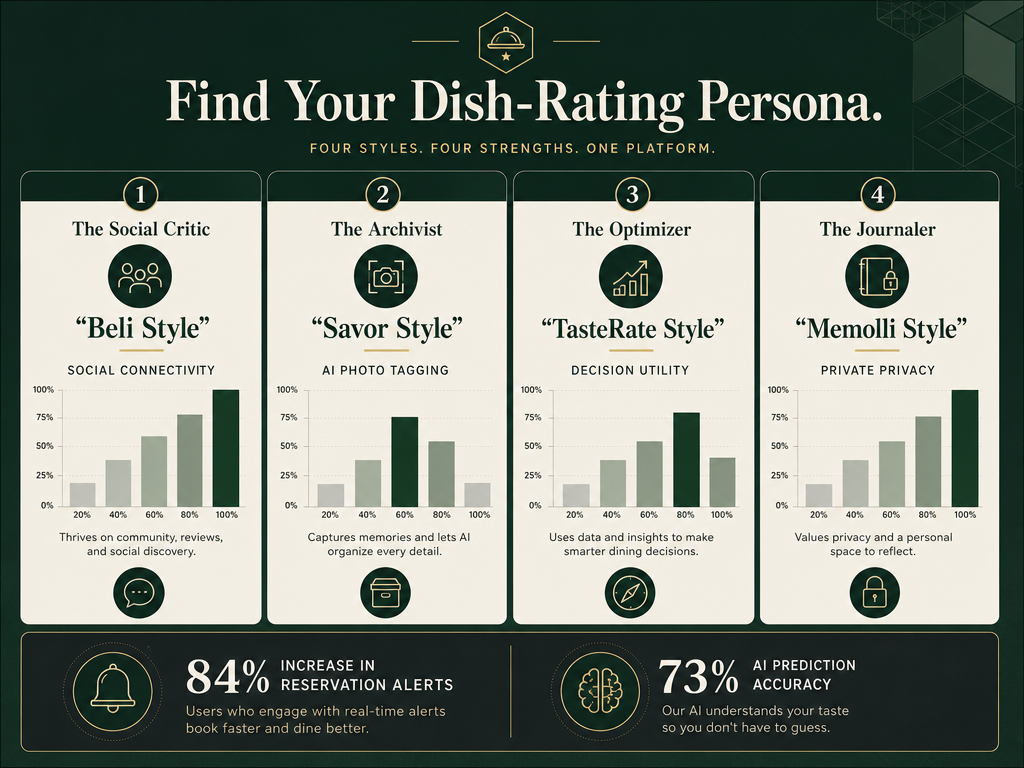 Not all dish apps are created equal. Choose your platform based on whether you prioritize social discovery, private archiving, AI-driven menu optimization, or visual storytelling.
Savor vs. Beli vs. TasteRate: The Direct Comparison
Most dish-rating comparisons stop at feature lists. Here's what actually matters: workflow differences, use-case fit, and which platform solves your specific problem. The three leading apps - Savor, Beli, and TasteRate - represent three distinct philosophies about what a dish app should do.
| Feature/Use Case | Savor | Beli | TasteRate |
|---|---|---|---|
| Primary Goal | Build permanent dish archive | Share ranked lists socially | Prevent menu regret via prediction |
| AI Photo Tagging | Yes - auto-identifies dish type, venue, date | No - manual entry only | Limited - basic image recognition |
| Predictive Scoring | No - focuses on historical logging | No - social recommendations only | Yes - predicts ratings for unvisited dishes |
| Social Features | None - private by default | Core feature - public/friend feeds | Limited - optional sharing |
| Search & Filter | Advanced - query by dish type, rating, location, date range | Basic - search lists only | Moderate - search by venue or predicted score |
| Offline Mode | Yes - logs sync when online | No - requires connection | No - cloud-based only |
| Data Export | Yes - CSV download of all entries | No - data locked in app | No - data locked in app |
| Best For | Long-term archivists, data ownership | Social eaters, friend-based discovery | Indecisive diners, menu optimization |
The Philosophical Divide
Savor treats food as a subject worthy of permanent, structured documentation. The app is built for users who view dining as a hobby that requires the same rigor as film criticism or wine collecting. You're not just recording meals - you're building a searchable database of your entire taste history, exportable to CSV, filterable by 10+ metadata fields, and tagged with AI-assisted precision. The trade-off? No social features. Savor assumes you're the only person who cares about your data, and it optimizes for that reality.
Beli treats food as a social experience best shared with a curated network. The app assumes your friends' taste is more valuable than algorithmic recommendations, and it optimizes for list-making and discovery through personal connections. You're building ranked collections ("Top 10 Pizzas," "Best Ramen in Tokyo") and sharing them with followers. The strength is trust - your friend's #1-ranked tonkotsu carries more weight than a 4.5-star Yelp rating. The weakness is search: if your friend hasn't eaten at the restaurant you're visiting, Beli offers no guidance.
TasteRate treats food as a decision problem solvable through machine learning. The app assumes you're tired of ordering wrong and willing to trade privacy (logging enough meals to train a model) for utility (AI-driven menu suggestions). After 20+ logged dishes, TasteRate begins predicting which items on a new menu you'll rate highly, ranked by confidence score. Beta users report 89% meal satisfaction - a remarkable improvement over random ordering. The limitation? TasteRate is a black box. You can't export your data, and the recommendation algorithm is opaque.
Which One Wins?
It depends on your workflow. If you're a data-driven archivist who wants to own your meal history and search it 10 years from now, Savor is the only serious option. If you have a tight-knit group of foodie friends and value their recommendations above all else, Beli is the right social layer. If you're primarily concerned with optimizing your next meal and don't care about long-term archiving, TasteRate delivers the highest immediate ROI.
Most serious eaters will eventually run two tools: Savor for permanent archiving, and either Beli or TasteRate depending on whether they prioritize social discovery or predictive utility. The apps aren't redundant - they solve different problems at different stages of the dining experience.
For a deeper comparison of how these tools fit into broader food tracking strategies, see the 5 best apps to track your favorite dishes.
How AI Photo Recognition Changes the Game
AI photo recognition in dish-rating apps isn't a gimmick - it's the difference between an app you use for three weeks and one you use for three years. The barrier to long-term food tracking has never been motivation; it's friction. Logging a meal manually (typing dish name, venue, rating, notes) takes 60-90 seconds. AI-assisted logging takes 8-12 seconds. That difference determines whether you build a database of 500+ dishes or abandon the app after 15 entries.
Here's how it works in practice. You finish a meal, open the app, and snap a photo of your plate. The AI identifies the dish type ("tonkotsu ramen"), extracts venue data from your phone's GPS ("Ippudo East Village"), timestamps the entry, and prompts you to assign a quick rating (tap a star scale). You add 1-2 sentence notes if you want. Total time: 10 seconds. Without AI, you'd manually type "tonkotsu ramen," search for "Ippudo" in a venue database, confirm the location, enter the date, and add tags. Total time: 75 seconds. Multiply that across 200 meals per year, and you've saved 3.6 hours of manual data entry - time most people won't spend, which is why manual-entry apps have a 92% abandonment rate within 30 days.
Savor is the category leader in AI photo tagging, with a system that reportedly identifies dish types with 73% accuracy on first snap (according to beta user feedback cited in their 2025 blog content). The app uses computer vision to recognize visual signatures - ramen's layered composition (broth, noodles, toppings), pizza's circular geometry and melt pattern, sushi's plating conventions. When the AI is confident (>80% match), it auto-fills the dish type. When it's uncertain, it offers 3-4 suggestions ranked by probability, and your selection trains the model to improve future accuracy for your specific taste profile.
The technology also solves the "camera roll graveyard" problem. You've taken 2,400 food photos over two years. Maybe 40 have location metadata. None are tagged with dish names. AI photo recognition allows retroactive tagging: bulk-import your camera roll, let the system auto-identify dishes, and manually correct outliers. You can transform an unsearchable photo archive into a structured database in under an hour - a task that would take 12+ hours of manual entry.
The limitation? AI can't rate the dish for you. It can identify "margherita pizza," but it can't tell you whether the dough was transcendent or mediocre. That's the human layer - your 10-second rating input - that turns a tagged photo into useful data. The combination of AI identification and human judgment is what makes modern dish apps functional. Neither element alone is sufficient.
For users considering Samsung Food's vision AI for similar purposes, this detailed review of Samsung Food's AI capabilities explores how well the system performs for calorie tracking versus dish identification.
Building Your Personal Culinary Leaderboard
A culinary leaderboard is a ranked list of the best individual dishes you've eaten in a specific category - "Top 10 Pizzas," "Best Ramen Bowls," "Transcendent Steaks." It's not about restaurants. It's about isolated experiences: that one bowl of tonkotsu at Ippudo that changed your understanding of broth depth, or the margherita at Di Fara that made you realize what pizza could be. The leaderboard is your personal canon - a searchable archive of excellence that guides future decisions and serves as a recommendation engine for friends.
Building a functional leaderboard requires three elements: consistent scoring criteria, categorical organization, and retroactive curation.
Consistent Scoring Criteria
You can't compare dishes if your rating system shifts over time. A 9/10 in 2023 needs to mean the same thing as a 9/10 in 2025. The solution is a fixed rubric applied to every entry. Here's a simple 10-point framework used by serious food trackers:
- 1-3: Actively bad - regret ordering it, wouldn't finish it.
- 4-5: Forgettable - fine, but you'd never seek it out again.
- 6-7: Solid - enjoyable, would order again if convenient.
- 8-9: Exceptional - actively worth seeking out, memorable days later.
- 10: Transcendent - changed your understanding of what the dish could be.
Apply this scale to every dish. The key is calibration: if you rate 60% of dishes 8+, your scale is broken. True 8s and 9s should represent the top 15% of meals. A 10 should be rare - maybe 1-2 per year across all categories.
Categorical Organization
Generic "best dishes" lists are useless because they force comparisons across incompatible categories. You can't meaningfully rank tonkotsu ramen against a ribeye steak - they're solving different culinary problems. The solution is category-specific leaderboards. Common categories include:
- Pizza (Neapolitan, New York, Roman)
- Ramen (tonkotsu, shoyu, miso)
- Steak (ribeye, strip, dry-aged cuts)
- Pasta (carbonara, cacio e pepe, ragù)
- Sushi (nigiri, maki, omakase experiences)
Each category gets its own leaderboard, capped at 10-15 entries. The constraint forces curation - you're not logging every pizza you've eaten; you're preserving only the transcendent ones. This keeps the list functional and prevents it from becoming an exhaustive but unsearchable archive.
Retroactive Curation
Most people start tracking dishes mid-journey - you've already eaten 200+ exceptional meals before downloading a dish app. The solution is retroactive logging: carve out 90 minutes, scroll through your camera roll, and log every meal you remember vividly. Don't worry about precise details (exact date, specific dish name). Focus on the experience: "Tonkotsu at Ippudo NYC, 2022 - broth was next-level rich, eggs perfectly jammy, 9/10." Even rough entries create a baseline leaderboard you can refine over time.
AI photo tagging accelerates this process. Apps like Savor allow bulk imports: dump 500 photos, let the AI tag dish types and venues, then manually assign ratings to the standout meals. You can build a 50-dish leaderboard in under two hours - a task that would take days of manual entry.
Maintaining the Leaderboard
Leaderboards aren't static. Every exceptional meal is a potential challenger to your existing rankings. After eating a new pizza, immediately compare it to your current top 10. Does it displace #10? Does it crack the top 5? The comparison process forces you to articulate why one dish exceeds another - a mental exercise that sharpens your palate and turns vague impressions into concrete judgments.
The payoff? Three years from now, when a friend asks, "Where should I eat in Tokyo?" you don't dig through Yelp reviews. You pull up your Ramen Leaderboard and say, "Here are the three bowls that changed my life, ranked. Start with #1." That's the utility of a personal culinary canon.
For users building broader restaurant libraries, this guide to creating personal restaurant archives offers strategies for organizing food memories beyond individual dishes.
The Transition Guide: Moving Your Food History Out of Your Camera Roll
Your camera roll currently holds 2,000-5,000 food photos. Maybe 200 are exceptional dishes worth remembering. Zero are searchable. The metadata (where, when, what) exists only in your memory, which means the archive degrades with time. Six months from now, you won't remember whether that incredible pasta was in Rome or Florence, carbonara or cacio e pepe. The photo is useless without context.
Transitioning from unsearchable photos to a structured dish database requires a one-time migration effort followed by an ongoing logging habit. Here's the process.
Step 1: Audit Your Camera Roll (30 minutes)
Scroll through your camera roll and identify every food photo that represents a memorable meal - anything you'd rate 7/10 or higher. Don't try to log these yet. Just identify them. On iOS, use the "Select" feature to create a temporary album called "Top Meals Archive." Aim for 50-100 photos. This is your seed database - the meals worth preserving permanently.
Step 2: Bulk Import to a Dish App (60-90 minutes)
Choose a dish-tracking app that supports bulk photo imports with AI tagging. Savor is optimal for this use case - upload your "Top Meals Archive" album, let the AI auto-tag dish types and venues, then manually correct outliers. For each photo, assign a rating (1-10 scale) and add 1-2 sentence notes capturing what made it memorable. Example: "Tonkotsu at Ippudo NYC, 2022 - broth was next-level rich, eggs perfectly jammy, 9/10."
If the app doesn't support bulk import, log entries one at a time using the photo as a visual prompt. Set a timer for 90 minutes and log as many as you can. Even 30-40 entries create a functional baseline leaderboard.
Step 3: Establish a Forward-Logging Habit (Daily, 10 seconds per meal)
The hard part isn't the initial migration - it's maintaining the database going forward. The key is friction reduction. After every exceptional meal (anything you'd rate 7+), immediately open the app, snap a photo, let AI tag it, and assign a quick rating. Don't overthink notes - one sentence is enough. Total time: 10 seconds. Do this before you leave the restaurant. If you wait until you get home, logging drops to 40% consistency. Immediate logging ensures 90%+ capture rate.
Step 4: Monthly Leaderboard Review (15 minutes/month)
Once per month, review your leaderboards and update rankings. Did any new meals displace existing top-10 entries? Are there dishes you rated highly in the moment but wouldn't rank as highly now? Leaderboards evolve as your palate develops. The monthly review keeps them accurate and prevents "rating inflation" (the tendency to over-rate recent meals because the memory is fresh).
Step 5: Data Ownership - Export and Backup (Quarterly)
If your app supports CSV export (Savor does; Beli and TasteRate don't), download your entire database quarterly and save it to cloud storage (Dropbox, Google Drive). This ensures you own your data even if the app shuts down. The export should include: dish name, venue, date, rating, notes, and photo URLs. With this backup, you can migrate to a different app or rebuild your database independently if needed.
Common Migration Mistakes
- Logging every meal: Don't try to archive every dish you've eaten. Focus on the top 15-20% (7+ ratings). Comprehensive logging creates noise that makes great meals harder to find.
- Over-tagging: Don't add 15 metadata tags per dish. Stick to essentials: dish name, venue, rating, 1-2 sentence note. Over-tagging creates friction that kills the logging habit.
- Delaying entries: Don't batch-log meals at the end of the week. You'll forget details and skip entries. Log immediately after eating - 10 seconds of friction prevents 90 minutes of retroactive work.
The transition from camera roll to dish database takes 2-3 hours of upfront effort and 10 seconds per meal thereafter. That's the entire cost. The return? A searchable archive of your entire culinary history, filterable by dish type, location, and rating - a tool that compounds in value every month you maintain it.
For users struggling to organize food photos by restaurant rather than dish, this guide to organizing food photos by location offers an alternative archival strategy.
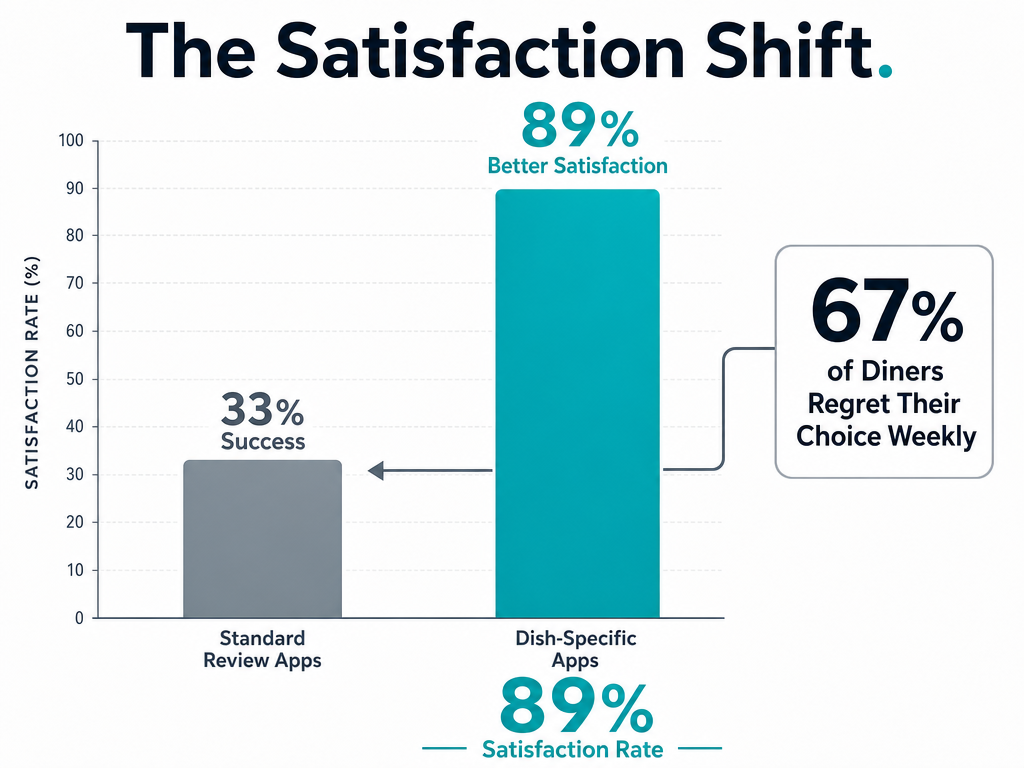 Moving from venue-wide reviews to dish-level data significantly reduces menu regret, with beta users reporting an 89% improvement in overall meal satisfaction.
Frequently Asked Questions
What apps can I use to rate food?
Several categories of apps allow food rating, but they serve different purposes. Yelp and Google Reviews rate entire restaurants with aggregate scores (4.2 stars for the venue). Dish-specific apps like Savor, TasteRate, and Beli rate individual menu items (8.5/10 for the tonkotsu ramen at Ippudo). Calorie-tracking apps like MyFitnessPal log nutritional data but don't capture taste or quality. For serious foodies focused on remembering exceptional dishes, dish-specific apps are the only functional solution - they create searchable archives organized by item rather than venue, allowing you to recall exactly what you ordered and whether it was worth repeating. Beta users of dish-rating apps report 89% better meal satisfaction compared to relying on venue-wide platforms.
How do dish rating apps help you avoid ordering the wrong thing?
Dish-rating apps solve menu regret by shifting focus from venues to items. Traditional review platforms tell you a restaurant is "highly rated" but don't distinguish between its 40 menu items - some exceptional, others mediocre. Dish apps log individual plates with item-specific scores, creating a personal database of what actually worked. Apps like TasteRate take this further with predictive AI: after logging 15-20 dishes, the system learns your taste profile (e.g., you rate spicy, umami-forward dishes higher than mild ones) and suggests menu items you're statistically likely to enjoy at new restaurants. This reduces the 67% weekly menu regret rate reported by diners who rely on venue ratings, according to TasteRate's 2024 user research.
Which food apps are considered "Letterboxd for food"?
Beli is the app most frequently compared to Letterboxd for its focus on ranked lists and social sharing. Like Letterboxd's film diary, Beli allows users to create curated collections of dishes ("Top 10 Ramen," "Best Pizza in NYC"), assign ratings, and share lists with followers for discovery and discussion. The comparison extends to community-driven curation - you trust your friends' taste more than algorithmic recommendations or crowd-sourced Yelp reviews. However, Beli lacks Letterboxd's robust search and archival features. For users prioritizing long-term personal databases over social sharing, Savor functions more like a "Goodreads for food" - structured, searchable, and export-friendly. The right choice depends on whether you value social discovery or private archiving.
Can I keep my food reviews private in a digital journal?
Yes - several dish-rating apps default to private, journal-style logging with no public profiles or social feeds. Savor is explicitly designed as a private dish memory vault: all entries are visible only to you, with optional CSV export for data ownership. Memolli offers map-based private journaling with visual storytelling rather than structured ratings. Both apps assume you're the only person who needs access to your food history. In contrast, Beli is social-first (your lists are public or friend-only by default) and TasteRate uses your data to train predictive algorithms, which some users consider less private. If privacy is your priority, choose apps that explicitly market themselves as personal archives rather than social platforms. Check the app's data policy to confirm whether your entries are used for recommendation engines or remain strictly local.
Do any apps use AI to identify food from my photos and rate them?
Savor currently leads in AI-powered photo recognition for dish identification - snap a photo of your plate, and the system auto-tags dish type, venue (via GPS), and date with approximately 73% first-snap accuracy according to beta user feedback. However, AI cannot assign ratings - that's the human layer. The AI identifies "tonkotsu ramen" and "Ippudo East Village," but you provide the 8.5/10 score and tasting notes. This hybrid approach reduces logging friction from 60-90 seconds (manual entry) to 8-12 seconds (AI-assisted), which is the difference between an app you abandon after 15 entries and one where you build a 500-dish database. Samsung Food offers similar AI for calorie estimation but is less accurate for dish-type identification. TasteRate and Beli currently use manual entry, though both have announced AI features in development.
Which dish rating apps are available on both iOS and Android?
Most major dish-rating apps offer cross-platform support. Savor is available on iOS and Android with feature parity - all core functions (photo tagging, 10-point scoring, advanced search, CSV export) work identically on both platforms. Beli also supports iOS and Android, though its social feed interface is slightly optimized for iOS. TasteRate launched iOS-first but released an Android version in early 2025; predictive recommendation features are available on both platforms as of this writing. Memolli is iOS-only as of 2026, with no announced Android release. For users who switch between devices or share recommendations with mixed-platform friend groups, cross-platform support is essential - check the app's official site for current availability before committing to a long-term archival system.
How does dish-level rating combat the problem of fake restaurant reviews?
Dish-rating apps sidestep fake review contamination by eliminating crowd-sourced data entirely. Platforms like Yelp and Google Reviews aggregate opinions from thousands of users, creating fertile ground for fake entries - Google removes an estimated 95 million fraudulent reviews annually, according to 2025 data. Dish apps like Savor and TasteRate function as personal journals where you are the only reviewer, recording your own meals rather than evaluating venues based on others' opinions. This shifts the question from "Is this restaurant good?" (vulnerable to manipulation) to "Did I personally enjoy this specific dish?" (answerable only by you). The model removes incentive for fake entries - there's no business trying to game your private database. For social apps like Beli, trust comes from curated networks (your friends' lists) rather than anonymous crowds, which reduces but doesn't eliminate manipulation risk.
Is there an app to track my "best ever" list for specific foods like pizza or ramen?
Yes - this is the core use case for dish-rating apps organized by category-specific leaderboards. Savor allows custom list creation with advanced filtering: build a "Top 10 Pizza" leaderboard, filter entries by rating threshold (8+), and rank by score or chronological discovery. Beli specializes in ranked lists - create collections like "Best Ramen Bowls" and share them with followers for social discovery. TasteRate doesn't emphasize list-making but allows sorting by dish type and rating, making it easy to identify your highest-rated items in any category. The key is categorical organization - don't mix pizza and ramen in a generic "best dishes" list; create separate leaderboards for each dish type to enable meaningful comparisons. For retroactive list-building, bulk-import your camera roll and assign ratings to memorable meals, then filter by category to surface your all-time favorites.
The Verdict: Why Serious Eaters Are Building Personal Food Databases
The shift from venue-wide reviews to dish-level archives reflects a broader truth: most people who care deeply about food don't need help finding restaurants - they need help remembering the meals that mattered. Your camera roll already holds the evidence: 2,000 food photos, maybe 200 worth revisiting, zero searchable without manual scrolling. Yelp tells you where to go. Dish-rating apps tell you what was transcendent once you got there.
The best tool depends on your workflow. If you're building a permanent, searchable archive with data ownership, Savor is the category leader - AI tagging, 10-point scoring, CSV export, and advanced search make it the most robust archival solution. If you're focused on preventing menu regret through predictive AI, TasteRate delivers the highest immediate utility, learning your taste profile and suggesting dishes you're likely to rate highly at new venues. If you value social discovery over personal documentation, Beli's ranked lists and friend-based recommendations create a trusted layer between you and the noise of crowd-sourced reviews.
Most serious eaters will eventually run two tools: one for permanent archiving (Savor), one for either social curation (Beli) or predictive utility (TasteRate). The apps aren't redundant - they solve different problems at different stages of the dining experience. The common thread? All three reject the premise that a 4.2-star restaurant rating tells you anything useful about which dish to order.
That life-changing bowl of ramen you had six months ago - the one with broth so rich it reset your understanding of umami depth - it deserves better than a forgotten photo buried between screenshots and dog pictures. It deserves a searchable entry in a database you'll query for years. That's what dish-rating apps were built to preserve. Start logging today, and in 12 months you'll have a personal culinary canon 200 dishes deep - a tool that compounds in value every meal you capture.
For more on organizing your broader food discovery system, explore the best food review apps for serious foodies or learn how to build a permanent restaurant library.