

A No-Nonsense Look at Bon Appétit App Reach, Downloads, and 2026 User Reviews
Harry the matcha king
Harry is our resident matcha obsessive. He’s tasted hundreds of bowls and tracks every cup in Savor.
The Complete Guide to Bon Appétit App Reach, Downloads, and Reviews (2026) You just typed "Bon Appétit app" into your phone's search bar, and what did you get?...
The Complete Guide to Bon Appétit App Reach, Downloads, and Reviews (2026)
You just typed "Bon Appétit app" into your phone's search bar, and what did you get? A digital magazine flipbook that can't be searched. A recipe database buried inside a different app entirely. A Reddit thread calling it a "cash grab." And a vague sense that you're about to pay $39.99 for something that might not even work on your phone.
Most people searching for the Bon Appétit app don't realize they're actually looking at two completely different products owned by the same company. One is a magazine reader. The other is a functional recipe tool. Mix them up, and you've just burned forty bucks on a PDF viewer when you needed a searchable culinary database. By the time you figure out the distinction, you're past the "no refunds" window, staring at a white screen that won't load, wondering if the test kitchen's 50,000 recipes are worth the technical headache.
What follows is the complete breakdown: which app does what, how BA's 54 million digital subscriber milestone compares to the competition, what the 2026 user reviews actually say about bugs and utility, and whether that annual subscription gives you access to the culinary library you're paying for - or just a glossy magazine you can't search.
Key Takeaways
- The Bon Appétit Magazine App is a digital flipbook for reading the monthly publication, not a searchable recipe tool.
- The Epicurious App houses the actual 50,000+ BA recipe database and is the functional cooking tool subscribers need.
- Condé Nast reached 54 million total digital subscribers in March 2026, with BA/Epicurious subscriptions growing 29% year-over-year.
- The Epicurious app maintains a 4.7/5 star rating from 99,000+ users, but 2025-2026 reviews cite persistent login loops and white screen bugs.
- A single $39.99/year subscription grants access to both the BA magazine app and the Epicurious recipe database.
- The BA/Epicurious ecosystem competes directly with NYT Cooking ($40/year, 20,000 recipes) but offers 2.5x the recipe volume with notably worse mobile UX.
Table of Contents
- The Great Confusion: Bon Appétit vs. Epicurious
- Reach & Downloads: Is Bon Appétit Still the Culinary Arbiter?
- What Are Users Actually Saying? 2026 Review Analysis
- Is the $39.99 Annual Subscription Worth It?
- The Technical Reality: Bugs, White Screens, and Workarounds
- How to Actually Use the BA Ecosystem for Serious Cooking
- Frequently Asked Questions
The Great Confusion: Bon Appétit vs. Epicurious
The Bon Appétit Magazine App is a digital replica of the print publication - a PDF-style flipbook you scroll through like a magazine rack. The Epicurious App is the searchable recipe database where all of BA's 50,000+ test kitchen recipes actually live. If you subscribe expecting one but download the other, you'll spend your first week convinced you've been scammed.
Here's what actually happened: Condé Nast, which owns both Bon Appétit and Epicurious, consolidated its recipe technology under the Epicurious brand years ago. When BA pivoted from a free web model to a paid digital subscription in 2020, the company didn't build a new recipe app - it bundled access to the existing Epicurious database. The BA Magazine App remained a separate product for readers who wanted the editorial experience: the photo essays, the feature stories, the "BA's Best" lists. The Epicurious App became the functional kitchen tool.
Most users don't know this until after they've downloaded the wrong one.
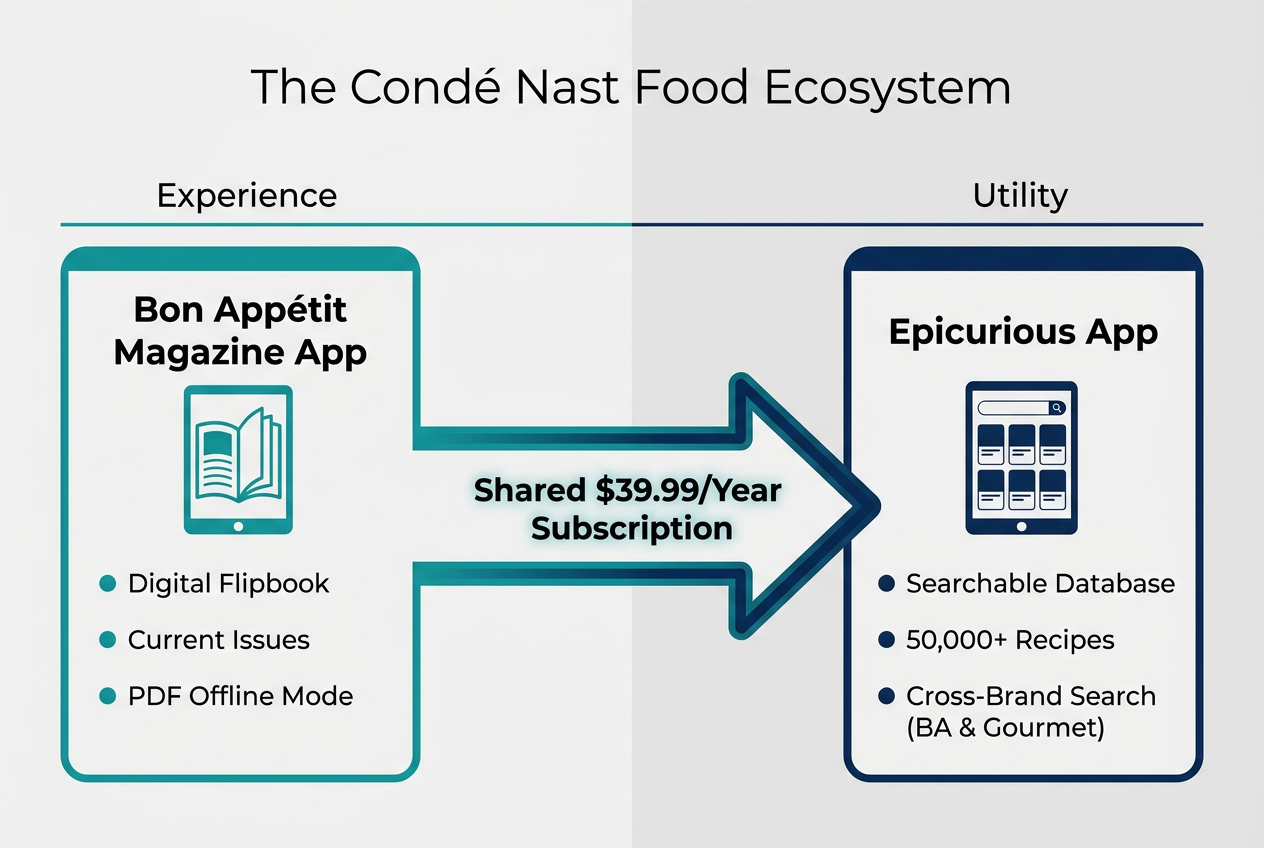 Understanding the BA ecosystem: Use the Magazine app for inspiration and the Epicurious app for functional recipe searching and kitchen utility.
| Feature | BA Magazine App | Epicurious App (BA Database) | NYT Cooking |
|---|---|---|---|
| Primary Format | Digital PDF Flipbook | Searchable Recipe Database | Searchable Recipe Database |
| Recipe Count | Current Issue Only (~12/month) | 50,000+ | 20,000+ |
| Annual Cost | ~$39.99 (Bundle) | ~$39.99 (Bundle) | ~$40.00 |
| Offline Mode | Yes (Full Issue Download) | No (Buggy as of 2026) | Yes (Reliable) |
| Search Functionality | None | Yes (Ingredient, Diet, Time) | Yes (Ingredient, Diet, Time) |
| Community Notes/Reviews | None | Yes (Desktop Better Than Mobile) | Yes (Best-in-Class Mobile UX) |
The confusion is compounded by inconsistent branding. When you search "Bon Appétit app" in the Apple App Store, you see two listings: one for the magazine and one for Epicurious. The Epicurious listing mentions BA in the description, but not prominently. Reddit threads from r/bon_appetit and r/Cooking are filled with users who downloaded the magazine app, couldn't find recipes, and assumed the subscription was a scam. It's not. It's just poorly explained.
If your goal is to cook BA recipes, you need the Epicurious app. If your goal is to read BA's editorial content in a magazine format, you need the BA Magazine App. Most serious foodies need both, which is why the subscription bundle exists. But the company does a terrible job communicating this upfront.
For those building a personal culinary database, understanding this distinction is critical. The magazine app is inspiration. The Epicurious app is execution.
Reach & Downloads: Is Bon Appétit Still the Culinary Arbiter?
Condé Nast reached a collective 54 million digital subscribers as of March 2026, with digital subscriptions across all properties growing 29% year-over-year in 2025. For context, that 29% growth rate outpaced legacy food media competitors and positioned Condé Nast as the second-largest digital publisher by subscription volume in the United States.
Bon Appétit's specific contribution to that total isn't publicly broken out, but indirect reach metrics tell the story: bonappetit.com receives approximately 4.9 million monthly visits as of May 2026, and the BA brand commands 18.1 million social media followers across platforms. That follower count is split primarily between Instagram (9.4 million), YouTube (6.8 million), and TikTok (1.9 million), making it one of the most digitally engaged food brands in the U.S. Interestingly, 49.6% of BA's social media traffic is driven by Reddit, where users congregate to discuss recipes, critique editorial decisions, and troubleshoot app issues.
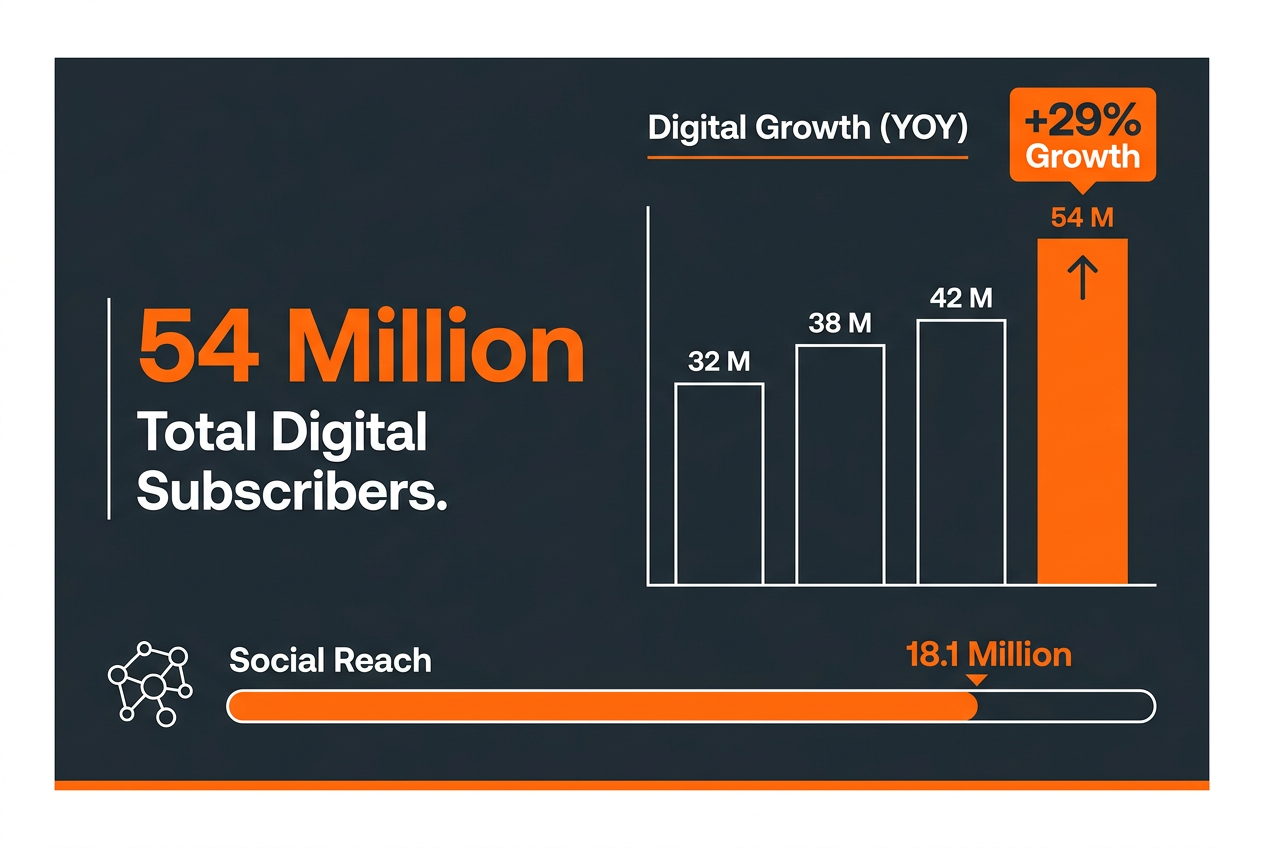 Bon Appétit continues to dominate the digital culinary space with massive year-over-year subscriber growth and an 18.1 million social media reach.
The Epicurious app, which houses the BA recipe archive, maintains a 4.7/5 star rating with over 99,000 user reviews on iOS - a volume of feedback that makes it one of the most reviewed cooking apps in the App Store. The standalone Bon Appétit digital edition app has a 4.4/5 star rating from 259 users, a significantly smaller but still positive sample.
How does this compare to the competition? The New York Times Cooking app, BA's primary rival, doesn't publicly disclose subscriber numbers, but independent analysis suggests NYT Cooking surpassed 1 million paying subscribers in 2023 and continues to grow. The NYT Cooking app holds a 4.8/5 rating with 290,000+ reviews, indicating higher user satisfaction and deeper market penetration. While BA's recipe database is 2.5x larger (50,000 vs. 20,000 recipes), NYT Cooking's mobile experience is consistently rated as superior.
The global recipe app market reached a valuation of $6.41 billion in 2025 and is projected to grow at a 13.1% CAGR through 2030, driven by increased smartphone adoption and the rise of home cooking post-pandemic. Within that market, subscription-based recipe services like BA/Epicurious and NYT Cooking represent the premium tier - users willing to pay for test kitchen reliability rather than rely on ad-supported blogs or free platforms like AllRecipes.
BA's reach, then, is substantial but not dominant. It's a legacy brand with a loyal following, but its app ecosystem lags behind competitors in UX polish. The question for potential subscribers is whether 50,000 test kitchen recipes justify the technical friction.
What Are Users Actually Saying? 2026 Review Analysis
The Epicurious app's 4.7/5 star rating looks solid at a glance, but recent reviews reveal a pattern: users love the recipe quality and hate the app's technical execution. A January 2026 review on the iOS App Store reads, "Best recipes, worst app. Constant login loops even after reinstalling. Half my saved recipes disappeared after the last update." Another from March 2026: "The white screen of death is back. Can't access my shopping list when I'm actually at the store."
These aren't isolated complaints. Sorting App Store reviews by "Most Recent" for the Epicurious app shows a consistent thread: the recipes are excellent, the app crashes frequently. A February 2026 one-star review states, "I've been a subscriber for three years and the app has gotten worse, not better. Search doesn't work half the time. Timer feature is useless because the app resets when you switch to another app."
The standalone Bon Appétit Magazine App fares slightly better technically - 4.4/5 from 259 reviews - but its smaller user base means fewer people are testing edge cases. The most common critique is that it's "just a PDF reader" with no added functionality. A December 2025 review notes, "I thought I was getting access to recipes. This is just the magazine. Can't search anything. Feels like a waste."
On Reddit, the sentiment is harsher. A highly upvoted thread from r/Cooking in November 2025 titled "Is the Bon Appétit subscription worth it?" contains replies like: "The recipes are great but the no-refund policy is predatory. If the app doesn't work for you, you're stuck." Another user wrote, "I cancelled after six months. Too many login issues and the search is terrible compared to NYT Cooking."
The technical complaints cluster around three specific issues:
- Persistent Login Loops: Users report being logged out mid-session and having to re-enter credentials multiple times per week, even with biometric authentication enabled.
- White Screen Crashes: The app loads to a blank white screen, requiring a force-quit and restart. This bug reappeared in the December 2025 update after being "fixed" in mid-2025.
- Offline Mode Failure: The Epicurious app advertises offline recipe access, but users report that saved recipes frequently fail to load without an internet connection - a critical failure for a kitchen tool.
Positive reviews emphasize the recipe quality, ingredient substitution suggestions, and the sheer volume of content. A four-star review from February 2026 reads, "If you can get past the bugs, this is the best recipe database available. Every BA recipe I've tried has worked perfectly." Another five-star review: "The shopping list feature is great when it works. I just wish it worked consistently."
For serious foodies evaluating whether to subscribe, the pattern is clear: the content is world-class, the container is broken. If you're willing to tolerate technical frustration for access to 50,000 test kitchen recipes, the subscription delivers. If you prioritize seamless mobile UX, NYT Cooking is the safer bet.
For anyone tracking their culinary experiences across platforms, the best food review apps offer alternatives that focus on dish-level memory rather than recipe databases.
Is the $39.99 Annual Subscription Worth It?
A single $39.99/year subscription to Bon Appétit grants access to both the BA Magazine App and the entire Epicurious recipe database - 50,000+ recipes, monthly digital magazine issues, and unlimited access to BA's editorial archive. For comparison, NYT Cooking costs $40/year and includes 20,000 recipes plus the Times' cooking newsletter. The recipe volume advantage is clear, but volume doesn't equal value if you can't access it reliably.
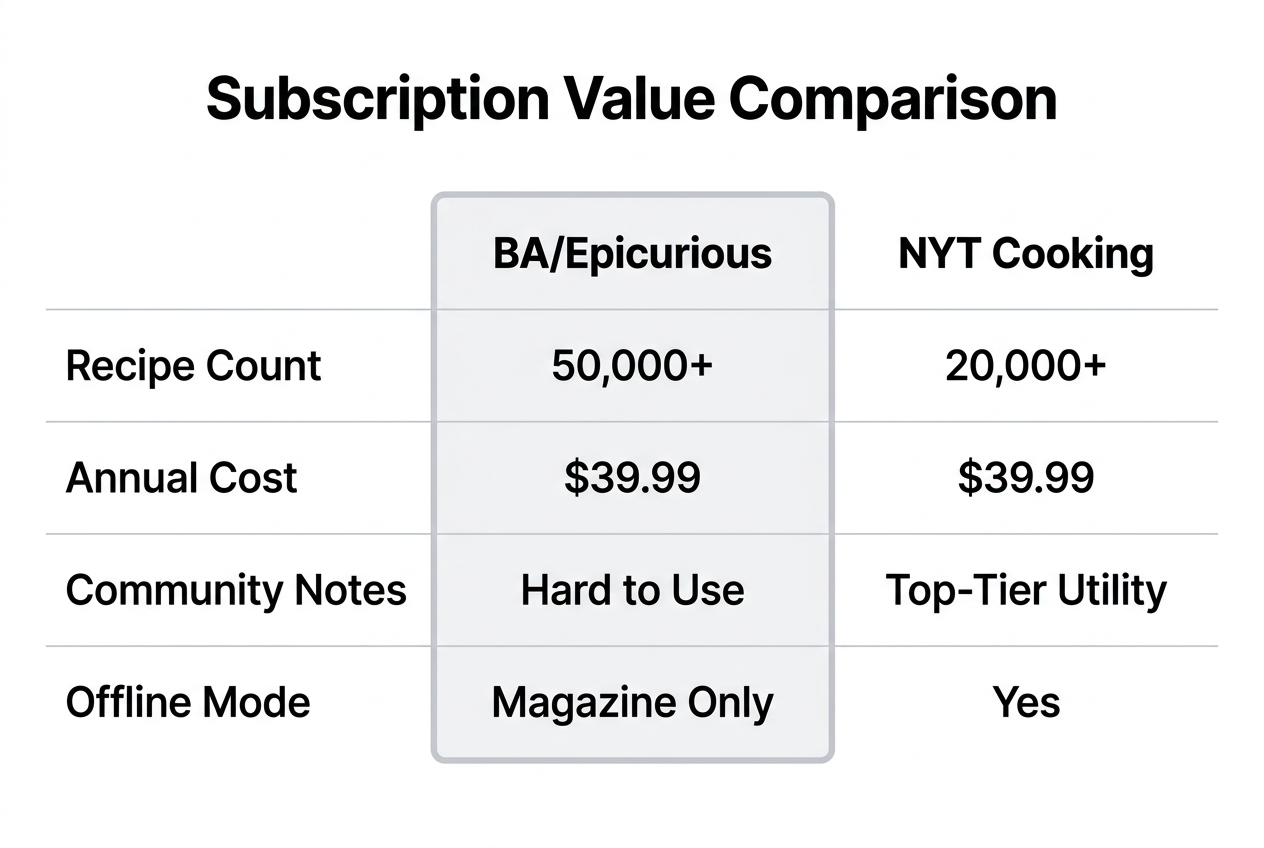 How the BA subscription stacks up: Weighing the massive 50,000-recipe library against the technical utility of its main competitor, NYT Cooking.
| Feature | BA/Epicurious Bundle ($39.99/year) | NYT Cooking ($40/year) |
|---|---|---|
| Recipe Database Size | 50,000+ | 20,000+ |
| Magazine Access | Yes (Full Digital Archive) | No |
| Mobile App Stability | 4.7/5 (Frequent Crashes) | 4.8/5 (Reliable) |
| Offline Recipe Access | Buggy | Reliable |
| Community Reviews/Notes | Yes (Desktop-Optimized) | Yes (Mobile-Optimized) |
| Grocery List Integration | Yes (Inconsistent Sync) | Yes (Seamless) |
| Test Kitchen Reliability | Industry-Leading | Industry-Leading |
| Free Trial Period | 7 Days | 7 Days |
| Refund Policy | No Refunds | Discretionary Refunds |
The value proposition hinges on two questions: Do you care about magazine content, and can you tolerate technical friction? If the answer to both is yes, BA/Epicurious offers more content per dollar. If you prioritize user experience, NYT Cooking wins decisively.
The "no refunds" policy is a significant consideration. Once you've paid, you're committed for the year, even if the app doesn't work on your device. Condé Nast's customer service team is notoriously difficult to reach, and Reddit is full of users who attempted chargebacks after the app failed to function. By contrast, the New York Times has a more flexible refund policy and responsive support.
One often-overlooked advantage of the BA/Epicurious bundle: the magazine itself is a curated inspiration engine. Each monthly issue features tested seasonal recipes, ingredient deep dives, and technique guides that don't exist in a pure recipe database. For users who want both culinary education and execution, the bundle makes sense. For users who just want dinner on the table, it's overkill.
A third option worth considering: free alternatives. AllRecipes, Serious Eats (free with ads), and Food52 all offer extensive recipe databases without a paywall. The trade-off is ad clutter, inconsistent test kitchen standards, and no curated editorial content. For the serious foodie building a personal restaurant library, the subscription model offers a level of reliability that free platforms can't match - if the app actually works.
The final calculus: $39.99/year is $3.33/month. If you cook from BA recipes more than once per month, the subscription pencils out. If you're a casual cook who mostly uses Pinterest and YouTube, it doesn't.
The Technical Reality: Bugs, White Screens, and Workarounds
The most frequently reported bug in the Epicurious app as of 2026 is the "white screen of death" - the app opens to a blank screen, no recipes load, and force-quitting doesn't resolve the issue. This bug was supposedly fixed in the July 2025 update, reappeared in December 2025, and remains unresolved for a subset of users as of March 2026.
The second most common issue: login loops. Users authenticate successfully, browse recipes, then get kicked back to the login screen mid-session. This happens even with "Remember Me" enabled and biometric authentication configured. A February 2026 support thread on the Epicurious website suggests the issue is related to session token expiration, but no permanent fix has been deployed.
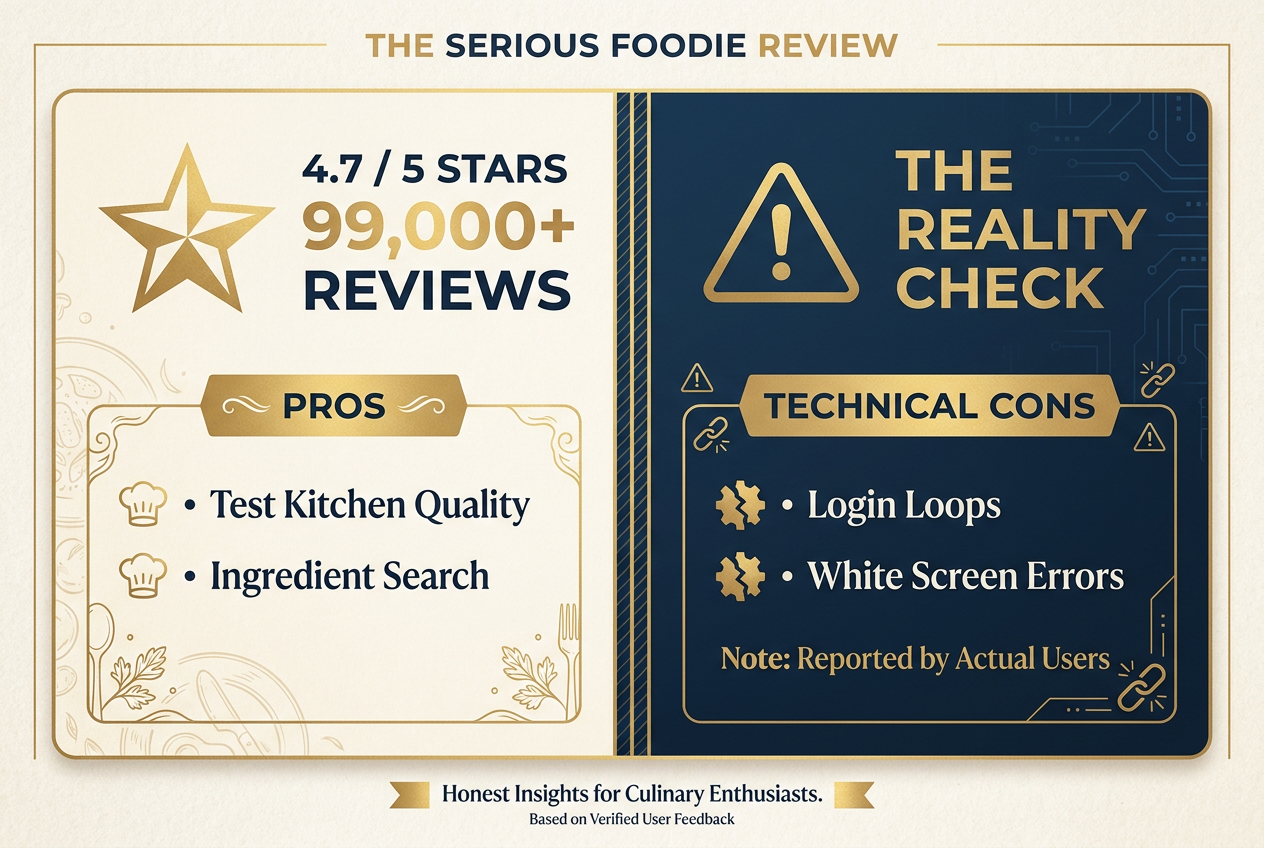 The user verdict: While the recipe quality and volume are industry-leading, technical bugs like login loops remain a point of friction for subscribers.
Workarounds that users report as effective:
- Clear Cache Weekly: Settings > Epicurious > Clear Cache. This resets the app's local data and often resolves white screen issues temporarily.
- Use Desktop for Browsing, Mobile for Cooking: Many users browse recipes on bonappetit.com or epicurious.com (desktop), save to their account, then access them on mobile only when actively cooking. This avoids triggering search bugs.
- Screenshot Critical Recipes: If you find a recipe you love, screenshot it. Offline mode is unreliable, and saved recipes sometimes vanish after app updates.
- Enable Airplane Mode After Loading: Once a recipe loads fully, toggle Airplane Mode on. This prevents the app from attempting to sync and potentially crashing.
- Reinstall Every 3 Months: A nuclear option, but some users report that deleting and reinstalling the app quarterly keeps it functional.
The shopping list feature - a standout when it works - has its own quirks. Ingredients don't always sync across devices, quantities sometimes disappear, and the feature requires constant internet connectivity to update. By contrast, NYT Cooking's shopping list is device-agnostic and works seamlessly offline.
One Reddit user in a March 2026 thread summarized the experience: "I love BA recipes. I hate the Epicurious app. I keep the subscription because I've memorized the workarounds, but if you're new, be prepared for a learning curve that has nothing to do with cooking."
For users committed to the BA ecosystem despite these issues, the best strategy is to treat the app as a reference tool, not a real-time kitchen assistant. Browse and save recipes when you have time and patience for technical issues. On cooking day, use screenshots or printed copies as your guide.
If you're evaluating whether this friction is worth enduring, consider exploring best apps to track restaurant meals as an alternative way to document your culinary journey without relying on a single platform.
How to Actually Use the BA Ecosystem for Serious Cooking
If you're subscribing to the BA/Epicurious bundle, here's the workflow that experienced users recommend for maximum utility:
Step 1: Install Both Apps Download the Bon Appétit Magazine App for editorial content and the Epicurious App for recipes. Sign into both with the same credentials. Verify your subscription is active in each app's settings.
Step 2: Use the Magazine for Inspiration, Epicurious for Execution When a new BA issue drops, read it in the Magazine App. Flag recipes you want to try. Then, open Epicurious and search for those recipes by name. Save them to your "Favorites" collection. This two-app workflow is clunky, but it's intentional - the magazine curates, the database delivers.
Step 3: Tag and Organize Aggressively The Epicurious app allows custom collections. Create categories like "Weeknight Dinners," "Dinner Party Showstoppers," and "Batch Cooking." BA recipes are often multi-step and time-intensive, so knowing which ones are 30-minute meals versus 3-hour projects saves decision fatigue on cooking day.
Step 4: Screenshot Before Cooking Before you start cooking, screenshot the recipe or print it. If the app crashes mid-recipe, you won't lose your place. This sounds absurd for a $40/year app, but it's the reality as of 2026.
Step 5: Use Desktop for Recipe Research The Epicurious website (epicurious.com) has a better search interface than the mobile app. Use it to find recipes by ingredient, dietary restriction, or prep time. Once you've identified winners, add them to your account via desktop, then access them on mobile when cooking.
Step 6: Adapt Recipes to Your Kitchen BA recipes are test kitchen perfect, which means they assume you have a stand mixer, a food processor, and a well-stocked pantry. If you don't, the "Community Notes" section (desktop-optimized) often includes user substitutions and shortcuts. These notes are gold - learn from others' trial and error.
Step 7: Track What Works The BA/Epicurious ecosystem doesn't have a built-in rating system for your personal cooking history. If you make a recipe and love it, save it to a dedicated collection or log it externally. Many serious foodies use tools like best apps to track favorite dishes to maintain a parallel archive of tried-and-true recipes.
Step 8: Exploit the Archive Your subscription includes access to decades of BA editorial content. Search the archive for ingredient deep dives (e.g., "miso," "anchovies") and technique guides ("how to break down a chicken"). This evergreen content is where the subscription's real value lives - not in the app's UX, but in the cumulative knowledge.
For urban professionals who cook 3-5 times per week, this workflow turns the BA ecosystem from a frustrating app into a functional culinary library. It requires intentionality, but the payoff is access to 50,000 recipes that actually work.
If you're building a broader system to remember every meal you've loved, consider reading how to build a personal restaurant library for strategies that extend beyond a single app.
Frequently Asked Questions
Does Bon Appétit Have a Recipe App?
Yes, but it's called Epicurious, not Bon Appétit. Bon Appétit's recipe archive - 50,000+ test kitchen recipes - is housed within the Epicurious app, which is owned by the same parent company, Condé Nast. When you purchase a Bon Appétit digital subscription, you gain access to both the Bon Appétit Magazine App (a digital flipbook) and the Epicurious App (the searchable recipe database). The confusion arises because the BA brand doesn't have a standalone recipe app; its culinary content lives inside Epicurious, alongside recipes from other Condé Nast properties.
Is the Epicurious App Worth It?
The Epicurious app is worth the $39.99/year subscription if you prioritize recipe volume and test kitchen reliability over mobile user experience. With access to 50,000+ recipes from Bon Appétit, Epicurious, and Gourmet magazines, it offers 2.5x more content than NYT Cooking at roughly the same annual cost. However, persistent bugs - including login loops, white screen crashes, and unreliable offline mode - make it a frustrating choice for users who need seamless mobile functionality. If you're willing to use desktop for browsing and mobile only for cooking (with workarounds), it's a valuable resource. If you expect a polished app experience, NYT Cooking is the safer alternative.
Does a Bon Appétit Subscription Include Epicurious?
Yes. A single $39.99/year Bon Appétit digital subscription grants full access to both the Bon Appétit Magazine App and the Epicurious recipe database. You receive monthly digital magazine issues, unlimited access to BA's editorial archive, and the ability to search, save, and cook from 50,000+ test kitchen recipes within the Epicurious app. This bundled model is Condé Nast's strategy for consolidating its culinary brands under one subscription, though the company does a poor job explaining this to new subscribers, leading to widespread confusion.
What Happened to Bon Appétit Magazine?
Bon Appétit magazine still exists as a monthly print and digital publication, but it underwent significant upheaval in 2020 following allegations of workplace racism and inequitable pay practices. Editor-in-Chief Adam Rapoport resigned, and several high-profile video personalities left the brand. In the years since, BA has rebuilt its editorial team, shifted toward a more diverse editorial voice, and doubled down on digital subscriptions as print advertising revenue declined. The magazine's reputation took a hit, but its culinary content - anchored by rigorous test kitchen standards - remains widely respected within the food media industry.
Why Did Everyone Quit Bon Appetit?
The 2020 exodus from Bon Appétit was triggered by a leaked photo of then-Editor-in-Chief Adam Rapoport in brownface at a Halloween party, which prompted BIPOC staff members to speak publicly about systemic pay inequities and a toxic workplace culture. Test kitchen stars Sohla El-Waylly, Priya Krishna, Rick Martinez, and others revealed they were paid significantly less than their white colleagues for video appearances, despite comparable screen time and audience engagement. Rapoport resigned, and several video personalities left the brand in solidarity. The scandal led to a broader industry reckoning about representation and compensation in food media, and Condé Nast has since hired a more diverse editorial team and restructured its video operations.
How Many Subscribers Does Condé Nast Have?
Condé Nast reached a collective 54 million digital subscribers across all its properties as of March 2026, with digital subscriptions growing 29% year-over-year in 2025. This total includes subscribers to The New Yorker, Wired, Vanity Fair, Bon Appétit, and other Condé Nast brands. The company does not publicly break out subscriber numbers for individual titles, but this aggregate figure positions Condé Nast as the second-largest digital publisher by subscription volume in the U.S., trailing only The New York Times.
Is Condé Nast Doing Well?
Condé Nast is financially stable and growing its digital subscription business, but it faces ongoing challenges in print advertising and physical circulation. The company's 29% year-over-year growth in digital subscriptions in 2025 demonstrates successful diversification away from legacy ad revenue, but it has also closed or sold several legacy titles (including Glamour's print edition) and implemented multiple rounds of layoffs. CEO Roger Lynch has described the company's strategy as "digital-first," prioritizing subscription growth over traditional print metrics. As of 2026, Condé Nast remains one of the most influential media companies in the U.S., but its health is tied to its ability to convert legacy brand equity into recurring digital revenue.
What Is the Best Food Review App?
The best food review app depends on whether you prioritize crowd-sourced restaurant reviews or personal dish tracking. For restaurant-level reviews, best food review apps like Google Maps, The Infatuation, and Beli dominate. However, these platforms focus on venues, not specific dishes. For serious foodies who want to track individual dishes and build a personal culinary database, best apps to track favorite dishes like Savor offer a different approach: dish-level memory, private ratings, and searchable photo libraries that go beyond generic star ratings.