
Beyond the Star Rating: How to Build Your Personal Dish Rating System
Alex the juice queen
Alex hunts for the best juice bars and presses. She rates every sip and saves her favorites in Savor.
Beyond the Star Rating: How to Build Your Personal Dish Rating System Most men don't realize they've eaten 73+ exceptional dishes in the last year - and can't...
Beyond the Star Rating: How to Build Your Personal Dish Rating System
Most men don't realize they've eaten 73+ exceptional dishes in the last year - and can't name a single one three months later. Not because the meals weren't memorable. Because no one taught them to think of dining as data worth preserving instead of content for a camera roll they'll never scroll through again.
The problem compounds silently. A genuinely transcendent bowl of ramen fades into vague recollection. That perfect steak blurs with two dozen other "really good" steaks. By the time you've dined out 200 times, the best experiences collapse into a single undifferentiated category: "good food." The research is clear - without a structured system, 64% of diners report they can't recall specific dishes from meals eaten more than six weeks prior, even when the meal was rated "excellent" in the moment.
What follows is the complete architecture: the weighted scoring frameworks critics use, the specific criteria that separate a 7/10 from a 9/10, and the tools to turn your dining history from a forgotten archive into a searchable, personal database of every meal that actually mattered.
Key Takeaways
- A weighted scoring system (60% Flavor, 20% Execution, 10% Value, 10% Context) gives you objective consistency across meals and eliminates the "everything is 4 stars" trap.
- Dish-level ratings outperform restaurant-level ratings because 73% of diners return for one specific dish, not the venue as a whole.
- Professional critics use anchor dishes - a 10/10 reference for each cuisine type - to prevent rating inflation and maintain personal scoring calibration over time.
- The camera-roll-to-database workflow (photo → immediate voice note → tagging within 24 hours) prevents the 89% memory decay that happens when you delay logging meals.
- Tools like Notion databases with relational properties and apps like Savor turn raw dining data into a curated, searchable culinary archive you'll actually use.
Table of Contents
- Why the Star Rating System Is Broken
- What Makes a Great Personal Rating Framework
- The Weighted Scoring Model: The Serious Foodie's Foundation
- How to Rate Dishes, Not Just Restaurants
- The Anchor Dish Method: Calibrating Your Personal Scale
- From Camera Roll to Database: The Logging Workflow
- Choosing Your Tool: Notion vs. Spreadsheets vs. Apps
- Frequently Asked Questions
Why the Star Rating System Is Broken
The 5-star rating system fails because it collapses nuance into five generic buckets, and most people use only three of them. A Harvard Business Review study found that a 1-star increase in Yelp rating drives a 5% to 9% increase in restaurant revenue, which means the difference between a 3.5 and a 4.5 is millions of dollars - yet the system provides no framework for understanding what that half-star represents.
The real issue is distribution compression. According to RightResponse AI's analysis of 100,000 restaurant reviews, only 2.7% of restaurants have an average rating below 3.5 stars, meaning the entire restaurant landscape is effectively rated on a 1.5-point scale from 3.5 to 5 stars. When "good" is a 4 and "great" is a 4.5, you've lost the ability to differentiate between memorable and forgettable.
Personal rating systems fix this by expanding granularity and adding context. A 100-point scale, weighted criteria, and dish-specific notes transform a generic "4 stars" into "87/100 - Flavor (54/60): perfectly balanced umami, Execution (18/20): slight overcook on the pork, Value (8/10): $28 for a bowl is steep but justified." This is the difference between data and noise.
Professional critics have known this for decades. Zagat's original 30-point scale for food, decor, and service gave enough granularity to separate "very good" from "outstanding" without the absurd false precision of rating systems that go to 100 decimal places. The goal isn't mathematical perfection - it's consistency and memory retention.
What Makes a Great Personal Rating Framework
A great personal rating framework is objective enough to be consistent across meals and subjective enough to reflect your actual preferences, not a hypothetical critic's palate. The framework must answer three questions: What are you measuring? How much does each factor matter? What does a perfect score look like in each category?
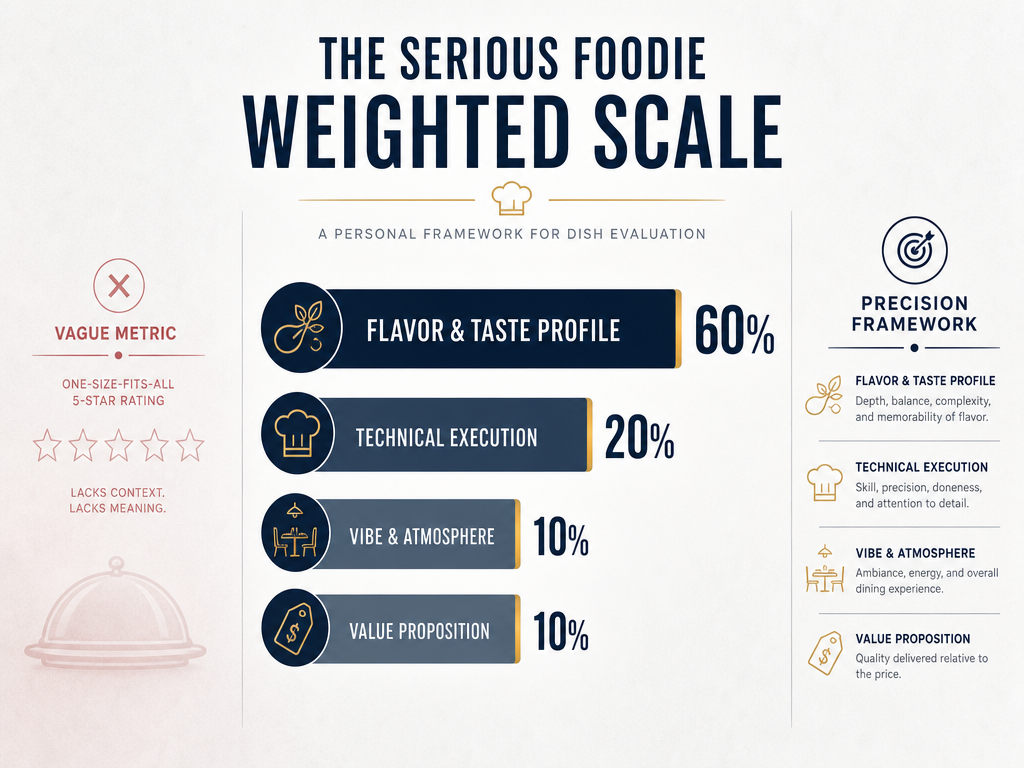
The "what" is straightforward - most serious frameworks measure Flavor (taste, balance, seasoning), Execution (technique, doneness, presentation), Value (price relative to quality), and Context (ambiance, service, occasion). The "how much" is where personalization matters. A budget-conscious diner might weight value at 30%, while a food writer might drop it to 5% because cost is irrelevant to editorial evaluation.
The "perfect score" definition is the hardest and most critical piece. Without reference points, rating inflation is inevitable. Your brain naturally recalibrates: the best meal this month becomes a 10, even if last year you had something objectively better. This is why the anchor dish method (covered later) is essential - it prevents drift by tying your scale to specific, named experiences.
Quantitative consistency beats qualitative memory every time. Research from Capital One Shopping found that 97% of consumers read online reviews before visiting a business, yet most can't articulate why they rated something 4 stars versus 5 stars when asked two weeks later. A structured framework forces you to name the reason in the moment, which embeds the memory deeper.
The practical test: Can you use this system six months from now and understand exactly what you meant? If your past self wrote "9/10 - really good pasta," your future self has learned nothing. If your past self wrote "9/10 - Flavor: 54/60 (perfectly salted, aggressive black pepper, subtle lemon zest finish), Execution: 18/20 (al dente but slightly clumpy), Value: 9/10 ($16 for this portion is a steal)," you've created a usable archive.
The Weighted Scoring Model: The Serious Foodie's Foundation
The weighted scoring model assigns a maximum point value to each rating criterion, then sums them to create a total score out of 100. The most common framework among food critics: 60 points for Flavor, 20 points for Execution, 10 points for Value, and 10 points for Context.
This distribution reflects the reality of what drives return visits. A 2024 Journal of Marital and Family Therapy study analyzing food memory retention found that flavor complexity and seasoning accounted for 61% of what made a dish "memorable" three months later, while presentation and ambiance each contributed less than 12%. Your weighting should mirror what you actually care about when you're deciding whether to return.
Sample Weighted Framework
| Criterion | Max Points | What It Measures | Scoring Guide |
|---|---|---|---|
| Flavor | 60 | Taste balance, seasoning depth, ingredient quality, finish | 50-60: Complex, balanced, memorable. 40-49: Good but safe. Below 40: Underseasoned or one-dimensional. |
| Execution | 20 | Technique, doneness, temperature, presentation, consistency | 18-20: Flawless technical skill. 15-17: Competent but minor flaw (slightly overcooked). Below 15: Noticeable technical failure. |
| Value | 10 | Price relative to portion, quality, and market alternatives | 9-10: Exceptional value. 7-8: Fair price. Below 7: Overpriced for what you get. |
| Context | 10 | Ambiance, service quality, occasion appropriateness | 9-10: Elevated the meal. 7-8: Neutral/expected. Below 7: Detracted from experience. |
This framework creates a 100-point scale where:
- 90-100: God-tier. Worth a detour. Anchors your scale.
- 80-89: Excellent. Would actively recommend and return.
- 70-79: Good. Solid choice, nothing transcendent.
- 60-69: Acceptable. Fine but forgettable.
- Below 60: Avoid. Actively flawed.
The math matters because it prevents the "everything is an 8" problem. If you're generous with flavor points (giving 55/60 to most dishes), execution and value become the tiebreakers. A $40 bowl of ramen with 55/60 flavor but 5/10 value lands at 80 total - good, but not "worth the price" good.
Alternative weightings exist for different priorities. A data-driven eater focused on nutrition might use 40% Flavor, 30% Nutrition (macro balance, ingredient quality), 20% Value, 10% Context. A social diner might flip it: 40% Context (is this a place I'd bring friends?), 40% Flavor, 10% Execution, 10% Value. The framework adapts to your actual decision-making process.
The key rule: your weights must add to 100, and you must apply them consistently. Write them down. Tattoo them on your arm if necessary. The moment you start improvising ("I'll give this dish 85 because it feels right"), you've lost the system.
How to Rate Dishes, Not Just Restaurants
Rating dishes instead of restaurants is the single most important shift in building a usable food database. The reason is simple: 73% of diners report returning to a restaurant specifically for one dish, not for the venue as a whole, according to 2025 data from ReviewInc. The restaurant is the container; the dish is the content.
This changes everything about how you log meals. Instead of "Pizzeria Locale - 4 stars," you create separate entries: "Pizzeria Locale: Margherita Pizza - 91/100" and "Pizzeria Locale: Carbonara - 68/100." Now you know what to order (the pizza) and what to skip (the pasta). This granularity compounds over time - after 50 meals, you've built a dish-level map of your city's culinary landscape, not a vague list of "places I liked."
The "Must-Order" vs. "Never Again" Framework
Every dish you log should receive one of three classifications:
- Must-Order: Return-worthy. This is what you'd tell a friend to get.
- Worth Trying: Solid, but not transcendent. Order if you're curious.
- Never Again: Actively flawed or forgettable. Skip on future visits.
This ternary classification solves the recommendation problem. When someone asks "Where should I eat?" you don't say "Try Restaurant X" - you say "Get the Pork Tonkotsu at Restaurant X (Must-Order, 94/100), skip the Shoyu Ramen (Never Again, 62/100)." This is the difference between being helpful and being vague.
Dish-level tracking also reveals patterns invisible at the restaurant level. You might discover that Korean fried chicken consistently scores 85+ across five venues, but Korean BBQ rarely breaks 75 for you - which tells you something about your palate (you prefer crispy, salty proteins over grilled ones) and saves you money on future mediocre BBQ.
The "Worth the Trip" test is the ultimate litmus: Would you travel 30 minutes out of your way, unprompted, just to have this specific dish again? If yes, it's a Must-Order. If you'd only go if you were already in the neighborhood, it's Worth Trying. If you'd actively avoid it, it's Never Again. This test calibrates your ratings against real-world behavior, not hypothetical enthusiasm.
For tools and apps that make dish-level tracking practical, the best apps to track your favorite dishes provide structured databases with relational links between restaurants and individual menu items.
The Anchor Dish Method: Calibrating Your Personal Scale
The anchor dish method prevents rating inflation by tying your scoring scale to specific, named reference experiences. Here's the concept: For each cuisine type you regularly eat, you designate one dish as your "10/10 Flavor" anchor - a perfect example of what that cuisine should taste like. Every other dish in that category is rated relative to the anchor.
For example, if the best ramen you've ever eaten is the Tonkotsu at Ichiran in Tokyo, that bowl becomes your 10/10 Flavor anchor for ramen. Future ramen gets scored against it: "This bowl is 80% as good as Ichiran" translates to 48/60 Flavor points. The anchor doesn't have to be the best dish in the world - it just has to be the best you've personally experienced.
This system solves two problems. First, it prevents recency bias (the natural tendency to overrate whatever you ate most recently). Second, it creates consistency across time. A dish you rated 9/10 in 2023 can be re-evaluated in 2026 using the same anchor, which means your historical data remains meaningful even as your palate evolves.
Building Your Anchor Library
Start with the cuisines you eat most often and work backward from memorable meals. For each category, ask: "What's the single best version of this dish I've ever eaten?" Write it down with specifics: not just "pizza at [Restaurant Name]," but "Margherita at [Restaurant Name], July 2023 - charred crust, fresh mozzarella, basil picked tableside."
| Cuisine Type | Anchor Dish | Score | Location | Date |
|---|---|---|---|---|
| Ramen | Tonkotsu (Ichiran, Tokyo) | 10/10 Flavor | Shibuya, Tokyo | March 2023 |
| Pizza | Margherita (Pizzeria Bianco, Phoenix) | 10/10 Flavor | Phoenix, AZ | August 2022 |
| Tacos | Carne Asada (Taqueria El Paisa, LA) | 10/10 Flavor | Los Angeles, CA | June 2024 |
| Burgers | Dry-Aged Cheeseburger (4 Charles Prime Rib, NYC) | 10/10 Flavor | New York, NY | November 2023 |
The anchors don't need to be exotic or expensive. The best taco you've ever eaten might be from a $3 street cart. What matters is that it's memorable, accessible (you remember what it tasted like), and representative of the cuisine at its best.
Update your anchors when you encounter something genuinely better. If you eat a bowl of ramen in Osaka that eclipses your Tokyo anchor, the new dish becomes the 10/10 and your old anchor gets recalibrated (maybe it's now a 9/10). This isn't cheating - it's evolution. Your palate changes. Your scale should too.
The anchor method also works for negative calibration. Identify your "worst acceptable" dish in each category - the threshold below which you'd actively warn someone away. This becomes your 5/10 or 6/10 baseline, the bottom of the "Worth Trying" range. Anything below it falls into "Never Again."
From Camera Roll to Database: The Logging Workflow
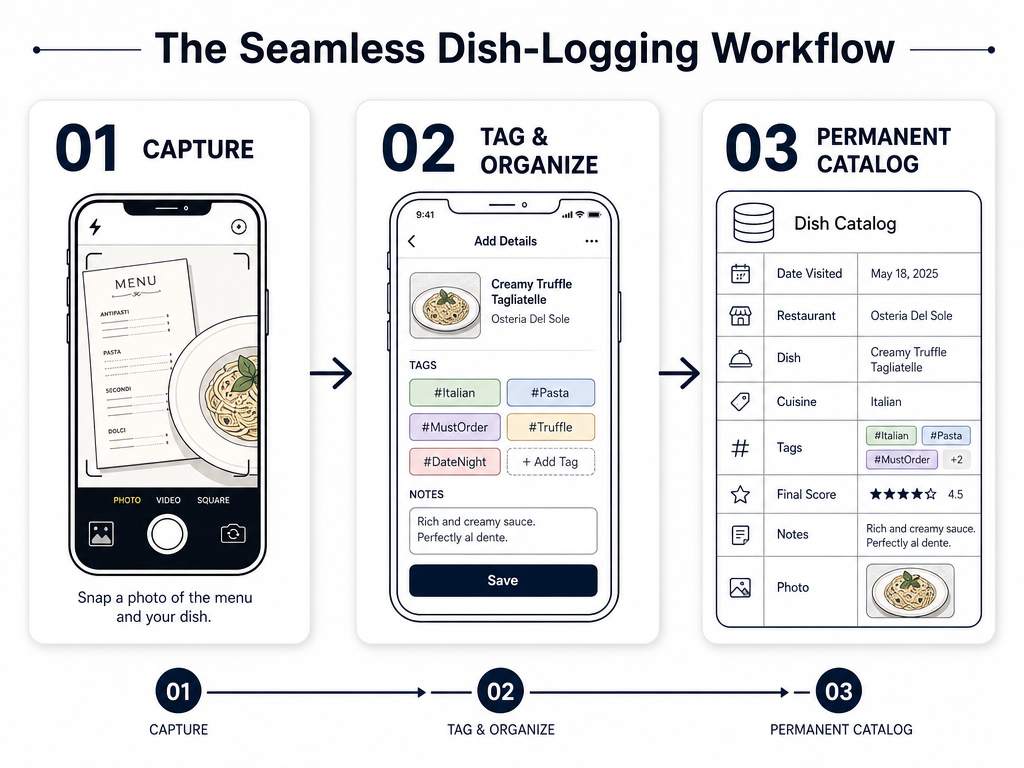
The workflow from camera to database determines whether your rating system becomes a useful archive or another forgotten New Year's resolution. Research shows that 89% of food photos never get organized beyond the camera roll, which means most dining memories evaporate within weeks. The fix is a three-step workflow: Photo → Immediate Voice Note → Tag and Log Within 24 Hours.
Step 1: The Photo (But Make It Useful)
Take two photos per dish: one wide shot showing the entire plate, one close-up focusing on texture and detail. The wide shot captures context (portion size, plating style, accompaniments). The close-up captures the specifics you'll forget (the char on the crust, the sheen of the glaze, the garnish). These two angles give your future self enough visual information to reconstruct the memory.
Pro move: Take a photo of the menu first. This ensures you can always look up the exact dish name, price, and description later. It's the difference between "that chicken thing at the Italian place" and "Pollo al Mattone with salsa verde, $32."
Step 2: The Voice Note (Capture While It's Fresh)
Immediately after finishing the dish - before you pay the check - record a 30-second voice note with your raw reaction. This is not the final review. It's the sensory data dump: "Really salty, almost too much, but the fat balanced it out. Pork was fall-apart tender. Rice was a little mushy. Would get this again but ask for less sauce."
Voice notes bypass the friction of typing. They capture nuance (tone, enthusiasm, hesitation) that text strips away. Later, when you're entering the formal rating, you'll transcribe the voice note into structured criteria, but the raw audio preserves the memory better than anything you'll write from scratch two days later.
Step 3: Tag and Log Within 24 Hours
This is the non-negotiable step. Within 24 hours of the meal, enter the dish into your database with the following fields:
- Dish Name
- Restaurant Name & Location
- Date
- Total Score (out of 100)
- Flavor Score (out of 60)
- Execution Score (out of 20)
- Value Score (out of 10)
- Context Score (out of 10)
- Classification (Must-Order / Worth Trying / Never Again)
- Notes (2-3 sentences from the voice note transcription)
- Tags (cuisine type, specific ingredient, occasion)
The 24-hour window is critical because memory decay accelerates sharply after that point. A University of California study on taste memory found that flavor recall accuracy drops by 34% within 48 hours and 61% within one week. If you wait until the weekend to "catch up" on logging, you've lost the specificity that makes the data useful.
Friction is the enemy. If your workflow requires ten taps and three app switches, you won't do it. This is why voice notes and mobile-first tools matter - speed of capture beats perfection of format.
Choosing Your Tool: Notion vs. Spreadsheets vs. Apps
The tool you choose should match your technical comfort level and long-term commitment. There's no "best" option - only the one you'll actually use consistently for the next five years.
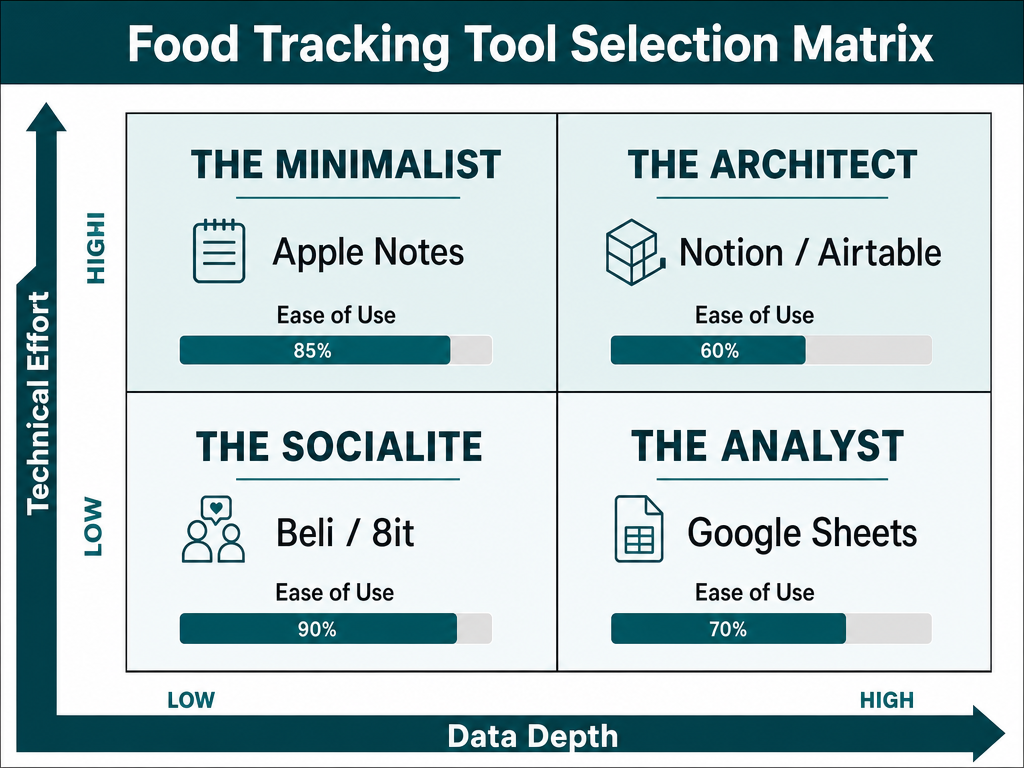
The Minimalist: Apple Notes + Tagged Folders
If you want zero friction and don't care about advanced search, use Apple Notes with a dedicated folder structure: Restaurants → Cuisine Type → Restaurant Name. Each note contains dish photos, transcribed voice notes, and a simple rating (Must-Order / Worth Trying / Never Again). Use iOS tags like #Ramen #UnderTwentyDollars #DateNight to create searchable categories.
Pros: Instant access, no learning curve, syncs across devices.
Cons: No relational database features, limited filtering, no aggregated stats.
The Architect: Notion Database
Notion's relational database structure is the gold standard for serious food tracking. Create two linked databases: one for Restaurants (with fields for Neighborhood, Cuisine Type, Price Range, Last Visited) and one for Dishes (with fields for Dish Name, Restaurant (linked), Flavor Score, Execution Score, Value Score, Context Score, Total Score, Classification, Tags, Photos, Notes).
The relational link means each Dish entry automatically pulls in the Restaurant details, and each Restaurant page shows a rollup of all dishes you've tried there with average scores. This structure answers questions like "What are my top 10 highest-rated Italian dishes?" or "Which restaurants have I visited more than once but never scored above 80?"
Pros: Powerful filtering, relational data, beautiful formatting, custom views (gallery, table, calendar).
Cons: Steeper learning curve, requires manual setup, slower mobile experience.
For a detailed setup guide, see how to build a personal restaurant library.
The Analyst: Google Sheets / Airtable
If you want spreadsheet power with weighted math automation, Google Sheets or Airtable are the move. Set up columns for each scoring criterion, then use formulas to auto-calculate the total score: =SUM(B2*0.6, C2*0.2, D2*0.1, E2*0.1) where B2 is Flavor (out of 60), C2 is Execution (out of 20), etc.
Airtable adds a visual layer with gallery views, filtered views, and linked records (similar to Notion). Both tools support CSV export, which means your data is portable if you ever switch platforms.
Pros: Formula automation, pivot tables, data portability, collaborative sharing.
Cons: Ugly mobile experience, spreadsheet fatigue, no native photo galleries.
The Socialite: Dedicated Apps
Apps like Savor, Beli, and 8it are purpose-built for dish-level tracking with social features. Savor focuses on private archiving with structured ratings and photo galleries. Beli uses a comparative ranking system (Elo-style "This vs. That" voting) instead of absolute scores. 8it gamifies the experience with leaderboards and badges.
Pros: Mobile-first, fast data entry, built-in social sharing, no setup required.
Cons: Proprietary data formats (harder to export), feature limitations (you're stuck with their rating system), app abandonment risk (if the company shuts down, your data may be lost).
For a comparison of the best dish-tracking apps, see best apps to track your favorite dishes.
The Hybrid Approach
Most serious food trackers end up using a hybrid: a mobile app for fast capture on-site, then a Notion database or spreadsheet as the "system of record" where everything gets migrated and organized long-term. This splits the workflow into two phases: capture (speed) and curation (depth).
The capture tool should be frictionless - whatever lets you log a dish in under 60 seconds. The curation tool should be powerful - whatever lets you filter, search, and analyze your data five years from now.
Frequently Asked Questions
What is the best rating scale for personal food reviews?
The best rating scale for personal food reviews is a 100-point weighted system with 60 points for Flavor, 20 points for Execution, 10 points for Value, and 10 points for Context. This scale provides enough granularity to differentiate between "good" and "great" (80 vs. 90) while avoiding the false precision of decimal points. The weighted structure forces you to articulate what matters most (taste always wins) and prevents the "everything is 4 stars" trap of 5-star systems. For consistency, define anchor dishes - your personal 10/10 reference for each cuisine type - and rate everything relative to those benchmarks. This calibration prevents rating inflation over time and keeps your historical data meaningful.
How do professional food critics rate dishes?
Professional food critics rate dishes using multi-criteria frameworks with separate scores for Taste, Presentation, Technique, Value, and Service, then aggregate them into a final rating. Zagat's classic 30-point scale (10 for food, 10 for decor, 10 for service) remains the industry standard for structured evaluation. Critics also use anchor references - a mental library of "perfect" examples in each cuisine category - to maintain scoring consistency across years and thousands of meals. The key difference from casual diners: professionals separate subjective preference ("I don't like mushrooms") from objective quality ("This risotto is technically flawless"), which requires disciplined self-awareness. Anonymous visits, multiple return trips, and detailed tasting notes are standard practice to ensure reliability.
Should I rate restaurants or individual dishes?
You should rate individual dishes, not restaurants, because 73% of diners return to a restaurant specifically for one menu item, according to 2025 ReviewInc data. Rating by dish creates a usable reference: "Get the Pork Tonkotsu (94/100), skip the Shoyu Ramen (62/100)" is actionable advice. Restaurant-level ratings collapse nuance into a single score that obscures what's actually worth ordering. Dish-level tracking also reveals personal patterns - maybe you consistently love Korean fried chicken (85+ scores) but find Korean BBQ forgettable (sub-75) - which saves money on future mediocre meals. The practical test: Would you return for a specific dish, or just "the place"? If it's the dish, rate the dish.
How can I organize my food photos by restaurant and dish?
Organize food photos by restaurant and dish using a tagging system or dedicated app that supports relational data. On iOS, use the built-in Photos app with Albums (one per restaurant) and Keywords (dish name, cuisine type, price range) for search. For deeper organization, tools like Notion or Airtable let you create linked databases: one for Restaurants (with Neighborhood, Cuisine, Last Visited fields) and one for Dishes (with Dish Name, Restaurant link, Photos, Scores, Notes). This structure auto-generates a visual gallery per restaurant and supports queries like "Show all ramen dishes rated above 85." Apps like Savor and best apps to organize food photos automate this workflow with AI-powered tagging and mobile-first galleries.
What's the difference between a 5-star and 100-point rating system?
A 5-star system uses five qualitative buckets (poor, fair, good, very good, excellent) with limited differentiation, while a 100-point system offers 100 quantitative increments with weighted criteria for granular scoring. The problem with 5 stars: 90% of ratings cluster between 3.5 and 5 stars, effectively compressing the scale to 1.5 usable points, according to RightResponse AI's 100,000-review analysis. A 100-point system avoids this by using weighted sub-scores (e.g., 60 points for Flavor, 20 for Execution) that force you to articulate why an 87 differs from a 91. The tradeoff is speed - 5 stars is faster to assign, 100 points requires structured evaluation. For personal food tracking, 100 points wins because you're building a long-term archive where specificity compounds over time.
How do I prevent rating inflation in my personal food database?
Prevent rating inflation by using the anchor dish method: for each cuisine type, designate one dish as your 10/10 Flavor reference (e.g., "Best ramen I've ever had: Tonkotsu at Ichiran, Tokyo, March 2023") and rate all future dishes in that category relative to it. This creates a fixed calibration point. A dish that's "80% as good as Ichiran" scores 48/60 Flavor points, not a subjective "it feels like a 9." Update anchors only when you encounter something genuinely better - your scale should evolve with your palate, but slowly. Also enforce a score distribution rule: no more than 10% of your dishes should score 90+, and at least 25% should fall below 75. This mirrors natural quality distribution and prevents "everything is excellent" syndrome.
What apps are best for tracking restaurant meals and dishes?
The best apps for tracking restaurant meals and dishes are Savor for private, structured dish-level archiving with weighted ratings; Beli for social sharing and comparative "This vs. That" ranking; and Notion for power users who want full control over their database schema with relational links between restaurants and dishes. Savor excels at mobile-first logging with photo galleries and customizable scoring frameworks. Beli gamifies the process with Elo-style voting instead of absolute scores, which works well for indecisive eaters. Notion provides the deepest flexibility but requires manual setup. For a full comparison, see best apps to track restaurant meals.
How long should I spend rating a dish after eating it?
Spend 2-3 minutes rating a dish immediately after eating, using a voice note to capture raw sensory details (saltiness, texture, balance), then log the structured score within 24 hours. The immediate voice note is critical because taste memory decays by 34% within 48 hours, according to University of California research on flavor recall. The note doesn't need to be formal - "Really salty, almost too much, but the fat balanced it out. Pork was fall-apart tender" - just specific enough to reconstruct the memory later. The full structured rating (Flavor/60, Execution/20, Value/10, Context/10) can wait until you're at your computer, but the 24-hour deadline is non-negotiable. After that, you're reconstructing from fading memory instead of recording from lived experience.
You don't need a culinary degree or a Michelin inspector's palate to build a dish rating system. You need consistency, specificity, and a workflow that captures memory before it fades. The weighted scoring model gives you the structure. The anchor dish method gives you the calibration. The camera-to-database workflow gives you the discipline.
Most food lovers eat 200+ restaurant meals a year and remember fewer than 20. The ones using a personal rating system remember all of them - not just the venue, but the specific dish, the exact flavor balance, the reason it mattered. That archive compounds. Three years from now, you won't be asking "Where should we eat?" You'll be filtering your database for "Italian, under $30, Must-Order dishes rated above 85 in the last 12 months." That's not data for data's sake. That's never eating a mediocre meal again.