
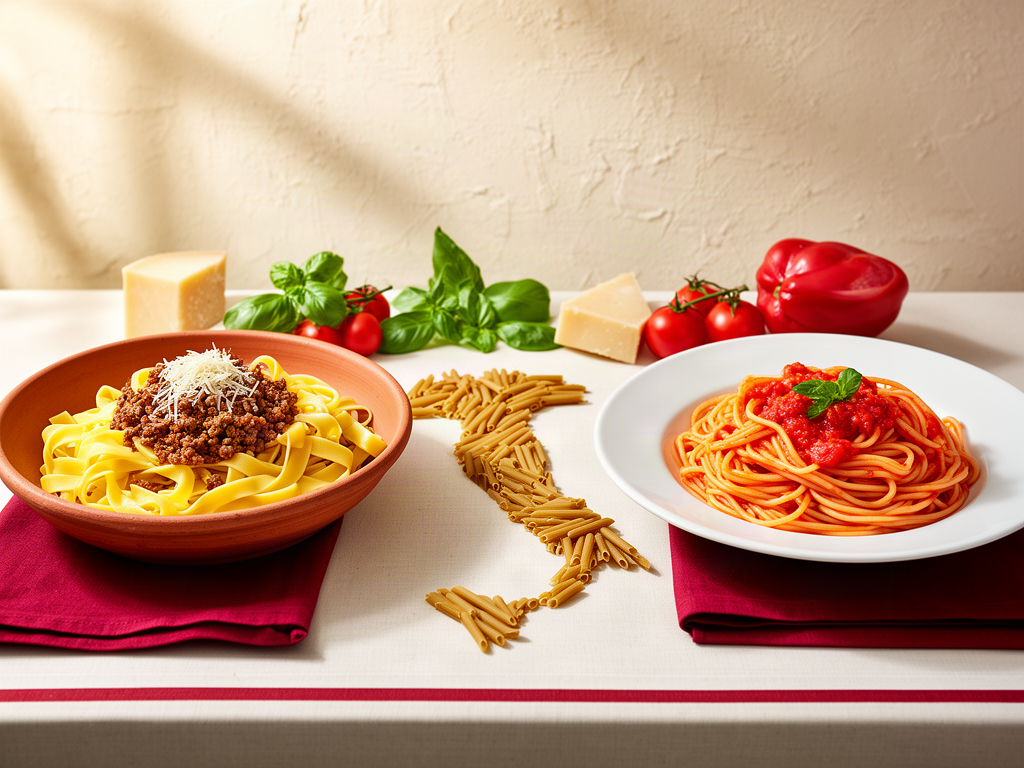
The Great Pasta Map: How Italian Cities Built Entirely Different Culinary Languages
Alex the juice queen
Alex hunts for the best juice bars and presses. She rates every sip and saves her favorites in Savor.
The Great Pasta Map: How Italian Cities Built Entirely Different Culinary Languages Three months after Rome, you're trying to remember the name of that...
The Great Pasta Map: How Italian Cities Built Entirely Different Culinary Languages
Three months after Rome, you're trying to remember the name of that life-changing carbonara. You can picture the plate, the way the egg yolk clung to the noodles, the exact pepper-to-pecorino ratio. But which trattoria was it? And why did the "carbonara" you tried in Naples taste nothing like it?
Here's what most food guides won't tell you: Italian pasta isn't one thing. It's a collection of regional dialects, each with its own grammar, vocabulary, and unbreakable rules. A plate of pasta in Bologna follows completely different laws than one in Naples, and those differences aren't just tradition - they're engineering.
This is your technical field guide to the pasta cities of Italy, organized by the logic that actually governs what ends up on your plate.
Table of Contents
- The Technical Divide: Bologna vs. Naples
- The Roman Big Four Logic
- The Functional Geography of Shapes
- The Serious Foodie's Unwritten Rules
- Dining Like a Local: Reading the Menu
- Frequently Asked Questions
The Technical Divide: Bologna vs. Naples
The deepest fault line in Italian pasta runs roughly through Florence. Above it, pasta is soft, yellow, and built to trap fat. Below it, pasta is hard, bronze, and engineered for oil.
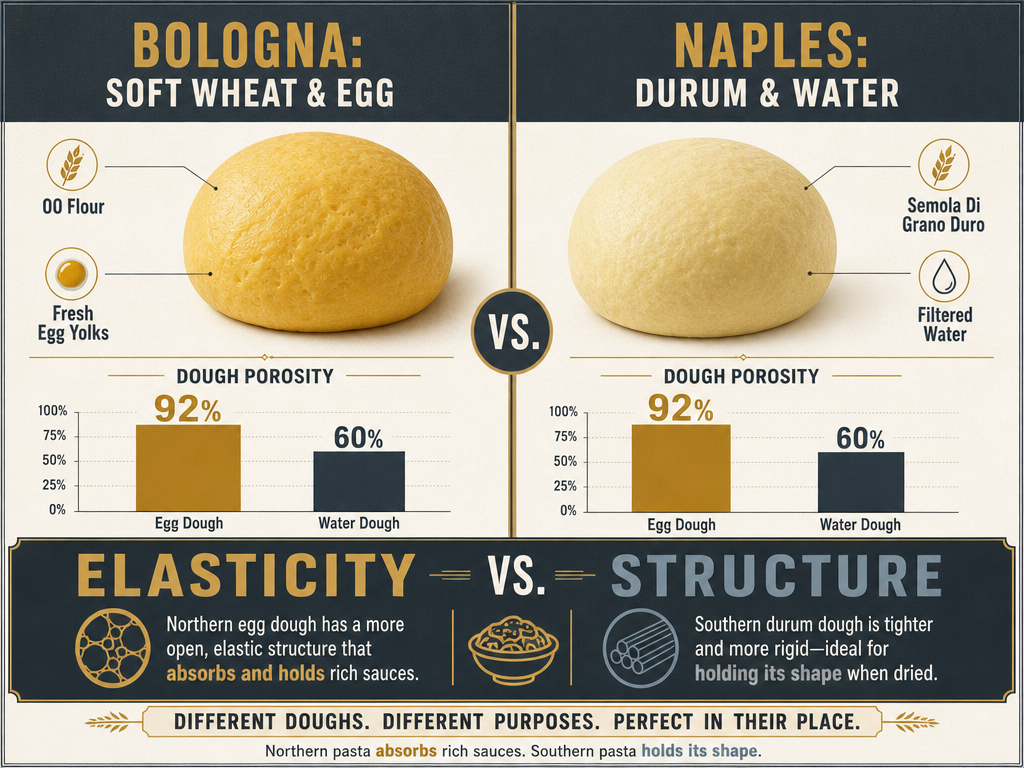 Understanding the technical foundation of pasta: The high porosity of egg-based dough in Bologna is specifically engineered to absorb heavy, fat-based meat sauces.
Bologna: The Architecture of Egg and "00" Flour
Bologna's pasta is built by sfogline - women who've spent decades mastering the sheets of fresh egg dough that define Emilia-Romagna's cuisine. The dough uses "00" flour (a superfine soft wheat) and a high ratio of egg yolks to flour. This creates a porous, tender texture that functions like a sponge.
That porosity isn't accidental. According to the Italian Academy of Cuisine, which registered the official recipe for Ragù alla Bolognese at the Bologna Chamber of Commerce on October 17, 1982, the ragù must be paired with tagliatelle because the rough, egg-based surface is required to physically hold the meat sauce. Smooth spaghetti lets it slide off.
The key dishes:
- Tagliatelle al Ragù: Ribbons of fresh pasta with a slow-cooked meat sauce of ground beef, pork, tomato, and milk
- Tortellini in Brodo: Tiny stuffed pasta parcels served in clear capon broth - the official recipe, registered in 1974, specifies pork loin, prosciutto, mortadella, Parmesan, egg, and nutmeg
- Lasagne alla Bolognese: Layered sheets of egg pasta with ragù, béchamel, and Parmigiano-Reggiano
Naples and the South: The Physics of Bronze Dies
Southern pasta is a different creature entirely. It's made with semola di grano duro - durum wheat semolina - and water, with no eggs. The dough is extruded through bronze dies, which leave a rough, pockmarked surface. This texture grabs onto oil-based sauces and seafood broths in ways that smooth, Teflon-extruded pasta can't match.
The durum wheat also changes the structure. It has a higher protein content than soft wheat, which creates a firmer bite when cooked al dente. That resistance isn't just texture - it's a requirement for the way these dishes are built.
The key dishes:
- Spaghetti alle Vongole: Spaghetti with clams, garlic, white wine, and olive oil
- Pasta alla Genovese: A Neapolitan slow-cooked onion and beef ragù (not to be confused with Genoa's pesto)
- Orecchiette con Cime di Rapa: Puglia's "little ears" pasta with bitter turnip greens, garlic, and anchovies
The divide is so fundamental that trying to swap ingredients across it usually fails. Fresh egg tagliatelle with a tomato-and-clam sauce loses the delicate brininess. Dried spaghetti with Bolognese ragù becomes a slippery mess.
The Roman Big Four Logic
Rome operates on a different system entirely. The city's pasta canon is built on four dishes, each a variation on a theme of pecorino, black pepper, and pork fat. They're not just similar - they're a progression.
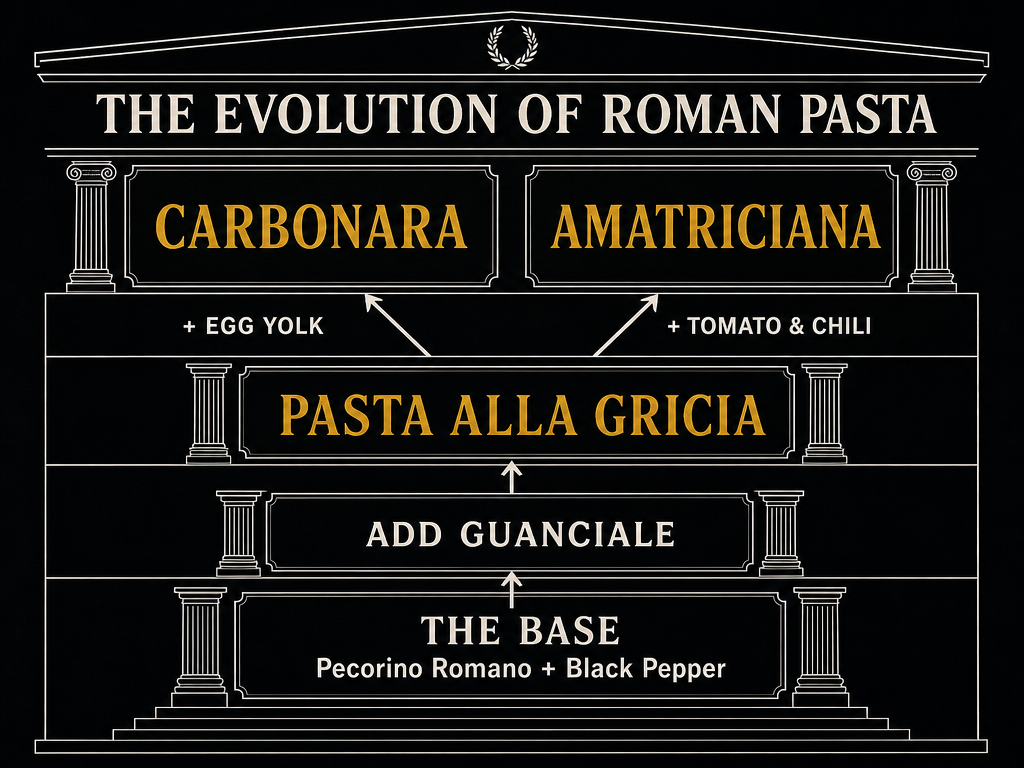 The Roman 'Big Four' are built on a logical progression of ingredients, starting from a base of Pecorino and pepper to create four distinct culinary staples.
| Dish | Base Ingredients | Addition | Final Result |
|---|---|---|---|
| Cacio e Pepe | Pecorino Romano + Black Pepper + Pasta Water | None | The foundation: cheese and pepper emulsion |
| Gricia | Cacio e Pepe | + Guanciale (cured pork jowl) | Add rendered pork fat |
| Carbonara | Gricia | + Egg Yolks (replace some cheese) | Add richness and creaminess |
| Amatriciana | Gricia | + Tomato (from Amatrice) | Add acidity and sweetness |
This isn't just a convenient way to organize a menu. It's how Roman cooks actually think about these dishes - as a decision tree. Start with the cheese-and-pepper emulsion, then add one ingredient at a time. Each addition changes the sauce's structure and what it needs from the pasta.
The traditional pasta shape for all four is tonnarelli (square-cut spaghetti) or rigatoni. The ridges and rough surface trap the thick, creamy sauce. Smooth spaghetti is a tourist trap tell - it won't hold the emulsion properly.
One critical technical note: authentic Carbonara never includes cream. The creaminess comes from emulsifying egg yolks with hot pasta water and the rendered fat from guanciale. Adding cream is a French innovation that dilutes the pecorino and breaks the balance.
If you're tracking and rating individual dishes across restaurants, the Roman Big Four are an ideal test case. The base ingredients are nearly identical, but execution varies wildly. A great Cacio e Pepe requires perfectly timed emulsification - too cold and the cheese clumps, too hot and the eggs scramble.
The Functional Geography of Shapes
Pasta shapes aren't decorative. They're tools, each engineered for specific sauce viscosities, ingredient sizes, and cooking methods. The shape determines how much sauce adheres, how the dish is eaten, and what textures hit your palate.
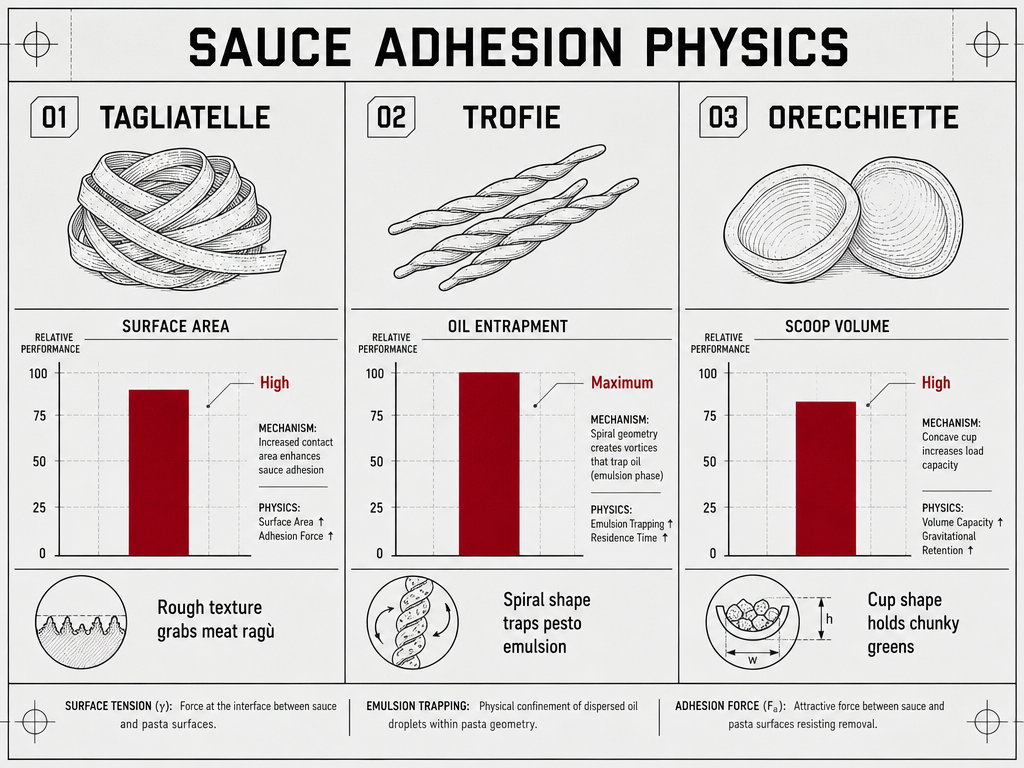 Pasta shapes are functional tools: specific geometries like the spiral of Trofie are engineered to trap specific sauce viscosities through mechanical surface area.
Genoa: Trofie and the Pesto Problem
Trofie look like short, twisted spirals. That geometry exists to solve a specific problem: how to trap basil pesto, which is too thick to cling to smooth pasta but too oily to stick to flat ribbons.
The twist creates pockets that capture the ground basil, pine nuts, garlic, Parmigiano-Reggiano, and olive oil. When you twirl trofie on a fork, the pesto stays put instead of sliding off. The traditional Ligurian combination also includes boiled potatoes and green beans, which add starch and texture contrast.
Puglia: Orecchiette as Edible Scoops
Orecchiette means "little ears," and the concave shape functions exactly like a scoop. Each piece is formed by pressing dough with a thumb, creating a bowl that captures chunky ingredients.
The classic preparation is Orecchiette con Cime di Rapa - bitter turnip greens sautéed with garlic, anchovies, and chili. The small pieces of greens sit inside each orecchiette, so every bite contains pasta, vegetable, and sauce. The texture contrast between the thick center and thin edges is deliberate - the center stays al dente while the edges get slightly chewy.
Sardinia: Fregola and the Nutty Dimension
Fregola (also called fregola sarda) is a toasted semolina pasta shaped like coarse couscous. The toasting process caramelizes the starches, adding a nutty, almost smoky flavor that balances the brine of seafood.
The traditional preparation is Fregola con Arselle - tiny clams in a tomato and white wine broth. The small, round shape means each spoonful contains dozens of individual pasta beads, creating a texture closer to risotto than traditional pasta. The toasted flavor also holds up against strong ingredients like bottarga (cured fish roe) or spicy Sardinian sausage.
The Serious Foodie's Unwritten Rules
Every region has culinary laws that aren't written down but are enforced with the kind of severity usually reserved for traffic violations. Break them, and you'll spot a tourist trap immediately.
No Cheese on Fish (Except When You Can)
The most famous rule: never put cheese on seafood pasta. The reasoning is flavor interference - aged cheese's umami and funk overwhelm the delicate sweetness of fish and shellfish.
But like most Italian food rules, it's more nuanced than it appears. In Sicily, Pasta con le Sarde (pasta with sardines, wild fennel, pine nuts, and raisins) often includes a grating of ricotta salata - a firm, salted ricotta that adds salt and creaminess without overpowering the fish. Some traditional preparations of Spaghetti alle Vongole in Campania include a light dusting of Pecorino Romano at the very end, for those who want it.
The real rule is this: don't add cheese if it will mask the seafood's flavor. A buttery lobster doesn't need Parmigiano. Oily anchovies can handle some Pecorino.
The "Spaghetti Bolognese" Red Flag
Here's your single best tool for identifying a tourist trap: if a restaurant in Bologna serves "Spaghetti Bolognese," walk out.
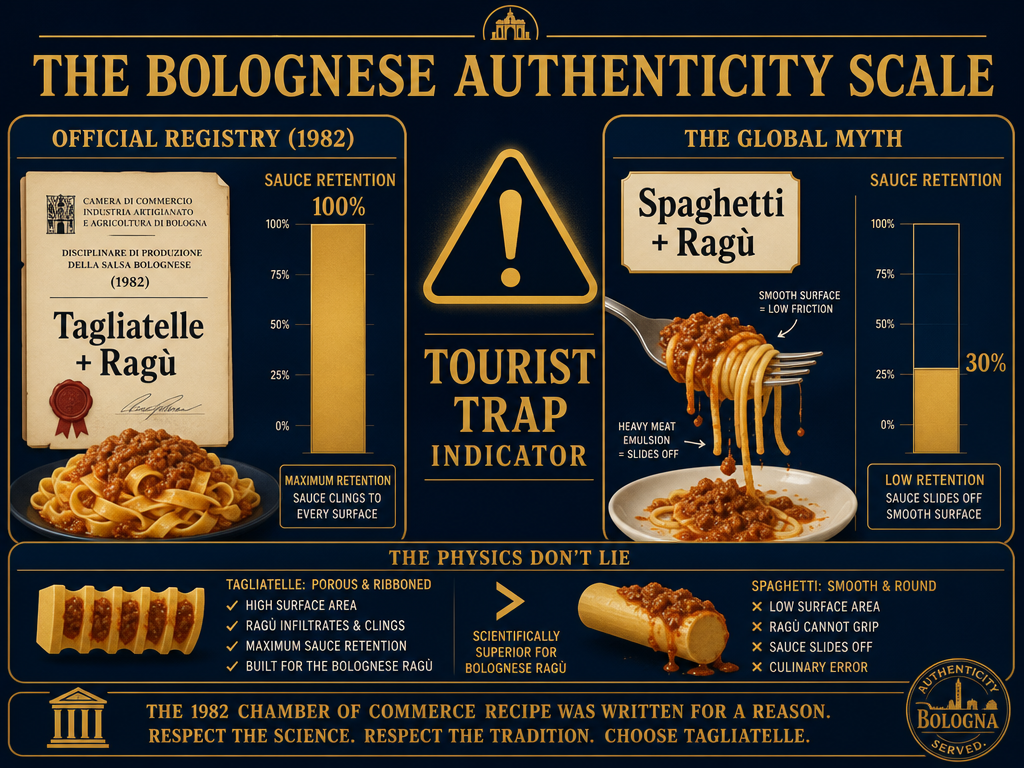 The 'Spaghetti Bolognese' myth debunked: official 1982 records specify Tagliatelle because its egg-based surface area is required to prevent the ragù from sliding off.
As registered by the Italian Academy of Cuisine in 1982, Bolognese ragù is paired with tagliatelle, never spaghetti. The scientific reason: smooth, round spaghetti doesn't have enough surface area to hold the chunky meat sauce. The ragù slides off, pools at the bottom of the bowl, and you end up eating plain pasta followed by a spoonful of meat.
Tagliatelle's flat, rough surface area distributes the sauce evenly across every ribbon. The wider shape also means you can cut through the pasta with a fork, rather than twirling it, which prevents the sauce from flying off.
"Spaghetti Bolognese" is an Anglo-American invention, probably from the post-WWII era when American GIs brought back vague memories of Italian food. It exists on menus in Bologna for exactly one reason: to extract money from tourists who don't know better.
Al Dente Isn't a Suggestion
Italians don't debate pasta texture. Al dente - "to the tooth" - means the pasta has a slight resistance when you bite it, with no raw flour taste in the center. Overcooked pasta is mushy, absorbs too much sauce, and loses its structural integrity.
This isn't about being precious. The texture affects how the dish works mechanically. Overcooked orecchiette loses its scoop shape and becomes flat. Overcooked spaghetti alle vongole turns into a gluey mass because the excess starch thickens the broth into paste.
For dried durum wheat pasta, al dente usually means cooking it 1-2 minutes less than the package instructions, then finishing it in the sauce with pasta water. Fresh egg pasta cooks much faster - sometimes in under a minute - and you're looking for a tender bite without mushiness.
Dining Like a Local: Reading the Menu
The fastest way to decode a restaurant's quality is to look for DOP (Denominazione di Origine Protetta) and IGP (Indicazione Geografica Protetta) ingredients on the menu. These are legally protected designations that guarantee the ingredient comes from a specific region and is made according to traditional methods.
Pecorino Romano DOP: Real Pecorino Romano comes from Lazio, Sardinia, or the province of Grosseto. It's made from sheep's milk, aged for at least 8 months, and has a sharp, salty flavor that's essential for Cacio e Pepe, Gricia, and Carbonara.
Parmigiano-Reggiano DOP: Only produced in Parma, Reggio Emilia, Modena, Bologna, and Mantua. The aging process (minimum 12 months, often 24-36) creates those characteristic crunchy crystals of concentrated umami. Used in Bolognese cooking, especially in ragù and filled pastas.
Mortadella di Bologna IGP: The original Italian mortadella, made with finely ground pork, cubes of pork fat, and spices. It's an essential ingredient in the filling for tortellini.
If a restaurant is serving "Carbonara" without mentioning guanciale or pecorino, it's probably using bacon and Parmesan - a functional substitute, but not the same dish. If the menu lists "Ragù Bolognese" without specifying tagliatelle, they're likely serving it with whatever pasta shape they have on hand.
Look for seasonal ingredients too. Authentic Italian restaurants change their pasta offerings based on what's available. Spring means fava beans and peas with fresh pasta. Fall means porcini mushrooms and game ragù. Winter means hearty dried pasta with preserved ingredients like anchovies and capers.
For those seriously building a personal restaurant database, noting these details becomes crucial. Three years from now, you won't remember which Tuscan restaurant served the exceptional pappardelle with wild boar ragù - unless you've logged the DOP Parmigiano, the pasta maker's name, and the specific cut of boar they used.
Frequently Asked Questions
What region of Italy has the best pasta?
There is no "best" region - there are regional specialists. Emilia-Romagna (Bologna, Parma, Modena) dominates fresh egg pasta and filled pastas like tortellini and tortelloni. Lazio (Rome) owns the pecorino-and-pork-fat canon. Campania (Naples) and Puglia are the masters of dried durum wheat pasta with vegetables and seafood. Liguria (Genoa) perfected pesto and delicate herb-based sauces. Your "best" depends on whether you prefer rich, meat-heavy dishes or lighter, oil-based preparations.
Why is pasta in Italy different than pasta in the USA?
Three main reasons. First, ingredient quality and tradition: Italian law protects traditional production methods, and most pasta is still made regionally with local ingredients. Second, cooking technique: Italians finish cooking pasta in the sauce with pasta water to create an emulsion, rather than draining it completely and adding sauce on top. Third, portion philosophy: pasta is a primo (first course) in Italy, not the entire meal, so portions are smaller and more focused on the pasta-sauce relationship rather than volume.
What are the four main types of pasta in Rome?
The Roman "Big Four" are Cacio e Pepe (pecorino and black pepper), Gricia (pecorino, black pepper, and guanciale), Carbonara (guanciale, egg yolks, pecorino, and black pepper), and Amatriciana (guanciale, tomato, pecorino, and black pepper). They're built on the same foundation - pecorino and pepper - with progressive additions. Traditional shapes are tonnarelli or rigatoni.
What is the official recipe for Bolognese sauce?
The Italian Academy of Cuisine registered the official recipe at the Bologna Chamber of Commerce on October 17, 1982. It specifies beef (usually cartella or shoulder), pancetta or unsmoked bacon, onion, carrot, celery, tomato paste or peeled tomatoes, whole milk, dry white or red wine, and a long cooking time (minimum 2 hours). The ragù must be served with tagliatelle - never spaghetti - because the flat, egg-based pasta surface is required to hold the sauce. Many Bolognese cooks add chicken liver for richness.
Why doesn't seafood go with cheese?
The traditional reasoning is that aged cheese's strong umami and funky flavors overpower the delicate sweetness of fish and shellfish. It's also a textural issue - cheese can make seafood pasta feel heavy and cloying rather than bright and clean. However, there are exceptions: some Sicilian seafood pastas include ricotta salata (a firm, salted ricotta) because it adds salt and creaminess without the funk. The rule is really about balance - don't add cheese if it will mask the seafood's flavor.
Is Spaghetti Bolognese actually served in Bologna?
No, not in traditional restaurants. Bolognese ragù is paired with tagliatelle because the flat, egg-based surface holds the meat sauce. Spaghetti is too smooth and round - the sauce slides off and pools at the bottom of the bowl. "Spaghetti Bolognese" appears on menus in Bologna only at tourist-trap restaurants. If you see it listed, that's your signal to leave.
What did Italians eat before pasta?
The first written reference to pasta in Italy appears in a 1154 text by the Arab geographer al-Idrisi, who documented dried pasta production in the Sicilian town of Trabia. Before that, Italians ate grains in other forms: polenta (cornmeal porridge, though corn arrived from the Americas much later), farro (emmer wheat), barley, and various forms of flatbreads. The Roman Empire's diet centered on bread, legumes, vegetables, olive oil, and for the wealthy, meat and fish. Fresh pasta likely evolved from lasagna-like sheets of dough, while dried pasta came from Arab influence in Sicily.