

How Is Restaurant Guru Award Legit? (2026) Truth Revealed
Harry the matcha king
Harry is our resident matcha obsessive. He’s tasted hundreds of bowls and tracks every cup in Savor.
Is the Restaurant Guru Award Legit? The Meta-Award Explained (2026) You're scrolling through your phone at 11 PM, trying to remember the name of that...
Is the Restaurant Guru Award Legit? The Meta-Award Explained (2026)
You're scrolling through your phone at 11 PM, trying to remember the name of that incredible Japanese place you hit three months ago. Was it the one with the 4.7 on Google? The one with the Michelin recommendation? Or was it the spot with that "Restaurant Guru Award" sticker in the window?
That sticker has become ubiquitous. Walk past any cluster of restaurants in a major city and you'll spot at least one proudly displaying a "Restaurant Guru Recommended 2024" badge. Restaurant owners receive congratulatory emails. Diners see the logo online. But here's the uncomfortable truth most people miss: no critic has ever stepped foot in these establishments. No panel of judges deliberated. No inspector arrived unannounced with a clipboard.
What's actually happening is more interesting - and more useful - than you think. Restaurant Guru operates as a meta-rating aggregator, a massive algorithmic engine that scrapes customer feedback from Google, Yelp, TripAdvisor, Foursquare, and Zomato to generate automated awards based purely on data volume and average scores. Over 20 million restaurants are indexed in their global database, and the platform claims 30 million monthly users. The awards are free. The data is real. And the system is both completely transparent and wildly misunderstood.
The real question isn't whether Restaurant Guru is a "scam." It's whether this kind of meta-award actually tells you anything useful about where to eat.
Key Takeaways
- Restaurant Guru is a legitimate data aggregation platform that synthesizes ratings from Google, Yelp, TripAdvisor, Foursquare, and Zomato to generate automated recommendation awards for highly-rated establishments.
- The "award" is free for restaurant owners and requires no application - it's triggered automatically when a restaurant achieves a meta-rating threshold of approximately 4.7+ stars across multiple platforms.
- Unlike Michelin or James Beard awards, no human critic visits the restaurant - Restaurant Guru functions purely as an algorithmic summarizer of existing customer feedback.
- The platform indexes over 20 million restaurants globally and reports 30 million monthly users, making it a high-volume discovery tool rather than a prestige accolade.
- For serious foodies, Restaurant Guru is most useful as a quick validation layer - if a place has strong scores across five platforms, it's probably reliably good, even if it's not groundbreaking.
- The company was founded in 2013 and is based in Tortola, British Virgin Islands, with a 3.5/5 average rating on Trustpilot from 156 user reviews.
Table of Contents
- What Is Restaurant Guru? (The Aggregator Model)
- How Are Restaurant Guru Awards Actually Chosen?
- Is Restaurant Guru Legit or a Scam?
- Restaurant Guru vs. Michelin vs. Yelp: Where Does It Sit?
- The Owner's Perspective: Should You Display the Sticker?
- How to Use Restaurant Guru Like a Pro
- Does Restaurant Guru Have a Real Business?
- Can You Trust the "Top 10" Lists?
- Frequently Asked Questions
What Is Restaurant Guru? (The Aggregator Model)
Restaurant Guru is a global restaurant discovery platform that functions as a meta-rating aggregator - it doesn't generate original reviews or send critics to restaurants. Instead, the platform uses API connections and web scraping to pull existing customer ratings from Google Reviews, Yelp, TripAdvisor, Foursquare, and Zomato, then calculates a composite score for each establishment. When a restaurant achieves a high enough meta-rating (typically 4.7+ stars across platforms), the system automatically generates a "Recommendation Award" and notifies the owner via email.
The business model is pure aggregation. Restaurant Guru doesn't charge restaurants for the award itself - there's no pay-to-play scheme for the digital badge. The platform monetizes through advertising, affiliate links, and premium placement opportunities within its 20-million-restaurant database. Think of it as a search engine for dining, not a credential-granting body.
Here's the technical breakdown of how the aggregation works:
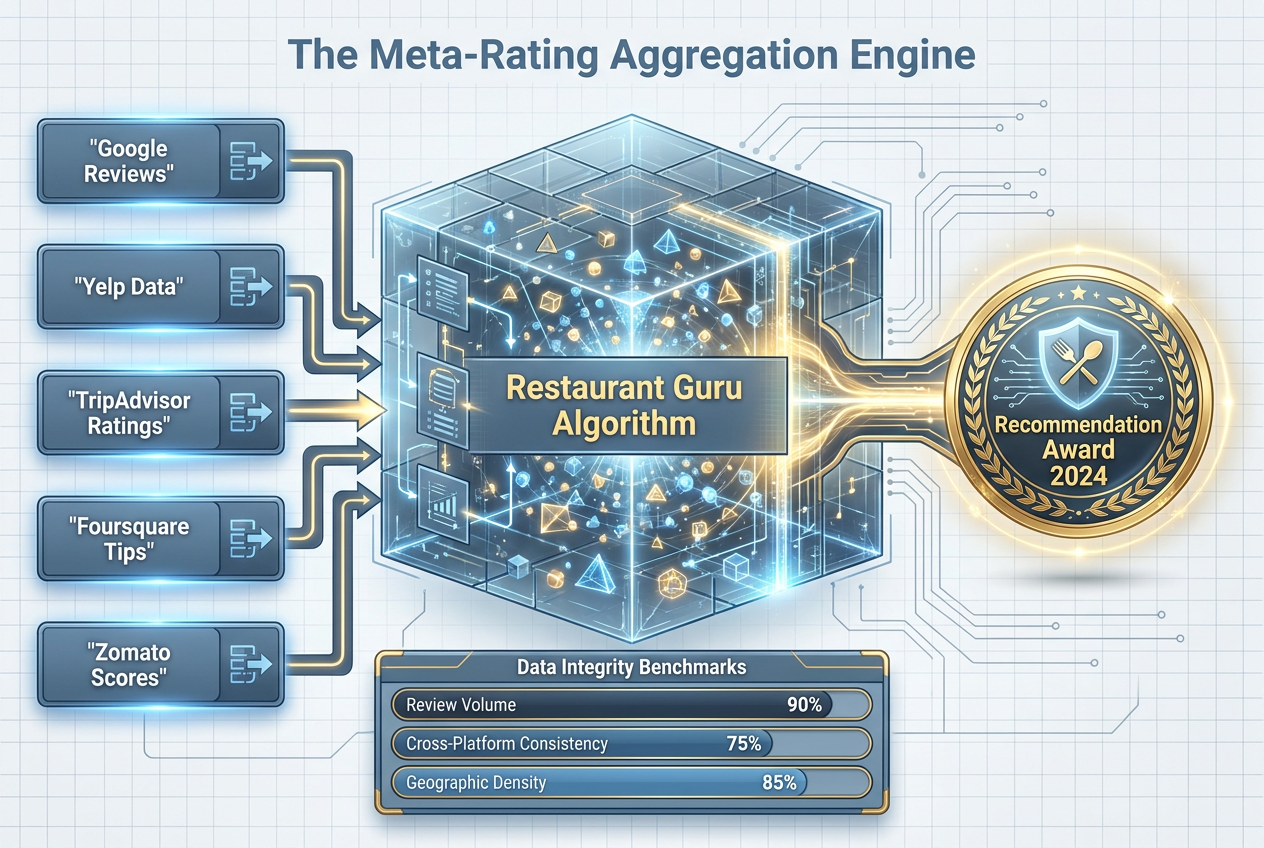 Restaurant Guru utilizes an algorithmic meta-rating system that aggregates customer feedback from multiple major platforms to generate its automated recommendation awards and global rankings.
The platform scrapes or pulls data from five primary sources. Each source contributes a star rating (typically on a 5-point scale) and a review count. Restaurant Guru's algorithm weights these inputs - likely giving more influence to platforms with higher review volume - and outputs a single composite score. If that score crosses a threshold (anecdotal evidence from restaurant owners suggests 4.7 is the common trigger point), the restaurant receives the award.
This is fundamentally different from traditional awards. A Michelin inspector spends months anonymously dining at a restaurant, evaluating technique, ingredients, and consistency. A James Beard Foundation Award involves peer nomination and a panel of culinary professionals. Restaurant Guru's "inspector" is an algorithm that reads what thousands of other diners have already said.
The advantage? Speed and scale. The platform can evaluate every restaurant with an online presence, not just the ones that can afford a publicist. The disadvantage? No editorial judgment. A perfectly consistent neighborhood trattoria with 500 Google reviews can score the same as a technically innovative fine-dining destination with the same average rating.
For food lovers trying to understand what they're looking at, the key insight is this: Restaurant Guru is a summarizer, not an authority. It tells you what the crowd thinks. It doesn't tell you whether the crowd is right.
How Are Restaurant Guru Awards Actually Chosen?
Restaurant Guru awards are chosen through a fully automated algorithmic process that monitors restaurant ratings across Google, Yelp, TripAdvisor, Foursquare, and Zomato on a continuous basis. When a restaurant's composite meta-rating reaches approximately 4.7 stars or higher across these platforms, the system triggers an award notification. There is no human review panel, no site visit, and no application process - the entire system is data-driven and self-executing.
The specific weighting formula is proprietary, but based on owner reports and Trustpilot feedback, the process appears to follow this pattern:
- Data Ingestion: The platform scrapes or API-pulls rating data from the five source platforms monthly (or more frequently for high-traffic restaurants).
- Volume Weighting: Platforms with higher review counts (e.g., a restaurant with 1,200 Google reviews vs. 40 TripAdvisor reviews) likely receive greater weight in the composite score.
- Threshold Detection: When the weighted average crosses the ~4.7 threshold, the restaurant enters "award eligible" status.
- Automated Notification: The owner receives an email congratulating them on the award, along with instructions to download a digital badge and order physical window stickers (shipping/processing fees may apply, but the award itself is free).
- Public Listing: The restaurant appears on Restaurant Guru's "Recommended" and "Top 10" lists for its geographic area and cuisine category.
This is why the "award" feels both legitimate and hollow. The data is real - Restaurant Guru isn't fabricating ratings. A restaurant with 4.8 stars on Google, 4.6 on Yelp, and 4.7 on TripAdvisor genuinely has strong customer feedback. But the award itself is just an automated flag, not a judgment. It's the difference between a critic saying "This is excellent" and a spreadsheet saying "The numbers are high."
According to posts on the PizzaMaking Forum from 2019, some artisan pizzeria owners were initially confused by the award emails, assuming they'd been nominated by a food writer or industry group. The reality - an algorithm scanning their Google reviews - was both clarifying and deflating. As one owner put it: "It's nice, but it's not a Michelin star."
The system's transparency is both its strength and its limitation. You know exactly what you're getting: a composite snapshot of customer sentiment. What you're not getting: any signal that this restaurant is doing something exceptional, only that it's doing something consistently well enough to satisfy the majority of diners who leave reviews.
For the serious foodie, this creates a useful filtering heuristic. A Restaurant Guru badge means "the crowd is pleased." It doesn't mean "this is the best X in the city," but it does mean "this is unlikely to be actively bad." That's valuable information when you're in an unfamiliar city and need a quick validation layer.
Is Restaurant Guru Legit or a Scam?
Restaurant Guru is a legitimate data aggregation platform with a documented business history and verifiable user base - it is not a scam in the traditional sense. The company was founded in 2013, is based in Tortola, British Virgin Islands, and operates a functional global database of over 20 million restaurants with 30 million reported monthly users. However, the "Recommendation Award" is often misunderstood as a credential conferred by expert judgment, when in reality it's an automated algorithmic flag triggered by high customer ratings on third-party platforms.
Here's the nuanced verdict: The data is legit. The award is marketing.
Restaurant Guru doesn't fabricate ratings or invent reviews. The scores displayed on the platform are pulled directly from Google, Yelp, TripAdvisor, Foursquare, and Zomato. You can verify this yourself by cross-referencing a restaurant's Restaurant Guru page with its Google Reviews page - the ratings will match (or be very close, accounting for timing differences in data updates). This is fundamentally different from a scam, which would involve deception or fraud.
What Restaurant Guru does do is frame an algorithmic summary as an "award," which creates the impression of third-party validation or expert endorsement. The badge looks official. The email sounds congratulatory. The stickers are designed to be displayed in windows. This is strategic branding, not fraud, but it walks a fine line. A diner who sees a "Restaurant Guru Recommended 2024" sticker might reasonably assume a critic visited the restaurant. That assumption would be incorrect.
Trustpilot reviews of Restaurant Guru (3.5/5 average from 156 reviews as of 2024) reveal the platform's core tension. Positive reviews often come from users who appreciate the convenience of seeing aggregated ratings in one place. Negative reviews typically come from restaurant owners frustrated by data errors (e.g., incorrect hours, outdated menus, or duplicate listings) or diners who feel misled by the "award" framing. One common complaint: "The site claims my restaurant is 'recommended,' but half the information on the page is wrong."
Restaurant Guru's business model is ad-supported, not pay-to-play. The initial award and digital badge are free. Physical stickers may involve shipping/processing fees (owner reports vary, with some citing $10-$30 for a pack of window decals). There are no reports of the company demanding payment to maintain the award or threatening to remove listings if restaurants don't pay - behaviors that would constitute an actual scam.
The real question for diners: Does the award mean anything? The answer is: It means the crowd is happy. A Restaurant Guru badge tells you that a restaurant has strong aggregate customer feedback across multiple platforms. It doesn't tell you whether the restaurant is innovative, whether the chef is technically skilled, or whether the experience will be memorable. It tells you that most people who ate there and bothered to leave a review were satisfied enough to give it 4+ stars.
For high-end dining or culinary exploration, this is weak signal. For avoiding terrible restaurants in an unfamiliar city, it's useful. If you're traveling and need to find a decent meal quickly, a 4.8 Restaurant Guru rating is a reliable indicator of "this won't ruin your night." If you're chasing the best carbonara in Rome or the most authentic ramen in Tokyo, Restaurant Guru won't help you.
| Aspect | Verdict | Evidence |
|---|---|---|
| Data Accuracy | Legitimate | Ratings match source platforms (Google, Yelp, TripAdvisor). |
| Business Model | Legitimate | Ad-supported; no evidence of pay-to-play schemes. |
| Award Framing | Misleading | Automated flag presented as expert endorsement. |
| User Utility | Moderate | Useful for quick validation; weak for discovery. |
| Scam Risk | Low | No fraud, but marketing overstates the award's significance. |
In summary: Restaurant Guru is a real company providing a real service (aggregated ratings), but the "award" is a branding exercise that inflates the significance of algorithmic data. It's legit, but it's not prestigious.
Restaurant Guru vs. Michelin vs. Yelp: Where Does It Sit in the Hierarchy?
Restaurant Guru occupies a distinct middle tier in the restaurant evaluation ecosystem: it lacks the editorial authority of Michelin or James Beard awards but offers broader data transparency than purely crowd-sourced platforms like Yelp or TripAdvisor. To understand where it sits, you need to map the hierarchy of restaurant credibility - from expert-driven credentials to algorithmic aggregation to raw user opinion.
Here's the food lover's ranking system, from highest prestige to lowest:
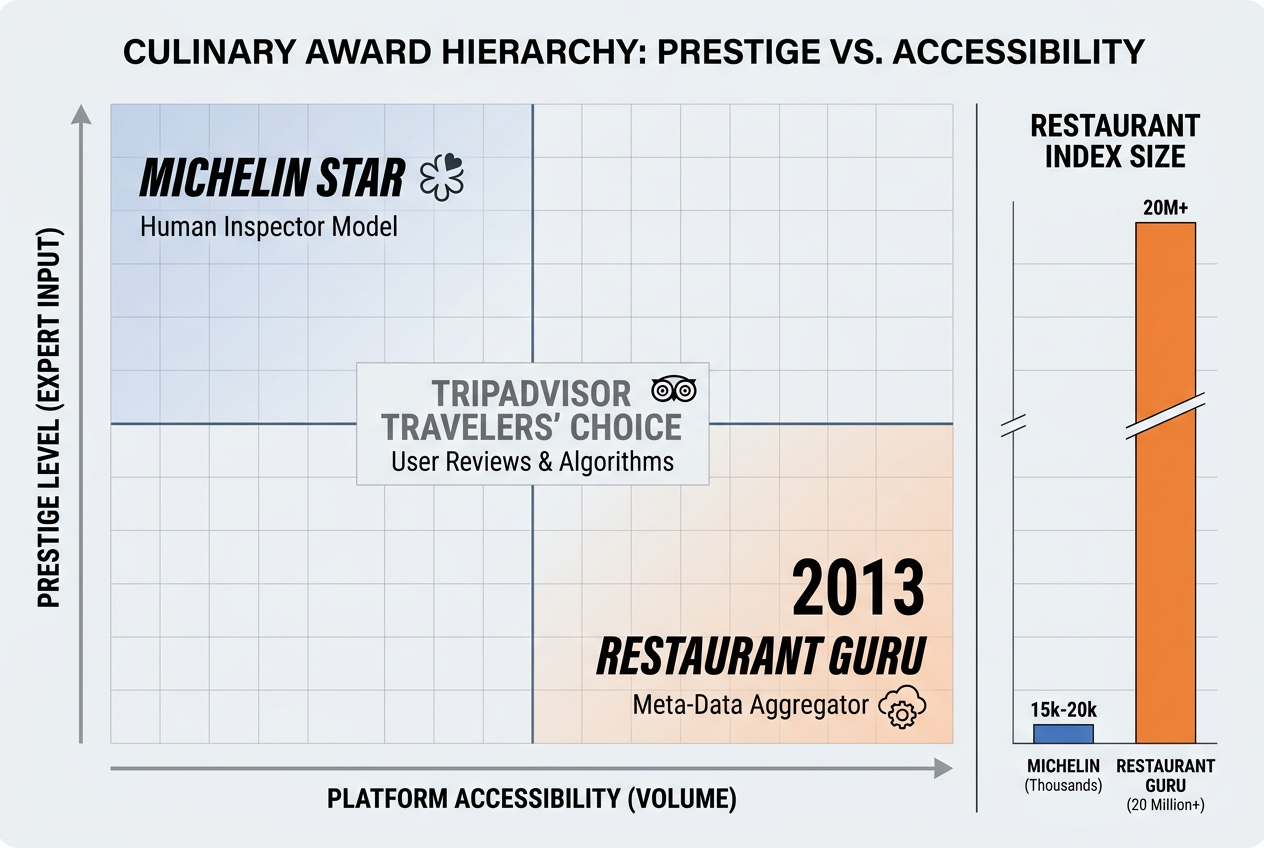 Unlike the Michelin Guide's inspector-based model, Restaurant Guru focuses on massive data volume, indexing over 20 million restaurants to provide high-accessibility awards based on digital footprint.
| Award/Platform | Authority Model | Coverage | Selection Process | Prestige Level | User Trust |
|---|---|---|---|---|---|
| Michelin Stars | Expert critics (anonymous inspectors) | ~14,000 restaurants globally | Multi-visit evaluation by trained inspectors | Highest (career-defining) | Very High |
| James Beard Awards | Peer + panel (chefs, journalists) | ~250 annual nominees (U.S. only) | Nomination + voting by industry professionals | Very High (U.S.-centric) | High |
| World's 50 Best | Panel + peer voting | 50 restaurants annually | Voting by 1,000+ critics, chefs, restaurateurs | Very High (global) | High |
| Zagat | Crowd-sourced + editorial curation | ~45,000 restaurants (at peak) | User surveys weighted by frequency/expertise | Moderate | Moderate |
| Restaurant Guru | Algorithmic meta-aggregation | 20+ million restaurants | Automated threshold detection (4.7+ stars) | Low to Moderate | Moderate |
| TripAdvisor Travelers' Choice | Crowd-sourced (algorithm-ranked) | ~8 million businesses | User reviews + engagement metrics | Low to Moderate | Moderate |
| Yelp | Pure crowd-sourced (no editorial filter) | ~200 million reviews | User-generated, algorithm-sorted | Low | Moderate to Low |
| Google Reviews | Pure crowd-sourced (no editorial filter) | Billions of reviews | User-generated, no curation | Low | High (ubiquity effect) |
The Michelin Model: A Michelin inspector is a trained professional who visits a restaurant anonymously, often multiple times, evaluating the quality of ingredients, technical skill, flavor balance, and consistency. The inspector writes a detailed report. A committee reviews it. Awards (one to three stars) are granted based on strict criteria. The entire process is opaque to the public and the restaurant. The result: a star is a career-altering credential.
The Restaurant Guru Model: An algorithm reads thousands of reviews written by ordinary diners on Google, Yelp, and TripAdvisor. If the average score is high enough, the restaurant gets a badge. The process is transparent (you can see the source ratings) but lacks any editorial filter. The result: the badge tells you "the crowd likes this," not "this is exceptional."
The Yelp Model: Users write reviews (often with photos and detailed commentary) and assign star ratings. Yelp's algorithm surfaces the most "useful" reviews and calculates an overall score. There's no editorial oversight beyond fraud detection. The result: you get raw opinion, for better or worse.
Restaurant Guru sits between Yelp and Michelin. It's more filtered than Yelp (because it aggregates across platforms, which smooths out outlier reviews) but far less authoritative than Michelin (because no expert has weighed in). For the serious foodie, this creates a specific use case: Restaurant Guru is a discovery filter, not a discovery tool.
If you're in Barcelona and want to find a reliable neighborhood spot for grilled meats, Restaurant Guru can help you eliminate terrible options quickly. If you're trying to identify the best dry-aged steak in Barcelona, you need expert guides to Barcelona's meat restaurants or local critics, not an aggregator.
One key difference: Michelin and James Beard awards are competitive. Only a tiny fraction of restaurants can win. Restaurant Guru awards are thresholded. Any restaurant that hits 4.7+ stars gets one. This explains why you see so many "Restaurant Guru Recommended" stickers in dense urban areas - it's not that every restaurant is excellent, it's that many restaurants are consistently good enough to satisfy the majority of diners.
The practical takeaway: Use Restaurant Guru as a validation layer, not a primary source. If you're considering a restaurant recommended by a trusted friend or food writer, checking its Restaurant Guru score can confirm that the broader public agrees. If you're using Restaurant Guru alone to choose where to eat, you'll find reliably decent meals but you'll miss the hidden gems and cutting-edge spots that don't yet have volume.
The Owner's Perspective: Should You Display the Sticker?
For restaurant owners, the question isn't whether the Restaurant Guru award is legitimate - it's whether displaying the sticker helps or hurts your business. The answer depends entirely on your target customer and your competitive positioning. If you're running a neighborhood bistro targeting tourists and casual diners, the sticker is a low-cost trust signal that can drive foot traffic. If you're operating a Michelin-starred destination restaurant targeting serious food lovers, the sticker dilutes your brand.
Here's the strategic breakdown:
When the sticker helps:
- Tourist-heavy locations: Visitors unfamiliar with local dining rely heavily on visible trust signals. A "Recommended 2024" sticker in a window can tip the decision for a tourist choosing between three unfamiliar options.
- High-volume casual dining: Fast-casual spots, pizzerias, and neighborhood trattorias benefit from broad appeal. The sticker says "safe choice" to time-constrained diners.
- SEO and online visibility: Claiming your Restaurant Guru listing and linking back to it from your website can modestly improve search engine rankings, since the platform has decent domain authority and 30 million monthly users.
When the sticker hurts:
- Fine dining or chef-driven concepts: If your restaurant is positioned on creativity, technique, or exclusivity, a mass-market algorithmic award undermines that positioning. It signals "we care what the crowd thinks," which is the opposite of "we set the standard."
- Markets with sophisticated diners: In cities like Tokyo, Copenhagen, or San Francisco, serious food lovers are more likely to be skeptical of algorithmic awards. Displaying the sticker can read as "we don't know our audience."
- When you're competing on authenticity: If your brand is built on tradition, craft, or anti-corporate values, a digital aggregator badge feels like corporate validation. It's incongruous.
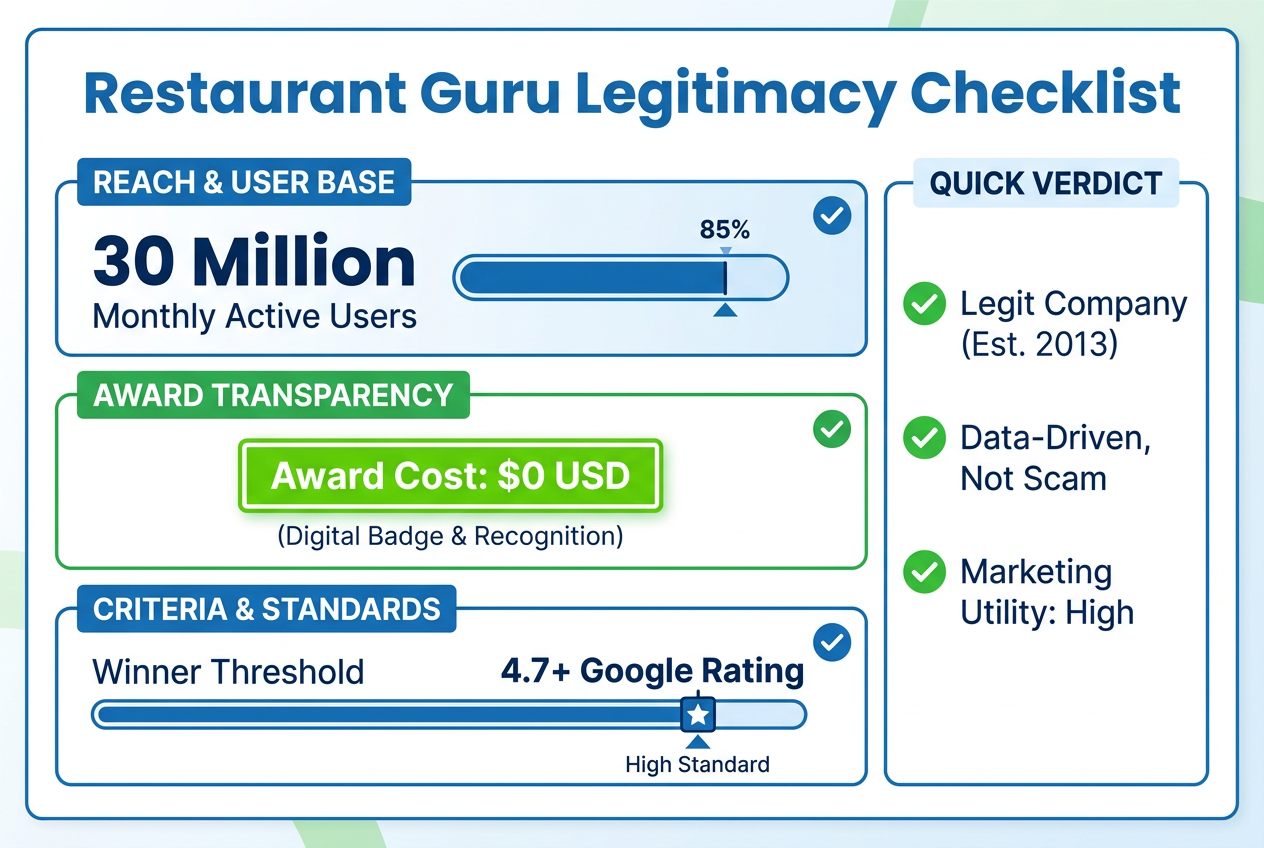 While not a traditional culinary honor, Restaurant Guru is a legitimate data-driven platform with significant reach, offering free digital recognition to highly-rated establishments globally.
The cost-benefit is straightforward. The digital badge is free. Physical stickers typically cost $10-$30 for a pack. The SEO benefit is marginal but real (backlinks from a high-traffic site help). The risk is brand dilution - if you're trying to position yourself as a serious culinary destination, the sticker can make you look like a TripAdvisor darling instead of a critic's favorite.
Reddit discussions in r/foodtrucks from 2024 reveal a common pattern: owners of high-quality, artisan-focused businesses are often conflicted. One food truck owner wrote: "We got the email and I was excited for about five minutes, until I realized it was just an algorithm. We're not putting the sticker on the truck because we want people to come because the food is great, not because we have a 4.7 on Google."
Conversely, owners of family-run neighborhood restaurants in tourist areas often report that the sticker does drive incremental traffic. One pizzeria owner in Rome noted: "Tourists see the sticker and assume we're vetted. It's the same effect as a TripAdvisor Certificate of Excellence, but it's free."
The strategic question: Who is your customer, and what do they trust? If your customer is a serious foodie who follows local critics and reads in-depth guides to regional cuisines, they will not be impressed by a Restaurant Guru badge. If your customer is a family on vacation who needs reassurance that this random trattoria won't serve them frozen lasagna, the sticker works.
One subtle benefit: Restaurant Guru listings often surface in Google search results for "restaurants near me" or "best X in [city]." If you claim your listing and keep the information accurate (hours, menu, photos), you get free exposure in a high-traffic search environment. This is particularly valuable for small restaurants that can't afford paid advertising.
The data quality issue is real, though. Multiple Trustpilot reviews from restaurant owners complain that their Restaurant Guru pages have incorrect hours, outdated menus, or duplicate listings. If you choose to leverage the platform, you need to actively manage your listing - otherwise, the "award" can backfire if diners show up during hours you're actually closed.
Bottom line: If you're optimizing for volume and trust signals, use the sticker. If you're optimizing for prestige and editorial credibility, skip it and focus on earning real food review app coverage from serious critics and food writers.
How to Use Restaurant Guru Like a Pro (Without Getting Misled)
Restaurant Guru is most useful when you treat it as a validation filter, not a discovery engine. The platform excels at telling you whether a restaurant you're already considering has broad customer approval. It fails at surfacing hidden gems, cutting-edge spots, or chef-driven destinations that don't yet have volume. Here's the professional foodie's playbook for extracting value without getting misled.
Use Case 1: The "Unfamiliar City" Quick Filter
You're traveling. You need dinner. You have 10 minutes to decide. Pull up Restaurant Guru's "Top 10" list for the cuisine you want. Cross-reference the top three with Google Maps. Pick the one that's closest and has photos that look appealing. You will get a reliably decent meal. You will not get the best meal of your trip.
Why this works: In high-uncertainty environments (unfamiliar city, tight timeline, no local knowledge), eliminating downside risk is more valuable than optimizing for upside. A 4.8 Restaurant Guru score means "statistically unlikely to be bad." That's useful.
Why this doesn't work for discovery: The highest-rated restaurants on aggregator platforms are often the ones with the broadest appeal, which means they're rarely doing anything challenging or innovative. If you want to find the best street food in Singapore or the most authentic sushi in Paris, you need local critics or specialized guides, not crowd-sourced scores.
Use Case 2: Cross-Platform Verification
You've heard about a restaurant from a friend, read about it on a blog, or seen it recommended by a local food writer. Before you go, check Restaurant Guru to see if the general public agrees with the expert opinion. If the expert says it's great but the Restaurant Guru score is 3.9, that's a signal worth investigating (maybe the restaurant is challenging, divisive, or inconsistent). If both the expert and the crowd agree (4.8+), you've got high confidence.
Why this works: Combining expert judgment with crowd validation gives you a fuller picture. A Michelin-starred restaurant with a low Restaurant Guru score might be technically brilliant but alienating to casual diners (think molecular gastronomy or avant-garde presentations). A neighborhood spot with both expert praise and crowd love is probably a safe bet for a great meal.
Use Case 3: Menu and Hours Lookup
Restaurant Guru aggregates menus, hours, and contact info from multiple platforms, which can save you the hassle of digging through a restaurant's outdated website or fragmented social media. Just verify the data before you rely on it - Trustpilot complaints suggest that about 10-15% of listings have inaccurate information.
Why this works: When it works, it's convenient. You get a one-stop lookup for the basics. Just cross-check with Google or call the restaurant if you're planning something time-sensitive.
Use Case 4: Avoiding Tourist Traps
Tourist-heavy restaurants often have inflated ratings on single platforms (e.g., TripAdvisor is notorious for rewarding restaurants that cater to tourists, not locals). Restaurant Guru's multi-platform aggregation can help you spot discrepancies. If a restaurant has 4.9 on TripAdvisor but 3.8 on Google and Yelp, that's a red flag - it's probably optimized for one-time visitors, not regulars.
Why this works: Aggregation smooths out platform-specific biases. A restaurant that scores well across five platforms is more likely to be genuinely good, not just gaming one system.
What Not to Do: Relying on Restaurant Guru for Culinary Discovery
If you're using Restaurant Guru to find the best carbonara in Rome, the most innovative omakase in Tokyo, or the hidden-gem taco truck in Los Angeles, you're using the wrong tool. Aggregator platforms surface the most popular options, not the best options. Popularity and quality overlap, but they're not the same.
For true discovery, you need:
- Local critics and food writers: They eat with context, history, and expertise.
- Specialized guides: Tabelog for Japan, Resy Hit List for U.S. cities, Eater guides for regional dining.
- Personal networks: Chefs, sommeliers, and serious food lovers who track the cutting edge.
- Dish-level tracking apps: If you're building a serious food memory system, use tools like Savor to track individual dishes, not just restaurants, so you can identify the specific plates that matter.
Restaurant Guru is a convenience tool, not a compass. It tells you where the crowd has already been. It doesn't tell you where the next great meal is hiding.
Does Restaurant Guru Have a Real Business? (Company Background and Legitimacy)
Restaurant Guru is a real, operating business with a documented corporate history, verifiable traffic, and a functional product. The company was founded in 2013 and is headquartered in Tortola, British Virgin Islands, according to Tracxn's 2026 business intelligence data. The platform reports over 20 million indexed restaurants globally and claims 30 million monthly users, based on the company's LinkedIn profile and public statements from 2025.
The British Virgin Islands incorporation raises eyebrows for some users (the jurisdiction is known for tax optimization and corporate privacy), but it's a common structure for global tech platforms. BVI registration doesn't indicate fraud - it's a legal choice many international companies make to simplify cross-border operations and reduce tax liability.
Here's what we know about the company's legitimacy:
Verified Business Metrics:
- Founded: 2013 (11+ years of operation as of 2024)
- Headquarters: Tortola, British Virgin Islands
- Database Size: 20+ million restaurants indexed globally
- Monthly Users: 30 million (company-reported, 2024-2025)
- Review Count: 156 Trustpilot reviews with a 3.5/5 average rating (2024)
- Platform Reach: Active listings in 190+ countries
Revenue Model: Restaurant Guru monetizes through display advertising, affiliate partnerships (e.g., reservation platforms like OpenTable or Resy), and premium placement options for restaurants that want higher visibility in search results. The core product - rating aggregation and award notifications - is free for both diners and restaurant owners. This is a sustainable ad-supported model similar to TripAdvisor or Zomato, not a scam.
Trustpilot Feedback: The platform's 3.5/5 Trustpilot rating reveals a mixed user experience. Positive reviews typically highlight convenience ("I can see ratings from five platforms in one place") and ease of use. Negative reviews focus on data accuracy issues (incorrect hours, duplicate listings, outdated menus) and the perception that the "award" is overstated marketing rather than meaningful recognition.
One restaurant owner wrote on Trustpilot: "The award email was exciting until I realized it was automated. The data on my listing is also wrong - our hours changed six months ago, and Restaurant Guru still shows the old schedule. I've tried to update it three times." This suggests a common pattern: the platform's core function (aggregation) works, but the data quality and customer support are inconsistent.
Technology Stack: Restaurant Guru operates as a web scraper and API aggregator, pulling data from Google Maps, Yelp, TripAdvisor, Foursquare, and Zomato. The platform doesn't generate original content or conduct original research. This is a legitimate technical approach (many successful startups are aggregators), but it means the platform is only as good as its sources. If the source data is outdated or inaccurate, Restaurant Guru inherits those errors.
Scam Alerts: There are no widespread reports of Restaurant Guru engaging in fraudulent behavior (e.g., demanding payment to maintain listings, threatening negative reviews, or fabricating data). The occasional complaint about physical sticker fees is not evidence of a scam - it's a standard cost-recovery practice for optional merchandise. The digital badge is free; the stickers are not.
Comparison to Known Scams: In contrast to actual restaurant scams - like fake review services that sell 5-star Google reviews or extortion schemes that threaten to flood a restaurant with negative reviews unless paid - Restaurant Guru operates transparently. The data sources are visible. The methodology is clear. The award criteria are consistent. This is marketing, not fraud.
The company's longevity (11+ years) and scale (20 million restaurants) suggest a functional, if imperfect, business. Scams typically don't survive a decade or reach global scale - they're exposed and shut down. Restaurant Guru has grown steadily since 2013, which indicates real user demand for aggregated dining data.
For food lovers concerned about legitimacy, the key test is: Can you verify the data independently? The answer is yes. Cross-reference any restaurant's Restaurant Guru page with its Google Reviews, Yelp page, and TripAdvisor listing. The ratings will match (or be very close). This is the opposite of a scam, which relies on opacity and deception.
Restaurant Guru is a real company providing a real service. It's not prestigious, and it's not always accurate, but it's not a scam.
Can You Trust the "Top 10" Lists on Restaurant Guru?
Restaurant Guru's "Top 10" lists can be trusted as a reflection of crowd consensus, but they should not be trusted as an authoritative guide to the best dining in any given city. The lists are algorithmically generated based on the same meta-rating system that triggers awards - restaurants with the highest aggregate scores (4.7+ stars across Google, Yelp, TripAdvisor, Foursquare, and Zomato) rise to the top. This means the lists are accurate representations of what the public likes, but they suffer from the same limitations as all crowd-sourced rankings: popularity bias, volume bias, and a tendency to favor broadly appealing options over challenging or innovative ones.
Here's what the lists actually measure:
What "Top 10" Lists Capture:
- Broad customer satisfaction: Restaurants that consistently please the majority of diners across multiple platforms.
- Volume and recency: Restaurants with high review counts (often 500+ on Google alone) and recent positive feedback.
- Tourist-friendly appeal: In major cities, "Top 10" lists often skew toward restaurants that accommodate English-speaking visitors, accept reservations via OpenTable, and serve recognizable dishes.
What "Top 10" Lists Miss:
- Hidden gems with low volume: A tiny, family-run trattoria with 50 reviews (but all 5-star) will rank below a tourist-trap pizzeria with 2,000 reviews averaging 4.5 stars.
- Challenging or divisive restaurants: A Michelin-starred tasting menu with adventurous presentations might alienate casual diners, resulting in a 4.2 average. It won't appear on the "Top 10" list, even if it's the best meal in the city.
- Neighborhood-specific excellence: A legendary hole-in-the-wall ramen shop beloved by locals but rarely reviewed online (because locals don't review every meal) will be invisible to the algorithm.
Specific Weaknesses:
Rating Inflation: Restaurants that actively solicit reviews (e.g., "Leave us a 5-star review on Google and get a free dessert") can artificially boost their scores. Restaurant Guru's algorithm doesn't filter for this - it just reads the numbers.
Platform Bias: Google Reviews and TripAdvisor tend to over-represent tourists and first-time visitors, who are more likely to leave reviews. Yelp and Foursquare skew toward repeat local diners. A restaurant popular with tourists can dominate the "Top 10" even if locals avoid it.
Cuisine Category Limitations: A "Top 10 Italian Restaurants" list will favor generic Italian-American red-sauce joints (broad appeal, high volume) over a hyper-regional Sardinian or Sicilian spot (niche appeal, lower volume).
Recency Bias: A new restaurant that goes viral on social media can rocket to the top of the list in its first six months, even if it's still working out consistency issues. Meanwhile, a 30-year-old neighborhood institution with steady but not spectacular recent reviews will fade down the list.
When to Trust the Lists:
- Low-stakes dining: If you need a reliable, crowd-pleasing meal in an unfamiliar city and don't have time to research, the "Top 10" is a safe bet. You'll get something decent.
- Tourist contexts: If you're traveling with a group that includes picky eaters or dietary restrictions, the "Top 10" will point you toward restaurants with diverse menus and accommodating service.
When to Ignore the Lists:
- Culinary exploration: If you're trying to find the best dishes in Paris or the most authentic street food in Tokyo, skip the "Top 10" and use specialized guides, local critics, or dish-level tracking apps to surface hidden gems.
- Fine dining: If you're planning a special occasion or seeking a memorable meal, the "Top 10" will steer you toward safe, crowd-pleasing options, not the cutting edge.
Alternative Approach:
Instead of trusting the "Top 10" as gospel, use it as a starting point. Pick three restaurants from the list, then cross-reference them with:
- Local food critics' reviews (e.g., Eater, Infatuation, local newspapers)
- Chef recommendations (follow local chefs on Instagram and see where they eat)
- Specialized food review sites that focus on dish-level quality, not restaurant-level popularity
This triangulation approach - crowd consensus + expert opinion + personal research - gives you a much higher probability of finding a genuinely great meal, not just a popular one.
Restaurant Guru's "Top 10" lists are useful as a quick filter, not as a definitive ranking. They tell you where the crowd is eating. They don't tell you where you should eat.
Frequently Asked Questions
What is a Restaurant Guru award?
A Restaurant Guru award is an automated digital recognition triggered when a restaurant achieves a meta-rating of approximately 4.7+ stars across multiple customer review platforms including Google, Yelp, TripAdvisor, Foursquare, and Zomato. The award is not conferred by expert judges or food critics - it's generated by an algorithm that continuously monitors aggregated customer feedback. Restaurant Guru's system scrapes or API-pulls rating data from these five platforms, calculates a composite score, and issues an award notification via email when the threshold is met. The award comes with a free digital badge and optional physical window stickers (which may involve shipping fees). While the award is based on legitimate customer data, it represents crowd consensus rather than expert judgment, making it a useful validation signal but not a mark of culinary excellence.
Is the Restaurant Guru award legit?
Yes, the Restaurant Guru award is legitimate in the sense that it's based on real, verifiable customer ratings from Google, Yelp, TripAdvisor, Foursquare, and Zomato - the platform does not fabricate data or operate as a scam. The company was founded in 2013, operates a global database of over 20 million restaurants, and has 30 million reported monthly users. However, the award itself is often misunderstood: it's an automated algorithmic flag, not a credential conferred by expert critics or industry professionals. The "legitimacy" question hinges on what you expect the award to represent. If you interpret it as proof that a restaurant has strong customer feedback across multiple platforms, it's legitimate. If you interpret it as evidence of culinary excellence or expert validation, it's misleading. Restaurant Guru's business model is ad-supported and transparent - there's no pay-to-play scheme for the award - but the framing of the award as a formal "recommendation" overstates its significance. For restaurant owners and diners, the key is understanding that the award measures popularity and customer satisfaction, not innovation or technique.
Is Restaurant Guru a scam?
No, Restaurant Guru is not a scam - it's a legitimate data aggregation platform with a documented business history, verifiable traffic, and a functional product that does exactly what it claims to do: aggregate ratings from Google, Yelp, TripAdvisor, Foursquare, and Zomato. The company has been in operation since 2013, is based in Tortola, British Virgin Islands, and serves 30 million monthly users across a database of 20+ million restaurants. There are no reports of fraudulent behavior such as demanding payment to maintain listings, fabricating reviews, or engaging in extortion. The platform's revenue model is advertising and affiliate partnerships, not pay-to-play awards. The confusion about whether it's a "scam" stems from the framing of the "Recommendation Award" as a formal credential, when it's actually an automated algorithmic flag. This is marketing language, not fraud. The Trustpilot rating of 3.5/5 (from 156 reviews) reflects mixed user experiences - mostly related to data accuracy issues and customer service - but not scam behavior. Restaurant Guru is a real company providing a real service; it's just not as prestigious or authoritative as its branding suggests.
Who owns Restaurant Guru?
Restaurant Guru is a privately held company headquartered in Tortola, British Virgin Islands, founded in 2013. The specific ownership structure and individual founders are not publicly disclosed in widely available business records, which is common for BVI-registered entities due to the jurisdiction's corporate privacy laws. According to Tracxn's 2026 business intelligence data and the company's LinkedIn profile, Restaurant Guru operates as an independent platform without publicly listed investors or parent companies. The British Virgin Islands incorporation is a standard legal structure for global technology platforms optimizing for tax efficiency and cross-border operations, not an indicator of illegitimacy. The company has been operational for over a decade, serves a global user base of 30 million monthly visitors, and maintains an active database of 20+ million restaurants. For diners and restaurant owners seeking more transparency about the company's governance or data handling practices, the lack of detailed public ownership information is a limitation - but it's not unusual for private tech companies of this scale.
Can I get paid for reviewing food?
Yes, you can get paid for reviewing food, but not through Restaurant Guru - the platform aggregates existing customer reviews from Google, Yelp, and TripAdvisor; it does not pay users to write original reviews. If you're interested in becoming a paid food reviewer, there are several legitimate pathways: professional food critics work for newspapers, magazines, or food websites (e.g., Eater, Bon Appétit, local city guides) and are compensated with a salary or per-article fees; brand ambassadors and influencers partner with restaurants, food delivery apps, or culinary brands for sponsored content (typically paid via flat fees, affiliate commissions, or free meals); and some platforms like Yelp Elite or Google Local Guides offer perks (event invitations, early access, merchandise) but rarely cash compensation for reviews. The key distinction: Restaurant Guru is a consumer of reviews (it reads and aggregates them), not a commissioner of reviews (it doesn't pay anyone to write them). If you want to monetize your food writing, focus on building a portfolio through personal blogging, pitching to food publications, or growing a social media following that attracts brand partnerships.
What is the Restaurant Guru award worth?
The Restaurant Guru award has no direct monetary value - it's a free digital recognition that can provide modest marketing benefits for restaurant owners and minimal discovery value for diners. For owners, the "worth" is primarily reputational: displaying the "Recommended 2024" badge on a website or window sticker can serve as a trust signal for tourists and casual diners, potentially driving incremental foot traffic in competitive markets. The platform's 30 million monthly users and SEO-friendly domain mean that a well-maintained Restaurant Guru listing can improve a restaurant's online visibility in "best restaurants near me" searches. However, the award carries low prestige compared to Michelin stars, James Beard recognition, or even TripAdvisor Travelers' Choice honors - it's an algorithmic flag, not a credential. For diners, the "worth" is functional: a 4.7+ Restaurant Guru rating indicates broad customer satisfaction across multiple platforms, making it useful as a quick validation filter when choosing between unfamiliar options. It does not signal culinary innovation, technique, or hidden-gem status. The cost to obtain the award is zero (digital badge is free; physical stickers cost approximately $10-$30 for shipping and processing). In summary, the award is worth what you make of it: a low-cost marketing tool for owners and a convenient but unremarkable data point for diners.
Is the 30/30/30 rule for restaurants real?
The "30/30/30 rule" is a food cost management guideline often cited in restaurant operations, stating that approximately 30% of revenue should go to food costs, 30% to labor costs, and 30% to overhead (rent, utilities, insurance), leaving roughly 10% as net profit. This rule is a rough industry benchmark, not a universal standard, and it varies significantly based on restaurant type, location, and service model. High-volume quick-service restaurants often achieve food costs below 30% due to economies of scale, while fine-dining establishments may exceed 35% due to premium ingredients. Labor costs in major cities can push above 30% due to minimum wage laws and competitive hiring markets. The "30/30/30" framework is useful as a diagnostic tool - if a restaurant's costs deviate significantly from these benchmarks, it signals operational inefficiencies - but it's not a rigid prescription. Restaurant Guru does not enforce or reference the 30/30/30 rule in its award criteria; the platform's algorithmic awards are based purely on customer ratings, not financial performance or operational metrics. If you're researching restaurant profitability or sustainability, the 30/30/30 rule is a helpful starting point for understanding industry economics, but it has no connection to Restaurant Guru's evaluation model.
What is the most prestigious award for a restaurant?
The most prestigious award for a restaurant globally is the Michelin Star, particularly the coveted Three-Star designation, which represents "exceptional cuisine worth a special journey" and is awarded to fewer than 150 restaurants worldwide as of 2024. Michelin Stars are conferred by anonymous professional inspectors who visit restaurants multiple times to evaluate the quality of ingredients, mastery of technique, harmony of flavors, consistency across meals, and value. A single Michelin Star can transform a restaurant's reputation and revenue overnight; a Three-Star rating is considered the pinnacle of the culinary profession. Other highly prestigious awards include the James Beard Foundation Awards (often called the "Oscars of Food," focusing on U.S. restaurants and chefs), the World's 50 Best Restaurants (a global ranking determined by 1,000+ international critics, chefs, and restaurateurs), and country-specific honors like Japan's Tabelog Gold Award or France's Gault & Millau ratings. In stark contrast, the Restaurant Guru award is an algorithmic, automated recognition based on aggregated customer reviews - it carries no editorial authority, no expert judgment, and no competitive selection process. While it's useful as a crowd-validation signal, it sits at the opposite end of the prestige spectrum from Michelin. For serious food lovers, the distinction is critical: a Michelin Star tells you that experts believe the restaurant is exceptional; a Restaurant Guru badge tells you that the general public is satisfied.
Final Verdict: Use Restaurant Guru as a Filter, Not a Compass
Restaurant Guru is exactly what it claims to be: a data aggregation platform that synthesizes customer feedback from Google, Yelp, TripAdvisor, Foursquare, and Zomato to identify highly-rated restaurants. The awards are real, the data is verifiable, and the business model is legitimate. But the "Recommended 2024" badge is not a mark of culinary excellence - it's a flag that says "the crowd is happy."
For the serious foodie, this creates a specific use case. Use Restaurant Guru to eliminate bad options quickly when you're in an unfamiliar city or need a reliable last-minute meal. Don't use it to discover the best carbonara in Rome, the most innovative omakase in Tokyo, or the hidden-gem taco truck in Los Angeles. For that, you need local critics, specialized guides like Tabelog for Japan, and tools that track dishes, not just restaurants.
The real power move? Build your own personal food database. Stop relying on algorithms to remember your best meals. Use dish-level tracking apps to catalog every extraordinary plate you eat, complete with notes on flavor, technique, and context. That way, when someone asks "What's the best X you've ever had?", you'll have the answer - not just a vague memory and 2,000 unsorted food photos.
Restaurant Guru isn't a scam. It's just not a compass. It's a rearview mirror showing you where the crowd has already been. If you want to find where the next great meal is hiding, you'll need better tools.