
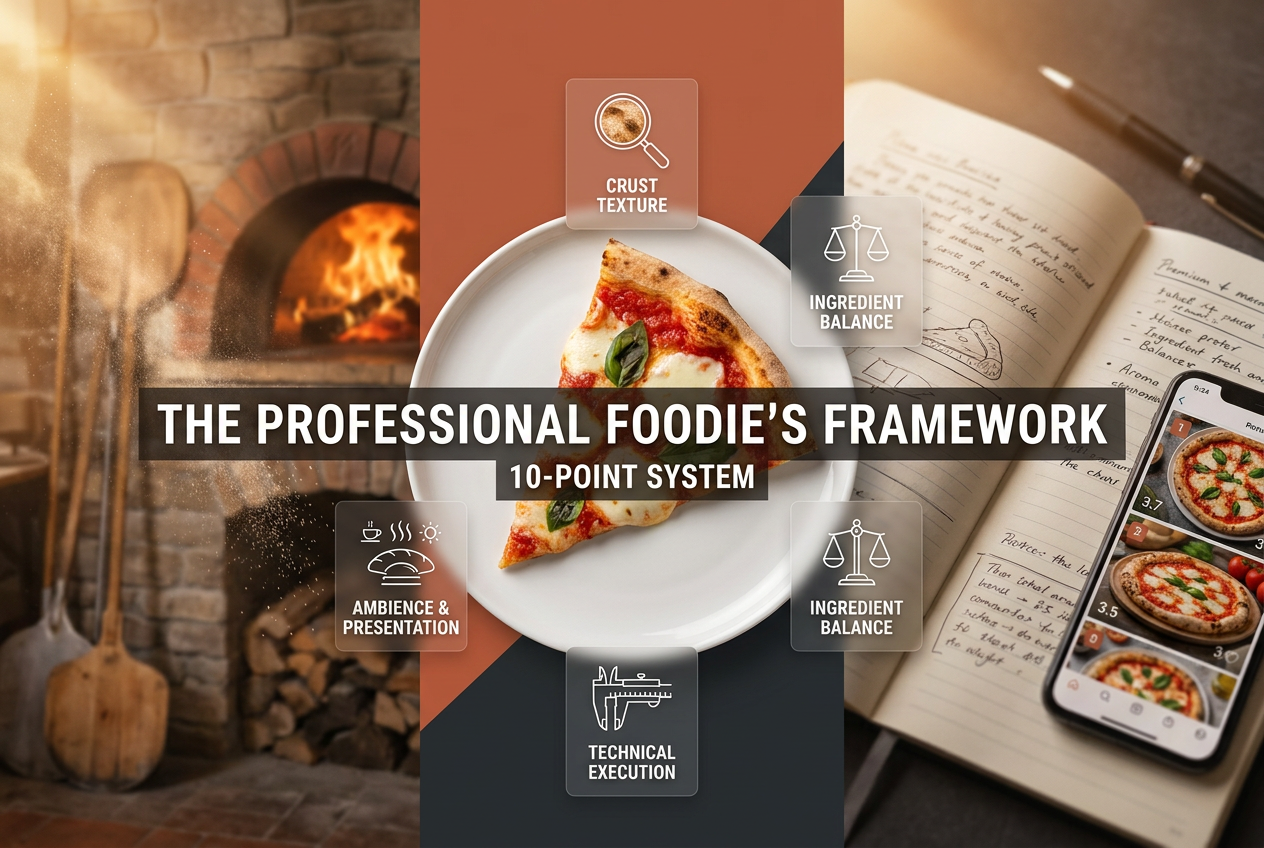
Pizza Reviews: The Professional Foodie’s 10-Point Framework
Alex the juice queen
Alex hunts for the best juice bars and presses. She rates every sip and saves her favorites in Savor.
Pizza Reviews: The Professional Foodie’s 10-Point Framework Your camera roll is a graveyard of incredible slices. You scroll past 47 photos of pizza - some...
Pizza Reviews: The Professional Foodie’s 10-Point Framework
Your camera roll is a graveyard of incredible slices. You scroll past 47 photos of pizza - some from that place in Naples, others from the corner spot you swear by, maybe a few from that trendy Brooklyn joint everyone’s been talking about. But which one was actually worth the line? Which crust had that perfect leopard spotting? Which sauce hit that elusive sweet-acidic balance that made you stop mid-bite and just... think about it?
The problem with most pizza reviews is they’re useless noise. A generic 4-star rating tells you nothing. "The best pizza I’ve ever had!" means nothing when you have no idea if that person thinks Papa John’s is acceptable. Even the famous One Bite reviews, while entertaining, reduce one of the world’s most technically complex foods to a single number based largely on "crunch."
This guide isn’t about where to eat pizza. It’s about building a framework - a professional lens - that lets you evaluate, document, and actually remember every slice you encounter. By the end, you’ll have a system that transforms your camera roll from a chaotic collection into a searchable, meaningful archive of your personal pizza journey.
Table of Contents
- The Anatomy of a Perfect Review: The Four-Pillar Framework
- The Searchable Memory Solution
- The Gold Standard Examples
- The Situational Matrix
- Building Your Personal Pizza Portfolio
- Advanced Techniques: Reading the Technical Specs
- Common Mistakes in Pizza Evaluation
- Frequently Asked Questions
The Anatomy of a Perfect Review: The Four-Pillar Framework
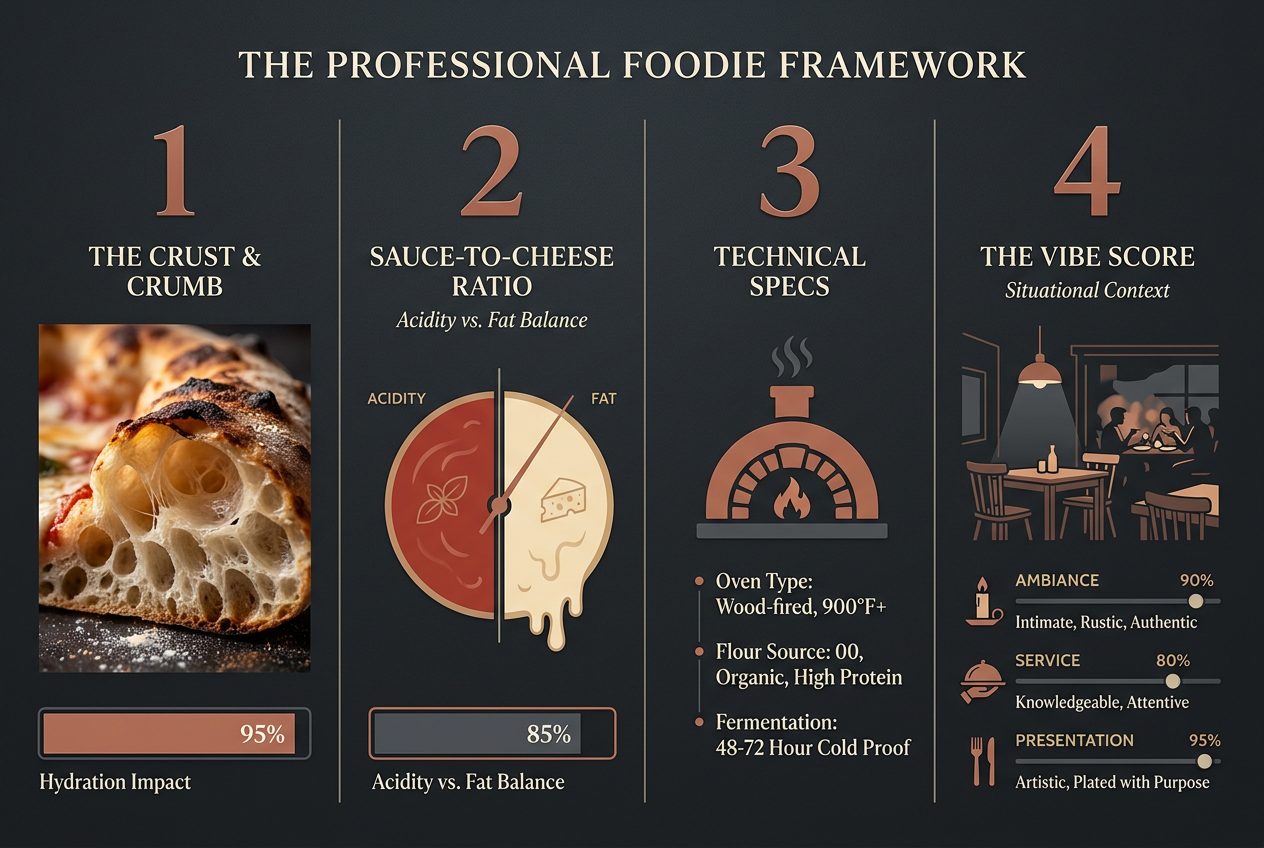
Establish technical authority using our four-pillar framework to evaluate every slice beyond just flavor, focusing on the science of fermentation and structural balance.
Most people taste pizza with their expectations, not their palate. They walk into a hyped-up spot already convinced it’s going to be amazing, or they dismiss a neighborhood joint because it doesn’t have the right Instagram aesthetic. The professional approach requires something different: a systematic breakdown that separates genuine craft from clever marketing.
Pillar One: The Under-Carriage and Crumb
Turn your slice over. This is where amateurs become connoisseurs.
The under-carriage reveals everything the pizzaiolo doesn’t want you to see. Is there uniform leopard spotting - those dark, almost burnt patches that indicate proper Maillard reaction from a screaming-hot oven? Or is it pale and anemic, suggesting a too-cool bake that dried out the dough instead of blistering it?
Look for char distribution. The best coal-fired and wood-fired pizzas show random patterns of blackened spots, proof that actual flames licked the dough. Gas ovens produce more uniform browning - not necessarily worse, just different. You’re building a vocabulary here.
Now the crumb structure. Break open the cornicione (that puffy edge crust). You should see an irregular network of air pockets - what bakers call "open crumb." Large, uneven holes mean proper fermentation and gluten development. Dense, uniform texture? That’s commercial yeast rushed through a same-day dough. It’s not wrong, but it’s not craft.
The "flop test" matters, but not how you think. Some people obsess over a slice that doesn’t flop at all. That’s nonsense. Proper hydration (the water-to-flour ratio) creates a tender dough that will naturally bend. The question is whether it bends gracefully or collapses into a soggy mess. If the tip droops within three seconds of picking it up, you’ve got structural problems. If it stays rigid like cardboard, you’ve got either too much gluten development or underbaked dough.
Pillar Two: The Sauce-to-Cheese Ratio and Balance
This is where personal preference meets objective quality. You can have strong opinions about how much sauce you like, but you can’t deny when the balance is off.
Start with the sauce. Is it sweet, acidic, or somewhere in between? San Marzano tomatoes from volcanic soil near Vesuvius have a naturally lower acidity and subtle sweetness. Domestic tomatoes often need sugar to balance their sharper acid. Neither is better - you’re just noting what’s there.
Can you taste individual tomato seeds and pulp, or is it puréed smooth? Rustic sauce with texture tells you they’re using quality whole tomatoes. Sauce that tastes like it came from a #10 can of commodity paste? That’s what it is.
The cheese layer should be visible but not suffocating. If you can’t see any sauce through the cheese, it’s a cheese bread, not pizza. The best margheritas use fresh mozzarella torn into chunks, leaving gaps where the sauce peaks through. Low-moisture mozz creates that stretchier, more uniform blanket of dairy - ideal for New York-style, wrong for Neapolitan.
Watch how the fat behaves. Does it pool in those little orange puddles? That’s not a flaw - it’s proof they used whole-milk mozz and didn’t over-shred it. Pre-shredded cheese includes anti-caking agents that prevent proper melting and fat separation.
Pillar Three: The Technical Specifications
Here’s where you separate the casual eater from someone who actually understands what they’re tasting. The technical specs aren’t pretentious - they’re diagnostic tools.
Oven type changes everything. Coal-fired ovens (like Di Fara in Brooklyn) hit 800-900°F and create aggressive char with a specific mineral undertone. Wood-fired ovens add subtle smoke and reach similar temps but with less consistent heat distribution. Gas deck ovens max out around 650°F and produce the most uniform bake. Conveyor belt ovens? You can taste the consistency, which is sort of the point.
Fermentation time shows up in flavor complexity. A 72-hour cold ferment develops deep, slightly tangy notes - almost sourdough-like. Same-day dough tastes flat and one-dimensional. You’re literally tasting time.
Flour type matters more than most people realize. Tipo 00 flour (the Italian standard) has a finer grind and lower protein content than American bread flour. It creates a more tender, delicate crust. Some pizzerias are milling their own flour in-house (Scarr’s in NYC, for example) - you can taste that freshness.
Hydration percentage is the water-to-flour ratio. Higher hydration (70-80%) creates an airier, more delicate crust with better oven spring (that dramatic puffing in high heat). Lower hydration (55-65%) produces a denser, chewier structure. Neither is superior - they’re different tools for different styles.
Pillar Four: The Vibe-Score (Situational Context)
This is the part where objectivity meets real life. The same pizza can be transcendent in one context and disappointing in another.
Consider what the pizza is trying to be. A late-night dollar slice should be evaluated on entirely different criteria than a $25 margherita at a sit-down spot. The dollar slice needs to deliver grease, salt, and carbs efficiently while you’re three drinks deep. The $25 pie should justify its existence with technique, ingredients, and a dining experience.
The environment shapes the meal. Counter service where you eat standing up creates a different relationship with the food than white tablecloths and wine pairings. Neither is better, but you need to acknowledge what you’re evaluating. Some of the best pizza in Naples is served on paper in loud, chaotic spaces where you eat in 15 minutes and leave. That’s not a flaw - it’s the format.
Time and company matter. Pizza eaten solo hits different than pizza shared with friends. Pizza at 1 AM after a concert tastes different than the same slice at 1 PM on a Tuesday. You’re not a machine, and pretending context doesn’t influence perception is dishonest.
The Searchable Memory Solution
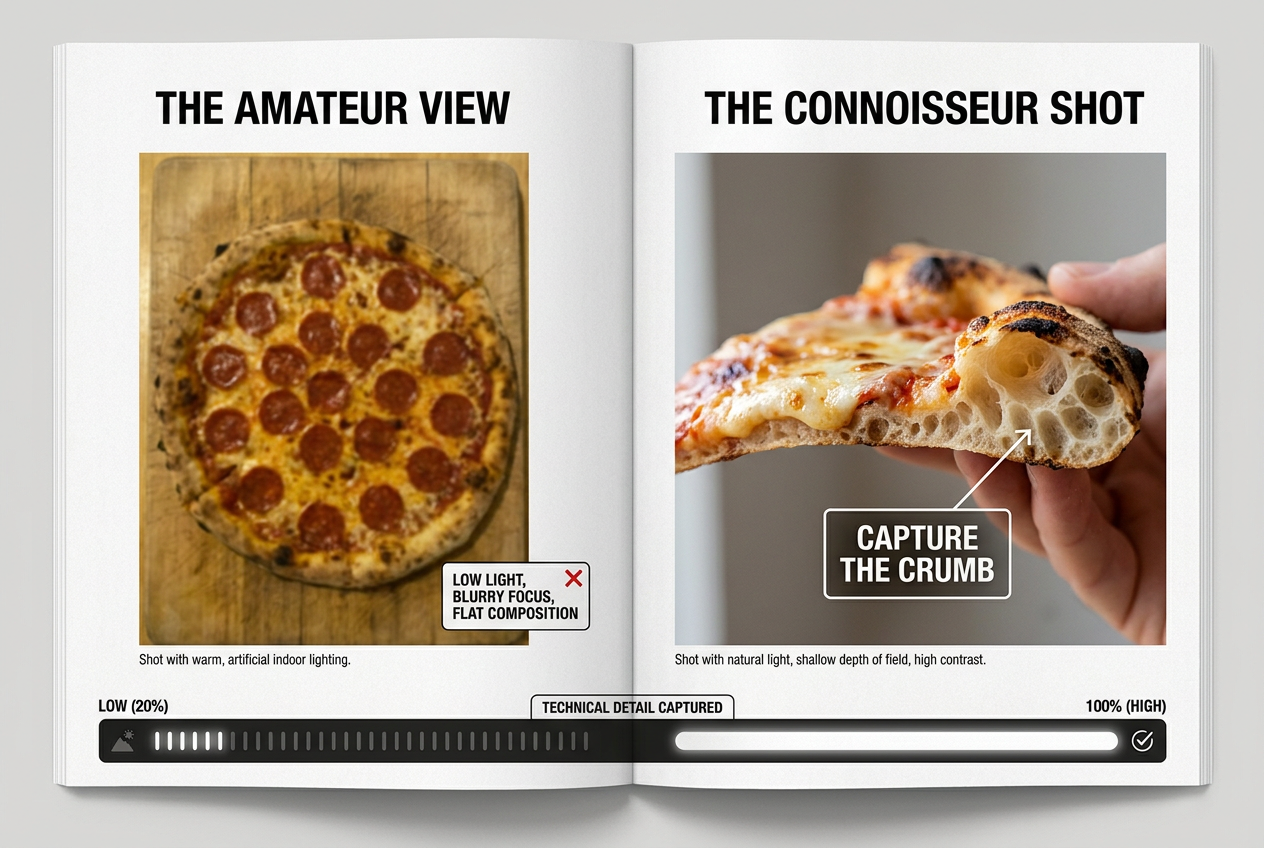
Stop wasting storage on unsearchable photos. Learn to capture the ’crumb shot’ and under-carriage to document the technical mastery of your favorite pizzerias.
The average food enthusiast takes 2,000-3,000 food photos per year. Most of them are useless.
You know this because you’ve lived it. You remember having an extraordinary slice somewhere, but you can’t remember where. You scroll through hundreds of nearly identical top-down photos of circular cheese blankets, all looking the same. The restaurant name isn’t in the metadata. You didn’t write a caption. The photo itself tells you nothing useful.
This is the camera roll graveyard problem, and it’s solved by structure, not more photos.
The Essential Shot List
Professional food documentation requires four specific photos, taken in order:
The establishing shot - Wide angle showing the full pizza (or your slice) in its environment. This gives you context: paper plate or porcelain, counter service or tablecloth, whole pie or single slice. You’re capturing the format, not just the food.
The under-carriage shot - Lift the slice and photograph the bottom at a slight angle. This captures the char pattern, the color gradient from edge to center, and any structural issues like soggy centers or burnt spots. This single photo tells you more about oven temp and bake time than ten photos of melted cheese.
The crumb shot - Tear or bite into the cornicione and photograph the internal structure. You want to see those air pockets, the texture of the dough, how the crust transitions from the thin base to the puffy edge. This documents fermentation and gluten development.
The cross-section - One bite out of the middle of the slice, photographed from the side. This shows the ratio of crust to sauce to cheese, how the layers interact, and whether there’s structural integrity or everything’s sliding apart.
These four shots create a complete technical record. Six months later, you’ll be able to reconstruct exactly what you ate and why it did or didn’t work.
The Documentation Template
Taking better photos only solves half the problem. You need a system for cataloging what you’ve learned.
The most effective approach is a simple structured note attached to each pizza. You don’t need an essay - you need consistent data points you can search and compare later. Here’s the framework:
Location & Date - "L&B Spumoni Gardens, Brooklyn - March 15, 2025"
Style & Format - "Sicilian square slice, counter service"
Technical Observations - "Thick, focaccia-like base, low hydration dough. Cheese applied under the sauce (classic Sicilian reverse-layer). Gas deck oven, even browning, no char. Dense crumb with small uniform air pockets."
Taste Notes - "Sauce is bright and acidic, clearly quality tomatoes. Cheese has that slightly rubbery texture from low-moisture mozz, which works here. Crust is crispy-chewy, almost fried texture on bottom."
The Score - "8.7/10 - Perfect execution of this specific style, though not my personal preference for everyday pizza."
The Situational Context - "Ideal for: Feeding a group, nostalgic Brooklyn food tour. Not ideal for: Date night, showcasing technical craft."
This template takes 90 seconds to complete on your phone. Do it immediately after eating, while the details are fresh. That’s how serious food journaling works - consistency over perfection.
Digital Tools vs. Analog Systems
You have two paths here, and both work if you actually use them.
The analog approach: A dedicated notebook (physical or digital) where you write entries by hand. The act of writing forces you to think more carefully about what you’re documenting. You’re building a personal encyclopedia, organized chronologically or by region/style. This works brilliantly until you need to find "that amazing coal-fired margherita from somewhere in Manhattan in 2023."
The digital approach: A structured app or database where each pizza entry has consistent fields. This creates searchability - you can filter by location, style, oven type, or score. The downside is friction: if the app is clunky or the entry process feels like work, you’ll stop using it within a month.
The hybrid approach (my recommendation): Photos with structured captions in your camera roll, backed up by periodic exports to a spreadsheet or dedicated food tracking tool. This gives you the immediacy of your phone’s camera app with the organizational power of sortable data.
Whatever system you choose, the critical element is reducing friction. If documentation feels like homework, you won’t do it consistently. If it takes more than two minutes per pizza, you’ll quit. The goal is a habit so automatic it becomes part of the meal.
The Gold Standard Examples
A deep dive into why a 9.3 score is earned through technical perfection, from the fermentation-driven leopard spotting to the structural integrity of the base.
Theory is worthless without application. Let’s break down real pizzas using the framework, showing how technical observation creates meaningful evaluation.
Case Study One: L’Industrie (Williamsburg, Brooklyn) - 9.3/10
Walk into L’Industrie on a Wednesday afternoon and you’ll wait in line with people who know. The space is tiny, the vibe is chaotic, and the pizza is a masterclass in modern Brooklyn-Neapolitan fusion.
The Under-Carriage: Aggressive leopard spotting across 40% of the bottom surface. Not uniform - you can see where the flames concentrated and where they pulled back. This is a proper wood-fired oven running north of 800°F. The char tastes slightly sweet, not acrid, meaning they’re managing heat correctly and not burning the dough.
The Crumb: Tear into the cornicione and you’re looking at massive, irregular air pockets. This is a 72-hour cold fermented dough with high hydration (probably 75-80%). You can see the gluten strands stretched thin between pockets. When you press the crust, it springs back - proper oven spring from rapid heat exposure. The edge crust is almost hollow, which means the steam inside expanded dramatically during baking.
The Sauce Balance: They’re using DOP San Marzano tomatoes - you can taste it. Low acidity, natural sweetness, with a slightly mineral finish. The sauce is crushed, not puréed smooth, so you get textural variation. Cheese is fresh mozzarella applied in torn chunks, not slices. You can see individual cheese islands with sauce showing through. The fat separation is visible - those little pools of orange oil are proof of whole-milk mozz.
The Technical Specs: Wood-fired oven (you can see the wood stacked near the entrance). Tipo 00 flour based on the tender texture. High hydration based on the open crumb. 72-hour ferment based on the complex, slightly tangy flavor profile. Each pizza bakes for roughly 90 seconds - you can watch the pizzaiolo pull them when the cheese just starts to brown and the crust puffs dramatically.
The Vibe Context: This is pizza for people who care about pizza. You eat standing at a counter or take it to go. There’s no ambiance, no wine list, no pretense. It’s technically excellent food served in a no-frills format. That alignment of quality and context is part of why it scores high.
Why 9.3 and not 10.0: The occasional slice gets slightly over-charred on one edge (you’re playing with fire literally, consistency suffers). The center can sometimes be a touch too wet - not structurally compromised, but requiring a fold to eat without dripping.
Case Study Two: Di Fara (Midwood, Brooklyn) - 9.1/10
Legendary. Polarizing. Worth the hype if you understand what you’re evaluating.
The Under-Carriage: Coal-fired oven running at 900°F creates a different char pattern than wood. It’s more concentrated and mineral-forward in flavor. The bottom is dark, almost burnt-looking in spots, but it’s not acrid - it’s deeply caramelized. This is the Maillard reaction pushed to its limit.
The Crumb: The dough is a bit denser than L’Industrie’s - probably 60-65% hydration and a shorter ferment (48 hours, not 72). You get smaller, more uniform air pockets. The texture is chewier, more substantial. This isn’t worse - it’s a different tool for a different style. The coal oven’s intense bottom heat prevents the massive puffing you get with wood-fired Neapolitan styles.
The Sauce Balance: Dom DeMarco’s sauce is notably sweet. He’s using domestic tomatoes and balancing with sugar. The first bite tastes almost like ketchup if you’re not ready for it. But here’s the thing: in context with the intense char and the richness of his cheese blend, that sweetness works. It’s a high-sugar, high-fat, high-salt bomb that somehow achieves balance through extreme contrasts.
The Technical Specs: Coal-fired oven (you can smell it when you walk in). Flour blend that includes some higher-protein American flour, giving more structure. Fresh mozzarella plus aged provolone for funk. Fresh basil scissored directly onto each pie. The pizzaiolo (or one of the family members who’ve taken over) adds a final drizzle of olive oil after the bake - you can see it pool slightly.
The Vibe Context: This is a pilgrimage spot. You wait an hour minimum. You watch your pizza being made from start to finish. The space is cramped and hot. If you’re expecting a quick, casual meal, you’ll be frustrated. If you understand you’re participating in a living piece of food history, the wait becomes part of the experience.
Why 9.1 and not higher: The wait is genuinely excessive and not necessary for quality (efficiency is possible without sacrificing craft). The sweetness of the sauce is a divisive choice that some palates will reject entirely. Consistency varies depending on who’s working the oven.
Case Study Three: Scarr’s (Lower East Side, Manhattan) - 8.9/10
Scarr’s represents the new wave of obsessive craft focused on the foundation: flour.
The Under-Carriage: Gas deck oven, so you get more uniform browning and less char. This isn’t a flaw - it’s a different aesthetic. The bottom is golden-brown edge to edge, with just a few darker spots where the heat concentrated. The lack of aggressive char lets other flavors shine through.
The Crumb: Open, irregular structure indicating long fermentation and proper hydration. What’s different here is the flavor - there’s a nutty, almost whole-grain character you don’t get from standard commercial flour. That’s because Scarr’s mills their own flour in-house from organic wheat. You’re tasting freshness and terroir that disappears in flour that’s been sitting in a warehouse for months.
The Sauce Balance: Simple tomato sauce with minimal intervention. You can taste individual tomatoes. The ratio leans slightly toward more sauce than some New York spots - it’s not swimming, but the tomato presence is strong. Low-moisture mozz that creates good coverage and that classic stretchy pull.
The Technical Specs: Gas deck oven at 550-600°F. In-house milled flour from organic wheat berries. Cold fermentation for 48-72 hours depending on dough batch. The dough balls are larger than standard (probably 280-300 grams), creating a slightly thicker, more substantial slice.
The Vibe Context: Casual slice joint with counter seating. You can grab a slice and be out in five minutes, or you can order a whole pie and linger. The space acknowledges its craft (the mill is visible) without being pretentious about it.
Why 8.9: The gas oven produces excellent pizza, but lacks the dramatic char and smoke that wood-fired or coal-fired ovens provide. That’s not objectively better or worse, but for my personal preference, I score the more aggressive heat signatures slightly higher. The flour innovation is brilliant, but it’s a subtle detail most eaters won’t notice or appreciate.
For more systematic approaches to evaluating dishes of all kinds, see this guide to building your personal food database.
The Situational Matrix
Use the Situational Matrix to ensure your Friday night plans align with your technical expectations, whether you’re seeking a vibe or a masterclass in dough.
Not all great pizza is appropriate for all situations. Understanding context prevents disappointment.
| The Need | Recommendation | The Foodie Factor |
|---|---|---|
| Impressing a Date | Lucali (Brooklyn) | The 2 PM line-waiting ritual signals commitment. BYOB format creates intimacy. The pizza is excellent but the environment does half the work. Reservation-only (call-ahead weeks in advance) adds exclusivity. |
| Technical Study | Scarr’s Pizza (LES) | In-house milled flour is a conversation starter. Counter seating lets you watch the process. Lower pressure than a formal sit-down means you can focus on the food without performance anxiety. |
| Regional Deep-Dive | Frank Pepe Pizzeria Napoletana (New Haven) | Understanding the New Haven "apizza" style (coal-fired, thin crust, charred edges, white clam as the signature) is essential knowledge for anyone serious about American pizza history. |
| Late-Night Fuel | Joe’s Pizza (Multiple NYC Locations) | Open until 4 AM. Consistent, reliable, exactly what you need when you need it. No pretense, no wait, no disappointment. This is the benchmark for "solid 7.5/10" pizza that feeds a specific craving. |
| Group Gathering | Roberta’s (Bushwick) | Full menu beyond pizza. Cocktail program. Outdoor seating. The pizza is excellent, but the space handles groups of 6-8 without feeling cramped. |
| Solo Mission | L&B Spumoni Gardens (Brooklyn) | Counter service, grab-and-go. The Sicilian square slice format is built for solo eating. No awkward table-for-one dynamics. Focus is pure food, no social performance required. |
| Culinary Education | Pizzeria Beddia (Philadelphia) | Joe Beddia’s book "Pizza Camp" provides context for what you’re eating. Limited daily pizza quantities mean what you’re eating was made fresh that day. The focused menu (3-4 pizzas, that’s it) shows restraint and confidence. |
The matrix isn’t prescriptive - it’s a starting point for thinking systematically about what you’re trying to accomplish. The best pizza for a first date is probably not the best pizza for understanding regional styles. That distinction matters.
Building Your Personal Pizza Portfolio
Data collection without purpose is just hoarding. The goal is creating a searchable, meaningful archive that actually improves your future dining decisions.
The Core Categories
Your pizza portfolio should organize information into four primary categories:
By Style - Neapolitan, New York, Sicilian, Detroit, New Haven, Roman (pizza al taglio), Grandma style, etc. This lets you compare like to like. A New York slice and a Neapolitan margherita are different foods evaluated on different criteria.
By Location - Organized geographically, from neighborhood level up. "Brooklyn coal-fired spots" becomes its own sub-category. "Naples trip 2024" becomes a contained collection. This structure helps when you’re planning travel or exploring a new area.
By Score - Your personal top 10, 20, 50. The best pizzas you’ve ever had, ranked and dated. This becomes your recommendation engine when friends ask "where should I eat?"
By Technical Element - "Best leopard spotting," "Best cornicione," "Most unusual topping combinations that worked." This is where you document specific craft elements worth returning for.
The Review Evolution
Your first 20 pizza reviews will be rough. You’re learning to see, learning to taste, learning to articulate. That’s expected and necessary.
By review 50, patterns emerge. You realize you consistently score coal-fired pizzas higher than wood-fired. Or you discover you’re drawn to higher hydration doughs regardless of regional style. Your personal taste profile becomes visible through data.
By review 100, you have a legitimate reference library. You can make confident recommendations based on specific criteria. "If you want aggressive char, go here. If you want delicate texture, go there. If you want the best ratio of quality to value, here’s the spot."
This isn’t about becoming a professional critic. It’s about building personal expertise that compounds over time. Your 100th pizza review is informed by the previous 99 in a way a standalone review never could be.
Sharing Your Knowledge
At some point, your pizza portfolio becomes valuable to others. Friends start asking for recommendations. You become the go-to pizza person in your social circle.
Consider whether you want to share your reviews publicly or keep them private. Both approaches have merit. Public sharing creates accountability and community. Private documentation gives you freedom to be completely honest without worrying about offending local establishments or seeming overly critical.
If you do share publicly, add context that helps readers calibrate to your taste. "I score high-char pizzas 1-2 points higher than most people" or "I have a strong preference for minimalist margherita over loaded specialty pizzas" gives readers a translation layer.
Advanced Techniques: Reading the Technical Specs
Once you’ve developed a baseline vocabulary, you can start identifying technical elements by taste and observation alone.
Identifying Fermentation Time
Taste the cornicione (edge crust) by itself, no sauce or cheese. Does it have a subtle tang, almost sourdough-like? That’s lactic acid buildup from extended fermentation (48+ hours). Is it bland and one-dimensional? That’s same-day dough.
A 72-hour ferment develops complexity you can’t fake. The flavor is layered - you get wheaty notes, subtle sweetness, that gentle acidity. It lingers after you swallow. Same-day dough tastes like... well, like raw flour that got cooked. It’s not offensive, just flat.
Diagnosing Hydration Levels
Look at how the slice behaves when you pick it up. High hydration (75-80%) creates a delicate structure that bends easily but doesn’t collapse. The dough feels tender, almost fragile. Low hydration (55-65%) gives you more rigidity and chew. The slice holds straight or requires more aggressive folding to bite.
Check the crumb structure. High hydration = large, irregular air pockets. Low hydration = smaller, more uniform holes. Neither is better, but they create completely different eating experiences.
Reading the Char Pattern
Random, aggressive char patterns = wood-fired or coal-fired ovens running extremely hot (800°F+). The flames literally kiss the dough in unpredictable spots.
Uniform browning with minimal char = gas deck oven running cooler (550-650°F). More consistent, easier to control, less dramatic.
Spotty browning with no real char = conveyor belt oven or home oven that can’t get hot enough. The pizza dried out rather than blistered.
Identifying Flour Types
Tipo 00 flour creates a tender, almost delicate chew. It’s finely milled, so there’s no grittiness. American bread flour (higher protein content) produces more structure and chew - that iconic New York fold-ability comes partly from higher-gluten flour.
Fresh-milled flour (like Scarr’s) has a nutty, slightly whole-grain character even if it’s refined white flour. That’s because the oils in the wheat germ haven’t oxidized yet. Commercial flour that’s months old tastes flatter.
If the crust tastes slightly sweet and has a golden color, they might be adding sugar or honey to the dough (common in New York-style). If it tastes purely savory, it’s probably just flour, water, salt, and yeast.
Common Mistakes in Pizza Evaluation
Even experienced eaters fall into these traps. Awareness helps you avoid them.
Mistake One: Confusing Personal Preference with Objective Quality
You can dislike an ingredient or style while acknowledging technical excellence. Maybe you hate anchovies - that doesn’t mean the anchovy pizza you tried was poorly made. Maybe you prefer thin crust - that doesn’t make a perfectly executed Detroit-style pizza objectively worse.
Separate "this is well-made" from "this is to my taste." Both can be true or false independently.
Mistake Two: Letting Hype Override Observation
That "best pizza in the city" spot everyone’s talking about might actually be mediocre. Or it might be excellent but not your style. Don’t let social proof override what your own palate is telling you.
Conversely, that corner slice shop nobody talks about might be technically superior to the hyped spot. Trust your framework, not the crowd.
Mistake Three: Ignoring Context
Evaluating a $2 slice against a $25 artisanal pie is absurd. They’re solving different problems. The dollar slice should be judged on whether it successfully delivers cheap, fast, satisfying calories. The expensive pie should justify its price through technique, ingredients, or experience.
Mistake Four: Overvaluing Single Elements
Maybe the crust is incredible but the sauce is wrong. Maybe the ingredients are pristine but the oven temp was off. A pizza is a system - one exceptional element doesn’t overcome three mediocre ones.
Your score should reflect the complete experience, not just the standout moment.
Mistake Five: Failing to Document Immediately
If you wait until you get home to write your notes, you’ve already forgotten crucial details. The char pattern becomes "pretty dark I think." The sauce balance becomes "it was good." The structural integrity becomes "I don’t really remember."
Document in real time, or accept that your reviews will be vague and useless.
Frequently Asked Questions
What’s the difference between Neapolitan and New York style pizza?
Neapolitan pizza is the original, from Naples, Italy. It’s made with Tipo 00 flour, San Marzano tomatoes, fresh mozzarella, fresh basil, and olive oil. It’s cooked in a wood-fired oven at 800-900°F for 60-90 seconds. The crust is thin in the center with a puffy, charred cornicione (edge). The texture is delicate and the pizza is eaten with a knife and fork.
New York style evolved from Neapolitan pizza when Italian immigrants adapted it for American ingredients and ovens. It uses higher-protein bread flour, a tomato sauce (often with oregano), low-moisture mozzarella, and cooks in a gas deck oven at lower temperatures for longer. The result is a larger, foldable slice with more chew and structural integrity. You eat it with your hands, often folded in half.
The fundamental difference is format: Neapolitan is a sit-down meal; New York style is grab-and-go street food.
How do I know if a pizza is using quality mozzarella?
Fresh mozzarella (fior di latte or buffalo mozzarella) comes in balls packed in liquid. On pizza, it creates an uneven layer with visible cheese chunks and gaps where sauce shows through. The fat separates visibly, creating those orange-ish oil puddles. The texture is tender and creamy, not stretchy.
Low-moisture mozzarella is aged longer and has less water content. On pizza, it creates a more uniform blanket of coverage with that classic "cheese pull" when you bite. It browns more readily and has a slightly firmer texture.
Pre-shredded mozzarella (from a bag) contains anti-caking agents and won’t melt properly. It creates a grainy texture and doesn’t develop good browning or fat separation. If the cheese layer looks dusty or powdery before baking, or if it melts into a uniform rubber sheet, it’s pre-shredded.
Quality isn’t about fresh versus low-moisture - both have proper applications. Quality is about using real cheese, not pre-shredded or imitation products.
What does "leopard spotting" mean and why does it matter?
Leopard spotting refers to the random dark spots and patches of char on the bottom crust, resembling a leopard’s spots. It’s caused by intense, direct heat from a wood-fired or coal-fired oven where flames make uneven contact with the dough.
It matters because it indicates proper baking technique in very hot ovens (800°F+). Those charred spots aren’t burnt - they’re deeply caramelized dough where the Maillard reaction and some actual carbonization created complex, slightly bitter flavor notes that balance the sweetness of the sauce and richness of the cheese.
Gas ovens running at lower temps produce more uniform browning without leopard spotting - that’s not inherently worse, just different. But if you’re eating pizza that claims to be "wood-fired Neapolitan" and there’s no leopard spotting, something’s wrong with their oven management.
How long should pizza dough be fermented?
There’s no single correct answer - different fermentation times create different results.
Same-day dough (4-8 hours) is what most commercial pizzerias use. It’s efficient and produces adequate pizza, but the flavor is one-dimensional. You taste cooked flour, not developed dough character.
24-hour fermentation starts developing complexity. You get more extensibility (the dough stretches easier) and subtle flavor development.
48-72 hour cold fermentation is the sweet spot for craft pizza. Long, slow fermentation in the refrigerator develops complex flavors (slightly tangy, nutty), improves texture, and makes the dough more digestible (the long ferment breaks down gluten and other proteins that can cause discomfort).
Beyond 72 hours, you start getting into sourdough territory where the tang becomes pronounced. This works for some styles but overpowers others.
You can taste the difference. Next time you eat pizza, pay attention to whether the crust tastes like "bread" or like "cooked flour." That’s fermentation talking.
Is coal-fired better than wood-fired better than gas?
They’re different tools, not a quality hierarchy.
Coal-fired ovens (like Di Fara, Totonno’s) reach extremely high temps and create aggressive char with a mineral undertone. The flavor is intense and distinctive. Coal maintains consistent heat better than wood but lacks the subtle smoke notes.
Wood-fired ovens (like most Neapolitan spots) add delicate wood smoke to the flavor profile. The heat is less consistent - you can see variation across a single pizza. This creates character but requires more skill to manage.
Gas deck ovens are the most consistent and controllable. They produce excellent pizza with uniform browning and can reach 600-700°F. They don’t create dramatic char or smoke, which some people see as a limitation and others see as letting the ingredients shine without competing flavors.
Your preference depends on what you value. If you love aggressive char and smoke, you’ll prefer coal or wood. If you want ingredient-forward pizza with consistency, you might prefer gas. None is objectively superior.
How do I rate pizza on a 10-point scale accurately?
First, decide what your scale measures. Are you rating objective technical quality? Personal enjoyment? Value for money? A combination? Be consistent.
Here’s a framework that works:
9.0-10.0 - Exceptional. Technical mastery across all four pillars. Creates a memorable experience you think about days later. Rare.
8.0-8.9 - Excellent. Very strong execution with perhaps one minor flaw or just shy of transcendent. Worth seeking out.
7.0-7.9 - Very good. Solid craft with no major mistakes but nothing that makes you stop and marvel. Your neighborhood go-to.
6.0-6.9 - Good. Competent pizza that satisfies the craving but doesn’t inspire. Nothing wrong, nothing special.
5.0-5.9 - Average. Does the basic job of being pizza but with noticeable flaws or mediocre ingredients.
Below 5.0 - Poor to inedible. Structural problems, bad ingredients, or fundamental mistakes in execution.
Use decimals to create nuance within these bands. An 8.3 might have excellent crust but slightly off sauce balance. An 8.7 might be nearly perfect with one small oven management issue.
The key is consistency. Your 8.5 today should match your 8.5 from six months ago, or your scale becomes meaningless.
Can I make professional-quality pizza at home?
Home ovens are the limiting factor. Most max out at 500-550°F, far below the 800-900°F needed for authentic Neapolitan or coal-fired styles. You can’t replicate that aggressive char and rapid bake at home.
That said, you can make excellent pizza within home oven constraints. Focus on perfecting your dough (invest time in learning proper fermentation and hydration). Use a pizza stone or steel preheated for at least an hour. Run your oven at maximum temperature. Learn to work with what you have rather than trying to replicate what requires equipment you don’t own.
Outdoor pizza ovens (Ooni, Roccbox) can reach 800-900°F and get you much closer to professional results. They’re investments, but if you’re serious about pizza, they remove the main home limitation.
The other elements - dough quality, ingredient selection, technique - are all achievable at home with study and practice. Your home pizza can be technically excellent even if it’s a different style than what you’d get in Naples.
How do I take better photos of pizza for documentation?
Natural light is everything. Shoot near a window during daytime, never with overhead fluorescent lights or flash. The golden hour (early morning or late afternoon) creates warm, flattering light.
For how to photograph food properly, the key shots were covered earlier: establishing shot, under-carriage, crumb, and cross-section. Take all four from slightly different angles to ensure you capture the details.
Get close enough to fill the frame but not so close you lose context. You want to see the full slice or pie plus a bit of the environment (the plate, the table, the pizza box).
Shoot at a 45-degree angle for the full pizza shot - it shows both the top surface and the edge profile. Shoot straight down for the under-carriage to capture char patterns clearly. Shoot straight-on at eye level for the cross-section to show the layering.
Don’t over-edit. Adjust brightness and contrast if needed, but resist the urge to oversaturate colors or add filters. You’re documenting reality, not creating art.
Your camera roll doesn’t have to be a graveyard of forgotten meals. With this framework, every pizza becomes data - a reference point in your growing expertise. The goal isn’t to become a professional critic. It’s to never again forget where you had that transcendent slice, or waste money on mediocre pizza because you couldn’t remember what worked before.
Start with your next slice. Take the four essential photos. Write your structured notes immediately. After 20 pizzas, you’ll notice patterns. After 50, you’ll have genuine expertise. After 100, you’ll be the person your friends ask when they need a recommendation.
The best pizza you’ll ever eat is probably still ahead of you. But only if you build the system to remember it when you find it.