
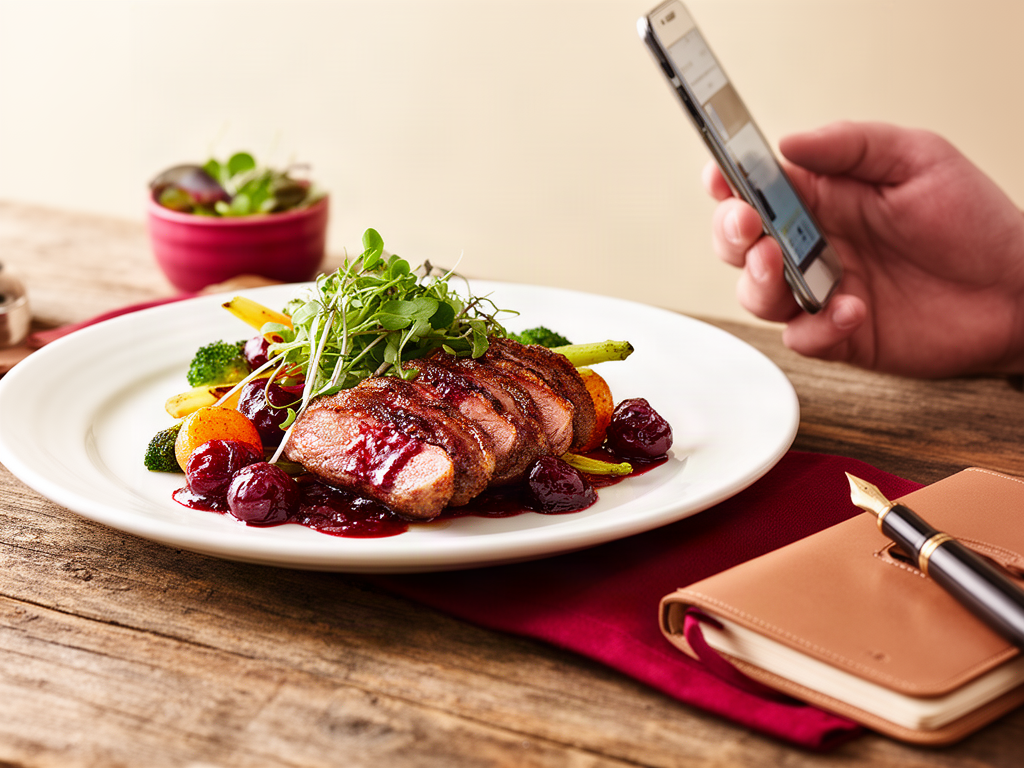
How to Remember Every Detail of Your Favorite Restaurant Meals
Alex the juice queen
Alex hunts for the best juice bars and presses. She rates every sip and saves her favorites in Savor.
How to Remember Flavor Notes from Restaurants: A Master Class Guide You spent a considerable sum on omakase in Tokyo, and three months later, you can't recall...
How to Remember Flavor Notes from Restaurants: A Master Class Guide
You spent a considerable sum on omakase in Tokyo, and three months later, you can't recall a single fish. You remember it was "really good," but you've lost the details that made it extraordinary - the specific texture of that one piece of toro, the way the wasabi cut through the fat, the exact moment your palate shifted from skepticism to revelation.
This isn't a memory problem. It's a systems problem.
Table of Contents
- The Sensory Framework: Understanding the Three Pillars of Flavor
- The Professional's 4-Step Tasting Method
- Logistics: The Stealth Recording System
- Building Your Searchable Archive
- The Flavor Vocabulary Cheat Sheet
- How to Develop Your Palate to Identify Flavors Better
- Frequently Asked Questions
The Sensory Framework: Understanding the Three Pillars of Flavor
Before you can remember flavor, you need to understand what you're actually tasting. Most people think flavor lives entirely on the tongue. It doesn't. What your brain interprets as "flavor" is a complex interaction between three distinct sensory systems.
Taste: The Foundation
Your tongue recognizes five basic tastes: sweet, salty, sour, bitter, and umami. That's it. Everything else is a combination or interpretation. When you taste that duck confit, your tongue is detecting salt from the cure, a hint of sweetness from the rendered fat, maybe some bitterness from the crispy skin, and the deep umami of the meat itself.
Understanding these basics gives you a structural framework. Instead of "it tastes good," you can identify the specific balance - how the acid from the cherry gastrique cuts through the fat, how a pinch of flaky salt amplifies the sweetness of a perfectly ripe tomato.
Aroma: The Secret Superpower
Here's the thing most people miss: smell accounts for roughly 80% of what the brain interprets as flavor. When you think you're tasting vanilla in a crème brûlée, you're mostly smelling it.
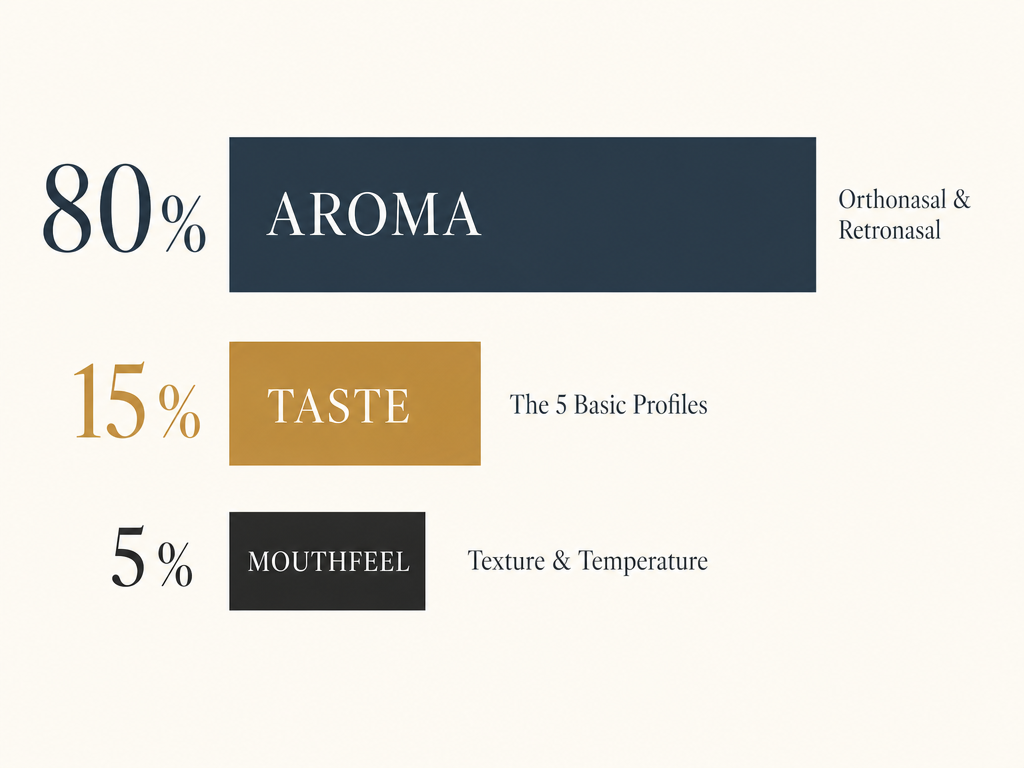 Aroma is the primary driver of flavor perception. By focusing on scent, diners can unlock up to eighty percent of the nuances within a complex dish.
There are two types of smell at work: orthonasal (what you smell before the food enters your mouth) and retronasal (the aromas that travel up the back of your throat while you're chewing). That second one is the game-changer. It's why wine tastes different after you swallow, why a cold diminishes flavor, and why professional tasters often exhale through their nose mid-bite.
If you want to remember a dish, pay attention to its aroma before your first bite. Lean in. Inhale deliberately. Ask yourself: Is it floral? Earthy? Sharp? Caramelized? These aromatic notes become the anchors for your memory.
Mouthfeel: The Forgotten Dimension
The difference between a good dish and a great one often lives in the texture. Mouthfeel describes the physical sensations in your mouth - silky, astringent, creamy, al dente, crispy, gelatinous.
Think about the best ramen you've ever had. The broth wasn't just flavorful - it had body, a richness that coated your tongue. The noodles had snap and chew. The chashu dissolved into tender, fatty threads. These textural contrasts create a multi-dimensional eating experience that a flat, one-note dish can't touch.
When you're cataloging a meal, describe the mouthfeel. Was the pasta properly al dente or mushy? Did the sear on that steak create a genuine crust or just surface browning? These details separate a memorable dish from a forgettable one.
The Professional's 4-Step Tasting Method
Professional critics don't wing it. They follow a structured approach that transforms a subjective experience into an analyzable memory. Here's the framework.
Step 1: Visual and Aromatic Observation
Before you touch your fork, observe the dish. How is it plated? What colors dominate? Is there steam rising? Are there visible textures - a glistening glaze, a dusting of herbs, a crack in a crust?
Then, smell it. Lean in and take a deliberate inhale. What hits first? Is there a dominant aroma or a complex bouquet? This pre-tasting ritual primes your brain to pay attention.
Step 2: The Initial Hit (Primary Taste)
Take your first bite. Don't chew yet. Let the food sit on your tongue for a second. What do you taste immediately? Salt? Sweetness? Acid? This is your primary impression - the dish's opening statement.
Step 3: Mid-Palate Evolution (Secondary and Tertiary Layers)
Now chew slowly. As you do, the flavor will evolve. The initial sweetness might give way to a subtle bitterness. The fat might melt and coat your palate, revealing hidden spice notes underneath. This is where complexity lives.
Pay attention to what changes. Does the dish get richer? More acidic? Do new flavors emerge as the ingredients mix on your tongue? These secondary and tertiary notes are what separate a simple dish from a layered one.
Step 4: The Finish (Length and Lingering Notes)
Swallow. What lingers? Does the flavor disappear instantly or does it hang around? A long, clean finish is often the mark of a well-executed dish. A cloying aftertaste or a harsh bitterness can ruin an otherwise solid plate.
Note how long the flavor lasts and what specific notes remain. Is it the charred crust of the fish? The bright acidity of the citrus? The warming spice of black pepper?
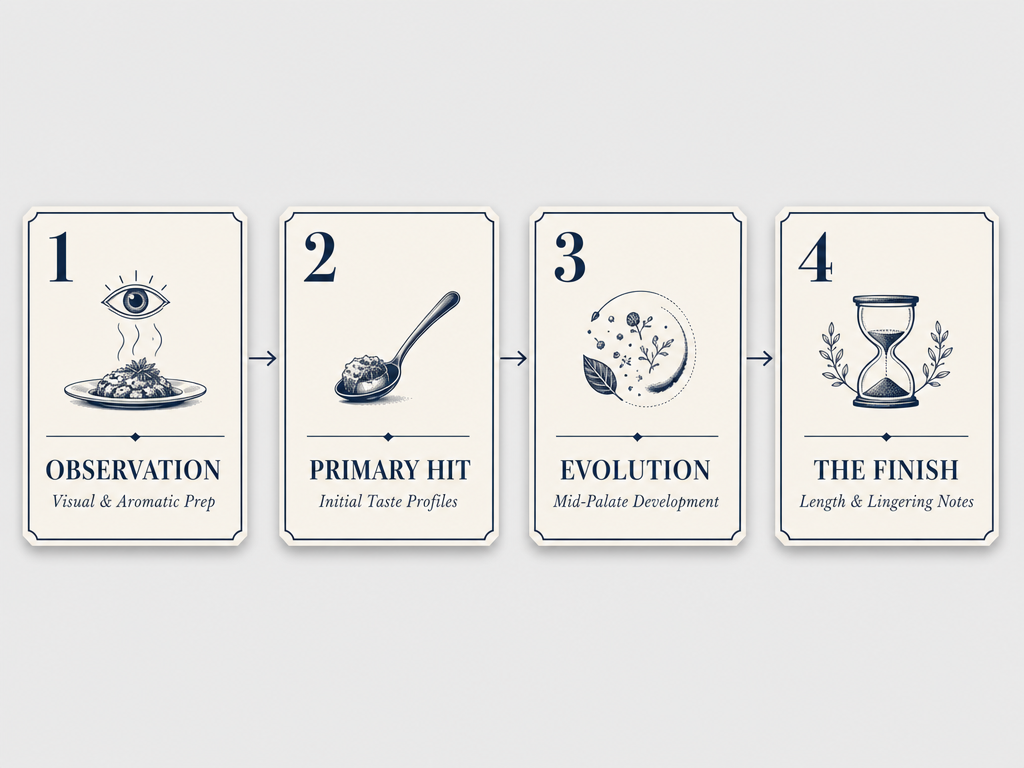 Mastering the professional four-step tasting method ensures you capture the entire lifecycle of a dish, from the first aroma to the lingering finish.
Logistics: The Stealth Recording System
You've just learned how to taste like a professional. Now you need a way to capture those observations without looking like you're conducting a lab experiment at dinner.
The Analog Approach: The Pocket Notebook
Some purists swear by a small pocket notebook - something slim enough to keep in a jacket or bag. After the meal (or during a discreet restroom break), you jot down quick notes: "Duck - crispy skin, rendered fat, cherry gastrique too sweet, 8/10."
Pros: No screen glare, no battery anxiety, tactile satisfaction.
Cons: Handwriting is slow, notes aren't searchable, and you still need to digitize later.
The Digital Arsenal: Specialized Apps
The modern foodie has options. Apps designed for tracking restaurant experiences fall into three broad categories:
Social Ranking (Beli-style): These apps let you build public or semi-public lists of favorite spots, often with a social layer where you can see friends' recommendations. Great if you want to share your culinary map with others, less ideal if you want a private archive.
Visual Journaling (Memolli-style): Photo-first platforms that emphasize offline sync and privacy. You snap a picture, add quick notes, and the app organizes everything by location and date. Works well for travelers who want a visual diary without the performance aspect of Instagram.
Flavor Libraries (Savor-style): Apps built around detailed dish profiles - name, ingredients, flavor notes, personal ratings. Think of these as personal food databases where you're archiving not just where you ate, but exactly what you ate and why it mattered.
If you're serious about building a searchable archive, look for tools that let you tag dishes by cuisine type, flavor profile, or ingredient. The ability to search "best umami-forward dishes in Tokyo" or "all the pasta I rated 9+ in Italy" is the difference between a collection and a graveyard.
The Restroom Memo: A Practical Tip
Here's the truth no one talks about: taking notes at the table can be socially awkward. If you're dining with someone who expects your full attention, pulling out your phone mid-meal sends the wrong signal.
Solution? The restroom memo. Excuse yourself between courses or at the end of the meal, open your voice-to-text app, and dictate your impressions while they're fresh. "Yellowtail sashimi, bright citrus, clean finish, slightly under-seasoned, texture perfect, 8 out of 10." It takes 20 seconds, you look like you're checking your messages, and you capture the details before they fade.
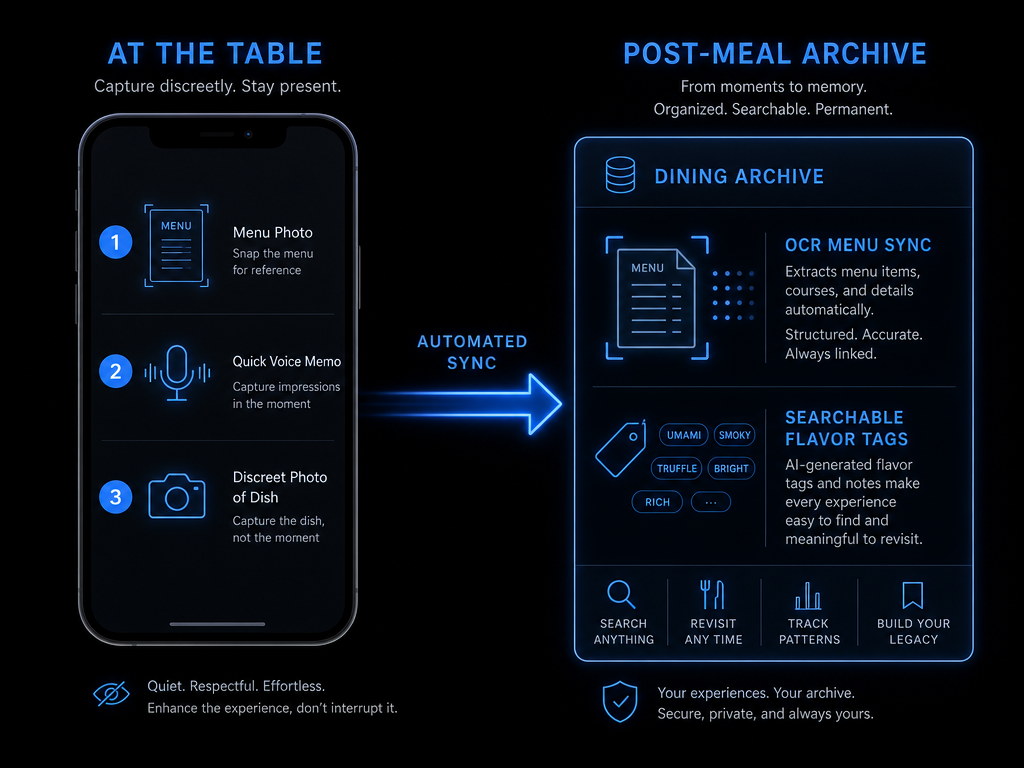 A discreet recording system allows you to build a comprehensive food archive without interrupting the social experience or restaurant service flow.
Building Your Searchable Archive
Raw notes are useful. A searchable archive is powerful.
The Data Fields That Matter
At minimum, your system should capture:
- Dish name (be specific: "Tonkotsu Ramen" not "ramen")
- Restaurant and location
- Date
- Primary ingredients
- Flavor notes (the 4-step observations)
- Texture/mouthfeel
- Personal rating (use a consistent scale - 10-point works well)
- Would you order again? (binary yes/no)
Platform Options
Notion: Infinitely customizable. You can build a database with all the fields above, tag by cuisine type, link photos to specific dishes, and use filters to surface your top-rated meals. The learning curve is moderate, but once it's set up, it's the most flexible option.
Specialized food apps: Many of the best dish tracking apps come with pre-built templates that handle tagging, photo uploads, and rating systems automatically. Less customization, but faster to start using.
Spreadsheets: If you're a data purist, Google Sheets or Excel can work. Add columns for each field, use filters and conditional formatting to highlight top dishes, and link to Google Photos for images. It's bare-bones, but completely free and platform-agnostic.
The OCR Trick
If you're photographing menus (and you should be), use optical character recognition (OCR) to extract the text. On iOS, the built-in Camera app can select text in photos. Google Lens does the same on Android. Copy the dish name and description directly into your notes. This eliminates transcription errors and saves time.
Geotags on photos automatically link the image to the restaurant's location. When you're building your archive three months later, you won't have to remember whether that incredible cacio e pepe was at Flavio al Velavevodetto or Trattoria Da Cesare al Casaletto - your phone already knows.
The Flavor Vocabulary Cheat Sheet
Generic descriptors are useless. "Delicious" tells you nothing. Here's a working vocabulary for more precise notes:
Taste-Specific:
- Bright (high acid, refreshing)
- Rich (fatty, coating)
- Balanced (no single element dominates)
- Sharp (aggressive acidity or spice)
- Mild (gentle, subtle)
- Savory (umami-forward)
Aroma-Specific:
- Floral (lavender, rose, chamomile)
- Earthy (mushroom, beet, truffle)
- Herbaceous (basil, mint, oregano)
- Smoky (charred, grilled, wood-fired)
- Pungent (garlic, onion, blue cheese)
- Fruity (citrus, stone fruit, berry)
Texture-Specific:
- Silky (smooth, velvety)
- Crispy (shattering crunch)
- Tender (yields easily to pressure)
- Al dente (firm resistance, toothsome)
- Creamy (rich, thick)
- Astringent (mouth-puckering, drying)
- Gelatinous (wobbly, soft-set)
- Flaky (layered, delicate structure)
Use these terms as building blocks. Instead of "the salmon was good," write "the salmon had a crispy skin with a silky, fatty interior, bright lemon, and a clean finish - 9/10."
How to Develop Your Palate to Identify Flavors Better
Remembering flavor starts with recognizing it in the first place. Your palate isn't fixed - it's trainable.
Deliberate Tasting: Once a week, do a focused tasting. Buy three different olive oils, or three types of soy sauce, or three brands of dark chocolate. Taste them side-by-side, making notes on the differences. This comparative approach sharpens your ability to detect subtlety.
Ingredient Study: Learn what individual ingredients taste like in isolation. Taste raw garlic, then roasted garlic, then black garlic. Understand how cooking transforms flavor. The more ingredient knowledge you build, the easier it becomes to deconstruct a complex dish.
Expand Your Reference Library: The broader your taste memory, the more you can recognize. If you've only ever had mediocre ramen, you won't fully appreciate a truly great bowl. Seek out benchmark versions of classic dishes - the platonic ideal of a croissant, the definitive carbonara, the reference-standard sushi. These become the standards against which you measure everything else.
Eliminate Distractions: When you're actively training your palate, don't eat while scrolling your phone or watching TV. Pay full attention. You're building neural pathways that connect flavors to memories. Multitasking dilutes the experience.
Frequently Asked Questions
What are the 7 flavor profiles?
There isn't a universally agreed-upon list of "7 flavor profiles," though some culinary frameworks organize dishes by dominant flavor characteristics: sweet, salty, sour, bitter, umami, spicy (pungency, not a true taste but a sensation), and fatty (increasingly recognized as a distinct perception). These aren't rigid categories - most great dishes layer multiple profiles. A well-made Thai curry balances sweet coconut milk, salty fish sauce, sour lime, bitter herbs, and fiery chilies.
Is Notion good for taking notes on meals?
Yes, if you're willing to invest time in setup. Notion's database functionality lets you create a fully searchable meal archive with custom tags, linked photos, and filters. You can build views that surface your highest-rated dishes by city, cuisine, or ingredient. The mobile app works offline, so you can add entries on the go. The downside is the initial learning curve - Notion isn't as plug-and-play as a dedicated food diary app.
How do you describe good-tasting food beyond generic adjectives?
Use the three-pillar framework (taste, aroma, mouthfeel) and specific descriptors. Instead of "this pasta is amazing," say "the cacio e pepe has a creamy, emulsified sauce with sharp pecorino, black pepper heat that builds gradually, and perfectly al dente rigatoni that holds the sauce in the ridges - the finish is rich but not cloying." Stack concrete observations. Reference the flavor vocabulary cheat sheet above.
How can I develop my palate for wine or coffee?
The same principles apply: deliberate, focused tasting with side-by-side comparisons. For wine, start with a tasting flight of three different varietals from the same region, or the same varietal from three different regions. Make notes on color, aroma, body, and finish. For coffee, try the same bean prepared three different ways (espresso, pour-over, French press). Repetition with variation builds your sensory reference library.
What is the best app for tracking food and activity?
If you mean calorie and macro tracking, MyFitnessPal remains the standard for its massive food database and barcode scanner. If you mean tracking memorable meals and flavor experiences, apps like Savor, Beli, or Memolli focus on dish-level detail rather than nutritional data. The best food tracking app for you depends on your goal - health metrics or culinary memory.
The serious foodie doesn't rely on memory alone. You build systems. You train your palate. You capture details while they're fresh, store them in a searchable format, and revisit them when you're planning your next meal, your next trip, or your next dinner party.
Your camera roll is full of forgotten meals. Your future self deserves better. Start now. The next extraordinary dish you eat won't vanish into the void - it'll become a permanent part of your culinary archive.