
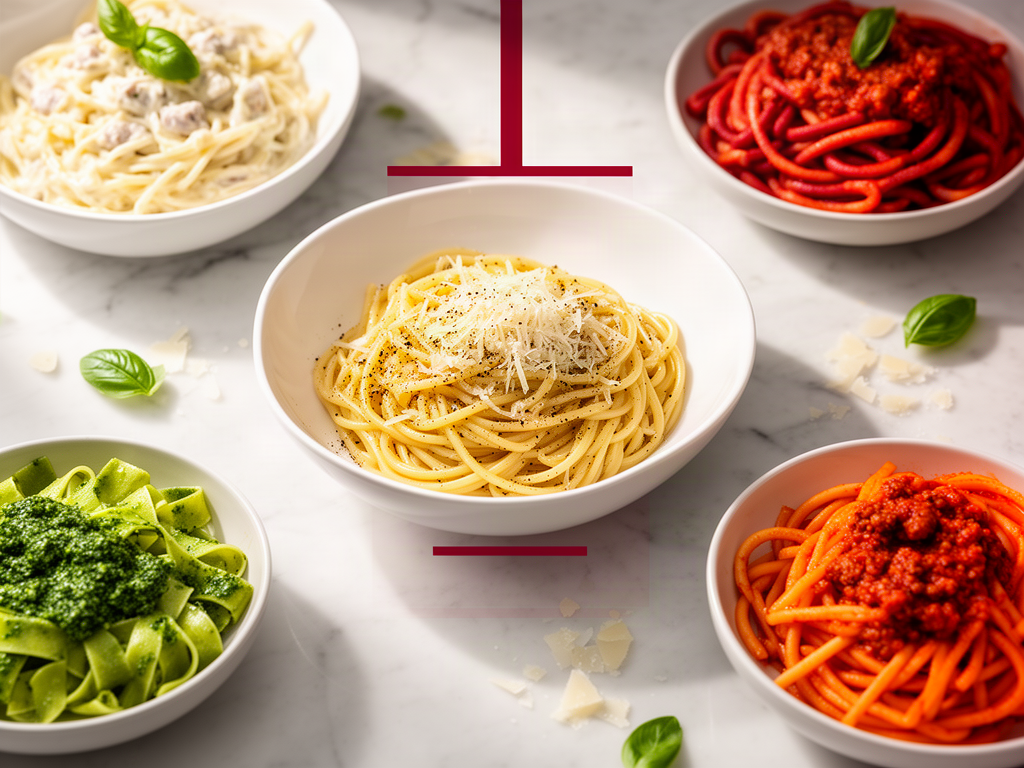
Beyond the Camera Roll: How to Track Your Favorite Pasta Dishes in Every City
John the smoothie monster
John lives for smoothie bowls and cold-pressed juices. He uses Savor to remember his best blends.
Beyond the Camera Roll: How to Track Your Favorite Pasta Dishes in Every City (2026) You're scrolling through 2,400 food photos at 11 PM, trying to remember...
Beyond the Camera Roll: How to Track Your Favorite Pasta Dishes in Every City (2026)
You're scrolling through 2,400 food photos at 11 PM, trying to remember where you had that transcendent carbonara three months ago. Was it Rome? Barcelona? The Instagram timestamp says March, but the restaurant name? Gone. The dish details? Lost in a sea of identical white plates.
Your camera roll is a graveyard of extraordinary meals you'll never find again.
For the serious foodie, this isn't just annoying - it's a culinary tragedy. You've spent years building an unintentional archive of pasta experiences across dozens of cities, but without a retrieval system, it's useless. A 4.3-star Yelp rating tells you nothing about whether the cacio e pepe was better in Rome's Testaccio neighborhood or that tiny place in Trastevere.
The solution isn't better photos. It's a better system for tracking dishes, not restaurants.
Table of Contents
- Why Restaurant Ratings Fail Pasta Lovers
- The Dish-First Revolution: Tracking Pasta, Not Places
- Choose Your Tracking Persona
- DIY Mastery: Build Your Own Pasta Archive
- Regional Context: What to Track in Which City
- The Camera Roll Recovery Problem
- Frequently Asked Questions
Why Restaurant Ratings Fail Pasta Lovers
47% of diners check apps before choosing a restaurant, but those apps are optimized for the wrong question. Yelp, Google Maps, and TripAdvisor answer "Is this restaurant good?" when what you actually need to know is: "Which specific plate of pasta should I order here, and how does it compare to the one I had in Bologna?"
Generic restaurant ratings create three specific problems for pasta tracking:
The Aggregation Trap: A restaurant earns 4.5 stars because its ambiance is lovely and the tiramisu is exceptional, but the bucatini all'amatriciana you actually care about is mediocre. The star rating hides dish-level variance.
The Memory Decay Problem: You remember loving a meal in Florence, but was it the pappardelle al cinghiale or the tagliatelle ai funghi porcini? Without granular notes, the specific dish that made the meal memorable dissolves into vague nostalgia.
The Geographic Chaos: Your camera roll has pasta from Rome, Bologna, Naples, New York, and London, but there's no way to filter by city, shape, or sauce style. When someone asks "Where should I get carbonara in Rome?" you can't answer with confidence because your data is trapped in chronological disorder.
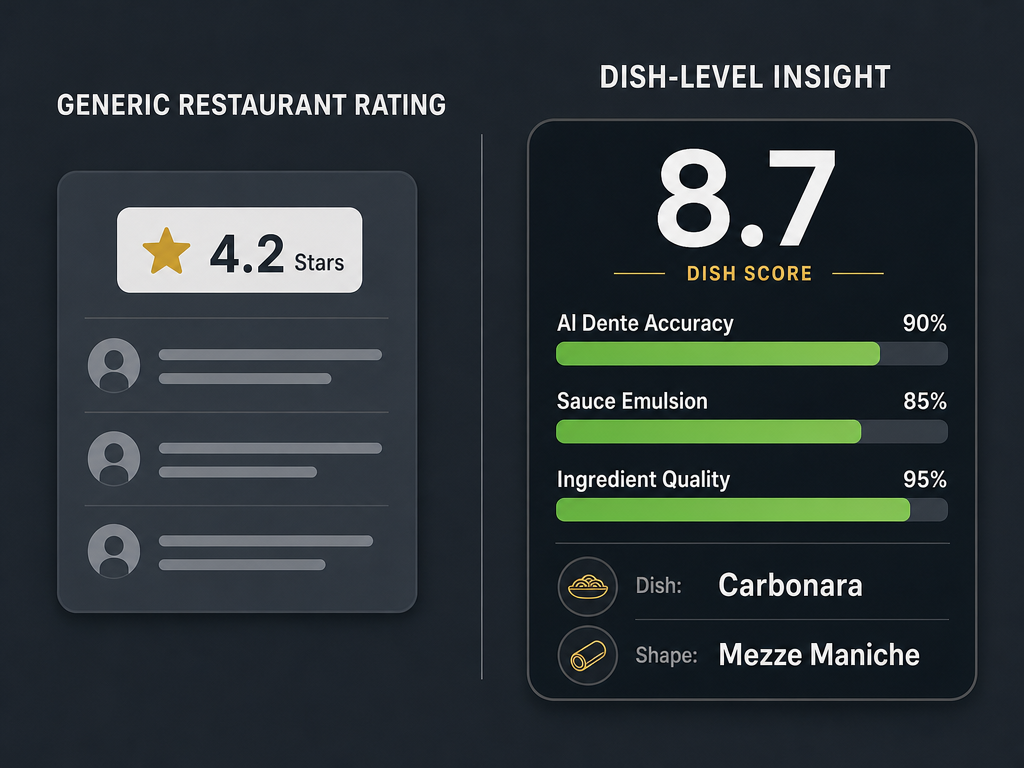 Transitioning from restaurant-level ratings to dish-specific data allows foodies to capture the technical nuances that define a truly great pasta meal.
The Dish-First Revolution: Tracking Pasta, Not Restaurants
The core insight is simple: you don't eat restaurants. You eat dishes.
A dish-first tracking system inverts the traditional hierarchy. Instead of filing "Restaurant X - 4 stars" and hoping you remember what you ordered, you log "Tonnarelli cacio e pepe - 9.2/10 - Flavio al Velavevodetto, Rome - March 2026." The restaurant becomes metadata attached to the dish, not the primary organizing principle.
This shift unlocks three capabilities traditional review apps can't provide:
Dish-Level Comparison: When you track individual plates, you can directly compare the same dish across multiple cities. Your personal database might reveal that the best carbonara you've had wasn't in Rome at all - it was at a trattoria in Bologna that doesn't even appear on most tourist guides.
Shape and Regional Indexing: Pasta shapes matter. Pici in Tuscany performs differently than bucatini in Lazio because the shape interacts with the sauce. A proper tracking system lets you tag by shape (long vs. short, tubular vs. ribbon) and regional style (Emilia-Romagna vs. Campania), turning your archive into a searchable reference library.
Temporal Recall: Three years from now, you won't remember which Roman restaurant had the better amatriciana. But if you've logged tasting notes with a scoring system, you can instantly retrieve your top-rated version and book a table on your next trip.
Choose Your Tracking Persona
The right tool depends on whether you're building a private memory vault or a social ranking game. Here are the four primary tracking archetypes, each optimized for different priorities.
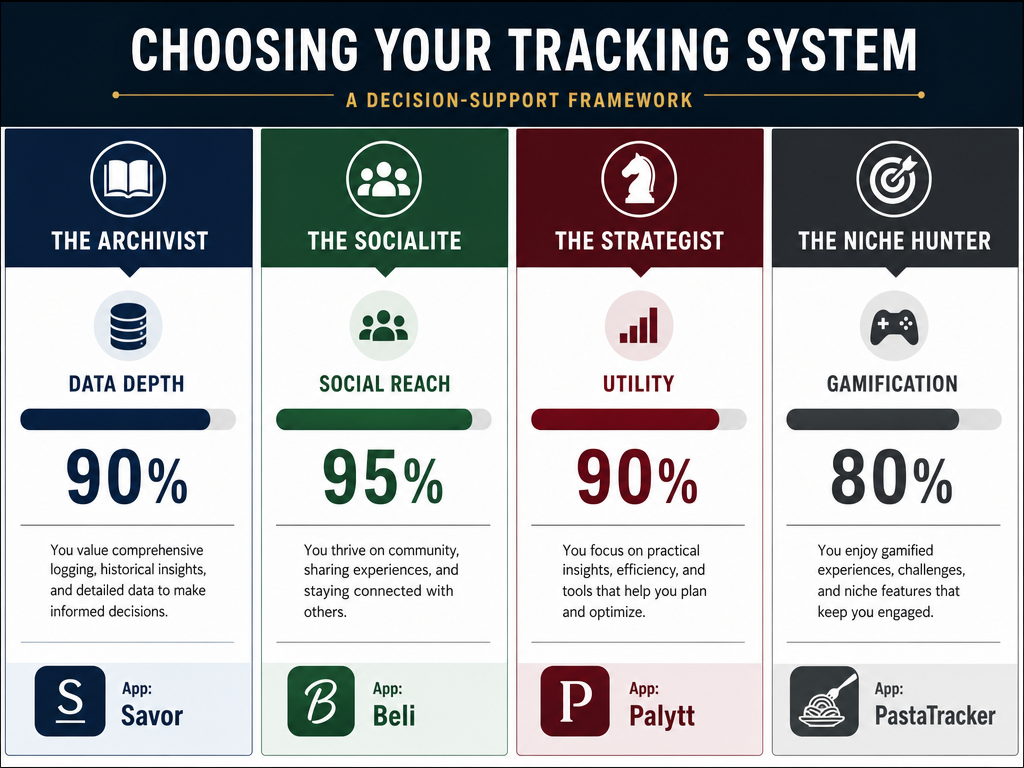 Selecting the right tracking tool depends on whether you value private data depth, social ranking, or gamified experiences like a 'pasta passport.'
The Private Archivist (Depth Over Social)
Best Tool: Savor
If your primary goal is to build a permanent, searchable record of every notable pasta dish you've ever eaten - without the social performance layer - Savor is the most technically robust option for 2026.
It's designed around a 1-10 scoring framework that breaks down individual components: sauce balance, pasta texture (al dente precision), seasoning, and presentation. The app uses AI photo recognition to automatically identify dish types (it can distinguish tonnarelli from spaghetti based on strand thickness), then attaches GPS metadata to reconstruct your dining history geographically.
The core advantage is private granularity. You're not performing for an audience - you're building a personal reference library. Five years from now, when you're planning a return trip to Rome, you can filter your archive by "cacio e pepe" and "Rome" and instantly surface your top three experiences with full tasting notes.
Savor also handles the "camera roll recovery" problem better than most competitors. If you've been taking food photos for years without logging them, you can upload historical images in bulk. The app extracts location and date metadata from the photo file, then prompts you to retroactively add dish names and scores. This turns your existing photo archive into structured data without starting from scratch.
Ideal For: Solo travelers, culinary professionals, and anyone who values data depth over social discovery. If you'd rather spend 90 seconds writing detailed tasting notes than scrolling through friend recommendations, this is your system.
The Social Ranker (Letterboxd for Food)
Best Tool: Beli
Beli operates on a fundamentally different premise: food is a social experience, and your taste is only meaningful in conversation with other people's taste. Think of it as Letterboxd for restaurants - a platform where you rank places, follow friends, and compare your top lists against theirs.
Contrary to outdated information still circulating online, Beli is no longer invite-only as of late 2025. The app reached 30 million users in 3 years, a trajectory that dramatically outpaced Yelp's 20-year growth curve. It's now a standard freemium model, though it maintains a "curated club" aesthetic.
The ranking mechanism is Beli's signature feature. You don't assign star ratings - you rank restaurants in order of preference. When you add a new spot, the app asks: "Was this better than [Restaurant X]?" You answer yes or no until it slots the new entry into your personal hierarchy. Over time, this builds a stable, relativistic ranking that reflects your true preferences more accurately than isolated star ratings.
For pasta tracking specifically, Beli works best when you treat each dish as a separate "restaurant" entry in your head. If you care about ranking the best carbonara you've ever had, you'll need to manually create lists like "Top 10 Carbonara" and populate them with individual restaurant visits. It's clunky for dish-level granularity, but the social layer compensates: your friends can see your rankings, challenge your picks, and share their own.
Ideal For: Social diners who want to participate in the status game of taste. If you care about where your favorite pasta spot ranks compared to your friend's, and you want a feed of trusted recommendations, Beli delivers.
The Strategic Utility Hunter
Best Tool: Palytt
Palytt is built for decision-making, not nostalgia. It's optimized to answer the question: "What should I order next time I'm here?"
The app's core mechanic is binary: for every dish you try, you mark it as "Order Again" or "Skip." There's no elaborate scoring system - just a simple verdict. This makes logging faster (5 seconds instead of 60) and the resulting database more actionable. When you return to a restaurant, Palytt surfaces your "Order Again" list automatically, so you're not gambling on menu items you've already tested.
For pasta tracking, this means you can quickly build a guide of which shapes and sauces worked at which restaurants without writing essays. If you tried four different pastas at a trattoria in Bologna and only one was exceptional, you mark that one as "Order Again" and skip the rest. Three years later, when you're back in Bologna, Palytt tells you exactly what to order.
The app also supports "What to Order" guides created by other users. If you're visiting Naples for the first time, you can follow a local foodie's "Best Pasta in Naples" guide and import their "Order Again" dishes into your own list. It's a faster, more practical version of reading blog posts - you get the actionable intel without the narrative padding.
Ideal For: Frequent diners who value speed and utility over detailed memory archives. If you eat out 200+ times a year and need a fast system to track winners versus duds, Palytt is the most efficient tool.
The Niche Pasta Obsessive
Best Tool: PastaTracker
PastaTracker is exactly what it sounds like: a hyper-specific app designed exclusively for pasta lovers who want to gamify their regional tasting journey.
The app operates on a "passport" model. Italy is divided into 20 regions, and each region has a canonical pasta dish (e.g., carbonara in Lazio, tortellini in Emilia-Romagna, trofie al pesto in Liguria). Your goal is to collect "stamps" by eating and logging the signature dish in each region. It's less about building a permanent archive and more about completing a culinary quest.
The gamification layer appeals to a specific psychology: completionists who want to "catch 'em all." If you're the type of traveler who plans trips around food milestones ("I need to eat orecchiette alle cime di rapa in Puglia to complete my Southern Italy collection"), PastaTracker makes the quest visible and shareable.
The major limitation is that it's Italy-centric and doesn't support global tracking. If you want to log pasta in New York or Tokyo, you'll need a second app. But for travelers focused exclusively on Italian regional pasta traditions, the narrow focus is a feature, not a bug.
Ideal For: Travelers with a specific goal of eating canonical pasta dishes across Italy's regions. If you're planning a multi-year project to taste every traditional shape in its home territory, this app turns the quest into a game.
DIY Mastery: Build Your Own Pasta Archive
If existing apps feel too restrictive or you want complete control over your data structure, building a custom system is surprisingly straightforward. The two most powerful DIY methods are Google My Maps for geographic visualization and a tagging taxonomy for text-based retrieval.
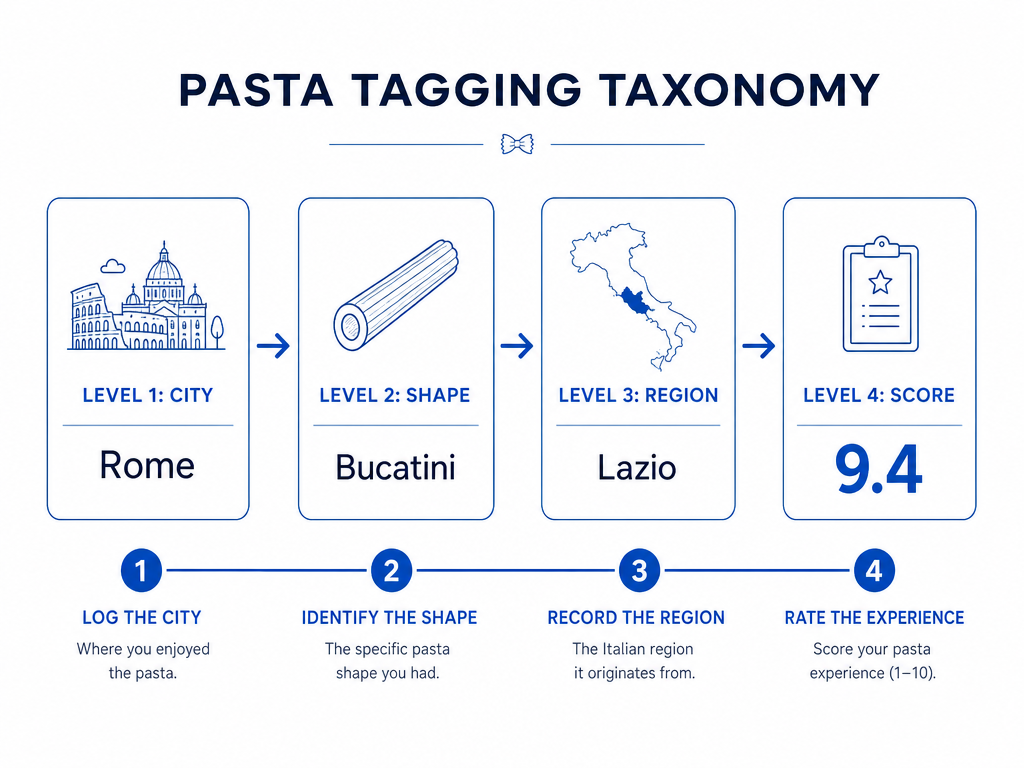 Implementing a consistent tagging taxonomy ensures your personal pasta archive remains searchable and organized as your travel history grows over the years.
Google My Maps: The Free Power-User Method
Google My Maps lets you create custom map layers with unlimited data fields, turning your dining history into a visual atlas. Here's the step-by-step setup for a pasta-specific map:
- Open Google My Maps on desktop (the mobile app is read-only).
- Create a new map titled "Pasta Archive."
- Add a layer for each pasta category you care about (e.g., "Carbonara," "Cacio e Pepe," "Regional Specialties").
- Drop a pin at each restaurant location and fill in custom fields: Dish Name, Shape, Sauce Type, Score (1-10), Tasting Notes, Date Visited.
- Use color-coded pins to indicate quality tiers: green for 9-10, yellow for 7-8, red for below 7.
The visual map becomes a geographic memory aid. When you're planning a trip to Rome, you zoom in and instantly see clusters of high-rated pasta locations. The pins are clickable, so you can read your original tasting notes and compare dishes side by side.
The limitation is mobile usability - Google My Maps on iPhone and Android is clunky for real-time logging. It's best used as a post-meal desktop ritual where you spend 10 minutes each week updating your map from recent dining experiences.
The Pasta Tagging Taxonomy
If you prefer text-based retrieval over maps, a consistent tagging system turns any note-taking app (Apple Notes, Notion, Evernote) into a searchable pasta database. The key is using a four-level taxonomy that captures the dimensions you actually care about:
[City] - [Shape] - [Region] - [Score]
Example entry:
"Rome - Bucatini - Lazio - 9.2
Flavio al Velavevodetto
Amatriciana with guanciale that actually crisps. Sauce has the right tomato-to-pork-fat ratio. Bucatini cooked 30 seconds past al dente (intentional, works with this sauce weight). Would order again."
The taxonomy creates search shortcuts. If you type "Rome Bucatini" into your notes app, you'll surface every bucatini dish you've logged in Rome, sorted by score. If you search "Lazio," you'll see all Lazio-region pasta regardless of city.
The discipline required is front-loading the structure. You need to use the exact same format for every entry, or search breaks down. But once the habit is established, the system scales indefinitely. Five years and 500 entries later, your archive remains fully searchable without relying on a third-party app that might disappear.
For serious pasta tracking across multiple food journals or apps, consider reading how to track dishes you've tried for a broader framework that extends beyond pasta into other culinary categories.
Regional Context: What to Track in Which City
Not all pasta is created equal, and your tracking strategy should reflect regional authenticity. Here's a quick reference for which dishes to prioritize in major pasta cities, sourced from regional culinary traditions rather than tourist guides.
Rome (Lazio):
Track the "Four Pastas" - carbonara, cacio e pepe, amatriciana, and gricia. These are the canonical Roman dishes, and you'll find wildly different executions across neighborhoods. Testaccio and Trastevere are the traditional strongholds, but don't ignore newer spots in Pigneto.
Bologna (Emilia-Romagna):
Focus on tagliatelle al ragù (what Americans incorrectly call "Bolognese") and tortellini in brodo. The shape matters here - tagliatelle is the traditional pairing for meat ragù, not spaghetti. Track which restaurants make pasta in-house versus using dried.
Naples (Campania):
Log spaghetti alle vongole and paccheri al ragù napoletano. Neapolitan ragù is structurally different from Bolognese - it's tomato-forward with large cuts of meat braised for hours. Shape pairing is critical: paccheri (large tubes) hold the chunky sauce better than thinner shapes.
Florence (Tuscany):
Track pappardelle al cinghiale (wild boar ragù) and pici cacio e pepe. Pici is a hand-rolled thick spaghetti that's specific to Southern Tuscany - if you see it on a menu in Florence, it's worth trying for the textural contrast with Roman versions made with thinner pasta.
For expert-level regional research, cross-reference your targets with TasteAtlas, which maps traditional dishes to their geographic origins with surprising granularity. You'll discover that trofie is the traditional Ligurian shape for pesto, not the spaghetti most American restaurants use.
If you want curated expert picks instead of crowd-sourced noise, World of Mouth aggregates recommendations from over 800 culinary experts across 30,000+ trusted entries. It's useful for discovering which specific dishes professional food writers and chefs recommend in each city, though it operates at the restaurant level rather than dish granularity.
The Camera Roll Recovery Problem
If you've been photographing food for years without a tracking system, you're sitting on a data goldmine that's currently locked in chronological chaos. The good news: several 2026 apps can retroactively structure your existing photos using metadata extraction.
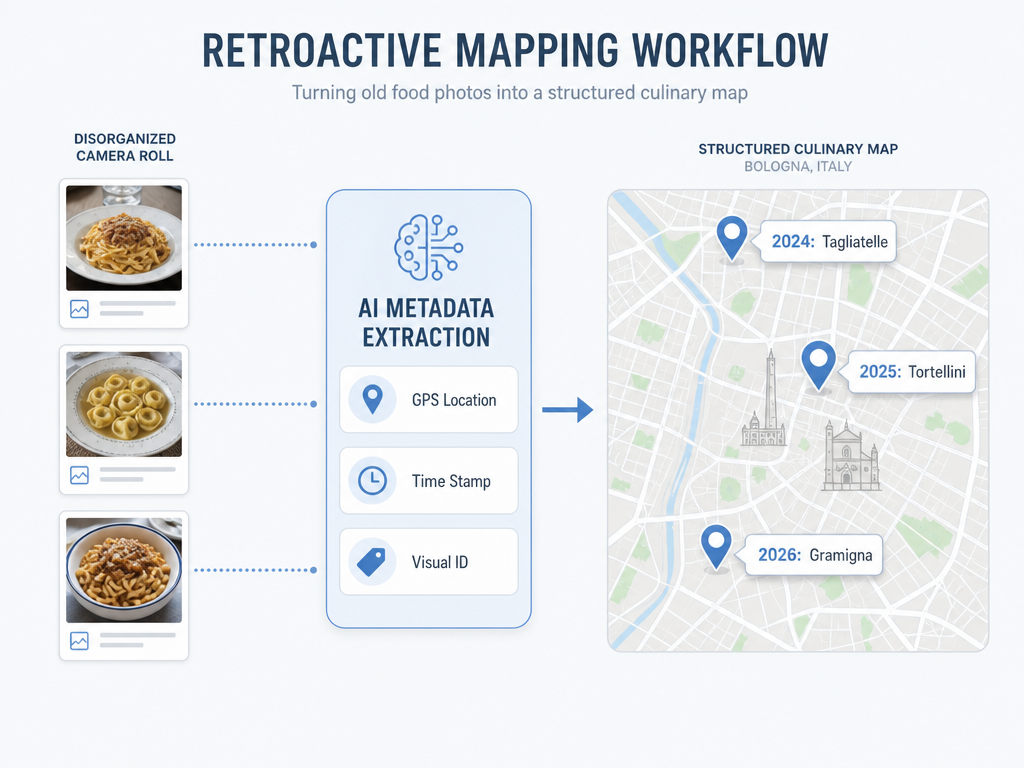 Modern apps can scan your historical camera roll to retroactively build a map of your pasta journey, saving hours of manual data entry.
How Metadata Extraction Works:
Every photo your iPhone or Android takes embeds EXIF data: GPS coordinates, timestamp, device type, and sometimes even altitude. Apps like Savor and YumPal can scan your camera roll, read this metadata, and auto-populate a map with your dining history.
The process:
- Upload photos in bulk (most apps support batch imports of 100+ images).
- The app extracts GPS coordinates and plots each photo on a map.
- It groups photos by location (e.g., all photos taken at the same restaurant appear as a single entry).
- You manually add dish names and scores to each photo cluster.
This turns 2,000 unsearchable photos into a structured database in a few hours instead of months. The catch is that metadata extraction only works if location services were enabled when you took the photos. If you routinely disable GPS to save battery, older photos won't have coordinates, and you'll need to manually tag locations.
For a step-by-step guide on organizing existing food photos, see how to organize restaurant photos by dish, which covers both automatic and manual methods for turning your camera roll into a searchable archive.
Frequently Asked Questions
What is the best free app to track my meals?
For pasta-specific tracking without paying for premium features, Google My Maps is the most capable free option. It requires manual data entry, but you get unlimited storage, full export control, and lifetime access to your data. If you want an app with automatic features, Savor offers a free tier that supports up to 50 logged dishes with basic scoring and photo storage.
Is Beli still invite only?
No. As of late 2025, Beli transitioned to a standard freemium model. You can download the app and start using it immediately without an invite code. The "invite-only" era was part of its initial launch strategy in 2022-2023, but that exclusivity model is no longer in place.
What is an app for foodies?
The term "app for foodies" is too broad to have a single answer - it depends on what you're trying to do. If you want to track individual dishes with detailed tasting notes, Savor is the best option for serious food archiving. If you prefer social ranking and comparing your taste with friends, Beli is the right tool. For fast, utility-focused tracking of what to order again, Palytt is more efficient. Each serves a different foodie psychology.
What is the best app for tracking restaurants?
For restaurant-level tracking (not dish-level), Google Maps remains the most practical tool because it integrates directly with navigation and real-time hours. You can save restaurants to custom lists ("Rome Pasta," "Bologna To-Try") and add private notes. The limitation is that Google Maps doesn't support dish-level granularity or scoring systems, so it's best used as a supplement to a dedicated food tracking app rather than a replacement.
Can I create a custom map in Google Maps?
Yes, using Google My Maps (a separate tool from the main Google Maps app). You can create custom layers, drop pins with detailed notes, and share maps with collaborators. The mobile app is read-only, so you'll need to use a desktop browser for editing. Once published, the map syncs to the Google Maps app on your phone for reference while traveling.
What are the top 10 most popular pasta dishes?
The "top 10" question is a trap - popularity varies dramatically by region and context. In Rome, the four canonical pastas are carbonara, cacio e pepe, amatriciana, and gricia. In Bologna, tagliatelle al ragù and tortellini dominate. In Naples, spaghetti alle vongole is king. Tracking "popular" dishes misses the point - you should track what you personally find exceptional, not what TripAdvisor says is popular.
How do Italians eat pasta every day and not get fat?
This question conflates portion control, meal structure, and activity level. Traditional Italian pasta portions are smaller than American restaurant servings (typically 80-100g dried pasta per person versus 150g+ in the US). Pasta is usually a primo (first course) followed by a secondo (protein and vegetables), not the entire meal. The Mediterranean diet also emphasizes walking, olive oil, and lower sugar intake. But this is a diet question, not a pasta tracking question - if you want to explore health tracking alongside food memory, see how to track your meals.
What is the best app to track meal plans?
For meal planning (future cooking) rather than dining history (past meals), the requirements are different. Apps like Mealime and Paprika excel at weekly planning, grocery list generation, and recipe storage. But they're not optimized for tracking restaurant experiences or building a culinary archive. If you want to combine meal planning with dining history, you'll likely need two separate tools.
The serious foodie's pasta tracking system isn't about perfection - it's about building a retrieval system that actually works for your brain. Whether that's a 10-point scoring rubric in Savor, a ranked list in Beli, a binary "Order Again" database in Palytt, or a custom Google Map you've been maintaining for five years doesn't matter. What matters is that three years from now, when someone asks "Where did you have that incredible amatriciana?" you can answer with precision instead of scrolling through 2,400 unsearchable photos.
Your camera roll doesn't have to be a graveyard. Start logging today, and your future self will thank you.