
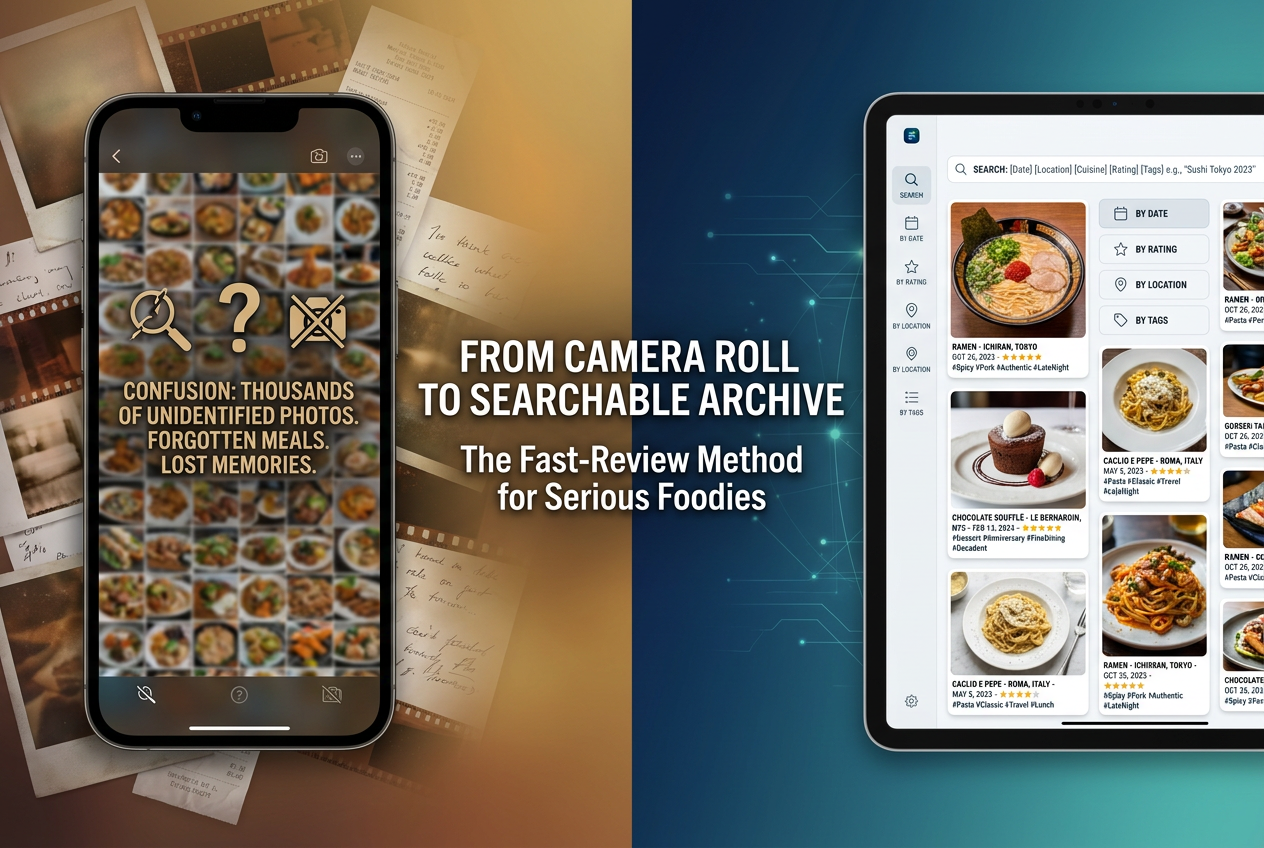
The Serious Foodie’s Guide to Never Forgetting a Meal Again: The Fast-Review Method
Alex the juice queen
Alex hunts for the best juice bars and presses. She rates every sip and saves her favorites in Savor.
The Serious Foodie’s Guide to Never Forgetting a Meal Again: The Fast-Review Method You dine out 200 times a year. You have 3,000 photos of plates. But when a...
The Serious Foodie’s Guide to Never Forgetting a Meal Again: The Fast-Review Method
You dine out 200 times a year. You have 3,000 photos of plates. But when a friend asks for a recommendation, you’re scrolling for 10 minutes, squinting at thumbnails, trying to remember if that carbonara was from March or October.
The problem isn’t that you don’t appreciate good food. The problem is that you’re treating meals like ephemeral moments instead of archivable data. Every incredible dish you’ve ever eaten deserves better than to disappear into the black hole of your camera roll.
This is where the Fast-Review method changes everything. It’s a system designed for people who understand that treating food as culture requires an archive, not a camera roll. And it takes less than 15 seconds per meal.
Table of Contents
- The Camera Roll Black Hole
- Why Legacy Platforms Fail
- The ReviewFast Framework
- Competitive Comparison
- Building Your Personal Food Database
- Implementation Strategy
- Advanced Techniques
- Frequently Asked Questions
The Camera Roll Black Hole
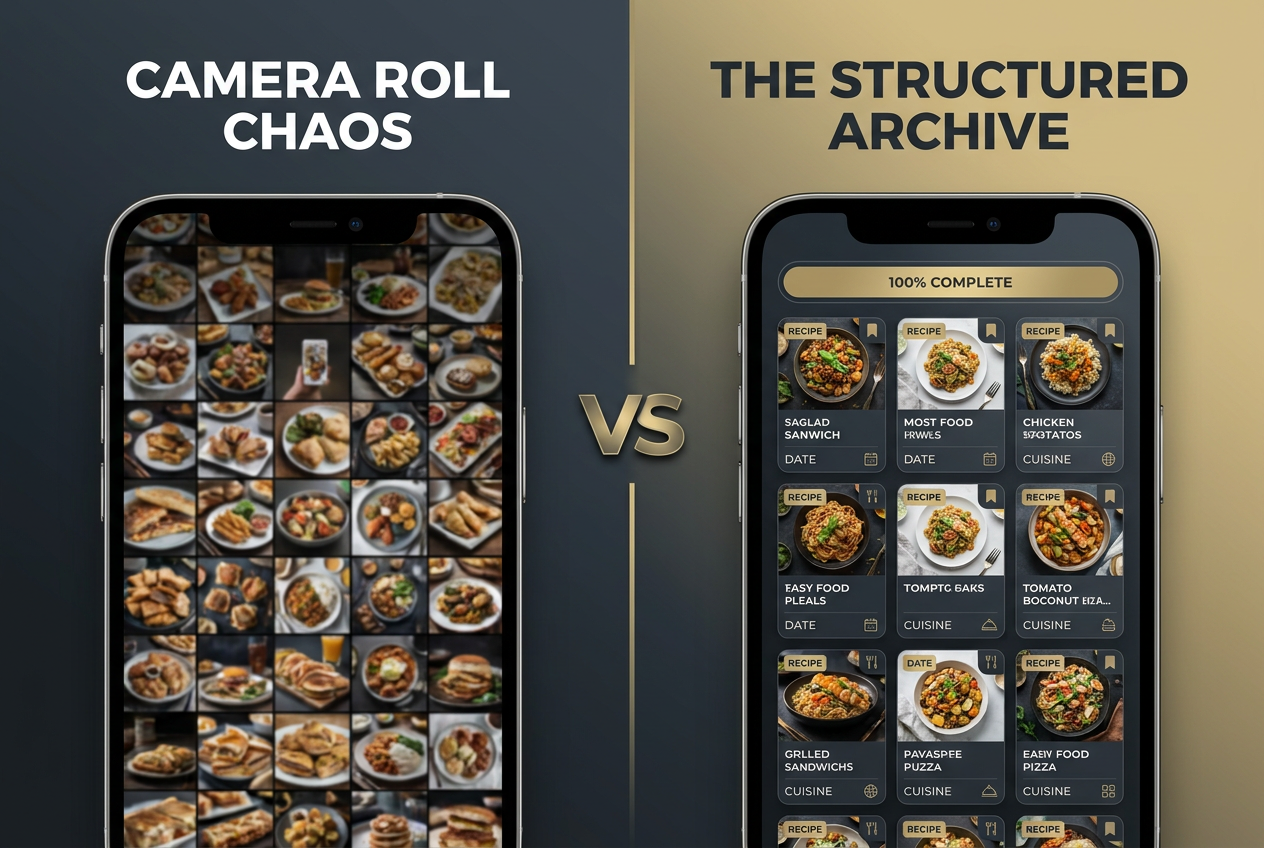
Transform your dining history from a cluttered camera roll into a searchable, high-utility archive designed for the serious food enthusiast.
Three months ago, you had a life-changing bowl of ramen. The broth was mahogany-dark, the chashu melted on contact, the noodles had that perfect chew. You took photos. You meant to write it down.
Now? It’s somewhere between 847 other food photos, unlabeled, unsorted, impossible to find without archaeological excavation through your entire photo library.
This is the modern foodie’s paradox: we document obsessively but recall nothing. The average serious eater takes 15-20 food photos per week. That’s over 1,000 meals photographed annually, with maybe 5% of that data actually retrievable when it matters.
The traditional solution has been to dump everything into social media or review platforms. But that creates a different problem: you’re performing for an audience instead of building a tool for yourself. You write reviews for strangers when what you really need is a personal reference system that answers one simple question: "What was that place with the incredible X?"
This is where the concept of "reviewing fast" becomes critical. Not fast food reviews. Fast reviewing. The ability to capture the essential data about a meal in the moment, without turning dinner into a documentation project.
Why Legacy Platforms Fail
Let’s talk about why Yelp, Google Maps, and their cousins don’t solve this problem for serious food people.
The Generic Reviewer Problem: These platforms conflate wildly different eaters. A one-star review because the parking was inconvenient sits next to a five-star rave from someone whose culinary peak is Olive Garden. When you’re looking for nuanced opinion on whether the pasta is properly al dente, you’re drowning in noise from people rating the "vibe" or the speed of service.
The Five-Star Bluntness: A 10-point scale exists in wine criticism, film criticism, and music journalism for a reason. Five stars is too crude an instrument for people who understand that there’s a meaningful difference between an 8.2 and an 8.7. The carbonara that changed your life and the pretty-good carbonara you had last Tuesday both get four stars, rendering the system useless for your actual needs.
The Social Performance Tax: Every review you write on a public platform is a tiny performance. You’re not just recording data, you’re crafting a persona. This adds friction. It makes reviewing feel like work. So you stop doing it, and your best meals vanish into the void.
The platforms optimized for restaurant discovery (Google, Yelp) are terrible at personal archiving. The platforms optimized for personal journaling (traditional food diaries) are too slow for real-world use. You need something in between.
For the serious foodie, restaurant tracking apps offer a fundamentally different approach than traditional review platforms - they prioritize your personal taste memory over crowd-sourced opinions.
The ReviewFast Framework
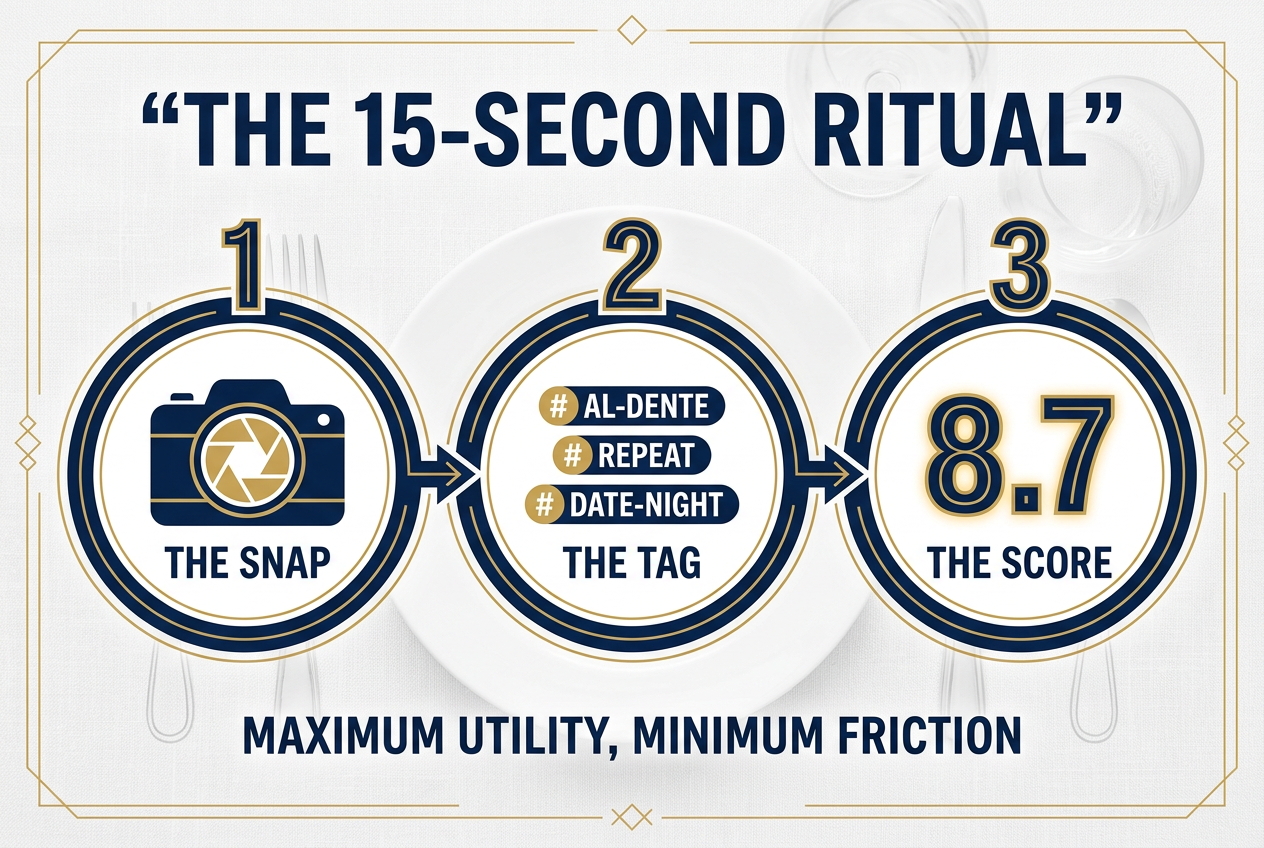
Master the 15-second ritual: A streamlined three-step framework that ensures you capture essential meal data without interrupting your dining experience.
Here’s the system that works. Three steps, executed at the table, total time investment: under 15 seconds.
Step 1: The Snap (3 seconds)
One photo. Dish-centric, not restaurant-centric. You’re not photographing the dining room or your tablemates. You’re documenting the actual thing you ate. Frame the plate. Natural light if possible. Don’t fuss. The goal isn’t Instagram perfection - it’s visual memory.
The key insight: your photo is metadata, not content. It’s there to trigger recall, not to impress strangers.
Step 2: The Tag (5 seconds)
Three keywords maximum. These are your search terms. Think of them as the filing system for your food brain.
Examples:
- #al-dente #truffle #repeat
- #too-salty #overpriced #skip
- #date-night #impressive #rich
The tags serve multiple functions. They describe the dish (al-dente, truffle). They record context (date-night). They encode future intent (repeat, skip). This is the architecture of a searchable food memory.
Avoid generic tags like "delicious" or "good." Be specific. If the stand-out element was the char on the octopus, tag #charred-octopus. If it was the unexpected yuzu note in the vinaigrette, tag #yuzu-surprise.
Step 3: The Score (7 seconds)
Use a 10-point scale. Not five stars. Ten points.
Here’s why: precision matters. On a 10-point scale, you can differentiate between "very good" (7.5), "excellent" (8.5), and "transcendent" (9.5). Those gradations are meaningful when you’re building a personal canon of great meals.
Your scoring criteria should be consistent:
- 1-3: Actively bad. You regret ordering it.
- 4-5: Forgettable. You ate it, you moved on.
- 6-7: Good. You’d order it again but wouldn’t seek it out.
- 8-9: Excellent. You’d recommend it and return specifically for this dish.
- 10: Perfect. A reference-standard version of this dish.
Don’t overthink it. Your gut reaction in the first three bites is usually correct.
The beauty of this system is speed. Photo, three tags, one number. You’re done. The meal continues. You haven’t turned dinner into a production.
Competitive Comparison
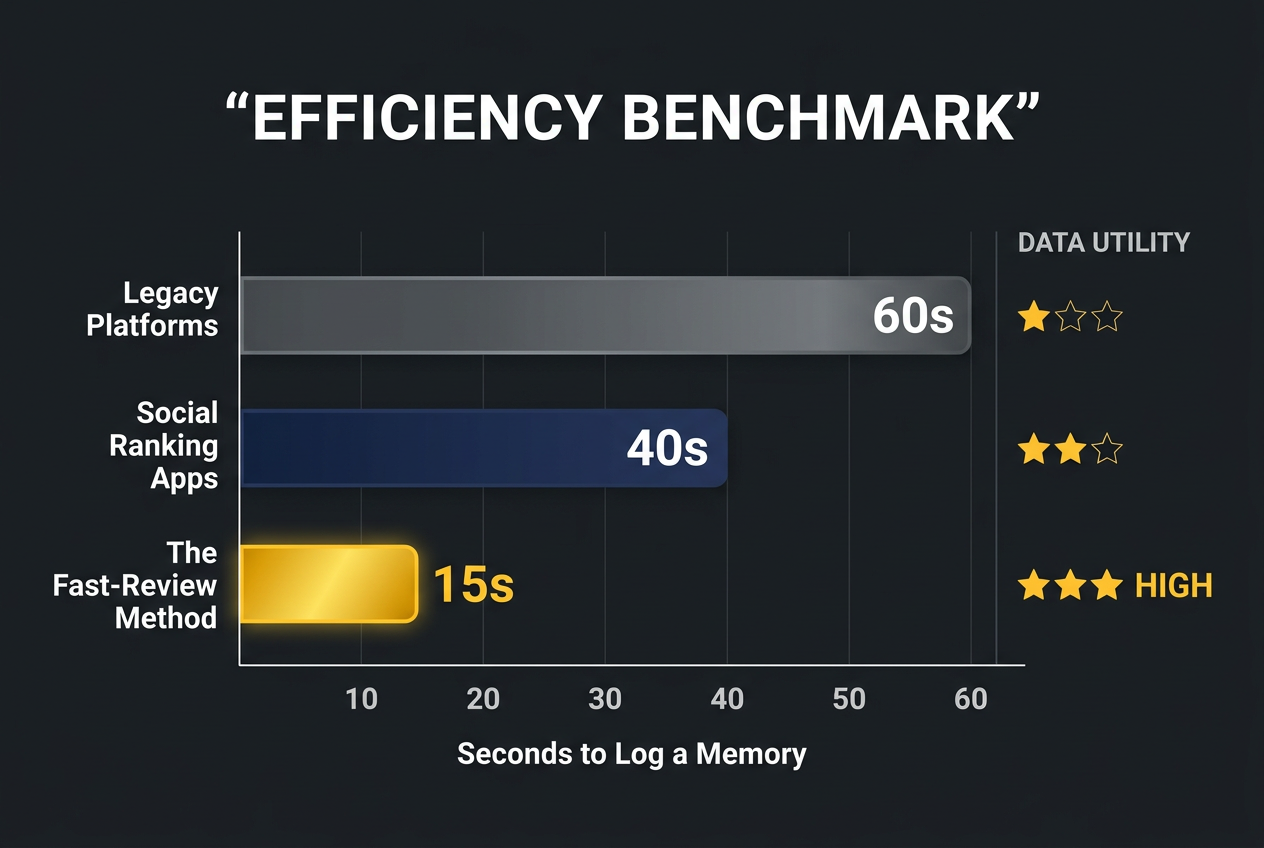
Our data shows that the Fast-Review framework captures high-utility data in under 15 seconds, outperforming legacy platforms and social-heavy apps.
The landscape of food memory tools breaks down into five categories. Each has strengths. None solves the complete problem the way a dedicated fast-review system does.
| Platform | Core Strength | Time to Log | Data Utility | Social Pressure | Best For |
|---|---|---|---|---|---|
| Fast-Review System | Speed + Precision | 15 seconds | High (personal) | None | Active eaters building a reference library |
| Beli | Social Ranking | 45 seconds | Medium (competitive) | High | Friend-group recommendations |
| Savor | Dish-Centric AI | 30 seconds | High (discovery) | Low | Tracking specific dishes across restaurants |
| Google Maps | Ubiquity | 2 minutes | Low (noisy) | Medium | General navigation |
| Traditional Journal | Depth | 5+ minutes | Very High (narrative) | None | Writers, detailed reflection |
Beli gamifies food tracking with leaderboards and social rankings. It’s excellent for creating a competitive dynamic with friends, but that social layer is also friction. Every review becomes a small performance. You’re not just documenting for yourself - you’re managing your reputation as a taste-maker within your friend group.
Savor uses AI-powered dish recognition and focuses on the meal, not the restaurant. This is philosophically aligned with the fast-review method. The platform excels at answering "where did I have that incredible carbonara?" But it still requires more input time than a pure fast-review system because it tries to be both journal and discovery engine.
Google Maps is everywhere, and that ubiquity is both strength and weakness. You already have it. But the data quality is terrible. Tourist reviews pollute local gems. One-star ratings from people angry about parking. Five stars from someone’s first-ever meal at a particular cuisine type. For serious eaters, it’s nearly useless.
Traditional food journals (pen and paper, long-form apps) offer the deepest reflection. If you want to write essays about meals, nothing beats a real journal. But they fail the speed test. Five minutes per entry means you won’t do it. And if you don’t do it, you don’t have data.
The fast-review approach occupies the sweet spot: high utility, low friction, personal focus. You capture what matters in the moment. You build a searchable archive. You skip the performance.
If you’re serious about cataloging your food experiences, understanding how to build a personal restaurant library provides the strategic foundation for a system that actually works.
Building Your Personal Food Database
A fast-review system is only as good as the database it feeds. Think of every meal you log as a data point. Over six months, you’ll have 200-300 entries. Over a year, 500-600. That’s not just a list. That’s a personal canon of taste.
The Three-Query Test
Your database should answer these questions instantly:
Query 1: "What’s the best pasta I’ve eaten in the last six months?"
- Sort by score, filter by #pasta tag
- You see your top 5, with dates and locations
- Decision made in 10 seconds
Query 2: "Where should I take my date who loves seafood?"
- Filter by #date-night and #seafood tags
- Results ranked by your scores, not crowd opinion
- You’re recommending from your actual experience
Query 3: "What was that place with the incredible mole?"
- Search #mole tag
- One result: Oaxacan spot from April, 9.2 score, tagged #complex #smoky #repeat
- You’ve recovered a memory that would otherwise be lost
This is the power of systematic archiving. You’re not relying on fuzzy recollection. You’re consulting your own curated reference library.
Organizing by Cuisine vs. Dish Type
There are two philosophical approaches to taxonomy.
Cuisine-based organization (Italian, Japanese, Mexican) works if you eat at a variety of restaurants within each category. It lets you compare the carbonara at three different Italian spots.
Dish-based organization (pasta, tacos, ramen) works if you’re tracking a specific item across cuisines. Some of the best pasta isn’t at Italian restaurants. Some of the best tacos aren’t at Mexican restaurants.
The fast-review system supports both. Use tags for cuisine (#italian), for dish type (#pasta), and for specific preparations (#cacio-e-pepe). This triple-tagging creates a multidimensional search space.
The Evolution of Your Palate
One unexpected benefit: you’ll watch your taste change over time.
Six months in, you might notice your scores for rich, butter-heavy dishes are trending down while your scores for acid-forward, lighter preparations are climbing. That’s data about your evolving preferences. It’s valuable.
A year in, you might see that your favorite meals cluster around specific neighborhoods, or specific chefs, or specific techniques. Patterns emerge. You learn things about yourself that you couldn’t articulate before you had the data.
This is why speed matters. The lower the friction, the more data you capture. The more data you capture, the richer your understanding of your own taste becomes.
Implementation Strategy
Starting a fast-review practice is simple, but consistency requires strategy.
Week 1: Baseline
Log every meal out. Don’t worry about perfection. Get comfortable with the three-step process (snap, tag, score). You’re building muscle memory.
Expect to take 30-45 seconds per review at first. That’s fine. Speed comes with repetition.
Week 2-3: Calibration
Start noticing patterns in your scores. Are you too generous? (Everything’s an 8 or 9?) Too harsh? (Nothing cracks 7?) Recalibrate.
A useful rule: your scores should approximate a bell curve. Most meals are 6-7 (good, not exceptional). Fewer are 8-9 (excellent, worth seeking out). Very few are 5-or-below (disappointing) or 10 (perfect).
If everything’s excellent, your scale is broken. If nothing’s excellent, you might be eating at the wrong places.
Month 2: Refinement
By now you have 50-80 entries. Start using your database. When a friend asks for recommendations, consult your own reviews instead of defaulting to Google.
Notice how much faster you can answer. Notice how much more confident you are in your recommendations. You’re citing your actual experience, not vague memory.
Month 3+: Mastery
The system becomes invisible. You’re reviewing without thinking about reviewing. Photo, tags, score. Done. 15 seconds, max.
Your database is now a real tool. You have enough data to identify trends, rediscover forgotten favorites, avoid past mistakes.
For those interested in the broader ecosystem of food tracking tools, the best food review apps offer different approaches to the same fundamental problem of food memory.
Advanced Techniques
Once the basic fast-review habit is ingrained, there are power-user strategies that add depth without sacrificing speed.
The Location Layer
Some reviewers add a fourth step: geotag. Your phone does this automatically with photos, but making it explicit in your system helps with neighborhood-based queries.
"Best meals within a 10-minute walk of my office" becomes a searchable filter. This is especially valuable in food-dense cities where you’re constantly making last-minute lunch decisions.
The Companion Variable
Who you eat with affects how you experience a meal. Some people add a companion tag (#solo, #date, #family, #business) to track context.
This sounds trivial until you realize that your "best date-night restaurants" and your "best solo dining experiences" are often completely different lists. The same restaurant can perform differently depending on the social dynamic.
The Return Rate
Track whether you’ve been back. Some systems add a #first-visit vs. #return tag. Others count visits numerically.
A restaurant with five visits, all scoring 8+, tells you something different than a one-time 9. Consistency matters. Repeatability matters.
The Negative Case Study
Don’t ignore bad meals. A 3.5 score with tags #underseasoned #overpriced #tourist-trap is valuable data. It helps you avoid future mistakes. It also makes your high scores more meaningful - you’re not grade-inflating everything.
The key is speed. If an advanced technique takes more than 5 additional seconds, it’s probably not worth the friction.
The Photo Library Rule
One photo per dish, always. No multi-angle documentation. No table spreads. One clear image of what you actually ate.
This discipline keeps your database navigable. When you’re scrolling through 500 entries looking for "that pork dish from summer," you need thumbnails that are immediately identifiable.
Transparency & Trust
Let’s address this directly: the reviewfast.food domain has been associated with scam operations offering fake McDonald’s rewards. That’s not this.
This guide is about a reviewing methodology, not a sketchy affiliate scheme. The Fast-Review framework is a personal practice for serious eaters who want to build a useful food memory system. No gift cards. No rewards. No affiliate deals.
The goal here is simple: help you remember great meals and avoid repeating disappointments. That requires a system you trust, built on your own data, for your own use.
If a platform or service promises rewards for reviews, be skeptical. Real food memory work is valuable precisely because it’s not monetized, not gamified, not performed for external validation.
You’re building a tool for yourself. That’s the only agenda.
Frequently Asked Questions
What is the Fast-Review method for food?
The Fast-Review method is a three-step system for documenting meals in under 15 seconds: take one photo of the dish, add three descriptive tags, and assign a score on a 10-point scale. It’s designed for people who want to build a searchable archive of their dining experiences without turning every meal into a documentation project.
Why use a 10-point scale instead of 5 stars for rating food?
A 10-point scale provides the precision serious eaters need. Five stars is too blunt - there’s a meaningful difference between "very good" (7.5) and "excellent" (8.5) that gets lost in a five-star system where both might receive four stars. The 10-point scale is standard in wine criticism and film criticism for exactly this reason: it allows for meaningful gradation.
How long does it take to review a meal using this system?
With practice, 15 seconds or less. Beginners typically take 30-45 seconds while building muscle memory, but the process becomes nearly automatic after two weeks of consistent use. The system is explicitly designed to be faster than writing a traditional review or posting to social media.
What’s the difference between the Fast-Review method and apps like Beli or Savor?
The Fast-Review method is a framework, not a specific app. Beli focuses on social ranking and friend-group recommendations, which adds social pressure to the reviewing process. Savor emphasizes dish-centric tracking with AI recognition and works well for discovery across restaurants. The Fast-Review framework prioritizes speed and personal utility over social features or AI assistance.
Can I export my food review data from the Fast-Review system?
This depends on the tool you use to implement the system. The methodology itself is platform-agnostic - you can use it with a dedicated app, a notes system, or even a simple spreadsheet. When choosing a platform, data portability should be a key consideration. You’re building a personal archive that should remain accessible regardless of which app is popular this year.
How do I choose the right tags for my food reviews?
Effective tags are specific, searchable, and serve multiple functions. Describe the dish (#al-dente, #charred), record context (#date-night, #business-lunch), and encode intent (#repeat, #skip). Avoid generic tags like "delicious" that don’t help you search later. Think of tags as the filing system for your food memory - they should help you answer specific questions six months from now.
What should I do with meals that don’t photograph well?
Take the photo anyway. The Fast-Review system treats photos as metadata, not content - they’re memory triggers, not portfolio pieces. A mediocre photo of an incredible soup is still more useful than no photo at all. Don’t let the pursuit of Instagram-worthy shots prevent you from documenting what you ate.
How many food reviews do I need before the system becomes useful?
You’ll start seeing value around 50-80 entries (roughly six to eight weeks of consistent logging). At that point, you have enough data to identify patterns, answer friend recommendations with confidence, and rediscover forgotten favorites. The system becomes truly powerful around 200-300 entries, when you have sufficient data density to see trends in your own palate evolution.