
How to Build a Dish-by-Dish Food Archive: The Complete System for Serious Foodies
Alex the juice queen
Alex hunts for the best juice bars and presses. She rates every sip and saves her favorites in Savor.
How to Build a Dish-by-Dish Food Archive: The Complete System for Serious Foodies You've taken 2,400 food photos this year. You remember the feeling - that...
How to Build a Dish-by-Dish Food Archive: The Complete System for Serious Foodies
You've taken 2,400 food photos this year. You remember the feeling - that perfect bite of tonkotsu ramen, the way the cacio e pepe made you reconsider everything you thought you knew about pasta. But three months later, when someone asks "where did you have that incredible ramen?" you're scrolling through an unsearchable camera roll, hoping the restaurant name is visible in the background of a photo.
This isn't a memory problem. It's an architecture problem.
Most food lovers treat their culinary experiences like disposable moments - a quick photo, maybe a star rating on Yelp, then on to the next meal. But what if you approached your dining history the way wine collectors approach their cellars, or the way serious readers track books? What if every dish became a searchable, comparable entry in your personal taste database?
This guide shows you how to build a dish-by-dish food archive - a personal knowledge management system for food that prioritizes culinary memory over social clout.
Table of Contents
- What Is a Dish-by-Dish Food Archive?
- Why Dishes Matter More Than Restaurants
- The Culinary Schema: 8 Essential Data Fields
- Three-Tier Implementation: From Minimalist to Architect
- The Stealth Log Workflow
- Advanced Search Scenarios
- Frequently Asked Questions
What Is a Dish-by-Dish Food Archive?
A dish-by-dish food archive is a personal database where the individual dish - not the restaurant - serves as your primary unit of data.
Think of it as the difference between cataloging books by publisher versus by title. Most people archive places ("I ate at Restaurant X"). A dish-level archive captures specific culinary experiences ("I had the duck confit at Restaurant X on March 15th, and here's why the technique mattered").
The mechanism is simple: every memorable dish gets its own entry with standardized metadata. This transforms scattered food photos into a queryable knowledge base. Instead of asking "where did I eat in Rome?" you can ask "show me every carbonara I've rated above 8/10" or "which restaurants nail brown butter technique?"
Personal restaurant journals are often built because public platforms feel performative or lack honesty. When you're writing for yourself rather than an audience, your notes become more specific, more honest, and infinitely more useful.
The limitation: this system requires consistent input. Unlike passive platforms that auto-populate from credit card data, a dish archive demands active participation. You're trading convenience for fidelity.
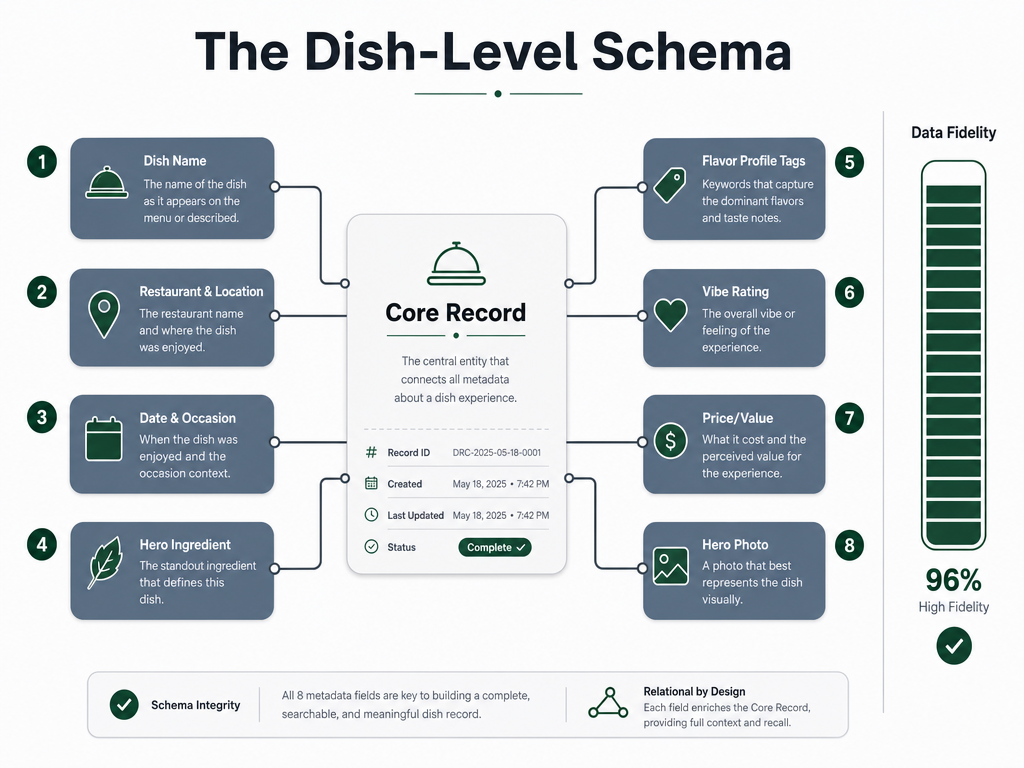 A robust culinary archive requires a standardized schema. By tracking these eight specific data points, you transform simple food photos into a searchable, relational knowledge base.
Why Dishes Matter More Than Restaurants
Here's the uncomfortable truth: most restaurants serve one or two exceptional dishes and several mediocre ones. When you archive at the restaurant level, you lose that granularity.
Consider this scenario: You return to a restaurant you loved six months ago, but you can't remember which dish made you fall in love with the place. You order based on a vague memory, and it's... fine. Not transcendent. You wonder if the chef changed or if your standards evolved.
The real answer: you ordered the wrong dish.
Dish-level archiving solves several problems that restaurant-level tracking can't:
Seasonal menu reconciliation. That spring pea agnolotti you loved? It's gone in August. A dish archive helps you track which restaurants rotate seasonal specials worth planning trips around.
Technique tracking. When you catalog by dish, you can search for "restaurants that excel at whole-animal butchery" or "places that understand miso fermentation." This is impossible when your data structure stops at the restaurant level.
Value analysis. A $45 restaurant can have a $12 dish that punches above its weight. Dish-level data captures this.
Cross-regional comparison. How does the tonkotsu in Austin compare to the one in Tokyo? Dish archives make these comparisons trivial.
Food writers often use the simple Notes app to track hundreds of meals a year, focusing on dish + restaurant + date. The professional approach recognizes that the dish is the atomic unit of culinary experience.
The Culinary Schema: 8 Essential Data Fields
Every dish entry needs a consistent structure. Here's the minimal viable schema:
1. Dish Name (The Header)
Be specific. "Pasta" is useless. "Cacio e Pepe with Pecorino Romano and Tellicherry Black Pepper" is searchable.
2. Restaurant & Location (Linked Data)
Name, neighborhood, city. If your system supports it, link to a separate restaurant entry to avoid duplicating address data.
3. Date & Occasion (Temporal Context)
When did you eat this? Was it a birthday, a work dinner, a solo Tuesday night? Context affects memory formation.
4. The "Hero" Ingredient (For Searchability)
What made the dish work? Was it the quality of the tomatoes, the aging on the beef, the fermentation technique on the cabbage? This field enables ingredient-based searches.
5. Flavor Profile Tags (Qualitative Markers)
Use consistent tags: #smoke, #acid, #ferment, #umami, #bitter, #fat, #heat. Avoid invented taxonomies - stick to what you can actually taste.
6. The "Vibe" Rating (1-10 Scale)
How did this dish make you feel? This isn't technique or execution - it's pure subjective response. An 8 means "I'd plan a trip around eating this again."
7. Price/Value (Economic Context)
What did it cost? Was it worth it? This matters more than people admit, especially when you're deciding whether to return.
8. The Photo (Visual Anchor)
One clear shot. Natural light if possible. The photo triggers memory better than any written description.
This schema balances completeness with sustainable friction. You can log these eight fields in under two minutes.
If you want to explore more sophisticated restaurant feedback approaches for building your archive, there are dedicated systems that add tasting note templates and historical comparison tools.
Three-Tier Implementation: From Minimalist to Architect
Your tool choice depends on your tolerance for setup complexity versus your need for sophisticated querying.
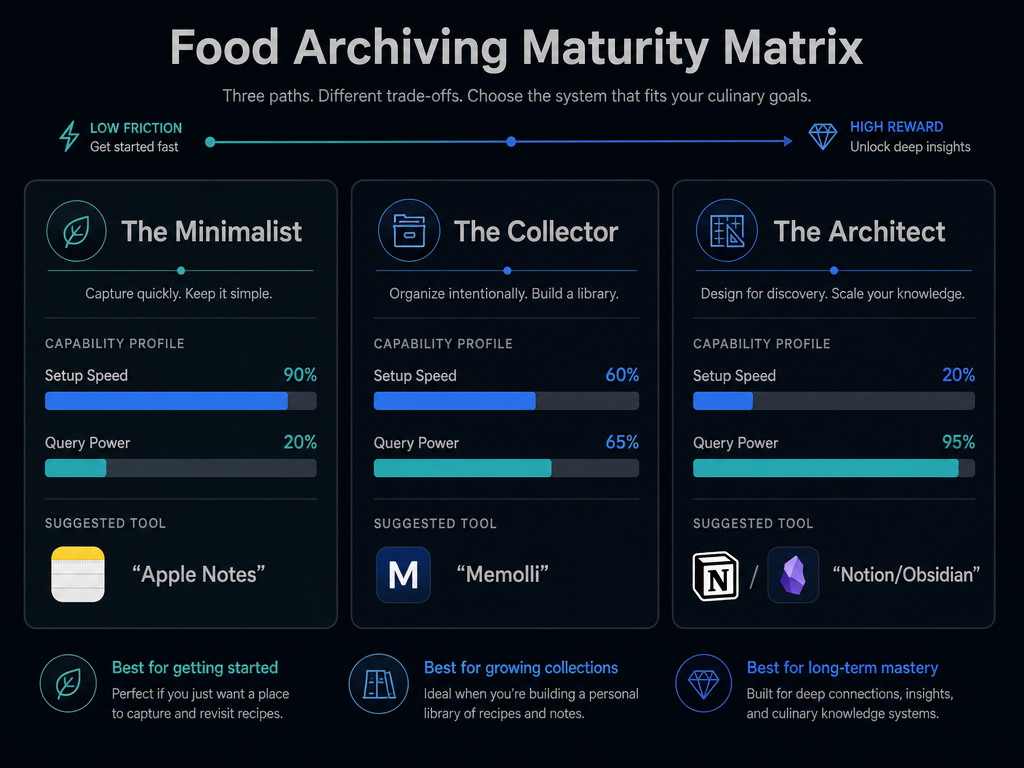 Your choice of tool depends on your desired balance of friction versus fidelity. Minimalist setups offer speed, while Architect systems provide unparalleled search capabilities.
Level 1: The Minimalist (Apple Notes/Bear)
Best for: People who want zero friction and don't need sophisticated search.
Create a dedicated note for each dish. Use a simple template:
🍝 Cacio e Pepe - Roscioli - Rome
📅 March 15, 2025
⭐ 9/10
💰 €18

The hero: Pecorino Romano aged 18 months
#cheese #pasta #umami #fat

Notes: Pepper toasted tableside. Pasta water emulsified perfectly...
Organize using folders (by city) and hashtags (by cuisine or technique). The search function in Apple Notes is surprisingly powerful if you're consistent with tags.
Limitation: Can't run complex queries. You can't easily answer "show me every dish above 8/10 that featured fermentation."
Level 2: The Collector (Memolli/Eatlist)
Best for: People who want purpose-built UI without technical overhead.
Dedicated food apps provide structured templates and basic querying. Beli is a social-first ranking app often described as "Goodreads for food", but its competitive ranking features can distract from personal reflection.
Memolli and similar apps offer private, map-based logging with fields pre-configured for restaurant data. The advantage: lower setup time. The risk: proprietary formats and the possibility that the app shuts down, taking your data with it.
For those interested in how different apps handle food tracking, the landscape includes everything from simple journaling tools to complex rating systems.
Level 3: The Architect (Notion/Obsidian)
Best for: People who want full data ownership and advanced querying.
This is where serious foodies build relational databases. In Notion, you create two linked databases:
Dishes Table:
- Dish Name (Title)
- Restaurant (Relation to Restaurants table)
- Date
- Rating (Number)
- Price (Number)
- Hero Ingredient (Text)
- Flavor Tags (Multi-select)
- Photo (File)
- Notes (Long Text)
Restaurants Table:
- Name (Title)
- City
- Neighborhood
- Cuisine Type
- Related Dishes (Relation to Dishes table)
This structure lets you ask complex questions: "Show me all dishes with #ferment tags rated 8+ under $20 in San Francisco."
Advanced users employ Dataview queries in Obsidian to turn Markdown notes into searchable restaurant databases. The learning curve is steeper, but the power is unmatched.
If you're interested in building a comprehensive personal restaurant library with this approach, the investment pays dividends over years of dining.
The Stealth Log Workflow
The biggest objection to food archiving: "I don't want to be that person on their phone at dinner."
Fair. Here's the compromise:
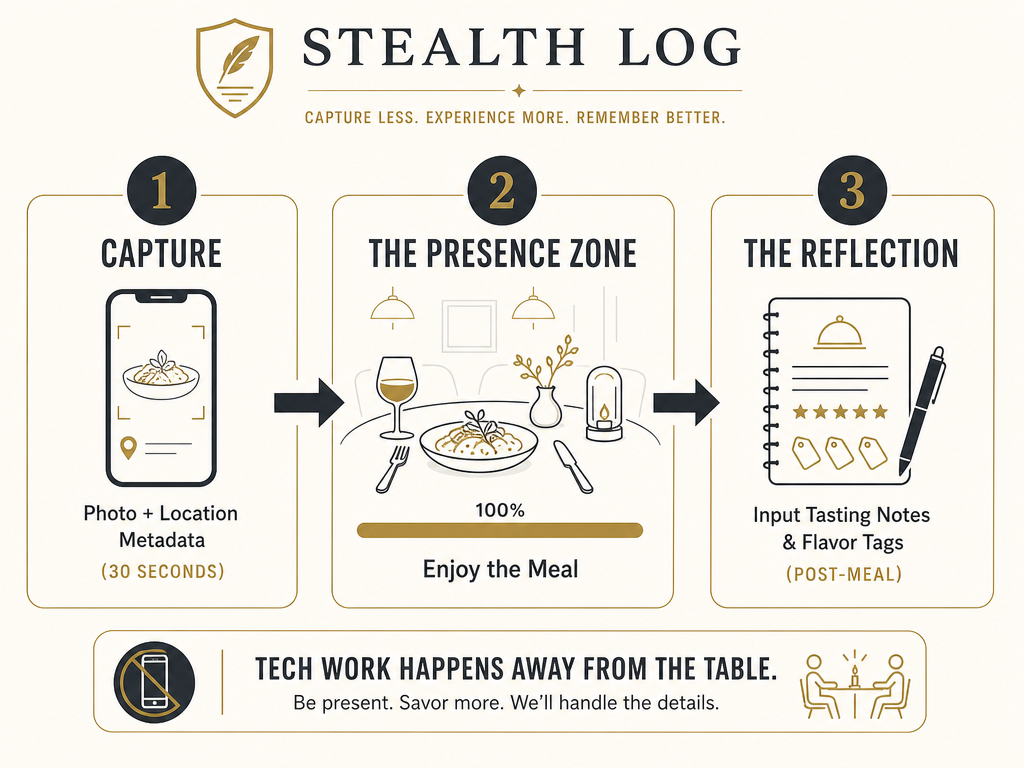 Don't let archiving ruin the meal. Use the 30-second capture rule at the table to log essential data, saving deeper sensory reflection for your journey home.
At the Table (30 Seconds Maximum):
- Take one clear photo when the dish arrives
- Open your capture tool (Notes, voice memo, or a dedicated app)
- Log three things: Dish name, restaurant name, one-word impression ("sublime" or "underwhelming")
- Put the phone away and eat
During the Commute Home (5-10 Minutes): Now fill in the rest. The temporal gap actually helps - you remember what stuck versus what was merely novel.
- Add your rating (now that you've had time to reflect)
- Write 2-3 sentences about technique or flavor
- Tag the hero ingredient and flavor profile
- Log the price
iOS Shortcut for One-Tap Logging: Set up a shortcut that:
- Takes a photo (or uses your last photo)
- Prompts for dish name and restaurant
- Automatically appends to a Notion database with location and timestamp
This reduces at-table friction to nearly zero. You're capturing metadata your phone already knows (location, date, time) without manual entry.
Some readers might also find value in strategies for organizing restaurant photos into a more searchable format, which complements the logging workflow.
Advanced Search Scenarios
This is why you built the archive. The queries that justify the work:
Query 1: Comparative Dish Analysis
"Show me every cacio e pepe I've had in the last two years, sorted by rating."
Result: You realize the €12 version at a neighborhood trattoria in Rome outscored the €28 version at a Michelin-recommended spot. The difference? The cheap place used older Pecorino and didn't overcomplicate the emulsion.
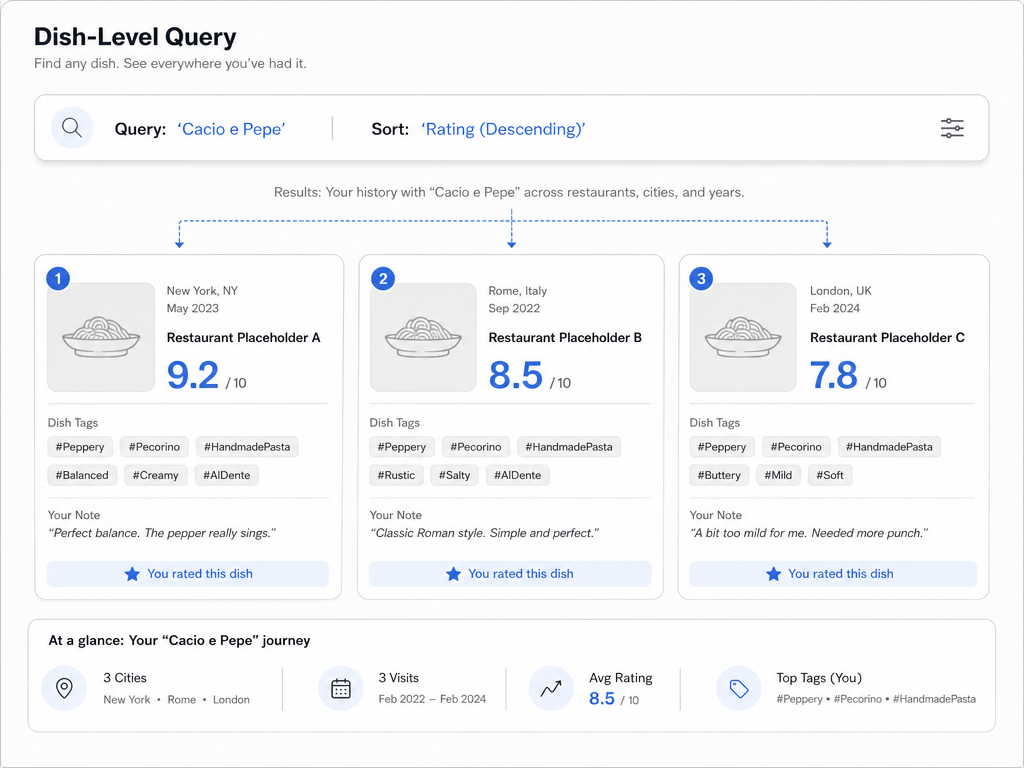 This is the ultimate goal of a food archive: the ability to query a specific dish and instantly compare every version you have ever tasted across your life.
Query 2: Technique-Based Discovery
"Which restaurants excel at fermentation?"
Filter for #ferment tags rated 8+. Suddenly you see patterns - three of your favorite dishes came from chefs who trained in Copenhagen during the Noma era.
Query 3: Value Optimization
"Show me dishes under $15 rated 8 or higher."
This is how you build a greatest-hits list of affordable excellence. The kind of intel that makes you valuable to friends planning trips.
Query 4: Seasonal Timing
"What was I eating in March last year?"
This helps you anticipate seasonal menus. If you loved spring pea agnolotti in March 2024, you know to return in March 2025.
Query 5: Travel Planning
"Show me all 9+ rated dishes in Tokyo."
Before your next trip, you have a curated hit list - not restaurants, but specific dishes worth planning meals around.
For those building more sophisticated systems, learning how to organize food reviews into meaningful categories enhances the querying capabilities significantly.
Frequently Asked Questions
What if a restaurant changes its menu seasonally?
Create separate entries for each seasonal variation. "Spring Pea Agnolotti - March 2024" and "Butternut Squash Agnolotti - November 2024" are different dishes, even if they occupy the same menu position. This lets you track which seasons a restaurant performs best.
How do I handle tasting menus with 12+ courses?
Log only the dishes that provoked a reaction - either exceptional or notably weak. A tasting menu with 12 courses might yield 3-4 entries in your archive. This prevents data bloat while capturing what matters.
Should I log dishes I didn't like?
Yes, but briefly. A 4/10 rating with a note like "sauce broke, underseasoned" takes 20 seconds and prevents you from re-ordering the same disappointing dish two years later. The archive's value includes negative space - knowing what to avoid.
How do I export my data if an app shuts down?
If you're using a proprietary app, check for CSV or JSON export options before you commit hundreds of entries. Notion and Obsidian export to standard formats. Apple Notes can be copied to plain text. Data portability is non-negotiable for a long-term archive.
What's better than star ratings for scoring food?
The 10-point scale provides more granularity than 5 stars without becoming paralyzing. Use it to capture visceral response: a 6 is "fine, wouldn't seek it out again," an 8 is "would plan a return trip," a 10 is "changed how I think about this ingredient." Consistent internal calibration matters more than absolute objectivity.
Is there an app that automatically logs what I eat?
No comprehensive automated solution exists yet. Credit card data shows where you ate, not what you ordered. Photo recognition AI can identify "ramen" but can't distinguish between tonkotsu and shoyu broths. The manual work is currently unavoidable.
How detailed should my tasting notes be?
Aim for 2-3 sentences that capture technique, standout ingredients, and one unexpected element. Avoid generic descriptors ("delicious," "amazing"). Focus on specifics: "The 45-day dry-aged ribeye had an almost blue-cheese funk. Charred over binchotan, not gas. The accompanying horseradish cream was a mistake - too aggressive."
If you're looking for more ways to track and remember your favorite dishes across different cities, the combination of structured data and disciplined logging creates a powerful reference system.
The best food you've ever eaten shouldn't disappear into a camera roll graveyard. A dish-by-dish archive transforms ephemeral dining experiences into a permanent, searchable knowledge base - your personal culinary reference system that grows more valuable with every meal logged.
Start simple. Pick one of the three implementation tiers. Log your next five memorable dishes. The archive reveals its value around entry 50, when patterns emerge and searches become genuinely useful.
Most people photograph their meals. Serious food lovers archive them.