
Beyond the Camera Roll: The Modern Food Review Revolution
Harry the matcha king
Harry is our resident matcha obsessive. He’s tasted hundreds of bowls and tracks every cup in Savor.
Beyond the Camera Roll: The Modern Food Review Revolution (And How to Finally Organize Your Culinary Life) You’ve taken 2,400 food photos this year. You...
Beyond the Camera Roll: The Modern Food Review Revolution (And How to Finally Organize Your Culinary Life)
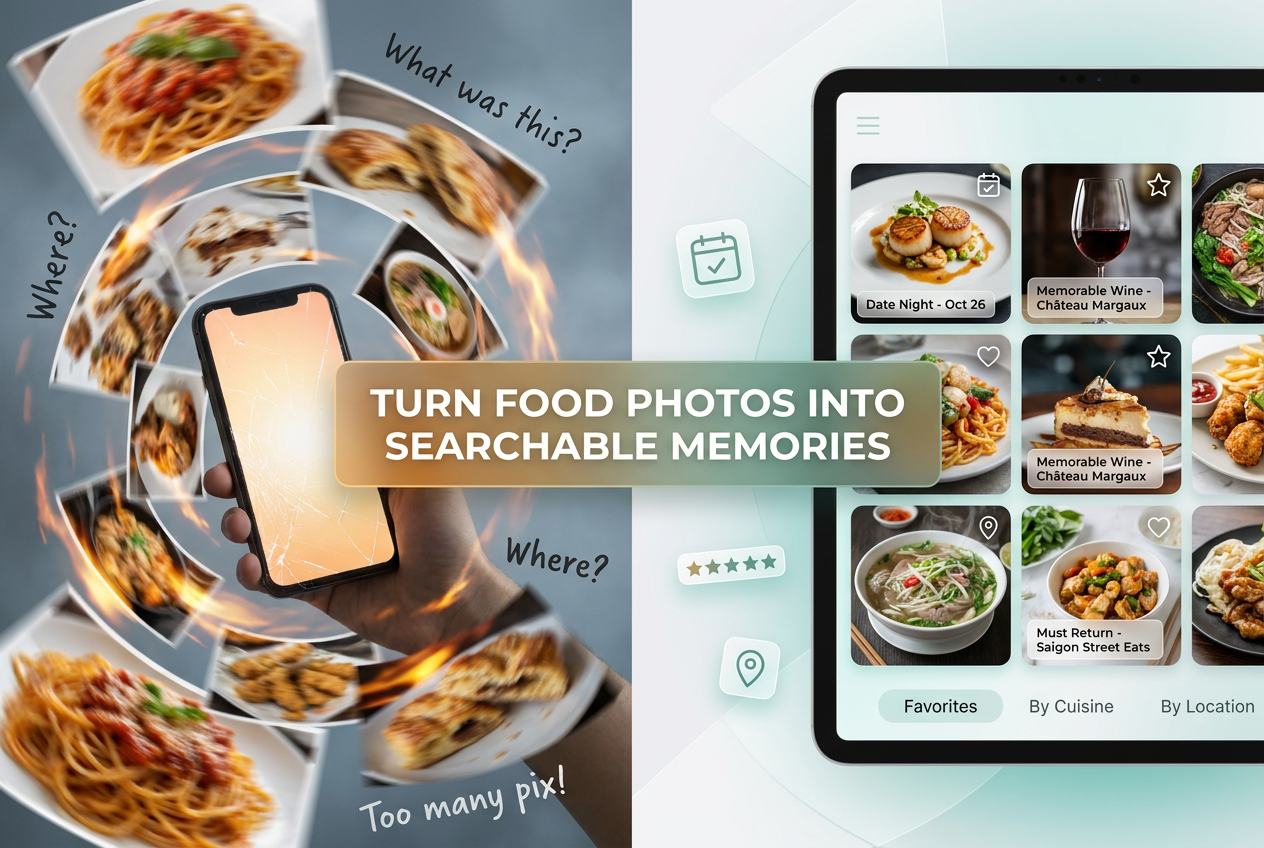
You’ve taken 2,400 food photos this year. You remember maybe seventeen of them.
That extraordinary tonkotsu ramen from last October? Gone. The name of that tiny trattoria in Rome where you had the best cacio e pepe of your life? Buried somewhere between 847 screenshots and your dog’s birthday. The specific wine pairing that made that braised short rib transcendent? Lost to the void.
This is Digital Gastronomic Amnesia, and it’s the defining affliction of the modern food lover. We’re not suffering from a lack of documentation - we’re drowning in it. The problem isn’t that we don’t take enough photos. It’s that we have no system to make those memories searchable, shareable, or useful.
By 2026, the food review landscape has fundamentally bifurcated. On one side: the mainstream platforms (Yelp, Google Maps) serving the general public looking for "fuel." On the other: a new ecosystem of curation and tracking tools built for what I call "The Serious Foodie" - people who view dining not as sustenance but as their primary cultural pursuit.
This guide will show you how to build your personal food operating system. Not just where to eat, but how to remember, organize, and actually learn from every meal you’ve ever loved.
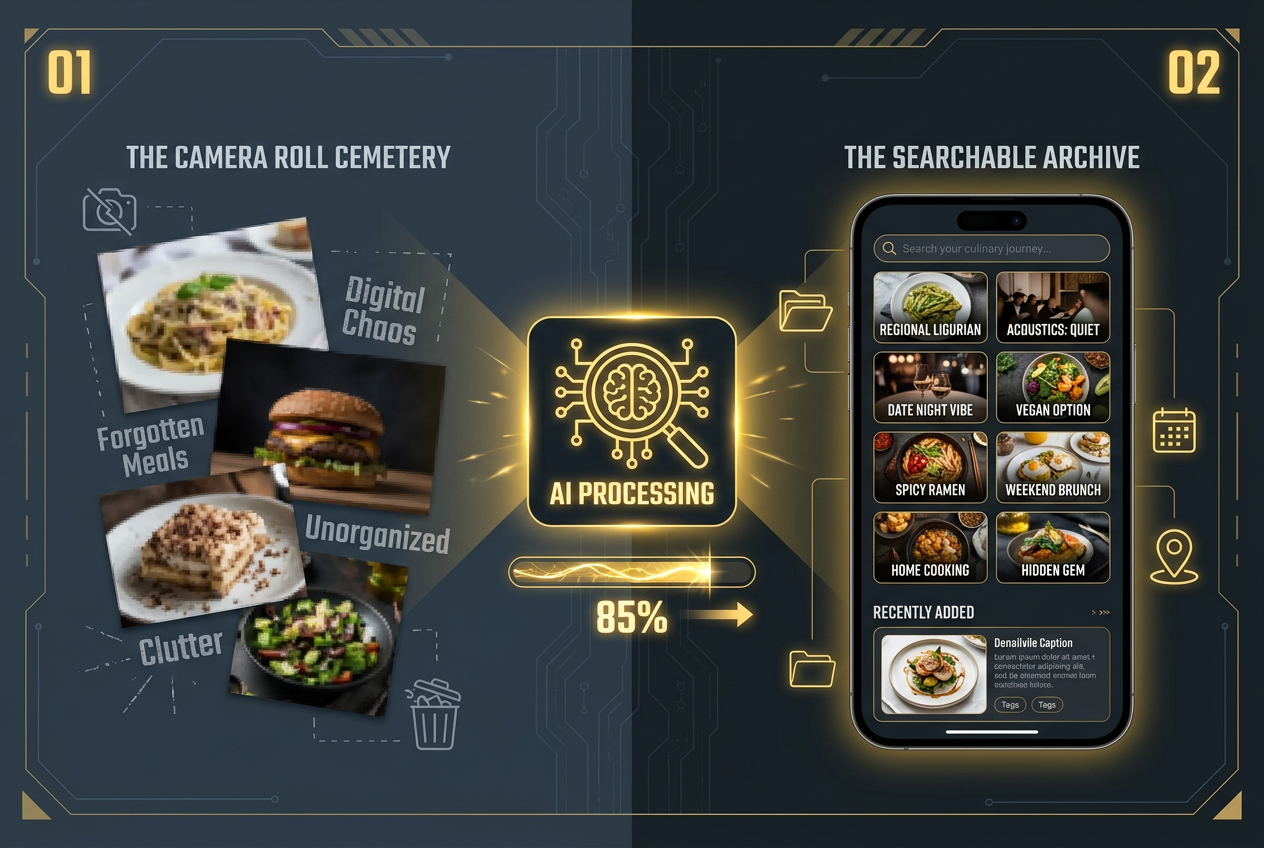 Modern foodies are moving away from disorganized photo galleries toward structured archives that prioritize searchable memories, specific vibes, and technical details like restaurant acoustics.
Table of Contents
- The Three Types of Food Review Intent (And Why Google Can’t Solve Them)
- Why Traditional Review Platforms Are Failing the Serious Foodie
- The Discovery Phase: Finding Restaurants by Scenario, Not Stars
- The Tracking Phase: Building Your Personal Food Archive
- The Anatomy of a Perfect Review (The Five-Point Framework)
- From Passive Eater to Culinary Curator
- Frequently Asked Questions
The Three Types of Food Review Intent (And Why Google Can’t Solve Them)
Research into the "Serious Foodie" demographic - urban professionals aged 25-45 who spend 15-30% of their discretionary income on dining - reveals three distinct intent phases that mainstream platforms fundamentally misunderstand.
The Discovery Intent: Vibe Over Value
You’re not looking for "best burgers." You’re looking for "best burgers for a high-stakes first date where I need to seem interesting but not pretentious." Or "places with 90s vinyl aesthetic and natural wine under $60/bottle." Or "counter seating where I can actually watch the chef work without seeming creepy."
Generic review platforms treat context as an afterthought. They optimize for volume (thousands of reviews) over specificity (the one review that actually matches your exact scenario). A 4.8-star rating tells you nothing about whether the lighting is good for a proposal or whether the acoustics allow actual conversation.
The Archival Intent: Memory Over Rating
Here’s the uncomfortable truth: you have 4,127 food photos on your phone. You can find maybe eight of them.
The modern foodie’s pain point isn’t discovery - it’s memory. You’ve had hundreds of extraordinary meals, and you can recall almost none of the details. Was that the place with the uni toast or the scallop crudo? Which wine paired with the duck? What was the name of that server who recommended the off-menu preparation?
Your camera roll has become a cemetery of unsearchable, untagged, essentially useless images. The best apps to organize food photos by restaurant address this exact problem by providing structure to chaos.
The Social Validation Intent: Taste Matching Over Crowd Wisdom
You trust a single friend with similar taste more than 10,000 anonymous Yelp reviewers. This isn’t snobbery - it’s statistical reality. If someone shares your sensitivity to salt, your preference for natural wine, your tolerance for experimental plating, their single recommendation carries infinitely more signal than aggregated noise.
The revolution in food reviews isn’t happening in the public square. It’s happening in private networks of "taste matches" - people who’ve proven, over dozens of meals, that they calibrate the world similarly to you.
Why Traditional Review Platforms Are Failing the Serious Foodie
Let’s address the elephant in the dining room: Yelp and Google Maps are optimized for a completely different user than you.
The Problem With Star Ratings: A 4.5-star rating tells you the restaurant doesn’t actively poison people. It doesn’t tell you whether they understand how to properly rest a steak, whether the pasta is made in-house, or whether the wine list was curated by someone who actually drinks wine.
Stars aggregate vastly different priorities. The person giving five stars because "huge portions!" has fundamentally different values than someone giving three stars because "the demi-glace broke." You’re trying to extract signal from noise designed for a mass market.
The Volume Paradox: More reviews often mean less useful information. When a restaurant has 3,000 reviews, you’re not reading them - you’re skimming for keywords. And what you’re really doing is pattern-matching your own biases rather than learning something new.
The Memory Hole: Traditional platforms treat each visit as an isolated event. You can’t build a longitudinal understanding of a restaurant (how did the new chef change things?), track a specific dish across multiple preparations, or remember what you ordered six months ago.
Most importantly: they’re public. Which means they’re performative. People write differently when they’re broadcasting to strangers versus documenting for themselves. Modern food reviews require a fundamentally different approach.
The Discovery Phase: Finding Restaurants by Scenario, Not Stars
The most sophisticated food discovery now happens through platforms that understand context.
The Infatuation: The "Perfect For" Filter
The Infatuation revolutionized food writing by replacing "best" with "perfect for." Their reviews don’t just describe food - they describe social scenarios. "Perfect for: reconnecting with an old friend over rare mezcal" or "Perfect for: impressing your parents without the sticker shock of a Michelin star."
This scenario-based approach mirrors how humans actually think about dining. We don’t wake up craving "highly-rated Italian food." We wake up needing "a place to celebrate a promotion where the wine list goes deep but the vibe isn’t stuffy."
Pro Tip: When using The Infatuation, ignore the neighborhood filters and search by their "Perfect For" tags. You’ll discover restaurants you’d never find through traditional geographic or cuisine searches.
Eater: The Power of the Essential List
Eater’s genius is curation through elimination. Their "Eater 38" lists (which vary by city) answer a different question than "what’s good?" They answer: "If you could only eat at 38 restaurants for the rest of your life in this city, which would they be?"
This forced scarcity creates far more useful signal than open-ended reviews. When a publication stakes its reputation on a short list, every inclusion means something.
The maps are the secret weapon. Eater’s geographic clustering reveals patterns invisible in text reviews - the concentration of great Indian food in a specific neighborhood, the off-the-beaten-path dumpling corridor, the three-block radius that contains a city’s entire natural wine scene.
The Anti-Yelp Philosophy
Here’s what these platforms understand that Yelp doesn’t: specificity beats comprehensiveness. A well-argued case for twelve restaurants is infinitely more useful than crowd-sourced opinions on twelve thousand.
They’re also written by people whose job is eating, not everyone who owns a smartphone. Professional curation isn’t elitist - it’s efficient. Would you rather trust 5,000 amateur medical opinions or three specialist doctors?
The Tracking Phase: Building Your Personal Food Archive
Discovery is half the battle. Memory is the other half.
In 2026, three platforms dominate the food tracking landscape, each solving the memory problem from a different angle.
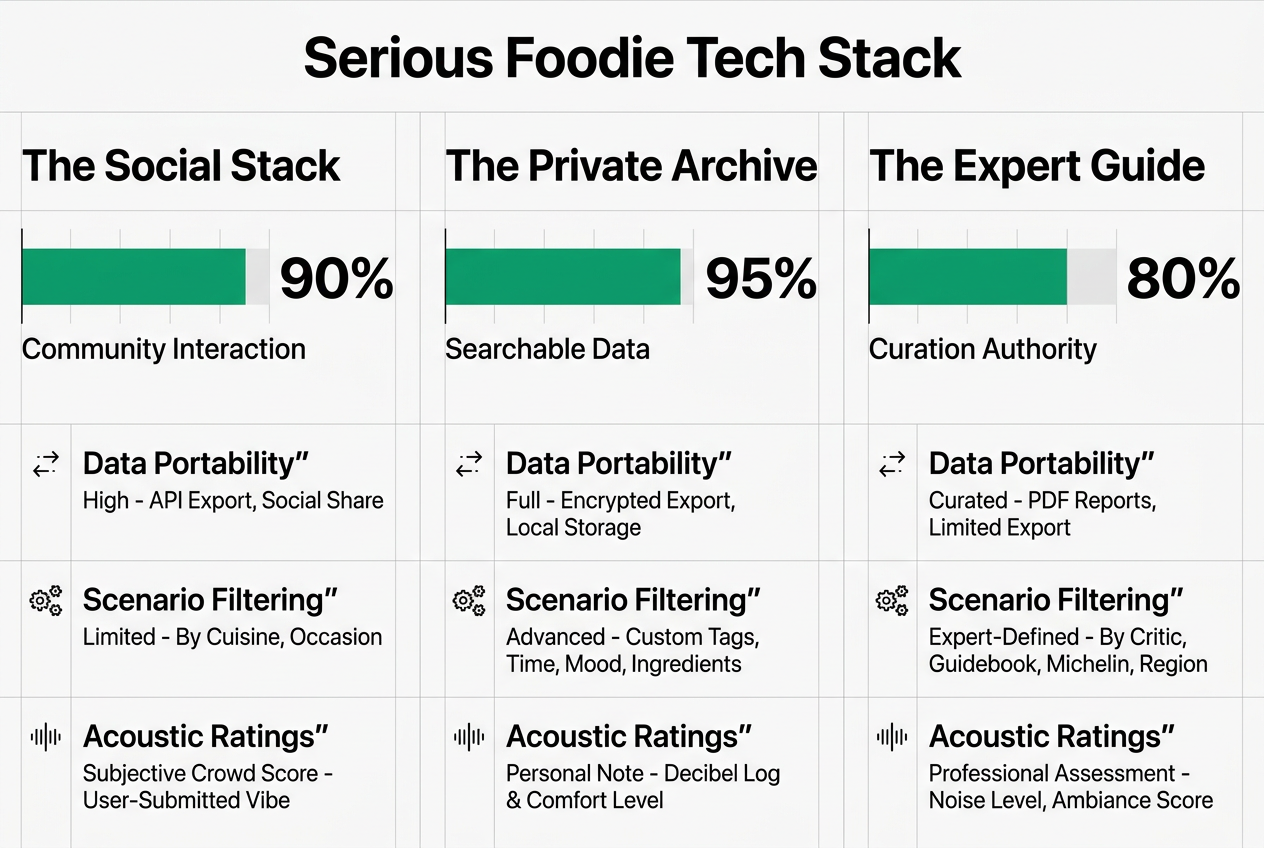 Choosing the right tool for your foodie stack depends on whether you value social validation, private data organization, or professional editorial expertise.
Beli: The Social Archive (Letterboxd for Food)
Beli solved a problem other apps ignored: ranking is more useful than rating. When you force yourself to stack-rank every meal you’ve ever had, you create a personal hierarchy far more meaningful than abstract star ratings.
The interface is deliberately social. You build "hit lists" (essentially mixtapes of great meals), follow friends with similar taste, and browse what your network is discovering. It’s performative in the best way - you’re documenting for yourself, but the public aspect forces rigor.
The Killer Feature: Hit lists are shareable, mappable, and actually used. When a friend visits your city, you don’t text them a chaotic paragraph - you send them your "Essential [City Name]" hit list.
The Limitation: It’s restaurant-focused, not dish-focused. You can’t track that specific preparation of octopus across five different visits.
For those specifically looking to share lists with other serious foodies, Beli’s social architecture is unmatched.
Savor: The Private Database (AI-Powered Journaling)
Savor takes the opposite approach: this is for you, not performance. The core innovation is dish-level tracking with AI tagging.
Take a photo of your meal. The app auto-identifies the dish, suggests tags based on image recognition, and lets you score individual components (taste, presentation, value, technical execution). Over time, you build a searchable database of every significant meal you’ve eaten.
The Killer Feature: Search. Type "spicy tuna crispy rice" and instantly find every variation you’ve photographed across dozens of restaurants, complete with notes on which preparation was superior and why.
The Use Case: This is for serious eaters building long-term taste memory. The person using Savor isn’t casually documenting brunch - they’re conducting a multi-year personal education in regional Chinese cuisine or natural wine or sourdough pizza. If you’re serious about tracking and rating individual dishes, nothing else comes close.
World of Mouth: The Expert Network
World of Mouth occupies a different category entirely: professional recommendations, not personal tracking. Think of it as insider access to the food world’s private recommendations.
Chefs, sommeliers, and food writers share their actual go-to spots - not for publication, but for each other. The value is radical specificity: not just "great sushi in Tokyo," but "the 14-seat counter in Tsukiji where the chef specializes in aged fish."
The Limitation: It’s read-only. You’re consuming others’ expertise, not building your own archive.
The Sweet Spot: Use it for travel. When you’re visiting a new city, World of Mouth gives you the insider track that TripAdvisor can’t.
The Comparison Table
| Platform | Primary Function | Best For | Key Limitation | Data Ownership |
|---|---|---|---|---|
| Beli | Social Stack-Ranking | Building shareable hit lists | Restaurant-level only | Exportable |
| Savor | Private Dish Database | Long-term taste education | Purely private | Fully owned |
| World of Mouth | Expert Curation | Travel & discovery | No personal tracking | N/A (read-only) |
| Yelp | Crowd Reviews | Finding safe bets | Generic & performative | Platform-owned |
| Google Maps | Utilitarian Discovery | "What’s nearby?" | Zero sophistication | Platform-owned |
The sophisticated approach isn’t choosing one - it’s using them in combination. Discover through The Infatuation and World of Mouth, track privately in Savor, share socially through Beli.
Those interested in building a personal restaurant library should understand this multi-platform strategy.
The Anatomy of a Perfect Review (The Five-Point Framework)
Whether you’re writing for yourself or sharing with friends, a serious food review has a structure. Not rigid, but intentional.
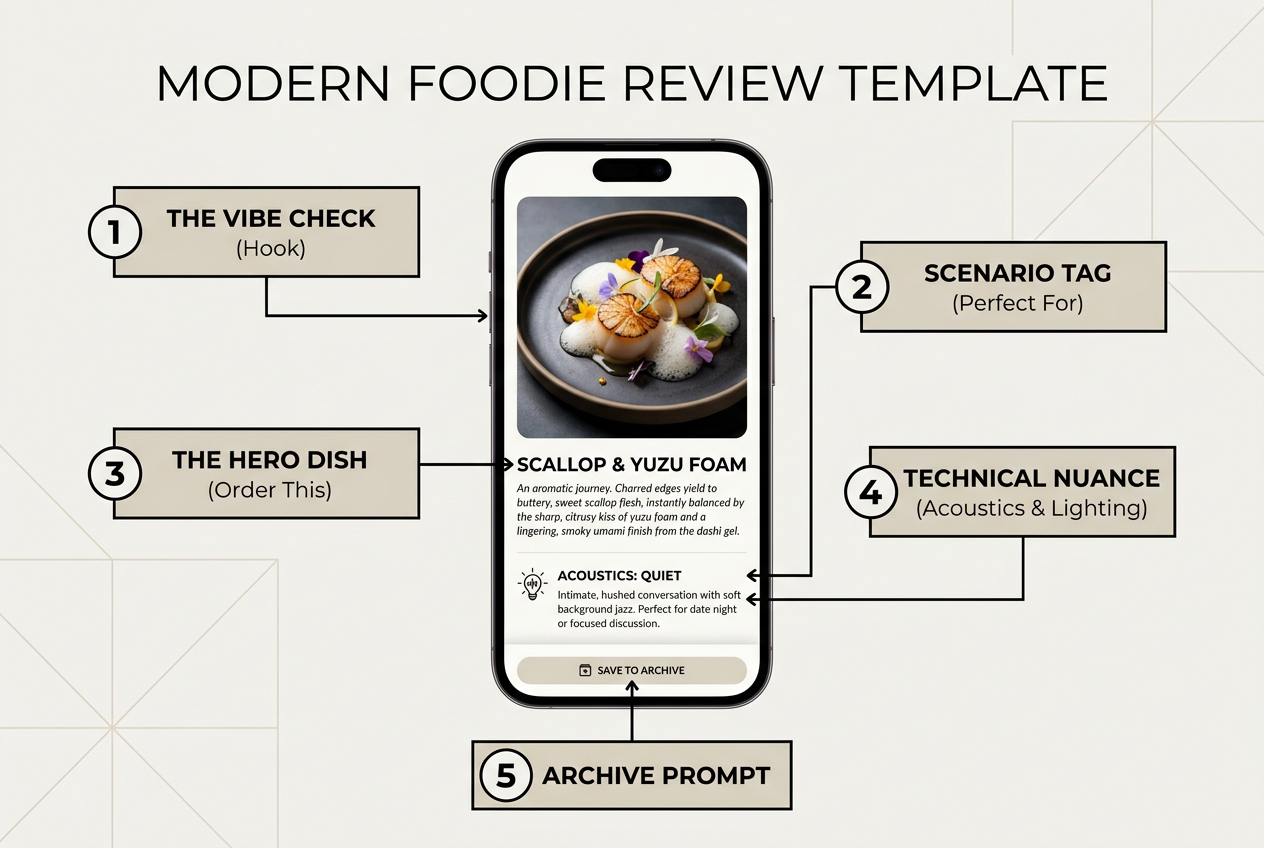 To build credibility in 2026, food reviews must move beyond basic ratings to provide specific context, sensory details, and technical notes on the dining environment.
1. The Hook (The Vibe Check)
Distill the restaurant’s soul into two sentences. Not what it is, but what it feels like.
Bad: "Italian restaurant in the West Village with good pasta."
Good: "The kind of neighborhood spot where regulars call the chef by his first name and the handwritten specials board changes based on what looked good at the market that morning."
The vibe check answers: Would I bring my mother here? A first date? A client dinner? The answer changes everything.
2. The "Perfect For" Tag
Stolen directly from The Infatuation because it works. Every meal exists in social context. Document it.
- Perfect for: Post-gallery opening wine with someone whose taste you’re still trying to decode
- Perfect for: Solo counter dining when you want to actually watch technique
- Perfect for: The friend visiting from out of town who claims to "really know food"
This single line often carries more decision-making weight than three paragraphs of description.
3. The Hero Dish (The "Order This")
Identify the 1-2 non-negotiable items. Not just what they are, but why they matter.
Don’t write: "The carbonara was good."
Write: "The carbonara arrives with the egg still barely set, the guanciale rendered to the edge of crispy, and enough reserved pasta water in the sauce that it clings to each strand without ever becoming heavy. This is the version that ruined the cream-laden American interpretation for me."
Sensory detail. Technical observation. Personal stake. That’s the formula.
Pro Tip: Include a dish score if you’re tracking systematically. Use a 10-point scale for each component: taste (how it hits your palate), technique (execution), creativity (innovation), and value (price-to-quality ratio). Average them for an overall score, but keep the components separate - they tell different stories.
4. The Serious Foodie Nuance
This is where you separate casual documentation from actual criticism. Address the details other reviews ignore:
- Acoustics: Can you have a real conversation, or is it see-and-be-seen noise?
- Lighting: Is it Instagram-friendly disaster lighting or can you actually see your food?
- Wine list depth: Are we talking "six bottles and they’re all from the same distributor" or "the sommelier clearly has opinions about biodynamic farming"?
- Reservation difficulty: Is this a walk-in spot or do you need to set a phone alarm for the Resy drop?
- Service cadence: Do they rush you out in 75 minutes or let you linger?
These operational details matter enormously for planning. A restaurant can serve transcendent food and still be wrong for the occasion.
5. The Archive Note
Here’s what separates a review from memory-building: explicit instructions to your future self.
"Next time: sit at the counter, order the omakase, and specifically ask about the dry-aged fish program. Skip the cocktails - they’re fine but not the point. Come early (5:45pm) or late (9:30pm) to avoid the post-work crush."
This transforms your review from documentation into actionable intelligence. When you return in eight months, you’re not starting from scratch - you’re building on accumulated knowledge.
For those developing their own food rating system, these five components create a replicable framework that improves with use.
From Passive Eater to Culinary Curator
The shift from consumer to curator is psychological, not technical. It requires treating your dining life as a serious practice worthy of systematic attention.
The 15-Second Review Habit
You don’t need to write essays. You need consistency. The most successful food trackers use what I call the "Fast-Review Method": immediately after the meal, while still at the table, take 15 seconds to capture three things:
- The hero dish (photo + one-sentence description)
- The standout element (what made it memorable?)
- The return factor (would you come back, and for what occasion?)
That’s it. Fifteen seconds. Do this consistently and you’ll have a searchable archive of hundreds of meals within a year. Understanding how to track restaurant meals efficiently makes this sustainable.
The Monthly Review Ritual
Once a month, spend 20 minutes reviewing your documented meals. Not adding new entries - analyzing patterns.
- Which dishes scored highest across different restaurants?
- Which neighborhoods or cuisines dominate your recent dining?
- Which places deserve a return visit?
- Which "highly-rated" spots actually disappointed?
This meta-analysis is where real taste education happens. You start to see your own preferences with clarity impossible in the moment.
The Data Portability Principle
Here’s the thing nobody tells you about food tracking apps: they all eventually die, get acquired, or pivot. Your data needs to be exportable.
Before committing to any platform, verify you can export your complete history in a usable format (CSV at minimum, ideally JSON). Your meal history is too valuable to lock into a proprietary system.
Some users maintain parallel systems - using one app for social sharing, another for private detailed tracking, and periodic exports to a personal database or spreadsheet. It’s redundant, but your future self will thank you.
The Community Paradox
The best food knowledge is shared in small, high-trust groups, not broadcast publicly. Build your personal network of taste matches - the five to ten people whose food opinions you genuinely trust.
Share hit lists with them. Compare notes on the same restaurant. When you find someone whose palate calibrates similarly to yours, their recommendations become infinitely more valuable than crowd wisdom.
This is why platforms like Beli succeed: they facilitate exactly this kind of selective sharing. You’re not writing for everyone; you’re building a library for the people whose taste you respect.
Frequently Asked Questions
What is the best app for tracking food and meals?
The best app depends on your specific goal. For private, dish-level tracking with AI tagging and search functionality, Savor offers the most comprehensive solution. For social sharing and restaurant-level stack ranking, Beli provides the best community features. If you’re focused purely on discovery rather than personal tracking, The Infatuation’s app gives you expertly curated scenario-based recommendations. Most serious food trackers use multiple platforms in combination rather than relying on a single tool.
How do I organize thousands of food photos on my phone?
Start by choosing a dedicated food tracking app that allows photo tagging and categorization rather than relying on your camera roll. Import your existing photos in batches, focusing first on restaurants you visit regularly or meals that were particularly memorable. Use AI-powered tools like Savor that can auto-tag dishes and locations, saving you from manual entry. Create a consistent tagging system (by cuisine, neighborhood, or dish type) and apply it retroactively to your archive. The key is transforming your camera roll from a chronological dump into a searchable database.
What’s the difference between rating restaurants and rating dishes?
Rating restaurants gives you a general sense of overall experience - service, ambiance, value - but obscures specific performance. A restaurant can have transcendent pasta and mediocre fish, exceptional wine but terrible cocktails. Rating individual dishes creates actionable intelligence: you know exactly what to order on return visits and what to skip. Dish-level tracking also reveals patterns across restaurants (which chef does the best version of a specific preparation) that restaurant-level reviews can’t capture. The most sophisticated food tracking combines both: restaurant-level context with dish-level specificity.
How do food critics develop their palate?
Professional palate development requires three things: volume, comparison, and documentation. Volume means eating the same dish prepared by different chefs to understand the range of possibility. Comparison means eating similar dishes side-by-side to calibrate differences. Documentation means writing detailed tasting notes that force you to articulate what you’re experiencing. Start by focusing on a single dish type (ramen, carbonara, margherita pizza) and eat it everywhere, taking systematic notes each time. Over months, you’ll develop sophisticated discrimination you didn’t know was possible. The key is intentionality - passive eating doesn’t build expertise.
Can I export my reviews from Yelp or Google Maps?
Yes, but with limitations. Google Takeout allows you to download your Google Maps reviews, ratings, and photos in JSON format. Yelp offers a similar data export function through your account settings. However, the exported data is often poorly formatted and difficult to import into other platforms. Neither service makes it easy to maintain an independent backup of your complete review history. This is why serious food trackers maintain parallel systems and periodically export their data to neutral formats like CSV or personal databases they control directly.
What makes a food review useful versus performative?
Useful reviews provide specific, actionable information: what to order, when to go, what to expect. They include technical details (cooking technique, ingredient sourcing), operational context (reservation difficulty, noise level), and comparative analysis (how this version differs from others). Performative reviews prioritize the writer’s personality over information, use vague descriptors ("amazing," "incredible"), and focus on social signaling rather than helping the reader make decisions. The test: would this review help your future self remember the meal and know what to order on a return visit? If not, it’s performative.
How do I find restaurants that match my specific taste preferences?
Start by identifying your "taste matches" - people whose dining preferences consistently align with yours. Follow their recommendations obsessively rather than relying on crowd wisdom. Use scenario-based discovery platforms like The Infatuation that filter by context rather than just cuisine or rating. Build your own cross-referenced database: when you love a dish, research where the chef trained, who they worked with, and what other restaurants share similar philosophies. Track patterns in your own documented meals to identify what you actually prefer (not what you think you prefer). The sophisticated approach is building personal intelligence rather than outsourcing discovery to algorithms.
Should I use public review platforms or private tracking apps?
Use both, strategically. Public platforms are useful for initial vetting (Is this place a disaster? Does it exist?) and contributing to community knowledge. Private tracking apps are essential for building your personal food memory and long-term taste education. The key distinction: public reviews are performative and influenced by social dynamics; private tracking is for your actual learning. Many serious foodies maintain both - contributing occasionally to public platforms while doing their real documentation privately. Your personal archive is too valuable to pollute with the social pressure of public performance.
Your camera roll doesn’t have to be a graveyard. The tools exist to transform scattered food photos into a searchable, shareable, genuinely useful archive of your culinary life.
The shift from passive eater to active curator is simple: document with intention, review with rigor, and build systems that serve your future self. Start with one meal. Take 15 seconds to capture what mattered. Repeat until it becomes automatic.
The extraordinary meals you’ve already eaten deserve better than digital oblivion. Give them the archive they deserve.